|
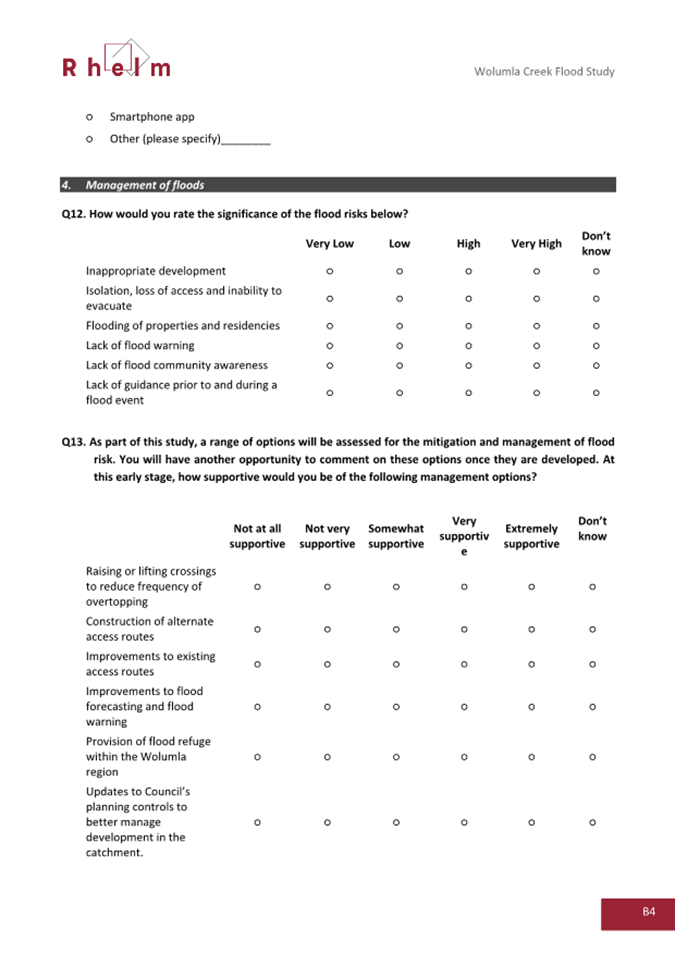
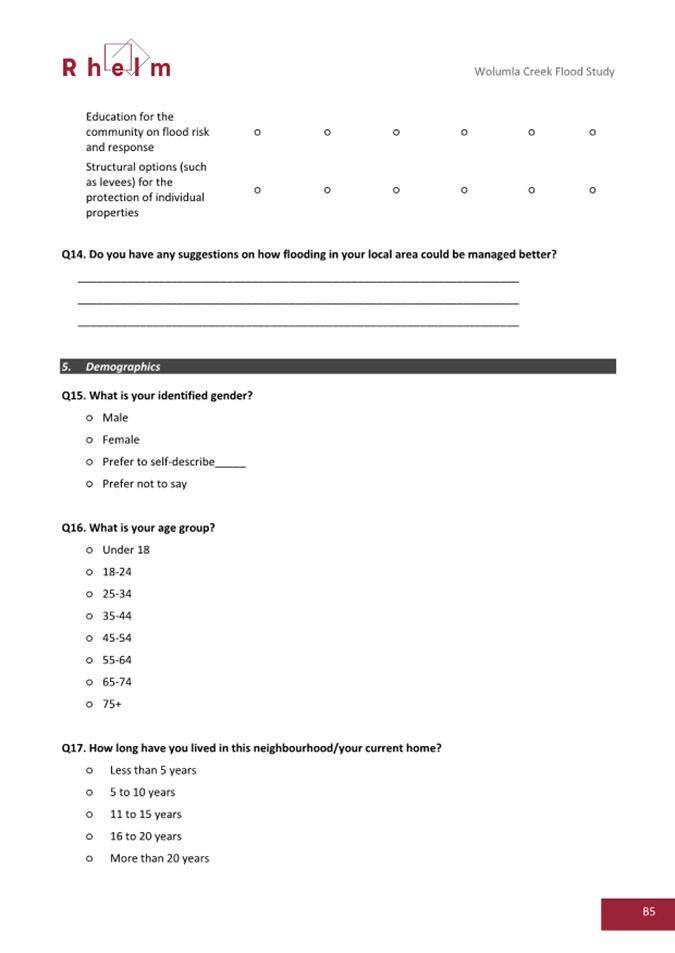
Ordinary
Meeting
Notice and Agenda
An Ordinary Meeting of the Bega Valley Shire Council will be held at Council Chambers, Biamanga Room Bega Valley Commemorative Civic Centre
Bega on Wednesday, 28 January 2026 commencing at 2:00pm to
consider and resolve on the matters set out in the attached Agenda.
To:
Cr Russell Fitzpatrick, Mayor
Cr Mitchell Nadin, Deputy Mayor
Cr Tony Allen
Cr Simon Daly
Cr Peter Haggar
Cr Clair Mudaliar
Cr Peggy Noble
Cr Helen O’Neil
Cr David Porter
|
Copy:
Chief Executive Officer, Mr
Anthony McMahon
Director, Infrastructure, Mr
Andrew Latta
Director, Community,
Environment and Planning, Mrs Emily Harrison
Director, Organisational
Services, Mrs Iliada Bolton
Manager Engagement and
Corporate Strategy, Mrs Kaliegh Smerdon
Executive Officer (Minute
Secretary), Mrs Jackie Grant
|
|
Live Streaming of Council Meetings
Council meetings are recorded and live streamed to the Internet
for public viewing. By entering the Chambers during an open session of
Council, you consent to your attendance and participation being recorded.
The recording will be archived and made available on
Council’s website www.begavalley.nsw.gov.au. All care is taken to
maintain your privacy; however as a visitor of the public gallery, your
presence may be recorded.
Publishing of Agendas And Minutes
The Agendas for Council Meetings and Council Reports for
each meeting will be available to the public on Council’s website as
close as possible to 5.00 pm on the Thursday prior to each Ordinary
Meeting. A hard copy is also made available at the Bega Administration
Building reception desk and on the day of the meeting, in the Council Chambers.
The Minutes of Council Meetings are available on Council's
Website as close as possible to 5.00 pm on the Monday after the Meeting.
1. Please
be aware that the recommendations in the Council Meeting Agenda are
recommendations to the Council for consideration. They are not the
resolutions (decisions) of Council.
2. Background
for reports is provided by staff to the Chief Executive Officer for
presentation to Council.
3. The
Council may adopt these recommendations, amend the recommendations, determine a
completely different course of action, or it may decline to pursue any course
of action.
4. The
decision of the Council becomes the resolution of the Council, and is recorded
in the Minutes of that meeting.
5. The
Minutes of each Council meeting are published in draft format, and are
confirmed by Councillors, with amendments if necessary, at the next
available Council Meeting.
If you require any further information or clarification
regarding a report to Council, please contact Council’s Executive
Assistant who can provide you with the appropriate contact details
Phone (02 6499
2222) or email execassist@begavalley.nsw.gov.au.
Ethical Decision Making and Conflicts of Interest
A guiding checklist for Councillors, officers and community committees
Ethical decision making
·
Is the decision or conduct legal?
·
Is it consistent with Government policy, Council’s
objectives and Code of Conduct?
·
What will the outcome be for you, your colleagues, the Council,
anyone else?
·
Does it raise a conflict of interest?
·
Do you stand to gain personally at public expense?
·
Can the decision be justified in terms of public interest?
·
Would it withstand public scrutiny?
Conflict of interest
A conflict of interest is a clash
between private interest and public duty. There are two types of conflict:
·
Pecuniary
– regulated by the Local Government Act 1993 and Office of
Local Government
·
Non-pecuniary
– regulated by Codes of Conduct and policy. ICAC,
Ombudsman, Office of Local Government (advice only). If declaring a
Non-Pecuniary Conflict of Interest, Councillors can choose to either disclose
and vote, disclose and not vote or leave the Chamber.
The test for conflict of interest
·
Is it likely I could be influenced by personal interest in
carrying out my public duty?
·
Would a fair and reasonable person believe I could be so
influenced?
·
Conflict of interest is closely tied to the layperson’s
definition of ‘corruption’ – using public office for private
gain.
·
Important to consider public perceptions of whether you have a
conflict of interest.
Identifying problems
1st Do
I have private interests affected by a matter I am officially involved in?
2nd Is
my official role one of influence or perceived influence over the matter?
3rd Do
my private interests conflict with my official role?
Local Government Act 1993 and Model Code of Conduct
For more detailed definitions
refer to Sections 442, 448 and 459 or the Local Government Act 1993 and Bega
Valley Shire Council (and Model) Code of Conduct, Part 4 – conflict of
interest.
Agency advice
Whilst seeking advice is generally useful, the
ultimate decision rests with the person concerned.Officers of the
following agencies are available during office hours to discuss the obligations
placed on Councillors, officers and community committee members by various
pieces of legislation, regulation and codes.
|
Contact
|
Phone
|
Email
|
Website
|
|
Bega
Valley Shire Council
|
(02)
6499 2222
|
council@begavalley.nsw.gov.au
|
www.begavalley.nsw.gov.au
|
|
ICAC
|
8281
5999
Toll
Free 1800 463 909
|
icac@icac.nsw.gov.au
|
www.icac.nsw.gov.au
|
|
Office
of Local Government
|
(02)
4428 4100
|
olg@olg.nsw.gov.au
|
http://www.olg.nsw.gov.au/
|
|
NSW
Ombudsman
|
(02)
8286 1000
Toll
Free 1800 451 524
|
nswombo@ombo.nsw.gov.au
|
www.ombo.nsw.gov.au
|
Disclosure of pecuniary interests / non-pecuniary interests
Under the provisions of
Section 451(1) of the Local Government Act 1993 (pecuniary interests)
and Part 4 of the Model Code of Conduct prescribed by the Local Government
(Discipline) Regulation (conflict of interests) it is necessary for you to
disclose the nature of the interest when making a disclosure of a pecuniary
interest or a non-pecuniary conflict of interest at a meeting.
The following form should
be completed and handed to the Chief Executive Officer as soon as practible
once the interest is identified. Declarations are made at Item 3 of the
Agenda: Declarations - Pecuniary, Non-Pecuniary and Political Donation
Disclosures, and prior to each Item being discussed:
Council
meeting held on __________(day) / ___________(month) /____________(year)
|
Item
no & subject
|
|
|
Pecuniary
Interest
|
In my opinion, my
interest is pecuniary and I am therefore required to take the action
specified in section
451(2) of the Local Government Act
1993 and or any other
action required by the Chief
Executive Officer.
|
|
Significant
Non-pecuniary conflict of interest
|
– In my opinion, my
interest is non-pecuniary but significant. I am unable
to remove the source of conflict. I am therefore required to treat
the interest as if it were pecuniary and take the action specified in section 451(2) of the
Local Government Act 1993.
|
|
Non-pecuniary
conflict of interest
|
In my opinion, my interest is non-pecuniary and less
than significant. I therefore make this declaration as I am required to do pursuant to clause
5.11 of Council’s Code of Conduct. However, I intend to continue to be involved with the matter.
|
|
Nature of interest
|
Be specific and include information
such as :
·
The names of any person or organization with which you have a
relationship
·
The nature of your relationship with the person or organization
·
The reason(s) why you consider the situation may (or may be
perceived to) give rise to a conflict between your personal interests and
your public duty as a Councillor.
|
|
If
Pecuniary
|
Leave
chamber
|
|
If
Non-pecuniary (tick
one)
|
Disclose
& vote Disclose
& not vote Leave
chamber
|
|
Reason
for action proposed
|
Clause 5.11 of Council’s Code of Conduct provides
that if you determine that a non-pecuniary conflict of interest is less than
significant and does not require further action, you must provide an
explanation of why you consider that conflict does not require further
action in the circumstances
|
|
Print
Name
|
I disclose the above
interest and
acknowledge that I will
take appropriate action as I have indicated above.
|
|
Signed
|
|
NB: Please
complete a separate form for each Item on the Council Agenda on which you are
declaring an interest.
Agenda
Statement of Commencement of Live Streaming
Acknowledgement of Traditional Owners of Bega Valley Shire
Statement of Ethical Obligations
1 Apologies and requests for leave of
absence
2 Confirmation Of Minutes
Recommendation
That the Minutes of the Ordinary Meeting and Closed session
held on 10 December 2025 as circulated, be taken as read and confirmed.
3 Declarations
Pecuniary,
Non-Pecuniary and Political Donation Disclosures to be declared and tabled.
Declarations also to be declared prior to discussion on each item.
4 Public Forum – report by Mayor
of deputations heard prior to the meeting
5 Petitions
6 Mayoral Minutes
7 Urgent Business
8 Staff Reports – Community,
Environment and Planning
8.1 Development
Application statistics - October to December 2025.......................................... 9
8.2 Development
Assessment Service Review................................................................................ 14
8.3 UPL
fee waiver for Eden Local Aboriginal Land Council's Bundian Way project................ 98
8.4 Investigation
of alternative co-mingled recycling processing facilities.............................. 101
8.5 Memorandum
of Understanding with Bega Littleton Citizens Exchange.......................... 105
8.6 Reporting
of minutes for committees with delegated authority and advisory committees 116
9 Staff Reports – Infrastructure
9.1 Request
for Tender (RFT) 2526-005 Merimbula CBD traffic trials...................................... 139
9.2 Draft
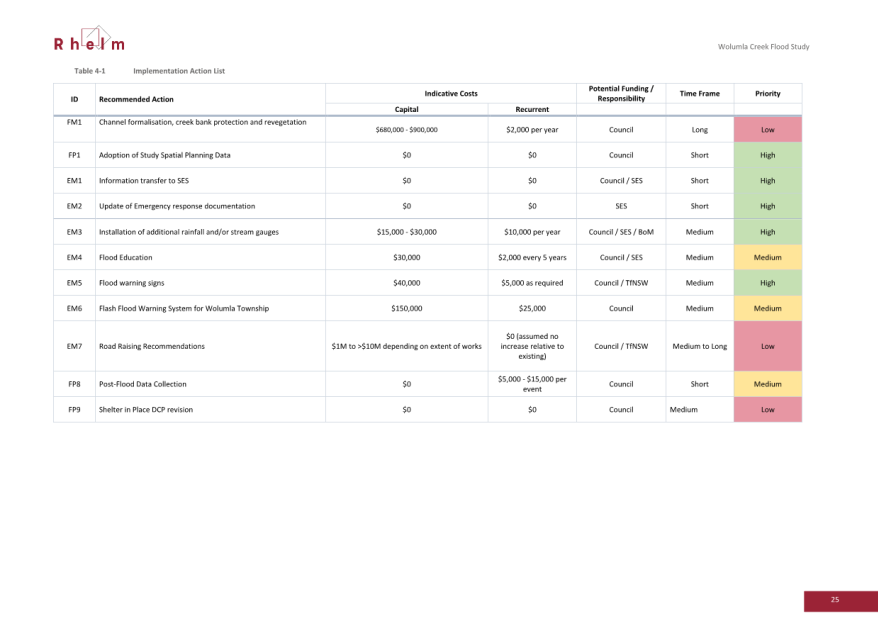
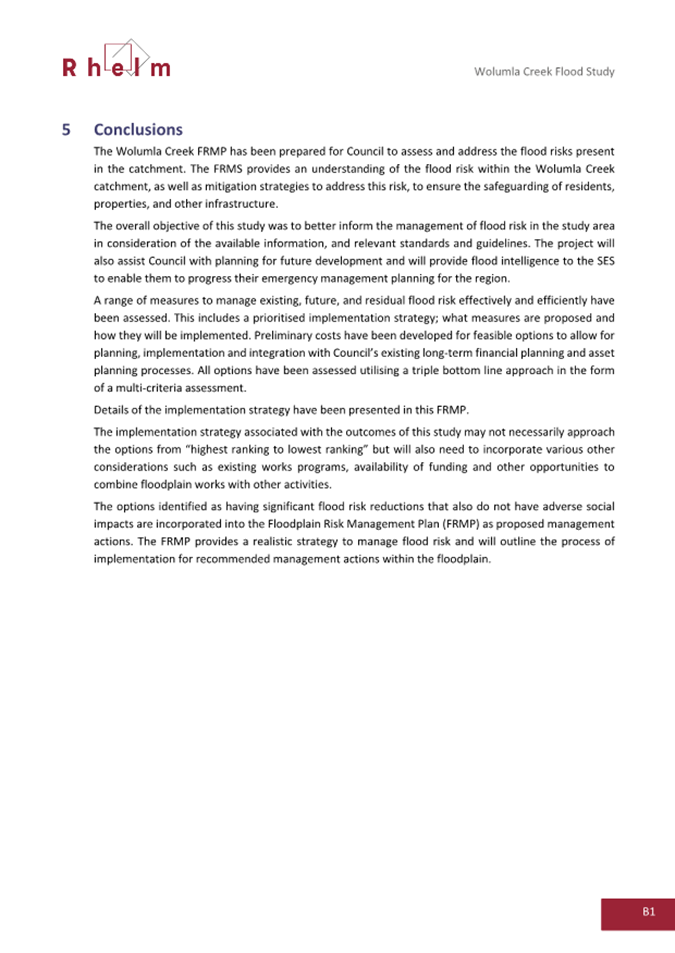
Wolumla Floodplain Risk Management Study and Plan findings.............................. 146
9.3 Bega
Valley Local Transport Forum 2 December 2025......................................................... 361
10 Staff Reports – Organisational Services
10.1 Lease
Renewal for Tathra Children’s Services Incorporated............................................... 364
10.2 Compulsory
acquisition and transfer of residue road - Cobandrah Pty Ltd...................... 373
10.3 Audit,
Risk and Improvement Committee Quarterly Report December 2025................. 380
10.4 Code
of Meeting Practice........................................................................................................... 385
10.5 Quarterly
Budget Review Statement (QBRS) December 2025 (Q2 Review)..................... 429
10.6 Certificate
of Investment December 2025.............................................................................. 454
11 Staff Reports - Executive Services
11.1 Snug
Cove Maritime Precinct Memorandum of Understanding......................................... 461
11.2 Actions
from resolutions of Council - Progress Report......................................................... 469
12 Councillor Reports
13 Rescission/Alteration Motions
14 Notices of Motion
14.1 Thank
you to Bega Valley Shire Council staff.......................................................................... 472
15 Questions with Notice
15.1 Cr
O'Neil - Update: Parbery Avenue, Bermagui...................................................................... 474
15.2 Cr
O'Neil - Cuttagee Bridge design and renewal progress.................................................... 476
15.3 Cr
O'Neil - Active Transport Strategy and Long Swamp track, Bermagui.......................... 477
16 Questions without Notice
16.1 Cr
Daly - Recovery of materials................................................................................................. 479
17 Confidential Business
Representations by members of the public regarding
closure of part of meeting
Adjournment Into Closed Session, exclusion
of the media and public........................... 483
Statement of Cessation of Live Streaming for the period of the Closed
Session.
Statement of Re-Commencement of Live Streaming
18 Noting of Resolutions from Closed Session
19 Declassification of reports considered previously
in Closed Session
Staff Reports
– Community, Environment and Planning
28 January 2026
8.1 Development
Application statistics - October to December 2025....................... 9
8.2 Development
Assessment Service Review.......................................................... 14
8.3 UPL
fee waiver for Eden Local Aboriginal Land Council's Bundian Way project 98
8.4 Investigation
of alternative co-mingled recycling processing facilities............ 101
8.5 Memorandum
of Understanding with Bega Littleton Citizens Exchange......... 105
8.6 Reporting
of minutes for committees with delegated authority and advisory committees........................................................................................................................... 116
|
Council 28 January 2026
|
Item 8.1
|
8.1. Development
Application statistics - October to December 2025
This report provides an update on
Council’s development application processing timeframes for the period
October to December 2025.
Director Community Environment and Planning
Officer’s
Recommendation
That Council
note the information contained in this report.
Executive Summary
This report provides an update on Council’s
development application processing timeframes and associated commentary for the
period 1 October to 31 December 2025.
During this period, the average net DA processing time (i.e.
minus ‘stop clock’ days) was 94.31 days,
with the 2025 calendar year net average of 87.86 days. (‘Stop
clock’ days is the time taken for the Applicant to provide additional
information when requested.)
The average gross DA processing time for this period was
161.01 days (and 161.12 days over the full 2025 calendar year).
These results should be interpreted with caution as
processing time varies based on the number and complexity of DAs, as well as
resourcing levels during the reporting period.
Background
Development Application processing times (Council
data)
|
|
2024
(full
year)
|
2025
Jan-Mar
|
2025
Apr-Jun
|
2025
Jul-Sept
|
2025
Oct-Dec
|
2025
(full
Year)
|
|
DAs
determined+
|
343
|
55
|
77
|
73
|
70
|
277!
|
|
No
of undetermined Applications@
|
168
(as at 31 Dec)
|
182
(as at 31 Mar)
|
157
(as at 30 Jun)
|
102
(as at 30 Sept)
|
113
(as at 31 Dec)
|
113
(as at 31 Dec)
|
|
Average
DA processing time (gross)
|
162.03
days
|
118.78
days
|
166.25
days
|
146.67
days
|
161.01
days
|
161.12
days
|
|
Average
DA processing time (net - ie minus ‘stop clock’ days)*
|
92.69
days
|
67.86
days
|
44.02
days
|
89.08
days
|
94.31
days
|
87.86
days
|
|
Estimated
cost of construction (approved)
|
$170,178,307
|
$15,554.475
|
$103,903,646
|
$59,989,385
|
$70,988,780
|
$282,528,867
|
Notes:
- Note: The statistics provided in the below table are
based on current Council data and reporting mechanisms and may not completely
align with data provided on the NSW Planning Portal and NSW Government’s
Council league table.
- + DAs determined does not include Modification
Applications.
- *Stop Clock days is the time taken for the Applicant to
provide additional information. This time may not be counted as processing time
for the purpose of the deemed refusal period as per the Regulations.
- @Total
number of undetermined applications includes Development Applications and
Modification Applications
- ! information
provided here is valid as at the time of running the information report. Some
minor variances may occur due to routine maintenance of applications between
reporting periods.
Minister’s Statement of Expectations Order
2024
The Environmental Planning and Assessment (Statement of
Expectations) Order 2024 came into effect on 1 July 2024. The Minister for
Planning and Public Spaces, the Honourable Paul Scully MP, made the order to
set the expectation for councils in relation to their performance of a range of
planning and development functions under the Environmental Planning and
Assessment Act 1979.
For the period of 1 July 2025 to 30 June 2026, the Bega
Valley has been set a gross average Lodgement time of 7 days and a gross
average DA processing time of 105 days. Staff are continuing to work towards
meeting these targets.
NSW Planning League Table
The NSW State Government League Table tracks gross DA
assessment timeframes across the state. Information from this data set is
provided below.
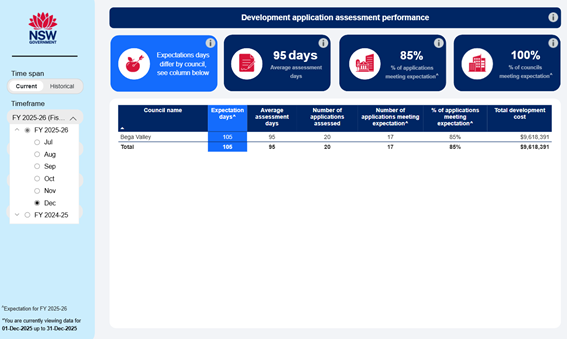
It is pleasing to note that in December 2025, 85% of
development applications assessed met the Minister’s expectations, with
the League Table reporting the average assessment time in December was 95 days
(gross).
Extract from Council League Table
|
|
April
2025
|
May
2025
|
Jun
2025
|
2024/25
(full
year)
|
Jul
2025
|
Aug
2025
|
Sept
2025
|
Oct
2025
|
Nov
2025
|
Dec
2025
|
|
DAs
assessed
|
16
|
30
|
29
|
291
|
23
|
26
|
23
|
27
|
22
|
20
|
|
Lodgement
days
|
10
|
13
|
23
|
15
|
11
|
7
|
9
|
9
|
8
|
7
|
|
Number
applications lodged^
|
13
|
22
|
19
|
266
|
30
|
17
|
24
|
19
|
18
|
22
|
|
Average
assessment days (gross)
|
142
|
146
|
138
|
137
|
111
|
162
|
89
|
148
|
102
|
95
|
^ Number of applications
lodged excludes modification applications and review of determination
applications
It is important to note that assessment timeframes will
continue to fluctuate throughout the year, based on the number and complexity
of DAs, as well as resourcing levels during the reporting period. Adjustments
will also be noted as legacy applications continue to be determined.
Extract from Council League Table for Dec 2025
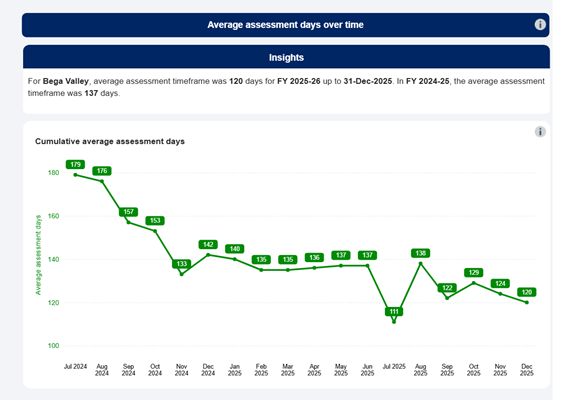
The graph below provides time series data from the League
Table for the 2024/25 financial year and into the second quarter of 2025/26
financial year. Assessment times continue to improve.
The Council league table is available online at: https://app.powerbi.com/view?r=eyJrIjoiMTlhNjZhZjItMWU1ZS00ZjE1LWI1YWUtMzY5YmIzYjM2ZjE2IiwidCI6Ijk2ZWY4ODIxLTJhMzktNDcxYy1iODlhLTY3YjA4MzNkZDNiOSJ9
Contributing factors
Council’s ability to meet the new targets depends, in
part, on the completeness of the applications received. In order to meet the
Lodgement timeframe, incomplete or low quality development applications are
being returned and applicants asked to resubmit once they have completed or
improved the application. Additionally, a much smaller window of time for
applicants to pay their DA fees is required in order to meet the new target.
The development professional’s groups has been advised of the changes,
however they are likely to result in continued frustration as the impacts are
experienced by applicants.
Development Assessment Service Review
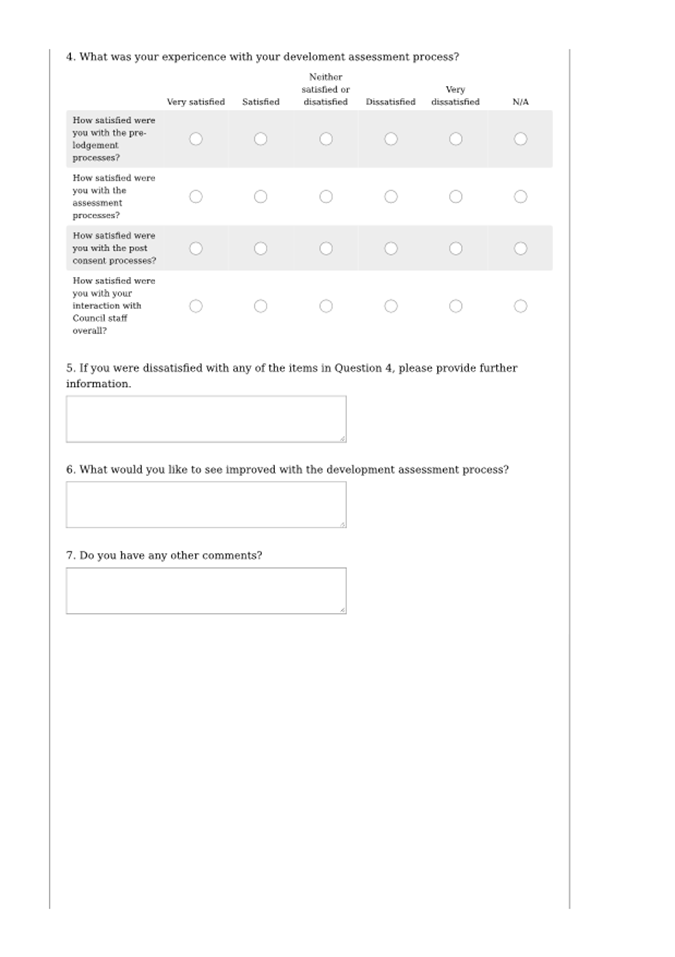
Morrison Low Advisory was appointed to undertake an
end-to-end review of our development assessment service. The final report is
being presented separately in the 28 January 2026 Council business paper.
Options
There are no options associated with this report.
Community
and Stakeholder Engagement
Engagement undertaken
Council has provided information on its website and through
media enquiries and statements as needed to alert the community to delays in DA
assessment timeframes as well as actions applicants and owners can take to
streamline the process. This includes the development and distribution of the
DA Matrix to guide applicants on what reports and information may be required
for different types of development.
Engagement planned
No further engagement is planned as a result of this report,
however website content will be updated as required to ensure the community is
aware of DA assessment challenges. Further updates to the website will be made
over time to provide additional information to support applicants through the
DA process.
Financial
and Resource Considerations
Providing a development assessment service is a key part of
Council’s core business and budget. There are no new financial impacts
arising from this report.
Legal
/Policy
Providing a development assessment service is a key part of
Council’s core business. There are no new legal or policy impacts arising
from this report.
Impacts
on Strategic/Operational/Asset Management Plan/Risk
Strategic
Alignment
Development Assessment supports the five key themes in the
Community Strategic Plan 2042 (2025 Revision):
A. Our
community: We are a vibrant, respectful, inclusive and connected community that
enjoys a culturally rich community life. We are a resilient and caring
community that supports the health and wellbeing of our residents. Our
shire is a safe and affordable place to live.
B. Our
economy: Our economy is prosperous, diverse and supported by innovative and
creative businesses. We have meaningful employment and learning opportunities
for people at all stages in life. Our key industries are resilient and strong.
C. Our
environment: Our air and water are clean, and our natural environment and rural
landscapes are protected. We adapt to and mitigate the effects of climate
change. We are leaders in sustainable living and support innovative approaches
to resource use and sustainable design principles.
D. Our
infrastructure: Our infrastructure meets community needs. Our community has
access to quality community assets that support health and wellbeing. Our
transport networks support our community to work, learn and socialise.
E. Our
civic leadership: Government services have strong organisational practices that
deliver services and facilities to meet community needs. We are an informed and
engaged community with transparent, consultative and responsive Government
services.
Development applications are assessed in accordance with the
Bega Valley Local Environmental Plan, Development Control Plan, and state
government legislation.
Environment
and Climate Change
There are no environment or climate change impacts arising
from this report.
Economic
There are no new economic impacts arising from this report.
Development plays a key role in supporting the shire’s
economy, creating short term employment and, with commercial development,
creating longer term employment opportunities.
Risk
There are no new risks arising from this report.
Social
/ Cultural
There are no new social or cultural
impacts arising from this report. Development assessment enables housing growth
and supports a connected and supported community.
Attachments
Nil
|
Council 28 January 2026
|
Item 8.2
|
8.2. Development
Assessment Service Review
The independent review of
Council’s development assessment service has been completed and the
report is now available for Council’s review.
Director Community Environment and Planning
Officer’s
Recommendation
1. That Council note the
development assessment service review report, including recommendations,
provided at Attachment 1.
2. That Council note the
high-level implementation timeframe included in the report, and that staff will
develop a detailed implementation plan (roadmap) in early 2026 to address the
recommendations.
3. That Council consider
budget implications of the recommendations as part of the development of the
FY27 budget and Long Term Financial Plan.
Executive Summary
An independent review of Council’s end-to-end
development assessment service has been completed by Morrison Low Advisory. The
final report is available at Attachment 1.
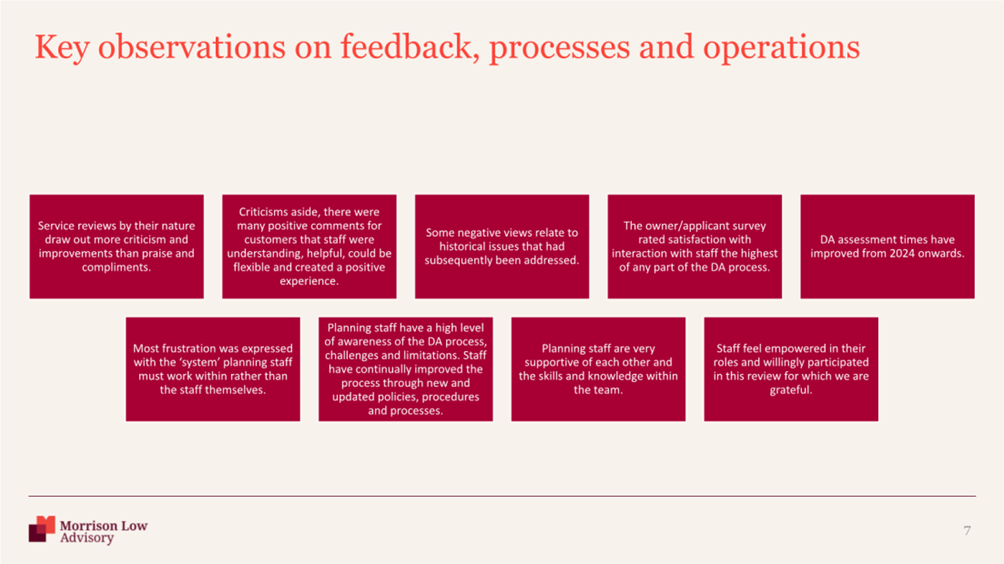
In summary, the review found that:
· staff were
understanding, helpful, could be flexible and created a positive experience for
customers
· development
application (DA) assessment times have improved from 2024 onward
· most frustration
was expressed with the ‘system’ planning staff must work within
rather than the staff themselves
· some negative
views relate to historical issues that had subsequently been addressed
· planning staff
have a high level of awareness of the DA process, challenges and limitations,
and have continually improved the process through new and updated policies,
procedures and processes.
However, a number of strategic improvements were recommended
to further streamline processes, improve customer experience and reduce
assessment timeframes.
The review report included a high-level implementation
timeframe for the recommendations proposed by the consultant. Staff will now
review this in detail and develop a roadmap (recommendation 13 in the review
report) to address the recommendations. Importantly, staff engagement in the
development of the roadmap is critical to ensuring the success of any
improvements or changes.
The roadmap and staff engagement process will also consider:
· the
improvements already made or underway while the review was in progress
· the detailed
practicalities of implementing the recommendations, including reviewing
the recommended timeframe for each action, to ensure DA timeframes are not
negatively impacted while systems, structures and procedures are being reviewed
and updated.
Once drafted, the roadmap will be workshopped with
Councillors prior to finalisation.
Background
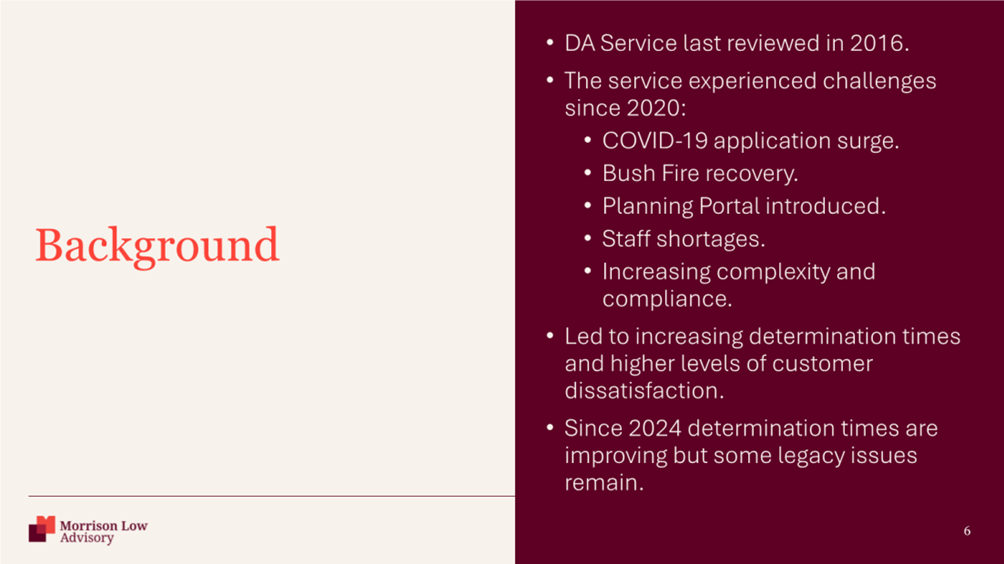
Following the Black Summer Bushfires in 2019/20 and the
COVID-pandemic, Council experienced a significant increase in the number and
complexity of development applications across the shire, coupled with
protracted vacancies in the development assessment team exacerbated by a
state-wide skills shortage. This resulted in significantly extended DA
processing times. Additionally, the requirement for councils to use the NSW
Planning Portal in 2020/21 provided new challenges during this time.
At the 16 April 2025 Council meeting, Council resolved to
endorse the scope of, and allocate a budget for, an independent review of
Council’s end-to-end development assessment service.
|
32/25
|
RESOLVED on the motion of Crs Nadin and O'Neil
1. That Council endorses the scope at
Attachment 1 for an external review of Council’s development
application process.
2. That Council endorses the budget
allocation as described in the confidential attachment.
3. That Council authorises the Chief
Executive Officer to engage an appropriate consultant following
Council’s approved procurement processes.
4. That Council notes a further report will
be provided to Council at the conclusion of the review.
In favour:
Crs Daly, Haggar, Mudaliar, Nadin, Noble and O'Neil
Against:
Crs Allen and Fitzpatrick
Absent:
Cr Porter
|
The report for the 16 April 2025 Council meeting is
available on the website at: https://begavalley.infocouncil.biz/Open/2025/04/OC_16042025_AGN_1072_AT_WEB.htm
Morrison Low Advisory was subsequently appointed to
undertake the review, following a competitive Request for Quote process.
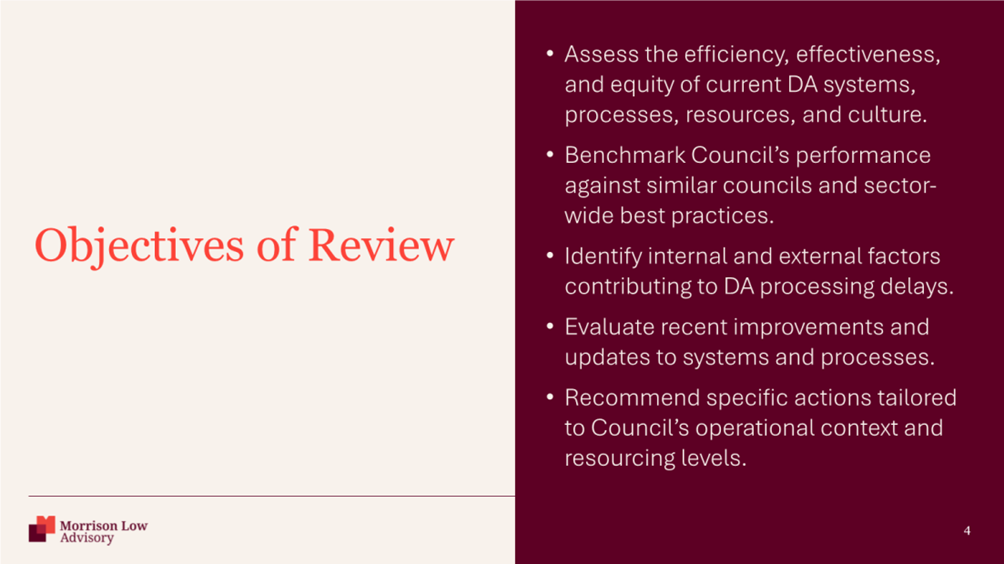
The objectives of the review were to:
• Assess the efficiency, effectiveness, and equity of current DA
systems, processes, resources, and culture.
• Benchmark Council’s performance against similar councils and
sector-wide best practices.
• Identify internal and external factors contributing to DA processing
delays.
• Evaluate recent improvements and updates to systems and processes.
• Recommend specific actions tailored to Council’s operational
context and resourcing levels.
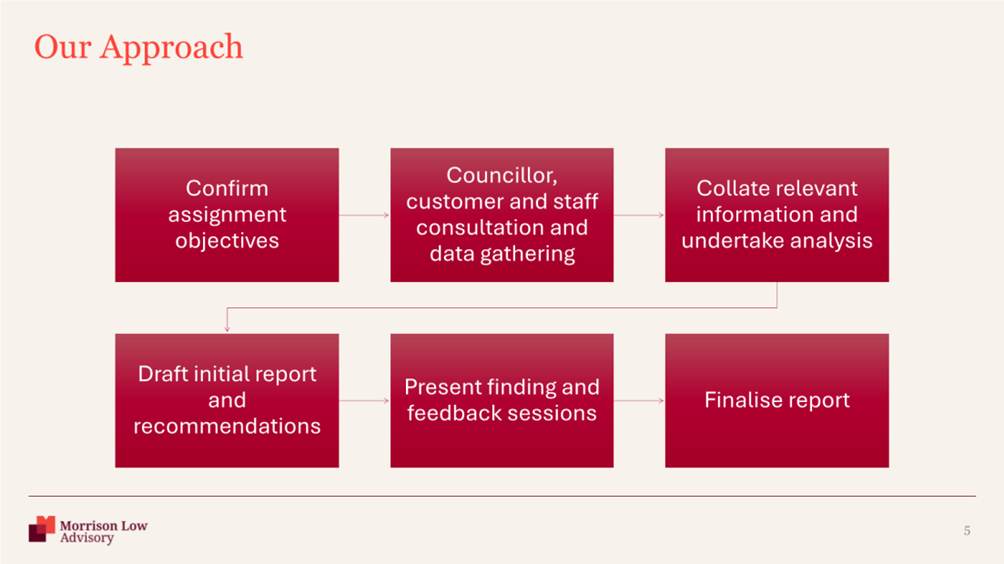
As part of the review, Morrison Low undertook a document
review, interviewed all staff involved in the DA assessment process, spoke with
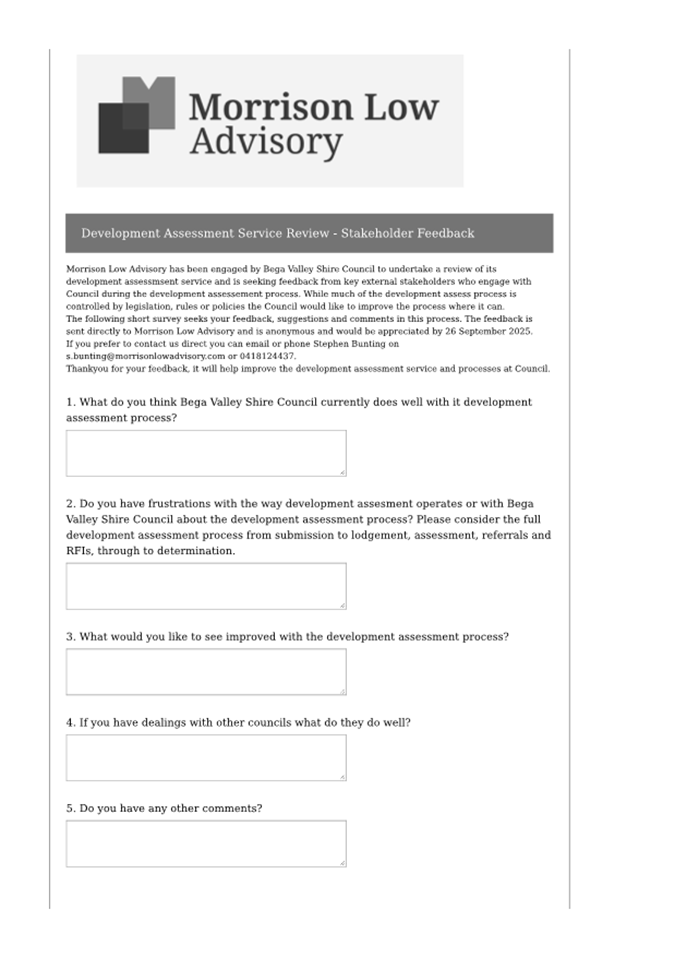
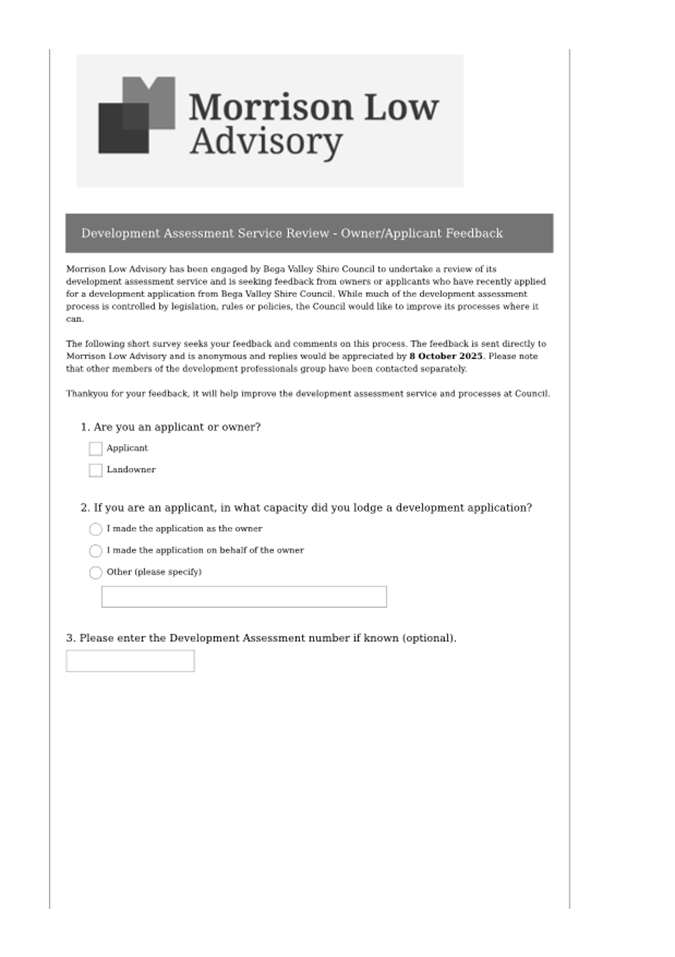
Councillors, distributed a survey to development professionals, applicants and
owners, and facilitated a workshop with development professionals.
Recent changes to the Environmental Assessment and
Planning Act 1979 have been considered in the review, however the report
notes:
There is limited clarity on the
impact of the changes to the Act, as some will rely on changes to Regulations
which haven’t been provided or require work to be completed by the State
before the outcomes of that work are known. (Attachment 1, p35)
Additionally, the changes may add further complexity to the
planning system (Attachment 1, pp25-26) which could impact Council’s
ability to reduce assessment timeframes and implement some of the
recommendations.
The recommendations put forward by the consultation are
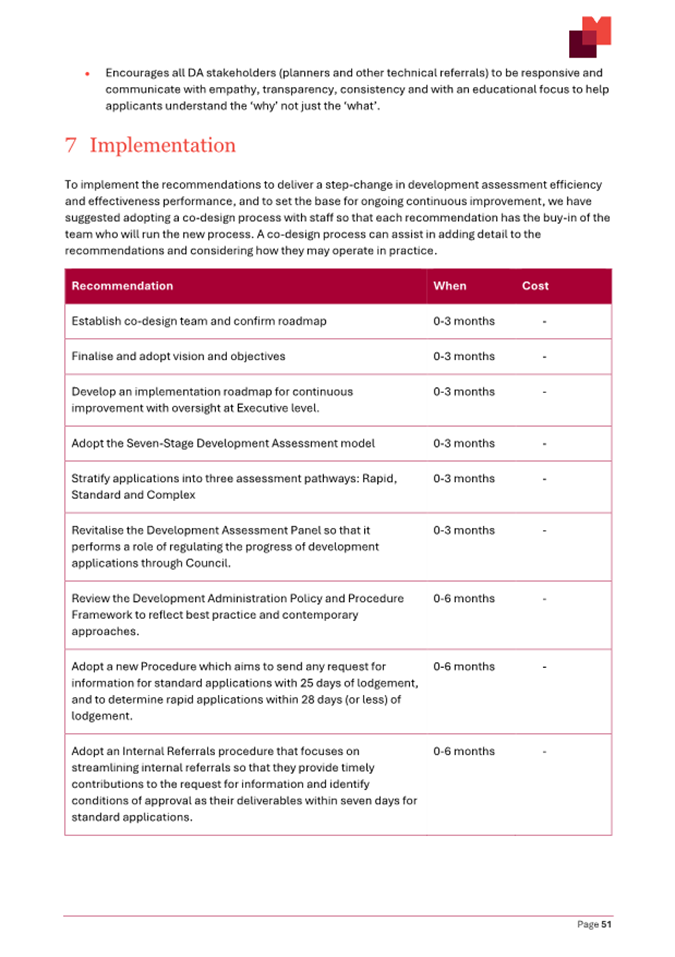
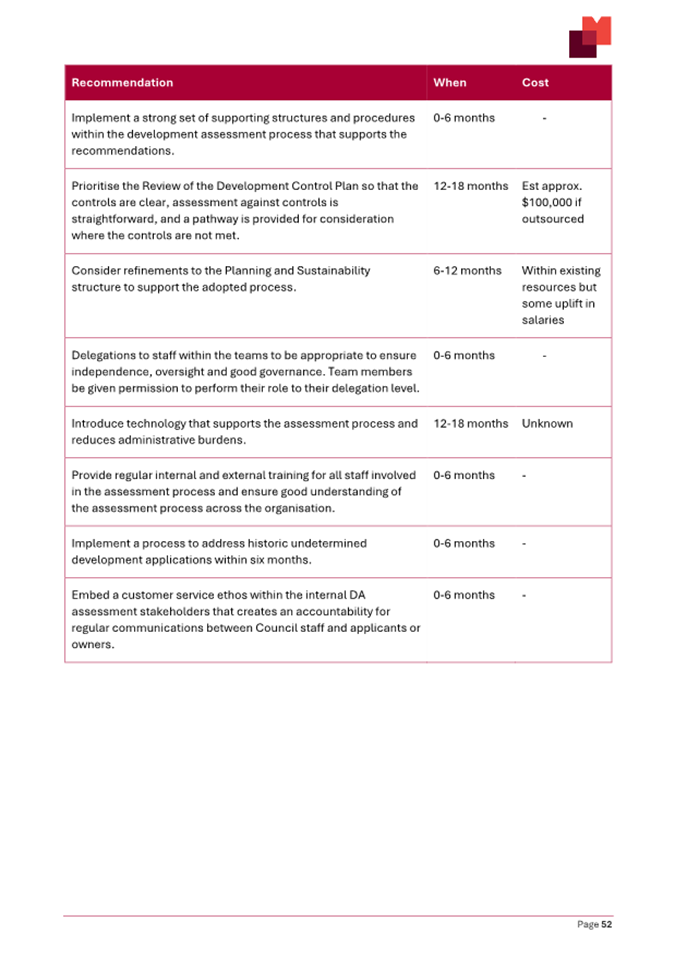
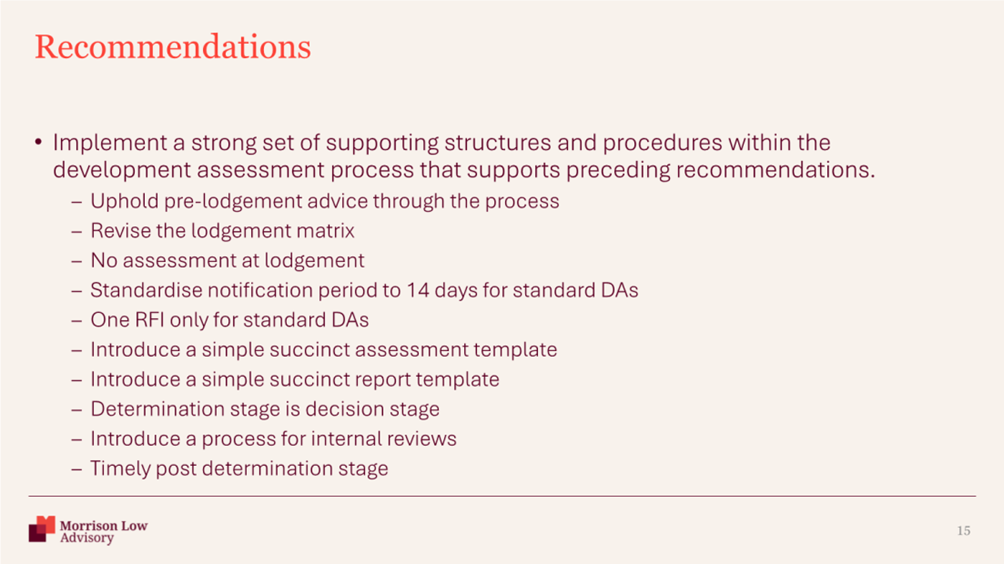
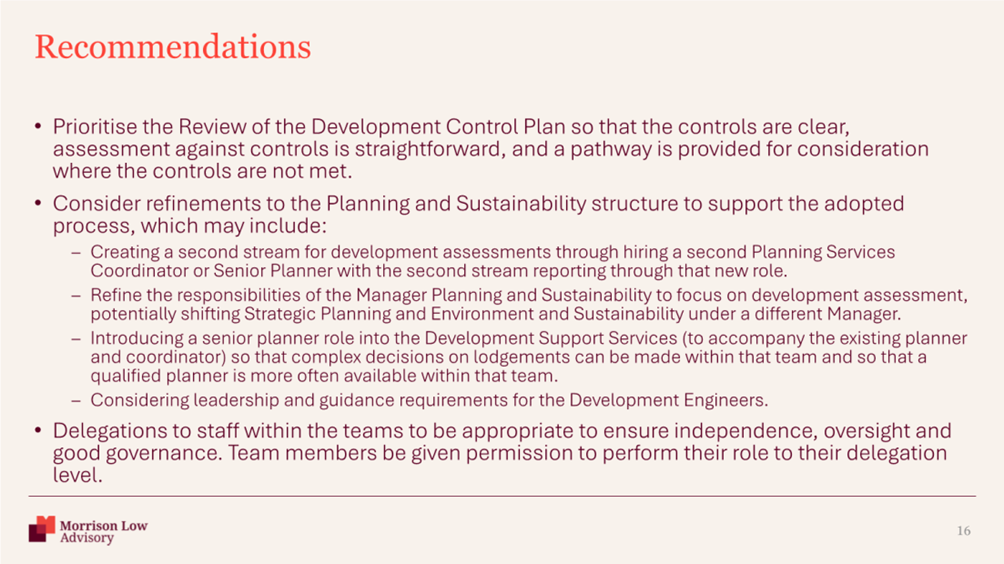
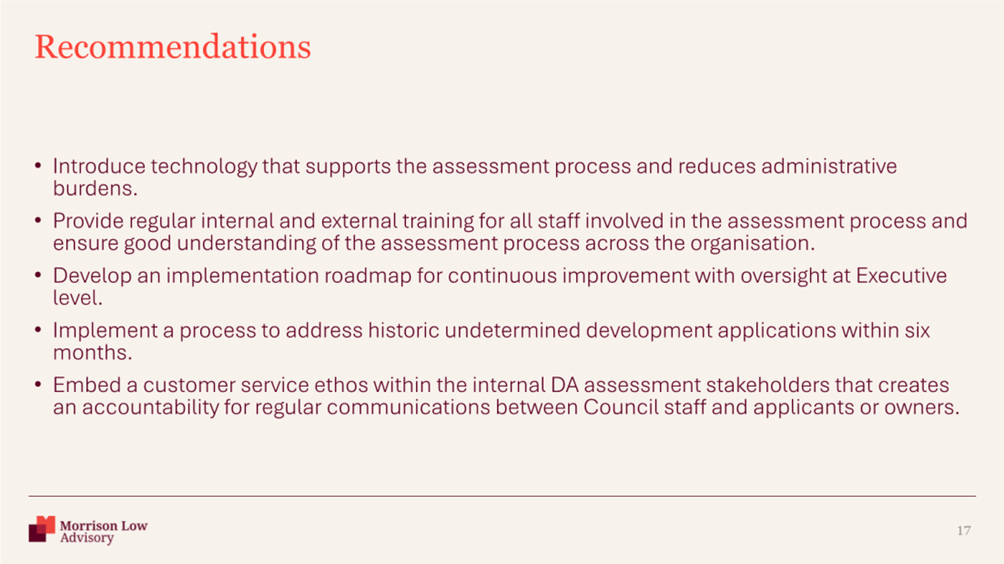
summarised below, ordered by suggested timeframe:
Short term (0-3 months)
· Establish
co-design team and confirm roadmap (in progress)
· Finalise and adopt
vision and objective
· Rec 13: Develop an
implementation roadmap for continuous improvement with oversight at Executive
level (in progress)
· Rec 1: Adopt the
Seven-Stage Development Assessment model
· Rec 2: Stratify
applications into three assessment pathways: Rapid, Standard and Complex
· Rec 3: Revitalise
the Development Assessment Panel so that it performs a role of regulating the
progress of development applications through Council
Medium term (0-6 months)
· Rec 4: Review the
Development Administration Policy and Procedure Framework to reflect best
practice and contemporary approaches
· Rec 5: Adopt a new
Procedure which aims to send any request for information for standard
applications within 25 days of lodgement, and to determine rapid applications
within 28 days (or less) of lodgement
· Rec 6: Adopt an
Internal Referrals procedure that focuses on streamlining internal referrals so
that they provide timely contributions to the request for information and
identify conditions of approval as their deliverables within seven days for
standard applications
· Rec 7: Implement a
strong set of supporting structures and procedures within the development
assessment process that supports the recommendations
· Rec 10:
Delegations to staff within the teams to be appropriate to ensure independence,
oversight and good governance. Team members be given permission to perform
their role to their delegation level
· Rec 12: Provide
regular internal and external training for all staff involved in the assessment
process and ensure good understanding of the assessment process across the
organisation
· Rec 14: Implement
a process to address historic undetermined development applications within six
months
· Rec 15: Embed a
customer service ethos within the internal DA assessment stakeholders that
creates an accountability for regular communications between Council staff and
applicants or owners
Longer term (6-12 months)
· Rec 9: Consider
refinements to the Planning and Sustainability structure to support the adopted
process
Longer term (12-18 months)
· Rec 8: Prioritise
the Review of the Development Control Plan so that the controls are clear,
assessment against controls is straightforward, and a pathway is provided for
consideration where the controls are not met
· Rec 11: Introduce
technology that supports the assessment process and reduces administrative
burdens
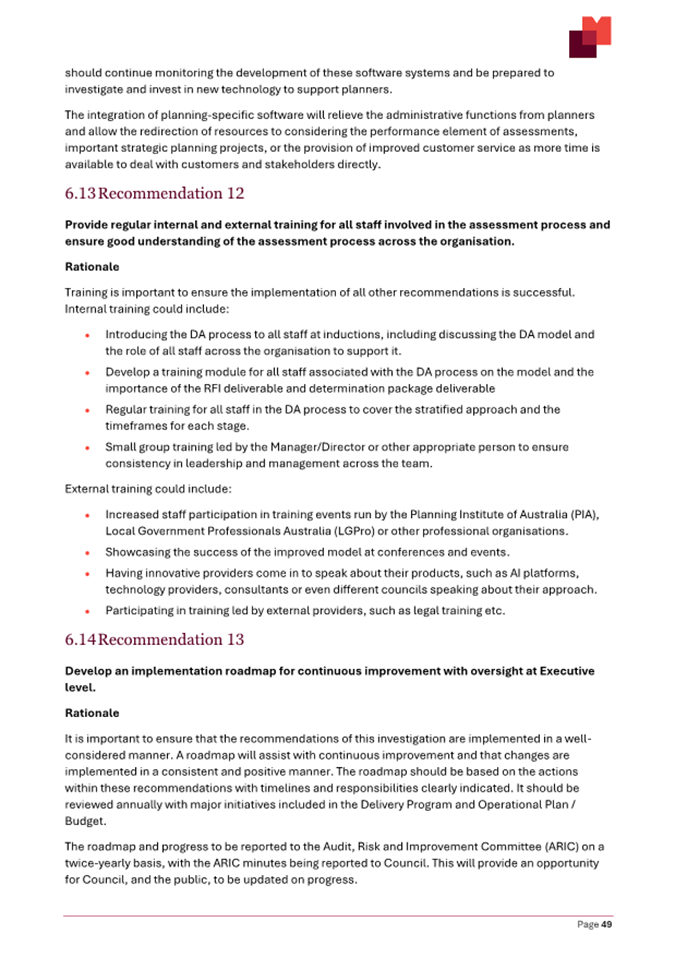
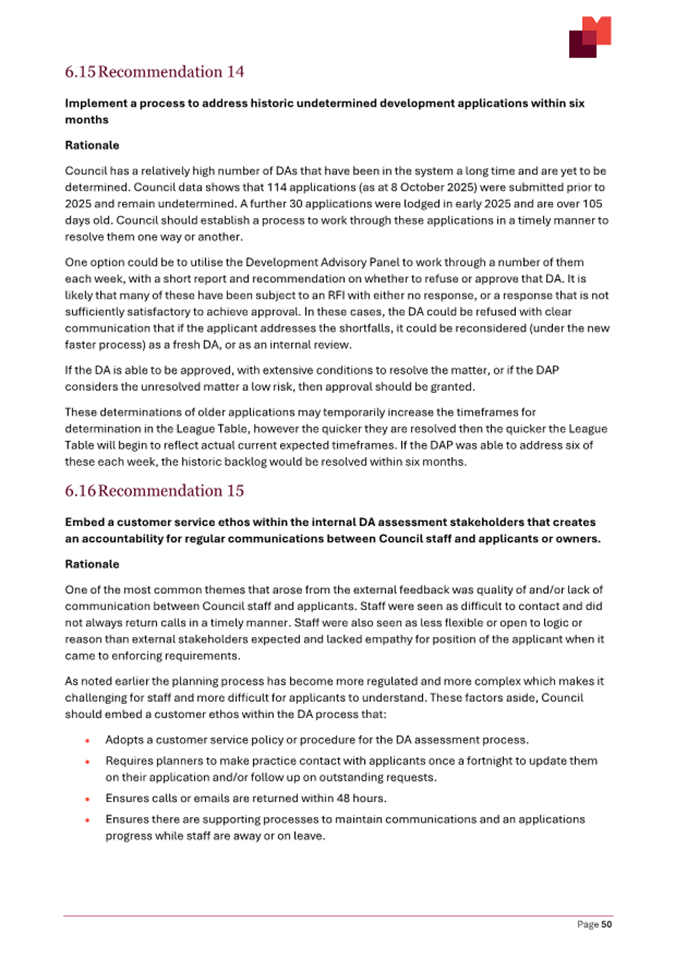
The full recommendations, including explanatory text, are
available on pages 37 to 51 in the report at Attachment 1, along with a
high-level recommended implementation timeframe on pages 51-52.
Options
Council can resolve to note the review report and next
steps, as recommended. This will allow staff to undertake further analysis of
the recommendations and develop a roadmap to step out how the recommendations
will be implemented.
Council could also resolve not to implement some or all of
the recommendations, which would provide direction to staff on where to focus
their efforts.
Community
and Stakeholder Engagement
Engagement undertaken
Following the Council resolution from April 2025, Director
Community, Environment and Planning met with staff to discuss the intent and
objectives of the review.
As part of the review itself, Morrison Low interviewed all
staff involved in the DA assessment process, spoke with Councillors,
distributed a survey to development professionals, applicants and owners, and
facilitated a workshop with development professionals.
More information is available in the review report at
Attachment 1.
Staff were kept informed of progress of the review through
meetings and emails.
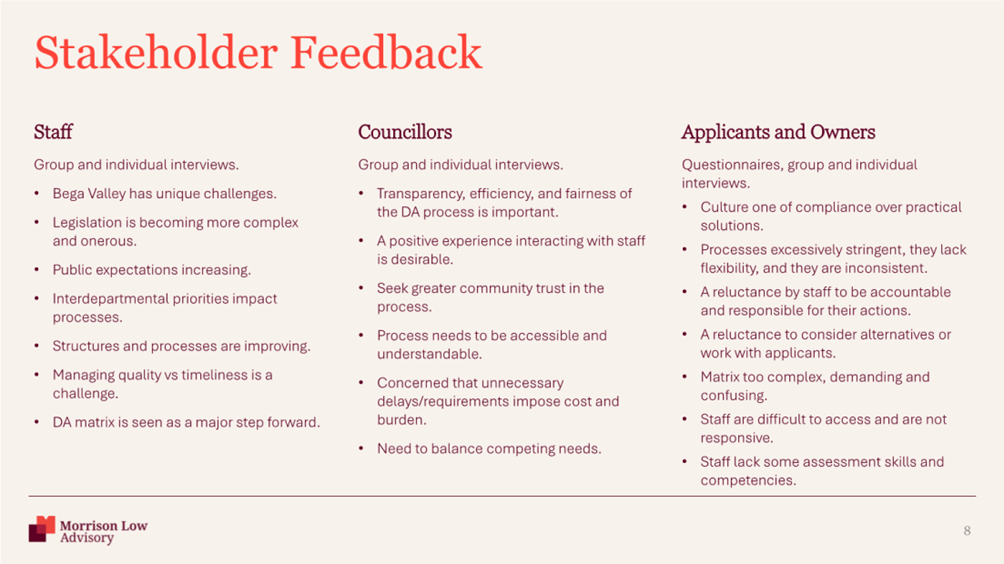
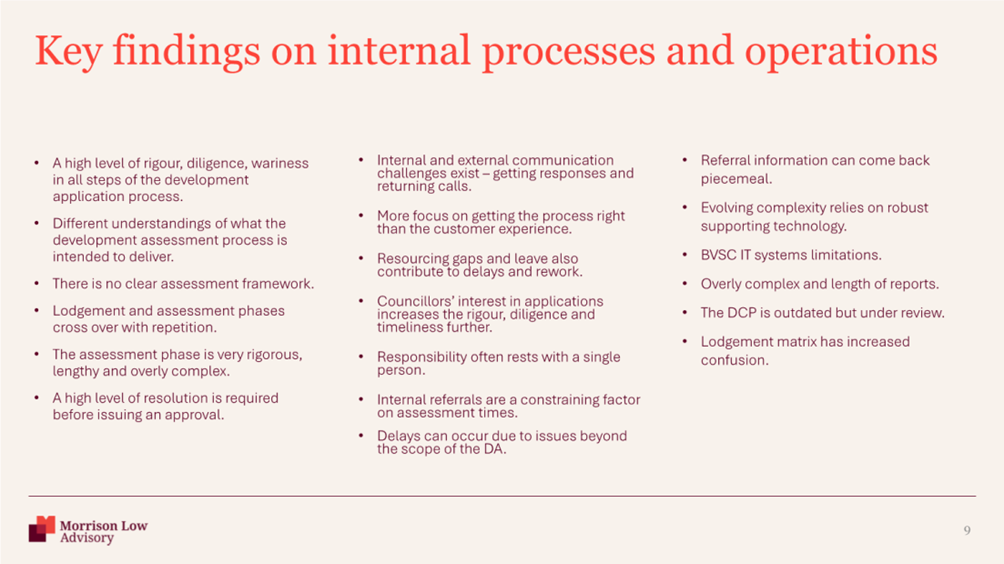
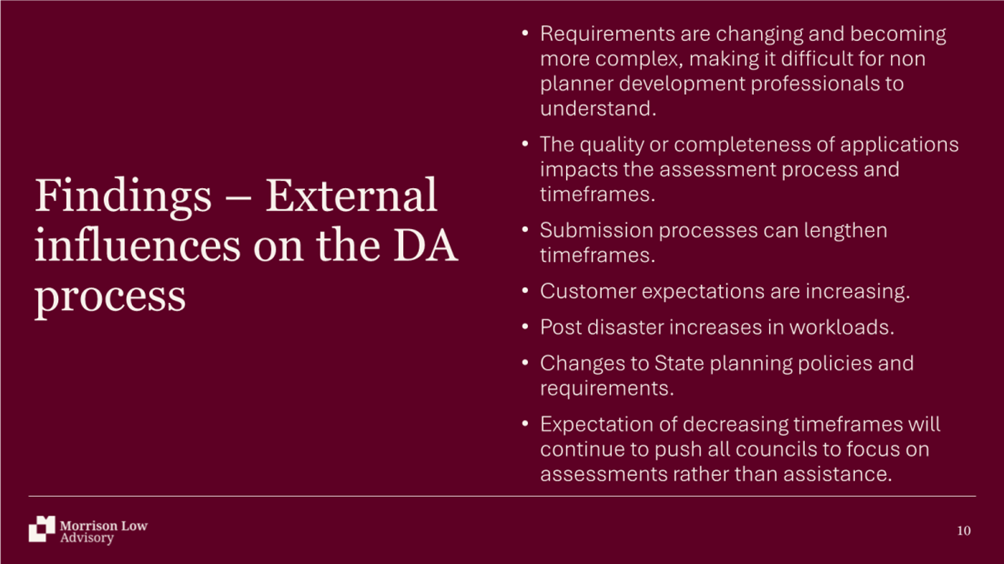
Morrison Low Advisory presented the review findings to staff
and Councillors at separate workshops on Wednesday 10 December 2025. The
presentation for these workshops is available at Attachment 2 as it provides a
high level summary of the report.
The development professionals group and owners/applicants
contacted as part of the review have been informed of this Council report and
that the review report is attached.
Engagement planned
Staff engagement in the development of the detailed
implementation plan (roadmap) is critical to ensuring the success of any
improvements or changes. This will be led by the Director Community,
Environment and Planning. Any significant workplace change will be subject to a
staff consultation process in line with clause 42 of the Local Government
(State) Award 2023.
Once drafted, the roadmap will be workshopped with
Councillors prior to finalisation.
The development professionals group will be informed of
relevant changes as they are implemented, through our usual channels. These
include emails and quarterly development professionals forums.
Website content will be updated as required, and media
release will be considered for changes that have broad impacts.
Financial
and Resource Considerations
Some of the recommended improvements will require a
financial investment from Council. Potential budget implications will be
provided to Councillors as part of the FY27 budget deliberations.
Legal
/Policy
The assessment of development applications is governed by
the Environmental Planning and Assessment Act 1979 and is guided by
Council’s strategic land use documents, State Environmental Planning
Policies, Local Environmental Plan and Development Control Plan.
Council is required to comply with the legislative framework
when assessing DAs. The complexity of the planning framework is often not well
understood by applicants, particularly those who are not planning
professionals.
If any significant workplace changes are proposed as part of
the roadmap/implementation process, staff and union consultation will be
undertaken in line with clause 42 of the Local Government (State) Award 2023.
Impacts
on Strategic/Operational/Asset Management Plan/Risk
Strategic
Alignment
Providing an efficient and effective development assessment
service is a core function of Council, highlighted in the Delivery Program and
annual Operational Plan.
A review of Council’s development assessment processes
and systems aligns with the following theme from the Bega Valley Community
Strategic Plan 2042 (2025 revision):
E. Our civic leadership | Local
leadership is strong, consultative and responsive to our community’s
needs.
Environment
and Climate Change
The review of Council’s development assessment
processes and systems, and any changes resulting from the recommendations, will
not impact the environment or climate change.
Impact to the environment and the impacts of climate change
are a key consideration during the Planning Proposal or DA assessment stage for
individual developments.
Economic
There are no direct economic impacts from the
recommendations of the review, however further streamlining the DA assessment
process and reducing assessment timeframes will have economic benefits for
individual developers and improve facilitation of future development in the
shire.
Risk
The review itself was intended to help address risk to
Council and the community from protracted assessment timeframes, and ensure we
are best placed to meet Ministerial expectations regarding gross development
assessment timeframes.
Importantly, while the recommendations are intended to
reduce the timeframe for DA assessment, the quality of applications and
supporting information submitted by applicants is largely outside of
Council’s control and will have a significant impact on our ability to
reduce and maintain timeframes. The review report notes that the low number of
local planning firms in our area ‘contributes to higher proportions of
applications being lodged by professionals who are not qualified planners, such
as draftspersons, consulting engineers, surveyors or even private owners
themselves’. This can, in turn, increase the gross timeframes for DA
assessment.
As the recommendations are implemented, it is likely more
DAs will be refused or determined with conditions that applicants are not happy
with. This will reduce the assessment timeframes but may result in issues being
pushed to post DA rather than being resolved before a consent is issued. This
will need to be carefully monitored and managed.
There is a risk that prioritising speed over other
considerations will result in more DAs being rejected, errors being made,
decisions made that have longer term impacts on Council’s infrastructure,
or more DAs being challenged in the Land and Environment Court. The review
recommendations have been drafted to minimise and mitigate these risks where
possible, and they will all be carefully considered in the development of the
roadmap.
The risks of implementing each specific recommendation in
the review report will be considered in the development of the roadmap.
Changes to the EP&A Act
It is important to note that there is limited clarity on the recently announced
changes to the Environmental Assessment and Planning Act 1979 and until
Regulations are updated or the State undertakes further work, the full impact
on Council’s DA assessment timeframes and processes is not known.
Additionally, the changes may add further complexity to the
planning system which could negate some of the gains made by implementing the
recommendations of the review.
Implementation timeframe and resourcing
It is important to note that implementing the
recommendations will require input and focus from a number of staff across the
organisation. This will need to be carefully balanced with assessment work to
ensure DA timeframes are not negatively impacted while systems, structures and
procedures are being reviewed and updated.
Social
/ Cultural
Development assessment enables
housing growth and supports a connected and supported community. Undertaking
this review of Council’s end-to-end development assessment service, and
implementing improvements, will enable Council to better support these outcomes
into the future.
Attachments
1⇩. Development
Assessment Service Review final report
2⇩. Development
Assessment Service Review presentation
|
Council
|
28 January 2026
|
|
Item 8.2
- Attachment 1
|
Development Assessment Service Review final report
|
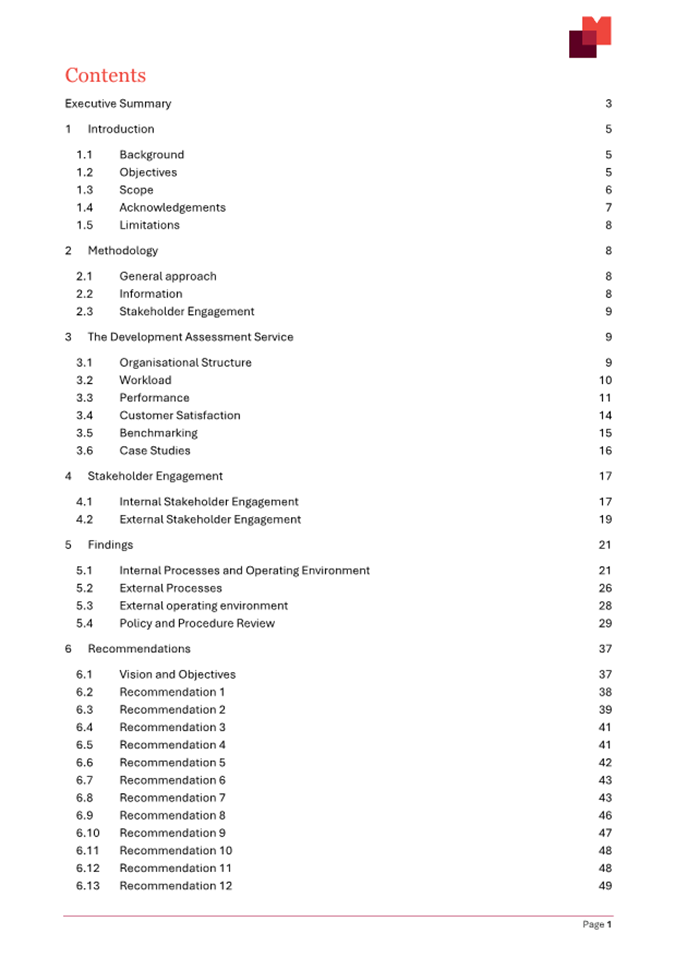
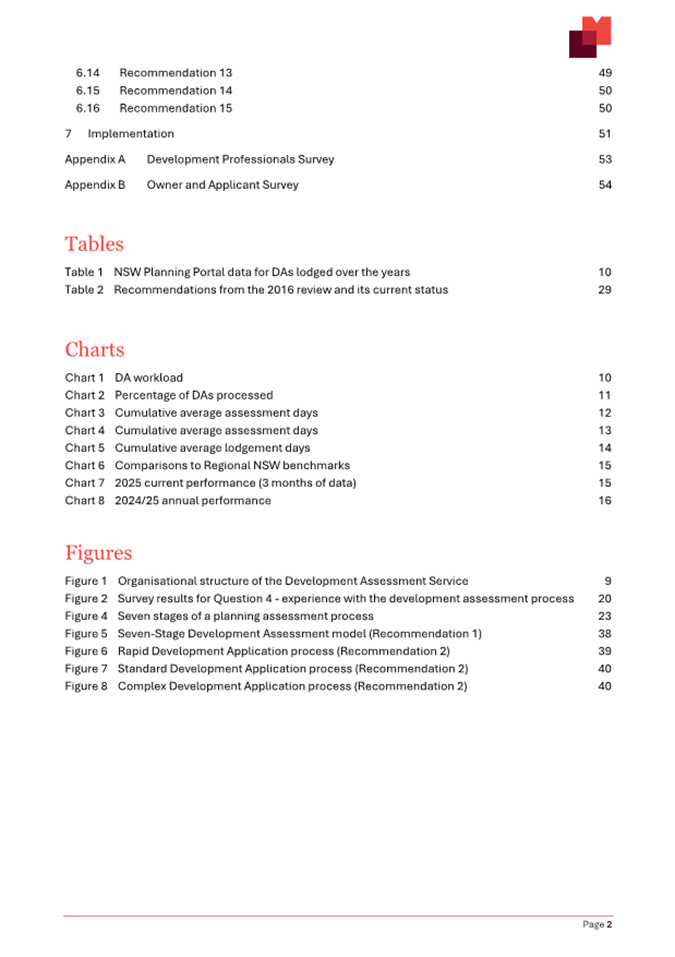
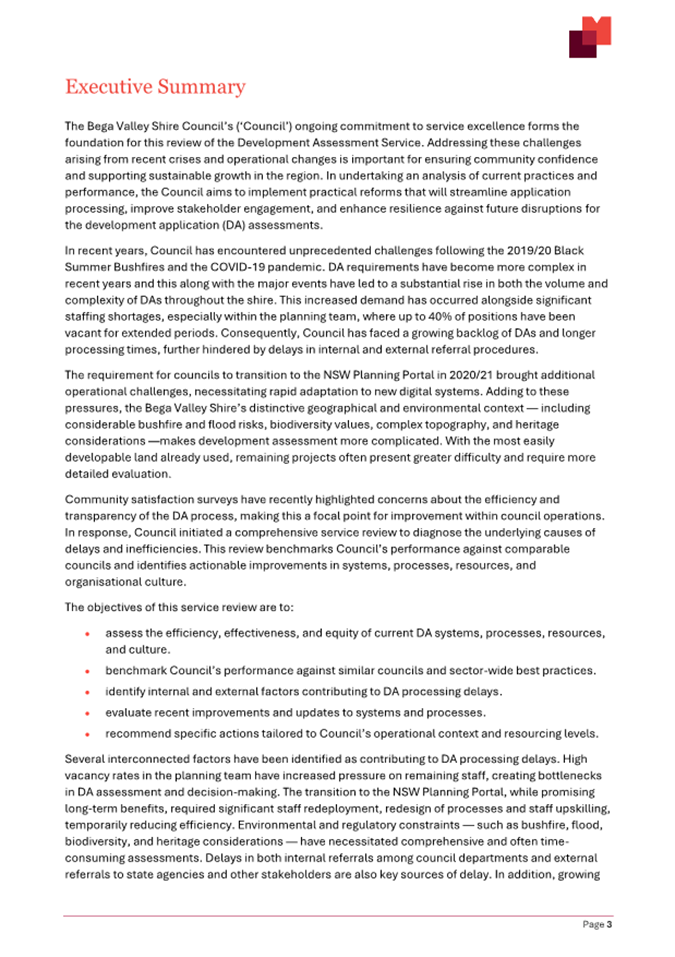
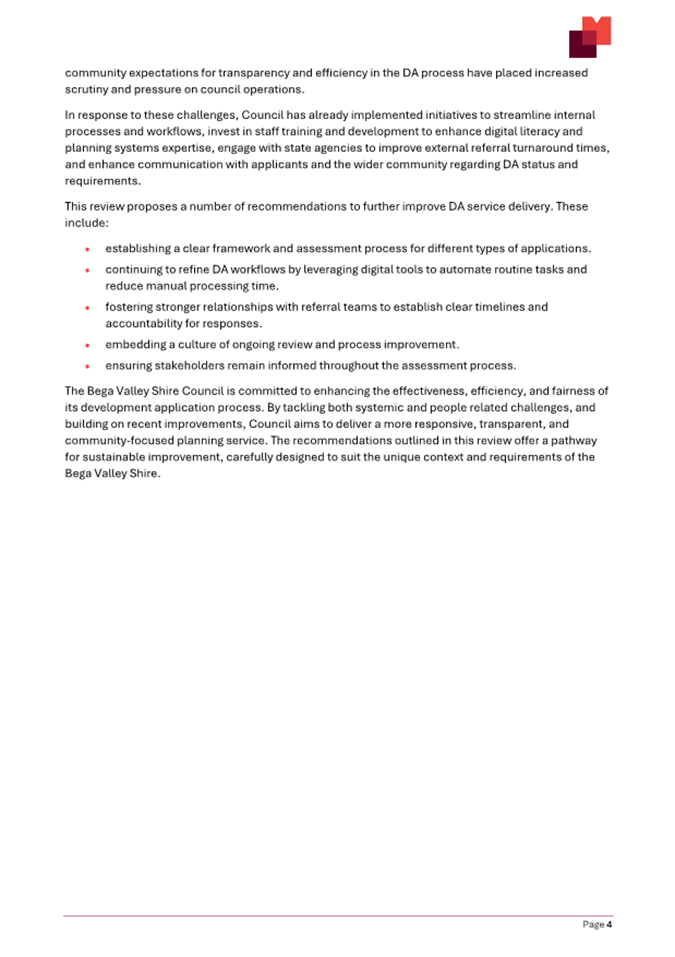
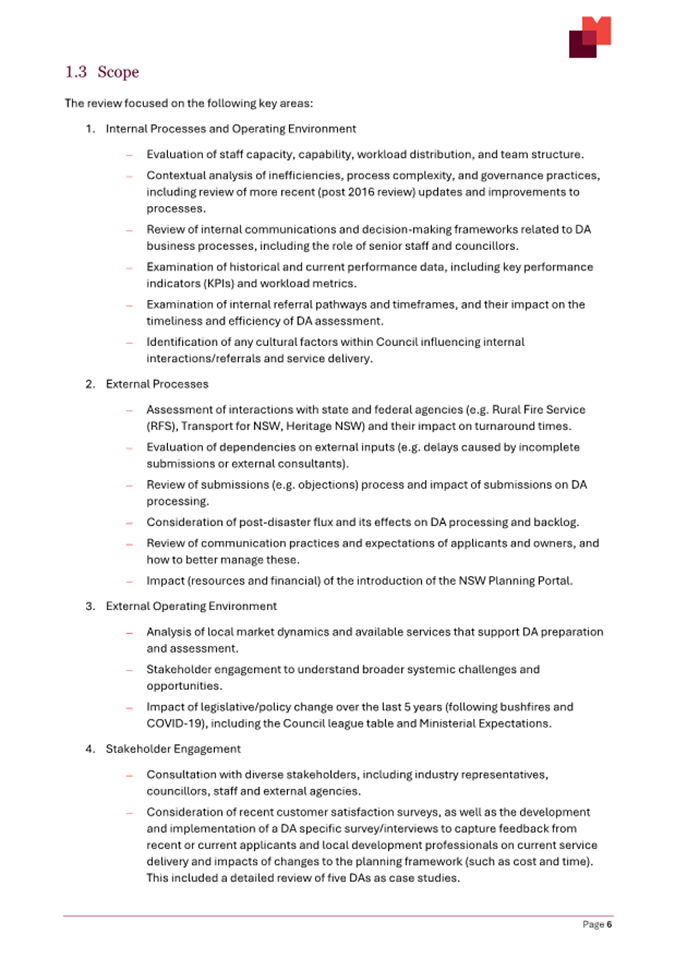
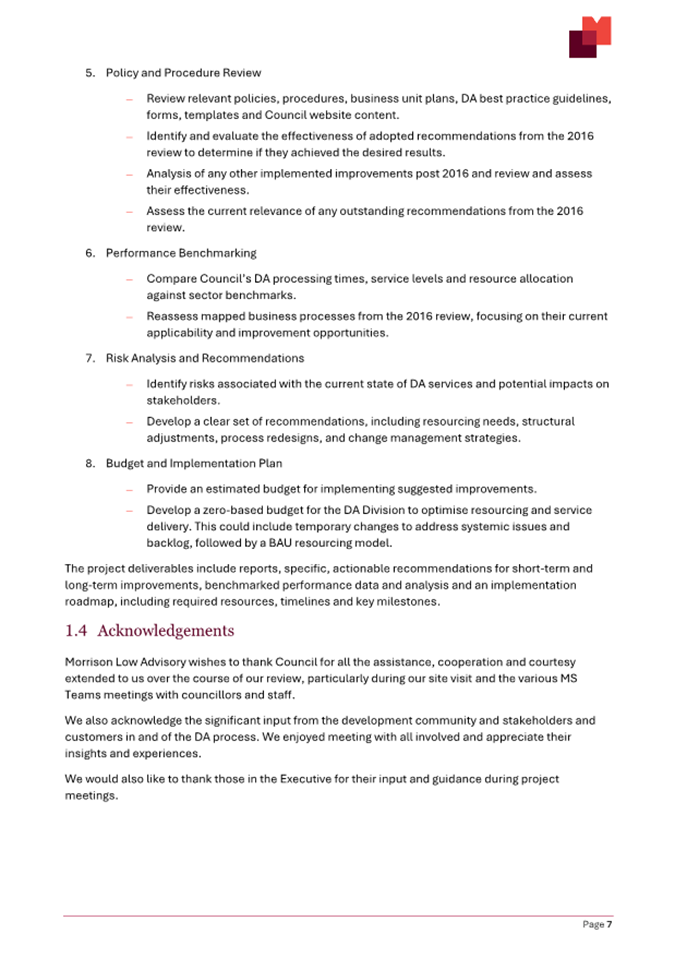
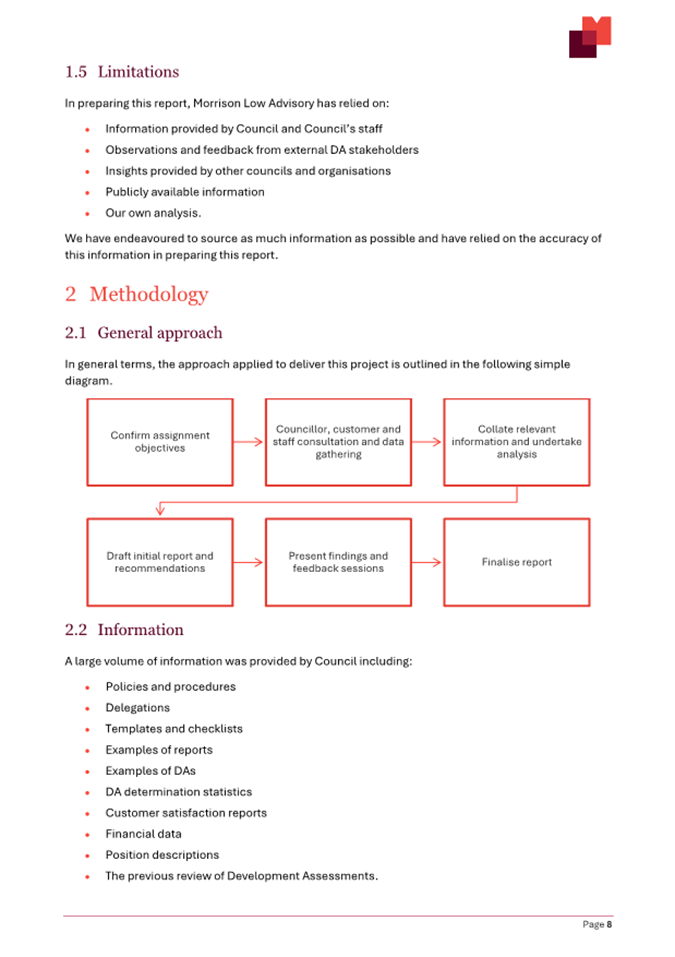
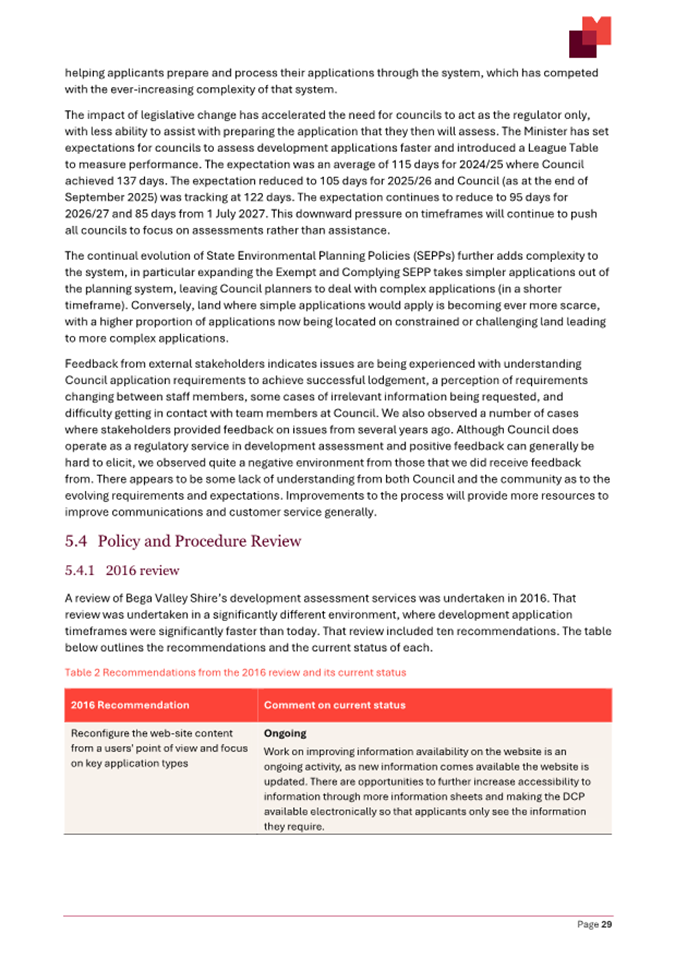
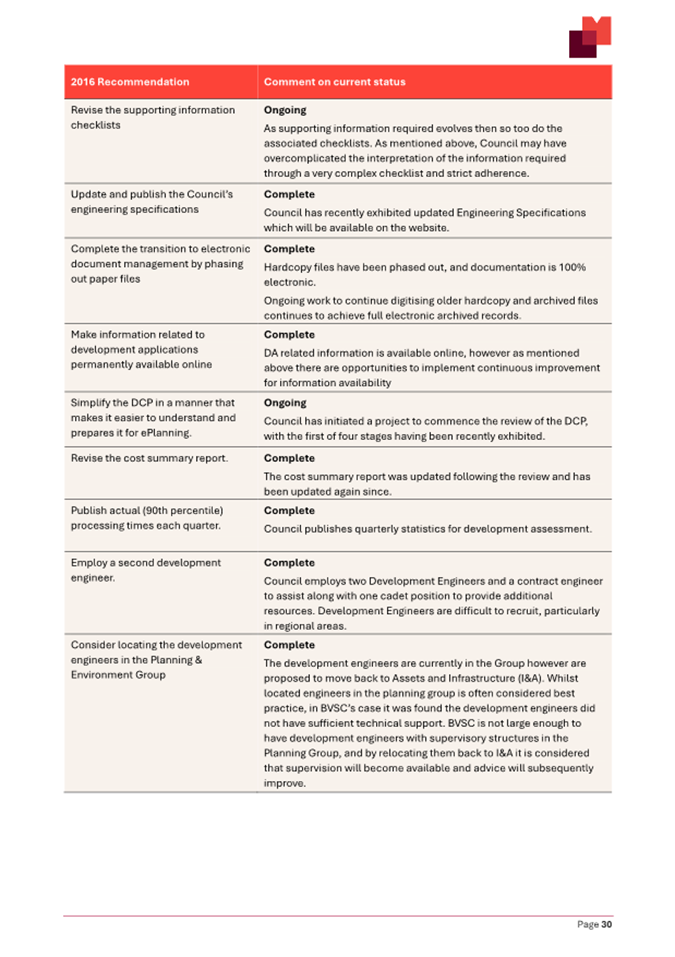
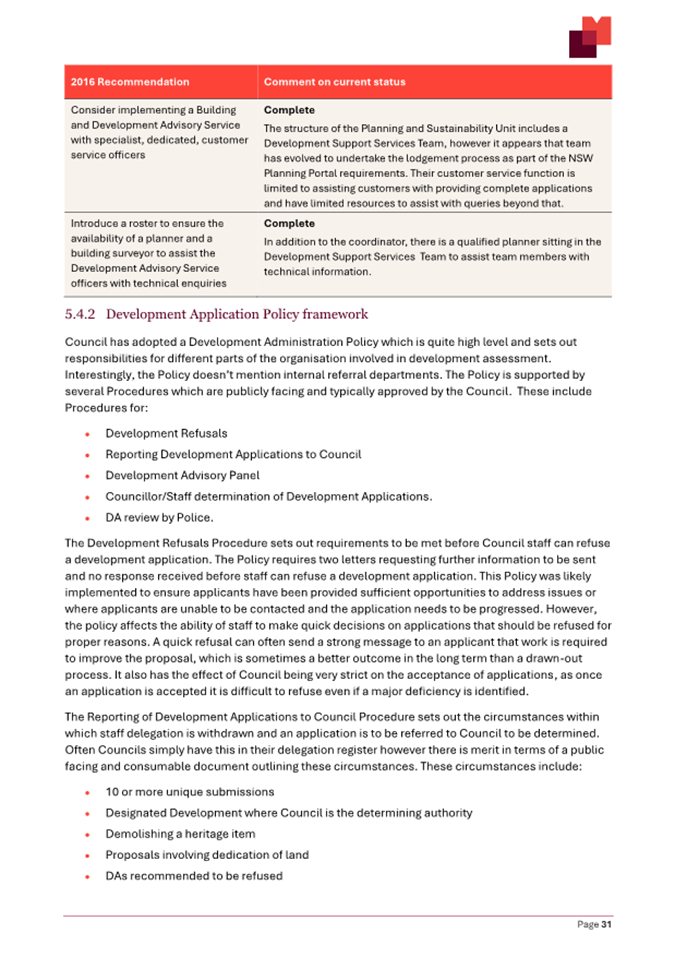
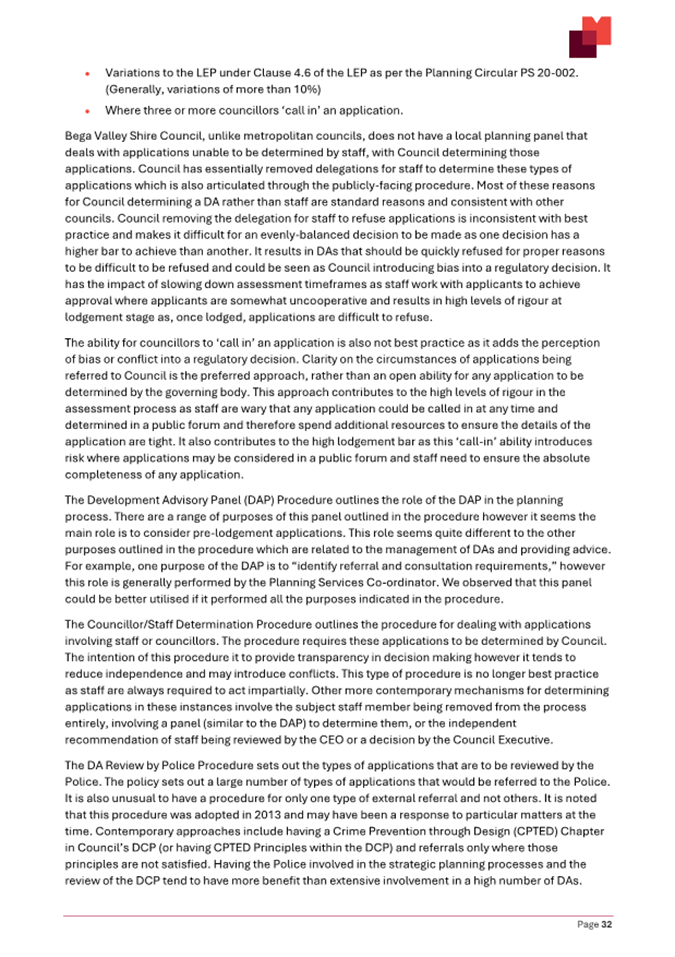
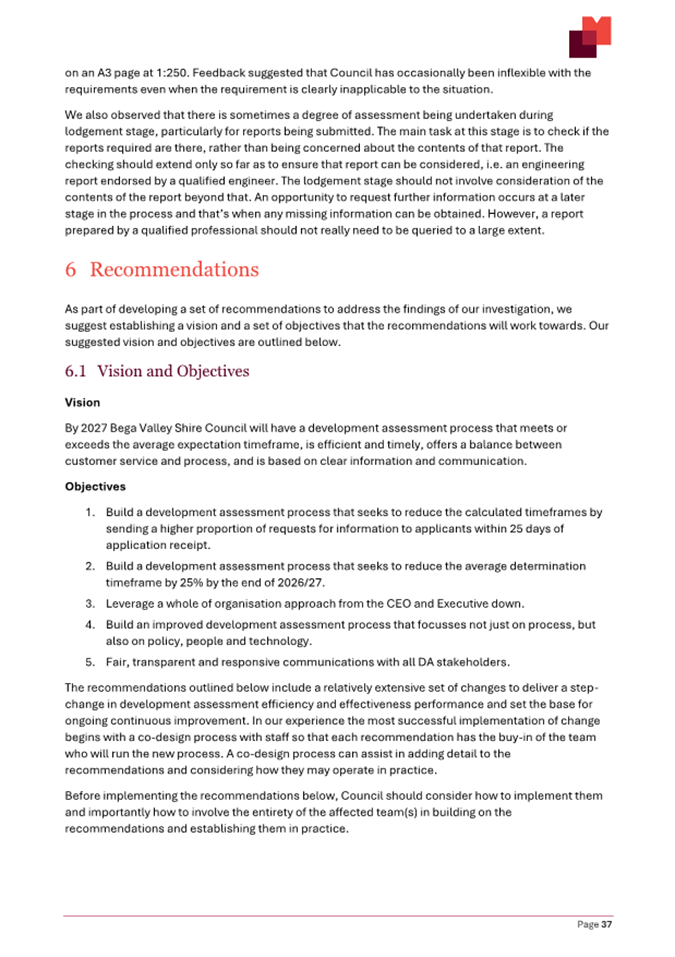
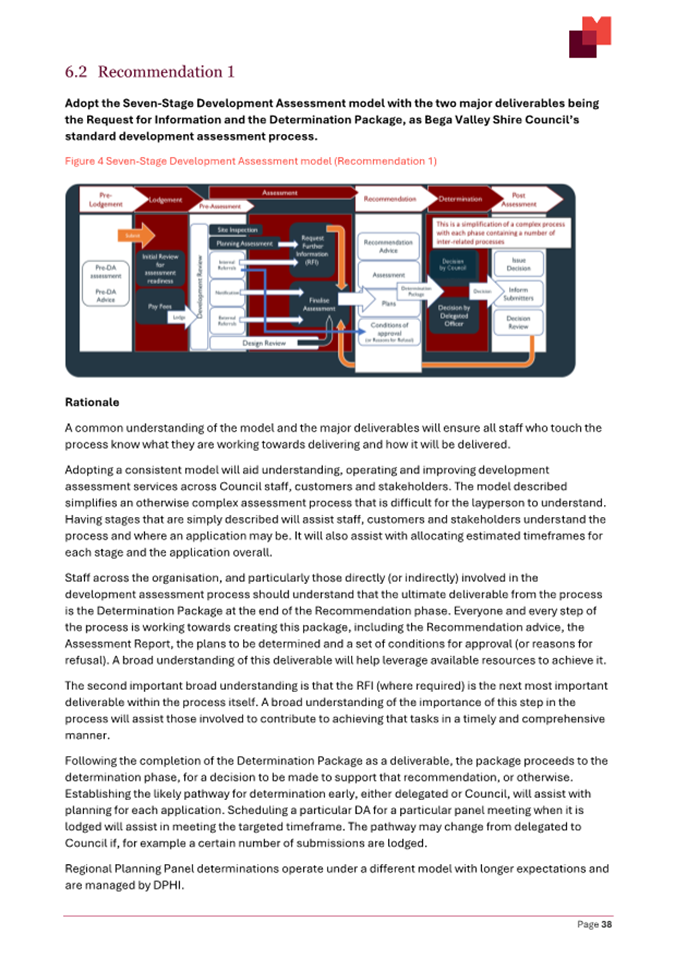
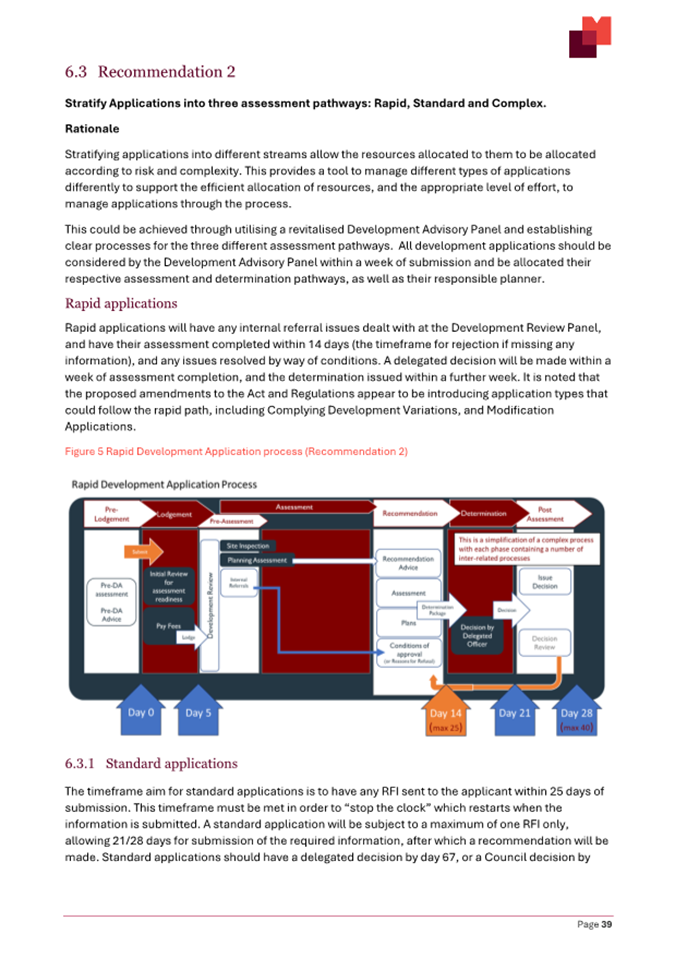
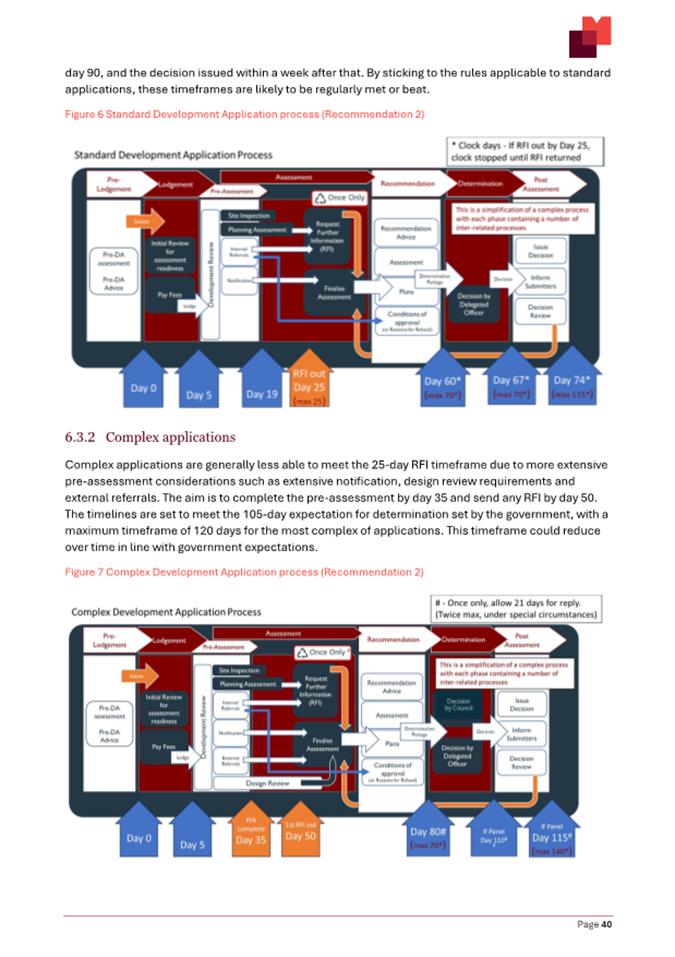
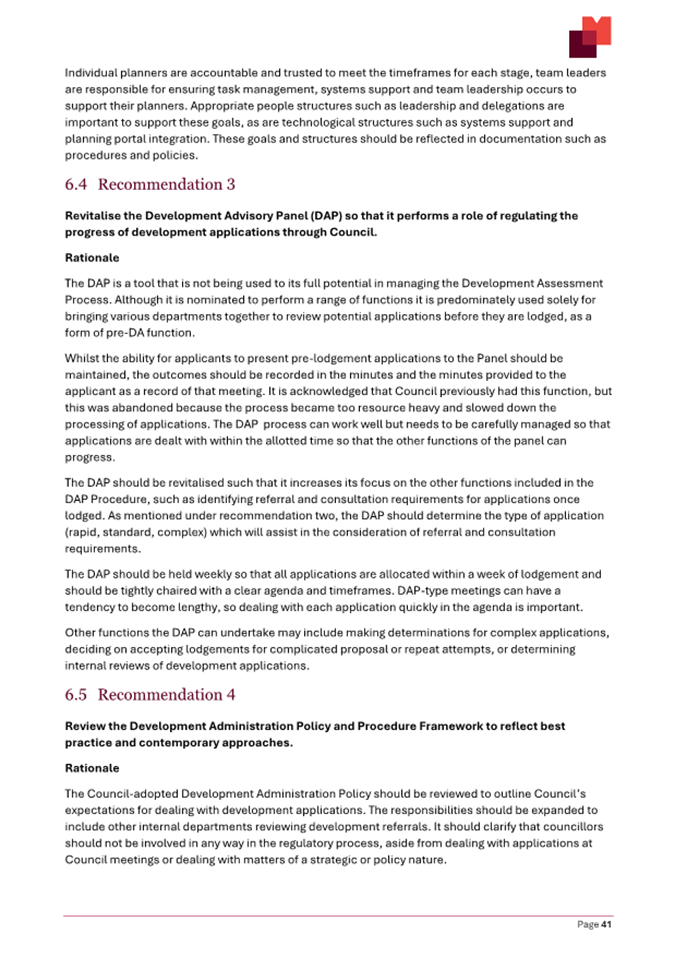
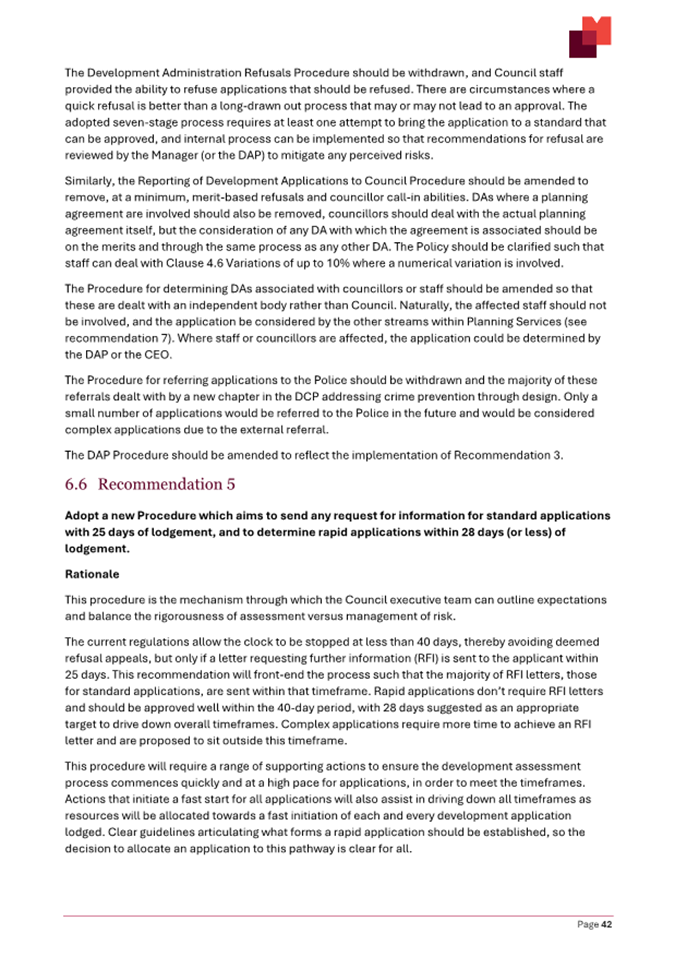
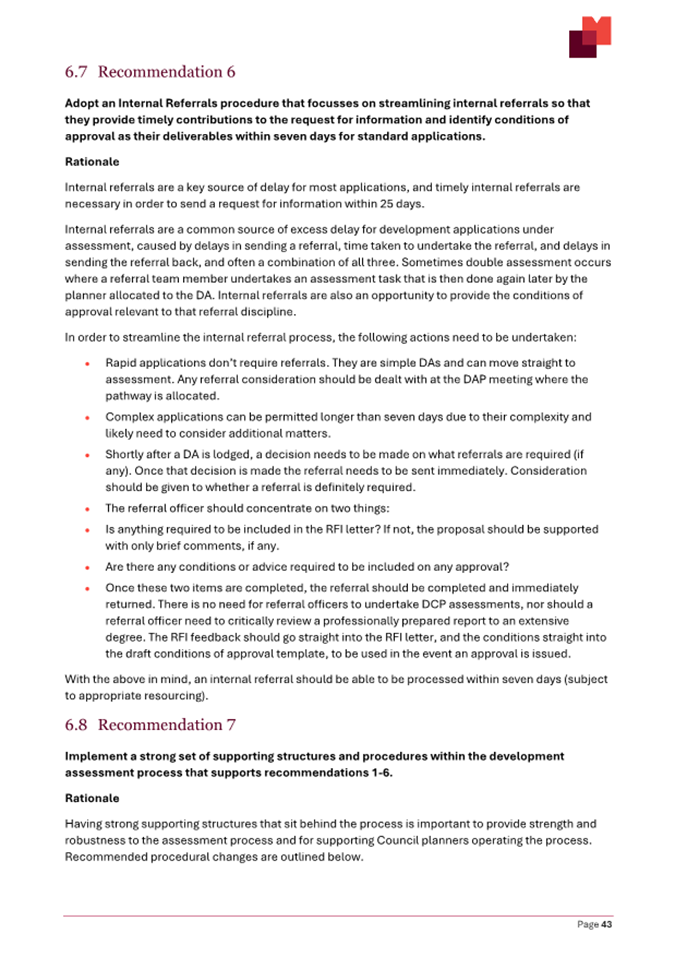
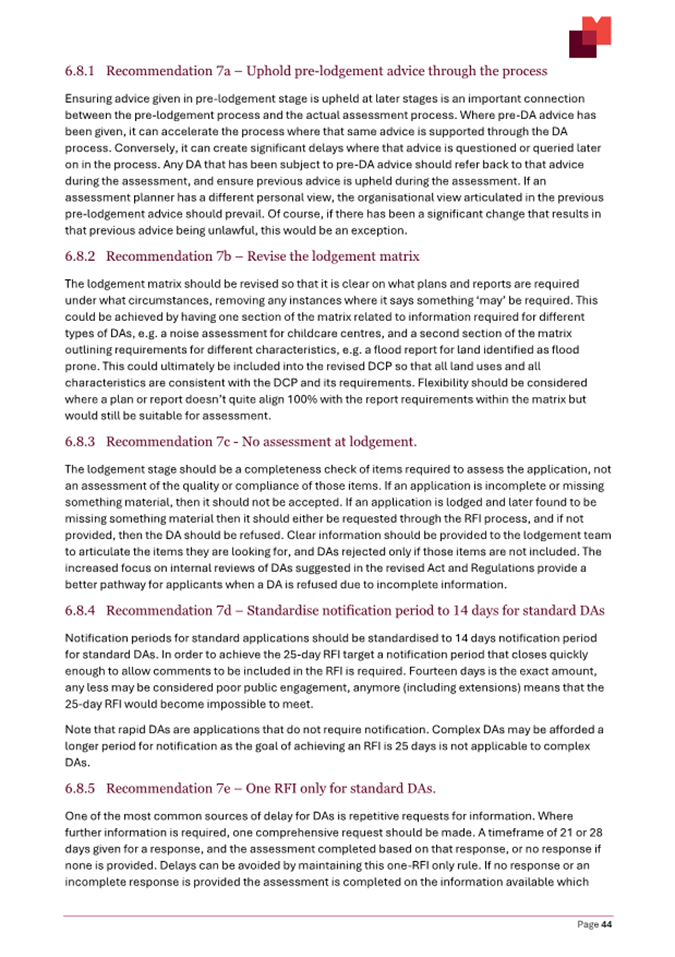
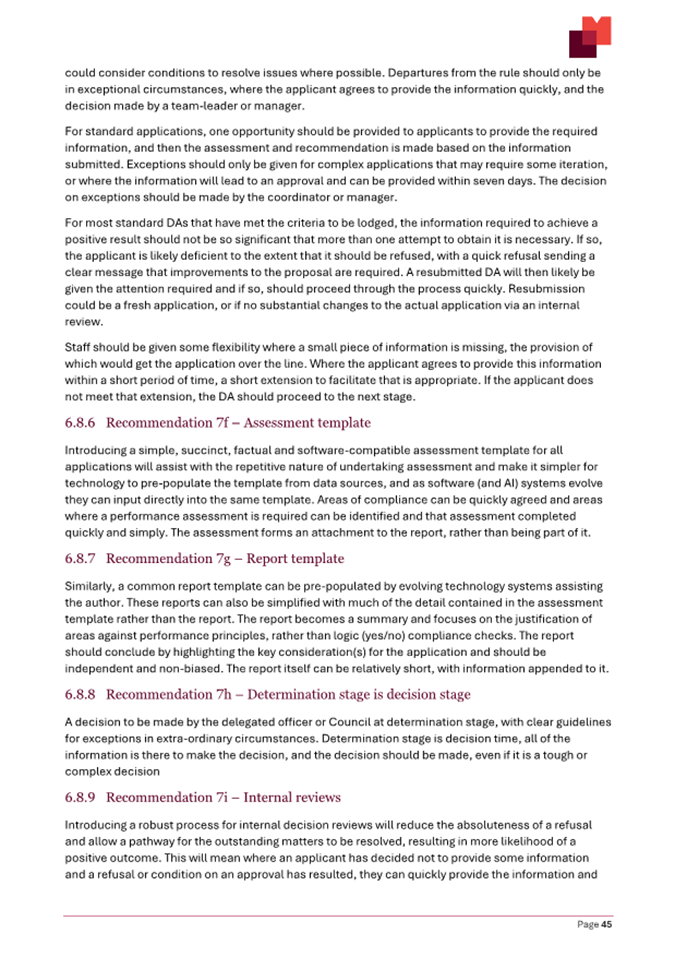
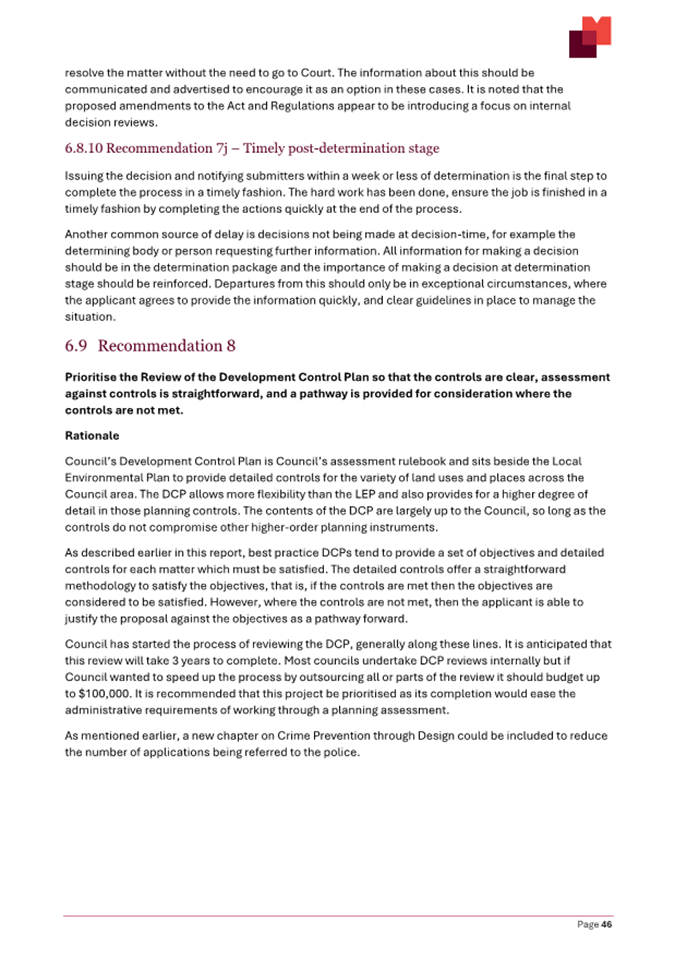
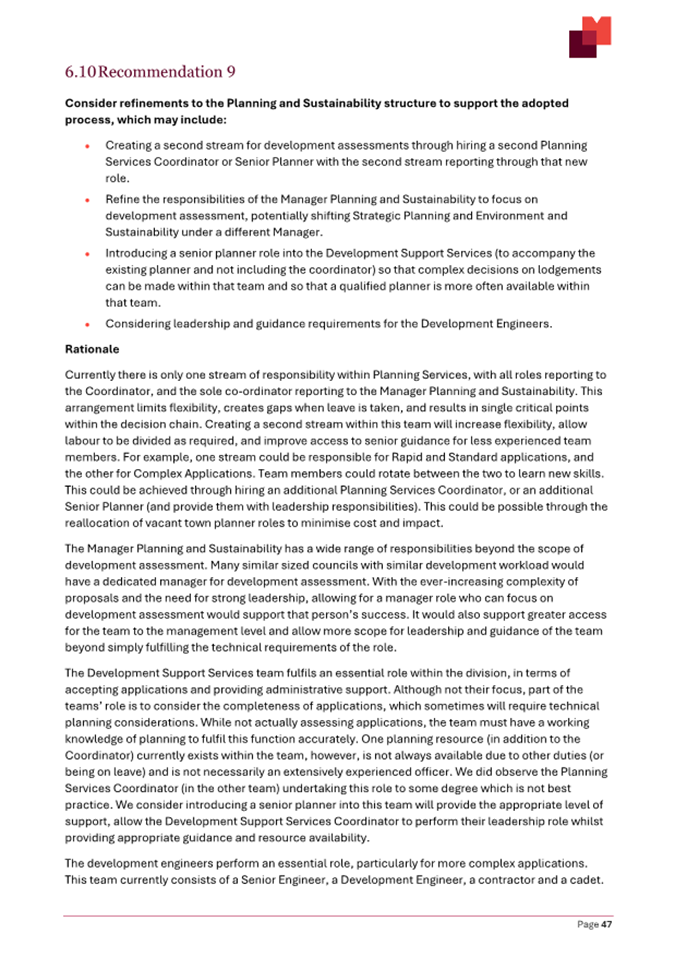
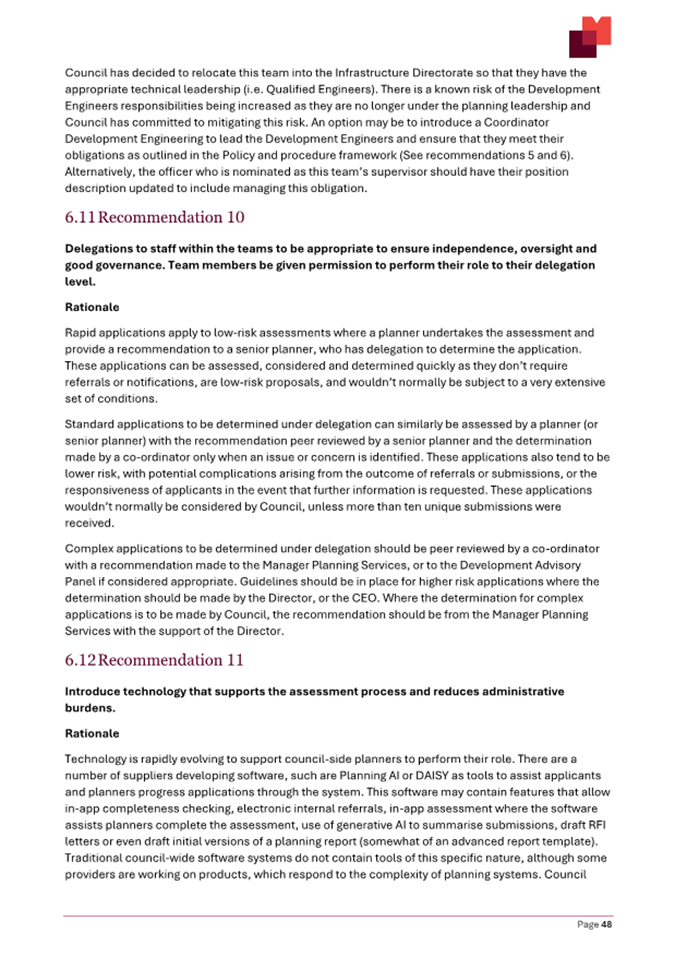

|
Council
|
28 January 2026
|
|
Item 8.2
- Attachment 2
|
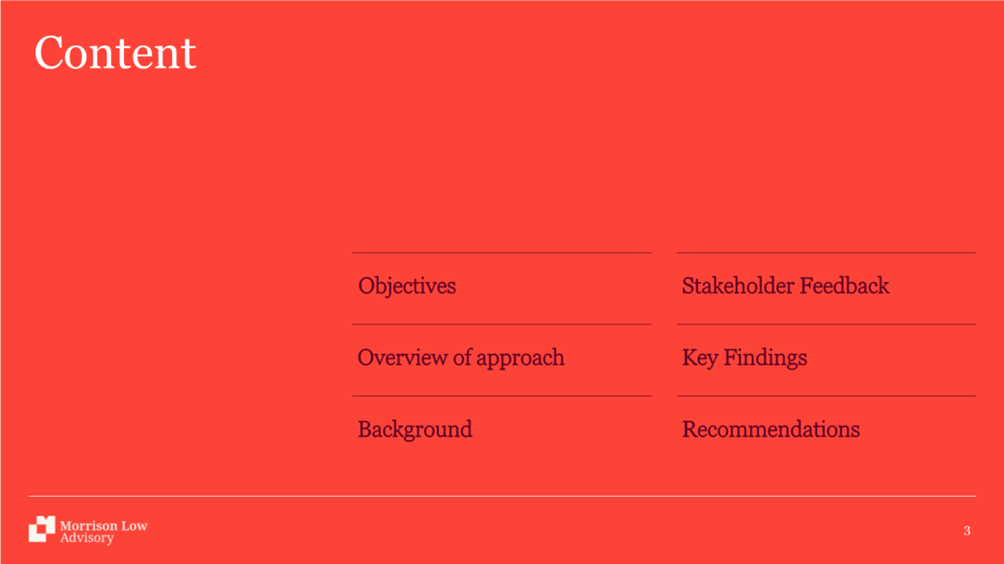
Development Assessment Service Review presentation
|
|
Council 28 January 2026
|
Item 8.3
|
8.3. UPL fee waiver
for Eden Local Aboriginal Land Council's Bundian Way project
Eden Local Aboriginal Land Council
has requested a waiver of the Use of Public Land fee for their Bundian Way
project.
Director Community Environment and Planning
Officer’s
Recommendation
That Council resolves to waive the use of public land fees
for the Eden Local Aboriginal Land Council’s Bundian Way Node 1 project,
as outlined in this report, and exhibit this for 28 days as required under the Local
Government Act 1993 and if no objections are received progress to implement
the waiver.
Executive Summary
Council has received a request from
the Eden Local Aboriginal Land Council (Eden LALC) to waive the use of public
land (UPL) fee for the use of the foreshore reserve at Cattle Bay to support
construction of the Bundian Way Node 1, totalling $1,161.42.
It is possible there may be other
UPL fees required for this project. Noting Council’s previous support of
this project through its resolution to waive any development assessment and
principal certifying authority fees (including contributions), and to minimise
administrative burden for staff, Councillors and the Eden LALC, Councillors are
being asked to consider a broader UPL fee wavier that would include any and all
UPL fees associated with the Bundian Way Node 1 project. It is not yet known if
further UPL approvals will be required.
Background
On 16 March 2022, Council resolved
to waive any development assessment and principal certifying authority fees,
including section 7.11, section 7.12 and section 64 developer contributions for
a number of identified projects, including the Bundian Way Node 1. To date
there have been no fees associated with this development as the works have been
able to be assessed under a Review of Environmental Factors pursuant to Part 5
of the Environmental Planning and Assessment Act 1979.
The current UPL request relates to
the use of public land within sections of Cattle Bay Foreshore Reserve and
Cocora Beach Reserve to establish a temporary construction zone comprising two
(2) material staging areas, each measuring approximately 95 m².
It also includes a proposed aerial
operation involving the transportation of twenty-five (25) stepping stones,
each weighing approximately 450 kg, to Parcels 35805 and 37533. The works are
forecast to be completed within a single day, with aerial operations conducted
over an estimated one-hour period.
Based on Council’s adopted
fees and charges, this would cost $130.00 for an Application Processing fee and
$1,031.42 for the occupancy of the Construction Zone fee, totalling $1,161.42.
It is not yet known if further UPL
approvals will be required as part of this project.
Options
Council may choose to waive all current and future UPL fees
for this project, waive part of the current and future UPL fees for this
project, waive only the fees for the current UPL application, or not make any
fee concessions at all.
Community
and Stakeholder Engagement
Engagement undertaken
Council has received a request from Eden LALC for Council to
waive the use of public land fee for construction of the Bundian Way.
Engagement planned
Pending the Council resolution, the intention to waive the
fee outlined in this report will be publicly exhibited for 28 days as per the
requirements of the Local Government Act 1993.
The applicant will be informed of Council’s decision,
and these provisions if relevant.
Financial
and Resource Considerations
The fees charged are in line with Council’s adopted
fees and charges and contribute towards the cost of providing the respective
services. If Council resolves to waive these fees, it will result in a loss of
revenue to Council in accordance with the adopted fees and charges.
The UPL fee for the current request totals $1,161.42. It is
unknown if further UPL approvals and fees will be required.
Waiving of fees is a practice Council has undertaken from
time to time, particularly to assist those impacted by significant natural
disasters including the Tathra and District fires in 2018, the Black Summer
bushfires in 2019/20, the Coolagolite bushfire in 2023, and the Cobargo main
street rebuild projects undertaken by the Cobargo Community Development
Corporation (CCDC).
Fee waivers are reported annually in Council’s Annual
Report.
Eden LALC has received grant funding to enable the project
to proceed, and has advised Council that the budget is already fully allocated.
Legal
/Policy
Use of public land fees have been
levied in accordance with Council’s adopted fees and charges.
Under s610E and s610F of the Local
Government Act 1993, a Council can waive or reduce fees and charges as long
as the intention to waive the fees and charges is exhibited for 28 days.
Section 610E Council may waive or reduce fees
(1) A
council may waive payment of, or reduce, a fee (whether expressed as an actual
or a maximum amount) in a particular case if the council is satisfied that the
case falls within a category of hardship or any other category in respect of
which the council has determined payment should be so waived or reduced.
(2) However,
a council must not determine a category of cases under this section until it
has given public notice of the proposed category in the same way as it is
required to give public notice of the amount of a proposed fee under section
610F(2) or (3).
Under s356 of the Local Government Act 1993, Council
can grant financial assistance to a person for the purpose of exercising its
functions, however, Council must do so by resolution and a proposed recipient
who acts for private gain must not receive any benefit pursuant to section 356
‘until at least 28 days’ public notice of the council’s
proposal to pass the necessary resolution has been given.’
Impacts
on Strategic/Operational/Asset Management Plan/Risk
Strategic
Alignment
CSP 2042 (2025 revision):
Theme A: Our community
A connected and vibrant community here people are happy, safe and well
Strategic objective: We are a vibrant, respectful, inclusive
and connected community that enjoys a culturally rich community life
Strategy A1: Provide and support opportunities for social
interaction, arts and culture, activities and events.
Strategy A2: Respect and promote our cultural heritage and
diversity and partner with and acknowledge Traditional Owners and First Nations
people.
Theme B: Our economy
A resilient and prosperous economy that supports employment and learning
opportunities
Strategic objective: Our economy is prosperous, diverse and
supported by innovative and creative businesses
B2: Promote and support opportunities to diversify and grow
our economy and provide local jobs.
Environment
and Climate Change
There are no environment or climate change impacts
associated with the recommendation of this report.
Economic
The Bundian Way is expected to have significant economic
impacts for the Eden LALC and broader Eden region, including through tourism
and improved economic independence of the Eden LALC and by extension, the
broader Aboriginal community.
Risk
Waiving of fees is a practice Council has undertaken from
time to time.
There is a risk that if Council provides a fee waiver in
this case, it will set a precedent for other organisations to request fee
waivers in future.
Social
/ Cultural
The Bundian Way is expected to have significant social and
cultural impacts for the Eden LALC, Aboriginal community and broader Eden
region, including knowledge transfer, community understanding and cohesion.
Attachments
Nil
|
Council 28 January 2026
|
Item 8.4
|
8.4. Investigation of
alternative co-mingled recycling processing facilities
This report seeks Council’s
endorsement to investigate alternative co-mingled recycling facilities and
explore preferred contractual arrangements.
Director Community Environment and Planning
Officer’s
Recommendation
That Council:
1. Delegate authority to the Chief
Executive Officer to investigate alternative facilities for processing
Council’s co-mingled recycling and explore preferred contractual
arrangements.
2. Note that any draft legal
agreement or variation to existing contracts will be presented back to Council
for further consideration.
Executive Summary
Delegation is sought from Council to investigate alternative
options to process Council’s co-mingled recycling. Under Council’s
current contract with Cleanaway Pty Ltd, Council’s recycling is sent to a
Sydney based sorting facility as there have been no regionally based facilities
since the end of 2022. This presents significant cost and resource
implications.
Shoalhaven City Council (SCC) is nearing completion of their
Material Recovery Facility (MRF) in South Nowra which will accept and sort
co-mingled recycling. They have approached Bega Valley Shire Council to explore
contractual arrangements and ascertain our willingness to enter into an
agreement with them.
If Council were to enter into an arrangement with SCC for
recycling services, it would have significant implications for Council’s
current contract with Cleanaway Pty Ltd which is not due to expire until June
2030 with options to extend to 2034.
This report seeks Council endorsement for staff to enter
into discussions with Shoalhaven City Council and Cleanaway to determine
potential options or variations that could be considered.
Background
Co-mingled recycling is all recycling material collected in
yellow lidded recycling bins. Council collects approximately 3500 tonnes per
annum under its waste services contract from domestic and commercial sources.
Co-mingled recycling is sent to a Material Recovery Facility (MRF) where items
are sorted and separated in bulk before being sent to downstream recyclers.
On 11 November 2024, the Chief Executive Officer (CEO)
executed Contract 2324-055 Domestic, Commercial and Public Place Waste
Collection Services with Cleanaway Pty Ltd for an amount of $22,066,767
(including GST), subject to variations, provisional sums and prime cost items.
The contract term is until June 2030, with two options to extend until June
2034.
The contract requires Cleanaway to nominate and manage all
contractual relationships with an MRF that sorts all of Council’s
co-mingled recycling. The Cleanaway owned and operated Rooty Hill MRF (in
Sydney) was nominated in their tender. At the time of tender there were no
regionally located MRFs.
On 1 April 2025, Council’s contract representative
formally approved the Contractor Nominated Sorting Facility. However, it was
noted in the contract correspondence that Council would in future preference
facilities that:
· are regionally
based, in order support our regional economy and to reduce transport logistics
· demonstrate
innovation (current or future) in what materials can be recycled, specifically
soft plastics
· prioritise
Australian based recyclers of the sorted material
· are lower priced
to reduce service costs.
Services commenced on 1 July 2025 under the new contract,
and Council’s co-mingled recycling has been transported to the Cleanaway
Rooty Hill MRF without incident.
Shoalhaven City Council (SCC) approached Bega Valley Shire
Council notifying us that they will soon be commissioning an SCC owned and
operated MRF in South Nowra. Their project has progressed significantly, and
they expect to be fully commissioned in January/February 2026.
They have indicated that the SCC MRF may meet all of
Council’s preferences for a regionally based MRF. In discussions with
SCC, they would prefer a Council-to-Council service agreement. Such a contract
would be exempt from tendering under the requirements of the Local
Government Act 1993. To enact this option a variation to Contract 2324-055
with Cleanaway would be required. A variation would likely change the way
operational risks are managed under the contract. This is explained further in
the risk section of this report.
Options
Due to the potential impact on service costs, the legal
complexity and operational risks, Council resolution is sought to investigate
alternative MRFs for processing Council’s co-mingled recycling under
delegated authority. This involves exploring potential contractual arrangements
with both SCC and Cleanaway Pty Ltd. The outcome of the investigations,
specifically any draft agreement with SCC and any draft variations to Contract
2324-055 with Cleanaway Pty Ltd, would be reported back to Council for a determination.
Alternatively, Council may choose not to explore this
option, and no further action would be required. Council would continue to send
its co-mingled recycling to the Cleanaway Rooty Hill MRF under the current
contract with Cleanaway.
Community
and Stakeholder Engagement
Changing recycling facility would not impact the service
that residents receive. As there will be no noticeable difference, community
engagement has not been undertaken and is not proposed.
Engagement undertaken
There has been no formal engagement undertaken to date,
other than operational correspondence with SCC to understand their progress on
completing the MRF and the potential to enter into a future service
arrangement.
Cleanaway is aware that Council has been seeking updates on
projects that could impact regional waste services, including the SCC MRF
project and that we continue to preference local and regional solutions.
Engagement planned
Should Council resolve to explore options, the CEO will
formally engage with SCC and Cleanaway to investigate the alternative
arrangements and develop draft contracts and variations for consideration if
the alternative arrangements prove viable.
Financial
and Resource Considerations
The transport and processing of co-mingled recycling comes
at considerable cost under Contract 2324-055. The average volume of co-mingled
recycling over the last 3 years is 3,560 tonne per annum. It is estimated to
cost more than $900,000 excl GST per annum, subject to exact volumes and CPI
based rise and fall.
The transportation distance is also a considerable resource
factor. The distance from Bega to the Cleanaway Rooty Hill MRF is 492km one
way. The distance from Bega to the SCC MRF is 268km one way.
As Council has not formally sought a variation to Contract
2324-055 or formalised a price offer with SCC, the total cost impact of any
alternative arrangements cannot be reported at this time. However, it is
Council’s aim to reduce overall service costs.
If Council resolves as per the recommendation of this
report, and negotiations with SCC and Cleanaway identify a viable alternative
to current arrangements, a further report will be provided to Council including
the full cost implications of any proposed changes.
Legal
/Policy
A direct Council (BVSC) to Council (SCC) legal agreement
(such as a contract) will require a resolution of Council due to its potential
value which is likely to exceed the CEO’s standard financial delegations.
These types of contracts are explicitly exempt from the tendering requirements
of the Local Government Act 1993 Section 55 which states:
Section 55 Requirements for
tendering (3) This section does not apply to the following contracts–
(c) a contract entered into by a council with another council.
Contract 2324-055 allows for variations by agreement of the
parties, and authority has already been delegated to the CEO to manage
variations as they arise in the execution of the contract when it was initially
awarded.
However, a variation of this kind is likely to have
significant cost implications and changes to how risk is assigned in the
contract. Due to this and its relationship to a potential Council to Council
contract, it is prudent to seek Council resolution to explore alternative
arrangements.
Impacts
on Strategic/Operational/Asset Management Plan/Risk
Strategic
Alignment
This proposal is broadly aligned with the Waste Strategy
2025-2035 Resources Not Waste, supporting regionally based waste and recycling
solutions.
It is consistent with the Community Strategic Plan 2042
Strategy (2025 revision) C.3. which calls on Council to support innovative
approaches to waste minimisation and resource recovery, circular economy and
local solutions. It also calls on Council to have well governed financial and
strategic management processes to ensure ongoing viability and value for money.
Environment
and Climate Change
There is the potential to lower Council’s
environmental footprint by reducing the transportation distance to a processing
facility. However the downstream offtake markets for sorted and separated
recycling is dynamic and complex, and the overall impact of alternative
arrangements would be difficult to quantify. For instance, the distance to the
SCC MRF may be less, but the material may still be exported internationally or
to major national industrial hubs for further processing or recycling. The overall
distance a recycled item may travel could remain substantially the same.
Economic
There are general benefits to supporting the regional
economy by seeking alternative processing solutions with a regionally based
MRF.
Risk
As this report only seeks delegation to investigate and
explore options, there are no new risks. If investigations do not lead to an
advantageous position for Council including a reduction in service costs, we
are not bound to proceed any further.
A full risk assessment would be conducted once the terms of
an agreement or variation to existing contracts have been explored.
Under Contract 2324-055 risks are shared between Council and
the contractor, under the general principle that individual risks are assigned
to the party best able to control them. As this relates to the collection,
transport and processing of co-mingled recycling, the majority of risks are
assigned to Cleanaway Pty Ltd.
If Council enter into a service agreement or contract with
SCC for the processing of co-mingled recycling, some risks under Contract
2324-055 are likely to be transferred to Council. These could include
financial, operational and safety risks. Some or all of these risks may be
transferred to SCC under a service agreement, but these will require careful
negotiation. Further information will be provided to Council in a separate
report once negotiations are completed, if Council resolve to proceed with further
investigations.
Social
/ Cultural
The processing of co-mingled
recycling is an established form of resource recovery with strong community
support for continuation and innovation. It is vital to achieve targets for
waste diversion from landfill, circular reuse and economic benefit. Whilst a
change in processing facilities is largely an operational matter with no
obvious social or cultural considerations there is a community expectation that
Council operate in the most financially and environmentally efficient manner.
Investigating options demonstrates we are undertaking due diligence and market
testing when alternatives become viable.
Attachments
Nil
|
Council 28 January 2026
|
Item 8.5
|
8.5. Memorandum of
Understanding with Bega Littleton Citizens Exchange
This report seeks Council approval
to enter into a new Memorandum of Understanding with the Bega Littleton
Citizens Exchange group to support the exchange program with Littleton,
Colorado, United States of America.
Director Community Environment and Planning
Officer’s
Recommendation
That Council delegate to the Chief Executive Officer
authority to enter into a new Memorandum of Understanding with the Bega
Littleton Citizens Exchange group (Attachment 1) to support the exchange
program.
Executive Summary
A Memorandum of Understanding (MOU) has been in place
between Council and the Bega Littleton Citizens Exchange (BLCE) group since
March 2022.
The previous MOU has expired, and a new MOU is proposed to
maintain Council’s recognition of, and commitment to, the sister-city
relationship between Bega and Littleton, Colorado.
The MOU provides a framework for the ongoing cooperation
between Bega Valley Shire Council and the BLCE group and enables Council to
support maintenance of fixed assets at Littleton Gardens, Kisses Lagoon and
Columbine Gardens, as well as a range of activities during the visit of
Littleton delegates and an annual flag raising ceremony.
The MOU also enables Council to make a financial
contribution to official visits if/when budget allows, noting there is
currently no allocation in the adopted budget.
The proposed new MOU has been endorsed by the BLCE group and
is presented to Council for final endorsement prior to execution.
Background
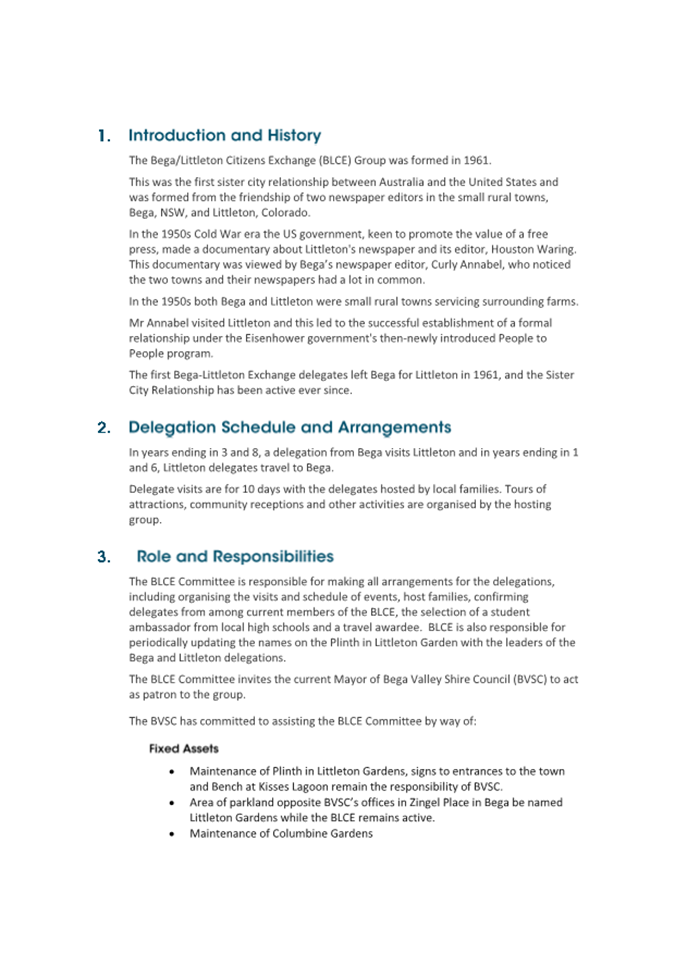
The BLCE group was formed in 1961 to establish the first
sister city relationship between Australia and the United States of America and
was formed from the friendship of two newspaper editors in the small rural
towns of Bega, NSW and Littleton, Colorado.
In the 1950s era the US government, keen to promote the
value of a free press, made a documentary about Littleton's newspaper and its
editor, Houston Waring. This documentary was viewed by Bega’s newspaper
editor, Curly Annabel, who noticed the two towns and their newspapers had a lot
in common. At that time, both Bega and Littleton were small rural towns
servicing surrounding farms.
Mr Annabel visited Littleton, and this led to the successful
establishment of a formal relationship under the Eisenhower government's
then-newly introduced People to People program. The first Bega-Littleton
Exchange delegates left Bega for Littleton in 1961, and the Sister City
Relationship has been active ever since.
In the years ending with 1 and 6, Littleton delegates travel
to Bega and visit for 10 days. In years ending with 3 and 8, Bega delegates
travel to Littleton for a 10-day visit.
Council has supported the BLCE group with civic ceremonies
during the periods when Littleton delegates have visited Bega. Due to budget
constraints, in recent years this support has focused on a formal presentation
to the elected Council and attendance from the Mayor and a senior Council
executive at a civic dinner arranged by the BLCE group. Council also provides a
gift for the Bega delegation to present to the City of Littleton on their
official visit.
A formal MOU has been in place between Council and the BLCE
group since March 2022, although Council actively supported the group for many
years before that.
Options
· Options available to Council are to:Delegate to
the Chief Executive Officer authority to enter into the MoU provided in
Attachment 1. This is the recommended option.
· Delegate
to the Chief Executive Officer authority
to enter into an MoU that varies from that described in Attachment 1. Council
would need to provide proposed alternative wording and further discussions with
BLCE group would be required.
· Not
enter into a formal MoU arrangement with BLCE group.
Community
and Stakeholder Engagement
Engagement undertaken
The development of the proposed MoU
has been undertaken in close consultation with the BLCE group and Council
staff.
Engagement planned
Should Council resolve to support the MOU, BVSC staff will
engage with the BLCE group to formally sign the MOU. It is proposed that the
signing ceremony be undertaken on a future Councillor workshop day.
Financial
and Resource Considerations
In the years ending with 1 and 6, Littleton delegates travel
to Bega and visit for 10 days. During this time, a civic reception and dinner
held in Bega will see Council cover the cost of Council representatives,
usually the Mayor and a senior Council executive, to attend.
The group has the opportunity to apply for grant funding to
assist the running of the event. During the event Council will arrange gifts or
certificates for the visiting delegates that will be presented at the civic
reception. Council also provides a gift for the Bega delegation to present to
the City of Littleton on their official visit, upon request.
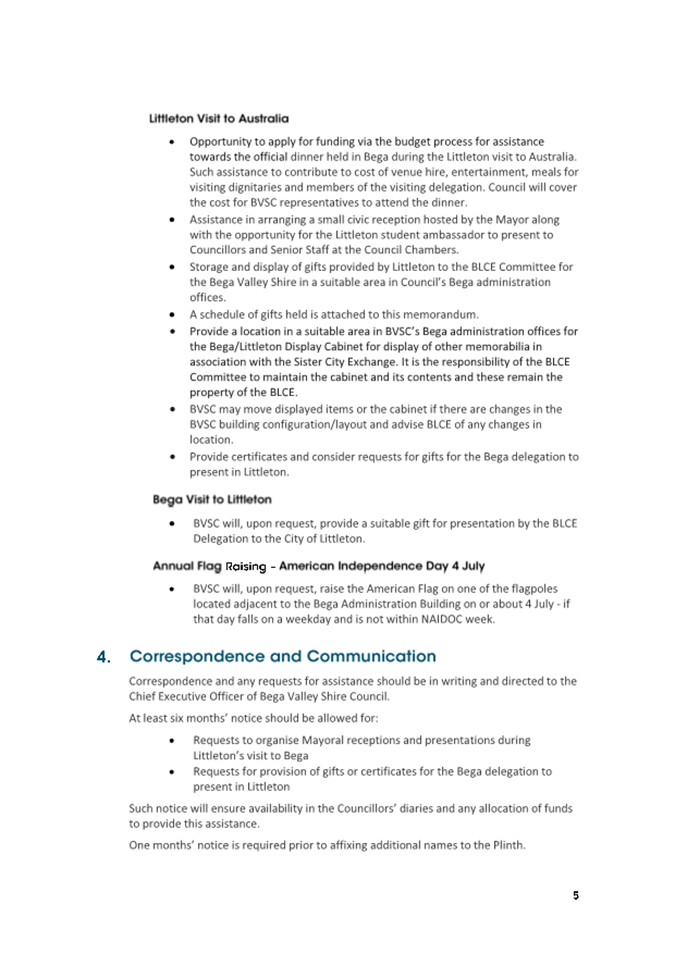
Council will, upon request, raise the American Flag on one
of the flagpoles located adjacent to the Bega Administration Building on or
about 4 July - if that day falls on a weekday and is not within NAIDOC week.
Maintenance of existing fixed assets is included in
Council’s annual budget.
Legal
/Policy
An MOU is not legally binding but sets out the intent of the
parties to work together to achieve a common goal or support a shared
aspiration. There are no direct legal or policy implications associated with
this proposal.
Impacts
on Strategic/Operational/Asset Management Plan/Risk
Strategic
Alignment
The proposal aligns with the
following goal in the Bega Valley Community Strategic Plan 2042 (2025
revision):
Theme
A: Our Community
A connected and vibrant community where people are happy, safe and well
Strategy A.1: Provide and support
opportunities for social interaction, arts and culture, activities and events
Strategy A.6: Support our
community to build connections and capacity to adapt to challenges
Environment
and Climate Change
There are no material environment
or climate change implications associated with the proposal.
Economic
There are no material economic
implications associated with the proposal.
Risk
Entering into an MOU with a
not-for-profit group such as the BLCE group is an activity that Council
periodically undertakes and does not introduce any additional organisational
risk.
Social
/ Cultural
The MOU is a positive way to foster
and recognise the contribution of the volunteers who have worked to maintain
the sister-city relationship over many years.
Attachments
1⇩. DRAFT
2025 - 2029 Memorandum of Understanding Bega Valley Shire Council and Bega
Littleton Exchange Group
|
Council
|
28 January 2026
|
|
Item 8.5
- Attachment 1
|
DRAFT 2025 - 2029 Memorandum of Understanding Bega Valley
Shire Council and Bega Littleton Exchange Group
|

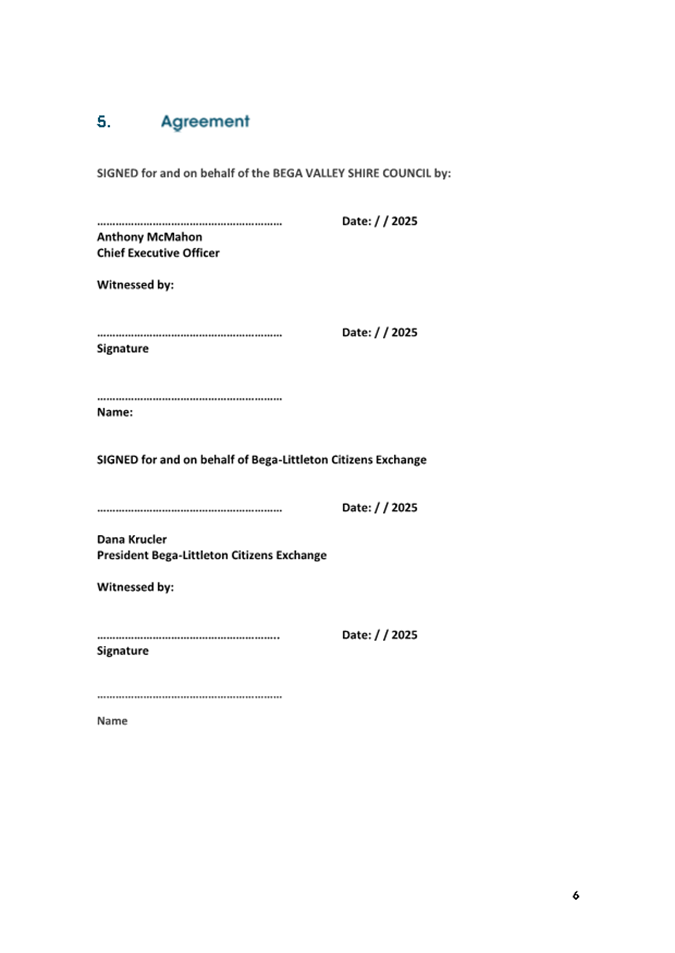
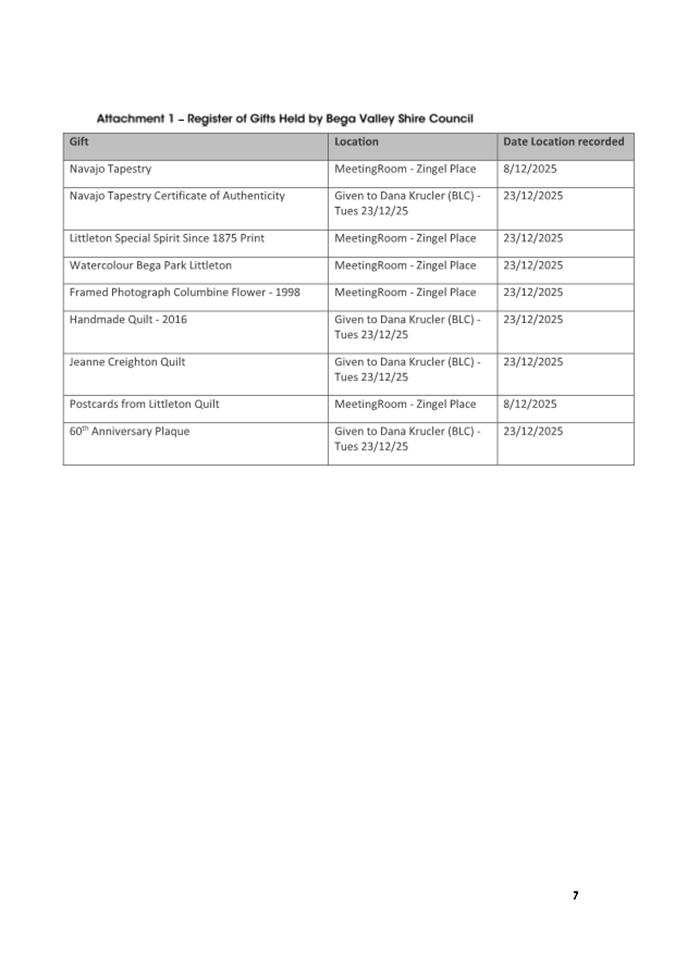

|
Council 28 January 2026
|
Item 8.6
|
8.6. Reporting of
minutes for committees with delegated authority and advisory committees
This report provides the adopted
minutes for the Affordable Housing Implementation Group for June and September
2025.
Director Community Environment and Planning
Officer’s
Recommendation
1. That Council note this report and the minutes for the Affordable
Housing Implementation Group for June and September 2025.
2. That Council
consider a review and update of the Affordable Housing Strategy actions as part
of its FY27 budget deliberations.
Executive Summary
This report provides the adopted
minutes for the Affordable Housing Implementation Group for June and September
2025.
It is important to note that additional items may have
progressed since the most recent meeting minutes were adopted.
At the most recent meeting on 15 December 2025, the AHIG
discussed the currency of the Bega Valley Affordable Housing Strategy noting it
was adopted in May 2022 and a number of substantial actions have been completed
(such as changes to the Bega Valley Local Environmental Plan 2013 to encourage
greater housing diversity), while others have not progressed as originally
intended (such as the actions relating to STRA for example) for a variety of
reasons including delays with state government reviews.
As such, the group strongly recommends a review and update
of the actions in the strategy by a suitably qualified consultant is required
to ensure staff and AHIG member time is focused on the most appropriate areas.
There is no current budget allocation available to undertake this work,
however, if Recommendation 2 is supported by Councillors, staff will seek
quotes to enable Councillors to consider this as part of the FY27 Delivery Plan
and budget.
Background
Committees of Council are established each term of Council
and disbanded at the end of each Council term. Committees were re-established
on 9 October 2024 following the 2024 local government election.
Committees of Council provide a mechanism for community
involvement in the provision of Council facilities or services. There are three
types of committee that may be established by a council: Committees of Council,
which are comprised entirely of Councillors; Section 355 Committees, which are
delegated under Section 355 of the Local Government Act 1993 to
undertake certain functions of Council and may include community
representatives, Councillors and/or members of Council staff; and Advisory
Committees, which may be made up of community representatives, Councillors
and/or members of Council staff, and provide advice to Council on relevant
matters.
Each committee has guidelines that detail its roles and
responsibilities, and where relevant, its delegated functions. All committees
are obliged to observe Council’s adopted Code of Meeting Practice.
The committees, through Council officers, must make their
agenda and minutes public, and report meeting minutes to Council periodically
once adopted by the relevant committee. Agendas and minutes are published on
Council’s website.
Relevant recommendations of Advisory Committees are reported
to Council meetings, through Council officers, for consideration.
Affordable Housing Implementation Group
Council adopted the Bega Valley
Shire Affordable Housing Strategy on 18 May 2022, which provides a framework to respond to housing needs in the Bega
Valley Shire to 2040.
An Affordable Housing
Implementation Group was subsequently established to help implement and monitor
progress of the strategy.
The meeting minutes from June and September are being
reported to Council concurrently as they were not able to be adopted by the
committee until the November meeting due to attendance numbers being below
quorum.
Options
Council could resolve to consider a review and update of the
Affordable Housing Strategy actions as part of its FY27 budget deliberations as
recommended. This will enable staff to seek quotes to understand the budget
implications of this, and enable Councillors to make a future decision in the
context of Council priorities for the next financial year.
Alternatively, Council could resolve not to further consider
a review of the actions. This would mean the actions and implementation plan
stays as is.
Community
and Stakeholder Engagement
Engagement undertaken
Nominations for Council committees are sought in line with
Council’s adopted Community Engagement Strategy and Community
Engagement Toolkit. Engagement with the committees to date includes formal
meetings and out of session correspondence to keep projects on track and ensure
progress of key actions.
Engagement planned
There are no further engagement requirements associated with
the recommendation of this report. Should any of the committees need to recruit
additional members to fill vacancies, these will be advertised in accordance
with the requirements of Council’s Community Engagement Strategy.
Meetings of each committee will continue to be held as per
the terms of reference.
If Recommendation 2 is supported, staff will seek quotes for
a review of the actions in the Affordable Housing Strategy in line with the
relevant procurement guidelines.
Financial
and Resource Considerations
Council officer time is required to
provide support to the committees as per committee guidelines which is part of
the annual activities of Council. A small budget is included in the Operational
Plan each year to cover room hire and other meeting costs. There are no
additional financial or resource considerations associated with the
recommendation of this report.
If Recommendation 2 is supported,
the costs of proceeding with a review and update of the actions in the
Affordable Housing Strategy will be considered by Councillors as part of FY27
Delivery Plan and budget processes.
Legal
/Policy
The Local Government Act 1993 provides for the
establishment of advisory committees to support Council decision-making.
Impacts
on Strategic/Operational/Asset Management Plan/Risk
Strategic
Alignment
Community representation on Council’s advisory
committees supports the following elements of the Bega Valley Community
Strategic Plan 2042:
6. Strong,
Consultative Leadership
6.11
We are an informed and engaged community with a
transparent, consultative and responsive Council
6.11.1
Improve communication about Council activities, decisions and
achievements
Environment
and Climate Change
There are no direct environmental or climate change
implications associated with the recommendation of this report.
Economic
There are no direct economic implications associated with
the recommendation of this report, however supporting the economic independence
of the LALCs, ensuring infrastructure, services and programs are accessible,
and maintaining and utilising our community assets such as halls, will have
broader economic benefits for the community.
Risk
The establishment and operation of committees of Council are
part of the regular business of Council. The recommendation of this report does
not introduce any new risks to Council.
Social
/ Cultural
Council committees seek to provide a mechanism for
interested community members to play an active role in advocating for change at
a local level. Committees of Council are an instrument for facilitating open
and transparent discussion about decisions made by Council and to contribute to
a more socially and culturally cohesive Bega Valley Shire.
Attachments
1⇩. Affordable
Housing Implementation Group meeting minutes 16 June 2025
2⇩. Affordable
Housing Implementation Group meeting minutes 8 September 2025
|
Council
|
28 January 2026
|
|
Item 8.6
- Attachment 1
|
Affordable Housing Implementation Group meeting minutes 16
June 2025
|
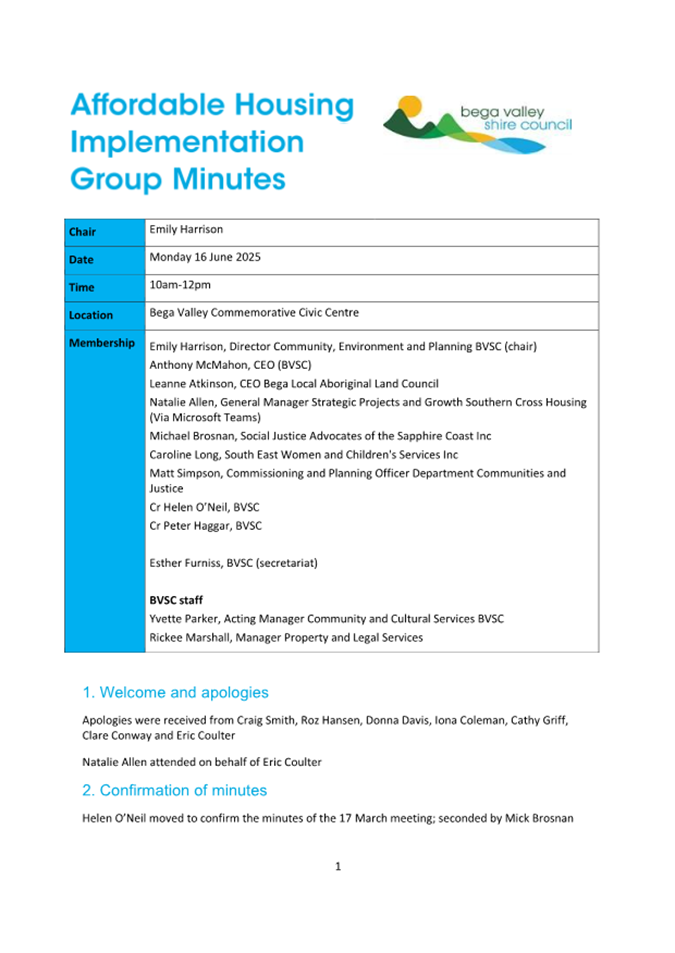

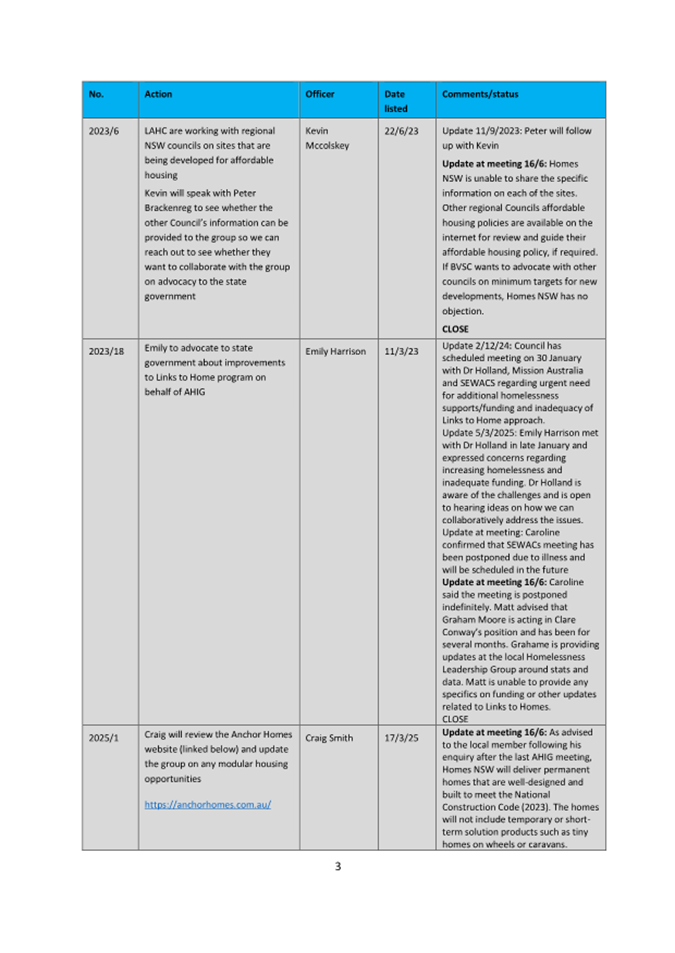
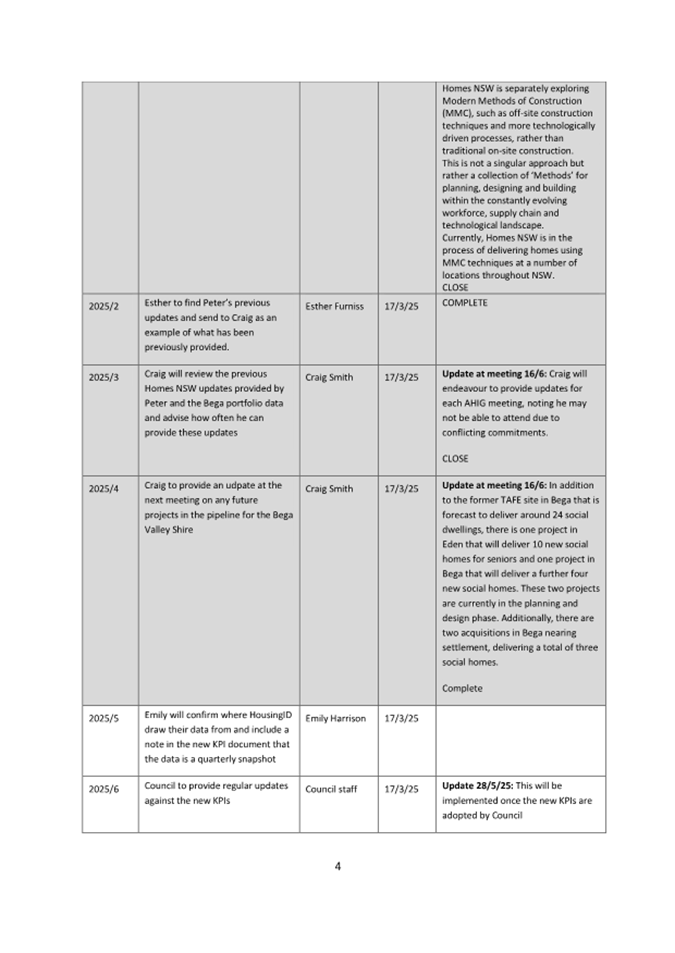
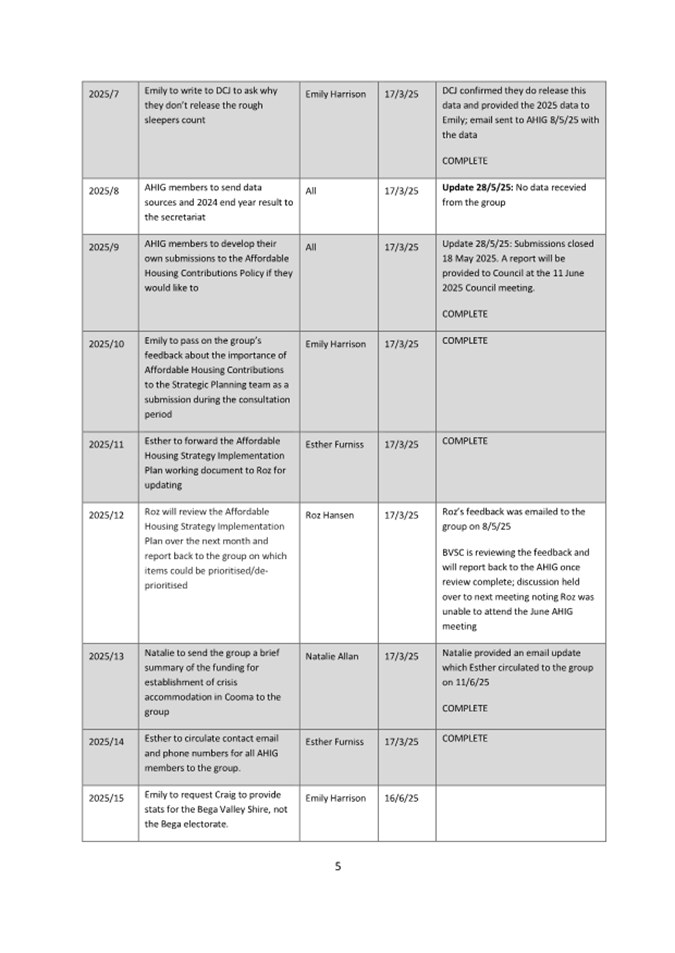
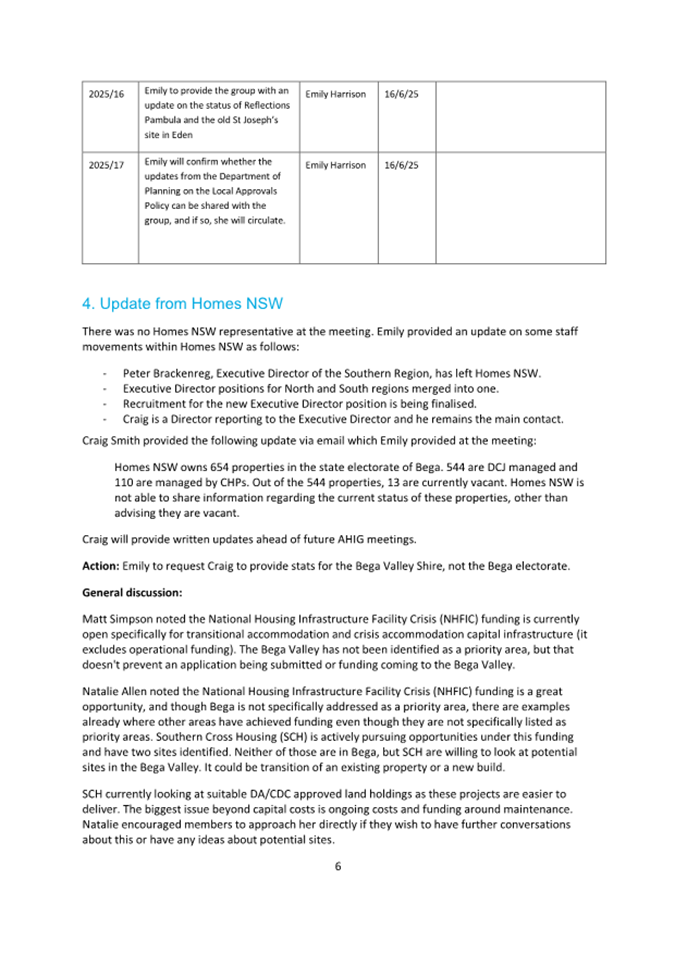
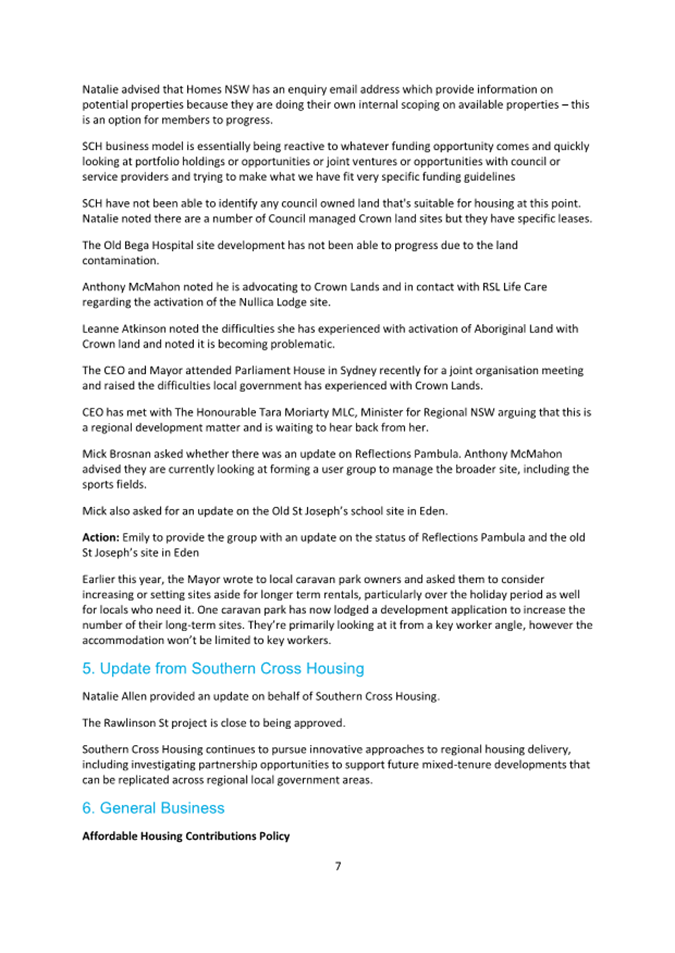
|
Council
|
28 January 2026
|
|
Item 8.6
- Attachment 2
|
Affordable Housing Implementation Group meeting minutes 8 September
2025
|
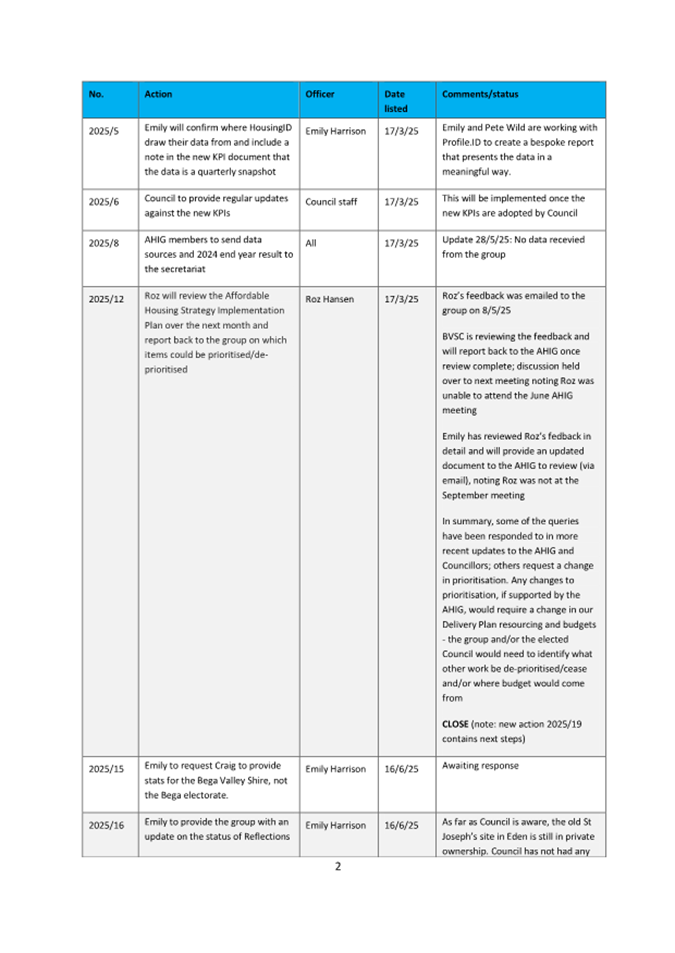
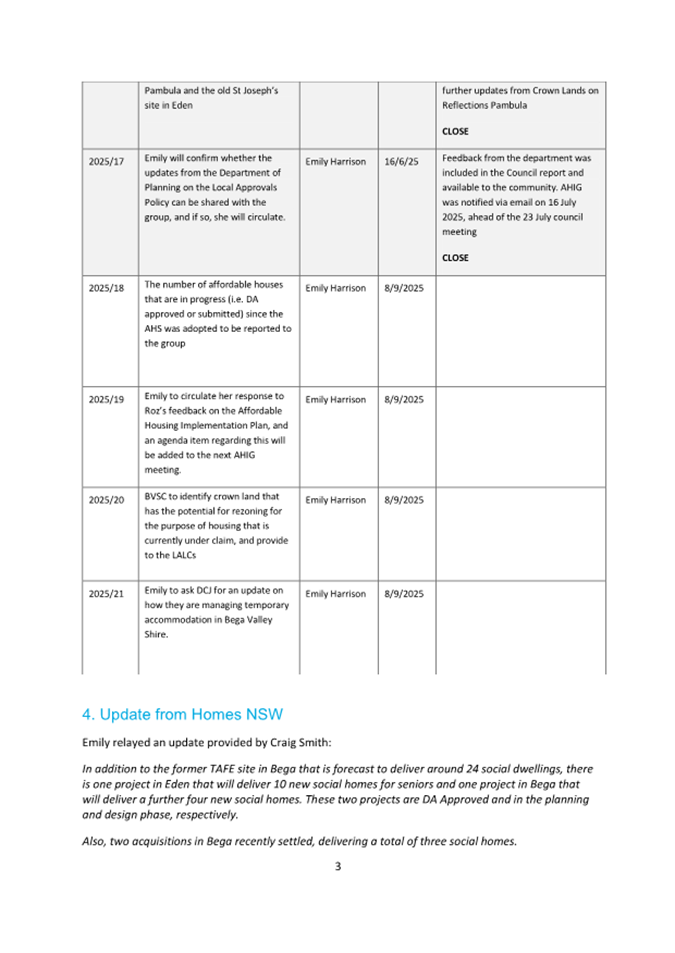
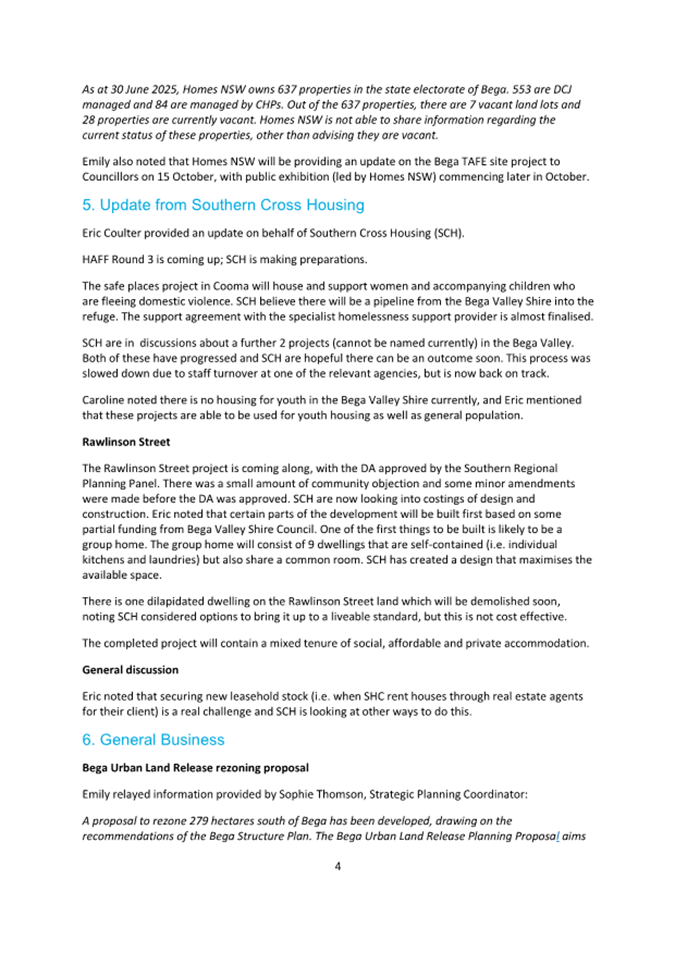
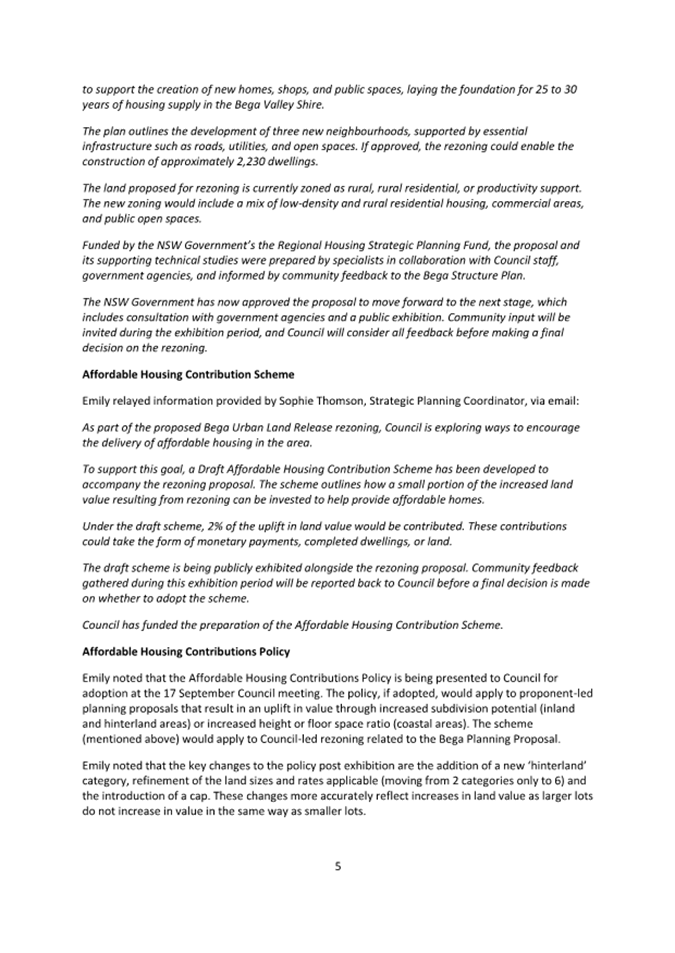
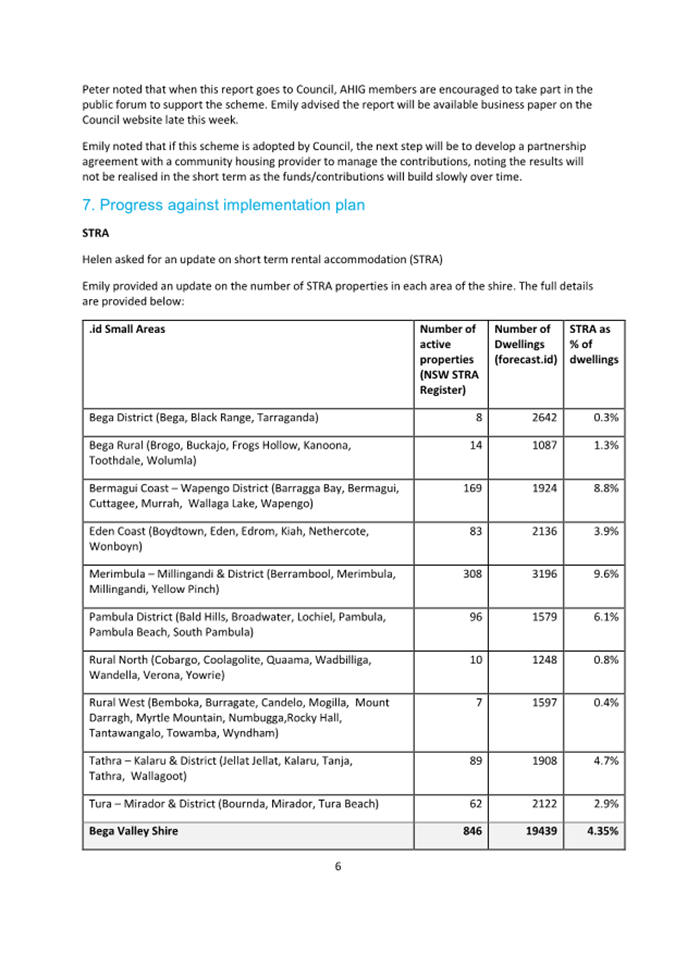
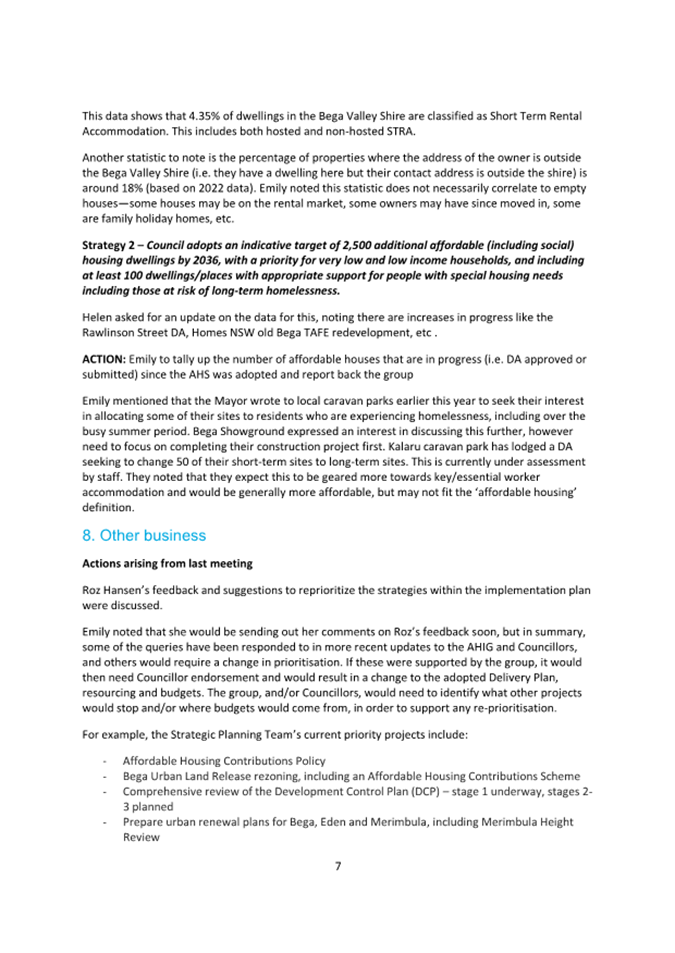
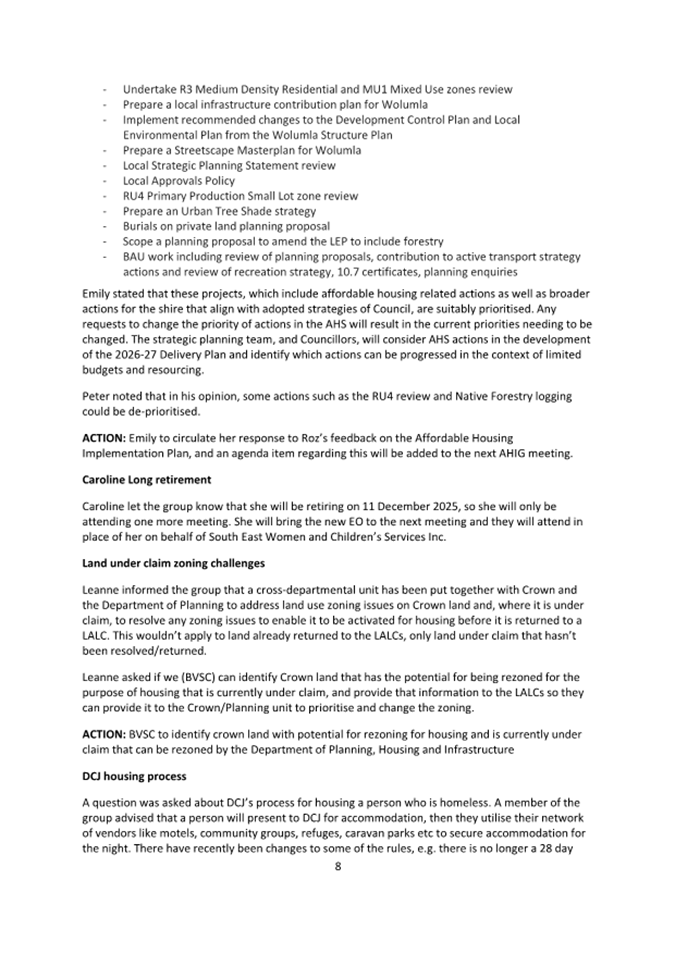
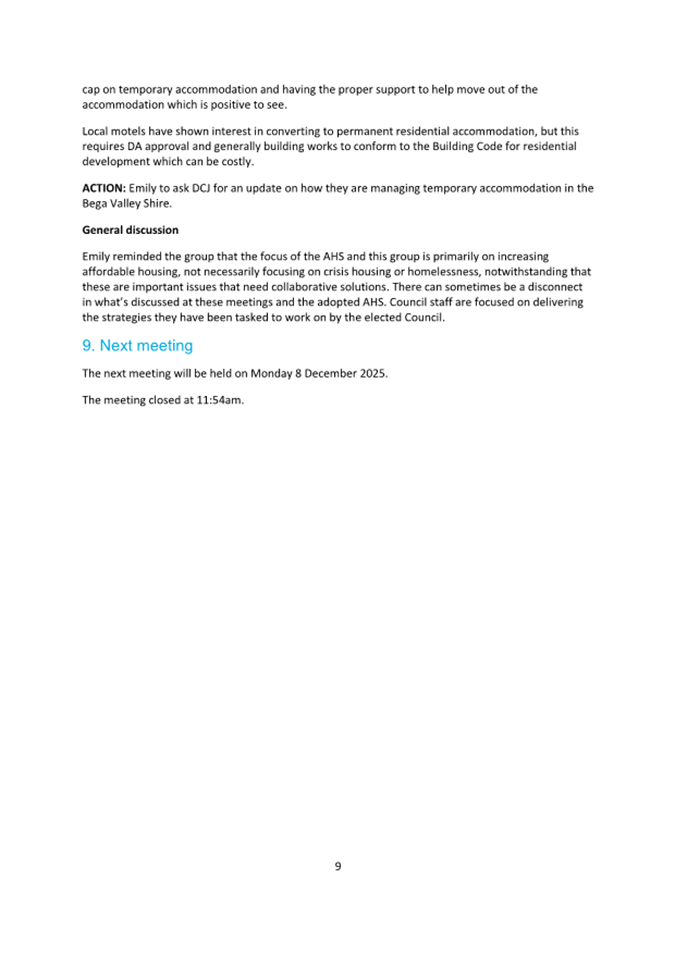
Staff Reports
– Infrastructure
28 January 2026
9.1 Request
for Tender (RFT) 2526-005 Merimbula CBD traffic trials.................... 139
9.2 Draft
Wolumla Floodplain Risk Management Study and Plan findings............ 146
9.3 Bega
Valley Local Transport Forum 2 December 2025..................................... 361
|
Council 28 January 2026
|
Item 9.1
|
9.1. Request for
Tender (RFT) 2526-005 Merimbula CBD traffic trials
This report outlines the results of
the evaluation of Request for Tender (RFT) 2526-005 Merimbula CBD traffic
trials - supply and installation of temporary road infrastructure; and
recommends a preferred contractor be engaged.
Director Infrastructure
Officer’s
Recommendation
1. That
Council accepts the recommendation as outlined in the attached confidential
memo.
2. That
Council accepts the tender from <XXX> in relation to contract for the
works described in RFT 2526-005 Merimbula CBD traffic trials, in the amount of
<XXX> (including GST), subject to variations, provisional sums and prime
cost items.
3. That
authority be delegated to the Chief Executive Officer to execute all necessary
documentation and approve contract variations up to the available allocated
budget.
4. That
all tenderers be advised of Council’s decision.
Executive Summary
The Merimbula CBD Upgrade project comprises three key
elements.
Element 1
The first element includes extensive traffic calming
measures to implement traffic flow change recommendations from the Merimbula
Transport Study Recommendations Report and elements from the Merimbula
Transport Study-CBD Landscape Masterplan Assessment.
The traffic calming measures will include the installation
of mini roundabouts, signage upgrades, barrier-defined kerb extensions and
reconfigured parking.
The implementation of the traffic calming measures aims to
improve safety, accessibility and public amenity in the town centre by
reconfiguring traffic flow, enhancing pedestrian crossings, reclaiming sections
of the road network for community use and activating key civic spaces as
per the Merimbula Transport Study recommendations.
This report is focussed on the procurement of works
associated with Element 1 of the Merimbula CBD Upgrade project.
Element 2
The second element will be physical upgrades to Hylands
Corner which will include installation of the following: (as outlined in a
report to Council at the October 2025 Council meeting)
§ Structural foundation for Christmas
tree Installation
§ Timber stage platform like the
structures surrounding Monaro & Market Street intersection
§ Roof cover of part of the timber
stage platform
§ Bollards to the side of the
driveway that goes through Hyland’s Corner.
§ Removal of the existing furniture
and installation of new furniture.
§ Pavement interaction play space to
the central open space area
§ Installation of a digital sign will
be progressed by the Merimbula Chamber of Commerce.
Element 3
The third element will be the detailed design of a Merimbula
CBD Upgrade Master Plan. This plan will be informed by existing studies, plans
and previous consultation outcomes along with stakeholder and technical
(engineering, traffic surveillance) feedback received during the implementation
of Element 1.
Background
Previous
decisions of Council
At the Bega Valley Shire Council meeting on Wednesday 15
November 2023 Council staff recommended:
1. That
Council resolve to adopt the Merimbula Transport Study as exhibited with a
change in preference for the one-way traffic loop in the Merimbula CBD from
option 2 to option 1.
2. That
Council do not pursue paid parking or smart parking sensors.
3. That
deletion of the proposed additional one-way configuration in Fish Pen.
4. That
Council leave traffic in Merimbula Drive as two-way.
5. That
Alice Street remain two way, or one-way south bound.
6. That
council refine the study plans as needed from time to time.
7. That
following endorsement, the final Merimbula Transport Study Context and
Recommendations Reports are published on Council’s website, and that
those who made a submission during exhibition of documents are advised of
Council’s decision on this matter
Tender process
The RFT 2526-005 for Merimbula CBD traffic trials - supply
and installation of temporary road infrastructure was released to open market
on Monday 10 November 2025 at 10:30am.
At tender close on Wednesday 10 December 2025 at 12pm, 1
submission was received.
The tender evaluation panel assessed this submission against
the criteria in the tender evaluation plan, in line with clauses 176 to 178 of
the Local Government (General) Regulation 2021 and council’s procurement
policies.
Information provided by tenderer within their tender submission,
in particular price information, is ‘commercial in confidence’.
Accordingly, this information and the details of the tender evaluation are
provided in a confidential memorandum, not the public report to council.
Options
1. Council
endorses the findings of the tender evaluation panel and enter a contract with
the preferred Tenderer. This is the recommended option.
2. Council
does not endorse the findings of the tender evaluation panel and Council is
required to retender; this will impact the project delivery time and
potentially the project budget due to escalation. This is not the preferred
option.
Community
and Stakeholder Engagement
Engagement undertaken
Informing Engagement
There has been significant community and stakeholder engagement
undertaken to date to develop a Merimbula Landscape Masterplan, a Transport
Study and a Chamber of Commerce led CBD Town Planning Report that have all
helped to inform the Merimbula CBD Upgrade project.
SPIIRE CBD Landscape Masterplan
A variety of avenues were used to inform the local
community of the draft Landscape Master Plans, the request for community
feedback on the drafts and the opportunities for community members to have
their say and discuss ideas with the project team. These included.
• Update of the project website with
current project information
• Media releases: details of which were
published on Bega Valley Shire website, Bega District News, Merimbula News,
Eden Magnet, and other media outlets.
• Town specific project bulletins which
were distributed amongst traders in each town.
• Local radio and newspaper interviews
with project team
• Launch of community survey
• Listening posts held in each town
Project website:
SPIIRE undertook to create and manage a project website to
provide a 24/7 window of opportunity for any stakeholder to find out about the
project, ask questions, register their details and participate in the project.
Project bulletins:
Town specific project bulletins were distributed amongst
traders and in key locations in each town promoting the draft Landscape Master
Plans and listening posts to be held in each town,
and the opportunities for the community to be involved and discuss, debate and
provide feedback regarding the draft Master Plans.
• Listening posts
• Telephone discussions
• Submissions
• Community survey
Merimbula Transport Study
Four stakeholder and community
workshops were held during the development of the study which included
· Workshop 1 – Transport for NSW (TfNSW) stakeholders
(31 May 2022)
· Workshop 2 – Bega Valley Shire Council stakeholders
(2 June 2022)
· Workshop 3 – Merimbula Chamber of Commerce (16 June
2022)
· Workshop 4 – Community members and Access and
Inclusion Committee (21 June 2022).
Workshop outcomes are outlined in the
following sections and incorporated into the findings of the Context report.
The draft study was informed by
stakeholder engagement across a variety of platforms including a community
consultation web portal, a Council web portal, public exhibition, and
stakeholder and community workshops. Stakeholder groups involved included community
members, local transport operators, TfNSW, the Merimbula Chamber of Commerce,
Council staff and Councillors. Engagement opportunities were promoted through
media releases, web content, formal public exhibition, social media and signage
in Merimbula.
Formal public exhibition of the draft
study occurred for a period of six weeks from 26 May to 9 July 2023. Notices
were placed in Council’s Bega Valley Together newsletter, Council’s
website and on Council’s social media channels. A media release was also
issued.
During the public exhibition period
feedback on the draft study was received via email, letter or online via the
‘Have your Say’ section of Council’s website and an online
survey. A total of 136 responses were received through the ‘Have your
say’ portal, 5 letters and emails were received from individual
respondents, and a response was received from TfNSW.
An ordinary Councillor meeting was
held on 15 November 2023 whereby Council resolved to adopt the Merimbula
Transport Study.
Merimbula Chamber of Commerce town summit
The need for a Merimbula CBD focused
planning workshop arose from the Merimbula town summit held in February 2021.
The town summit produced a 10-point action plan whereby the CBD revitalisation
and foreshore activation and integration with the town centre were identified
as main priorities with the completion of a CBD Masterplan being a critical
action to achieve these goals.
The Merimbula CBD planning workshop
was held on 21 July 2022 and was attended by approximately 15 key stakeholders
from the following organisations:
· Merimbula Chamber of Commerce –
committee and members
· Bega Valley Shire Council –
Councillors and key staff
· Merimbula Tourism
· Merimbula residents
· Representatives from the Access and
Inclusion Committee
· NGH Consulting (facilitator)
· Hansen Partnership (urban planning
adviser and co facilitator)
The workshop objectives were to:
· Build on previous work and to agree
on our aspirations and objectives for the Merimbula CBD
· Identify the top 3 priority projects
that can be activated with existing funding and resources.
· Identify the priority projects that
can be activated with additional funding and resources and seek appropriate
funding.
· Contribute to a visual outline of
priority projects that can inform funding requests and future works.
Merimbula Chamber of Commerce
– CBD Town Planning Report
The need for a Merimbula CBD
focused planning workshop emanated from the Merimbula Town Summit held in
February 2021.The workshop was held on the 21 July 2022 and was attended by
approximately 15 key stakeholders from the following organisations:
· Merimbula Chamber of Commerce –
Committee and Members
· Bega Valley Shire Council –
Councillors and Key Staff
· Merimbula Tourism
· Merimbula residents
· Representatives from the Access and
Inclusion Committee
· NGH (Facilitator)
· Hansen Partnership (urban planning
adviser and co facilitator)
The workshop clearly identified the
following top 3 priority projects that can be activated with in the short,
medium and long-term pending additional funding and resources.
1. Hylands Corner
upgrade
2. Market Street
upgrade
3. Beach Street
upgrade
Merimbula CBD Upgrade project engagement
Internal engagement and project planning with key
stakeholders has been the focus of this project to date.
Concept proposals for the Element 1 traffic calming
measures were presented at the Bega Valley Shire Local Transport Forum (LTF) in
October 2025. The LTF includes representatives from TfNSW, the local State
Member of Parliament, NSW Police, Bega Valley Shire Councillors and staff.
Engagement planned
An extensive communications and engagement plan for the
Merimbula CBD Upgrade project has been developed. The engagement planned with the community will be aligned
with Council’s Community Engagement Strategy. The communications and engagement plan identifies proposed
engagement methods and techniques.
Financial
and Resource Considerations
Project funding has been
secured through the following source:
Department of Infrastructure, Transport, Regional
Development, Communications and the Arts
|
Program
|
Investing in Our Communities Program
|
|
Project ID Number
|
IiOC0365
|
|
Grantee
|
Bega Valley Shire Council
|
|
Project
|
Merimbula CBD Upgrade
|
|
Total AG funding
|
$2,800,000 (GST exclusive)
|
|
Item
|
$ Excl GST
|
|
Expenditure
Detail
|
|
|
RFT 2526-005 Implementation Contract
|
See confidential memo
|
|
Total
Expenditure
|
See confidential memo
|
|
Source
of Funds
|
|
|
Investing in Our Communities, (IiOC)
|
See confidential memo
|
|
Total income available
|
See confidential memo
|
|
Total
Project Capital Cost
|
See confidential memo
|
|
Total
Available Construction Funding
|
See confidential memo
|
|
Project
Funding Shortfall
|
= total expense – total income
|
Legal
/Policy
The tender process conducted for RFT 2526-005 was undertaken
in accordance with Section 55 of the Local Government Act 1993, part 7
of the Local Government (General) Regulation 2021 and Section 171 of the Local
Government Regulations.
An Environmental Consultant was engaged by Council to
investigate and provide a Review of Environmental Factors (REF) report for the
purpose of assessing the potential environmental impacts associated with the
Merimbula CBD Upgrade works. This report was completed in September 2025 and
then submitted to the BVSC Town Planning team for determination. In November
2025 the BVSC Town Planning confirmed that the REF scope of works satisfies the
provisions under Clause 2.73 (3)(a) of State Environmental Planning Policy
(Transport and Infrastructure) 2021 and is permitted without consent and as
such, constitute an activity as defined by Part 5 of the Environmental
Planning and Assessment Act 1979 (EP&A Act 1979).
Impacts
on Strategic/Operational/Asset Management Plan/Risk
Strategic
Alignment
At a state level this project
aligns with the priorities and pillars from the NSW Future Transport Strategy 2056
The project also aligns with the
following goals of the Bega Valley Community Strategic Plan 2042:
• We are a vibrant, respectful,
inclusive and connected community that enjoys a culturally rich community life.
• Our transport networks support our
community to work, learn and socialise.
• Our community has access to good
quality open space, recreation and sporting facilities that support health and
wellbeing.
This project directly supports
implementation of Council’s adopted Local Strategic Planning Statement
in relation to the priorities and future directions for transport, town
centres and open space, as well as addressing the desired future character
statement and vision for Merimbula.
Environment
and Climate Change
Implementation of the traffic changes
will ideally lead to reduced vehicle volumes in the CBD area, particularly in
the CDB environment, and as a result, create a vibrant healthier seaside town.
The pedestrianisation and activation of the CBD encourages more physical
movement and active transport use reducing emissions and improving air quality.
Pedestrian zones allow for more green spaces, trees, and permeable surfaces,
reducing the urban heat island effect.
Economic
Awarding this contract will be step
forward to revitalising the Merimbula CBD which is predicted to benefit the
town’s economy. Pedestrian-friendly areas encourage people to linger,
shop, and dine locally. Walkable, attractive streetscapes appeal to tourists
seeking leisure and coastal charm which helps to bolster tourism growth. With
improved amenity in a CBD area, properties often see higher demand and
increased values with developers and investors favouring vibrant and accessible
CBDs.
Risk
Accepting the recommended tenderer as recommended in this
report mitigates project risks, including delays and funding loss. It ensures
the project can commence on schedule, supports compliance with funding
milestones, and enables timely project delivery.
Social
/ Cultural
The intention is that the traffic
improvements identified in the Merimbula Transport Study, that are being
implemented through this project, will benefit all locals and visitors and
improve the amenity of the Merimbula CBD area. This project will help to shift
focus towards active transport modes and social and cultural place making.
These are central elements of the NSW Government’s Movement and Place Framework
which will be key inputs into the shire wide Active Transport Strategy
currently under development. The mode share shift from vehicular to
active transport modes helps to realise the vision within the Local Strategic
Planning Statement for Merimbula.
Attachments
1. Confidential
Memo RFT 2526-005- Merimbula CBD traffic trials (Confidential - As
this attachment contains commercial information of a confidential nature that
would, if disclosed (i) prejudice the commercial position of the person who
supplied it; or (ii) confer a commercial advantage on a competitor of the
Council; or (iii) reveal a trade secret as per Section 10A(2)(d) of the Local
Government Act 1993.
Although the above relates more explicitly to the discussion
of closed business, it also forms part of the basis of justification as to why
information relied upon in informing the public decisions made by Council are
kept confidential. To consider this confidential material in open Council would
be, on balance, contrary to the public interest (as defined in Section 14 of
Government Information Public Access (GIPA) Act 2009) as it would
potentially disclose private business information provided by tenderers in a
confidential tender process and would also impact Council’s position in
relation to its consideration, therefore impacting the tender process. This
meets the requirements of Sect 10 D of the Local Government Act 1993
if Council were to close the meeting to discuss the details of individual
tenderers.
|
Council 28 January 2026
|
Item 9.2
|
9.2. Draft Wolumla
Floodplain Risk Management Study and Plan findings
The draft Wolumla Floodplain Risk
Management Study and Plan findings are now ready for public exhibition.
Director Infrastructure
Officer’s
Recommendation
1. That the draft Wolumla
Floodplain Risk Management Study and Plan findings be exhibited for a period of
not less than 28 days.
2. That a further
report be presented to Council for final endorsement of the Wolumla Floodplain
Risk Management Study and Plan considering any submissions received.
Executive Summary
The draft Wolumla Floodplain Risk
Management Study (FRMS) and Plan (FRMP) findings are now available for public
exhibition and comment.
Once finalised and endorsed, the
Floodplain Risk Management Study and Plan will form the technical basis and
strategic list of actions for mitigation of floodplain risk within the Wolumla
Creek catchment to eliminate ad-hoc decision making.
Background
Council has adopted an
Affordable Housing Strategy, Residential Land Strategy and Wolumla Structure
Plan which outline future directions for residential development within the
Wolumla catchment. Council has created capacity for approximately 1,000 new
dwellings to be constructed on greenfield sites bordering the existing village.
Council also has some critical
infrastructure such as 2 Regional Roads and its Central Waste Facility within
the catchment where flood impacts are required to be quantified for future
strategic asset planning.
A detailed study of potential
impacts of flooding and drainage is required to facilitate residential
development in the area and ensure that future residents and public assets are
protected from hazards.
The road network within the
catchment has also been impacted by flood and storm events occasioning loss of
access. Inundation information is required to support future emergency
response planning within the catchment.
With the assistance of a grant
from the NSW Floodplain Management grant program, Bega Valley Shire Council
engaged consultants, Rhelm, to undertake a flood study, a floodplain risk
management study (FRMS) and floodplain risk management plan (FRMP) for the
Wolumla Creek catchment.
The Wolumla Flood Study endorsed
23 July 2025 formed the initial phase of flood risk assessment to inform the
subsequent development of the draft floodplain risk management study and plan
for the Wolumla Creek catchment.
A FRMP is the formalisation of management measures
identified to address the flood risks identified at the Flood Study stage of
the process. A FRMS identifies options to address those risks that form the
basis for the considerations and decisions in the FRMP. The FRMS and FRMP
are based on a comprehensive and detailed evaluation of all factors that
affect, and are affected by, the use of flood prone land. It represents
the considered opinion of expert consultants, NSW Government floodplain management
officers, Council and the local community on how to best manage flood risk and
flood-prone land within the relevant catchment area. It also provides a
long-term path for the future development of land.
The draft Wolumla FRMS
identified the prima facie options available to manage floodplain risk within
the Wolumla Creek catchment. The draft Wolumla FRMP has incorporated the
best and most feasible actions following evaluation from the FRMS to address
floodplain risk within the catchment.
The completion of a FRMS and FRMP form the penultimate stage
towards implementation of a comprehensive floodplain risk management process
for the catchment, in accordance with the NSW Floodplain Risk Management
Manual, 2023.
Options
The options available to Council
are:
1. To publicly exhibit the draft
Wolumla Floodplain Risk Management Study and Plan findings.
This is the preferred option, aligns with Council’s Community Engagement
Strategy and will assist to validate findings for the endorsement of the
Floodplain Risk Management Study and Plan.
2. To not exhibit the draft Wolumla
Floodplain Risk Management Study and Plan findings.
This is not the preferred option as it minimises community input, validation
and ownership of the draft findings.
3. To develop
other options as Council deems suitable for the current project stage.
Community
and Stakeholder Engagement
Internal and external stakeholder engagement has occurred in
the development of the draft Wolumla Floodplain Risk Management Study and Plan
findings in accordance with the IAP2 Participation spectrum and Council’s
Engagement Strategy. Similarly, stakeholder engagement was completed
during the previous Flood Study phase.
Engagement undertaken
An internal technical working group comprising staff from
Assets and Technical Services and Planning and Sustainability provided input
into the consultant technical brief. During the initial Wolumla Flood
Study public exhibition period, an attempt was made to secure a community
representative from within the catchment to support the project without
success. Despite a resident indicating an interest during the community
survey, they declined to submit a formal application upon receiving the relevant
information package.
Staff from Department of Climate Change, Energy and
Environment and Water (DCCEEW) as the funding partner representative, also
provided technical input to the consultant brief as part of the relevant
funding deed requirements and participated in the technical working group
meetings.
The initial community engagement and data gathering for the
flood study phase occurred 17 May to 2 June 2024 using an online community
survey hosted on Council’s website Have Your Say page. A dedicated
project webpage was developed and the community engagement period promoted with
media releases and social media. Door knocking was also conducted 29 May
2024 to gather additional responses during the initial community engagement
period. The flood study was formally exhibited 18 April to 18 May 2025
and finally endorsed 23 July 2025 by Council.
A project overview was also given at the Flood and Coastal
Committee meetings held on 25 March 2025 and 20 November 2025.
Engagement planned
Consultation via formal public exhibition and the invitation
of public comment is the subject of this report. Community consultation
regarding FRMS and FRMP outcomes and findings are a requirement of the NSW
Government’s Flood Prone Land Policy and its Floodplain Risk Management
Manual.A further report will be presented to Council regarding the finalised
Floodplain Risk Management Study and Plan after consideration of any
submissions at the close of the public exhibition period for final endorsement.
Financial
and Resource Considerations
The project has been partly funded at a ratio of 2:1
(State/Council) under the NSW Government Floodplain Risk Management Program to
a maximum grant amount of $120,000 excluding GST as managed by the Department
of Climate Change, Energy, the Environment and Water (DCCEEW).
|
Item
|
$ Excl GST
|
|
Expenditure
Detail
|
|
|
Wolumla Flood Study and Floodplain Risk Management Plan
|
$184,690
|
|
Total Expenditure
|
$184,690
|
|
Source of Funds
|
|
|
Drainage General Fund
|
$64,690
|
|
NSW Floodplain Management Program
|
$120,000
|
|
Total income available
|
$184,690
|
|
Project
Funding Shortfall
|
$0
|
Legal
/Policy
The project is being undertaken in accordance with the
requirements of the NSW Floodplain Risk Management Manual 2023.
The manual was gazetted in June 2023 as the manual relating
to the development of flood-liable land for the purposes of section 733 of
the Local Government Act 1993. It replaced the former Floodplain
development manual (2005).
In accordance with Section 733 of the Local Government
Act 1993, floodplain risk management in urban and rural areas in NSW is
governed by the NSW Government’s Flood Prone Land Policy and its
Floodplain Development Manual.
Locally, NSW Government policy relating to land use is
implemented through Council’s adopted Bega Valley Local Environmental
Plan 2013 and the Bega Valley Development Control Plan 2013.
Part of the typical outcomes of a FRMS and FRMP are a review
of structural and non-structural flood mitigation options. Some of the
typical non-structural options arising from a FRMS and a FRMP include review of
flood related planning controls, flood prone land policies and flood related
development controls. The final mix of structural and non-structural
options are developed with the assistance of community consultation at these
subsequent stages. These outputs are then incorporated into
Council’s planning Instruments, where necessary.
Council issues planning certificates under Section 10.7 of
the Environmental Planning and Assessment Act 1979 to inform potential
purchasers of planning controls and policies that apply to the subject land.
The properties affected by flood hazards within the Wolumla Creek
catchment were identified as part of the Flood Study to allow changes to
planning certificates to be made.
There are several properties that do not currently have
these flood related planning and development controls. This may occur
because they are not flood prone, according to the definitions of the NSW
Government’s Flood Prone Land Policy, or no detailed flood mapping has
been undertaken in those areas. Some of these properties may have flood
related planning and development controls applied after the adoption of the
FRMS and FRMP.
Council also has obligations according to the terms and
conditions of the grant funding agreement with DCCEEW that include the
mandatory use of external consultants, co-publicity, whole-of-government access
to the final products and a current handover date of 31 March 2026 for the
project deliverables.
S733 of the NSW Local Government Act 1993 affords
councils exemption from liability where councils act in good faith and
substantially in accordance with the principles contained in the relevant
manual.
Impacts
on Strategic/Operational/Asset Management Plan/Risk
Strategic
Alignment
Completion of the Wolumla Flood Study and Floodplain Risk
Management Plan delivers the following action from Council’s adopted
Delivery Program 2022-25 - D.1.2.1 Continue Wolumla Flood Study and
Floodplain Risk Management Plan.
The completed FRMS and FRMP will form the key technical and
policy basis for decision making and implementation of the adopted FRMP. The
completed FRMS and FRMP will allow Council to identify and manage the existing,
continuing and future flood risk, hydraulic and hazard categories within the
Wolumla Creek catchment. The FRMS quantifies options to manage the identified
flood risks within the floodplain in a considered and strategic fashion.
Strategic responses for land-use planning, asset planning, emergency response
planning, environmental, social and economic impact management can then be
formulated to address existing and future flood risk and incorporated into
relevant key strategic documents. Once adopted, the FRMS and FRMP will
provide relevant information for consideration in revising Council’s
planning instruments, asset management plans, emergency management plans and
Long-Term Financial Plan.
An adopted FRMS and FRMP also allow Council further access
to funding for implementation of certain actions identified within the FRMP
through the NSW Government Floodplain Management Program upon successful grant
application. These grants are typically offered at a ratio of 2:1 NSW
Government to Council funding.
Environment
and Climate Change
The effect of climate change was considered in the
development of the technical brief and draft flood study findings in accordance
with the relevant technical requirements as defined by DCCEEW. Sea level
rise was not considered since the Wolumla catchment is so far upstream from the
ocean boundary for no sea level rise impact to occur as determined during the
2014 Bega and Brogo Rivers Flood Study and subsequent 2018 Bega and Brogo
Rivers Floodplain Risk Management Study and Plan projects.
Economic
There are minor positive economic benefits from the
completion of the recent Flood Study and current Floodplain Risk Management
Study and Plan projects through the consumption of local goods and services
during community engagement and public exhibition periods associated with
travel, accommodation and venue hire.
The co-ordinated suite of actions and intelligence gained
from the Flood Study, FRMS and FRMP projects are aimed at managing and
mitigating flood risk where possible to reduce the economic impact on the
community.
Risk
The adopted FRMS and FRMP and the implementation of the
identified actions will allow Council and the community to manage its existing,
continuing and future flood risk.
The Wolumla Floodplain Risk Management Study and Plan will
allow Council to identify a co-ordinated set of measures to manage flood risk
within the catchment. The development and implementation of a Floodplain
Risk Management Plan eliminates ad-hoc decision making that may magnify
residual flood risk within the catchment.
A lack of community engagement on the draft Floodplain Risk
Management Study and Plan findings may lead to sub-optimal outcomes for the
project and community of interest.
Placing the draft FRMS and FRMP on exhibition for public
comment is consistent with Council’s adopted Community Engagement
Strategy and is a requirement of the floodplain risk management process.
This consultation process ensures that the outcomes incorporate the views of
the community. Any submissions made during the public exhibition period
will be considered in the finalisation of the FRMS and FRMP.
Council has existing commitments according to the terms and
conditions of the grant funding agreement with DCCEEW. Delays in
finalisation of the FRMS an FRMP may lead a breach of the agreement that could
jeopardise the success of future floodplain risk management grant applications.
Social
/ Cultural
Floodplains are the commercial, social and environmental
arteries of NSW. Transport and communication infrastructure are often
located in floodplains which, as generally the more fertile areas, are a base
for a significant proportion of NSW agricultural activity and home to a large
proportion of the NSW population. Regular flooding enhances agricultural
productivity by increasing soil moisture, recharging groundwater and depositing
fertile silt across the floodplain. However, flooding can also interfere
with production, communication, transport, emergency management and
agricultural practices, as well as affecting property and potentially leading
to loss of life. Therefore, development and management of floodplains needs to
consider a broad range of issues, including balancing the benefits of occupying
the floodplain against the costs.
The findings, recommendations and implementation of the
adopted FRMP will form the technical and policy basis for the management of
social, cultural and economic impacts.
The suite of measures identified
during the FRMS and FRMP project will minimise the financial and social
disruption to the local community as a result of significant flood/storm events
as the risk management actions are implemented.
Attachments
1⇩. Draft
Wolumla Floodplain Risk Management Plan for public exhibition
2⇩. Draft
Wolumla Floodplain Risk Management Study for public exhibition
3⇩. Draft
Wolumla Floodplain Risk Management Study and Plan Map Compendium for public
exhibition
|
Council
|
28 January 2026
|
|
Item 9.2
- Attachment 1
|
Draft Wolumla Floodplain Risk Management Plan for public
exhibition
|
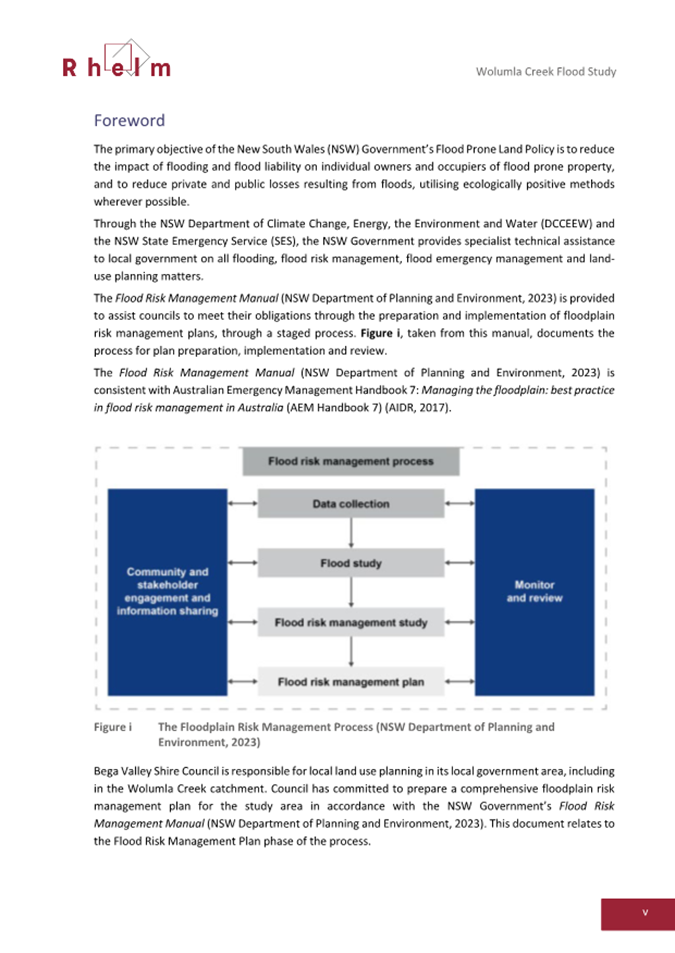
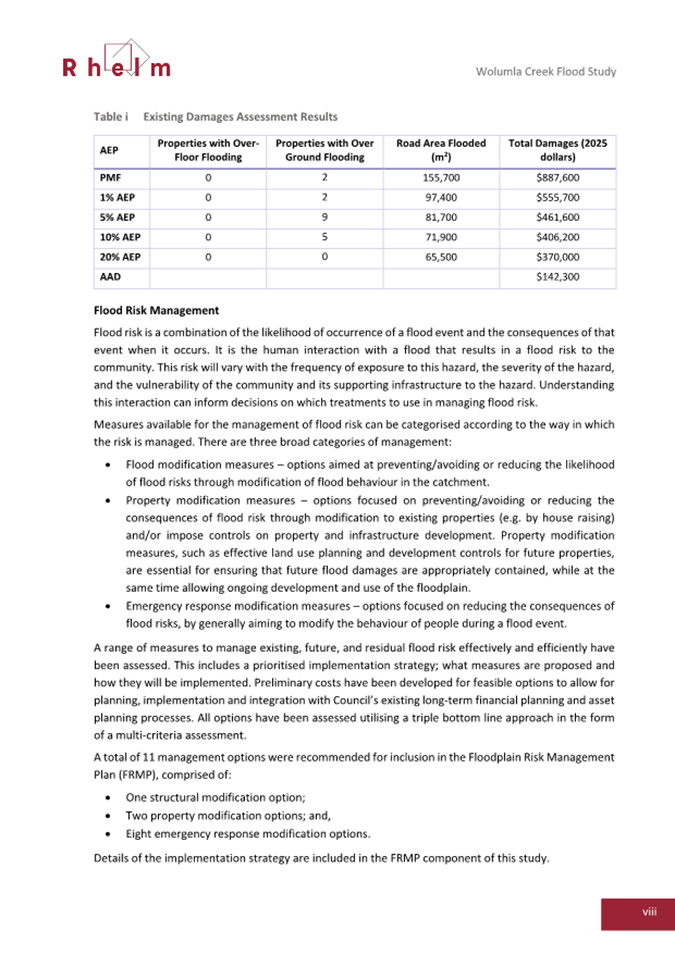
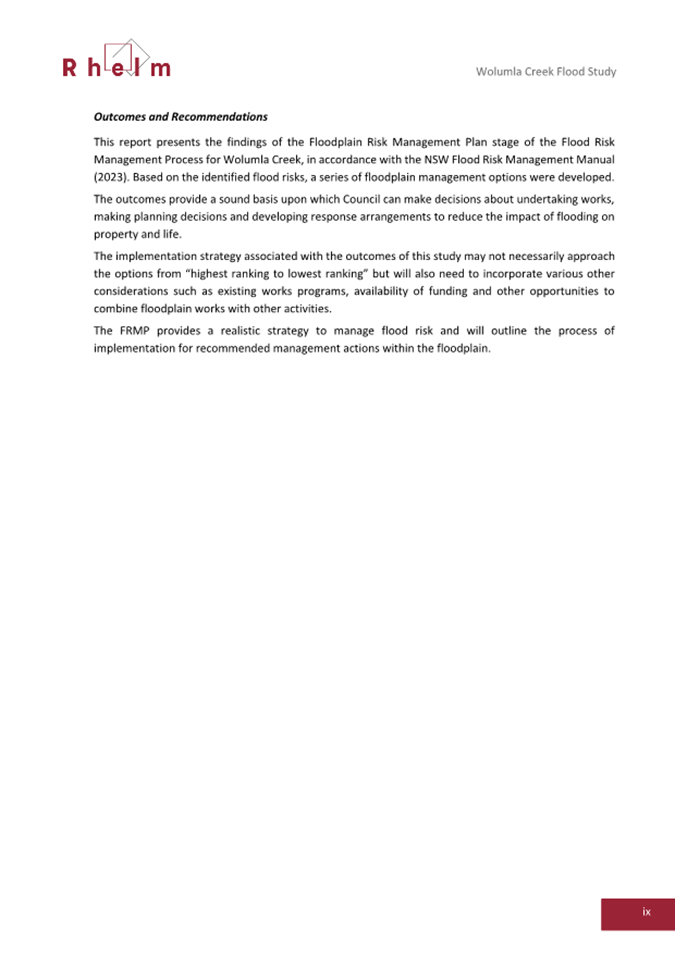
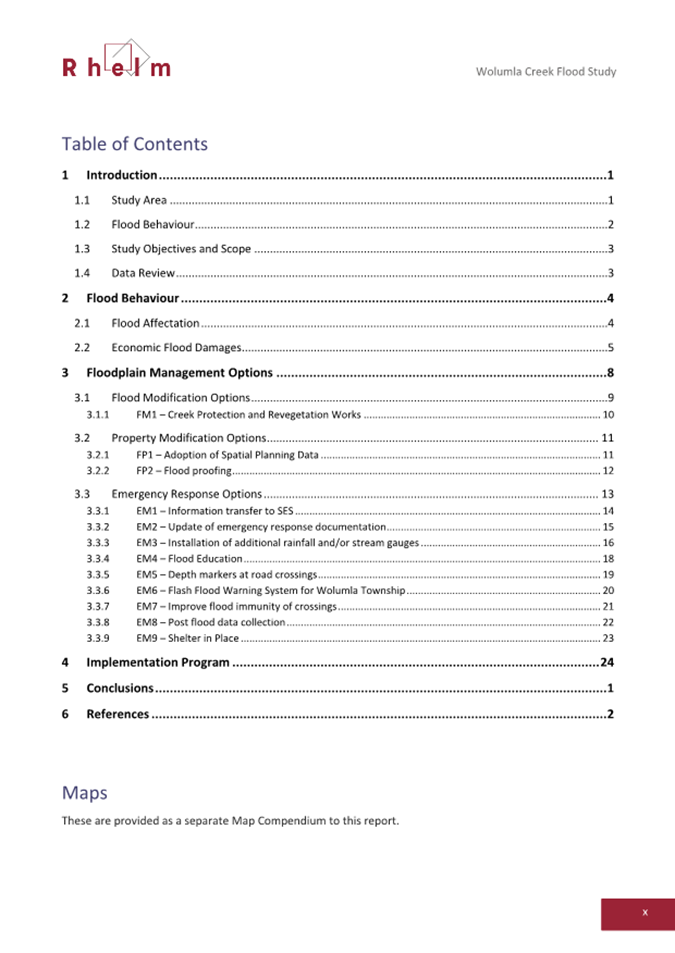
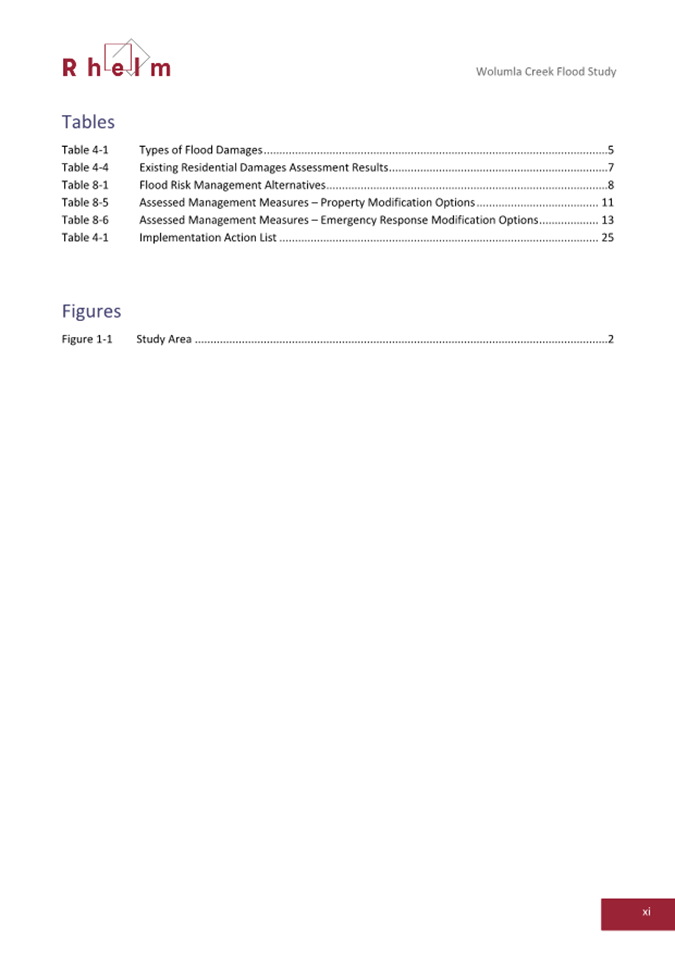
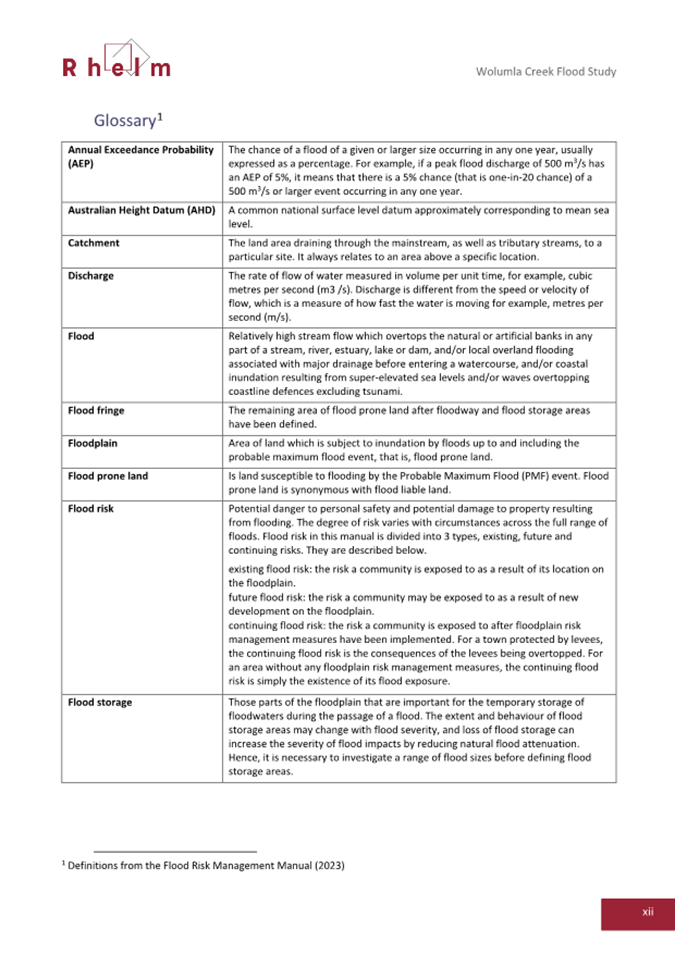
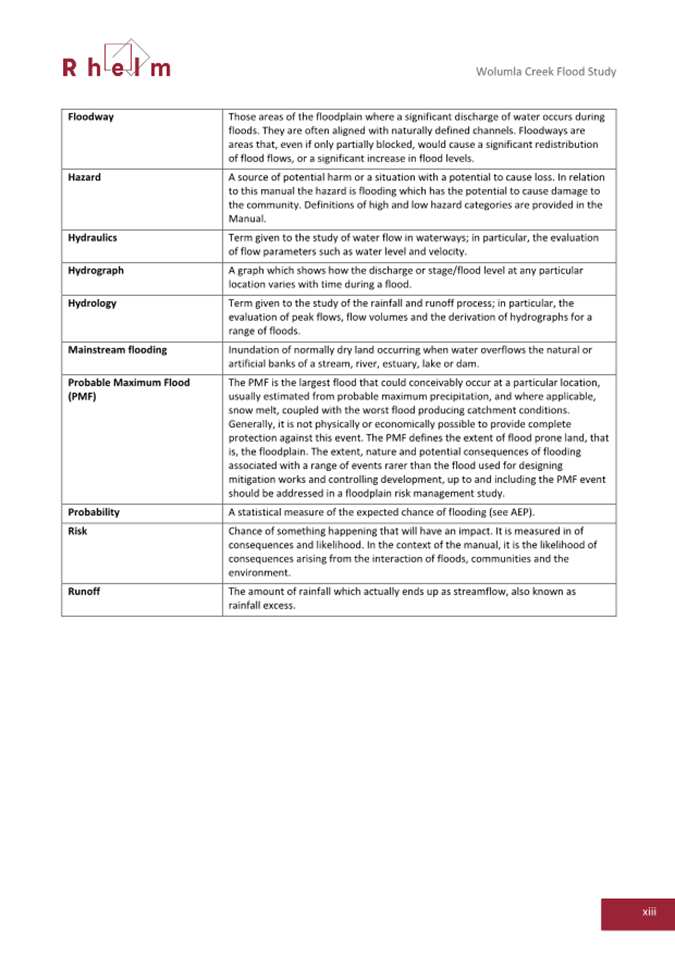
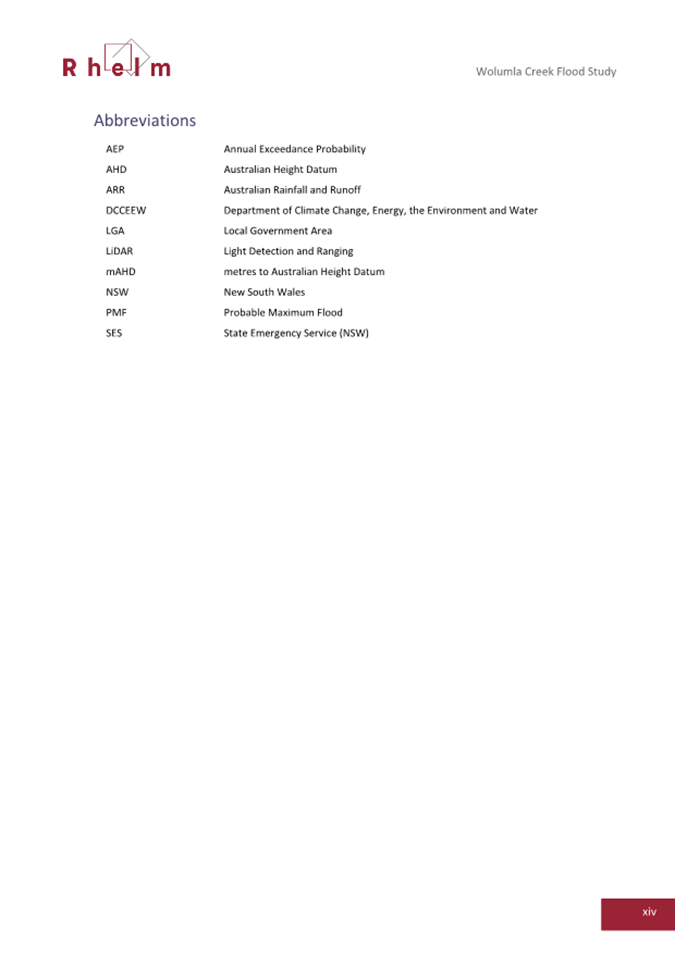
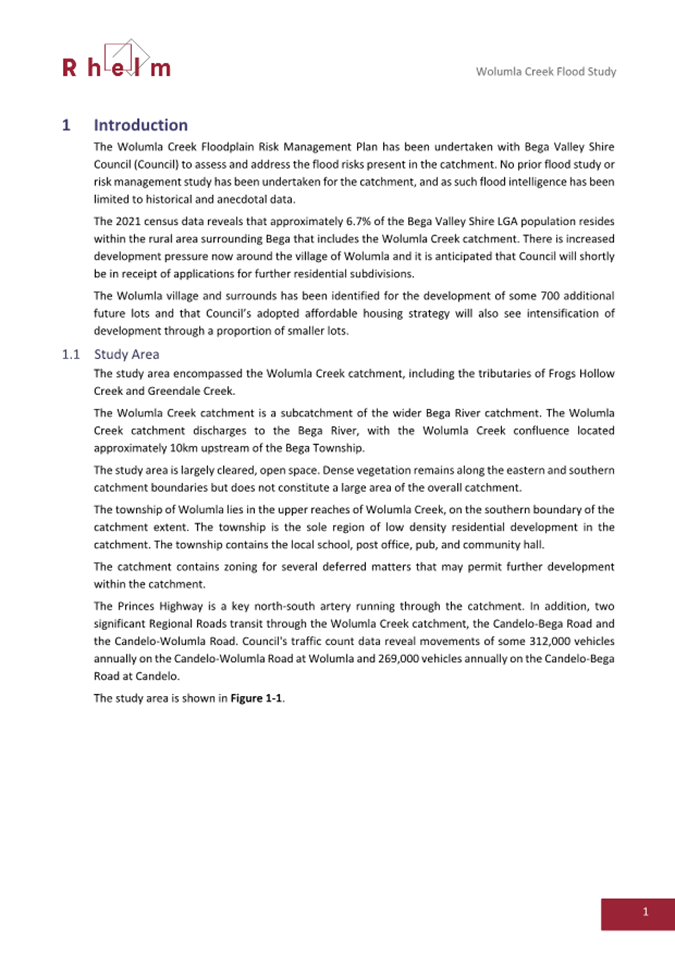
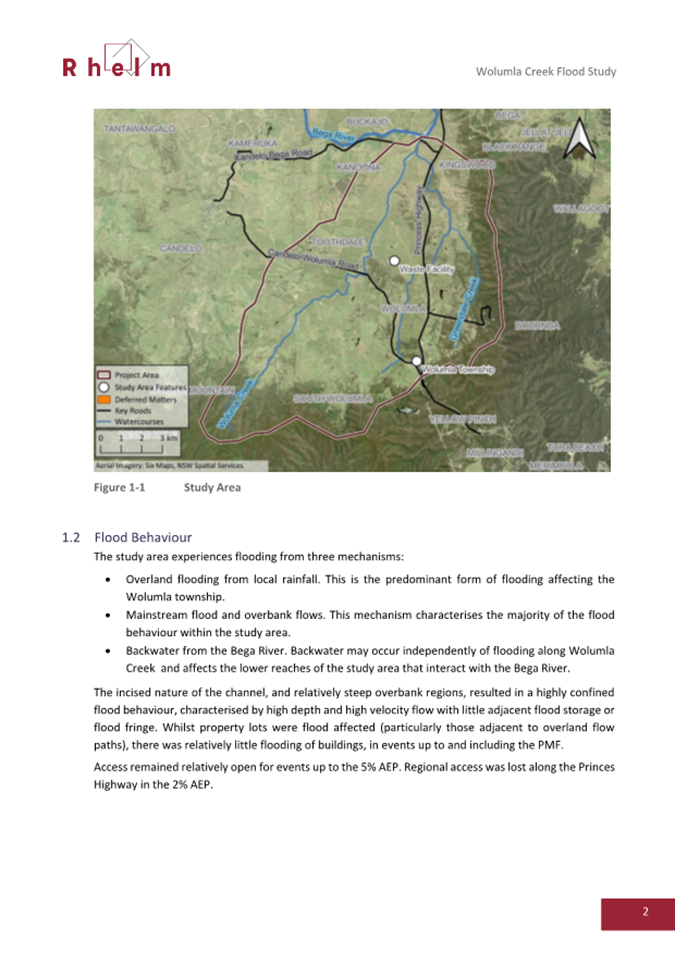
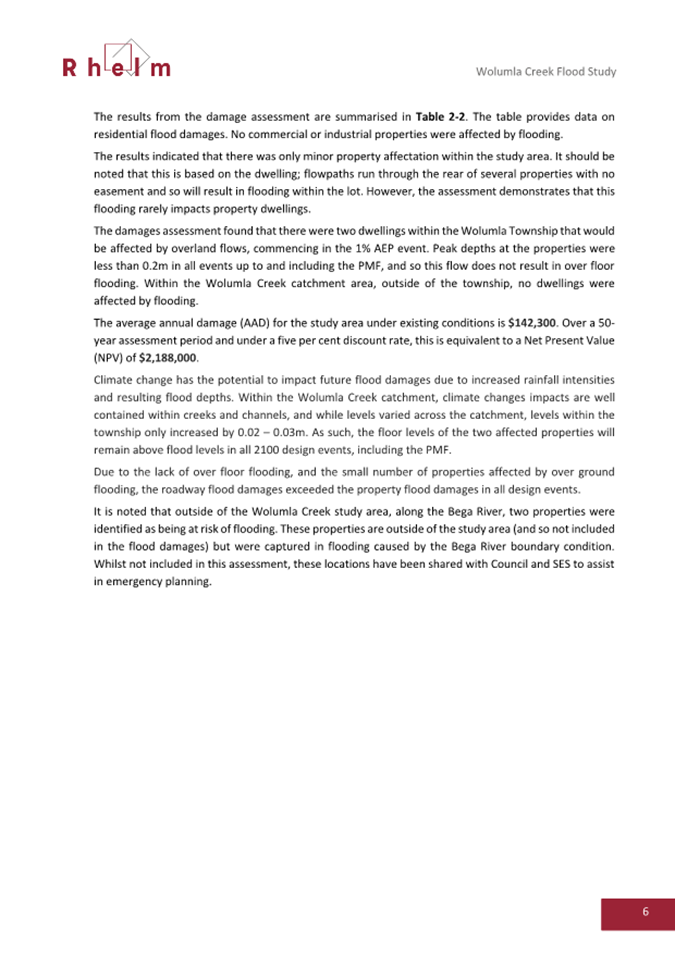
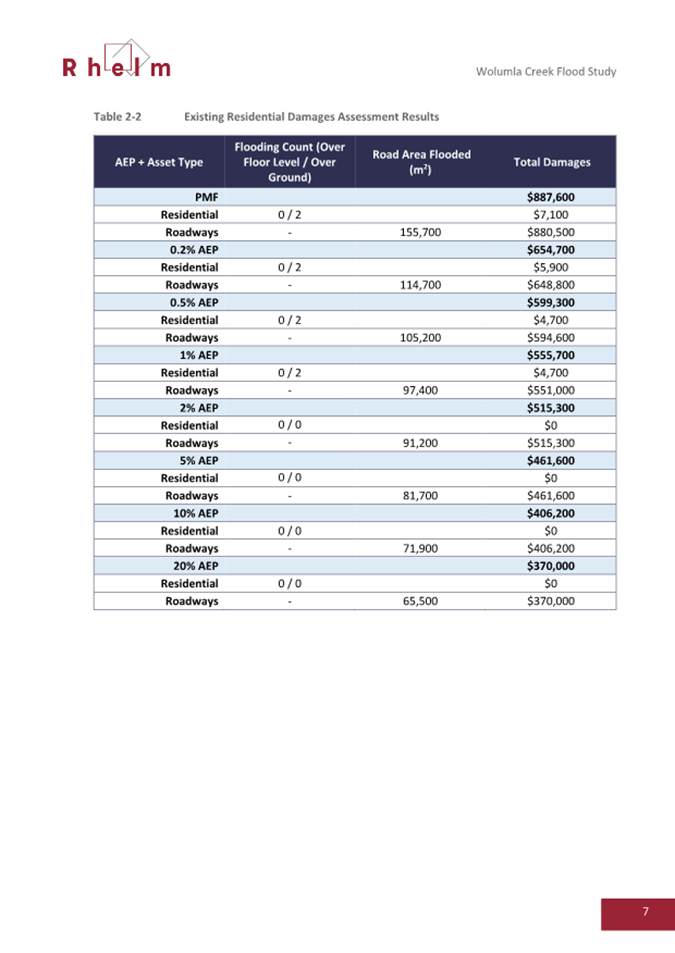
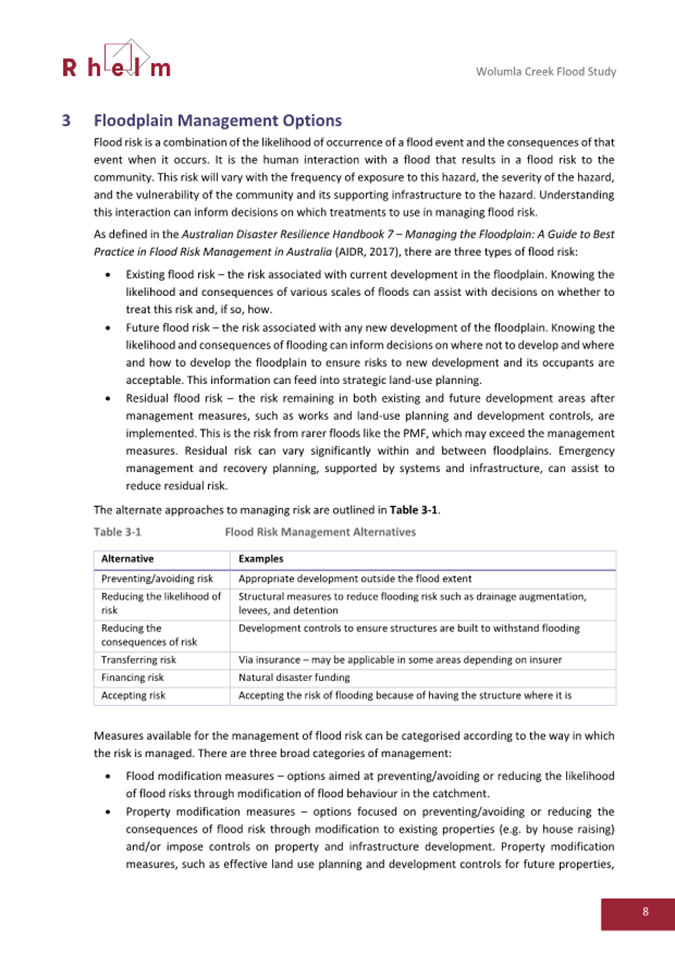
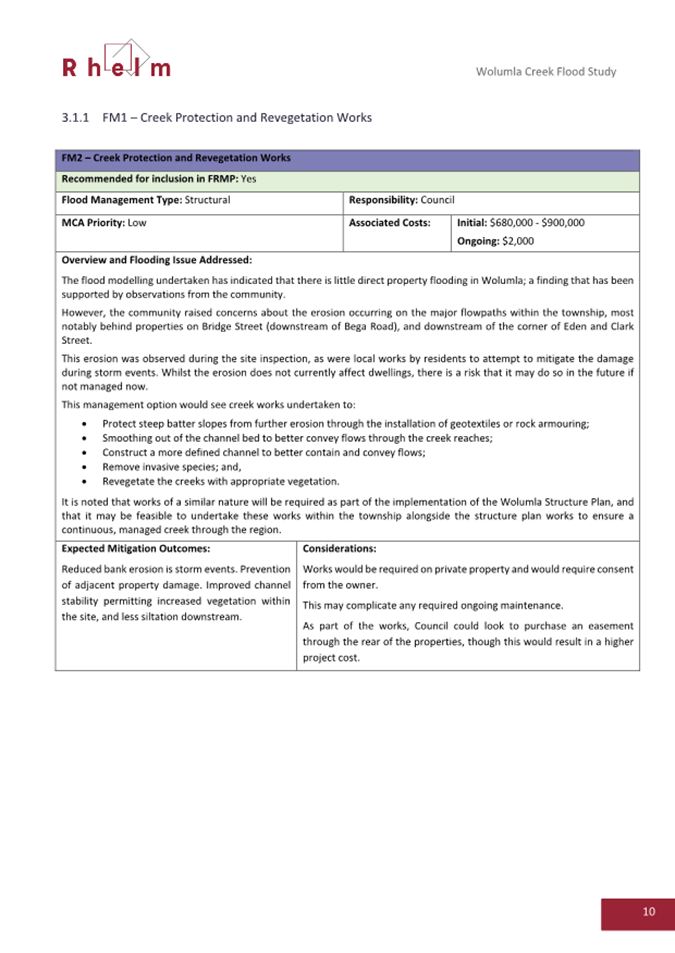
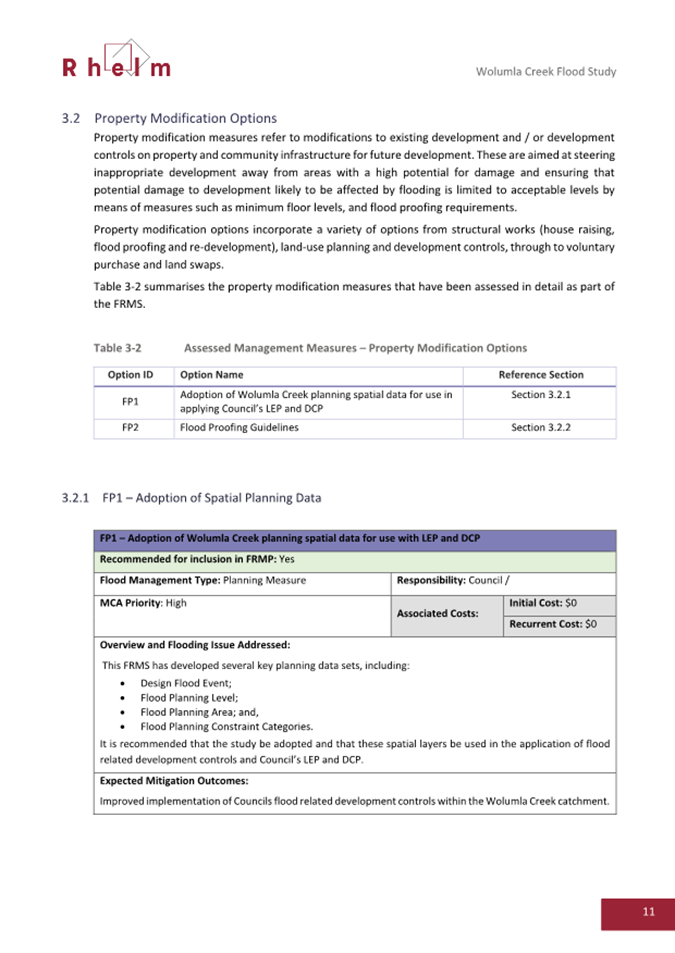
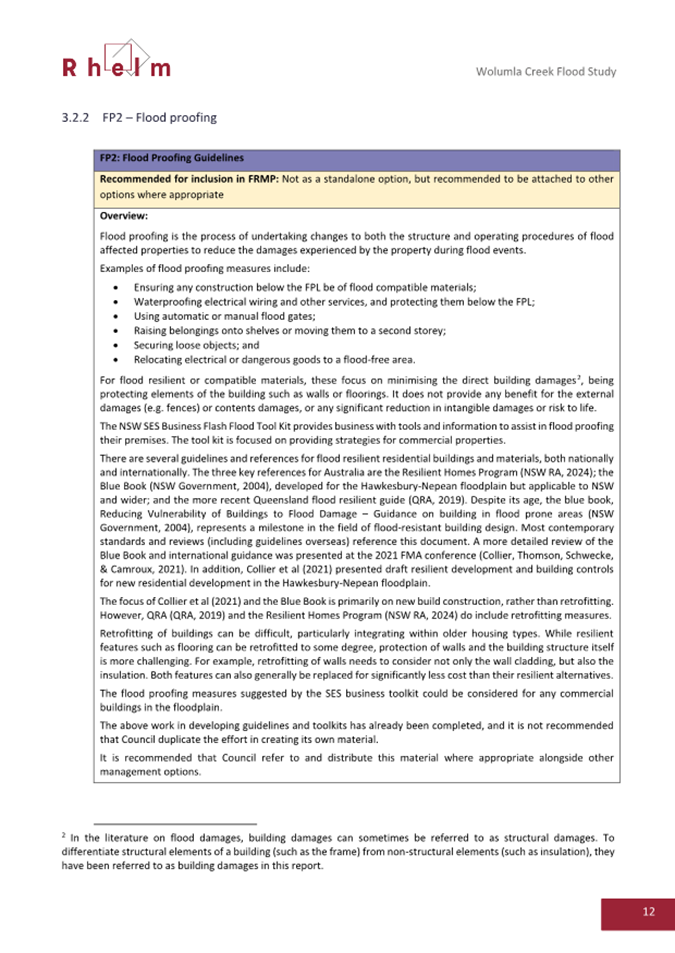
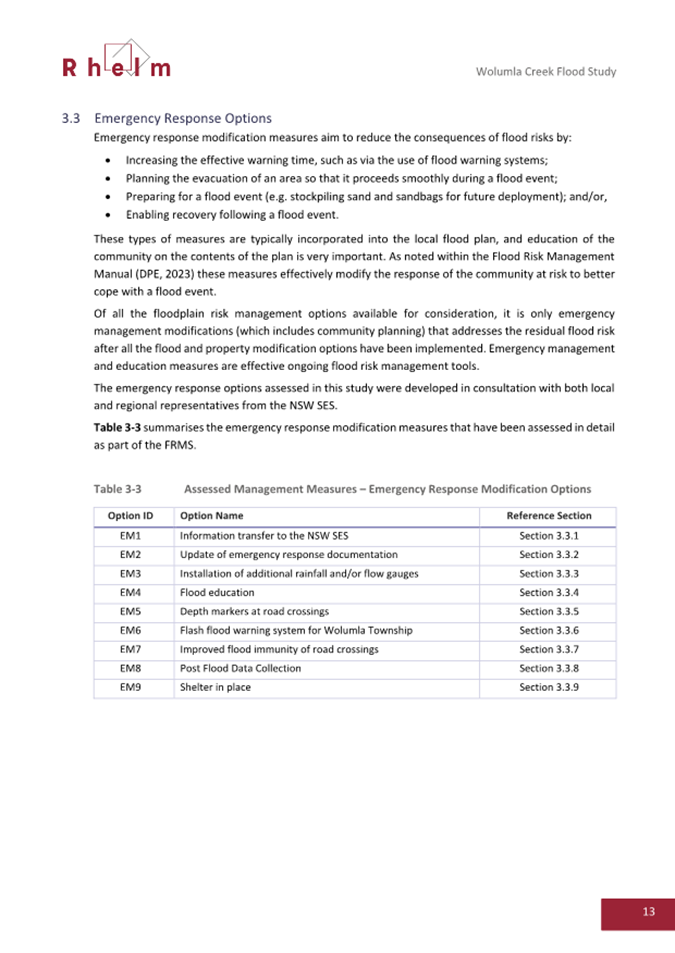
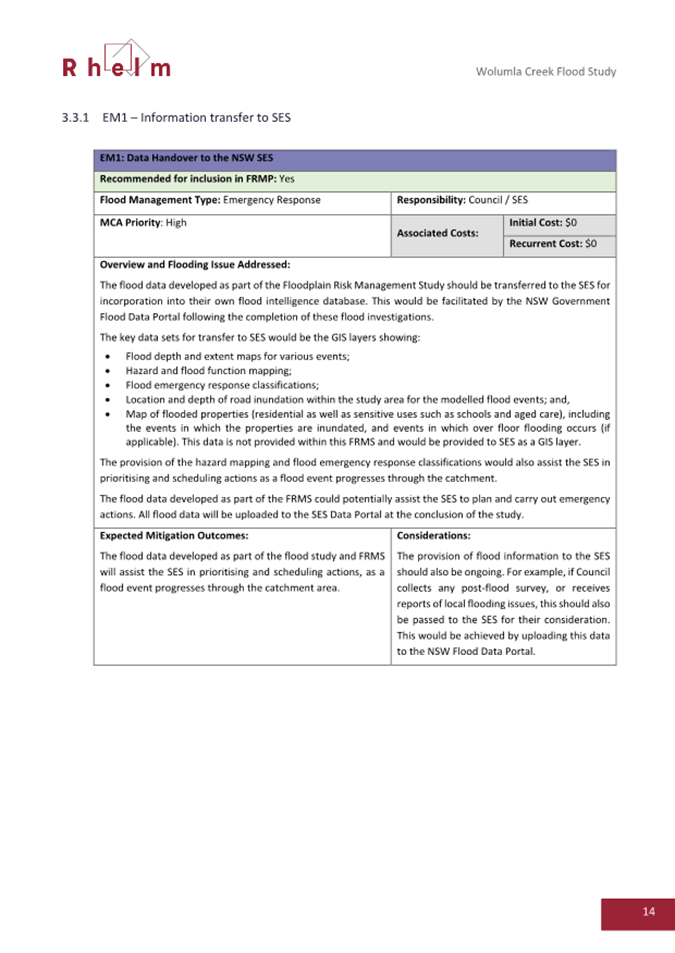
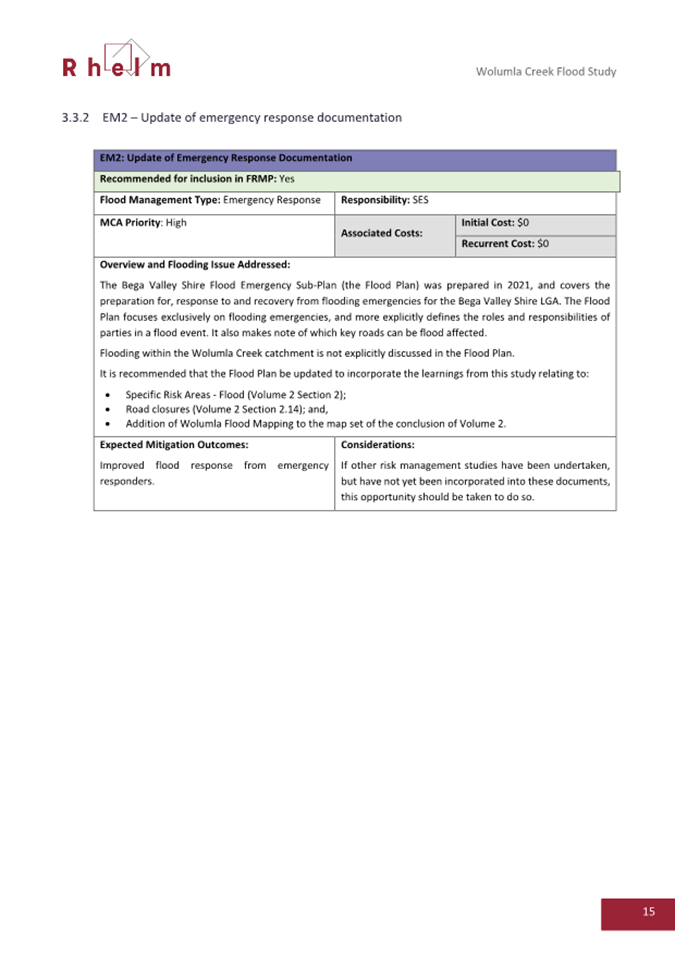
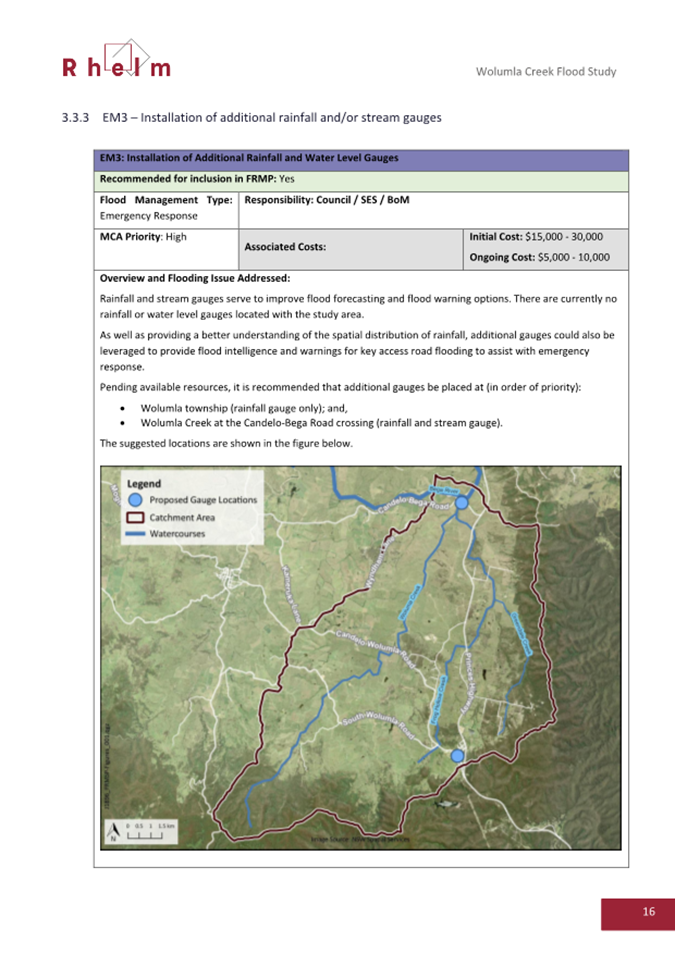
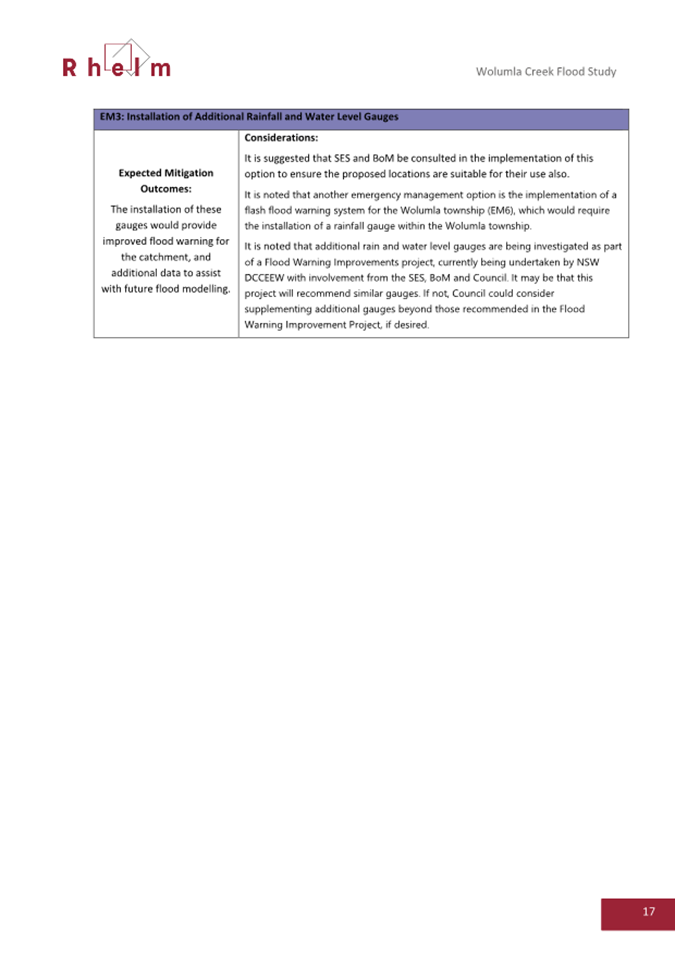
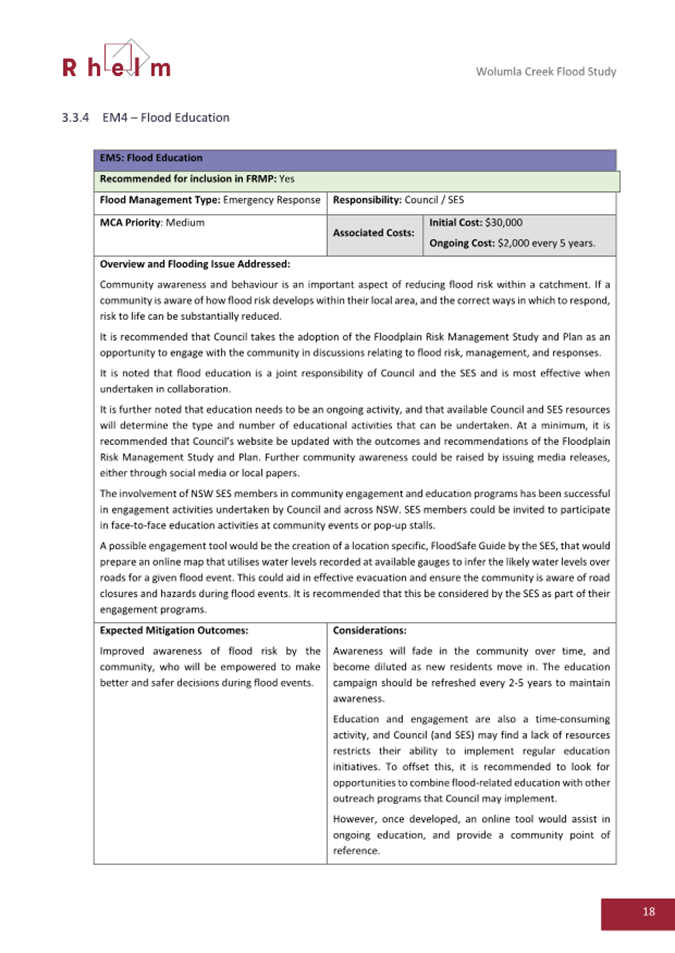
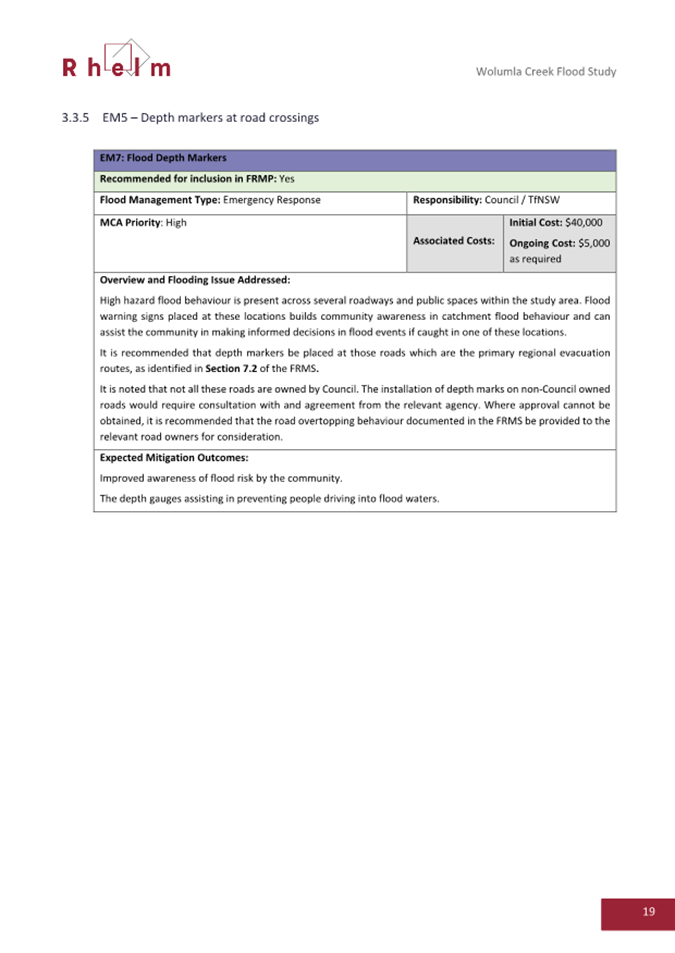
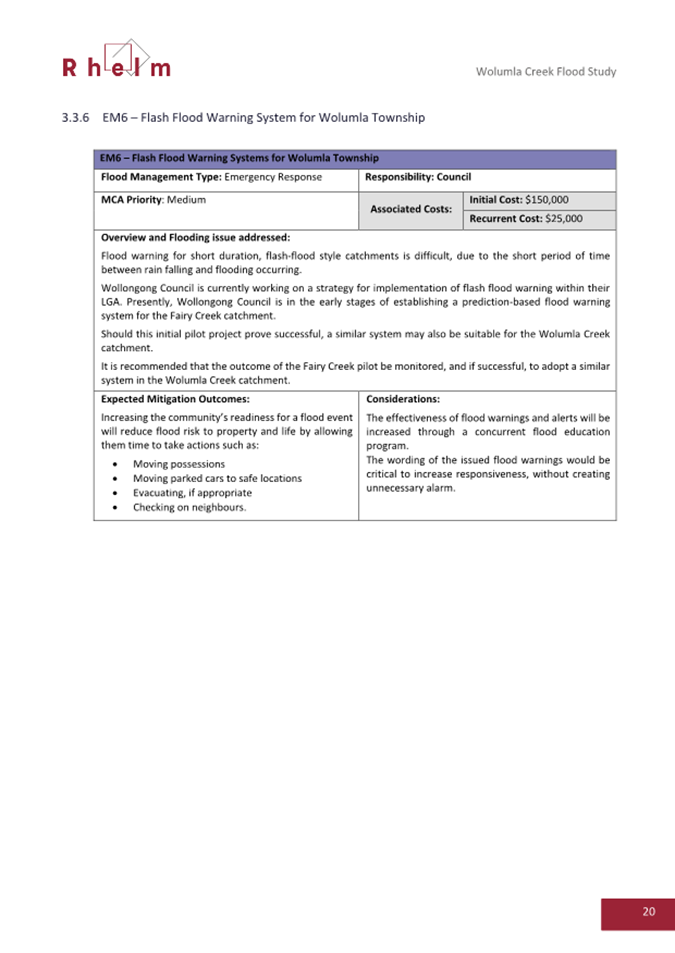
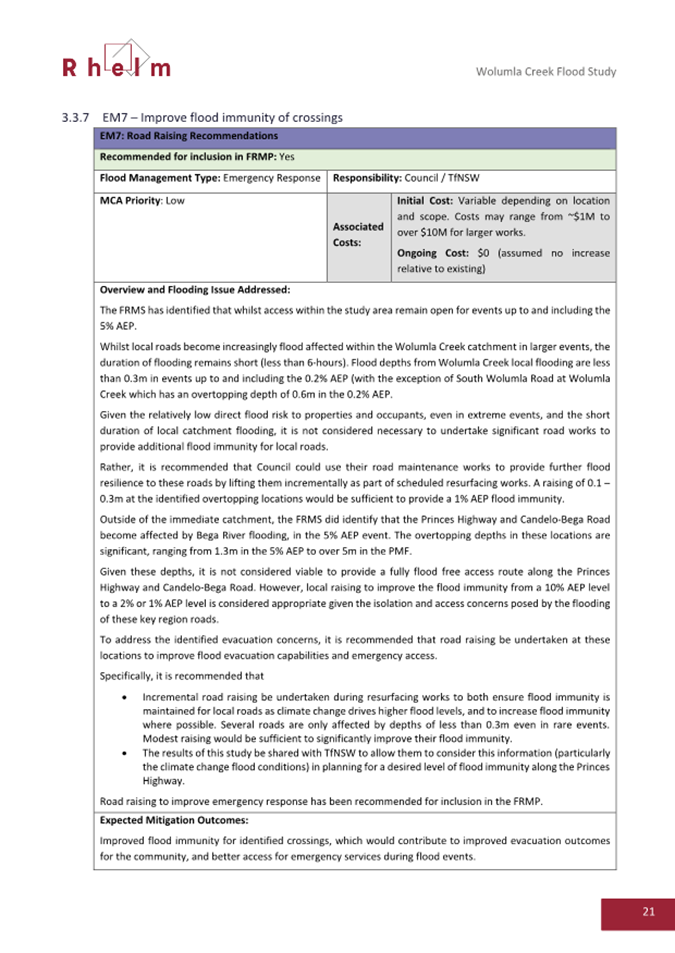
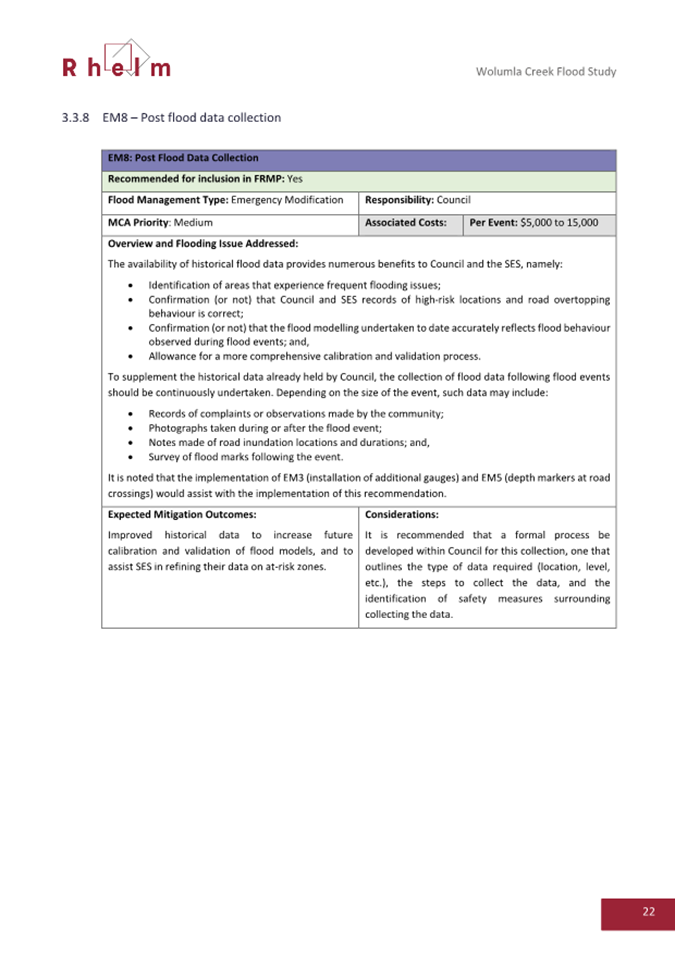
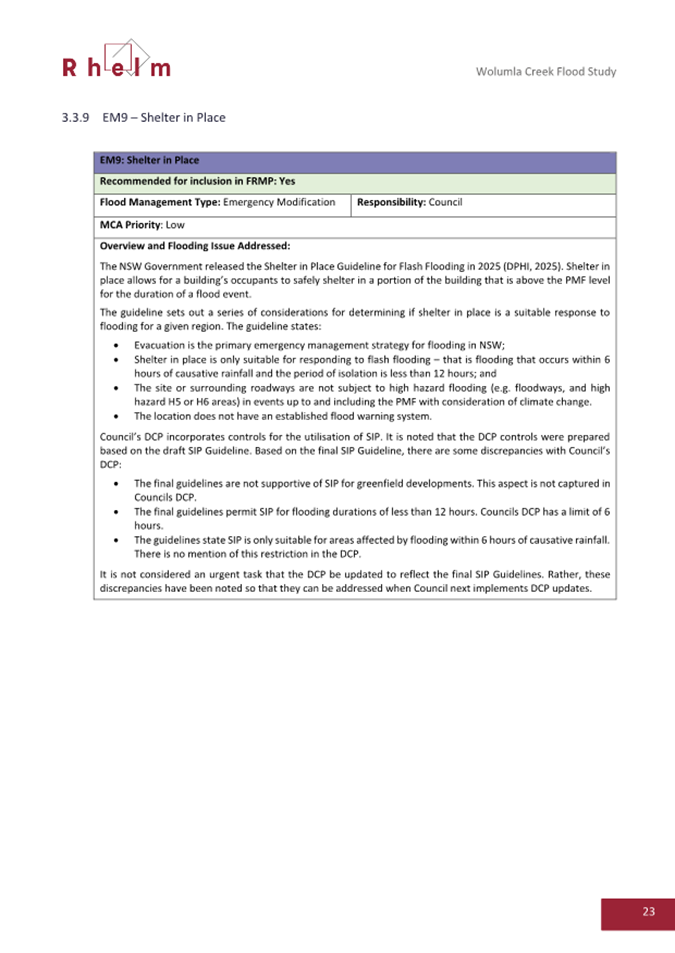
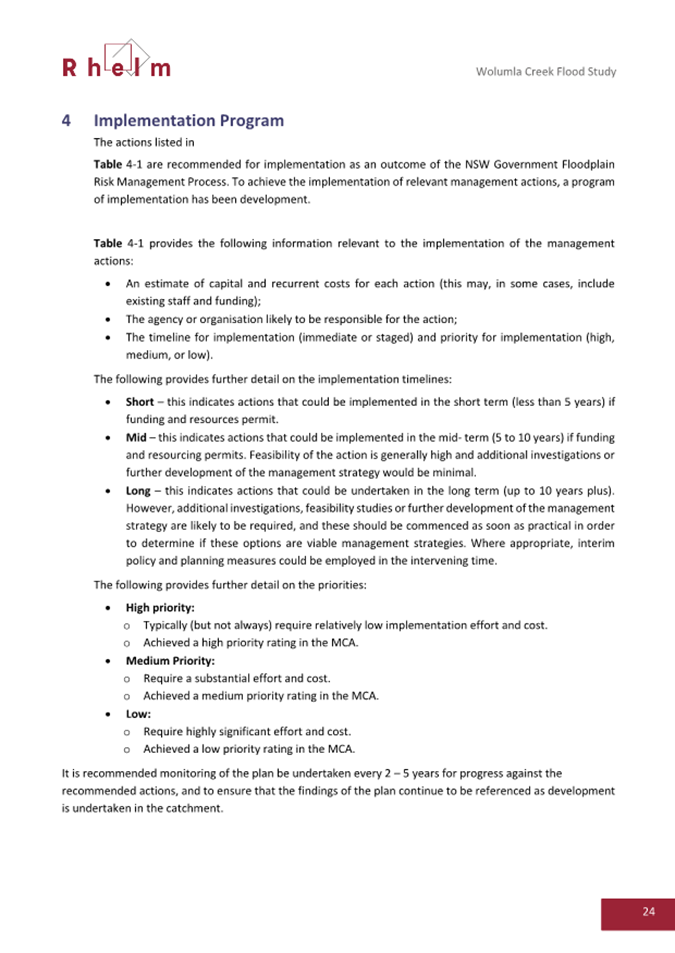
|
Council
|
28 January 2026
|
|
Item 9.2 - Attachment 2
|
Draft Wolumla Floodplain Risk Management Study for public
exhibition
|
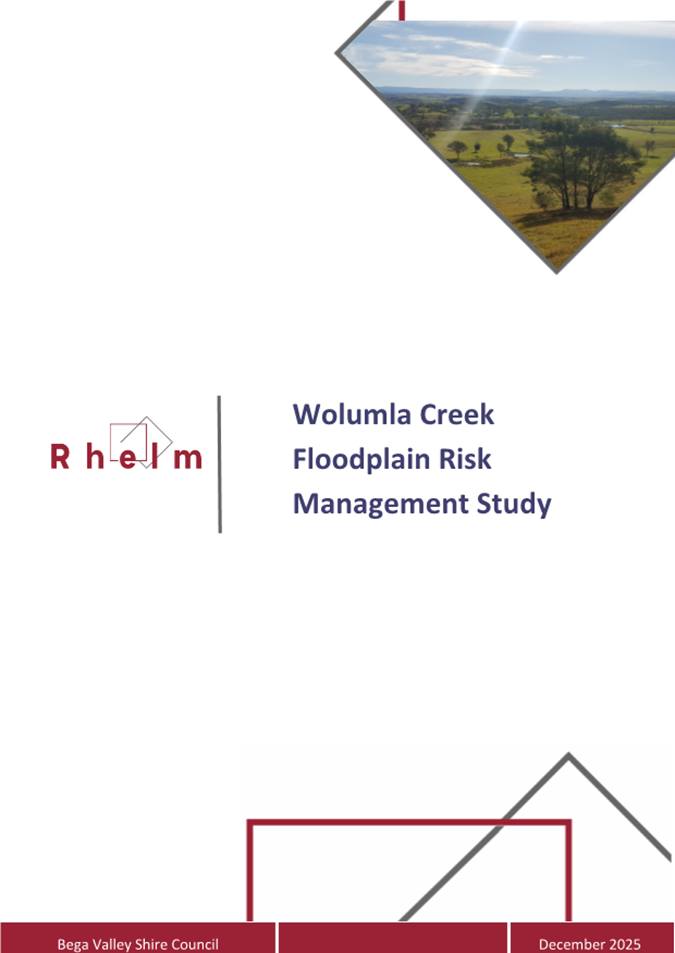
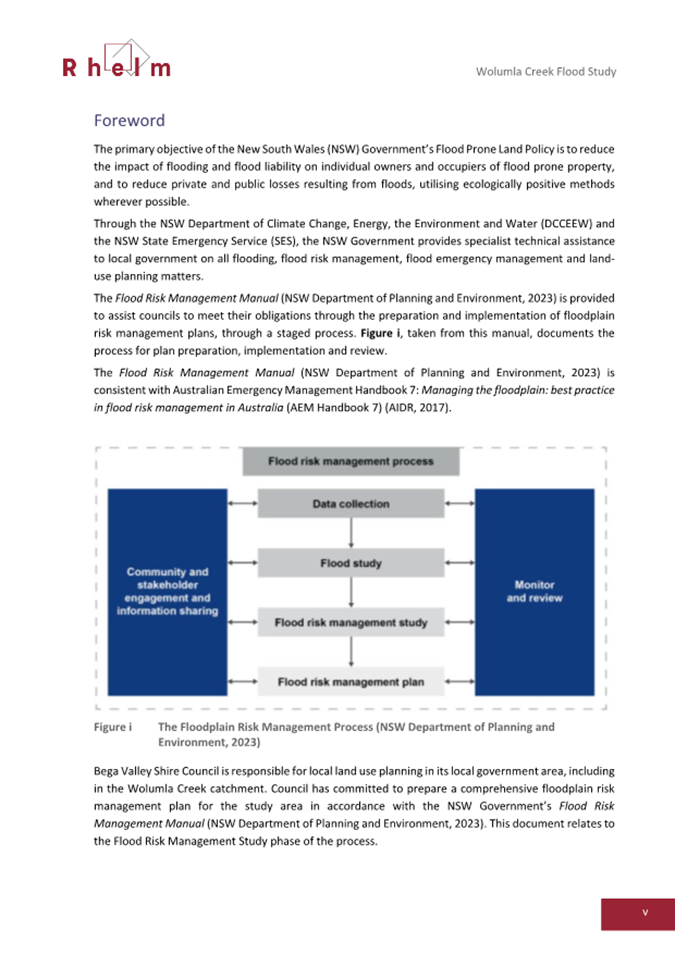
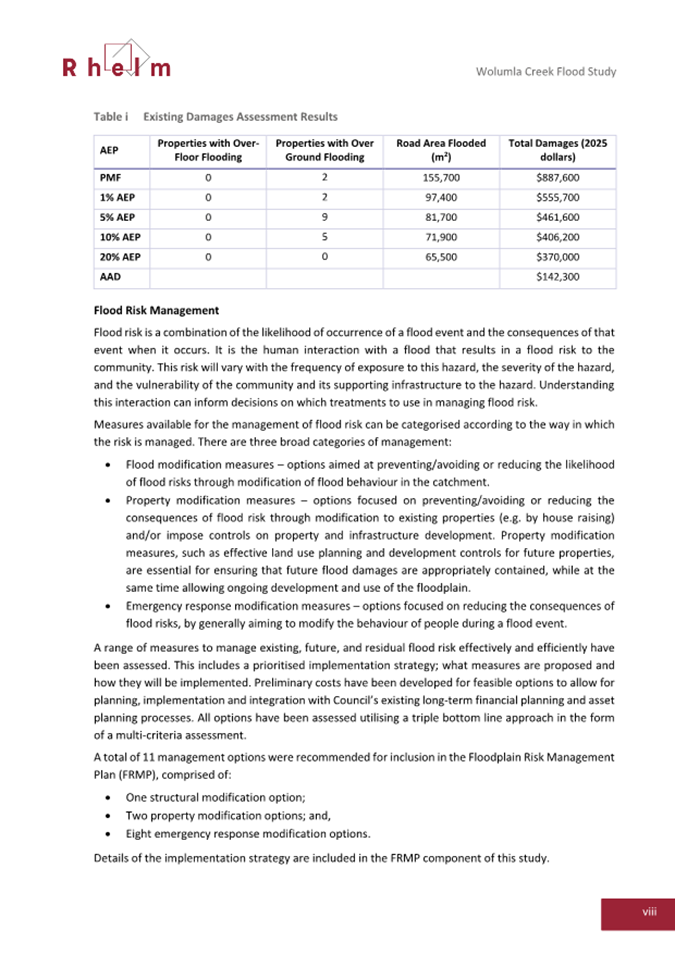
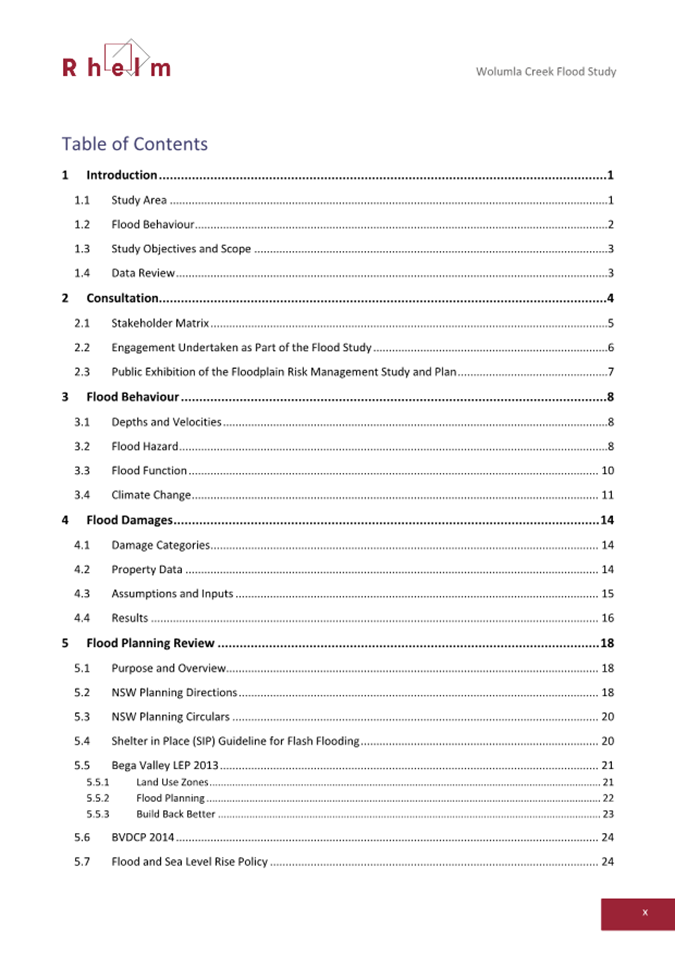
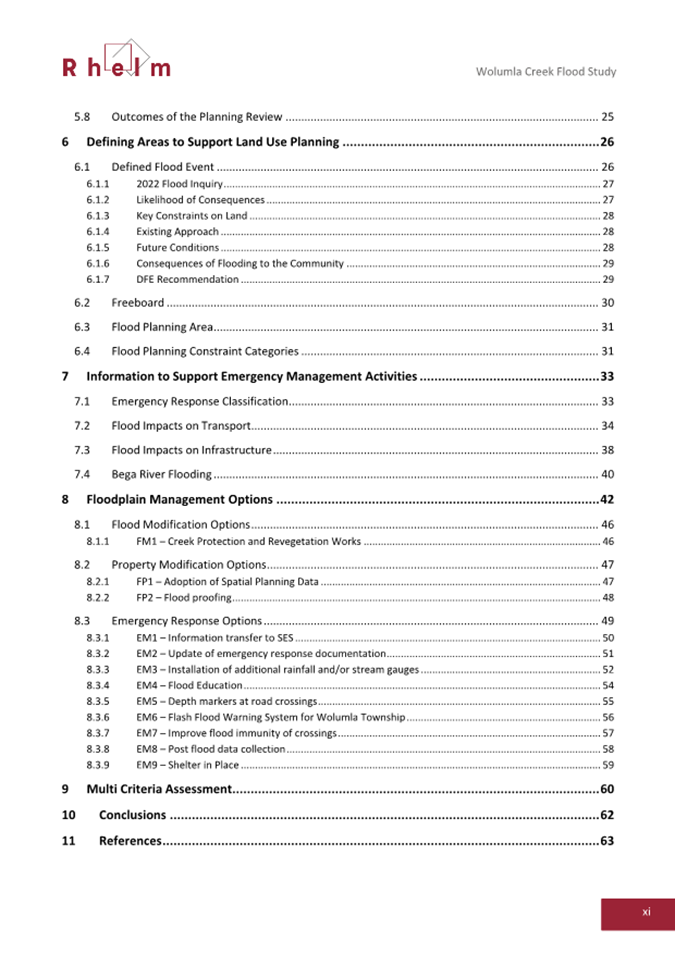
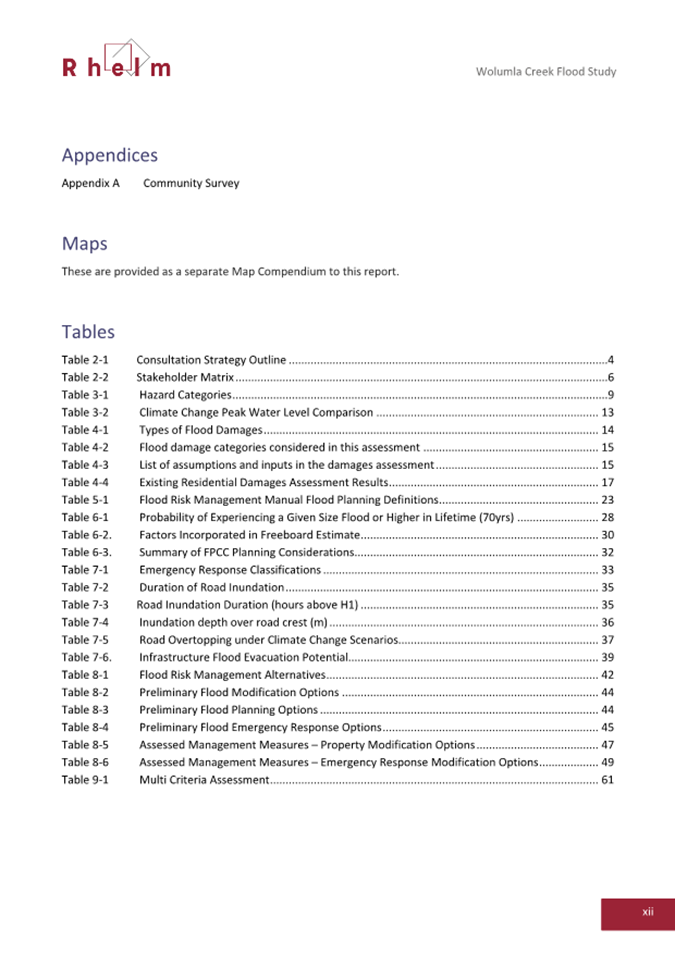
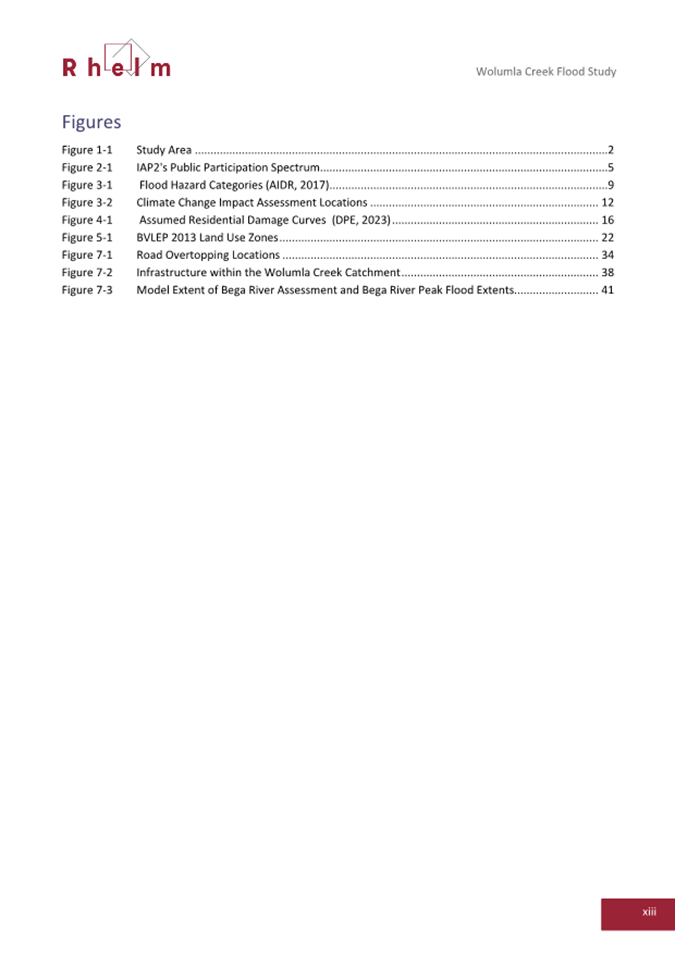
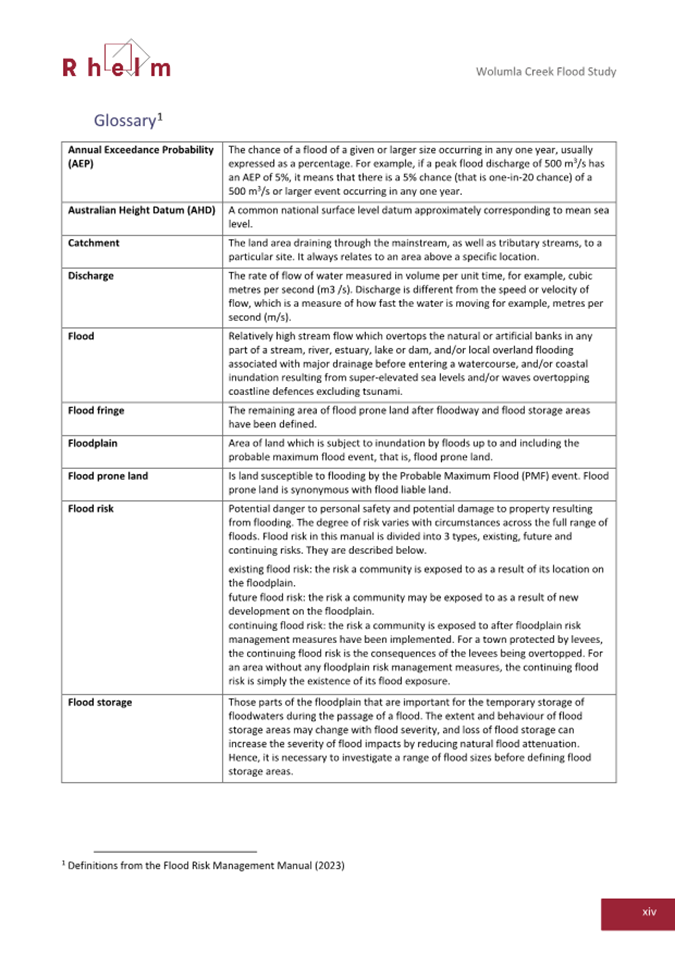
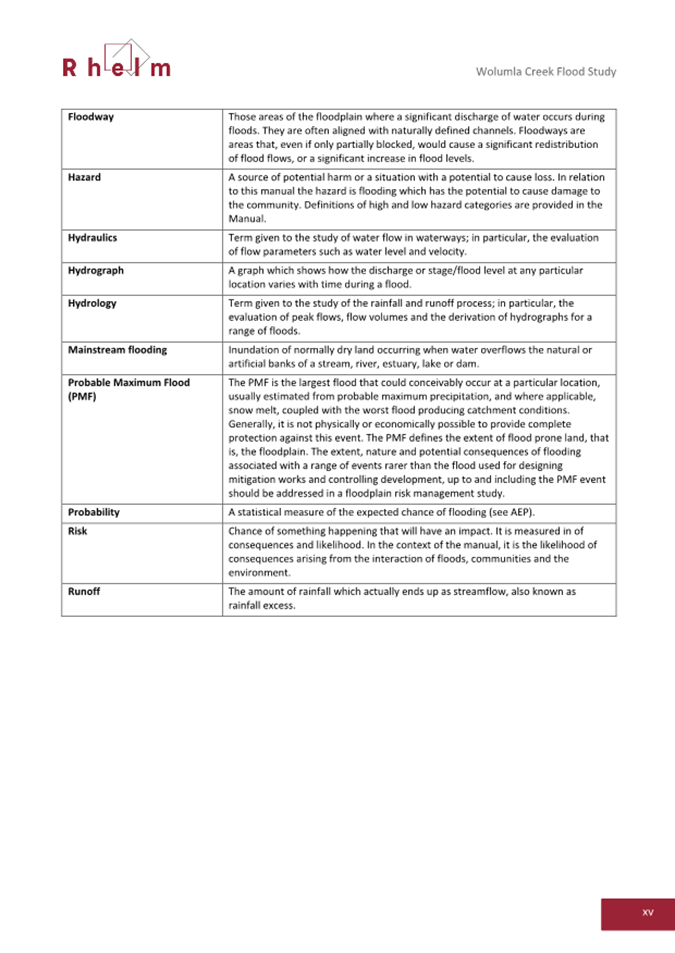
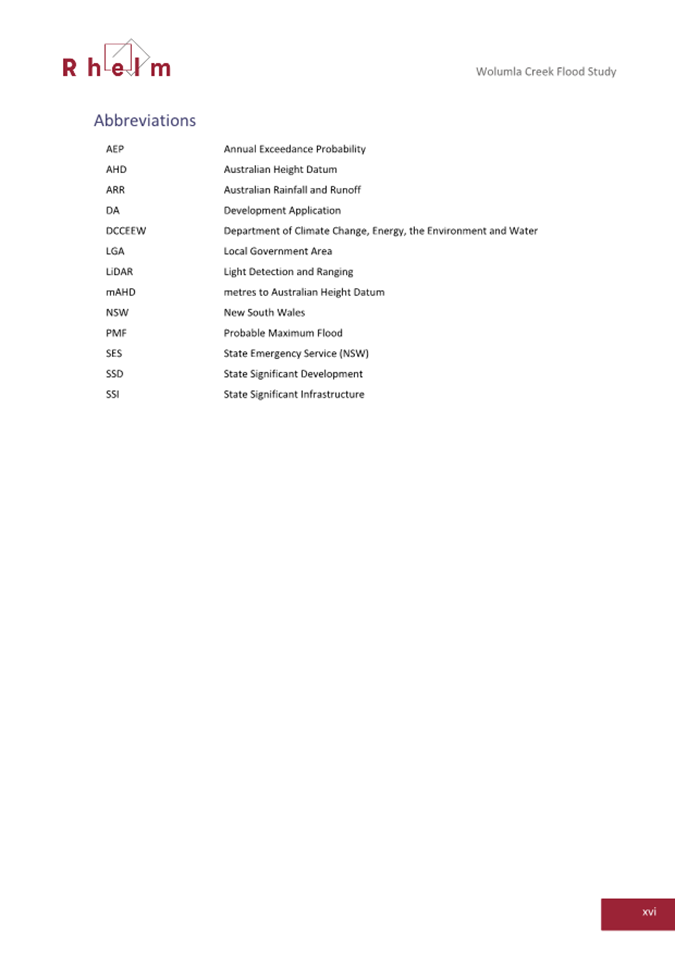
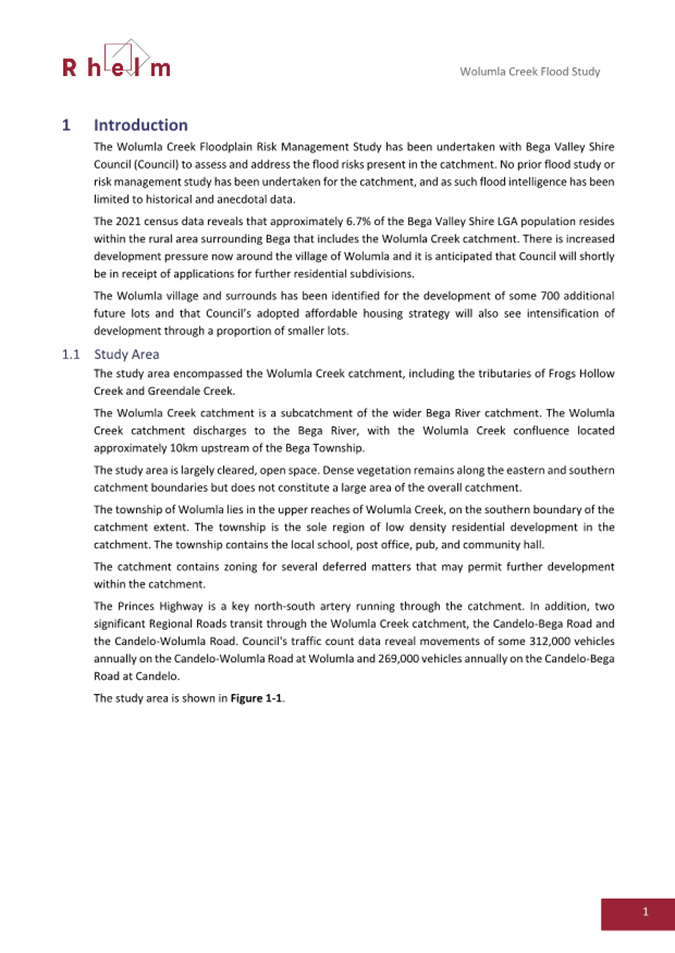
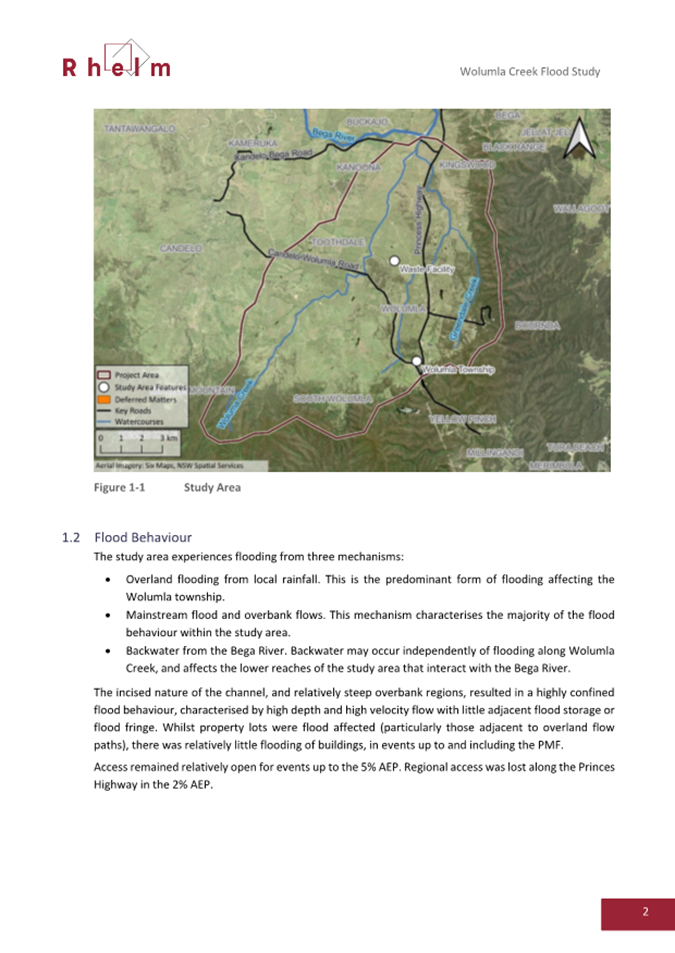
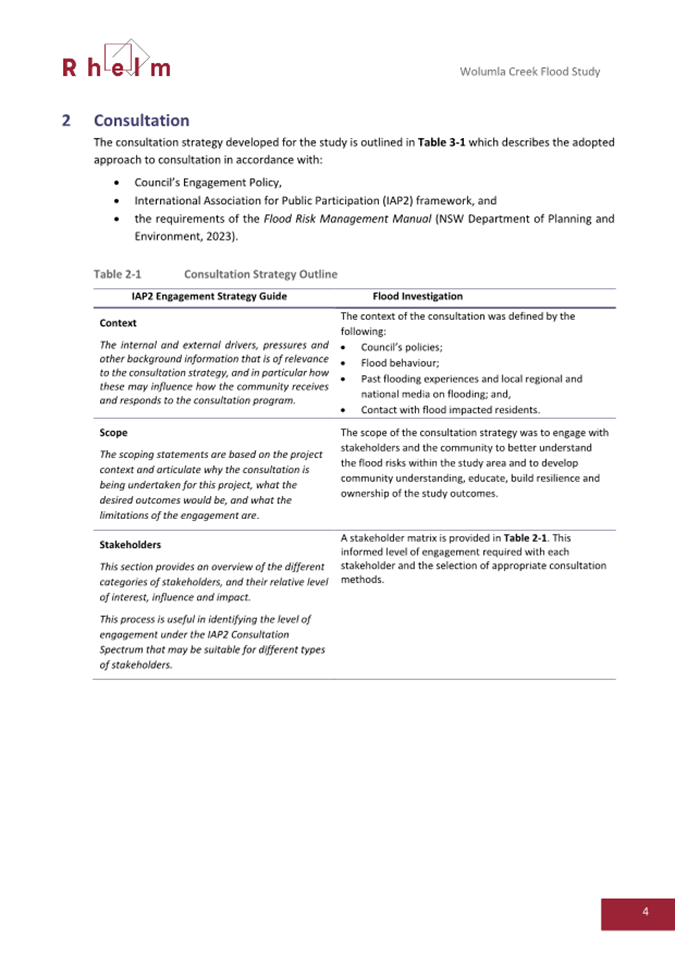
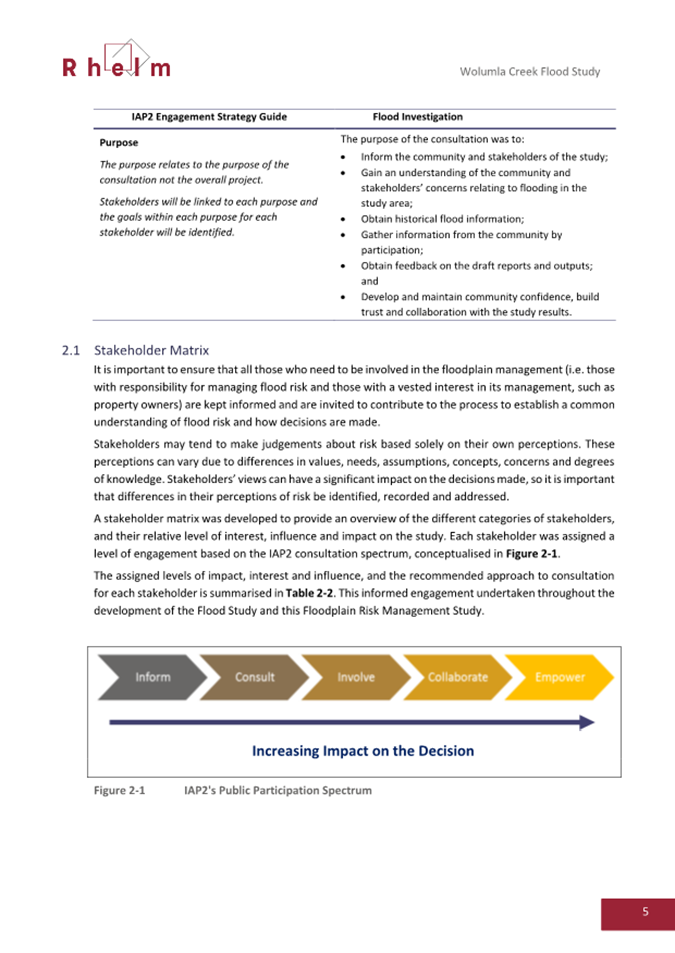
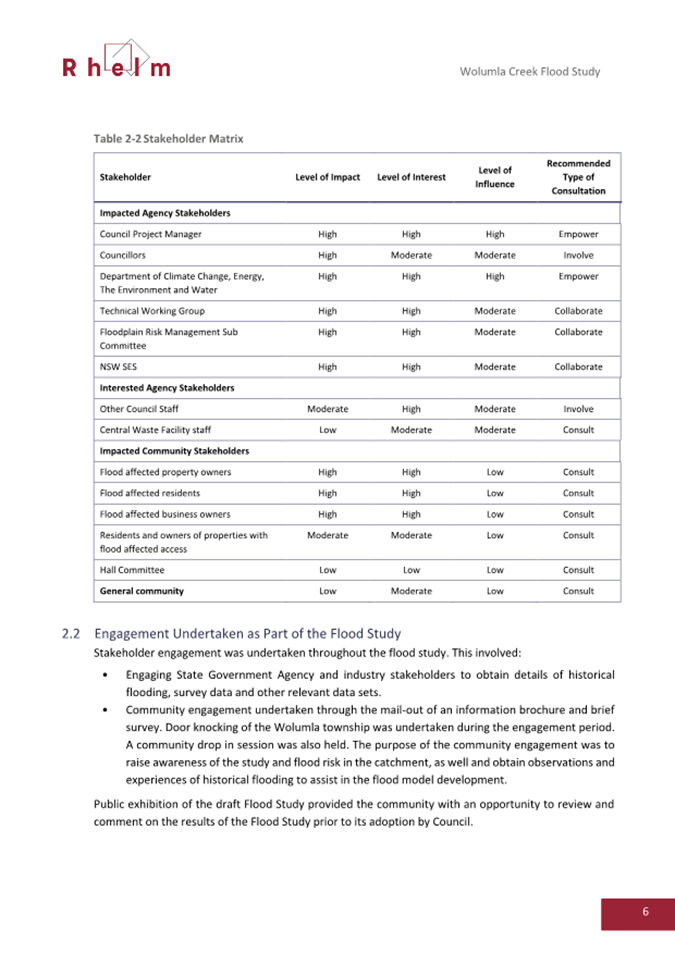
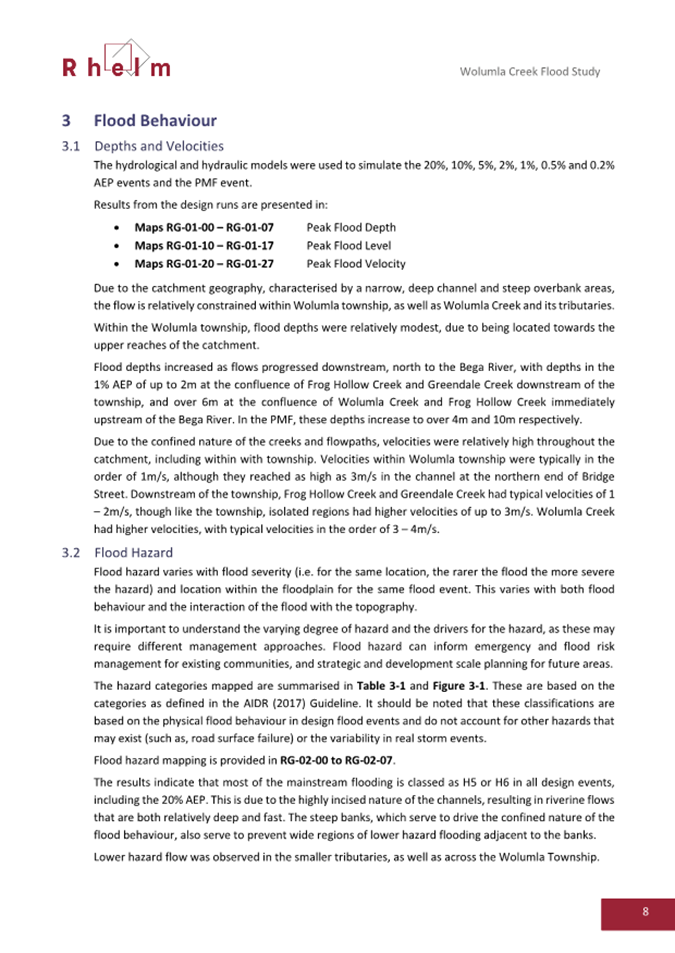
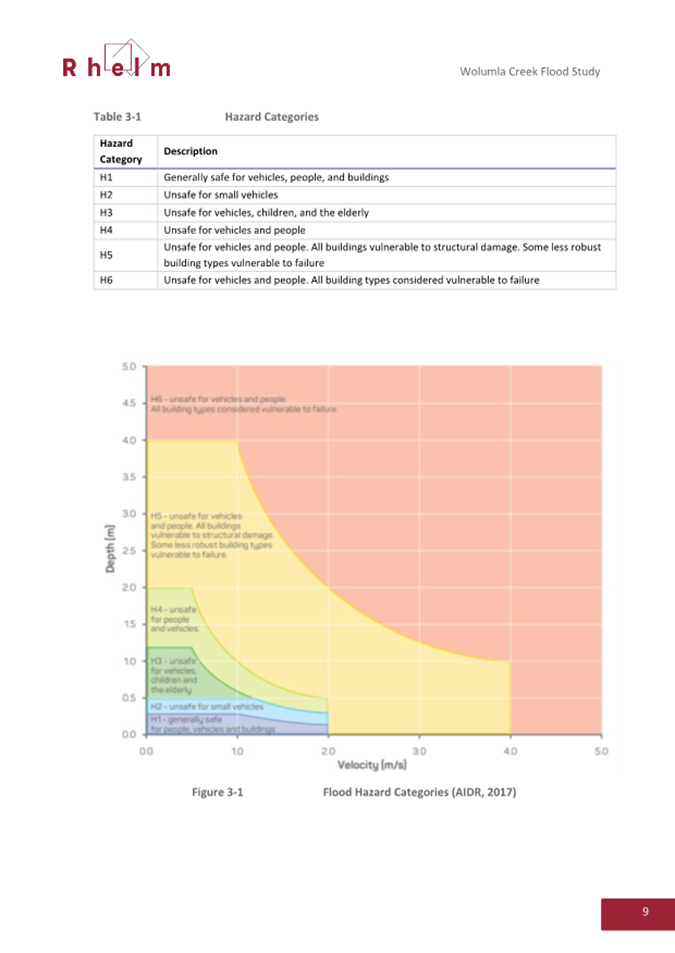
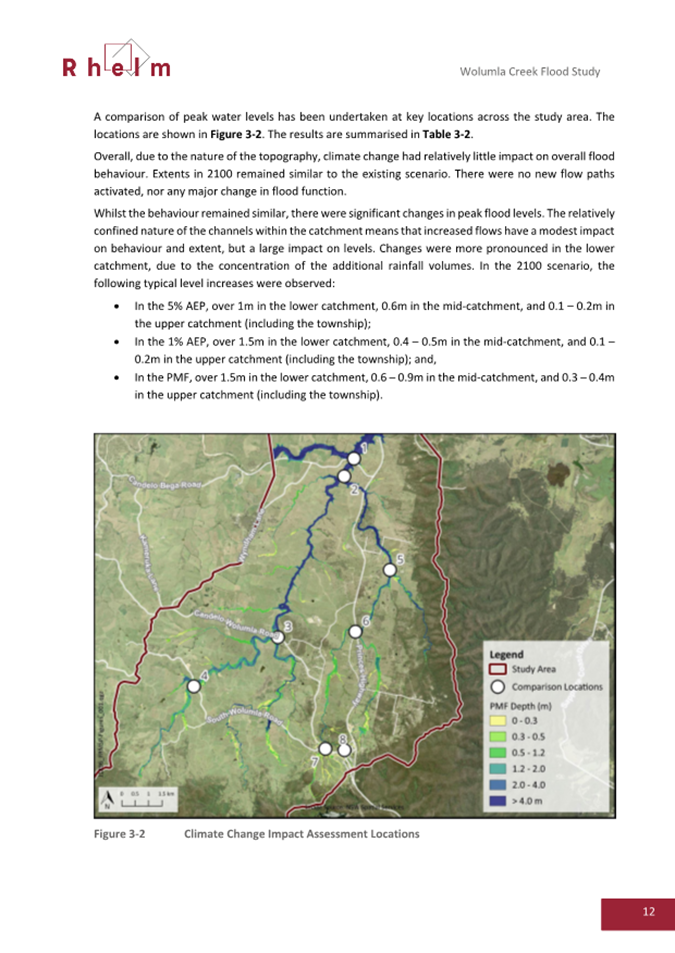
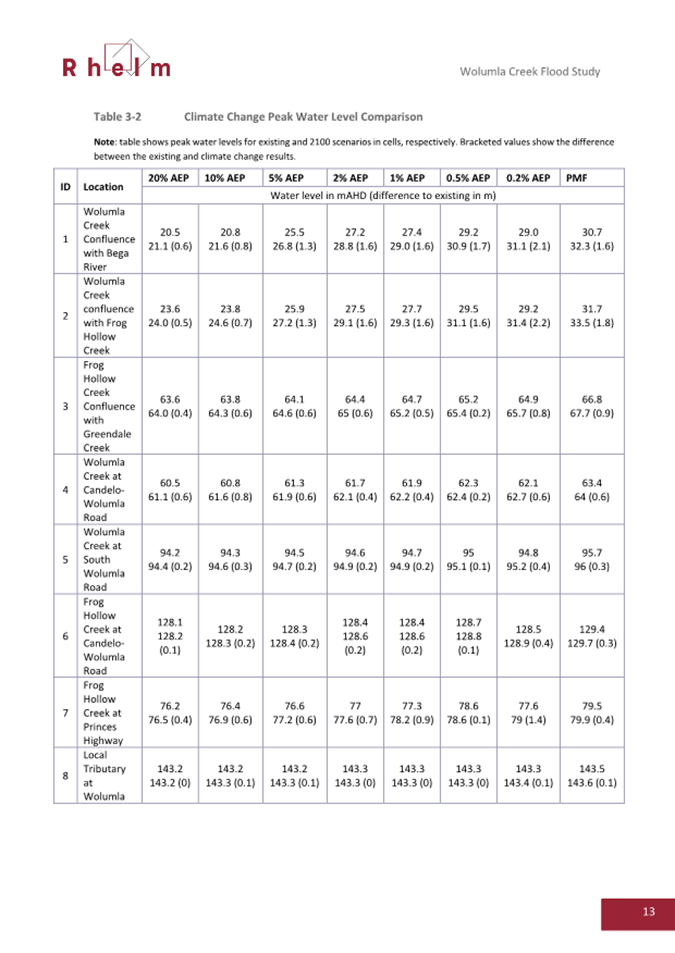
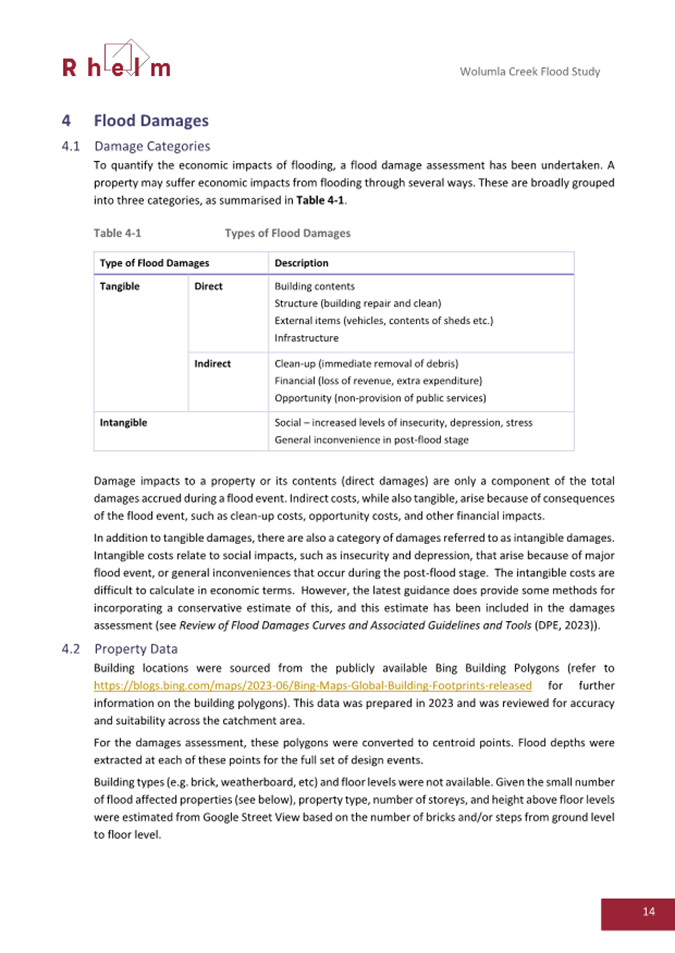
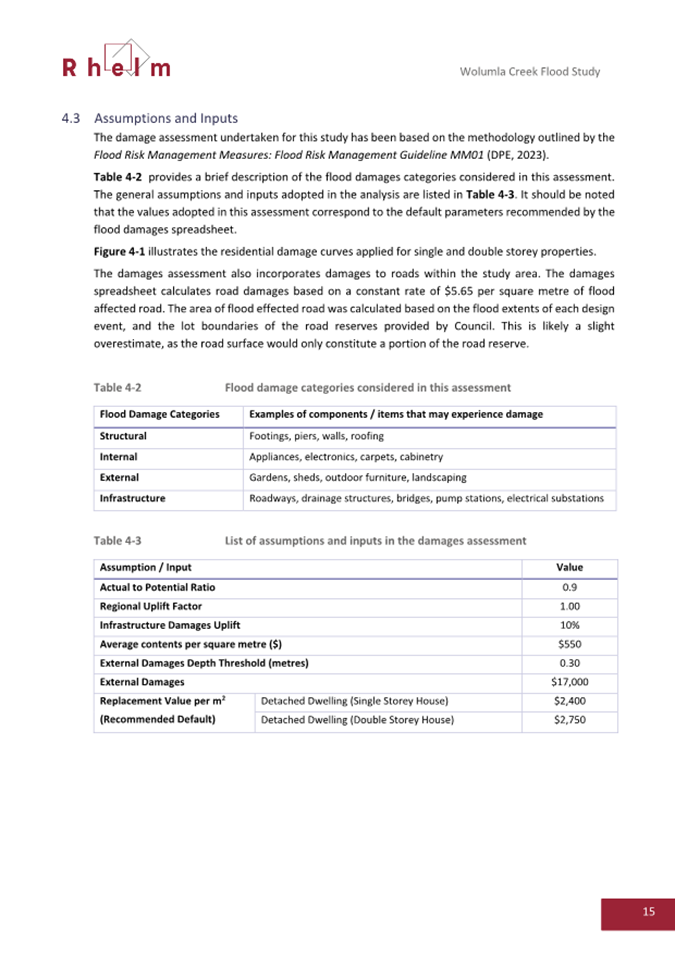
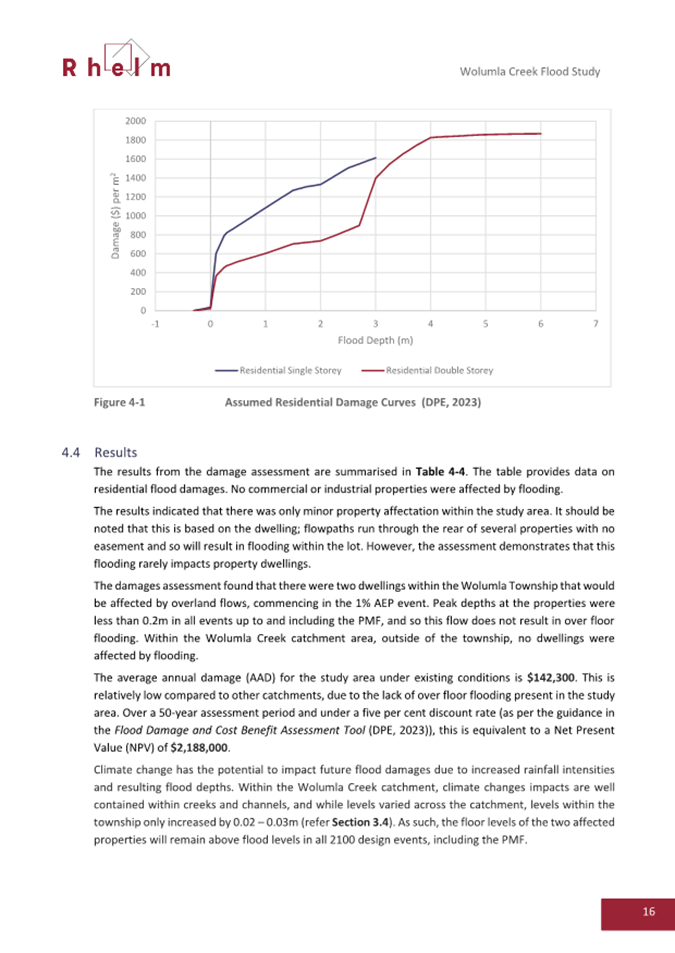
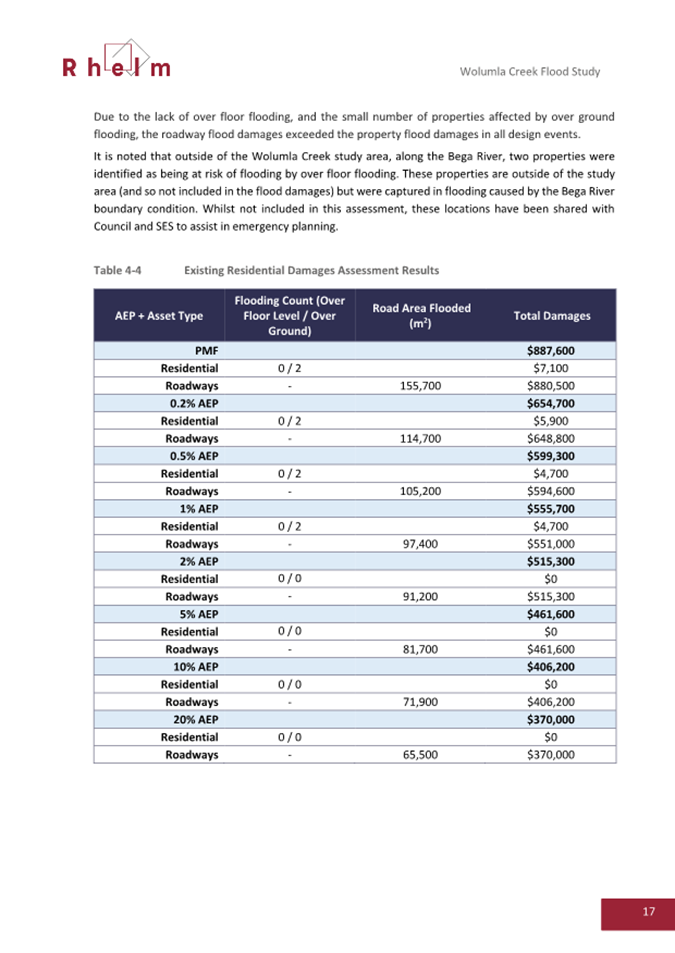
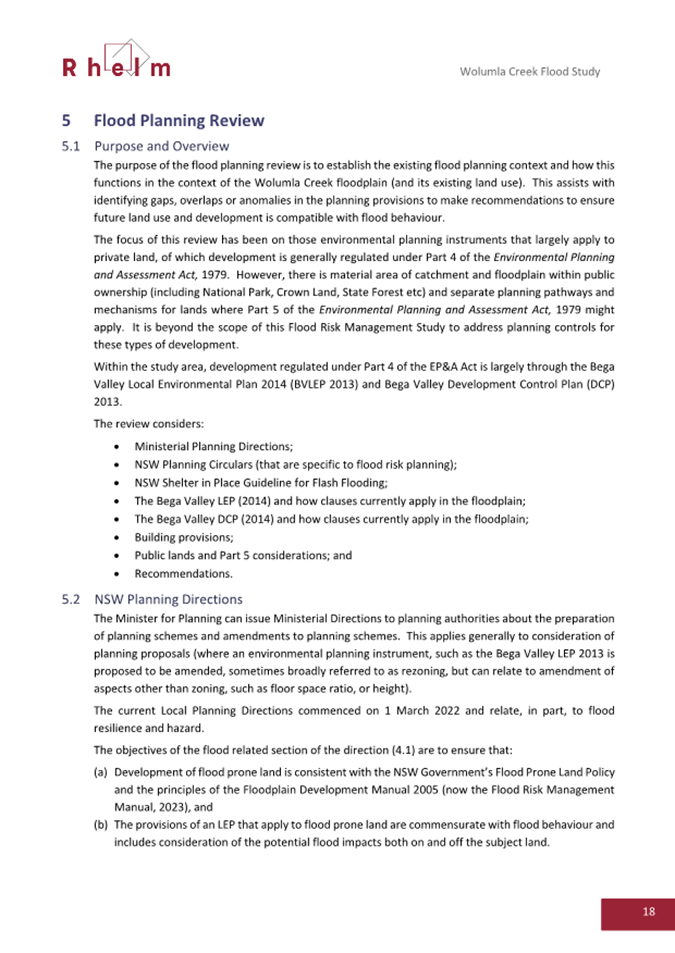
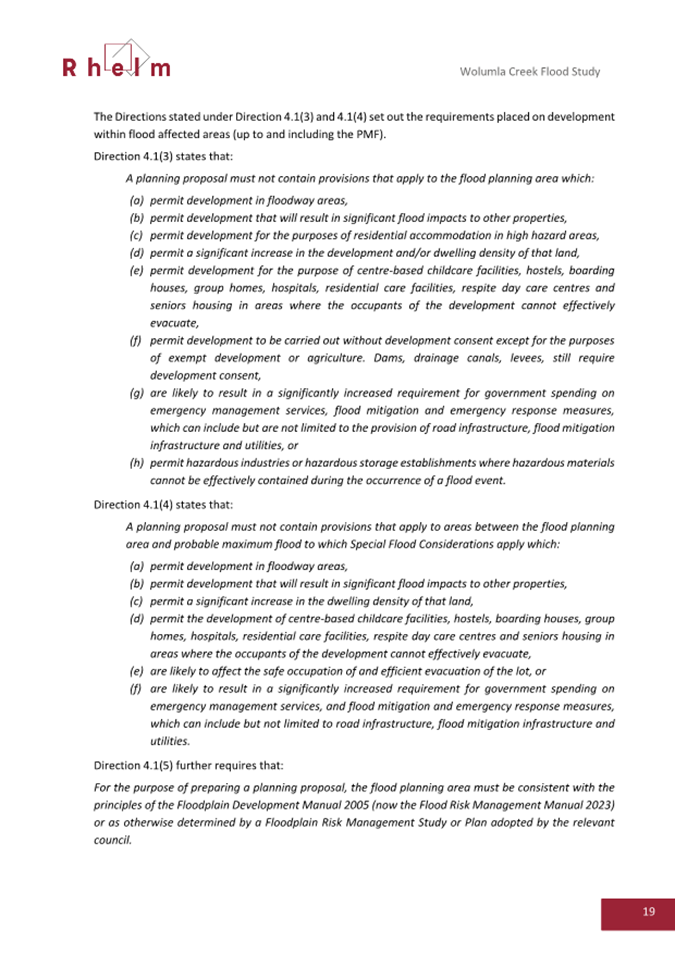
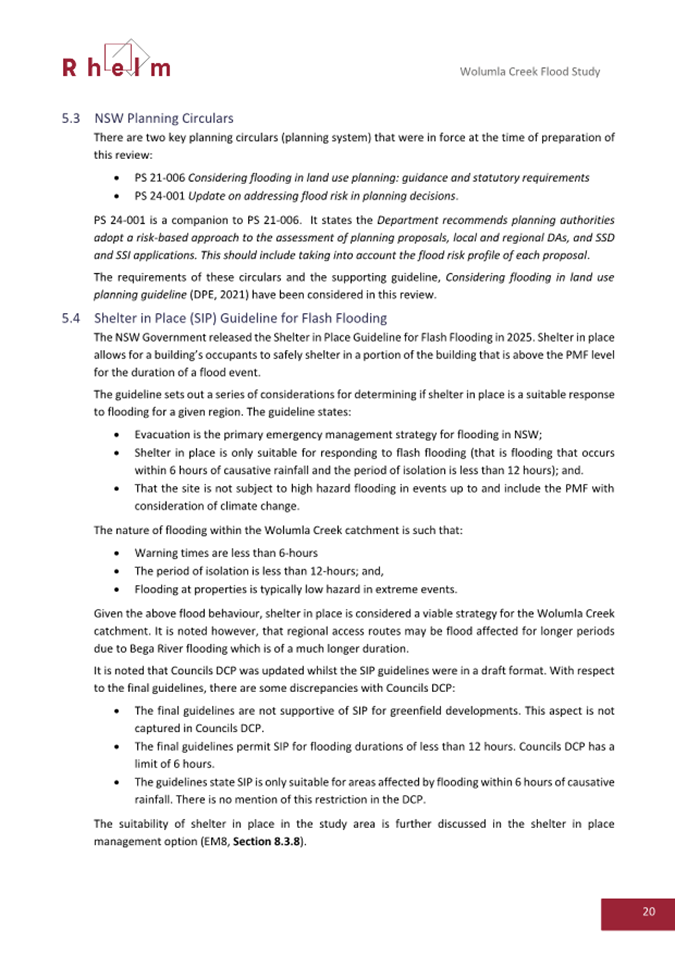
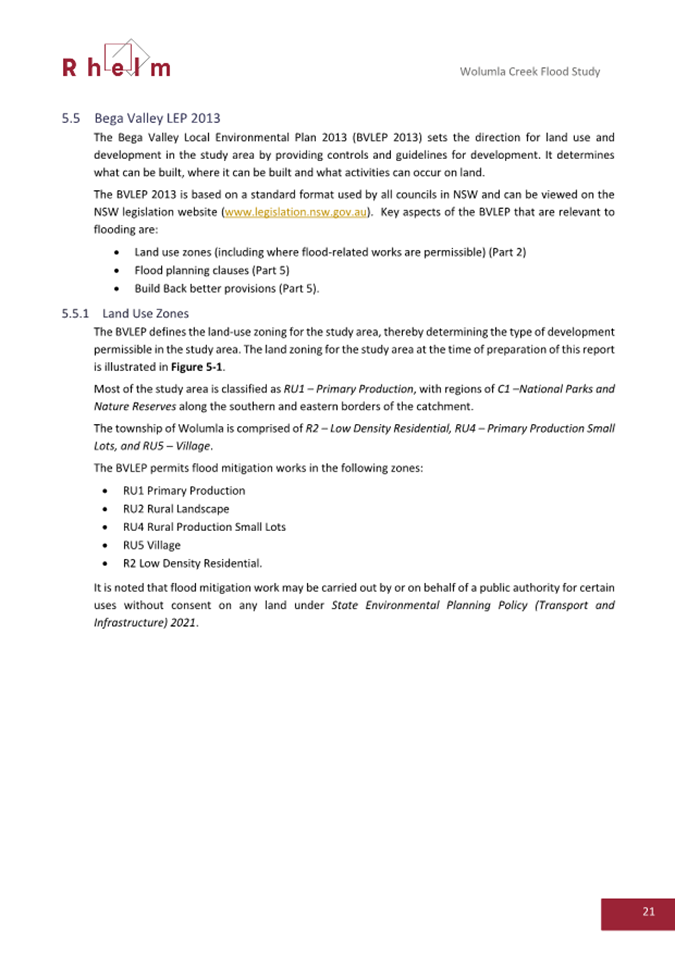
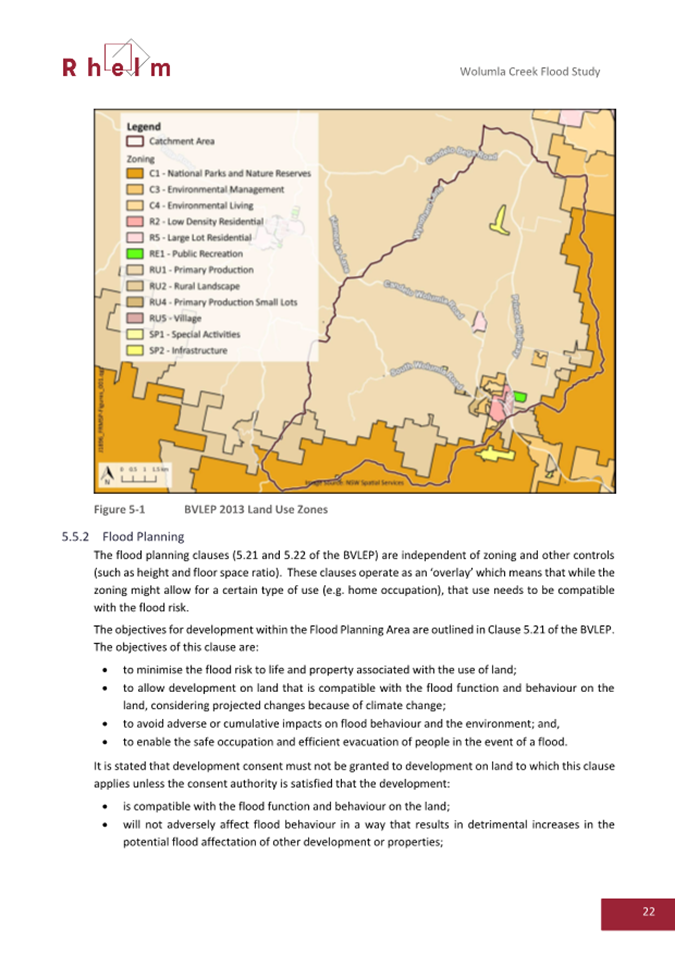
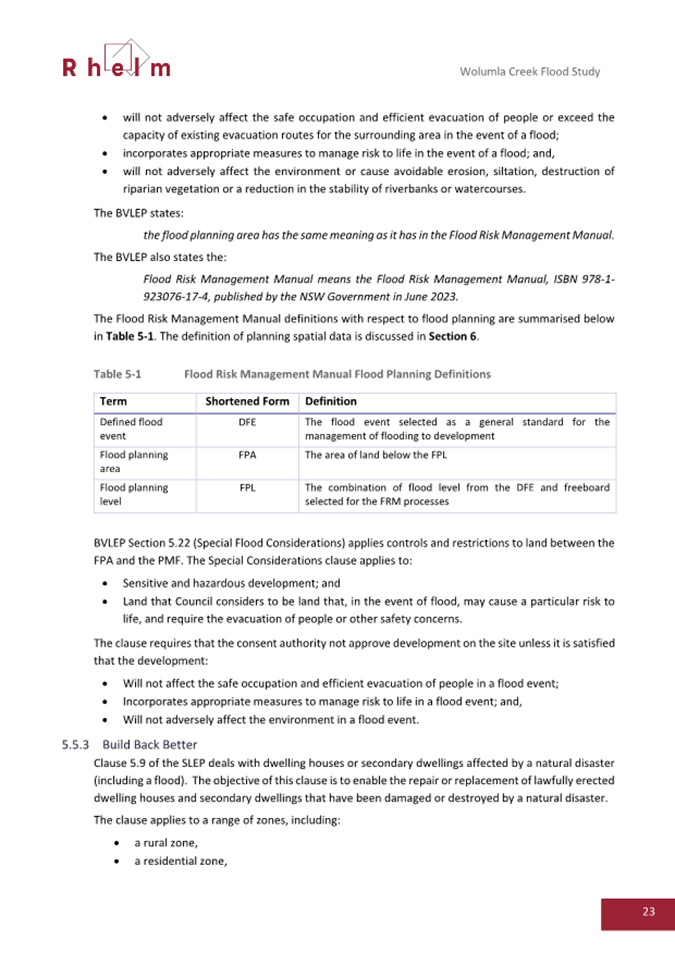
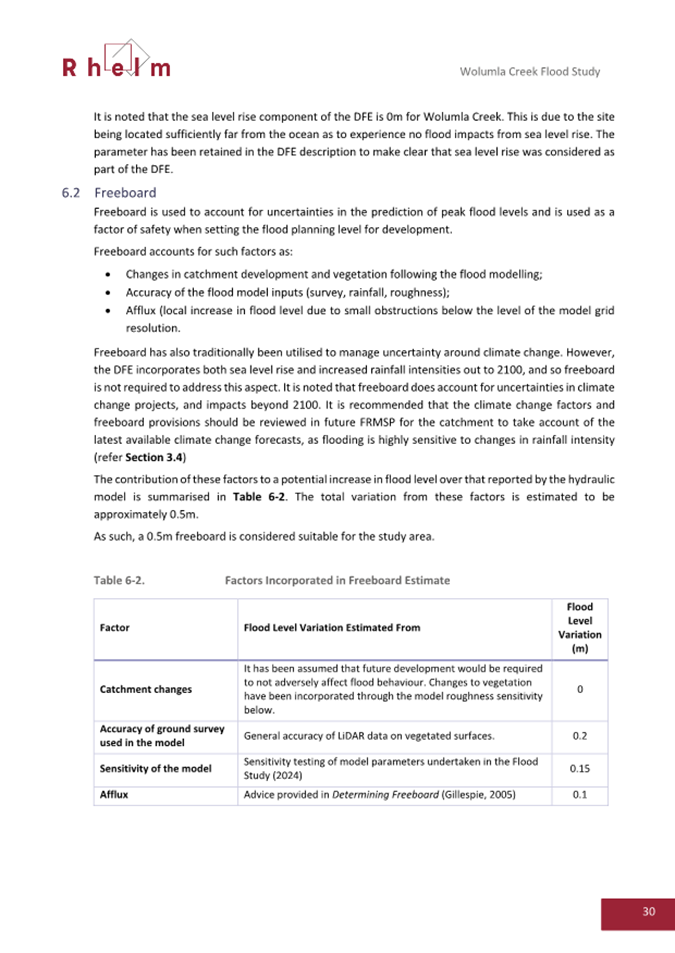
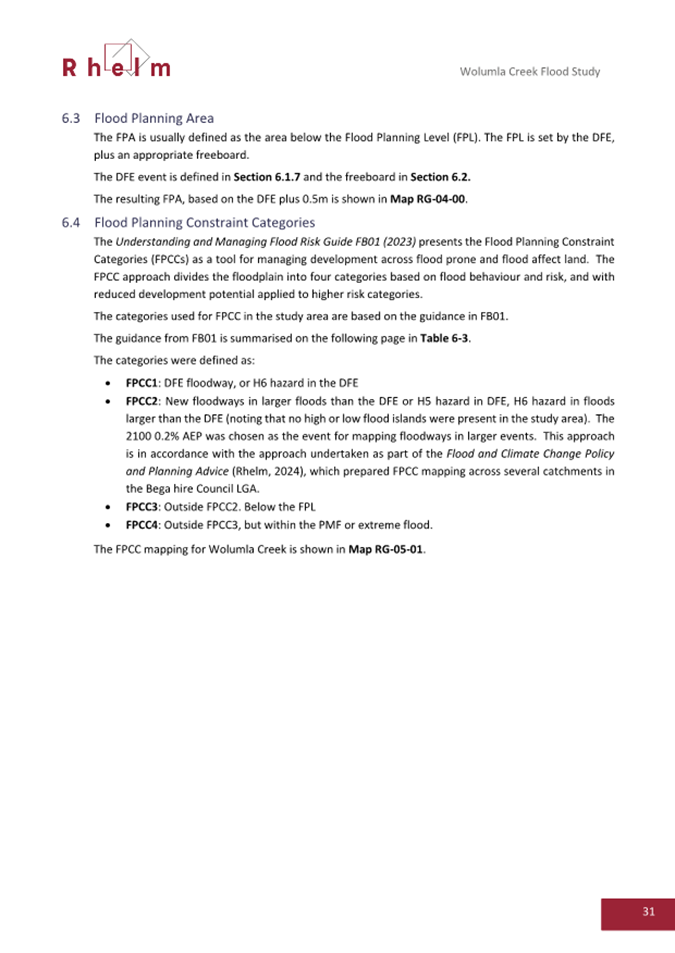
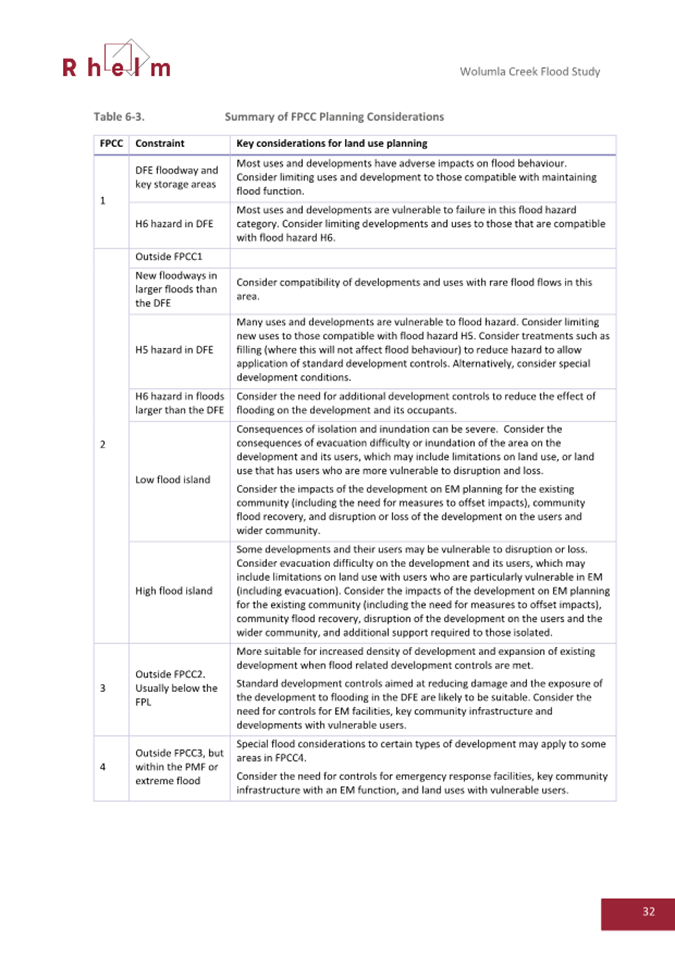
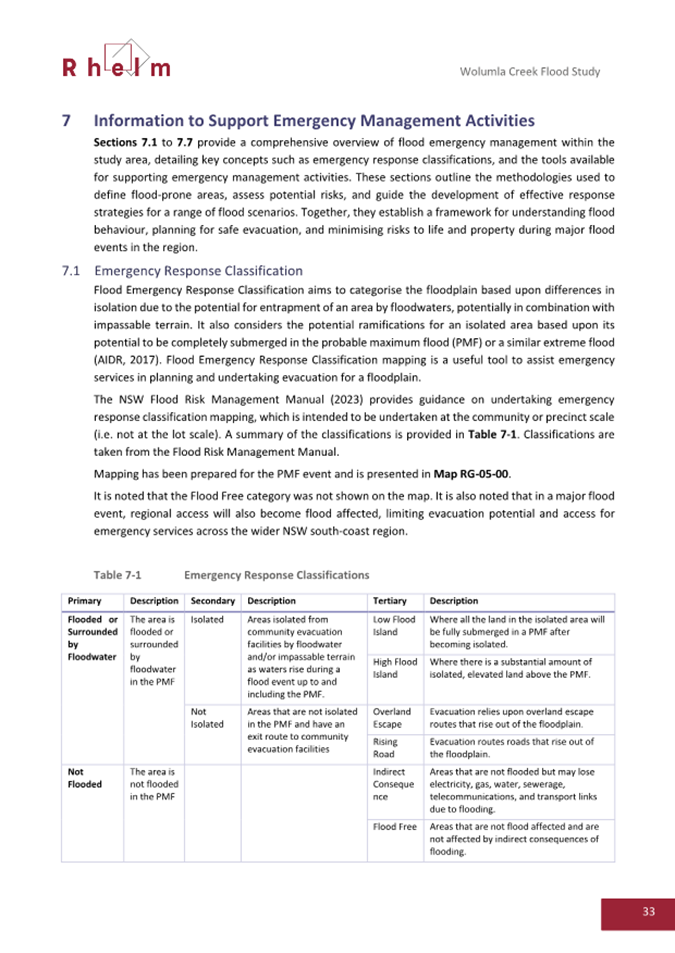
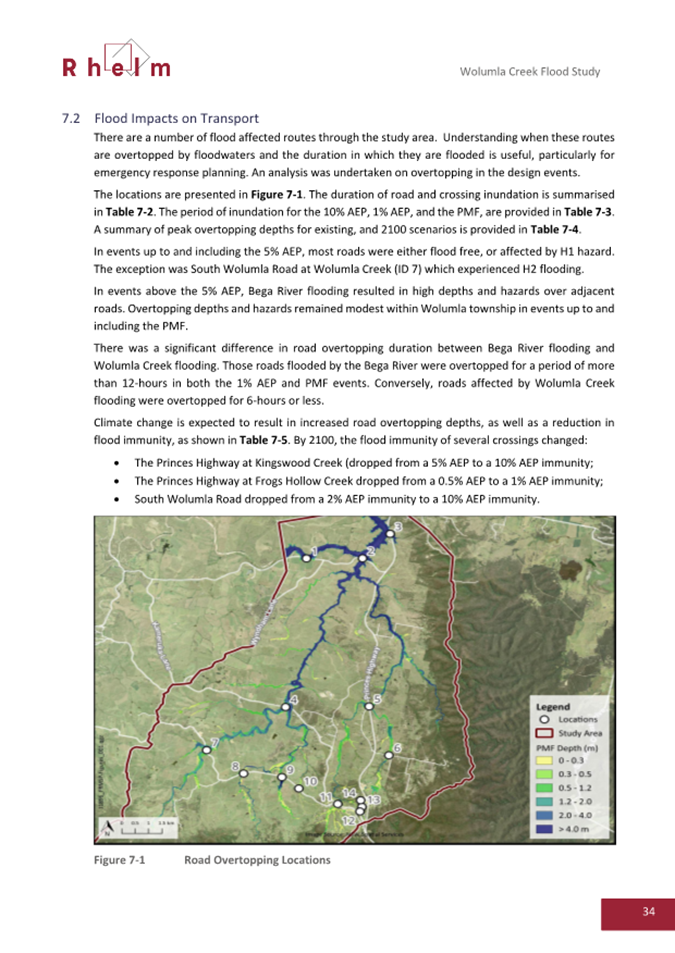
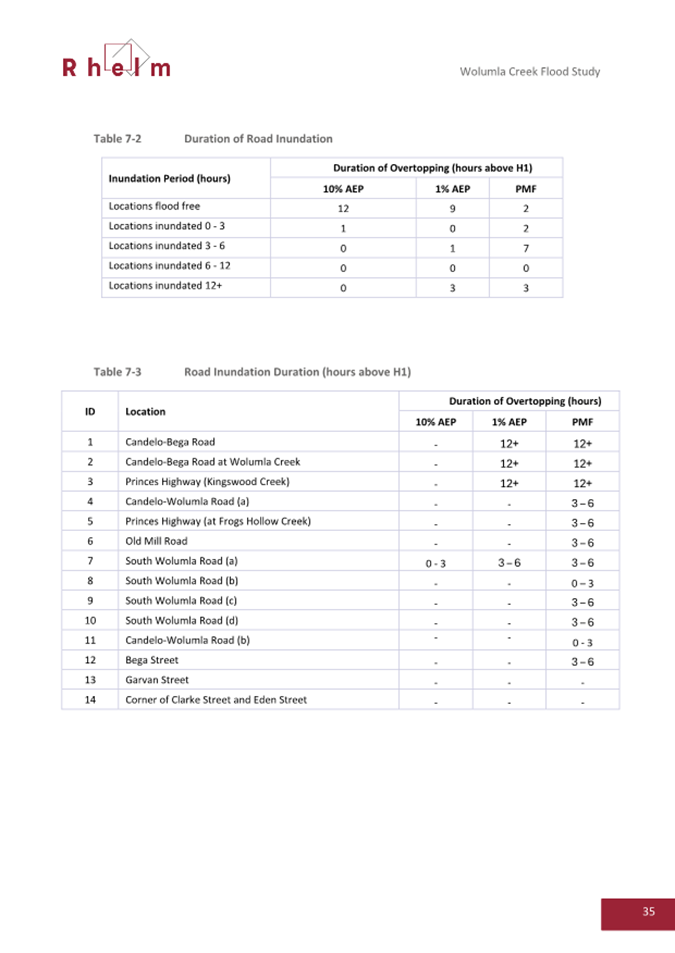
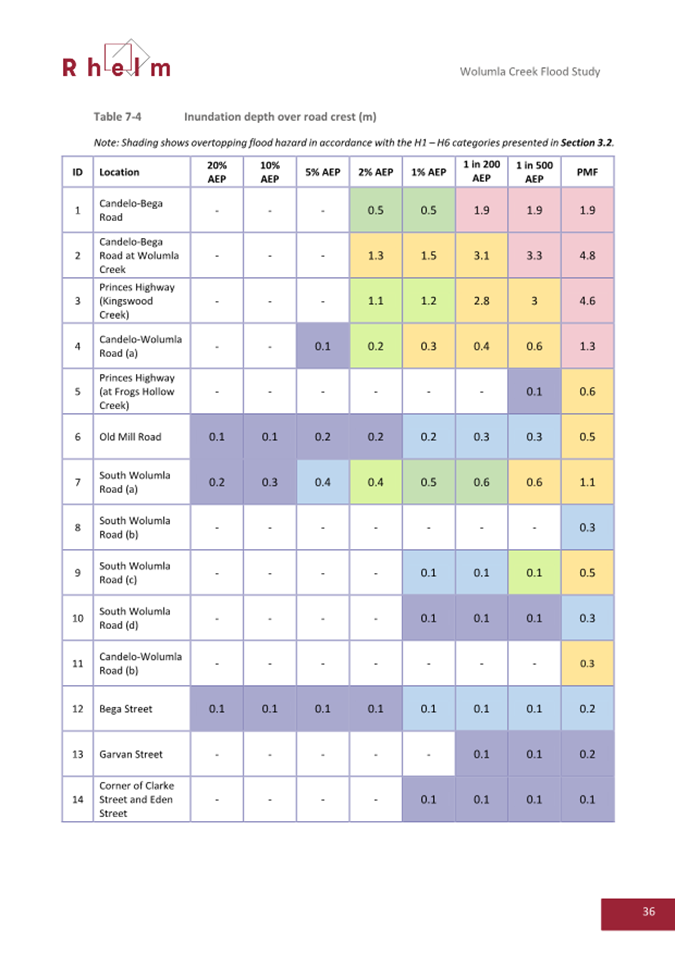
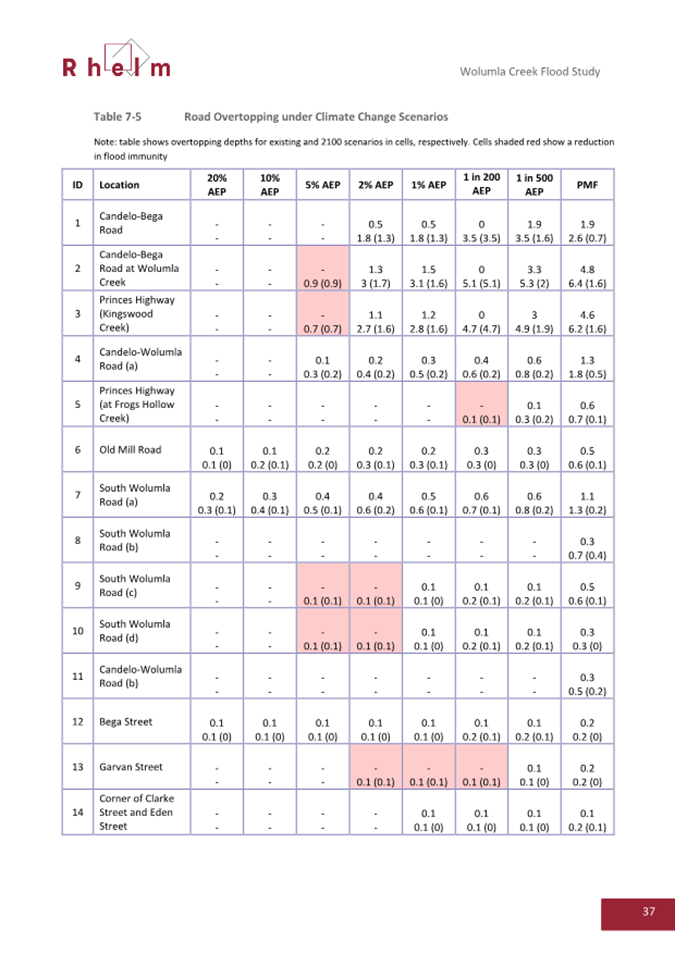
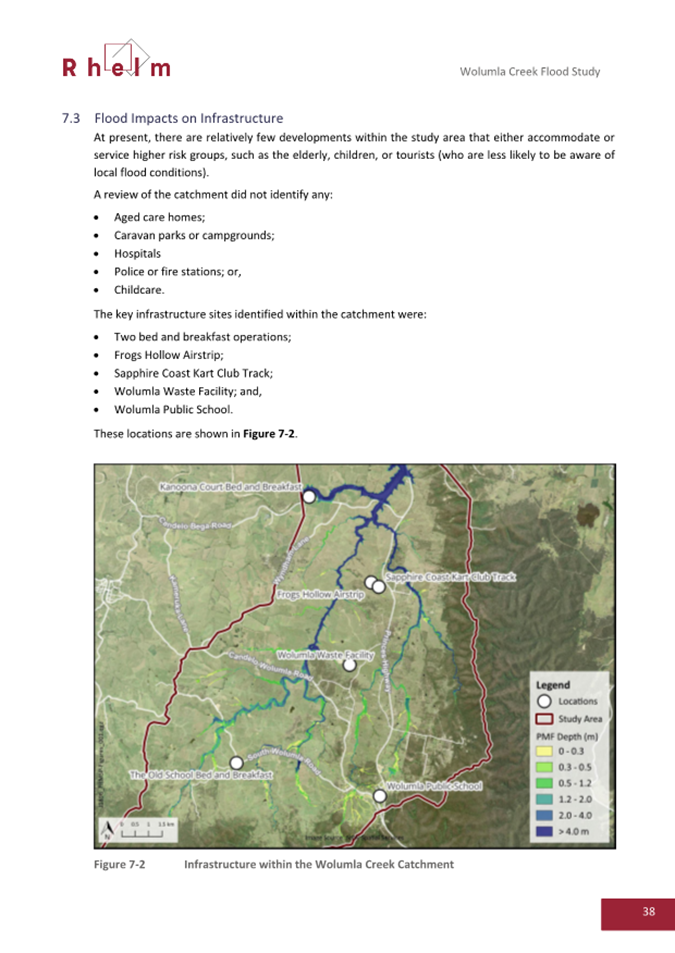
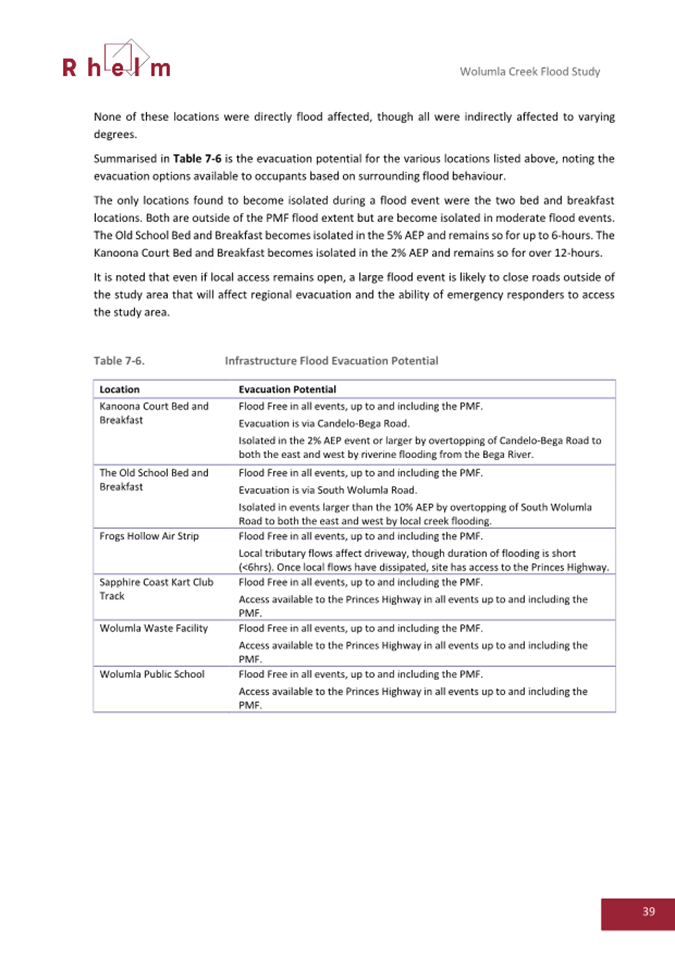
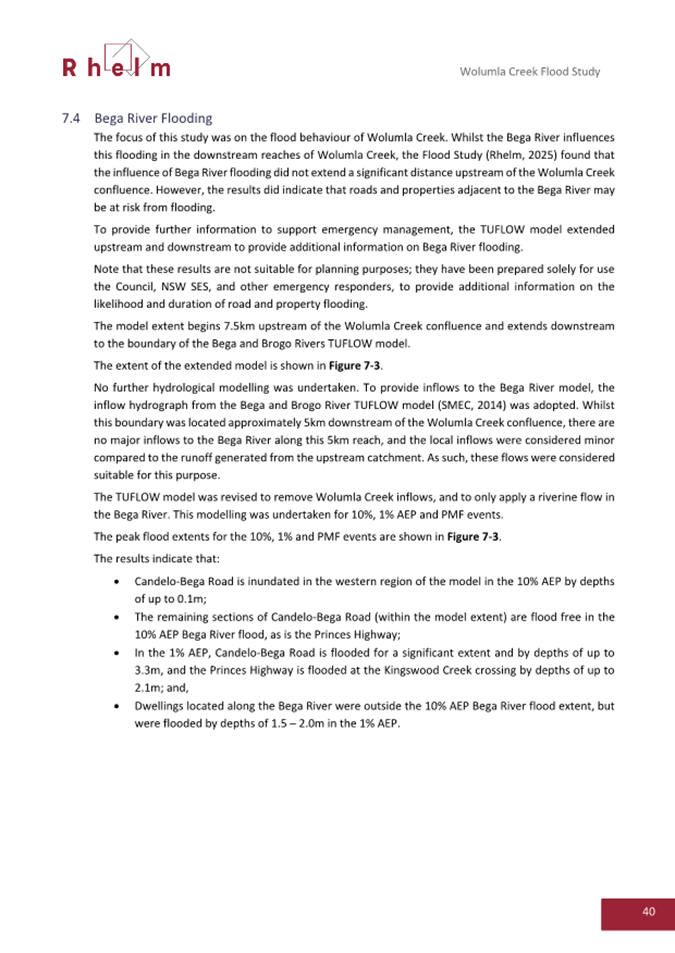
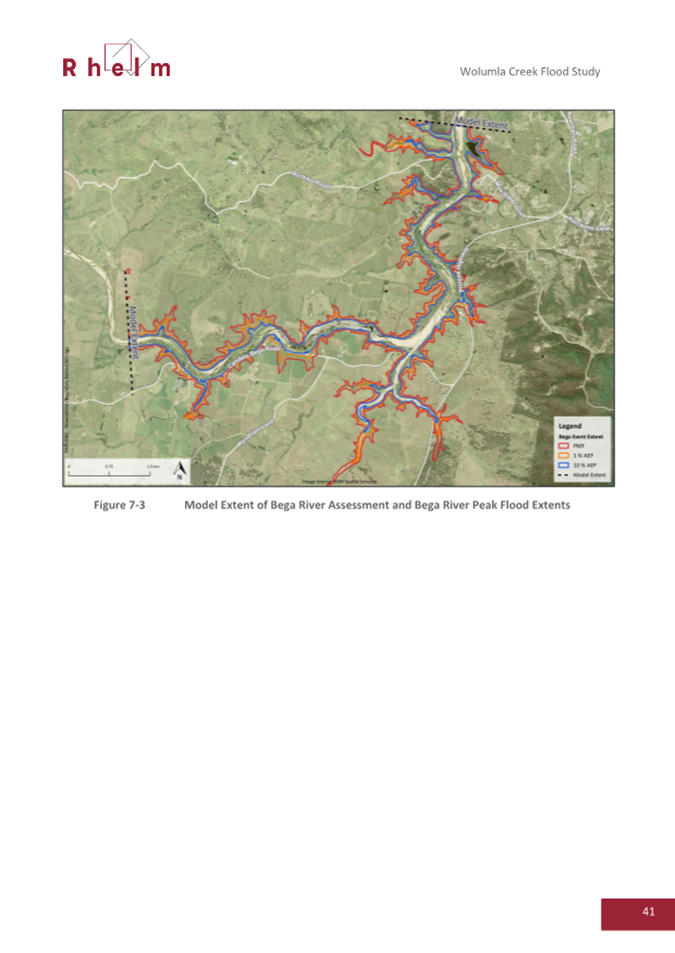
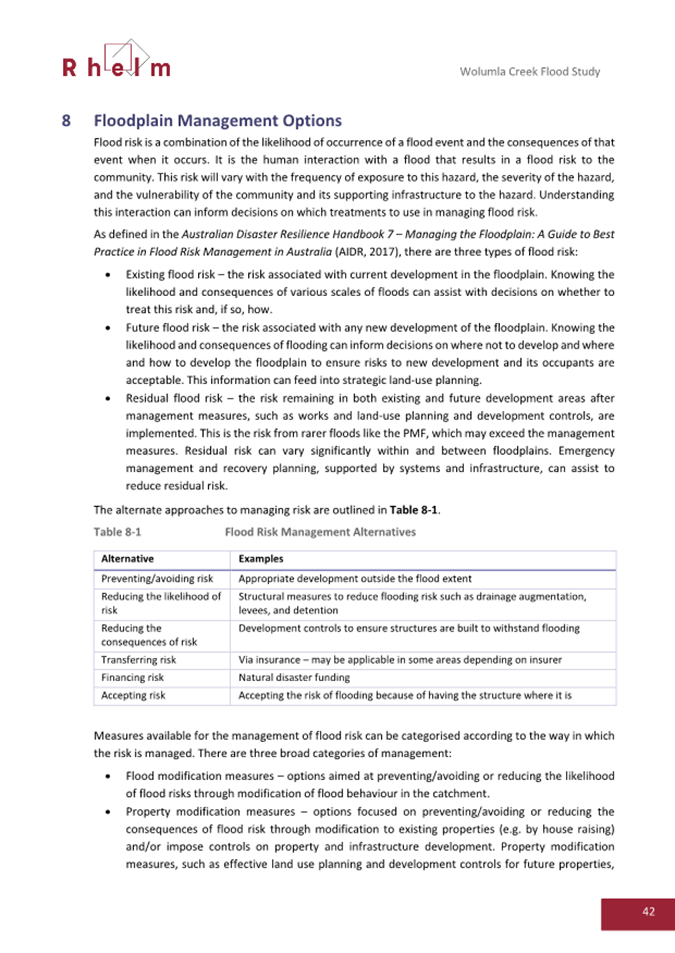
|
Council
|
28 January 2026
|
|
Item 9.2 - Attachment 3
|
Draft Wolumla Floodplain Risk Management Study and Plan Map
Compendium for public exhibition
|
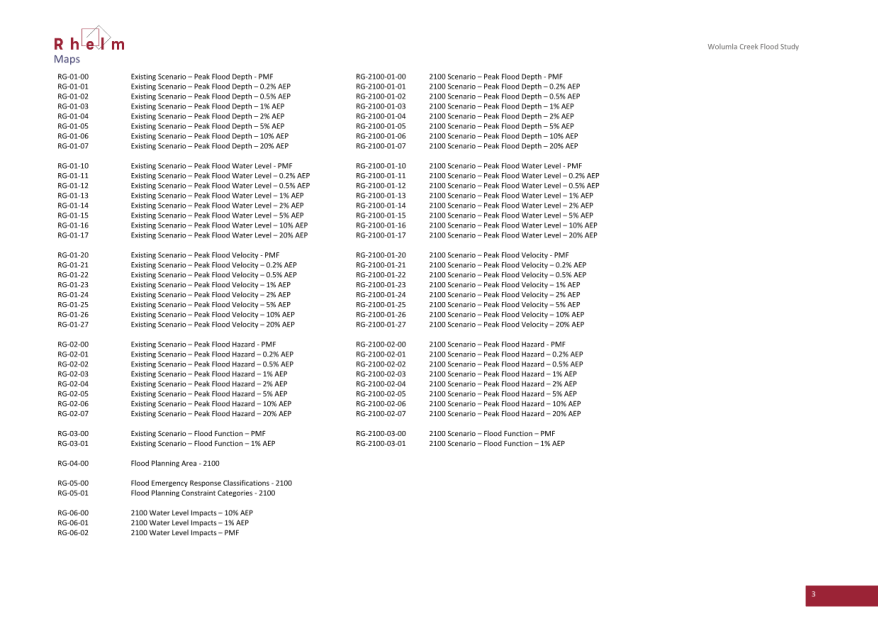
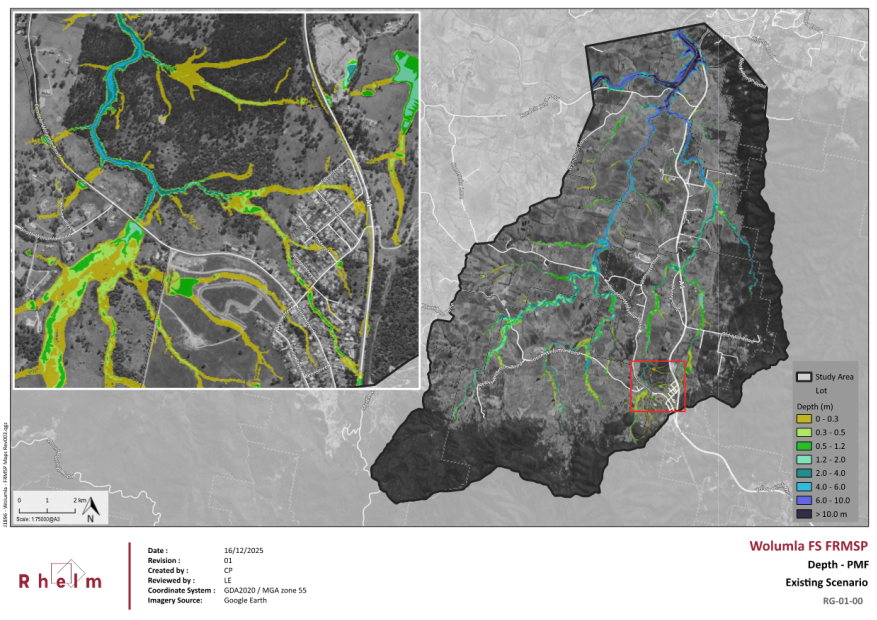
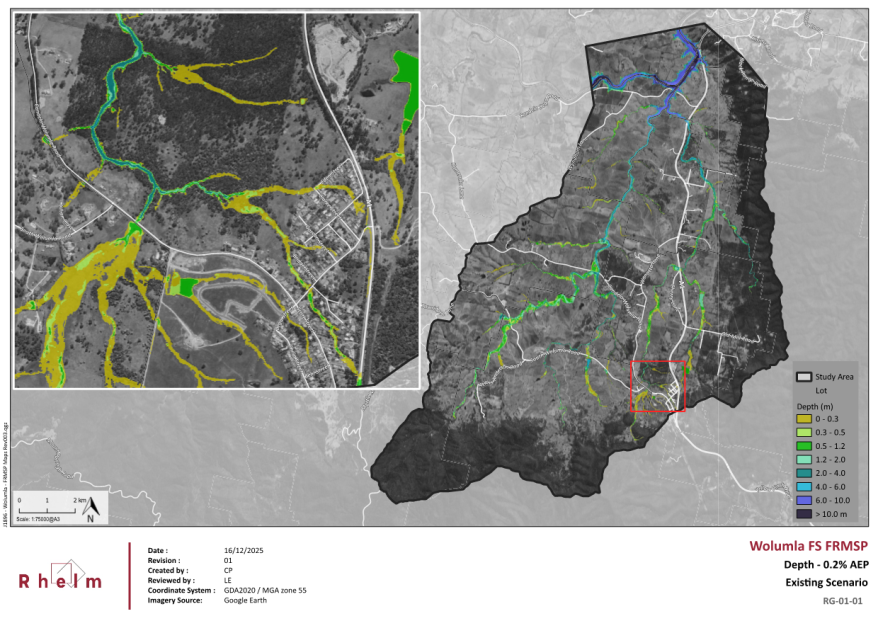
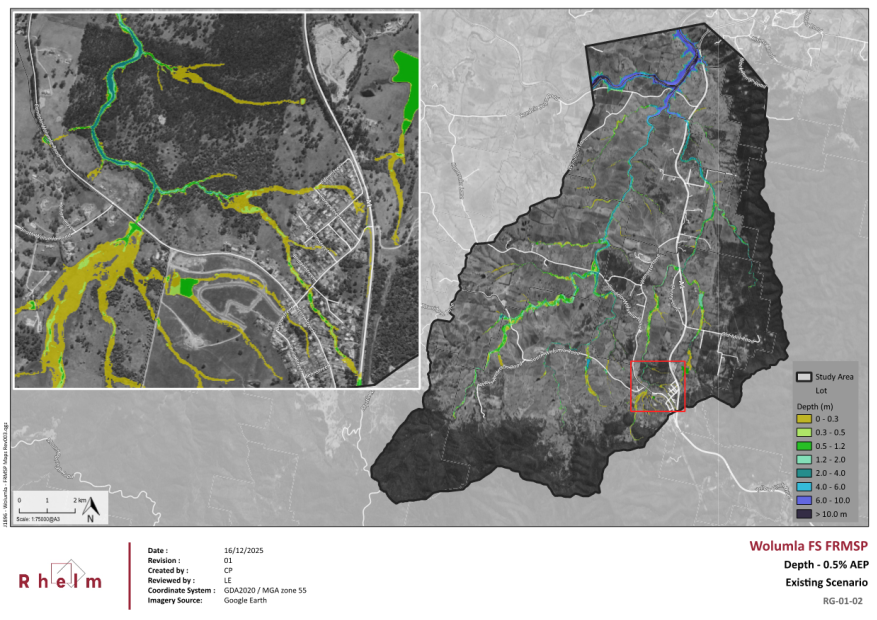
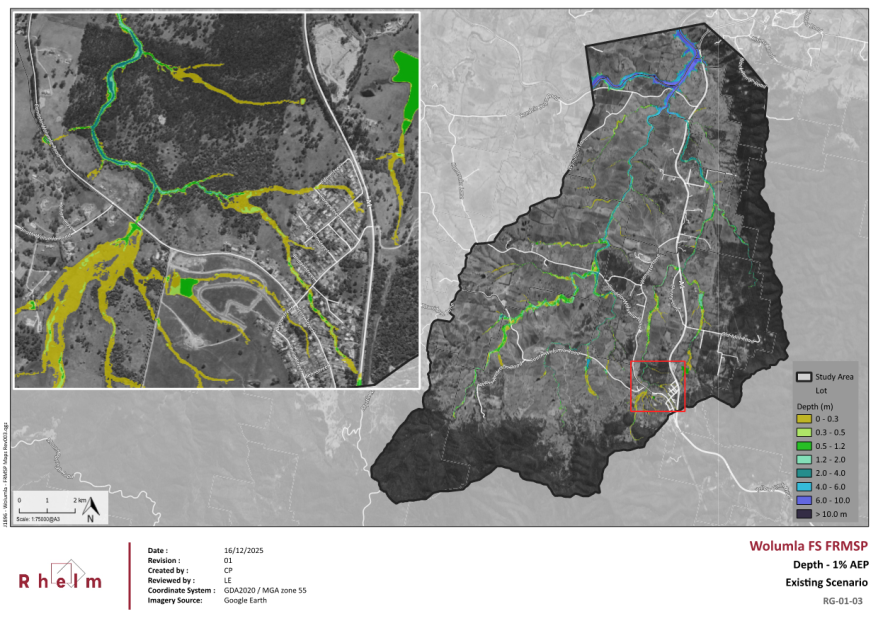
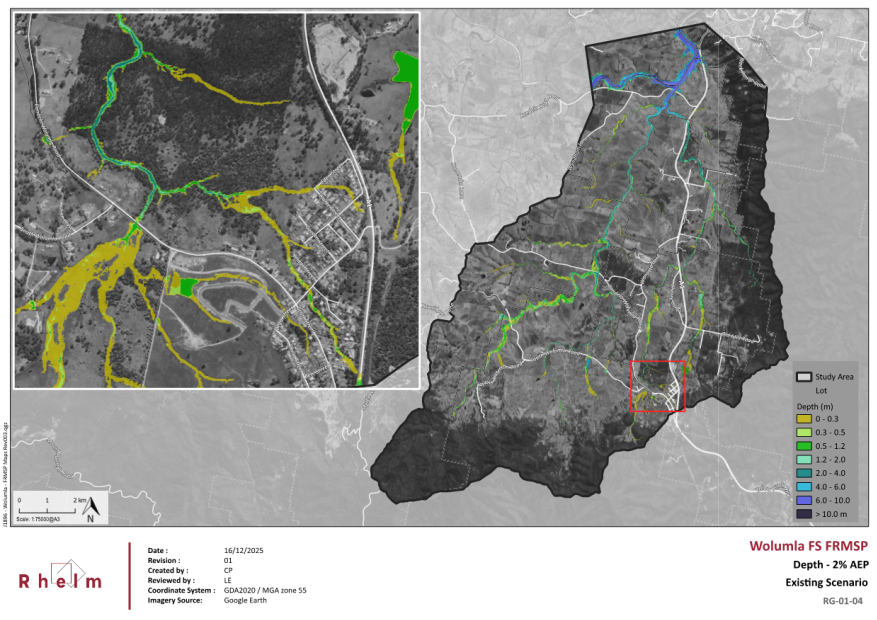
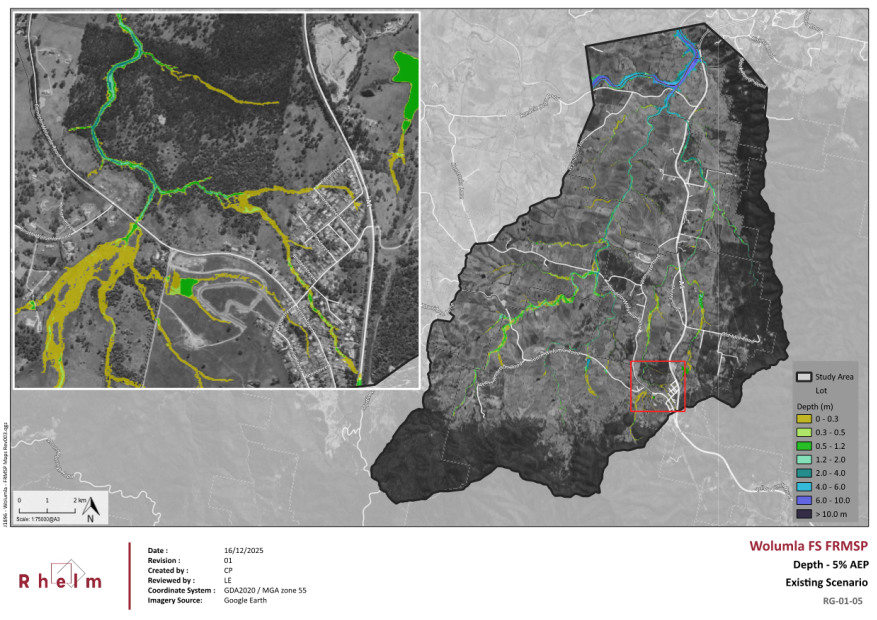
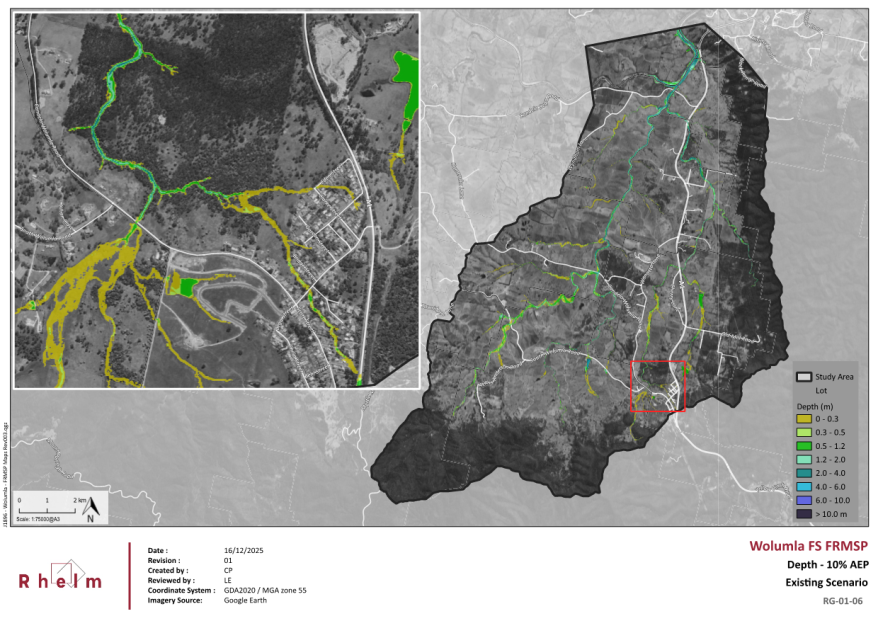
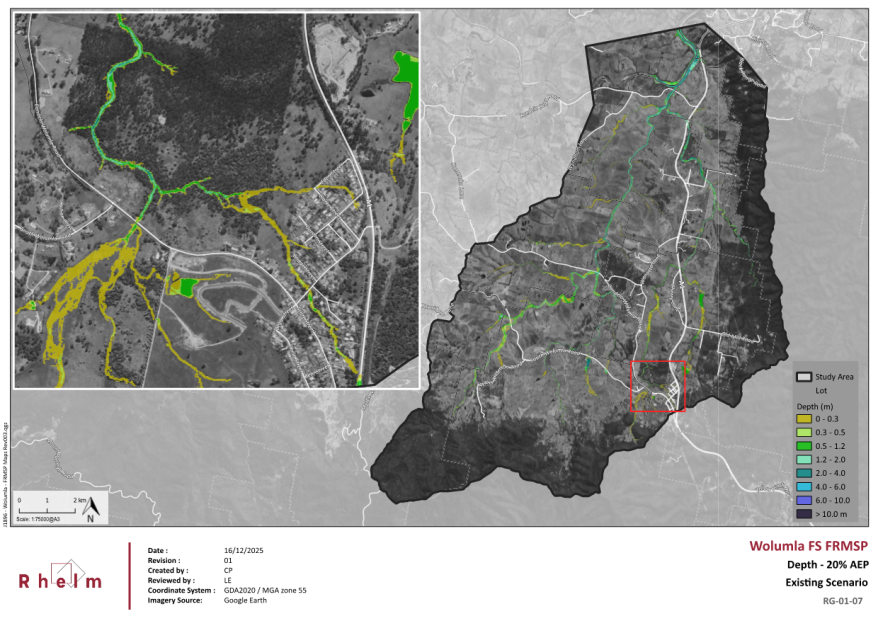
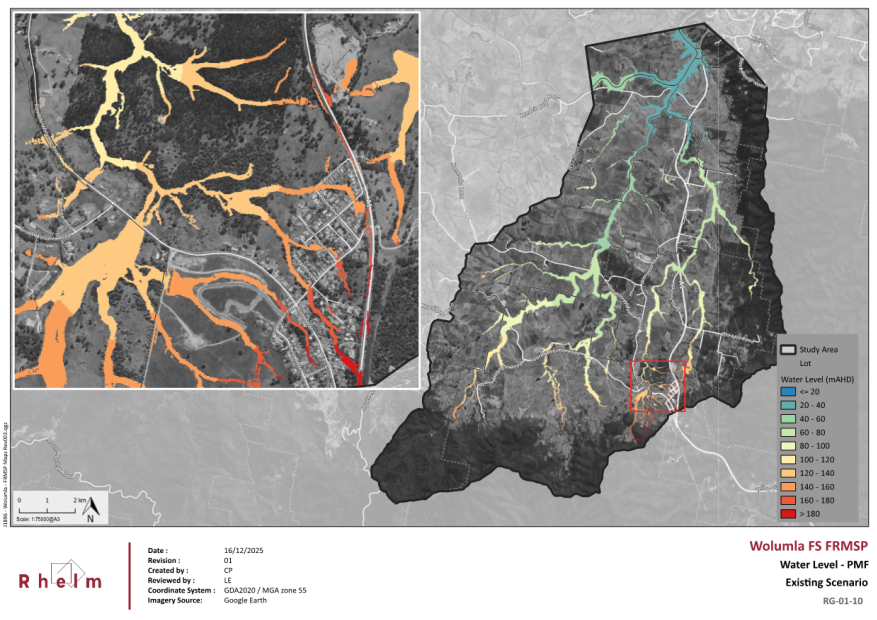
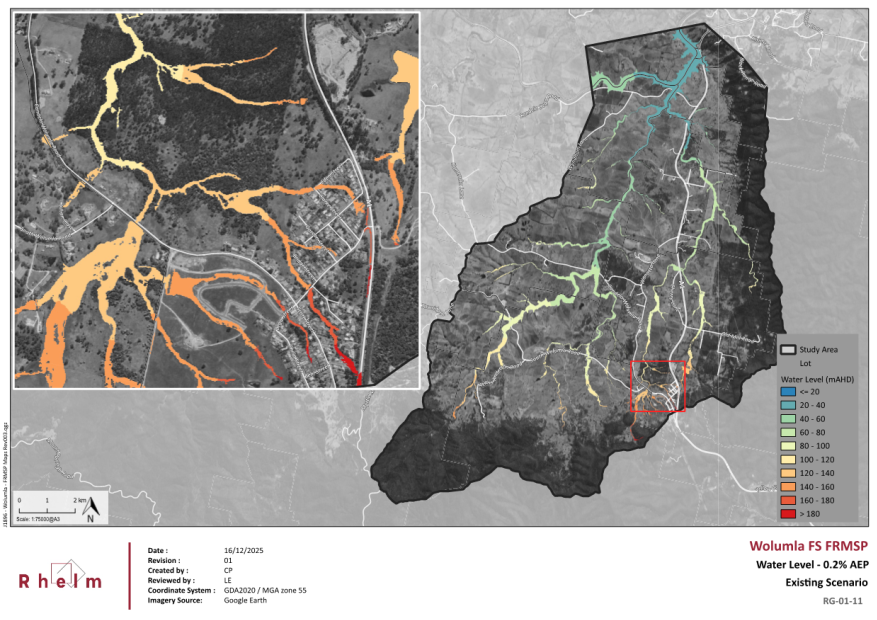
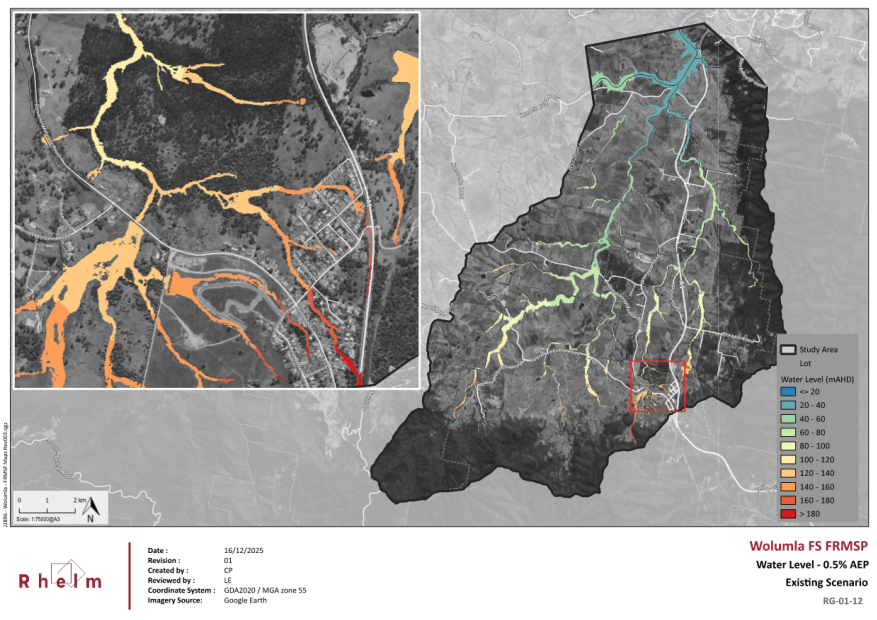
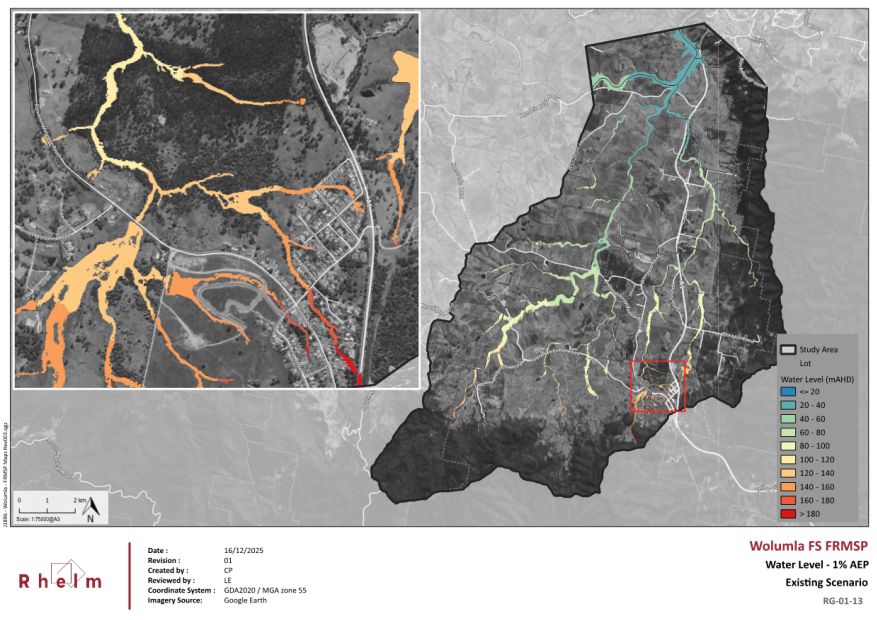
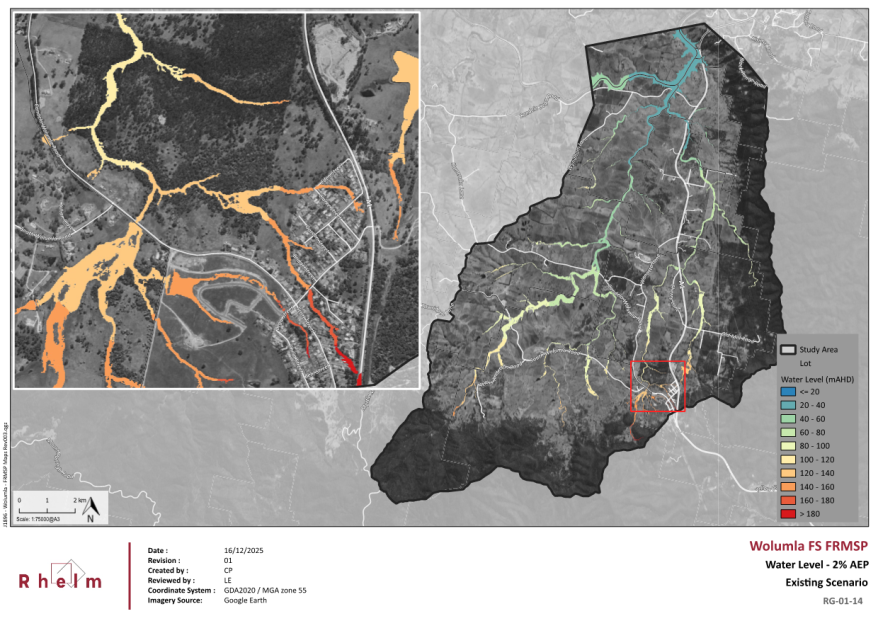
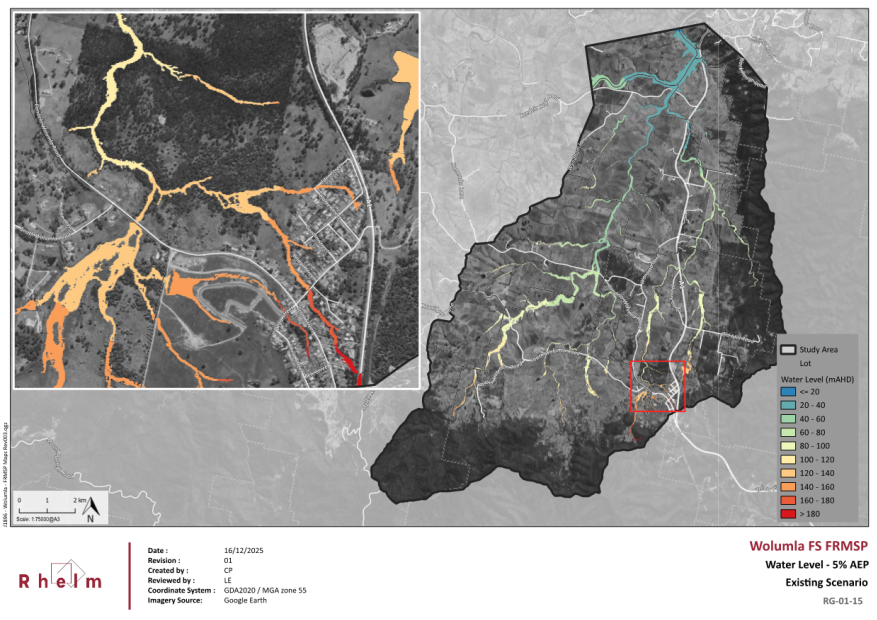
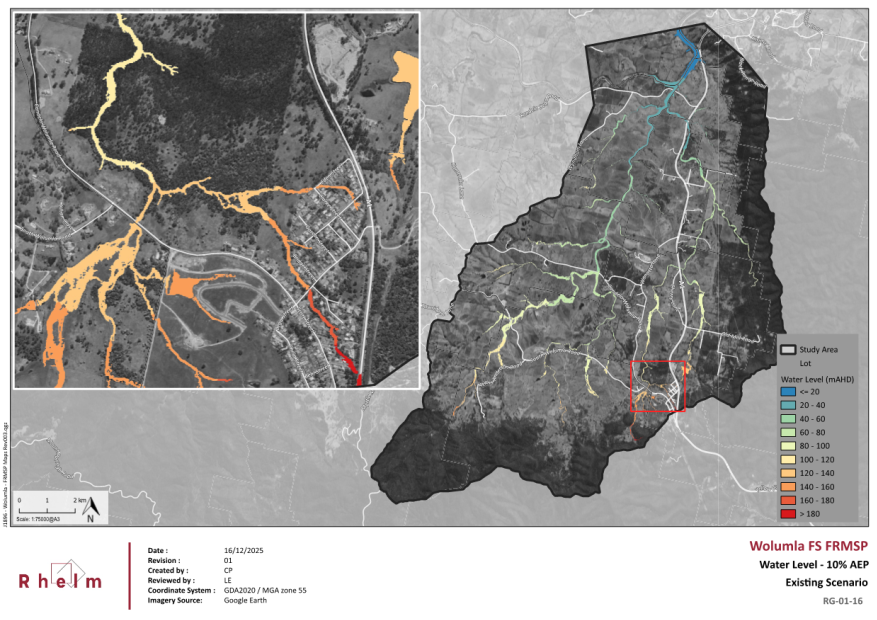
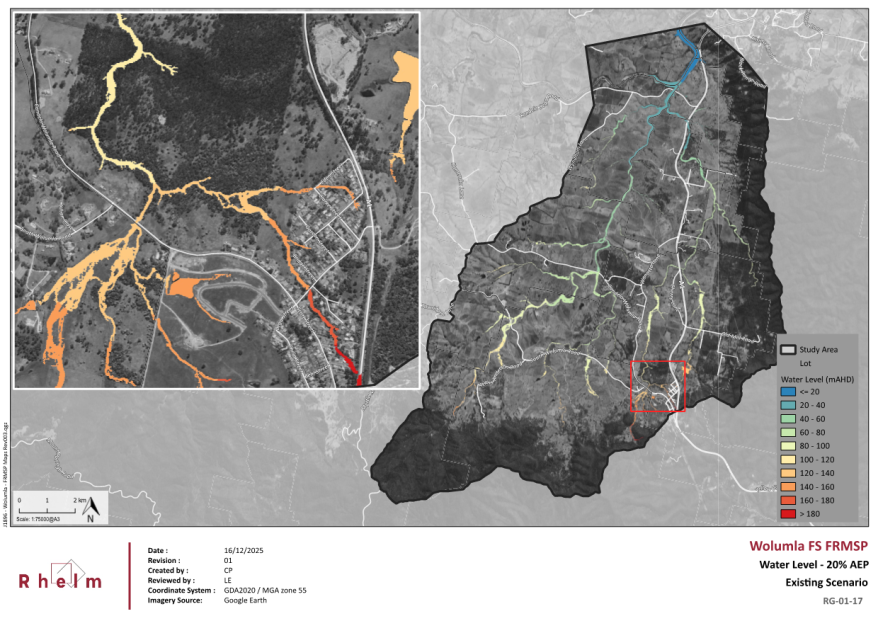
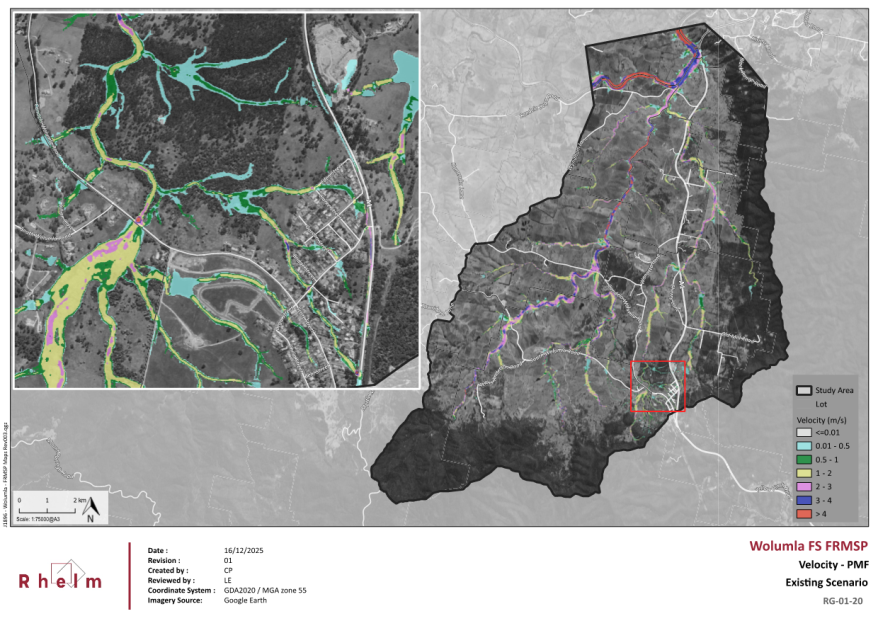
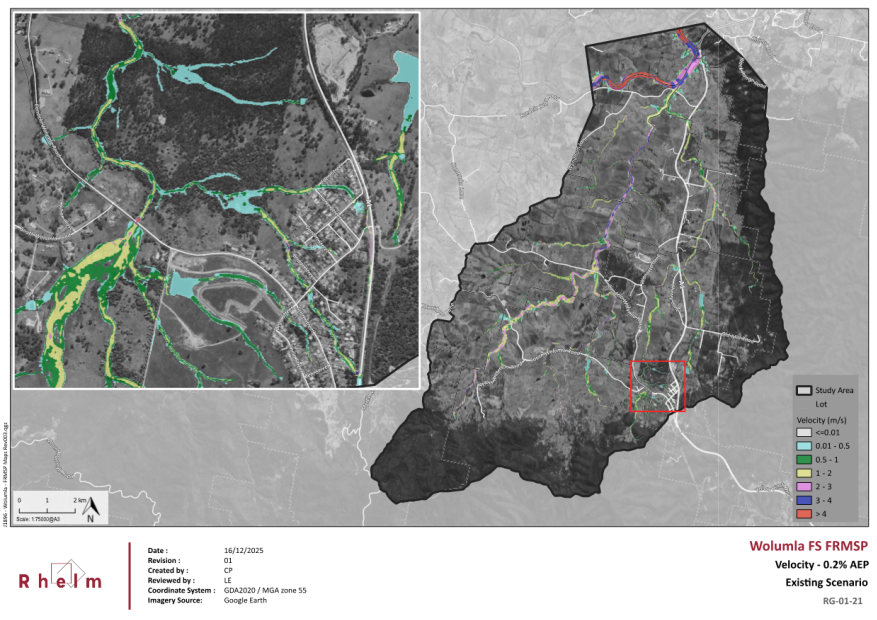
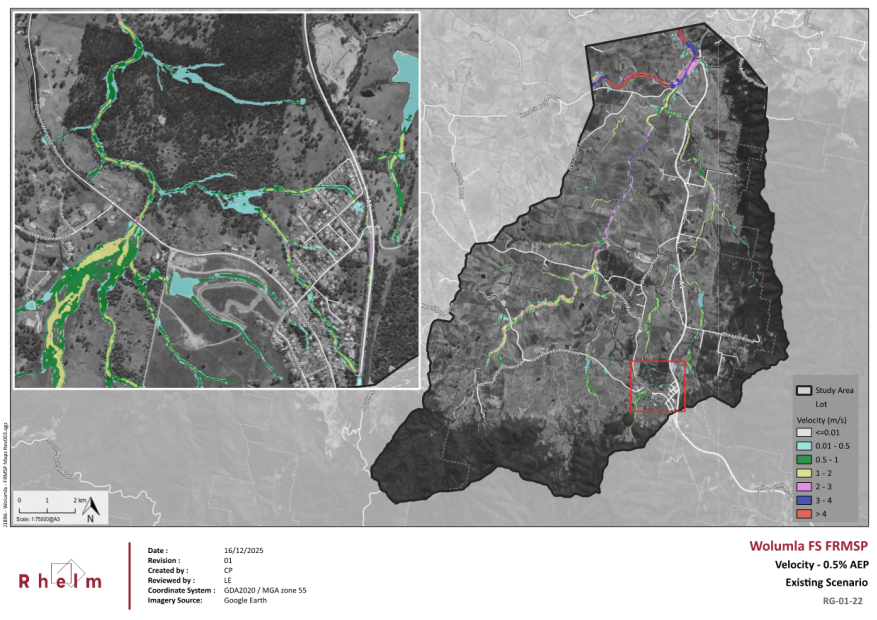
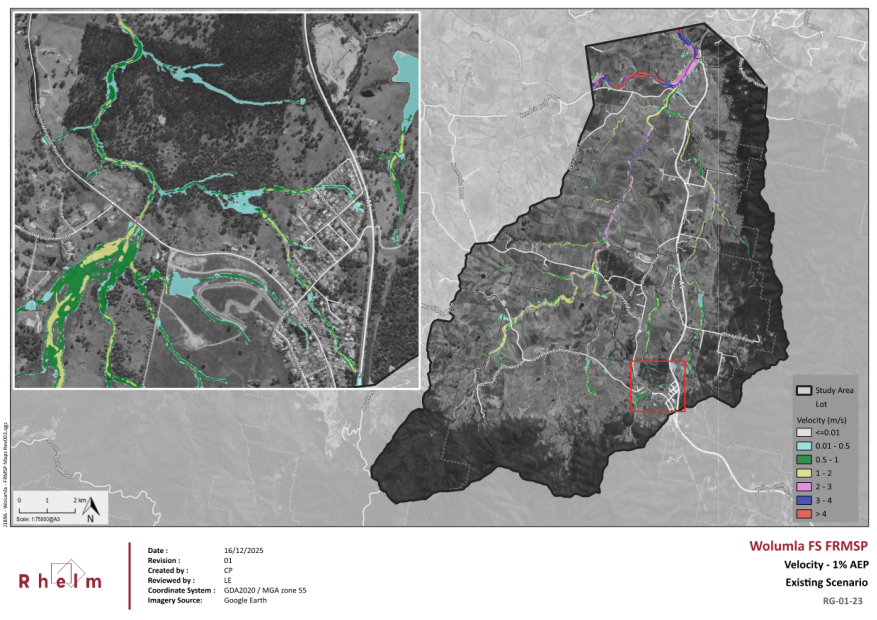
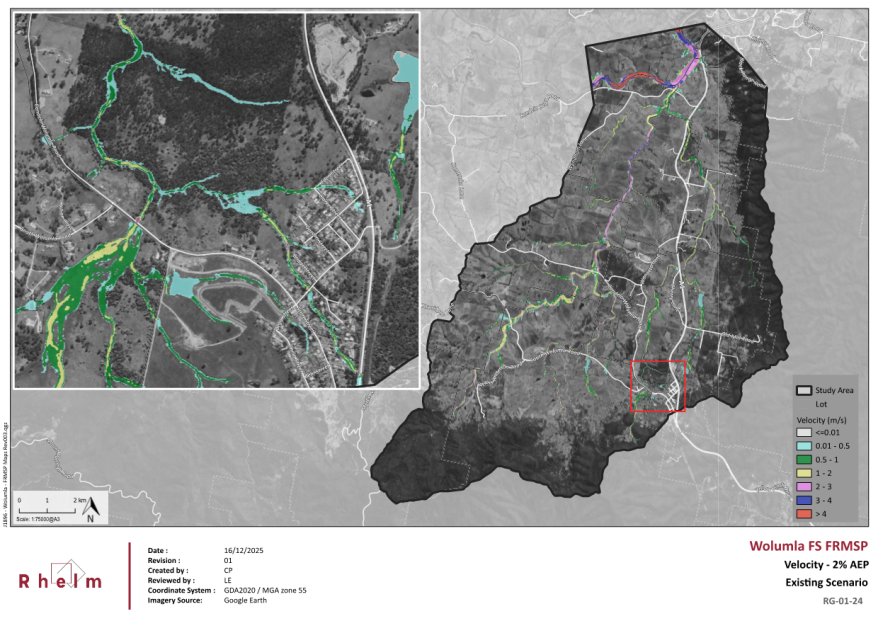
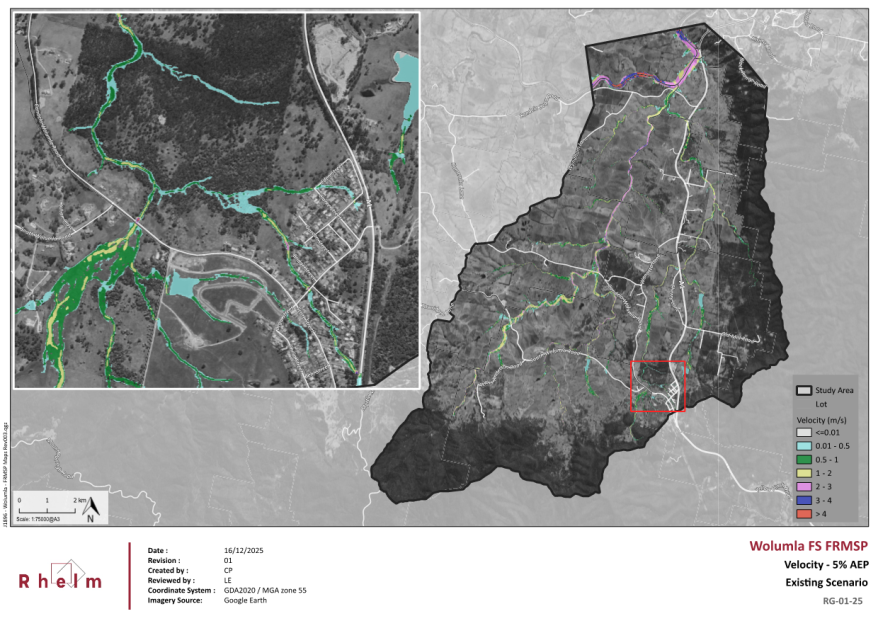
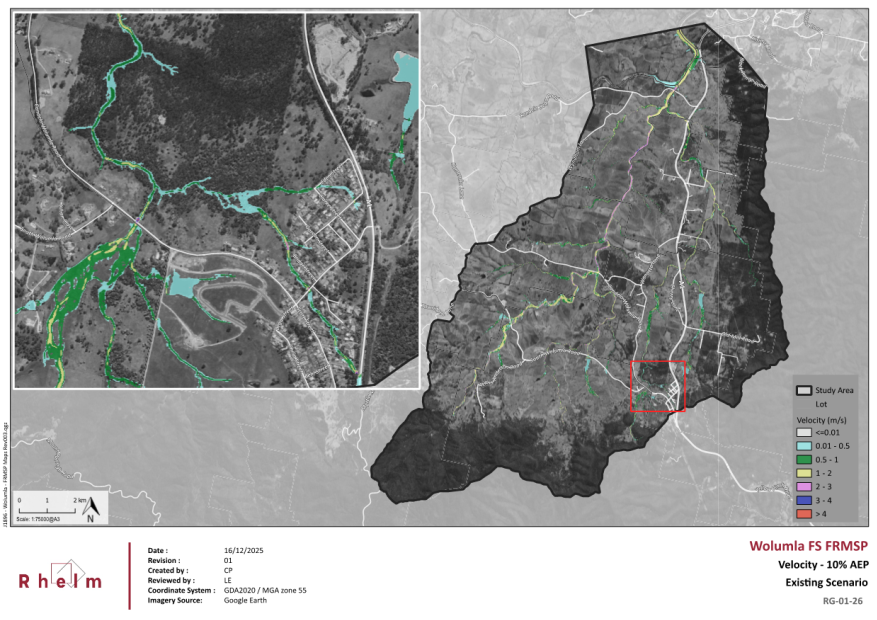
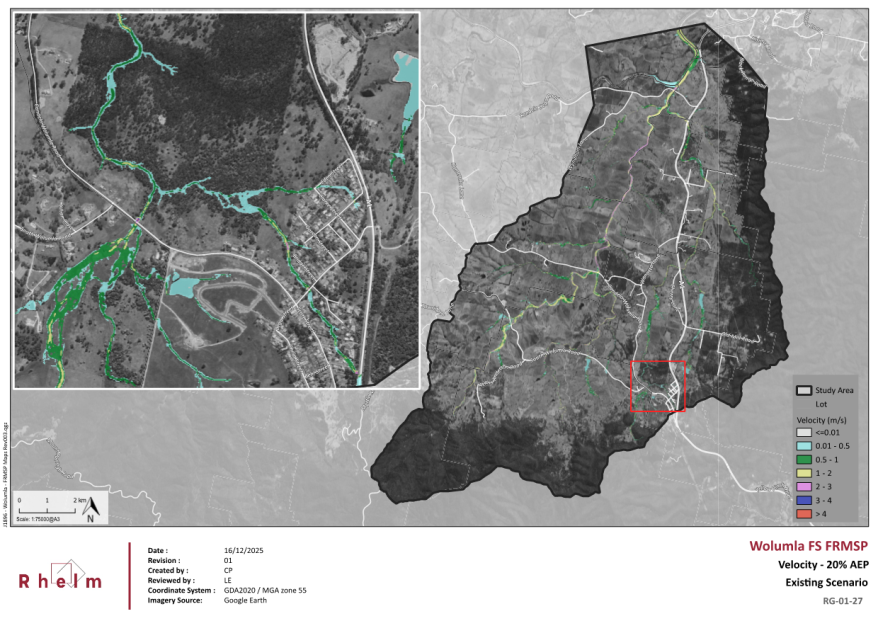
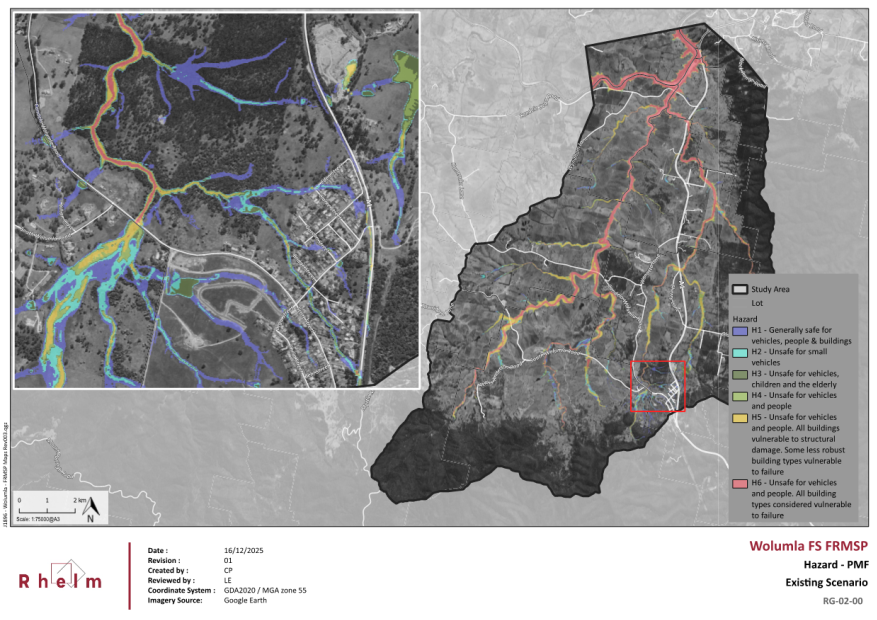
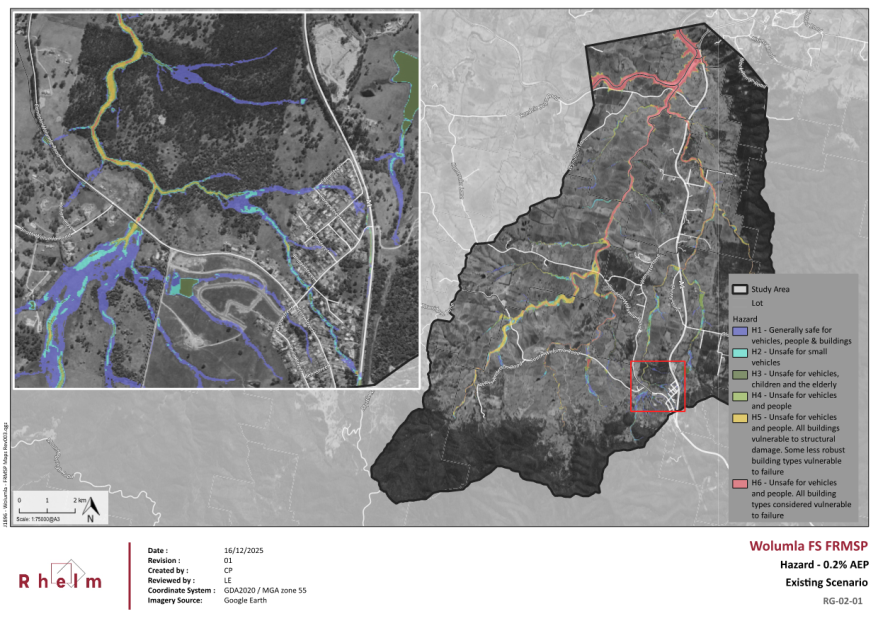
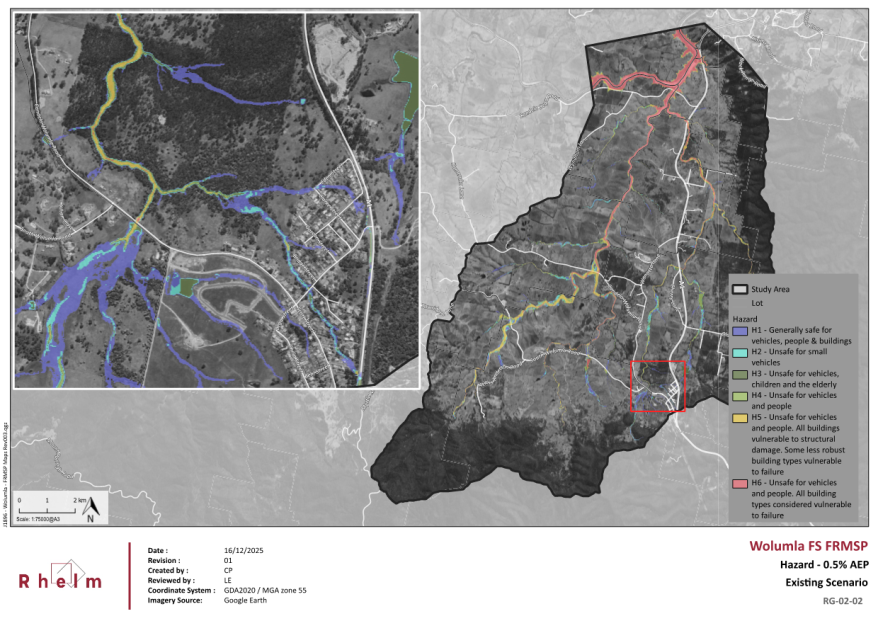
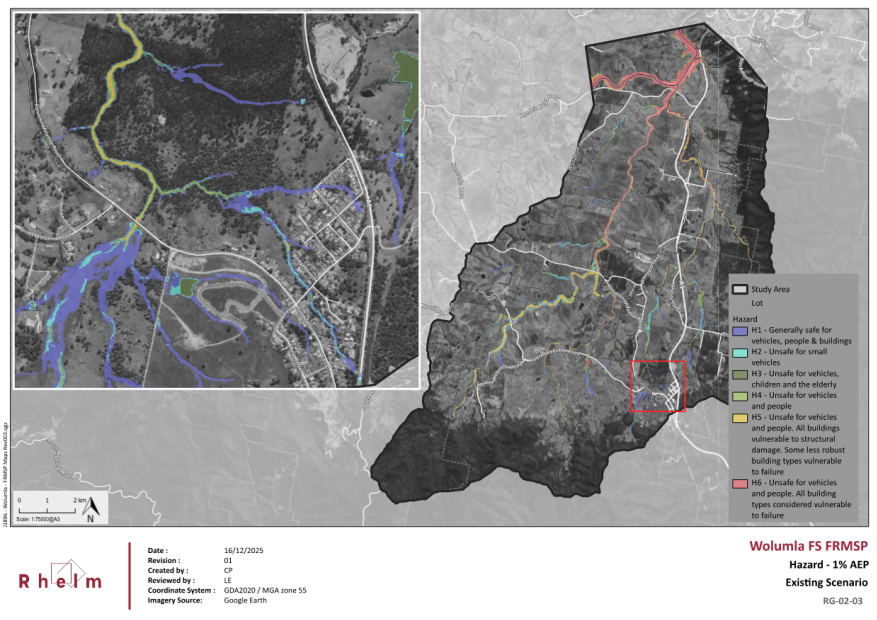
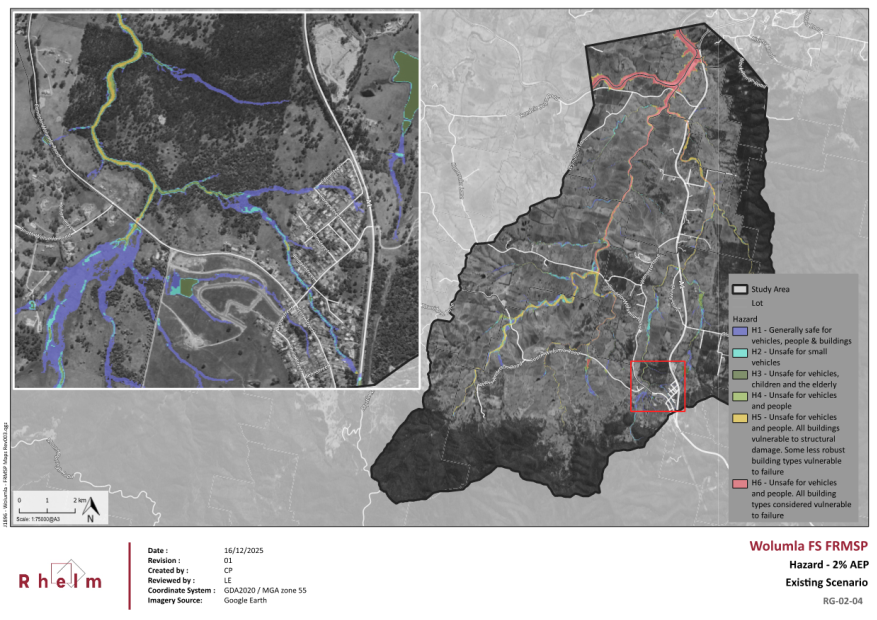
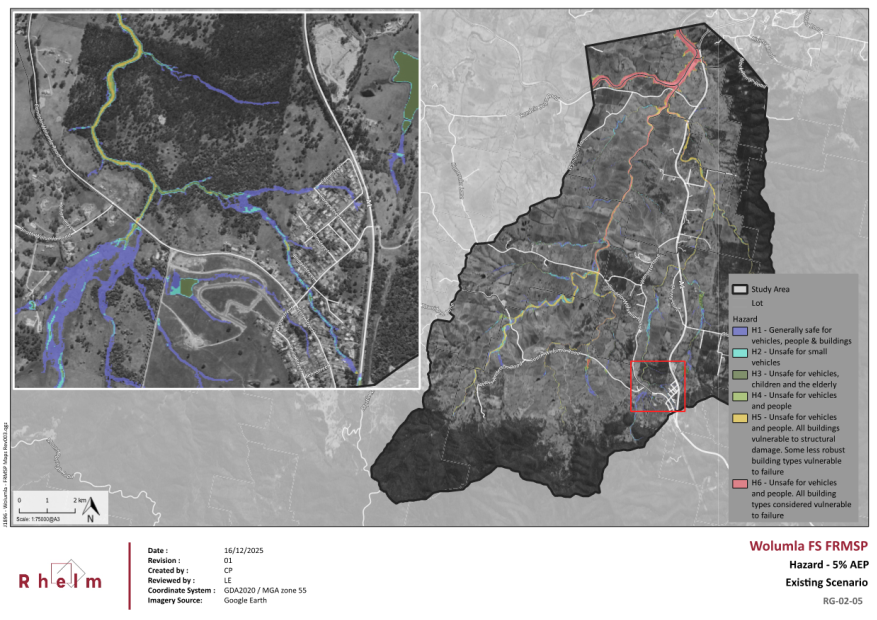
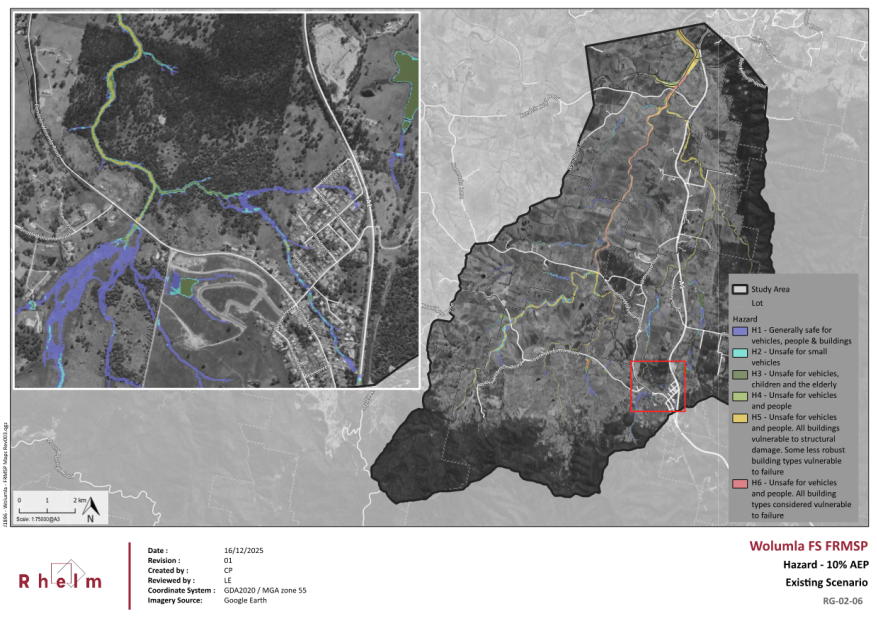
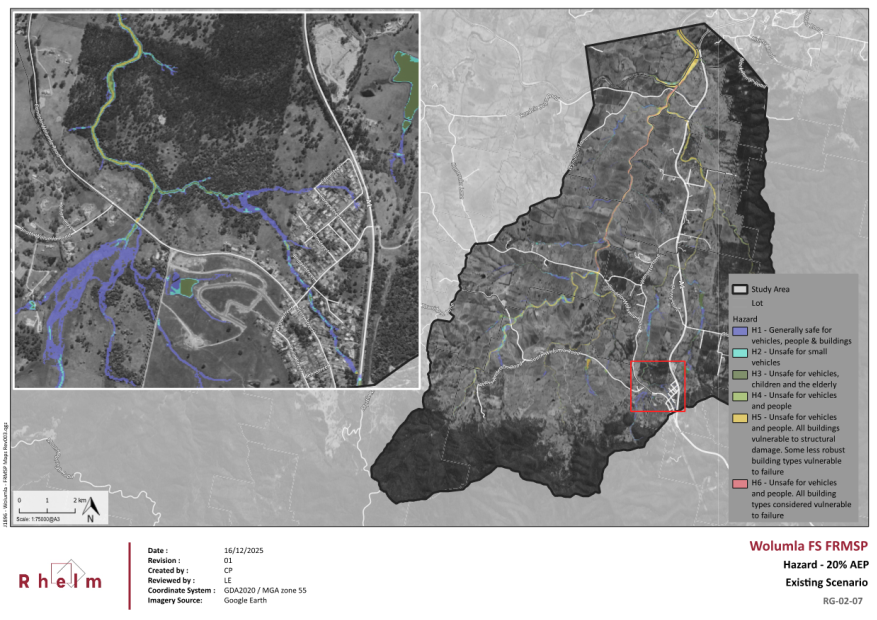
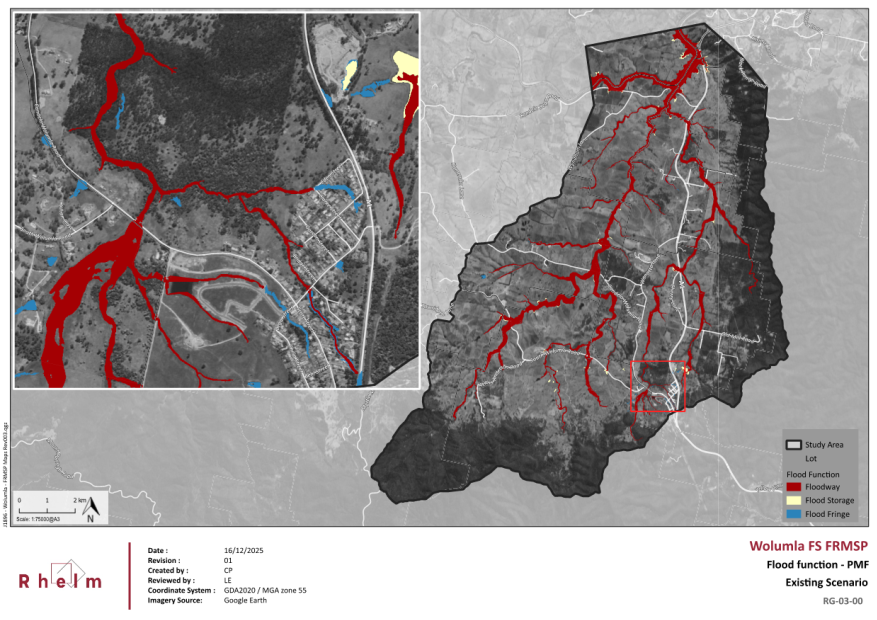
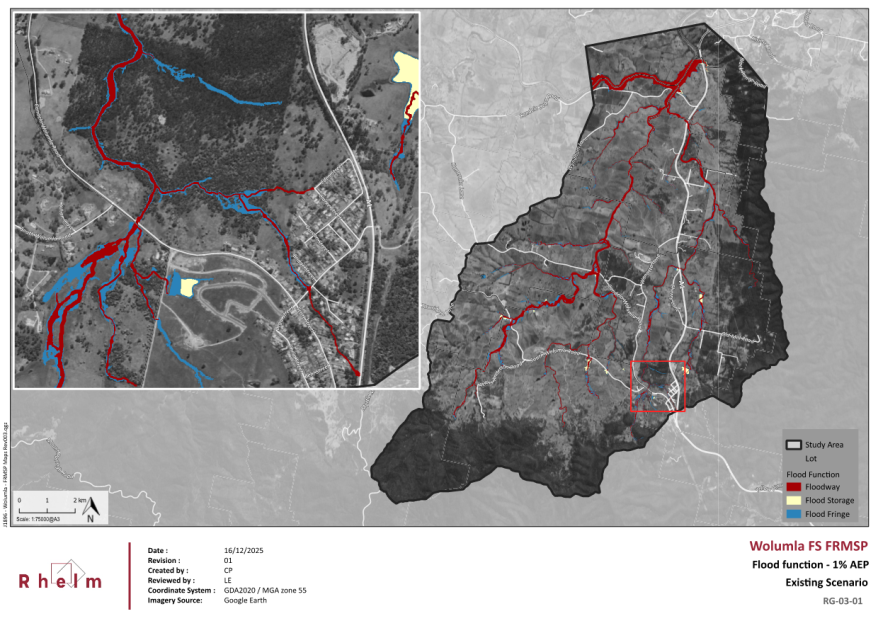
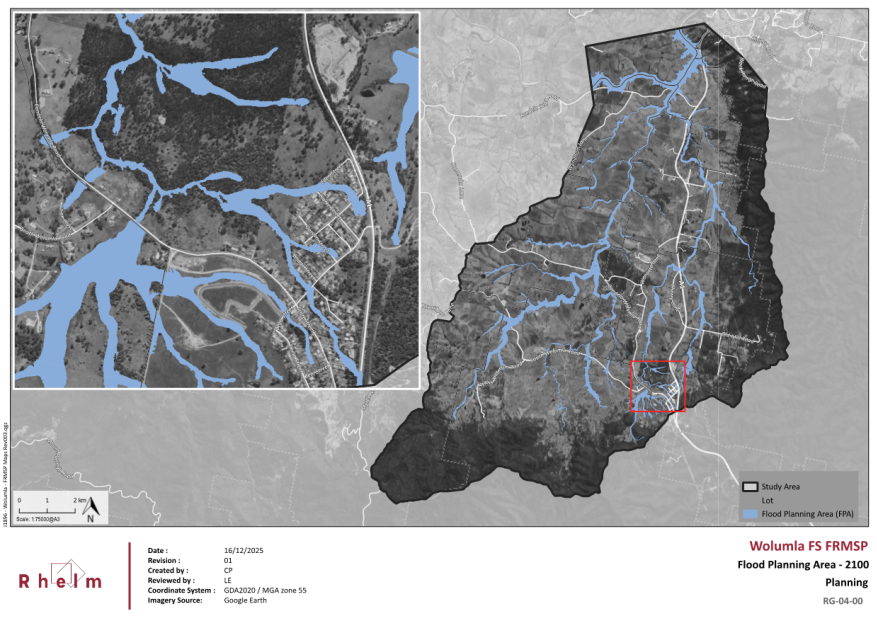
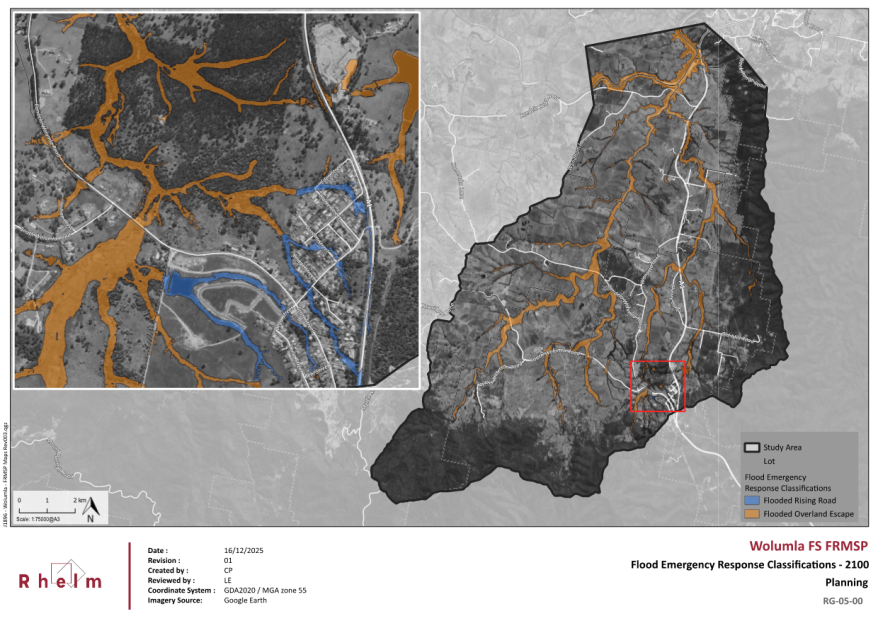
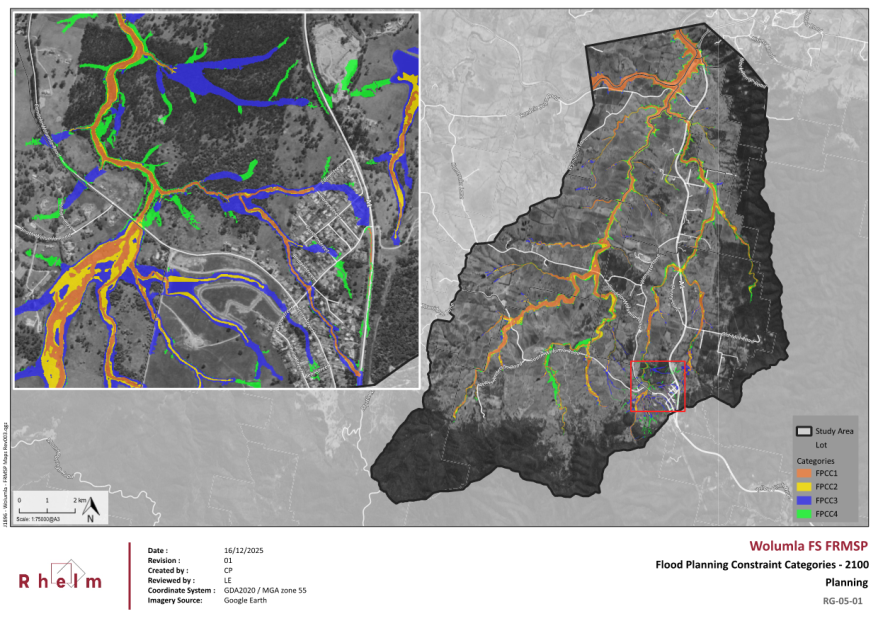
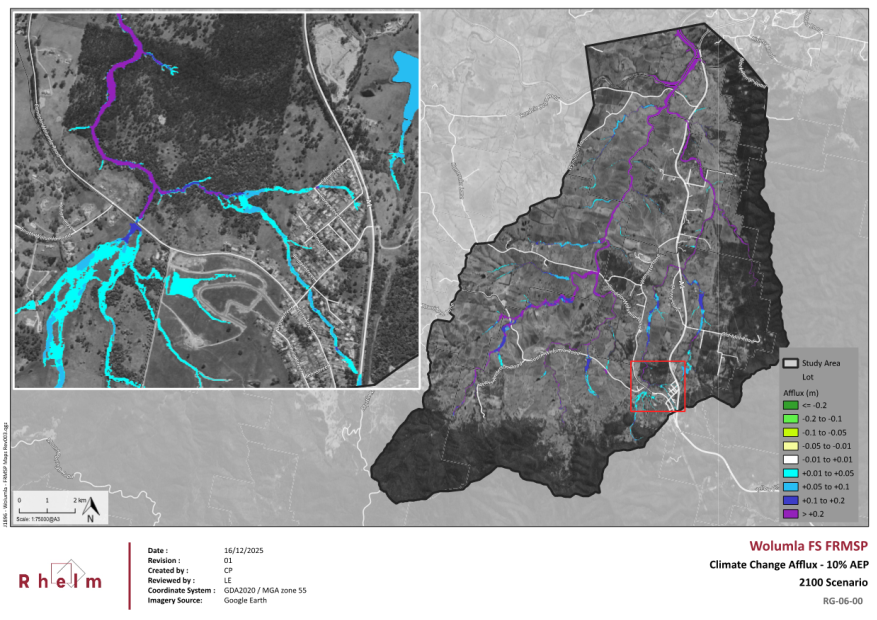
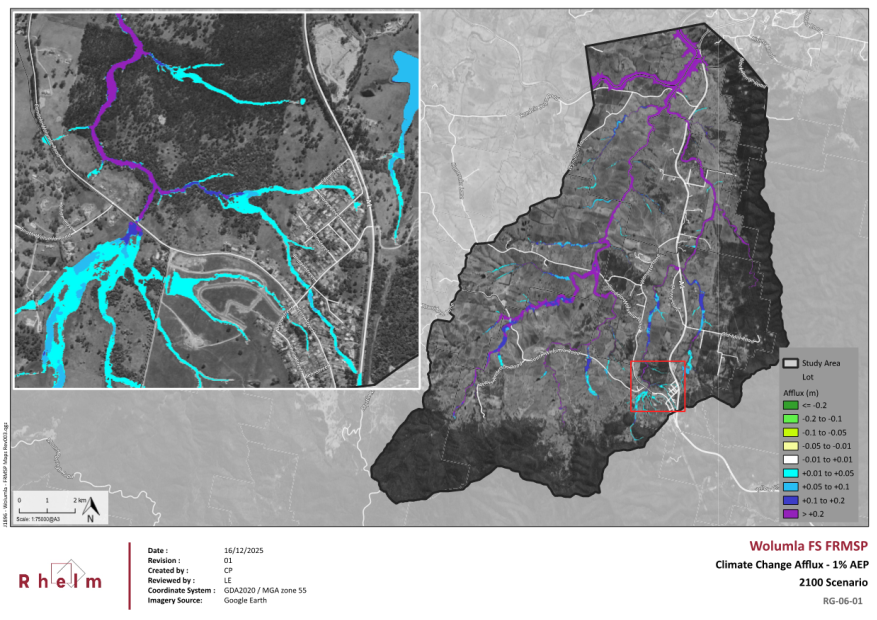
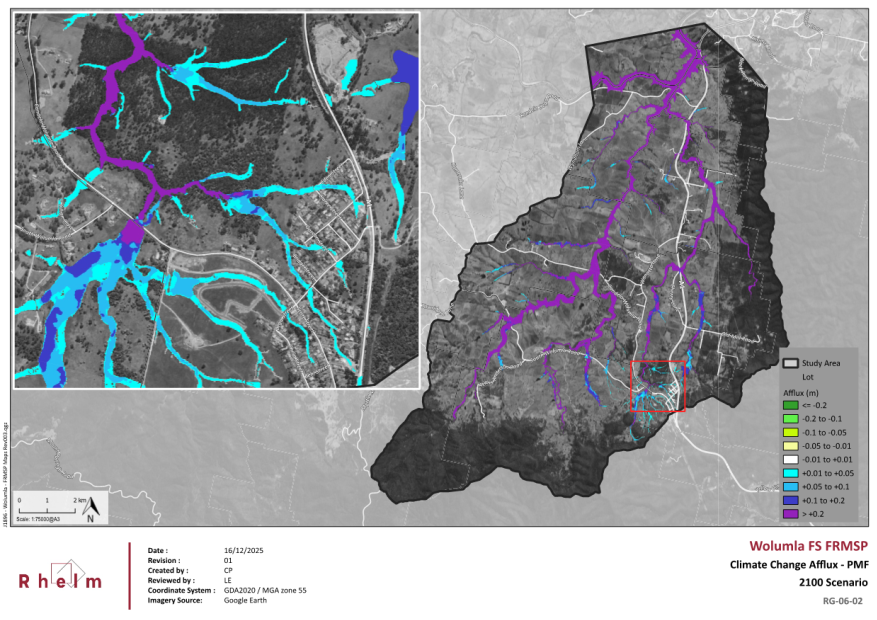
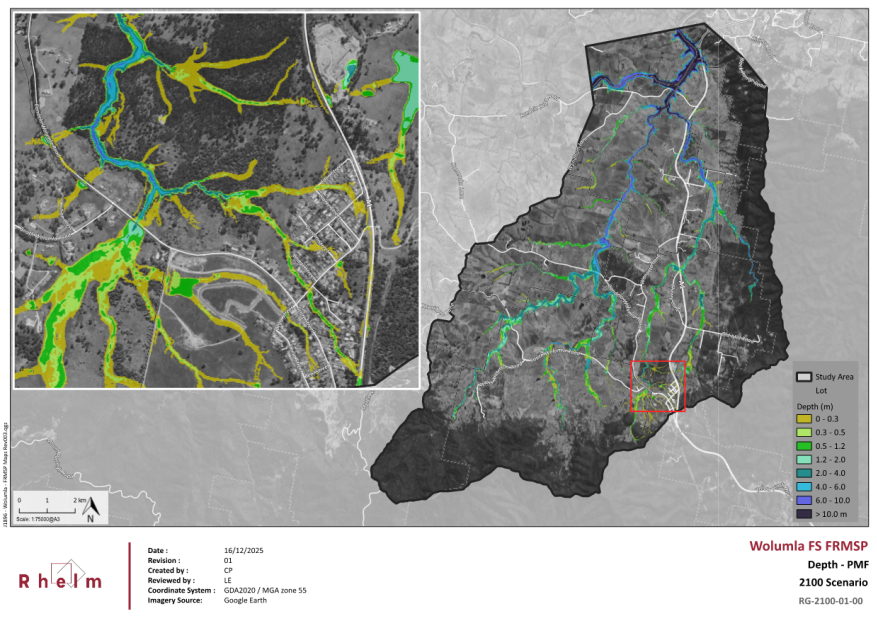
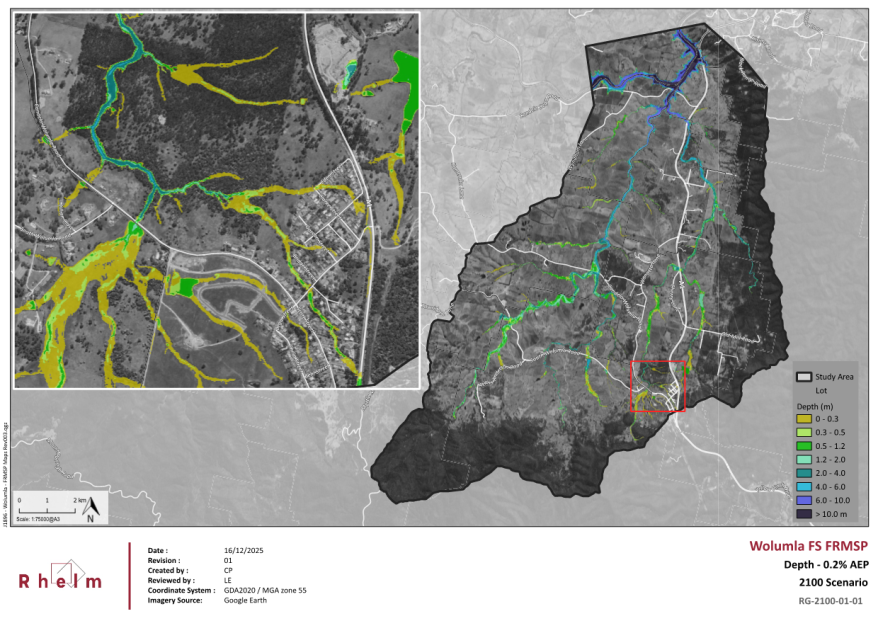
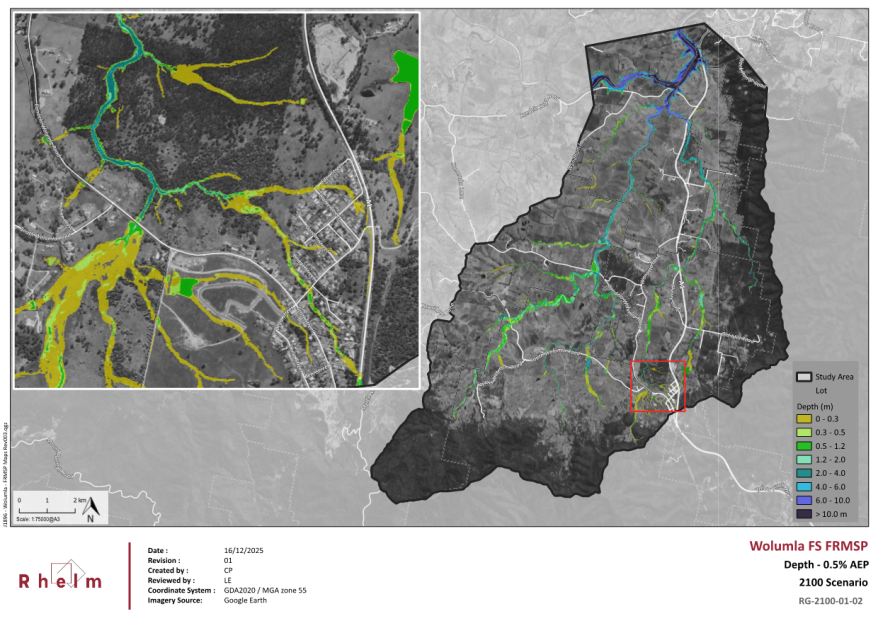
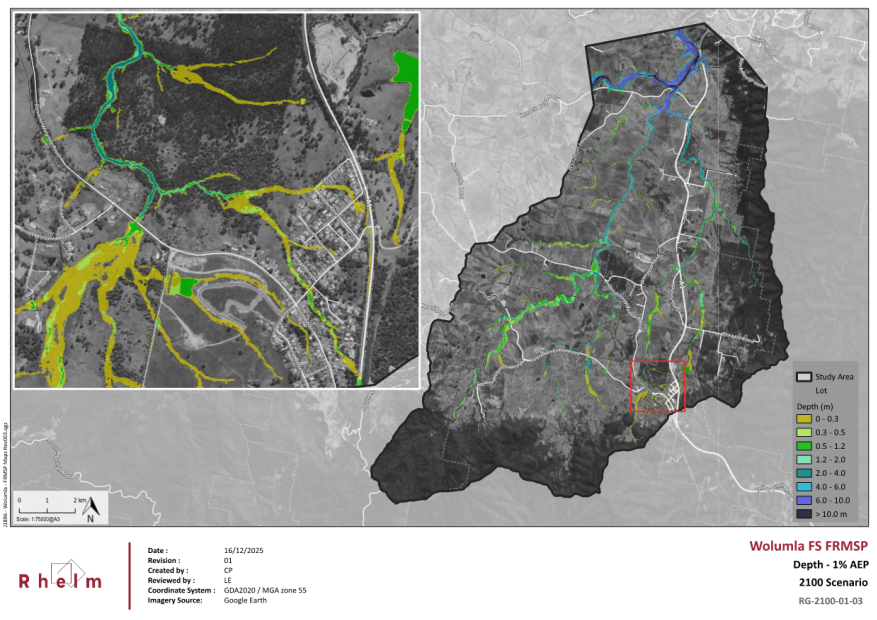
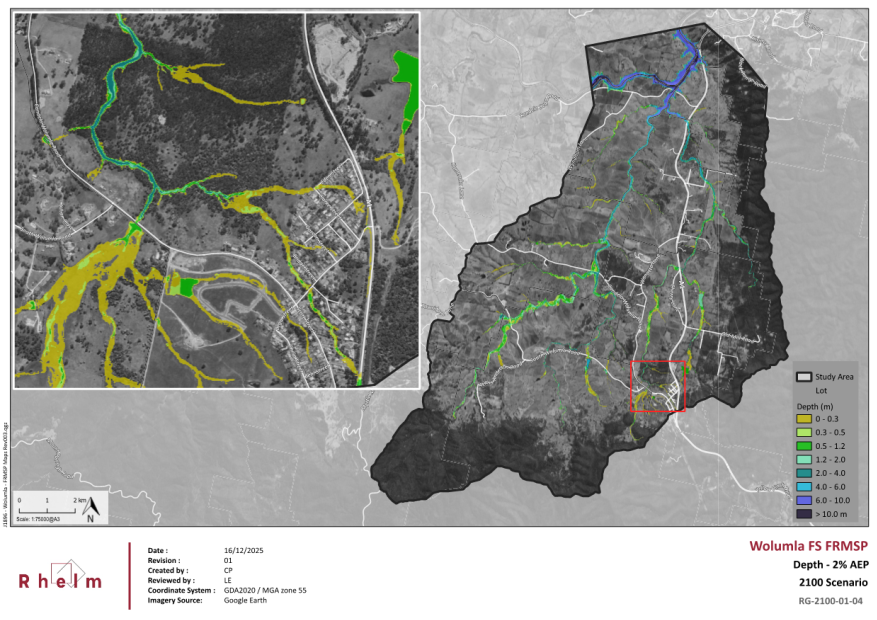
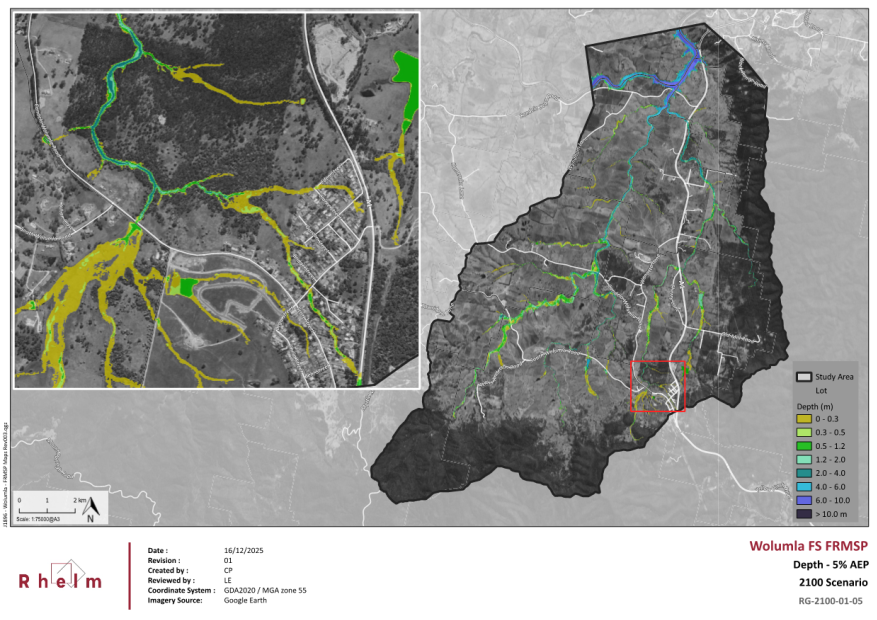
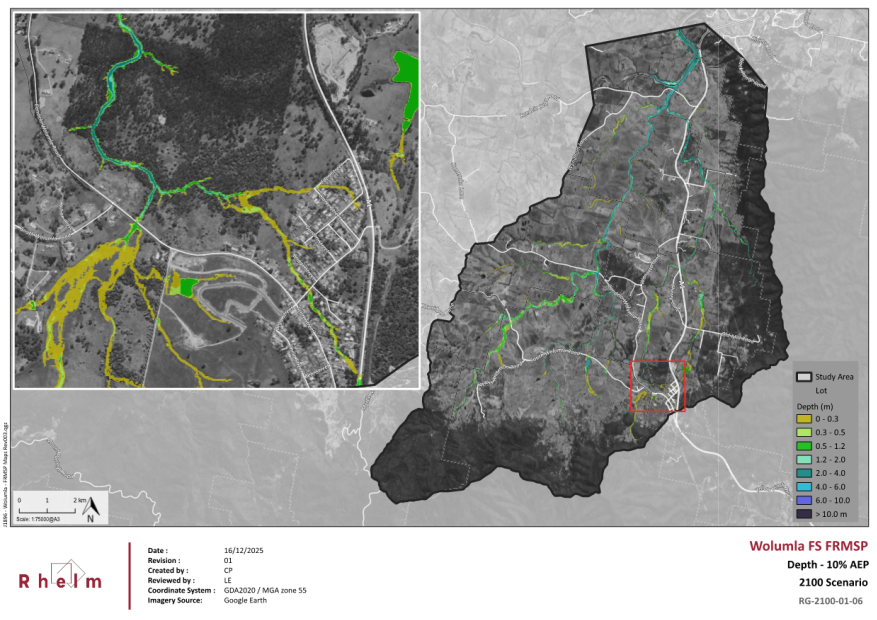
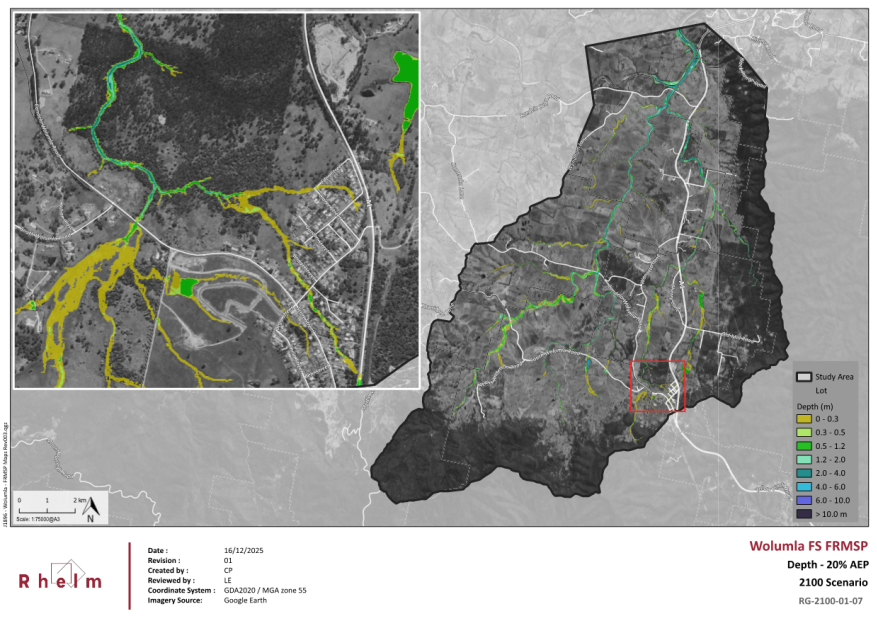
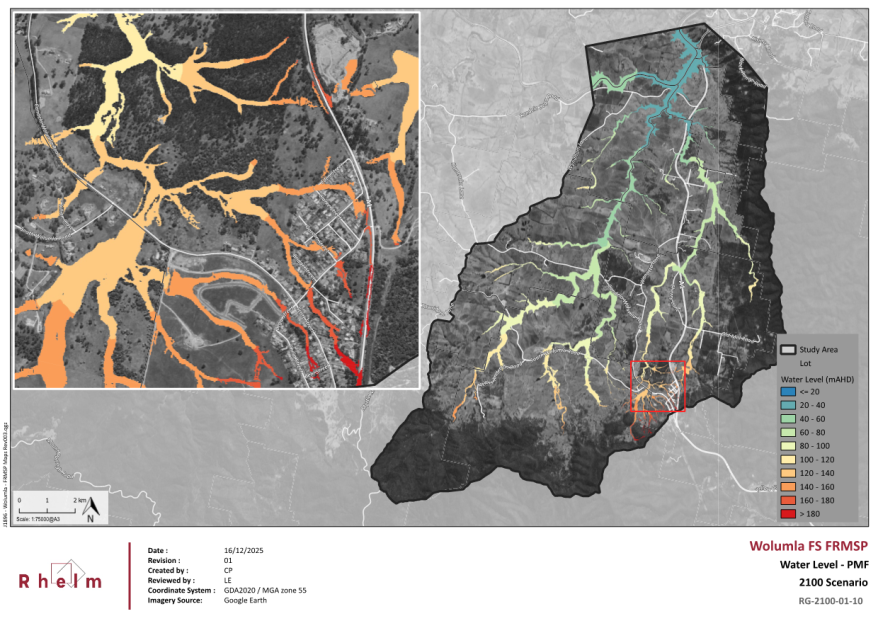
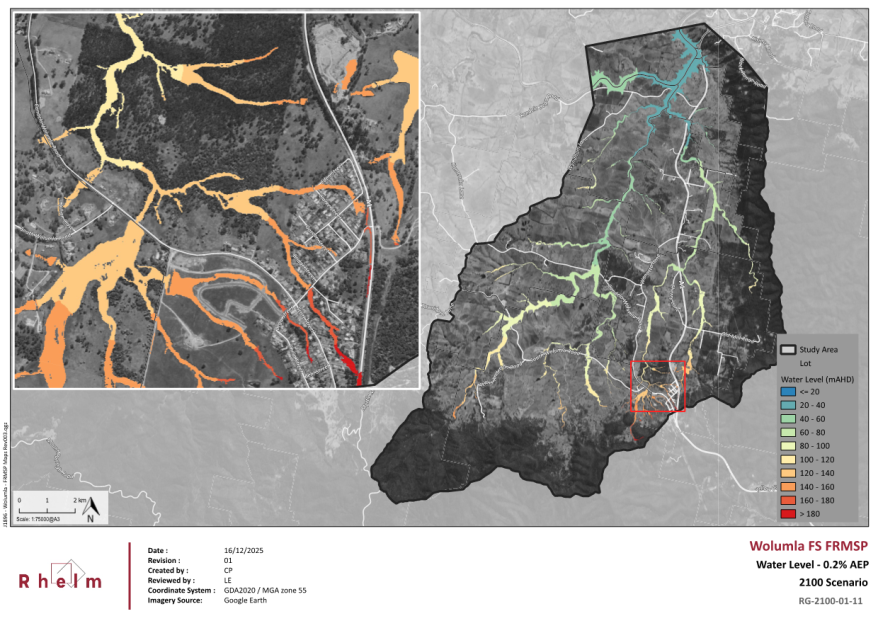
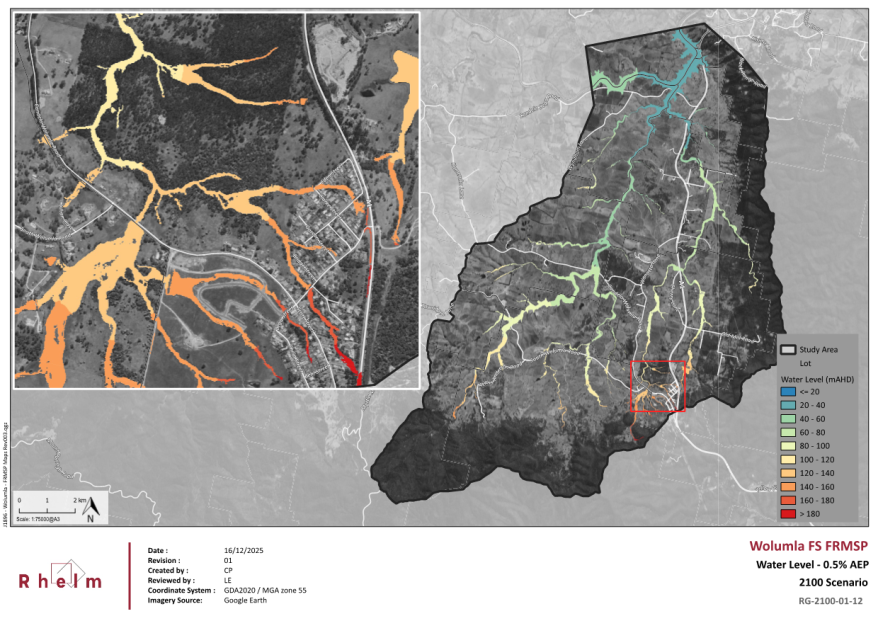
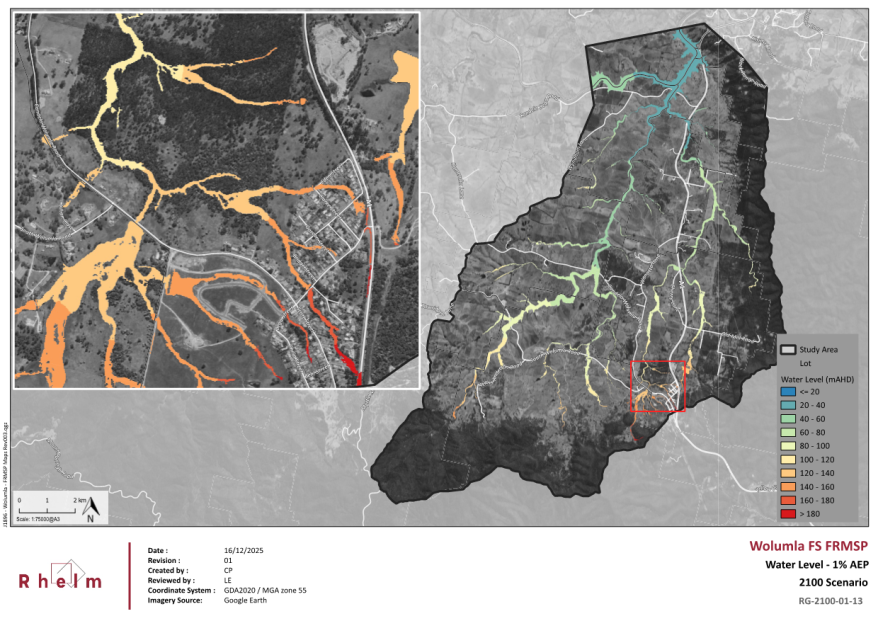
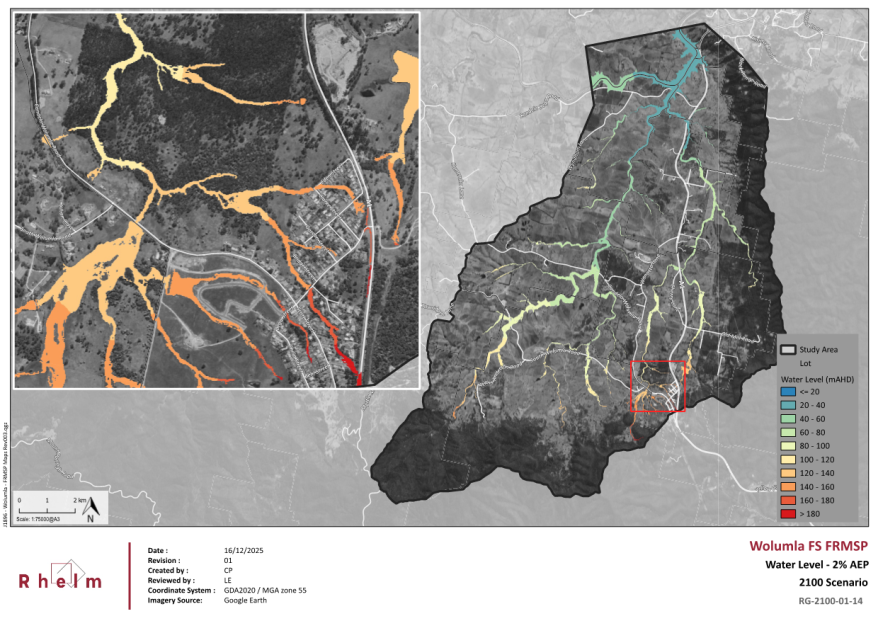
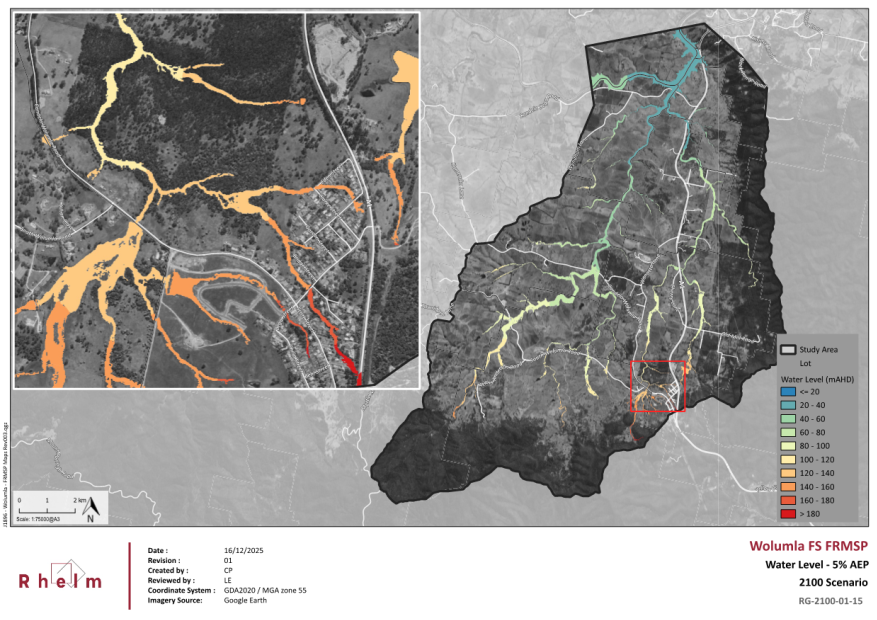
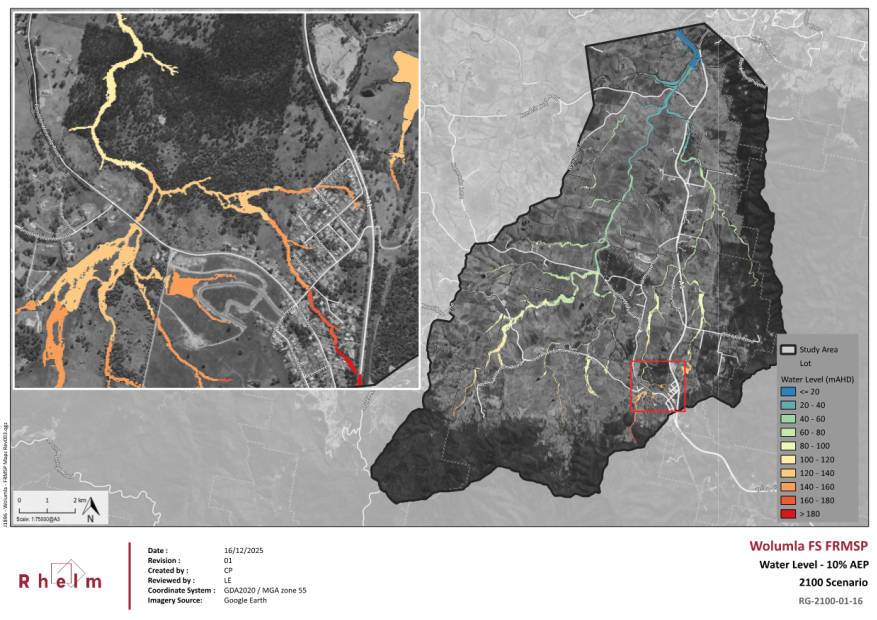
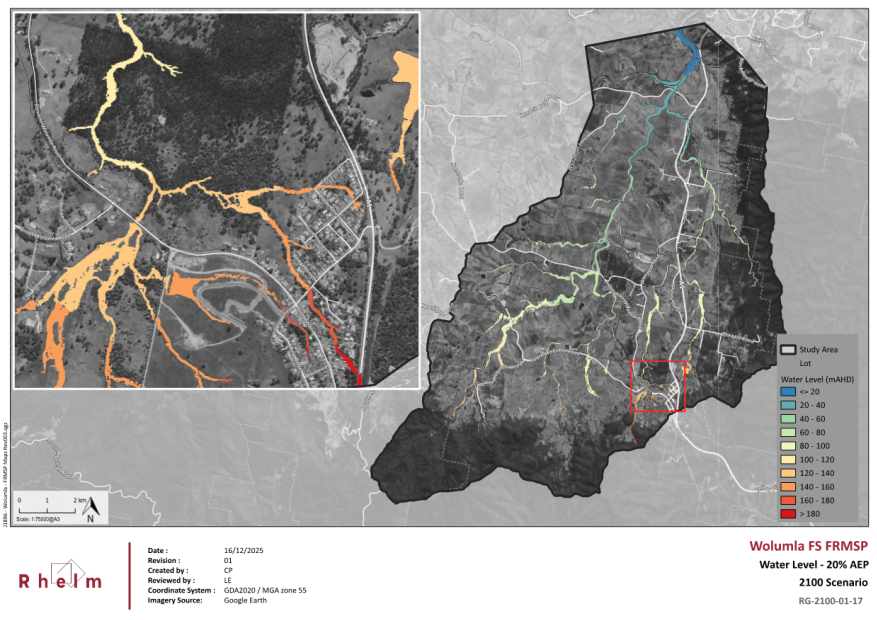
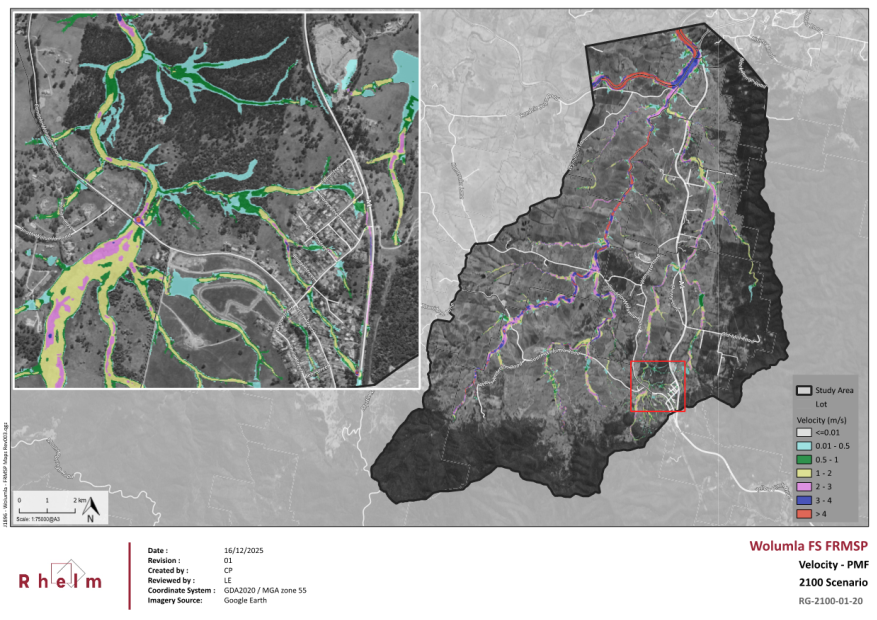
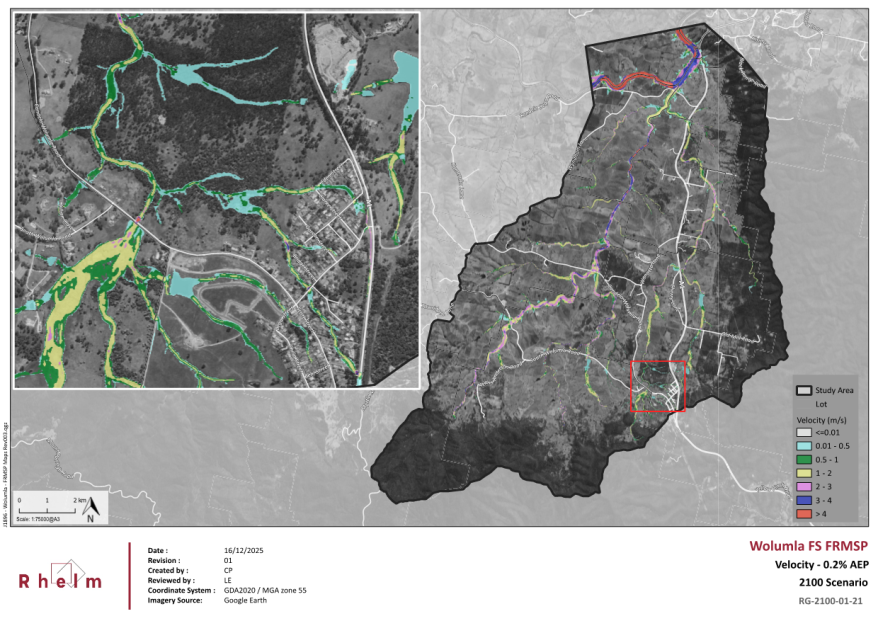
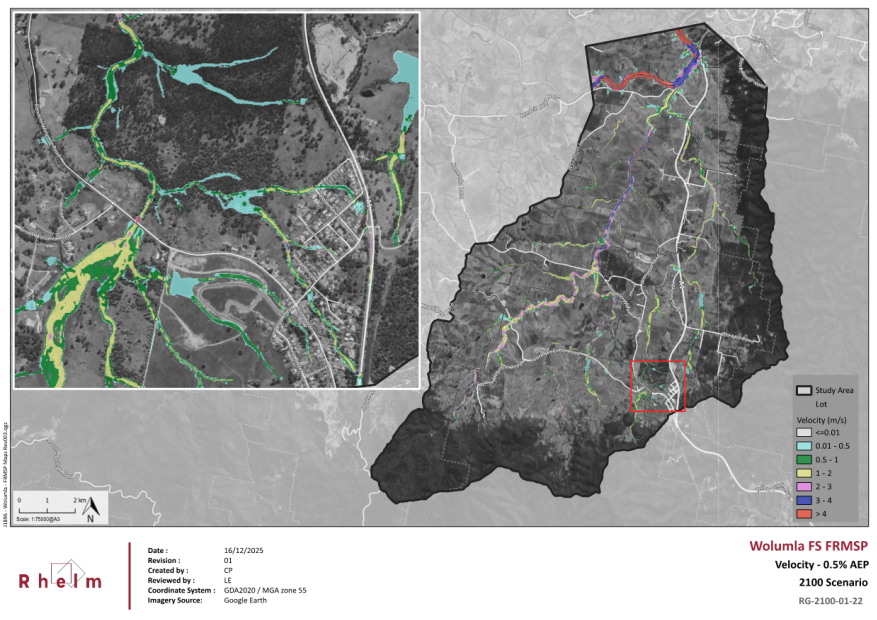
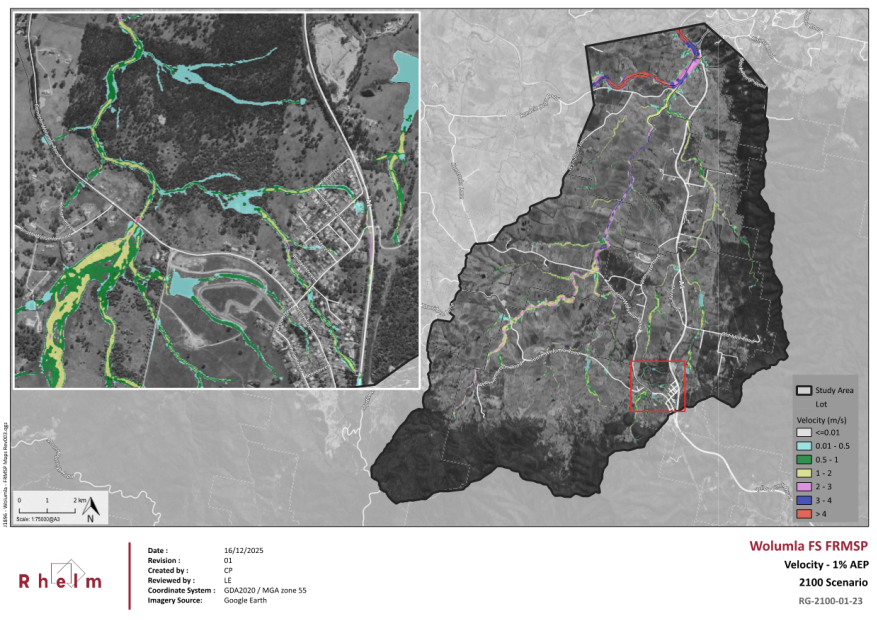
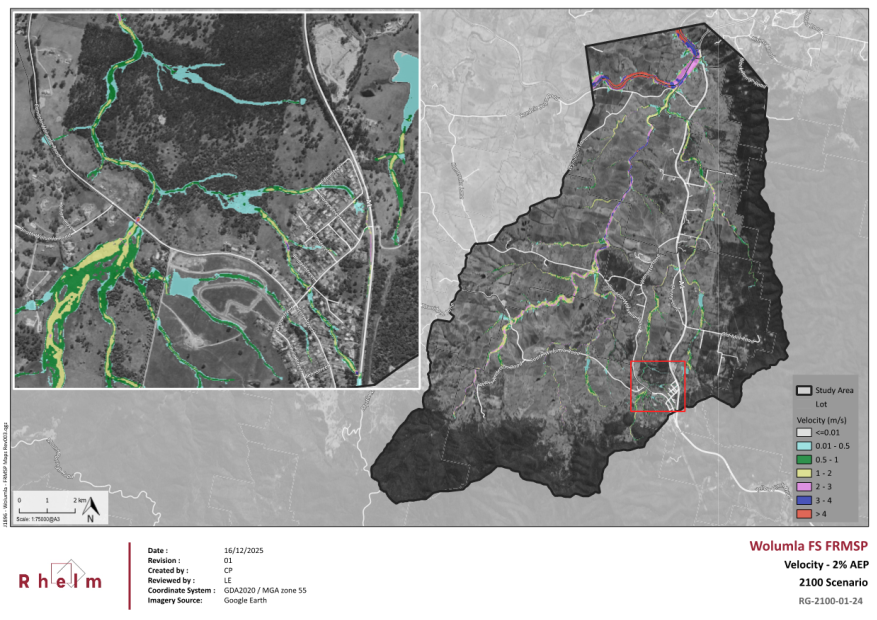
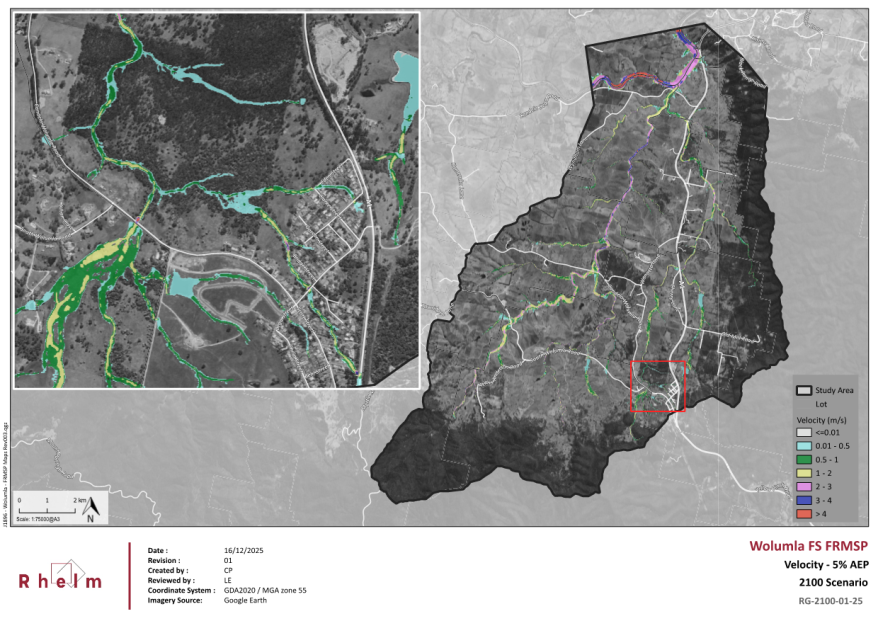
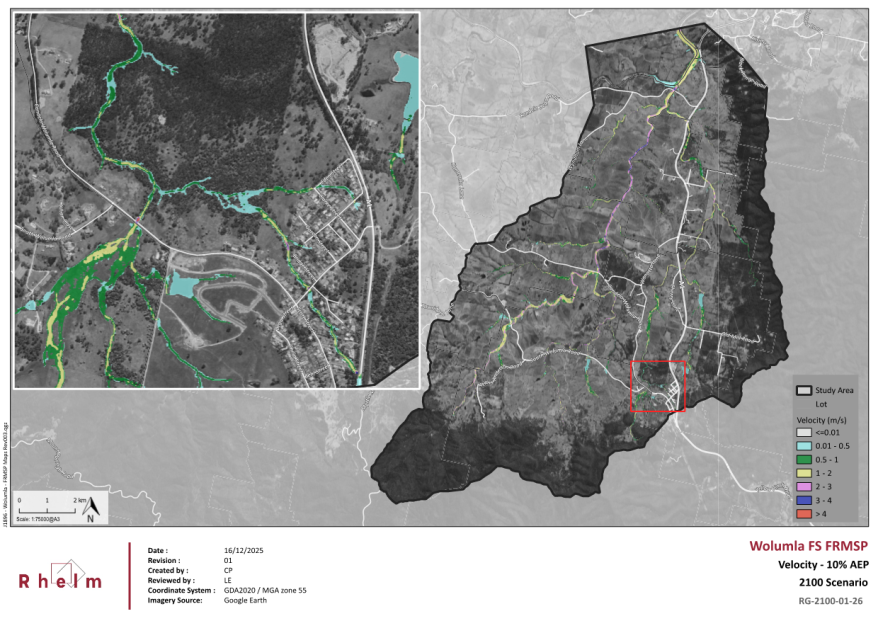
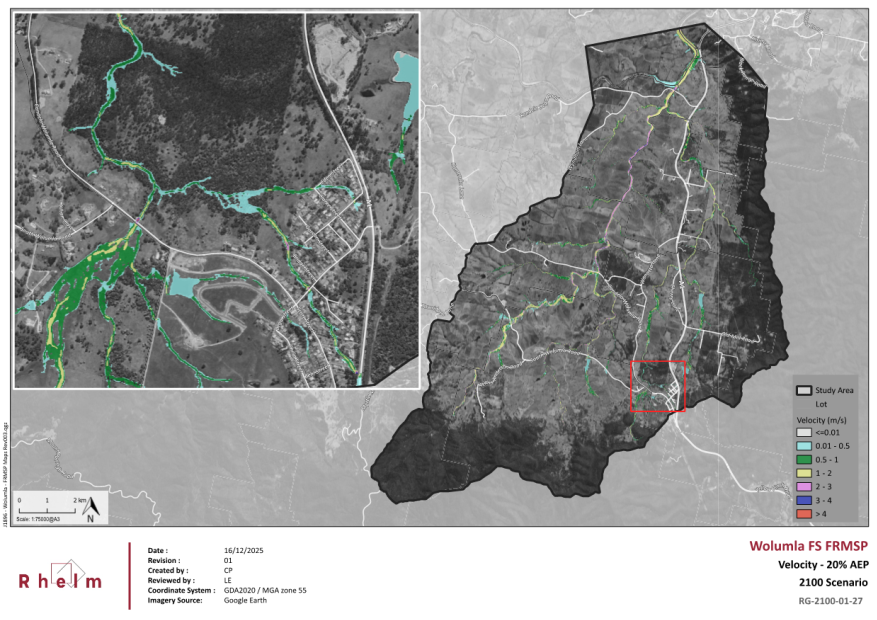
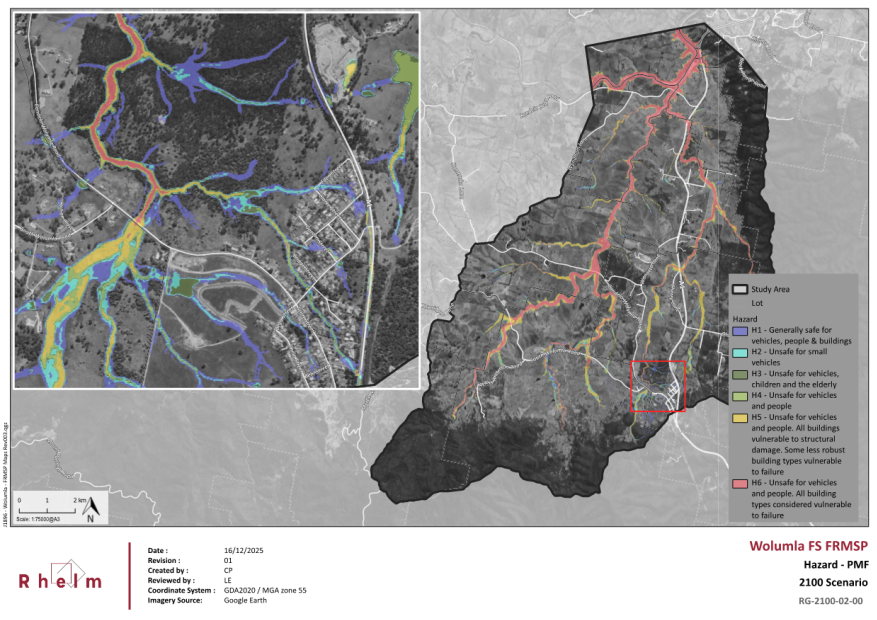
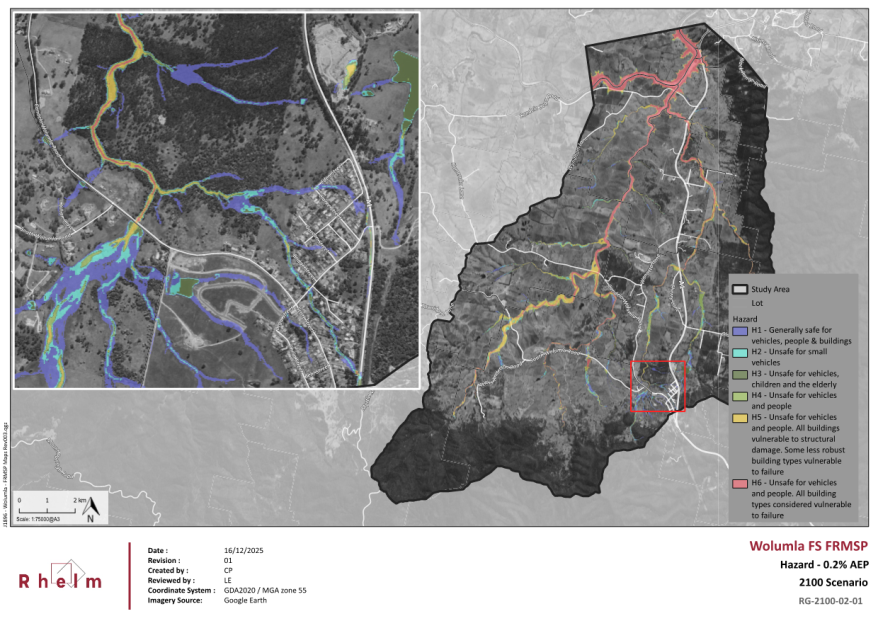
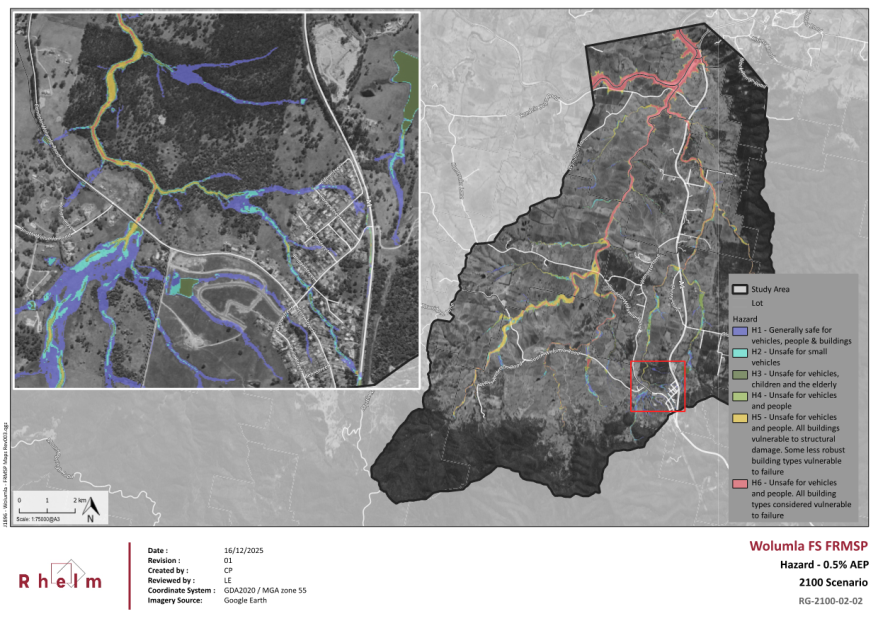
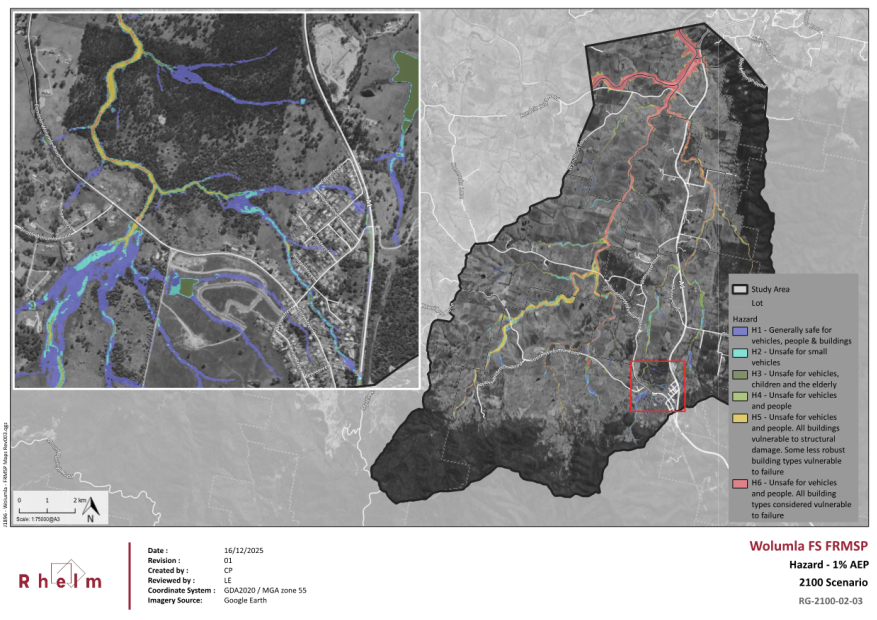
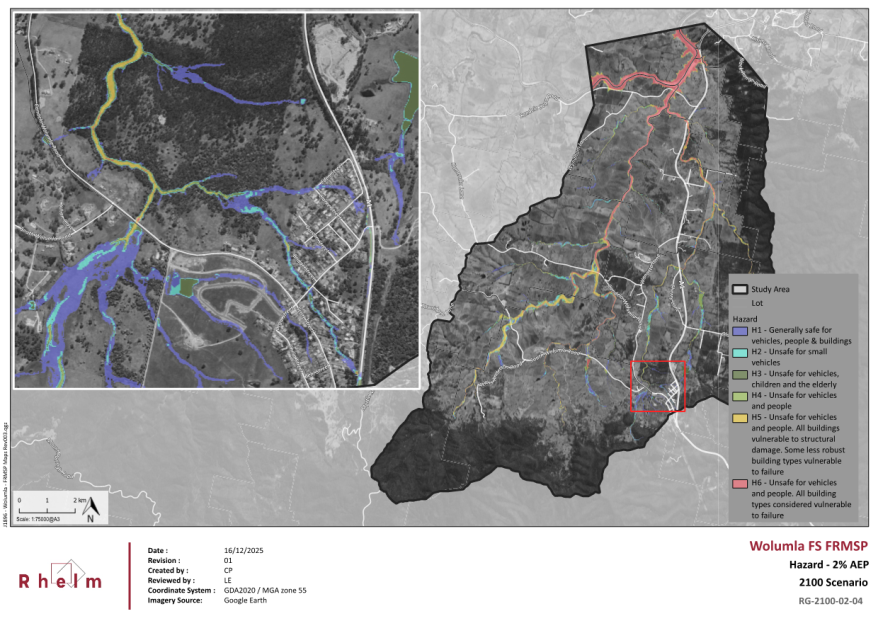
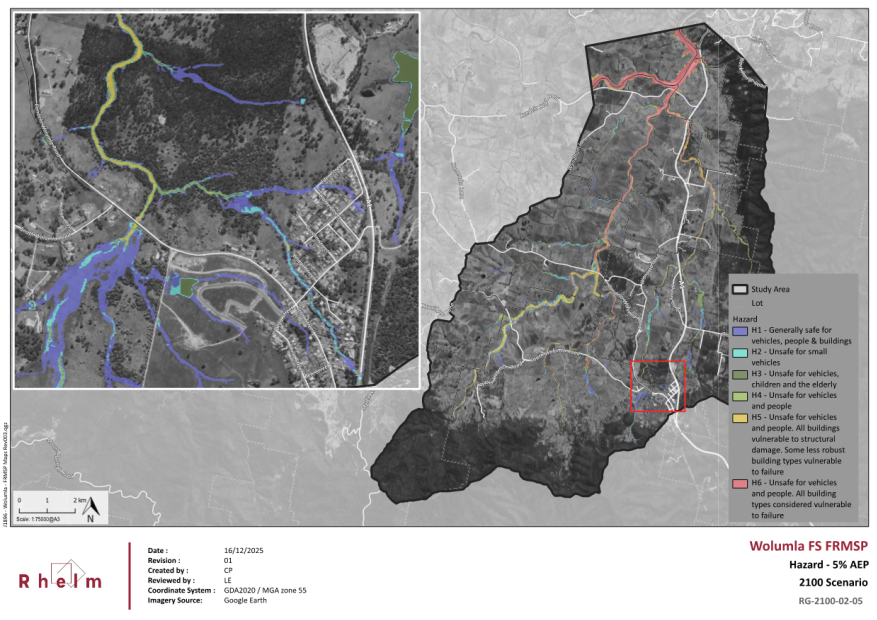
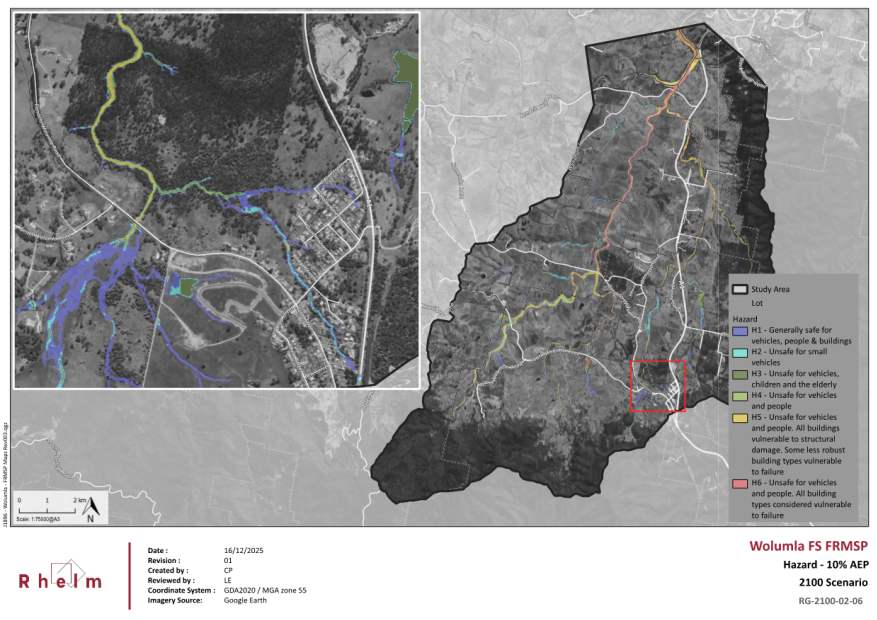
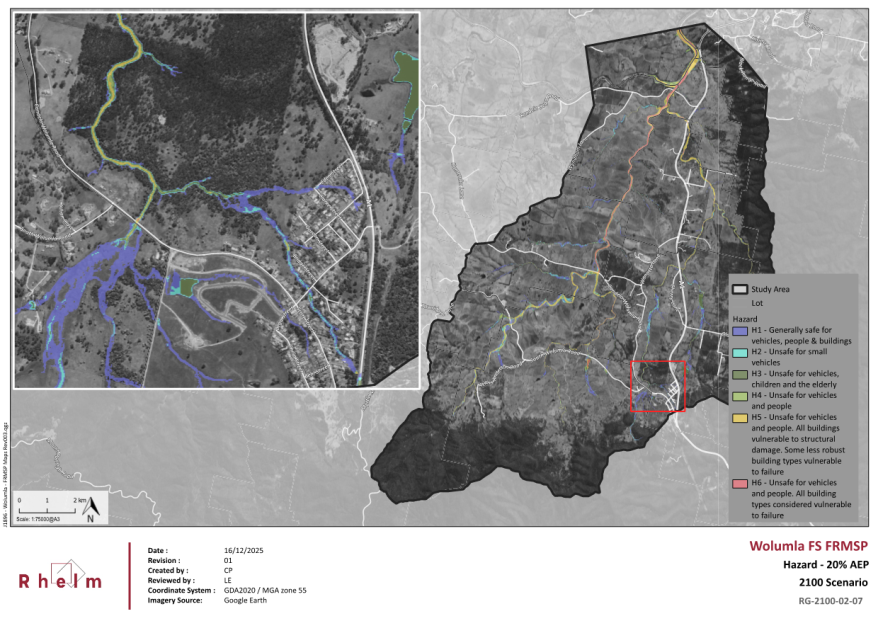
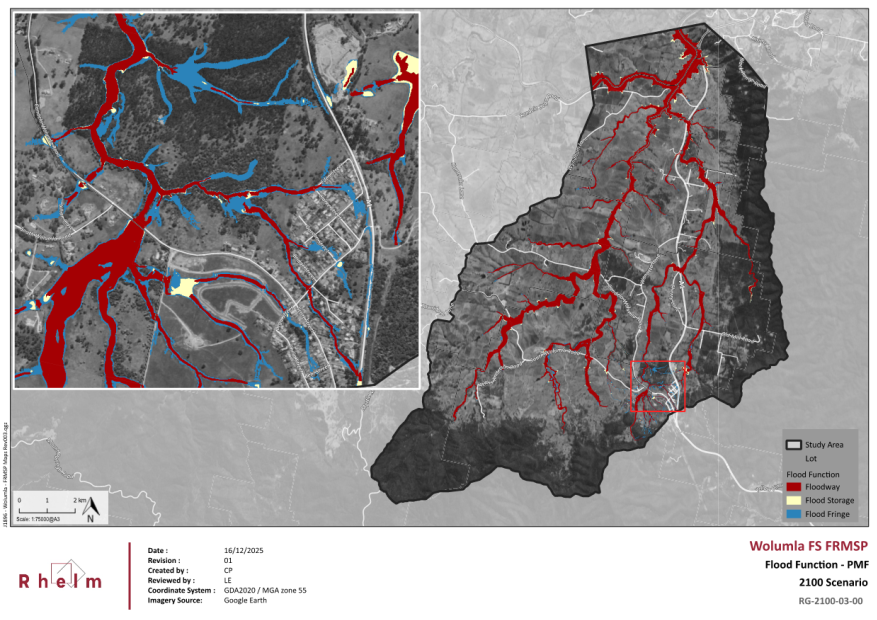
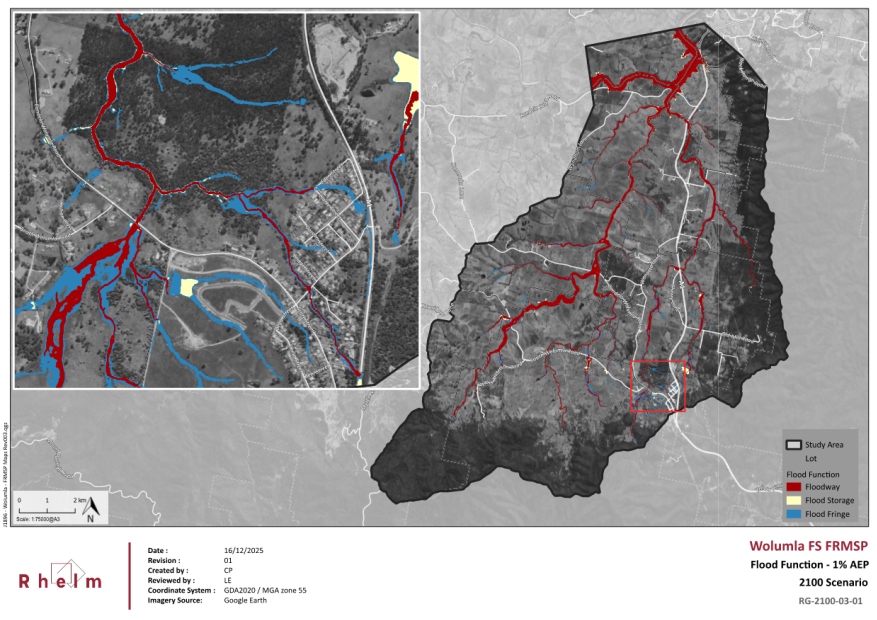
|
Council 28 January 2026
|
Item 9.3
|
9.3. Bega Valley
Local Transport Forum 2 December 2025
This report provides the recommendations of the Bega Valley
Local Transport Forum (LTF) meeting held on 2 December 2025.
Director Infrastructure
Officer’s Recommendation
That Council adopt the recommendations of the Bega Valley
LTF meeting held on 2 December 2025 as outlined below:
Camel Rock Carpark and Pedestrian
1. Proceed
with the installation of ‘Drive to Conditions’ or pedestrian
warning signage on Camel Rock Road.
2. Advise
the concerned resident, as per written advice issued to the customer on 17
November 2025, if they wish to have the speed zone reviewed they would be
required to submit a request using the Transport for NSW (TfNSW) portal: https://www.transport.nsw.gov.au/roadsafety/topics-tips/speeding/have-your-say/speed-limits-have-your-say
Executive Summary
The LTF is an advisory body incorporating technical review
and is not a decision-making committee of Council. LTFs operate under
delegation from TfNSW who are responsible for traffic management on all NSW
roads. Their role is to advise Council on traffic management matters that
relate to prescribed traffic control devices or traffic management facilities
for which Council has delegated authority.
It is a requirement for Council to formally adopt the
recommendations from the LTF prior to action being taken.
Background
The following submission for Council action was received at
the LTF meeting held 2 December 2025:
Camel Rock Carpark and Pedestrian
A concerned resident has raised safety issues regarding the
sealing of the road, noting that a sealed surface may lead to higher vehicle
speeds and increase the risk of pedestrian injuries. The road is frequently
used by walkers, with pedestrian activity significantly increasing during
holiday periods when families from nearby holiday homes access the beach.
They also noted that the road currently lacks speed limit
signage. Given that Wallaga Lake Road is signposted at 60 km/h in this area,
there is concern that drivers may assume the same speed applies to the Camel
Rock Carpark and Road.
The resident has requested that the Local Transport Forum
urgently consider installing a reduced speed limit—suggested at 25 km/h
or lower—along with pedestrian warning signs at both ends of the road to
improve safety.
Options
1. Accept the
recommendations provided by the LTF and resolve accordingly.
2. Reject the
recommendations provided by the LTF and resolve accordingly.
3. Resolve on
alternate or modified options raised by Councillors.
Community
and Stakeholder Engagement
Engagement undertaken
BVSC Assets Coordinator has been in discussion with various
staff and community members.
Engagement planned
The presentation of this report to Council and the notification
of outcomes to relevant stakeholders are the remaining engagement activities
planned.
Financial
and Resource Considerations
The financial and resource
considerations associated with this report from the above signage request will
be delivered through the adopted works maintenance budget.
Legal
/Policy
The legal and policy issues have been addressed through
the application of conditions to manage public safety and traffic hazards via
the LTF delegation from TfNSW.
Impacts
on Strategic/Operational/Asset Management Plan/Risk
Strategic
Alignment
The recommendations are in line with our road and reserve
management policies. The inherent risks associated with the events are
mitigated by adherence to the agreed Traffic Guidance Schemes and the stipulations
made by the LTF.
Environment
and Climate Change
There are no environmental impacts or climate change
implications associated with this report.
Economic
There are no economic impacts
associated with this report.
Risk
There is a mitigation of traffic and public safety risk by
implementing the actions recommended by the LTF.
Social
/ Cultural
There are no social/cultural impacts associated with this
report.
Attachments
Nil
Staff Reports
– Organisational Services
28 January 2026
10.1 Lease
Renewal for Tathra Children’s Services Incorporated............................ 364
10.2 Compulsory
acquisition and transfer of residue road - Cobandrah Pty Ltd..... 373
10.3 Audit,
Risk and Improvement Committee Quarterly Report December 2025. 380
10.4 Code
of Meeting Practice.................................................................................. 385
10.5 Quarterly
Budget Review Statement (QBRS) December 2025 (Q2 Review)..... 429
10.6 Certificate
of Investment December 2025........................................................ 454
Council 28
January 2026
|
Item
10.1
|
10.1. Lease Renewal for Tathra Children’s Services Incorporated
The lease agreement for Tathra
Children’s Services Incorporated to occupy Council-owned community land
(part Lot 1 DP 1125988 at Tathra) for the purpose of a preschool is due for
renewal. Council approval is therefore being sought to enter into a new tenure
arrangement.
Director Organisational Services
Officer’s
Recommendation
1. That Council
approve a further five-year lease to Tathra Children’s Services
Incorporated over part Lot 1 DP 1125988 at Tathra for the purpose of a
preschool, at a commencing annual rental fee of $1,432.32 plus GST and CPI, to
be increased annually by CPI.
2. That Tathra
Children’s Services Incorporated be responsible for payment of
Council’s or its solicitors’ costs associated with the preparation
and registration of the lease.
3. That the Chief
Executive Officer be authorised to execute all necessary documentation to
formalise the above arrangements.
Executive Summary
The lease agreement for Tathra Children’s Services
Incorporated to occupy Council-owned community land (part Lot 1 DP 1125988 at
Tathra) for use as a preschool expired on 31 December 2025. Council approval is
now sought to enter into a new five-year lease arrangement.
Background
Council resolved at its Ordinary Meeting of 16 December
2020, when considering land matters associated with Tathra Lawrence Park and
Preschool as follows:
1. That Council
receive and note the report.
2. That
Council approve a further five (5) year lease to Tathra Children’s
Services Incorporated over part Lot 1 DP 1125988 at Tathra for the purpose of a
preschool, for an annual rental fee as determined by a registered Valuer,
noting a rebate may be applied once assessed against Council’s Rental
Assessment and Rebate Procedure.
3. That
Tathra Children’s Services Incorporated be responsible for payment of the
costs of Council or its Solicitors in relation to the preparation and
registration of the lease.
4. That
the Mayor and/or General Manager be authorised to execute the necessary
documentation to formalise the above course of action.
Following the Council resolution, a market rental valuation
set the annual market rent at $6,400 plus GST and outgoings. In accordance with
Council’s Procedure 4.10.4 Rental Assessment and Rebate, Tathra
Children’s Services Incorporated received an 83% rebate, resulting in a
five-year lease with a current annual rental fee of $1,432.32 after the rebate
and annual CPI increases. This lease expired on 31 December 2025. Council
officers have confirmed with representatives of Tathra Children’s
Services Incorporated that they wish to renew the lease for a further term.
Options
The options available to Councillors are:
1. Approve
a further five-year lease to Tathra Children’s Services Incorporated for
their continued occupation of part Lot 1 DP 1125988 at Tathra for a continued
annual rental of $1,432.32 increased annually by CPI. Recommended.
2. Approve
a further five-year lease to Tathra Children’s Services Incorporated for
their continued occupation of part Lot 1 DP 1125988 at Tathra, at an annual
rental determined by formal market valuation, less the rental rebate.
Community
and Stakeholder Engagement
Engagement undertaken
Property Officers have consulted with representatives from Tathra
Children’s Services Incorporated who have indicated they wish to continue
with their occupation of the site for use as a preschool.
Engagement planned
As Council officers intend to issue five years tenure, in
accordance with the provisions of section 47A of the Local Government Act
1993 (NSW) (LG Act) if Council agrees to grant a lease, in respect of
community land for a period of 5 years, it must:
· Give public notice
of the proposal (including on the council’s website), and
· Exhibit notice of
the proposal on the land to which the proposal relates
· Give notice of the
proposal to such persons as appear to it to own or occupy the land adjoining
the community land, and
· Give notice of the
proposal to any other person, appearing to the Council to be the owner or
occupier of land in the vicinity of the community land, if in the opinion of
the Council the land the subject of the proposal is likely to form the primary
focus of the person’s enjoyment of community land.
Financial
and Resource Considerations
A market rental valuation was obtained from Opteon in
February 2021. As Tathra Children’s Services Incorporated has again been
assessed as eligible for an 83% rental rebate under Council’s rental
rebate application, Council officers do not consider it necessary or beneficial
to obtain a further market valuation at this time. The current annual rental of
$1,432.32 per annum (subject to annual CPI increases) remains appropriate for
this land-only arrangement. Proceeding on this basis avoids unnecessary expenditure
and administrative effort, given that the rebate outcome remains unchanged.
For reference, Opteon has provided indicative quotes for a
new market rental valuation:
· Desktop
assessment: $1,100 (inclusive of GST), with completion by late January 2026
· Kerbside/external
inspection: $1,650 (inclusive of GST), with completion by mid-February 2026
Given the cost and timing, and the fact that the rebate
assessment remains unchanged, it is recommended that the lease proceed at the
current annual rental.
Preparation of the lease renewal documentation and ongoing
lease management throughout the term will require Council officer time, and
registration of the lease will require engagement of legal representatives.
Legal
/Policy
Under Section 53 of the Real Property Act 1900 (NSW),
leases exceeding three years must be in the approved form, and Section 42(1)(d)
requires such leases to be registered on title. Lot 1 DP 1125988, part of
Lawrence Park, is Council-owned community land held in fee simple since 1976
and converted to Torrens title in 2011. However, the land remains limited
title, and boundaries have not been formally investigated, making survey work
more complex.
As the building is owned by Tathra Children’s Services
Incorporated, a premises lease is not preferred, as it would imply Council
ownership of the building. The market rental valuation has been based on land
only.
Council officers investigated subdividing the land to enable
a long-term land-only tenure for Tathra Children’s Services Incorporated
back in 2020. However, subdivision would require a development application,
full survey, and a bushfire assessment, with estimated costs exceeding $7,900
(plus bushfire report costs). As the preschool is a Special Fire Protection
facility, further upgrades and compliance measures would likely be triggered,
making subdivision financially unviable.
Impacts
on Strategic/Operational/Asset Management Plan/Risk
Strategic
Alignment
Council’s Delivery Program 2025-2029 identifies as
core business the oversight of leases and licences for Council-owned land and
buildings.
Additionally, Council manages numerous facilities and is
expected to either gain a commercial return on those community assets or
provide broad community benefit from those assets.
Environment
and Climate Change
The proposed lease is not expected to have significant
environmental impacts, as use remains within the existing building footprint
and permitted activities.
Economic
The lease agreement to Tathra Children’s Services
Incorporated provides an economic benefit to Council and the community.
Risk
Council has identified regulatory and statutory compliance,
along with workforce and public safety, as strategic risks. The increasing
complexity and cost associated with navigating multiple and evolving regulatory
frameworks continues to present a significant challenge. This risk is mitigated
by ensuring that third-party use of Council-owned and managed land is
formalised through appropriate tenure arrangements including indemnity and
insurance provisions.
Social
/ Cultural
Tathra Children’s Services
Incorporated is registered as a charity with the Australian Charities and
Not-For-Profits Commission and provides a much needed and well utilised service
to those in the Tathra and surrounding areas.
The building and surrounding
grounds has been substantially upgraded and maintained by Tathra
Children’s Services Incorporated over many years.
The benefits of participation in
quality early childhood education for children, families and the community are
widely documented.
The requirement for strict
accreditation and licensing to operate such facilities is not widely available
and the Tathra Children’s Services Incorporated has successful provided a
high-level service for some 20 plus years.
Attachments
1⇩. Council
report dated 16 December 2020 - Land matters associated with Tathra Lawrence
Park and Preschool
|
Council
|
28 January 2026
|
|
Item
10.1 - Attachment 1
|
Council report dated 16 December 2020 - Land matters
associated with Tathra Lawrence Park and Preschool
|
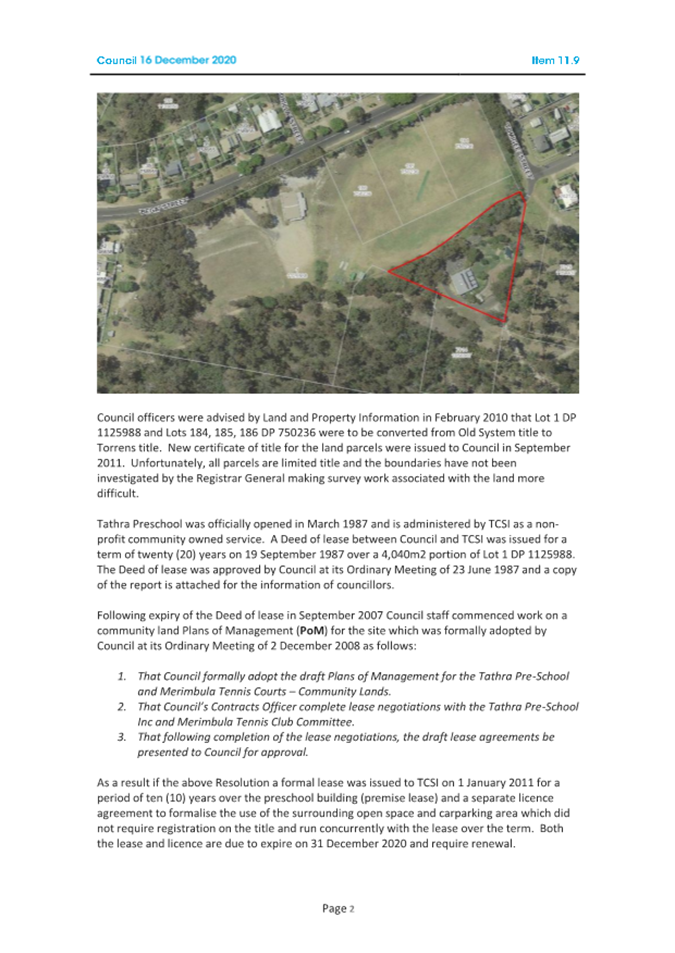
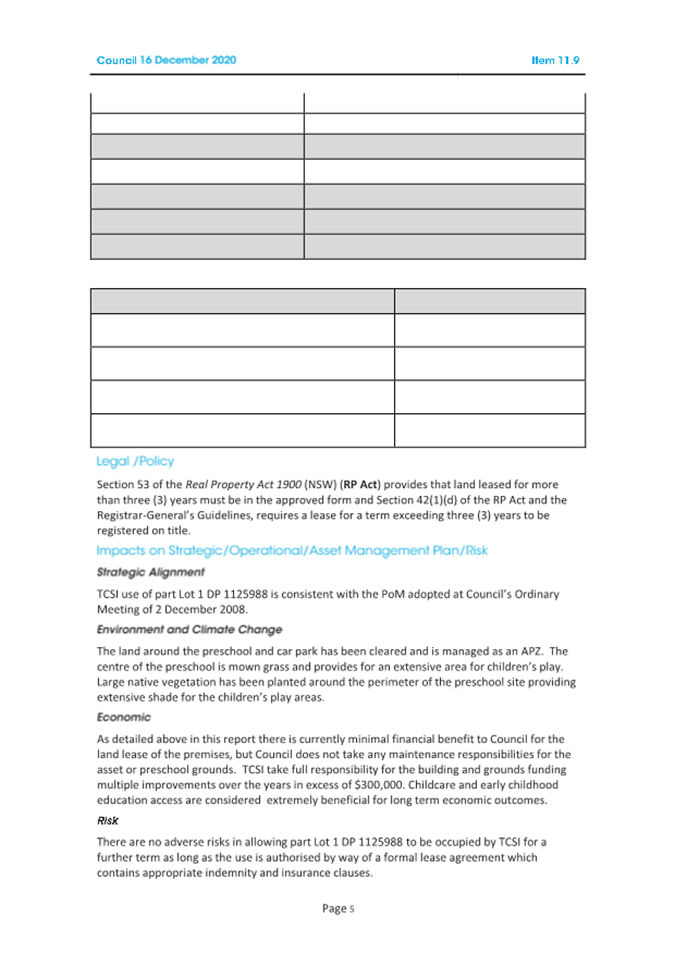
Council 28 January 2026
|
Item
10.2
|
10.2. Compulsory acquisition and transfer of residue road - Cobandrah
Pty Ltd
This report seeks Council approval
to proceed with the compulsory acquisition and classification of identified
road parcels to rectify historical road alignment encroachments and enable
their transfer to Cobandrah Pty Ltd, in accordance with statutory requirements
and prior Council resolutions.
Director Organisational Services
Officer’s
Recommendation
1. That Council
proceed with the compulsory acquisition of the land described as Lots 11, 12
and 13 in DP 1312022 for the purpose of road realignment in accordance with the
requirements of the Land Acquisition (Just Terms Compensation) Act 1991.
2. That Council make
an application to the Minister and the Governor for approval to acquire Lots
11, 12 and 13 in DP 1312022 by compulsory process under section 186(1) of the Local
Government Act 1993.
3. Where the public
road proposed for acquisition is an unformed council road, acquisition of the
road would result in the land reverting to the Crown as Crown land. Council
must secure the prior consent of Crown Lands before submitting the application
for compulsory acquisition to the Department of Local Government for Crown
Lands consent to the land vesting in Bega Valley Shire Council rather than
Crown Lands.
4. That Council gives
notice of its intention to classify the land to be vested in Bega Valley Shire
Council as operational land under section 34 of the Local Government Act
1993 (NSW).
5. That Council
proceed with the compulsory acquisition of the land described as Lots 1, 2, 3,
4, 5, 6 and 7 in DP 1312022 for the purpose of road realignment in accordance
with the requirements of the Land Acquisition (Just Terms Compensation) Act
1991.
6. That Council make
an application to the Minister and the Governor for approval to acquire Lots 1,
2, 3, 4, 5, 6 and 7 in DP 1312022 by compulsory process under section 177(2)(b)
of the Roads Act 1993.
Executive Summary
This report seeks Council approval to proceed with the
compulsory acquisition of various parcels of unformed Council road and private
land for the purpose of road realignment and subsequent transfer to Cobandrah
Pty Ltd. The process requires Council to obtain consent from Crown Lands and to
pass resolutions in accordance with the Land Acquisition (Just Terms
Compensation) Act 1991, the Local Government Act 1993, and the Roads
Act 1993.
Background
Council resolved at its Ordinary Meeting of 12 June 2024,
when considering the road widening acquisition, as follows:
1. That
Council enter into a formal Deed of Agreement with the proprietor of Cobandrah
Pty Ltd for the acquisition of part Lots 14, 15 and 16 DP 32269 and Lot 14 DP
750242 shown as lots 1, 2, 3, 4, 5, 6 and 7 on the draft plan attached to the
Council report dated 12 June 2024, for the purpose of public road pursuant to
section 177 of the Roads Act 1993 (NSW).
2. That
Council dedicates unnecessary road shown as lots 11, 12 and 13 on the draft
plan attached to the Council report dated 12 June 2024 to the proprietor of
Cobandrah Pty Ltd to offset part of the compensation associated with the
acquisition of land for road realignment purposes.
3. That
compensation payable to the proprietor of Cobandrah Pty Ltd be a total sum of
$36,512.77 being the difference in value of the lots being acquired less the
value of the lots being transferred as determined by a registered surveyor.
4. That
it be noted Council intends to dedicate the land, as referred to in
recommendation 1 above, in the NSW Government Gazette as a public road under
Section 10 of the Roads Act 1993 (NSW) upon acquisition.
5. That
the Chief Executive Officer and Mayor be delegated authority to execute the
necessary documents as required.
Since this resolution, Council officers have held further
discussions with Crown Lands regarding the sections of road Council intends to
acquire and transfer to Cobandrah Pty Ltd. Crown Lands has confirmed that the
relevant sections are unformed “Council” road. Council has
requested Crown Lands’ consent to acquire the land so it can vest in
Council as operational land and then be transferred to Cobandrah Pty Ltd. Crown
Lands has indicated a preference for the road closure process, but Council is
pursuing compulsory acquisition as the preferred pathway. Further Council
resolutions are now required to confirm the authority for acquisition and to
ensure compliance with legislative requirements.
Options
The options available to Councillors are:
1. Approve
the recommended resolutions to proceed with compulsory acquisition and transfer
of the identified land parcels. This is the preferred approach, as confirmed
through consultation with the Office of Local Government (OLG), to ensure
compliance with legislative requirements and to finalise the matter
efficiently. Recommended
2. Pursue
the road closure process as suggested by Crown Lands. After consulting with
OLG, this is not the preferred approach to finalise the matter.
Community
and Stakeholder Engagement
Engagement undertaken
Extensive engagement has been undertaken throughout this
process, including ongoing discussions with Crown Lands regarding the
acquisition and transfer of the road parcels, consultation with Cobandrah Pty
Ltd as the intended transferee, and regular liaison with Council’s legal
representatives to ensure all legislative requirements are met. Council
officers have also consulted with the Office of OLG to confirm the preferred
approach for finalising the matter and to ensure compliance with statutory obligations.
Engagement planned
Further engagement is planned, including continued liaison
with Crown Lands and the OLG to secure necessary consents, ongoing consultation
with legal representatives as the process progresses, and notification to
affected landowners and stakeholders as required by legislation.
Financial
and Resource Considerations
Compensation payable to Cobandrah Pty Ltd in the amount of
$36,512.77, representing the difference in value between the lots being
acquired and those being transferred as determined by a registered surveyor,
has been finalised. Survey, legal, and registration costs associated with the acquisition
and transfer will be funded from Council’s road closure reserve, in
accordance with legislative requirements that proceeds from road closures are
to be used for acquiring land for public roads or for carrying out road works.
Ongoing costs will include officer time for project management and liaison with
legal representatives throughout the process.
Legal
/Policy
The acquisition process must comply with the Land
Acquisition (Just Terms Compensation) Act 1991, the Local Government Act
1993, and the Roads Act 1993. Model resolutions provided by the OLG
have been used to ensure compliance. Crown Lands’ consent is required for
the vesting of unformed Council road in Council rather than reverting to the
Crown.
Impacts
on Strategic/Operational/Asset Management Plan/Risk
Strategic
Alignment
This proposal supports Council’s Delivery Program
2025–2029 and Operational Plan objectives for the management and
rectification of road alignments and public infrastructure. It also aligns with
Council’s Rural Residential Strategy, which identifies the affected land
as suitable for rural residential use.
Environment
and Climate Change
The proposed acquisition and transfer of road parcels is not
expected to have significant environmental impacts, as it relates to the
rectification of existing road alignments rather than new construction or
changes in land use.
Economic
By rectifying road alignment encroachments, Council avoids
potential costs and disruption associated with relocating the physical road or
restricting access. The process also supports the value and usability of
adjacent rural residential land, contributing to the local economy. Funding for
compensation and associated costs is sourced from Council’s road closure
reserve, ensuring that the project does not impact general revenue or other
service delivery areas.
Risk
There are several risks associated with this matter. If
Council does not proceed with the recommended acquisition, there is a
reputational risk related to the community’s perception of Council’s
commitment to maintaining public access and resolving road alignment issues.
Financial risks may arise if similar encroachment issues are identified
elsewhere along Mount Darragh Road, potentially leading to further costs for
Council. There is also a risk to Council’s assets and infrastructure, as
maintaining access to and the integrity of the road network is a core
responsibility. By proceeding with the acquisition, Council mitigates these
risks by ensuring legal access is secured, public infrastructure is protected,
and obligations to both the community and affected landowners are met.
Social
/ Cultural
The acquisition supports the
ongoing use and enjoyment of rural residential land in the area, contributing
to the social fabric and cohesion of the local community. No adverse cultural
impacts have been identified as part of this proposal.
Attachments
1⇩. Council
report dated 12 June 2024 Acquisition of land for road widening Main Road 91
|
Council
|
28 January 2026
|
|
Item
10.2 - Attachment 1
|
Council report dated 12 June 2024 Acquisition of land for road
widening Main Road 91
|
|
Council 28 January 2026
|
Item 10.3
|
10.3. Audit, Risk and Improvement Committee Quarterly Report December
2025
The purpose of this report is to
update on the activities of the Audit, Risk and Improvement Committee (ARIC)
and present the quarterly report for the December 2025 meeting.
Director Organisational Services
Officer’s
Recommendation
That Council receive and note the Audit, Risk and
Improvement Committee (ARIC) quarterly report from the December 2025 meeting.
Executive Summary
The quarterly report following each Audit, Risk and
Improvement Committee (ARIC) meeting provides an update on the activities of
the ARIC, supporting accountability and highlighting issues or emerging risks
identified by the ARIC that may influence the strategic direction of the
Council. This report is for the quarter September-December 2025.
The matters discussed at the December meeting include:
- External
audit closing report (FY2025 financial statements)
- September
Quarterly Budget Review Statement (QBRS)
- Internal
audit progress
- Statecover
Mutual annual update
- Results
of the Continuous Improvement Pathway (CIP) completed with Statewide Mutual
- Update
on corporate resilience
- Procurement
evaluation structure
- Items
of new business – membership and administration
Background
Ongoing reporting by the ARIC to the governing body is a
requirement of the Guidelines for Risk Management and Internal Audit for Local
Councils in NSW. Specifically, the ARIC must provide an update to the governing
body of Council of its activities and opinions after every committee meeting. A
copy of the ARIC December 2025 meeting quarterly report, which summarises the
discussions, issues raised, and actions required, is included as an attachment
in this business paper for the information of councillors.
Quarterly reporting to Council is essential for
accountability to ensure issues or emerging risks identified by the ARIC that
may influence the strategic direction of Council are considered.
Options
No applicable options for this report.
Community
and Stakeholder Engagement
ARIC is an independent advisory committee consisting of
independent community members that help our elected officials meet their
responsibilities to oversee Council. In this sense ARIC is a form of
consultation with independent members who conduct their service to Council in
accordance with the requirements of the Local Government Act 1993 (NSW)
(LG Act).
Engagement undertaken
ARIC meets at least four times a year, with one of these
meetings including review and endorsement of the annual audited financial
reports and external audit opinion as well as review and endorsement of the
annual Internal Audit Plan.
Engagement planned
The existing meeting arrangements
will continue with the next ARIC meetings scheduled to be held in March 2026
and June 2026.
Financial
and Resource Considerations
Membership to ARIC is a volunteer position under the adopted
terms of reference of council. Minimal budget is provided for hosting quarterly
meetings. At this meeting, the ARIC was notified of the intention to remunerate
members and call for expressions of interest for all positions of the
committee.
All other administration expenses are covered within general
fund operational salaries and wages budget for staff to provide support to the
function and reporting to the committee.
Legal
/Policy
As described in the Guidelines for Risk Management and
Internal Audit for Local Councils in NSW, Council`s ARIC must develop a
Strategic Work Plan every four years to ensure that all matters listed in
section 428A of the LG Act are reviewed by the committee and considered by the
internal audit function when developing their risk-based program of internal
audits. These include:
(a) compliance
(b) risk management
(c) fraud control
(d) financial management
(e) governance
(f) implementation of the
strategic plan, delivery program and strategies
(g) service reviews
(h) collection of performance
measurement data by the council, and
(i) any other matters
prescribed by the regulation. ARIC must also provide information to Council for
the purpose of improving Council’s performance of its functions.
The Guidelines further outline that the plan must be
developed by the ARIC in consultation with the governing body, Chief Executive
Officer and internal audit coordinator and adopted by the governing body at the
start of the Council term.
Impacts
on Strategic/Operational/Asset Management Plan/Risk
Strategic
Alignment
Delivery Program 2025-2029 identifies as core business the
need to “Support the function of Council’s Audit, Risk and
Improvement Committee (ARIC)”. This report directly contributes to
that objective by:
· Providing
quarterly updates to the governing body and Chief Executive Officer on audit
and risk activities.
· Highlighting
emerging risks and compliance issues that may influence Council’s
strategic direction.
· Ensuring
Council’s decision-making is informed by independent oversight and risk
intelligence.
· Fulfilling the
requirements of the Guidelines for Risk Management and Internal Audit for Local
Councils in NSW, which mandate quarterly reporting and strategic work planning.
· Documenting
ARIC’s review of internal and external audit matters.
· Supporting the
Delivery Plan’s capital program and service delivery targets through
effective risk management.
· Tracking and
following up on past audit actions via the Pulse system.
· Offering
independent assurance on financial management, governance, and internal
controls.
Environment
and Climate Change
ARIC provides assurance through monitoring and evaluation of
council’s risk management and audit functions, including assessment that
strategic and operational environment risks are managed, and climate change
impacts considered in governance frameworks.
Economic
The diversity of ARIC member’s skills and experience
contribute to the value of advice and probity in financial management and the
contribution of council to the local economy.
Risk
Risk management is a key focus area of the committee terms
of reference, and therefore a core set of skills that add value to the
operation and advice provided by the committee to councillors and management.
Social
/ Cultural
Council as a key contributor to
social and cultural infrastructure and services to the Bega Valley community.
The function and benefit of independent members on the committee provide
assurance that Council’s governance frameworks and decision making
consider social impacts.
Attachments
1⇩. Audit
Risk and Improvement Committee ARIC Quarterly Report December 2025
|
Council
|
28 January 2026
|
|
Item
10.3 - Attachment 1
|
Audit Risk and Improvement Committee ARIC Quarterly Report
December 2025
|
Council 28 January 2026
|
Item
10.4
|
10.4. Code of Meeting Practice
This report presents Council’s revised Code of Meeting
Practice (Procedure 6.02.02) for adoption, ensuring compliance with the Office
of Local Government’s (OLG) updated Model Code of Meeting Practice for
Local Councils in NSW (August 2025). The Code of Meeting Practice incorporates
all mandatory provisions and key changes required by OLG, following recent
legislative and policy updates.
Director Organisational Services
Officer’s
Recommendation
That Council:
1. Notes the
submission received at attachment 1 to this report.
2. Adopts
the Code of Meeting Practice at attachment 2 to this report.
Executive Summary
The Office of Local Government (OLG) released an updated
Model Code of Meeting Practice in August 2025. Council’s draft Code of
Meeting Practice Procedure has been reviewed and amended to incorporate all
mandatory provisions, including the prohibition of pre-meeting briefings and
the requirement to livestream and record meetings from 1 January 2026. These
changes are designed to enhance transparency, accountability, and community
engagement in Council decision-making.
This procedure supports Council’s Policy 6.02 Behaviour of Councillors
and Staff.
A submission was made to Council on the publicly exhibited
draft on 27 November 2025 and therefore a further report was required to be
presented to Council before adoption. There are no recommended changes to the
Code placed on public exhibition as a result of the submission.
Mandatory provisions were required to be adopted by all
councils by 31 December 2025 however this timeframe was not met.
The attached Code recommended for adoption is based on the
OLG Model Code and maintains supplementary sections previously adopted by
Council and amendments made by council resolution prior to public exhibition.
The attached recommended Code of Meeting Practice ensures
both compliance and continuity with local practice.
Background
Legislative Basis
The Model Code of Meeting Practice for Local Councils in NSW
(Model Meeting Code) is established under section 360 of the Local
Government Act 1993 and the Local Government (General)
Regulation 2005. It provides a consistent framework for conducting council
meetings across the State.
The Office of Local Government (OLG) issued Circular 25-20
and an updated FAQ in August 2025, outlining significant changes and clarifying
mandatory requirements.
Scope of Application
The Model Meeting Code applies to all meetings of councils
and committees where all members are councillors. Committees that include
non-councillor members may adopt alternative meeting rules, such as committee
Terms of Reference (TOR).
Adoption Requirements
Council’s previous Code of Meeting Practice has been
reviewed and updated to reflect these changes, ensuring ongoing compliance and
best practice governance. Prior to adoption, councils must consult with their
communities to ensure transparency and inclusiveness.
A submission was received on 27 November 2025 which has
required a further report be presented to council before adoption.
Purpose and Benefits
The Model Meeting Code promotes accessible, orderly,
effective, and efficient meetings. It ensures consistency in meeting procedures
while allowing flexibility through non-mandatory provisions that councils may
choose to adopt based on local needs.
Options
· Option
1: Adopt the Code of Meeting Practice attached to this report. Recommended.
· Option 2: Do
not endorse the draft Code. Consequence: Council risks
non-compliance, and any inconsistent provisions will be overridden by the Model
Code from 1 January 2026.
· Option 3:
Recommend further amendments to the non-mandatory or supplementary provisions
of the attached Code prior to adoption.
Community
and Stakeholder Engagement
Engagement undertaken
Members of the community were invited to make submissions on
the draft policy during the 42-day consultation period commencing on 16 October
2025.
The draft policy was accessible to the community via the
‘Have your say’ page on the Council website.
Council has reviewed the submission received and it is not
recommended to amend the procedure placed on public exhibition. The Government
Information Public Access Act supports council providing the information
listed as open access documents. The Local Government Act provides for
community engagement and consultation. The context provided and proposed
request for development of a Civic Engagement Strategy included in the
submission could be considered in a future review of Council’s Engagement
Strategy to avoid any duplication of existing processes that Council uses to
promote opportunities for participation in civic activities.
Engagement planned
Following adoption by Council, the final version of the
policy will be published on Council’s website for public access.
Council staff will provide feedback on the outcome of the
submission to Mr Kingston following Council’s decision regarding the
Code.
Financial
and Resource Considerations
Bega Valley Shire Council is
well-positioned to implement the 2025 Model Code of Meeting Practice with
minimal financial and resource impact. The Council already livestreams and
records meetings, hosts recordings on its website, and has trained staff and
established policy review processes.
There is no additional financial
expenditure or resource allocation anticipated for implementation of this Code.
Operational impacts are expected to be absorbed within existing budgets and
staffing levels.
Should Council wish to pursue the
ideas presented in the public submission regarding additional civic
participation strategies, this would require reprioritisation of existing
resources to change or refine focus from existing community engagement activities.
Legal
/Policy
The draft Code aligns with the Local Government Act 1993,
Local Government (General) Regulation 2021, and the OLG Model Code of Meeting
Practice (August 2025). Adoption ensures Council’s meeting procedures are
legally compliant and reflect best practice. A council’s adopted meeting
code must not contain provisions that are inconsistent with the mandatory
provisions.
Councils and committees of councils of which all the members
are councillors, must conduct their meetings in accordance with the code of
meeting practice adopted by the council.
Council has not met its obligation to adopt the draft code
of meeting practice by 31 December 2025.
Impacts
on Strategic/Operational/Asset Management Plan/Risk
Strategic
Alignment
This report supports the FY2025 Delivery Program and core
governance activities, ensuring Council meets legislative requirements and
maintains effective, transparent decision-making processes.
Environment
and Climate Change
There are no environmental or climate change considerations
related to this report.
Economic
There are no major economic impacts related to this report.
Risk
Adoption of a Code of Meeting Practice that aligns with the
OLG Model Code ensures Council complies with all mandatory requirements as
required under the Local Government Act 1993 and follows local
government best practice.
The document provides clear guidelines for Council and the
community on how Council and committee meetings should be conducted. Adoption
of the updated Code reduces governance risk and supports community confidence.
Social
/ Cultural
The Code of Meeting Practice informs the community on how
Council meetings are conducted and how the public can participate in Council
decision-making.
Attachments
1⇩. Attachment
1 Feedback on Procedure 6.02.2 - Code of Meeting Practice
2⇩. Attachment
2 - Code of Meeting Practice - version recommended for adoption
|
Council
|
28 January 2026
|
|
Item
10.4 - Attachment 1
|
Attachment 1 Feedback on Procedure 6.02.2 - Code of Meeting
Practice
|
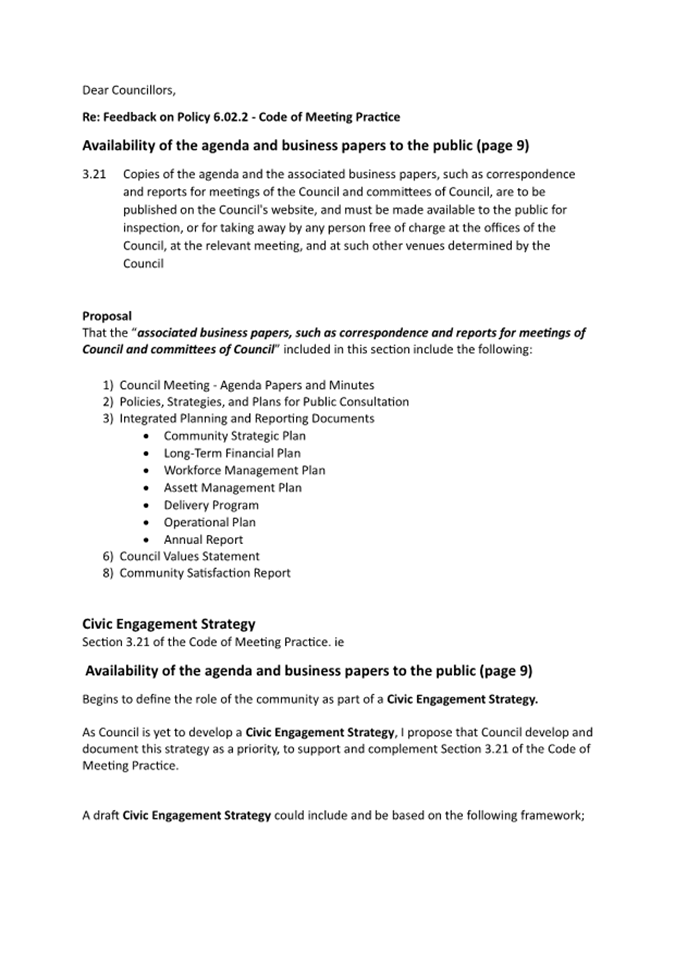
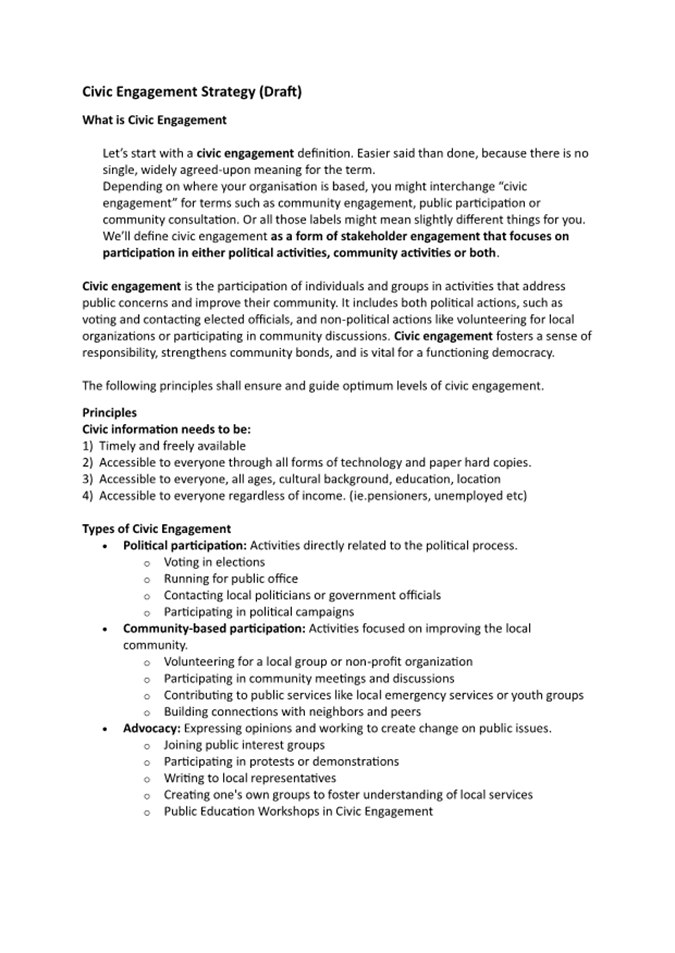
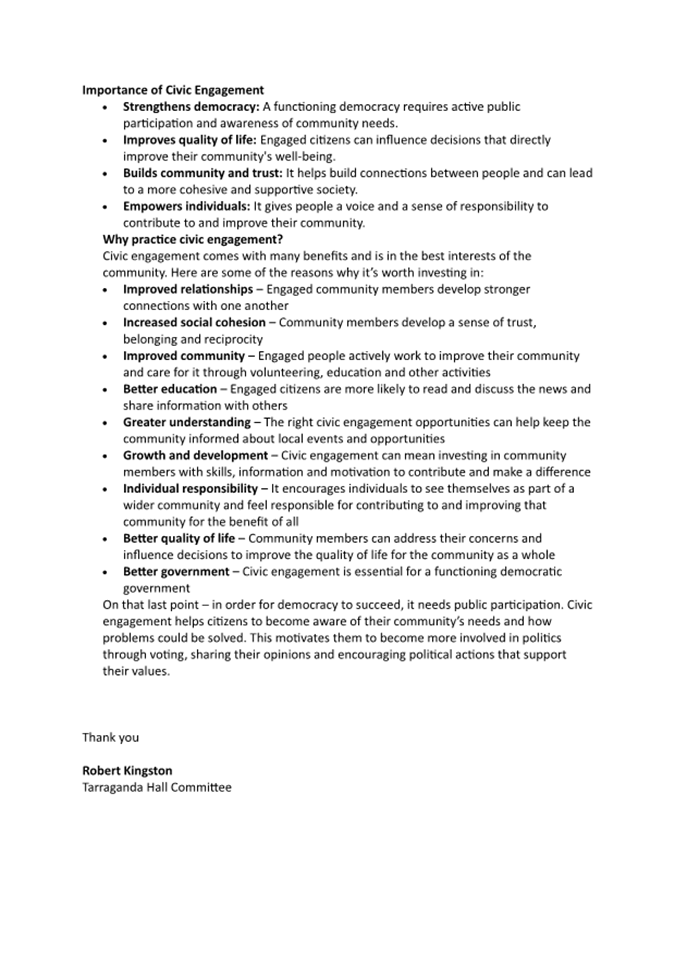
|
Council
|
28 January 2026
|
|
Item
10.4 - Attachment 2
|
Attachment 2 - Code of Meeting Practice - version recommended
for adoption
|
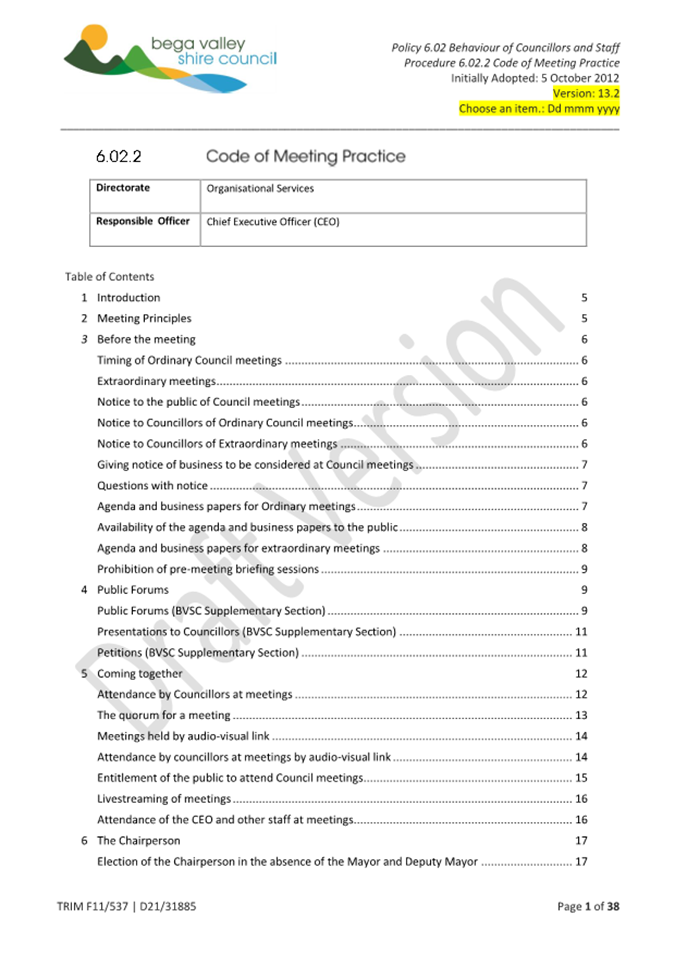
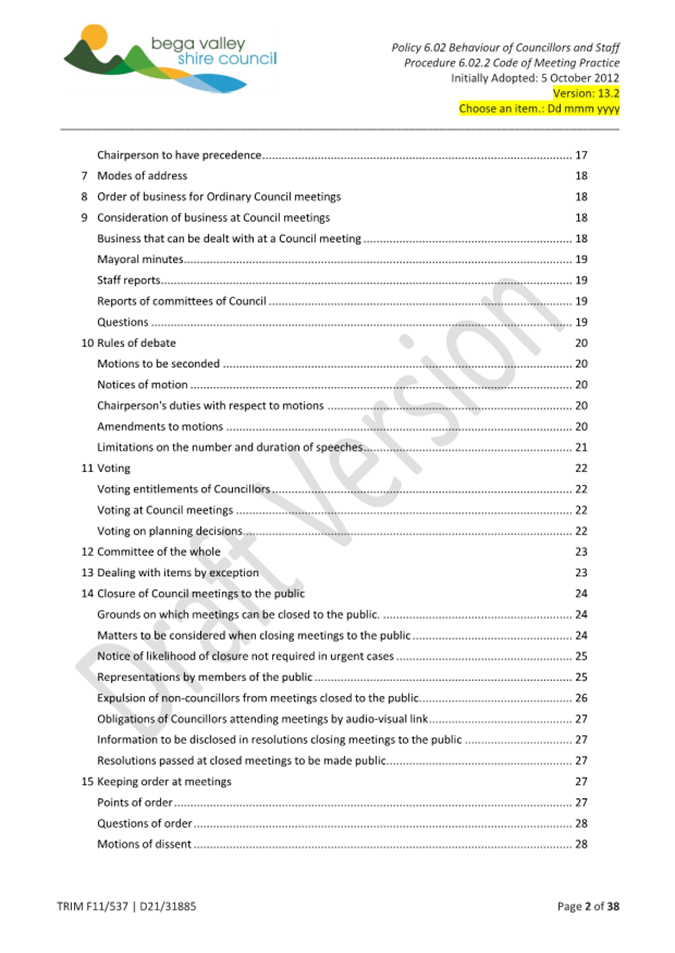
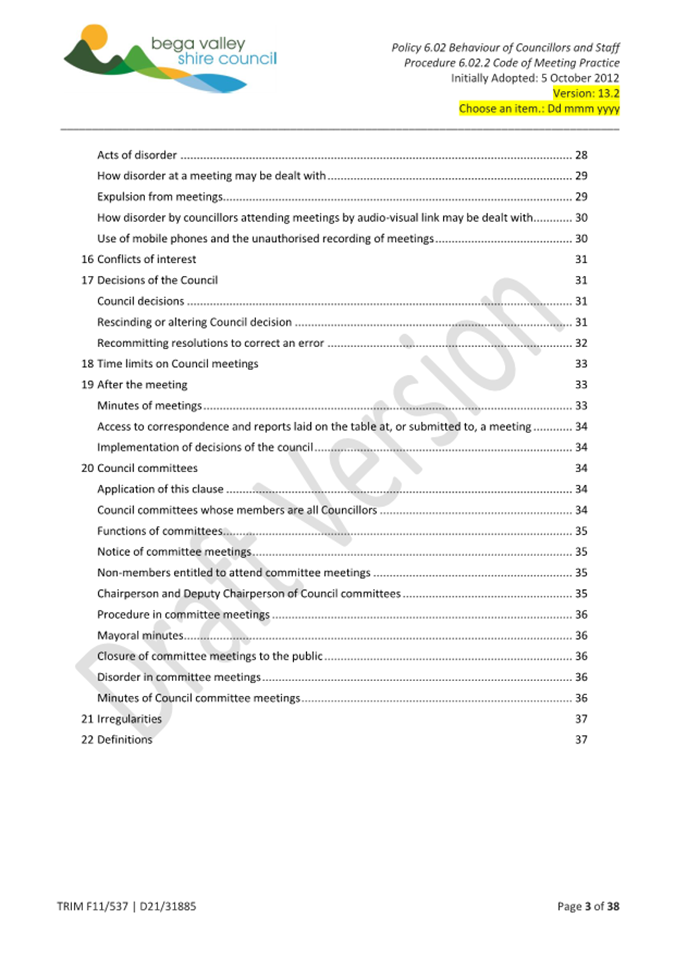
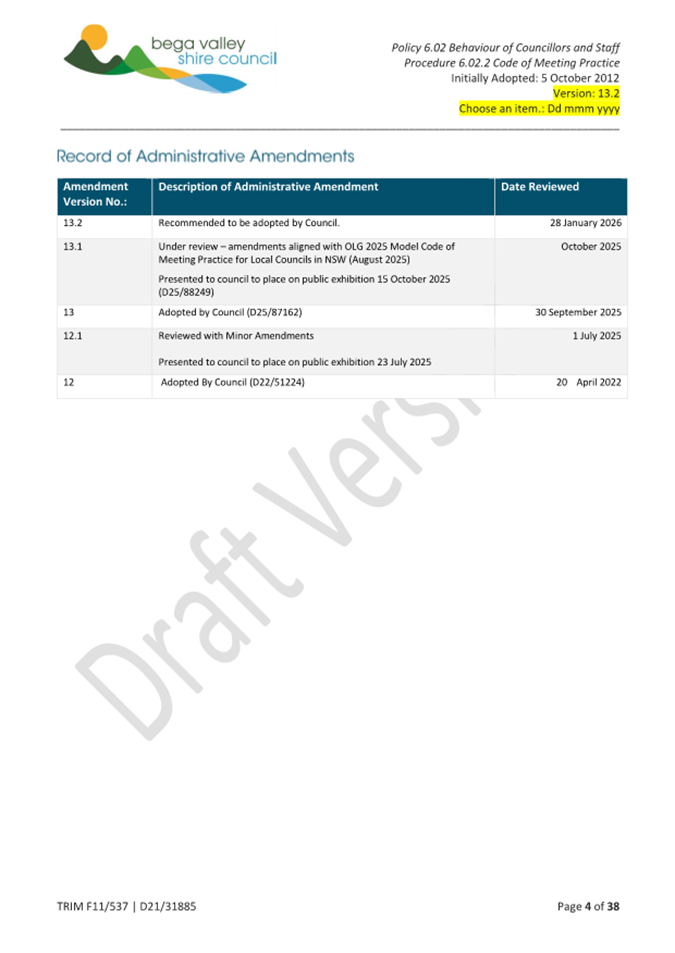
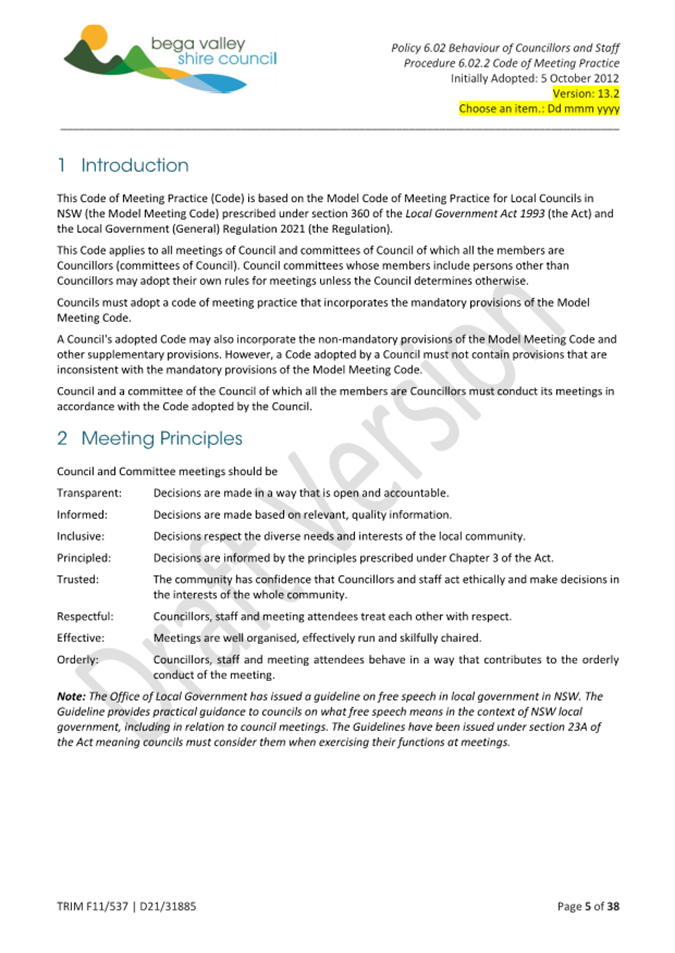
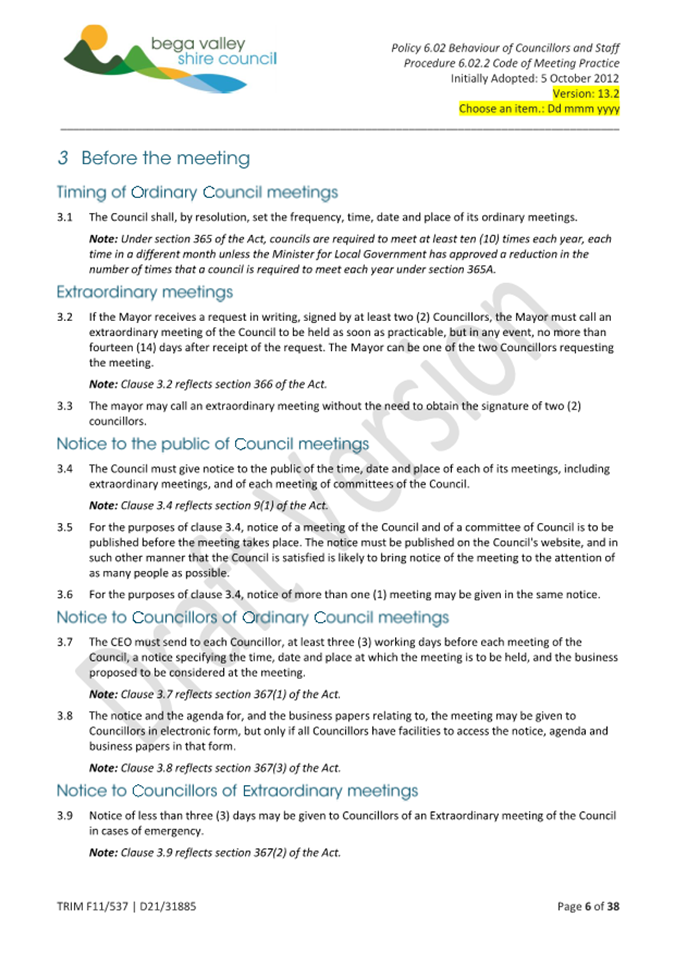
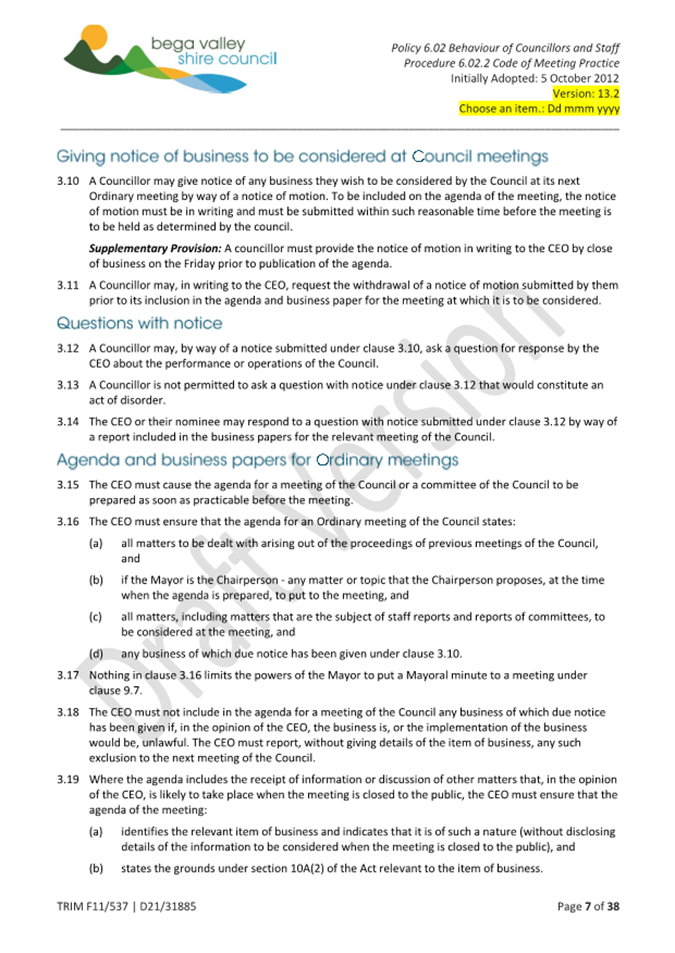
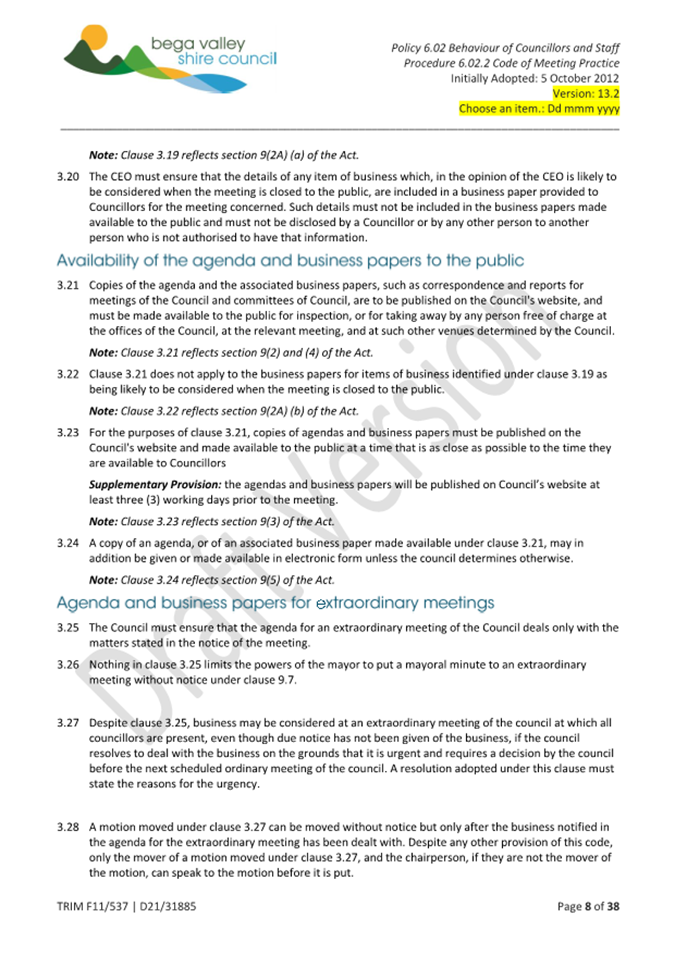
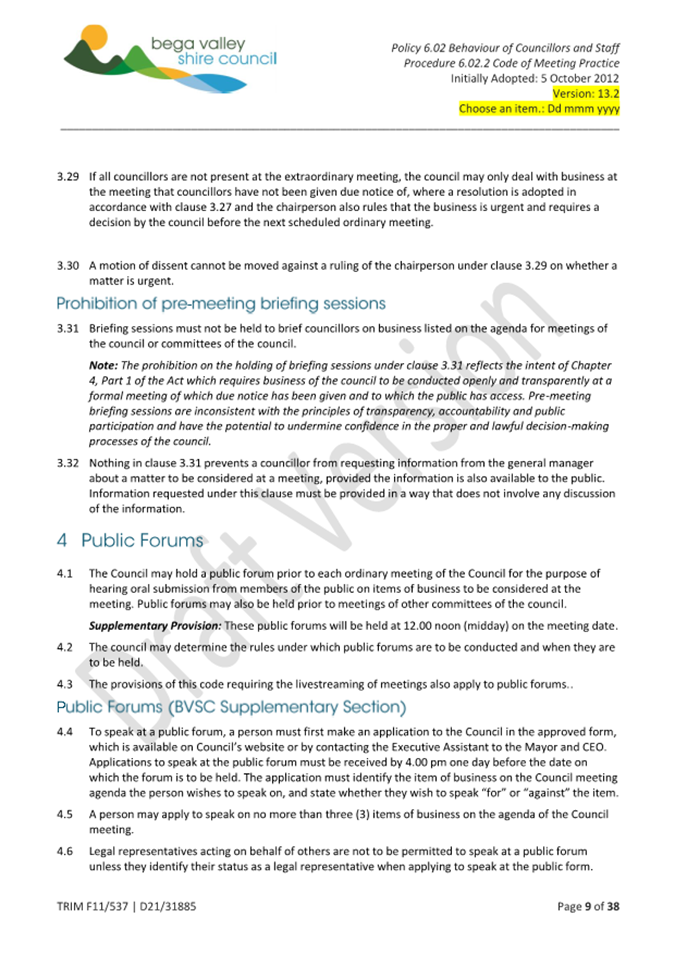
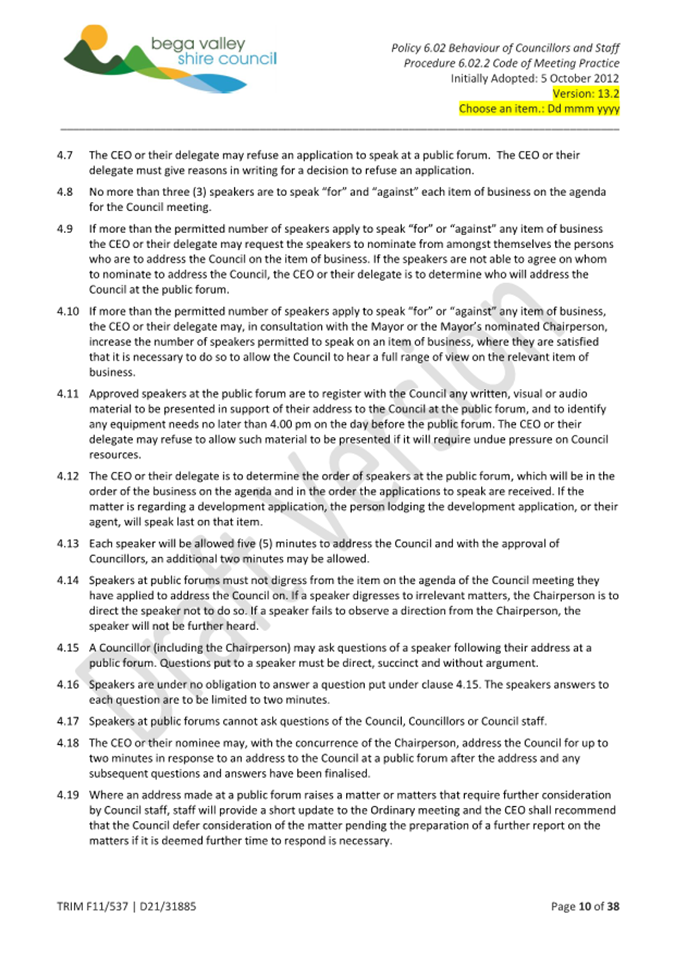
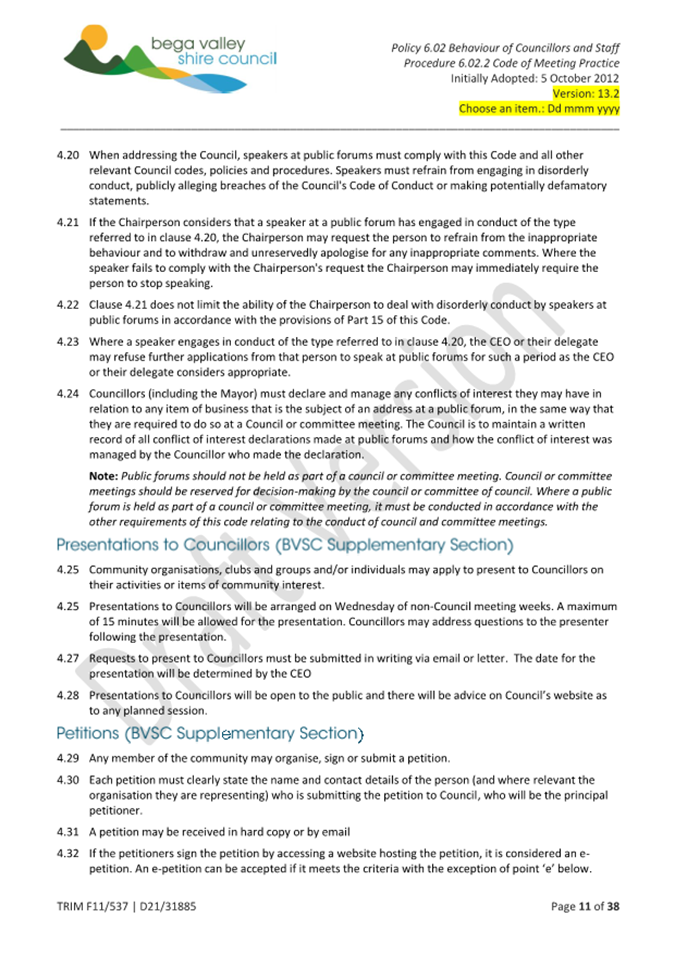
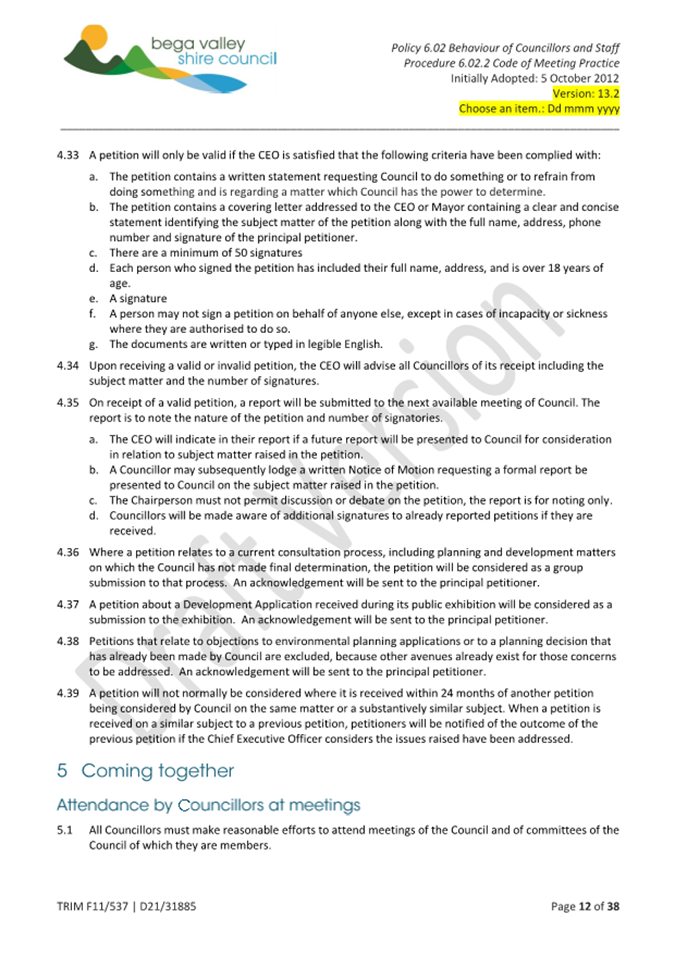
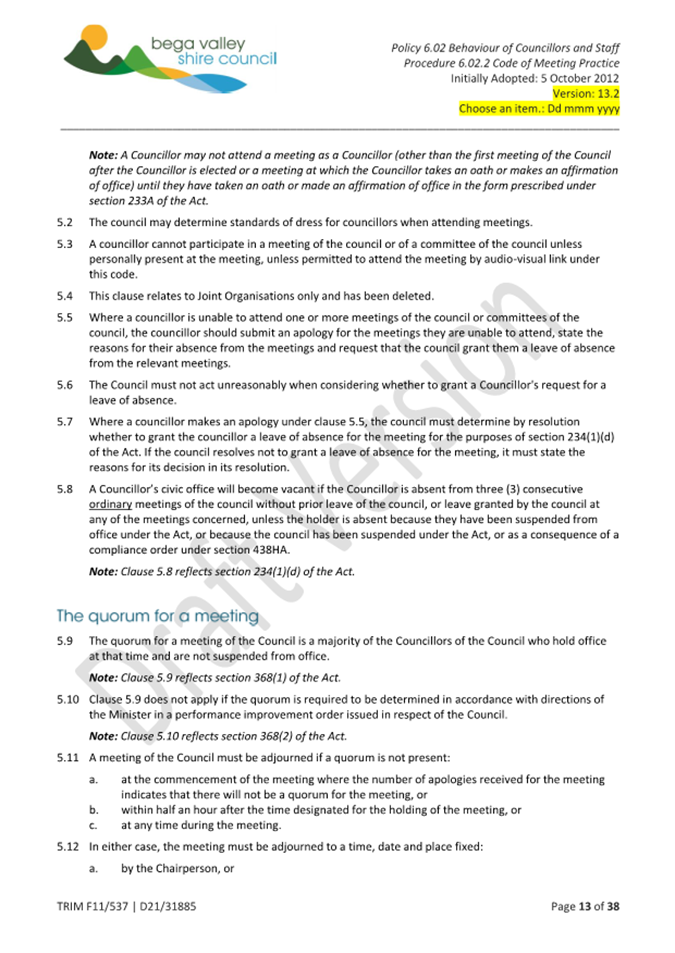
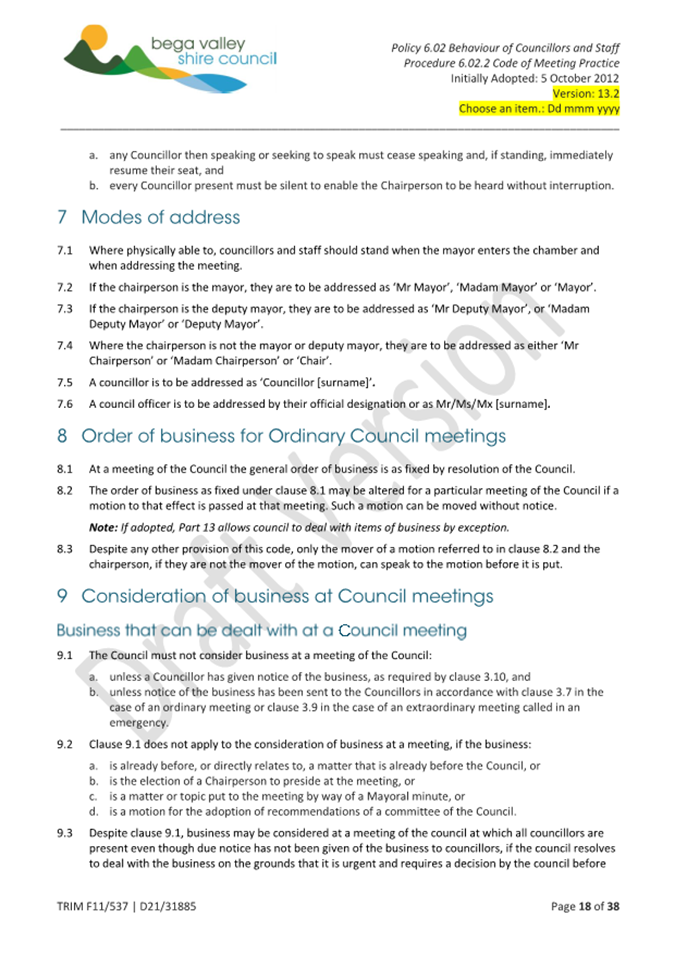
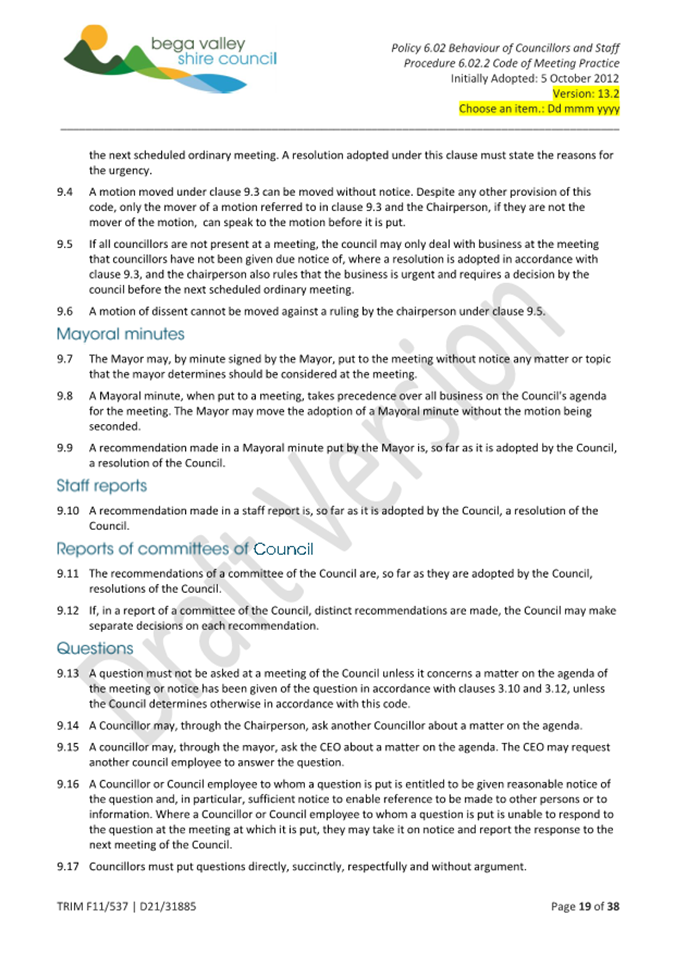
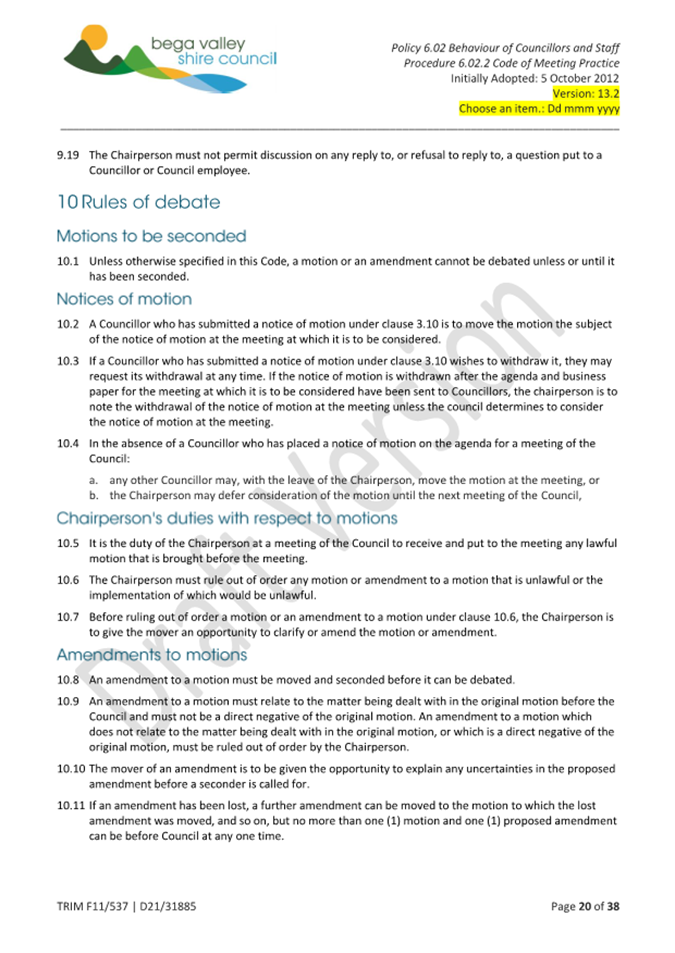
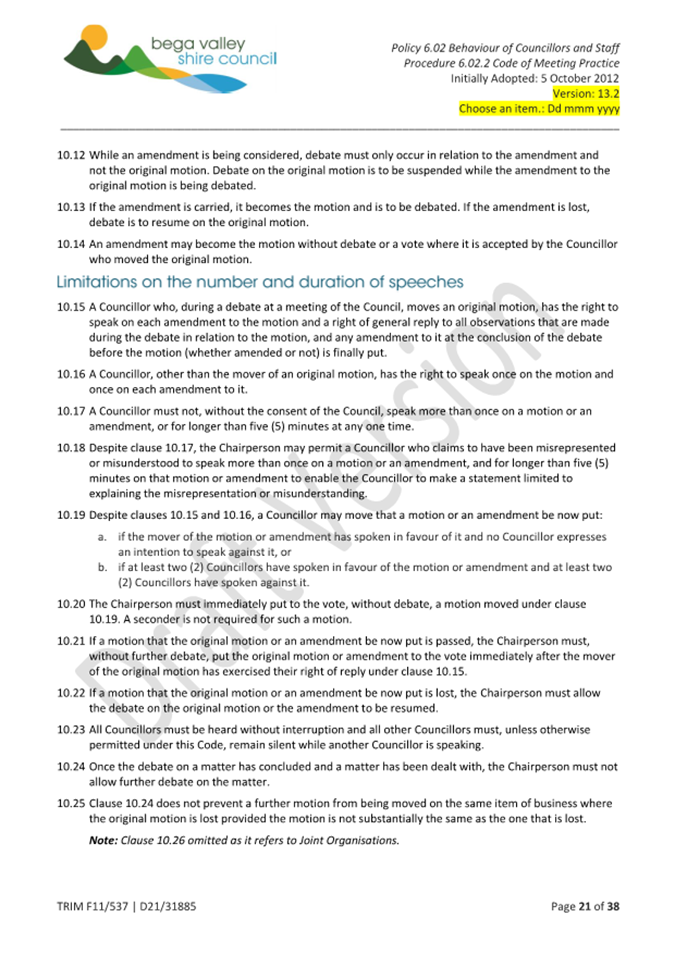
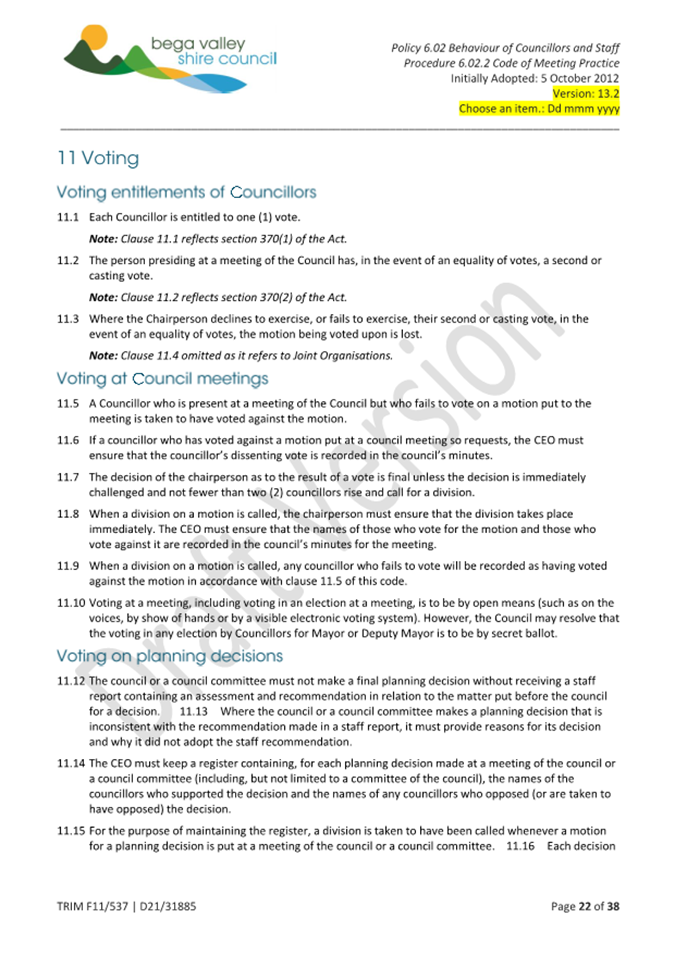
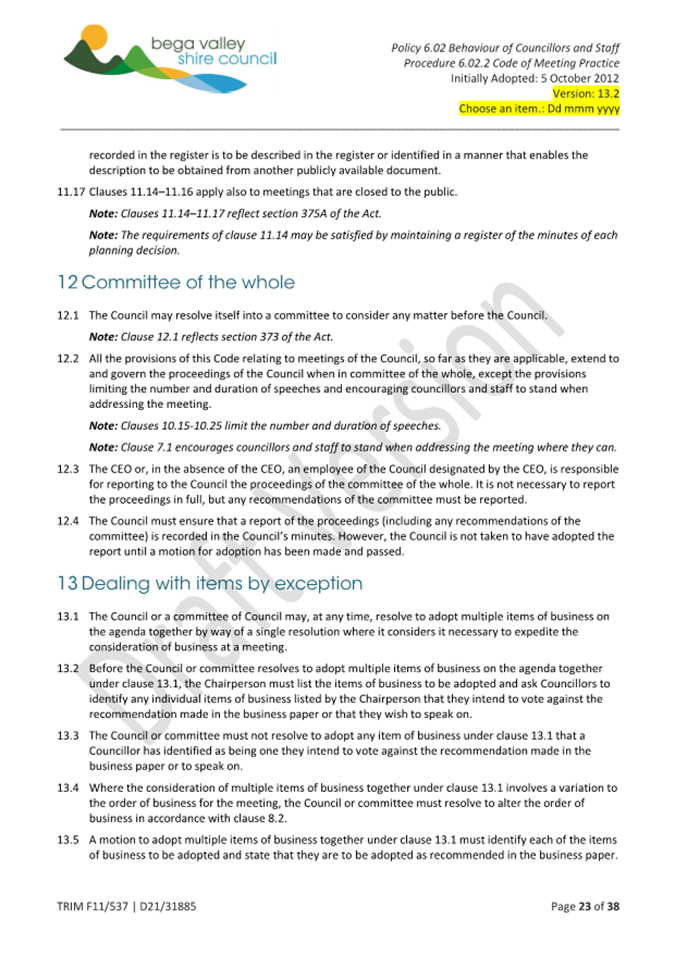
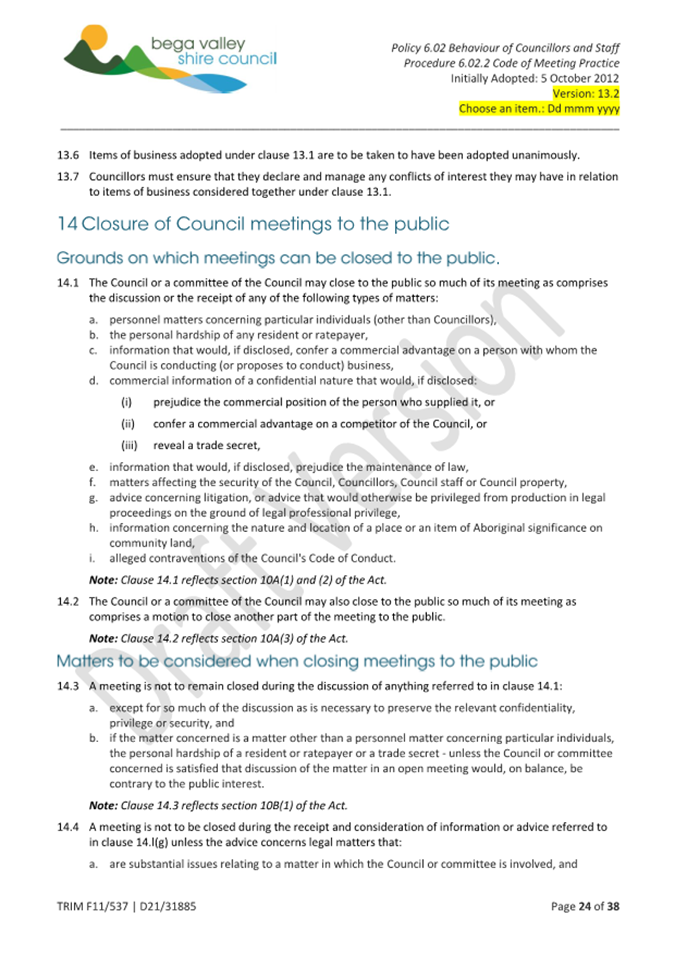
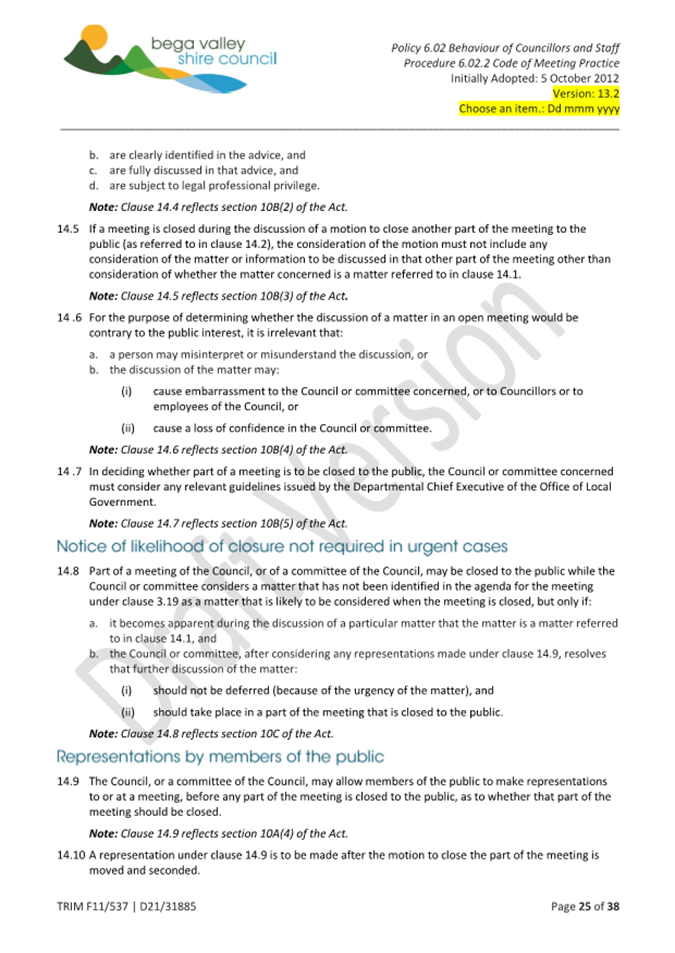
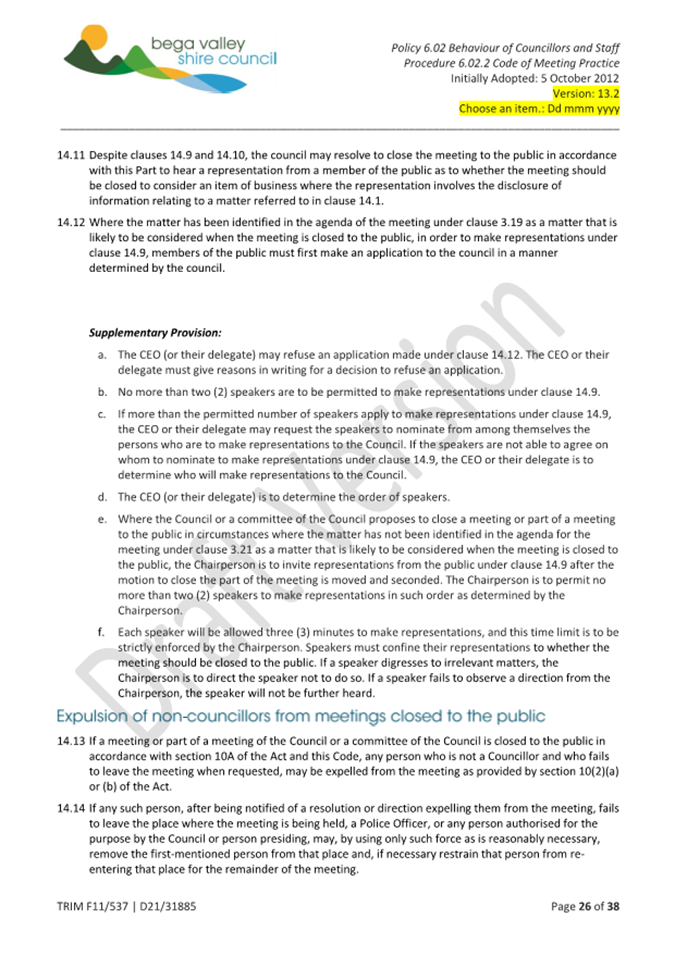
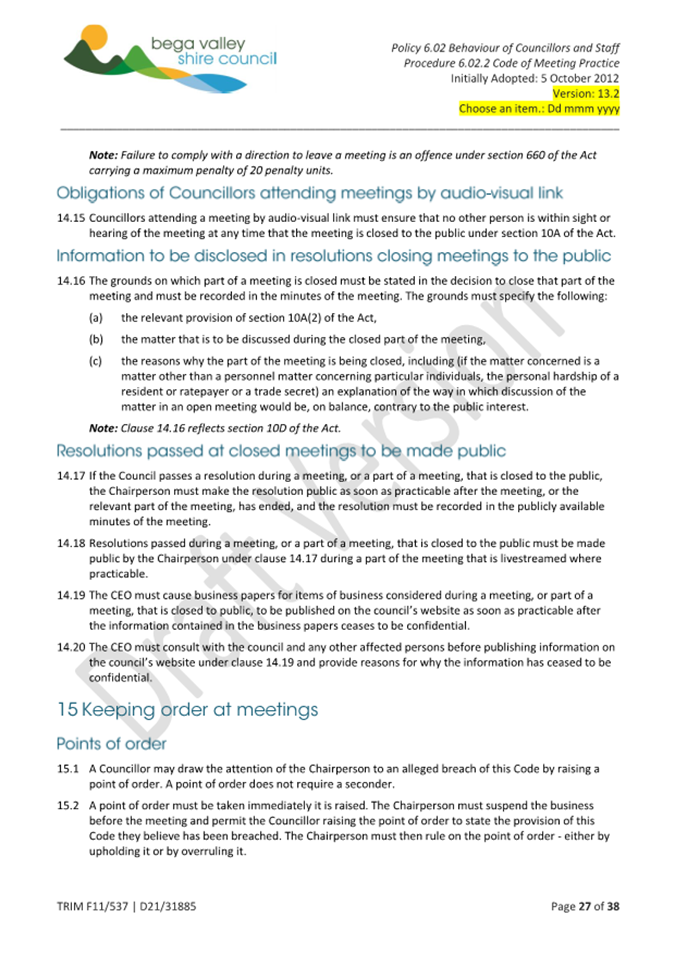
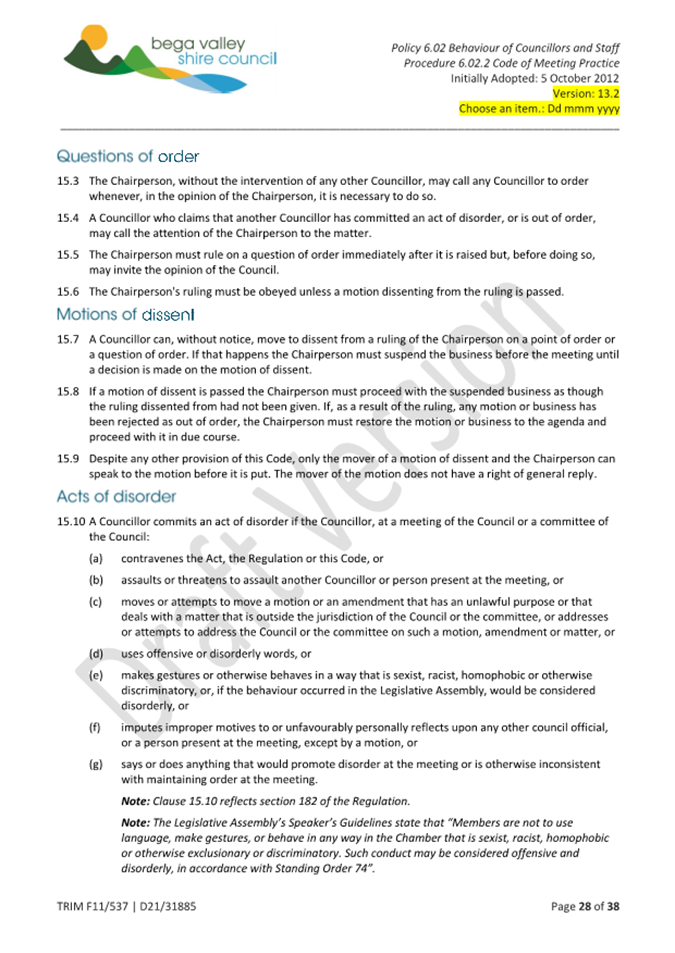
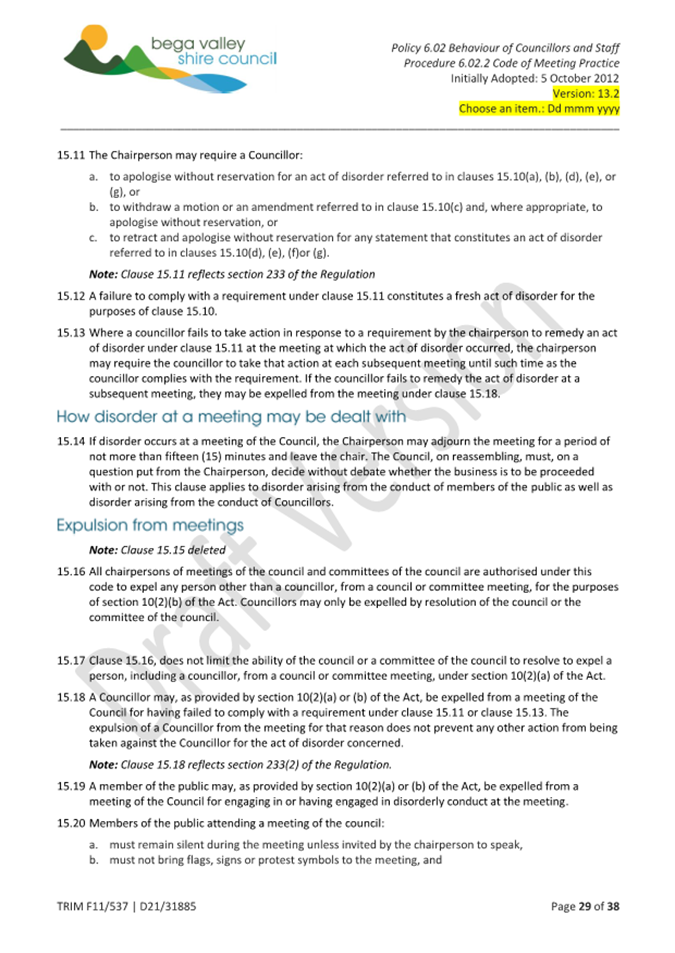
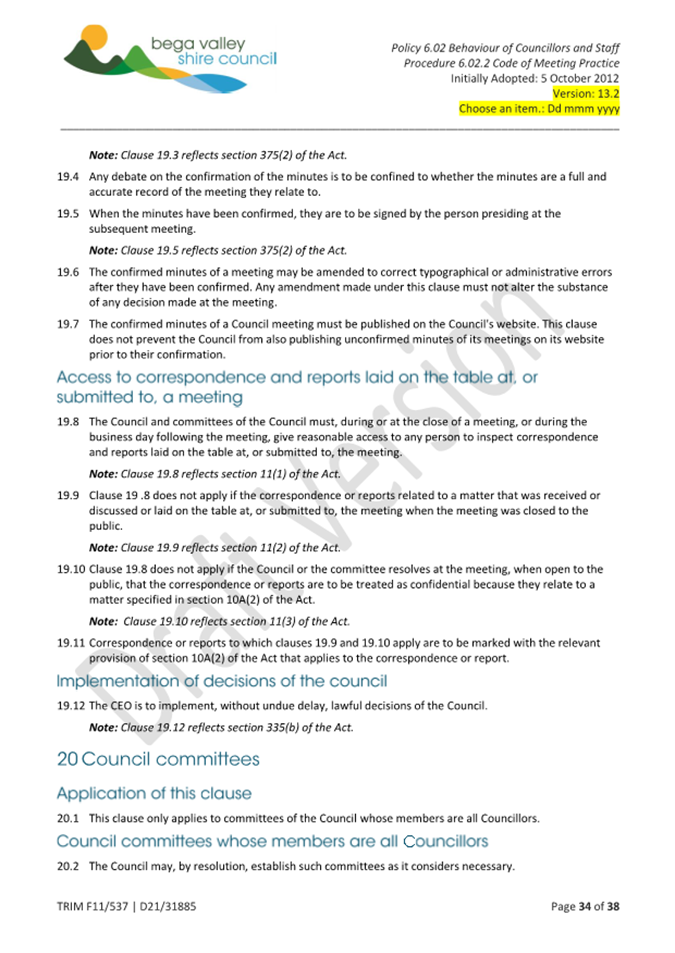
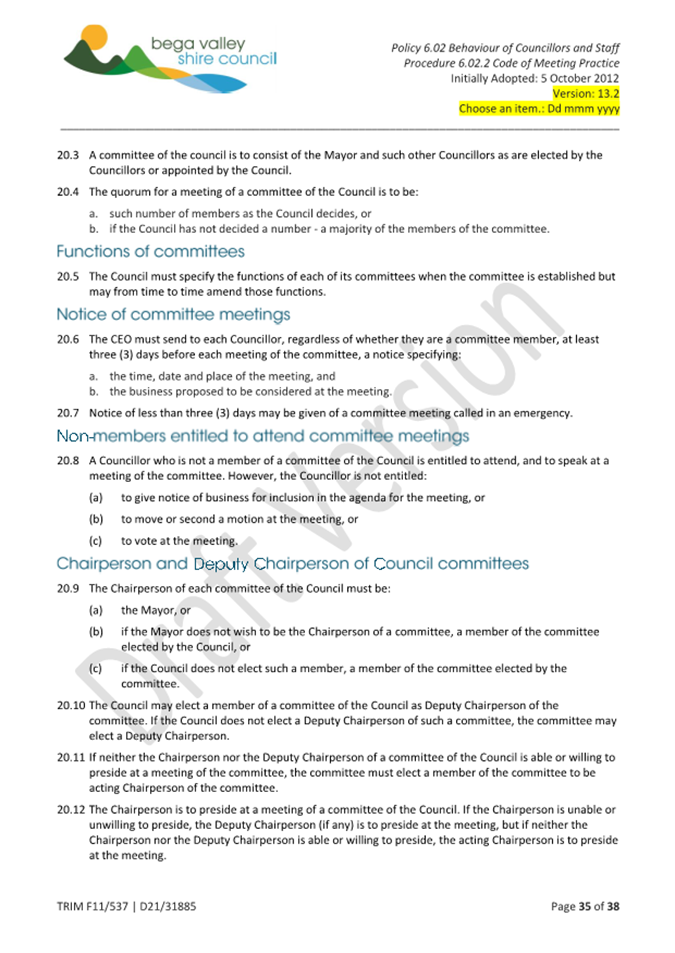
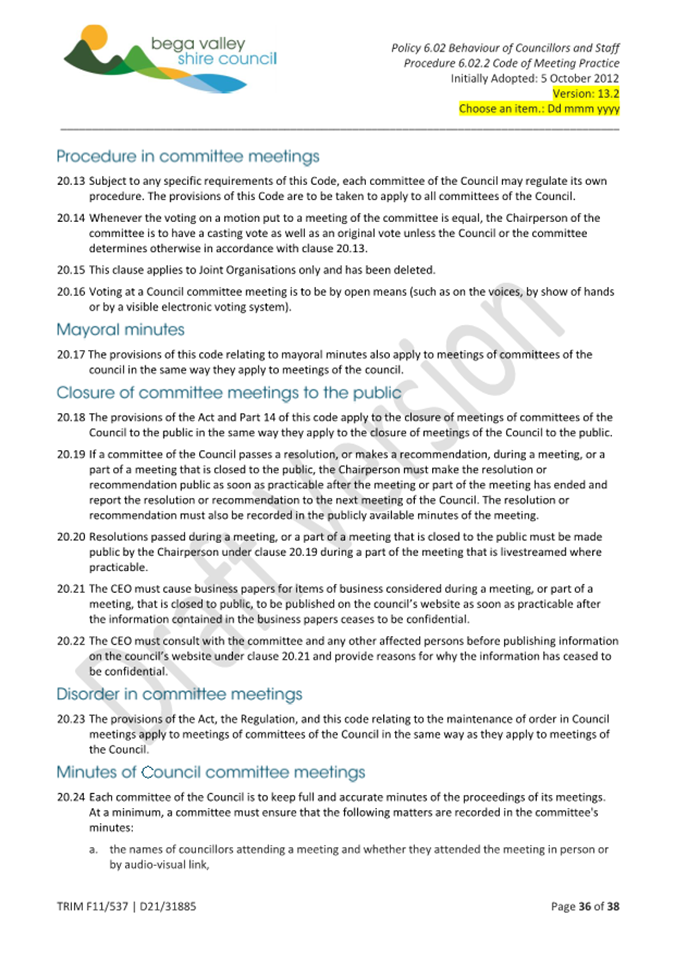
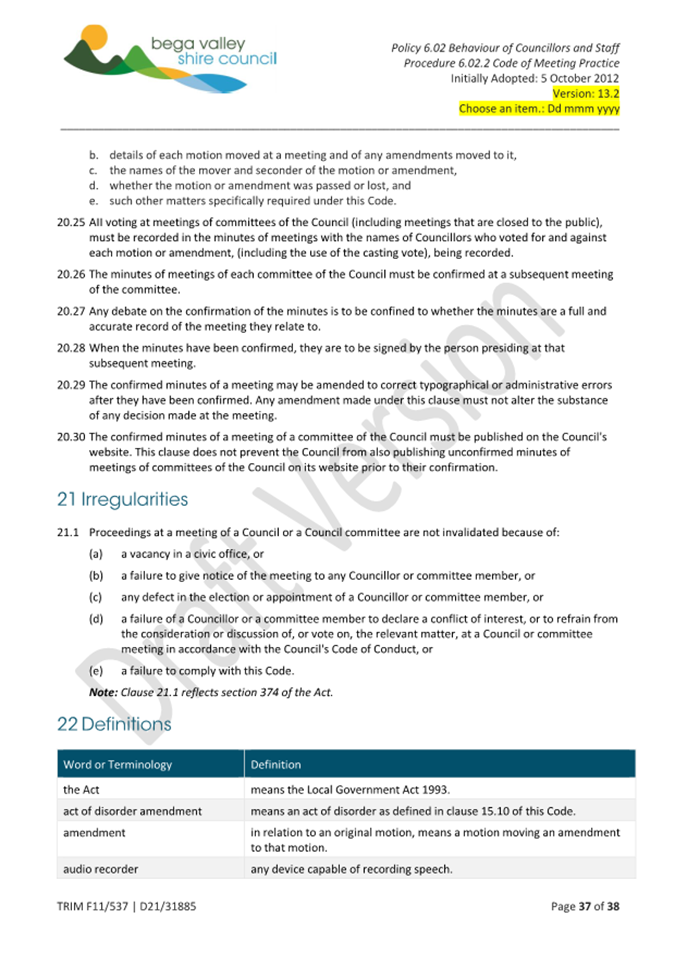
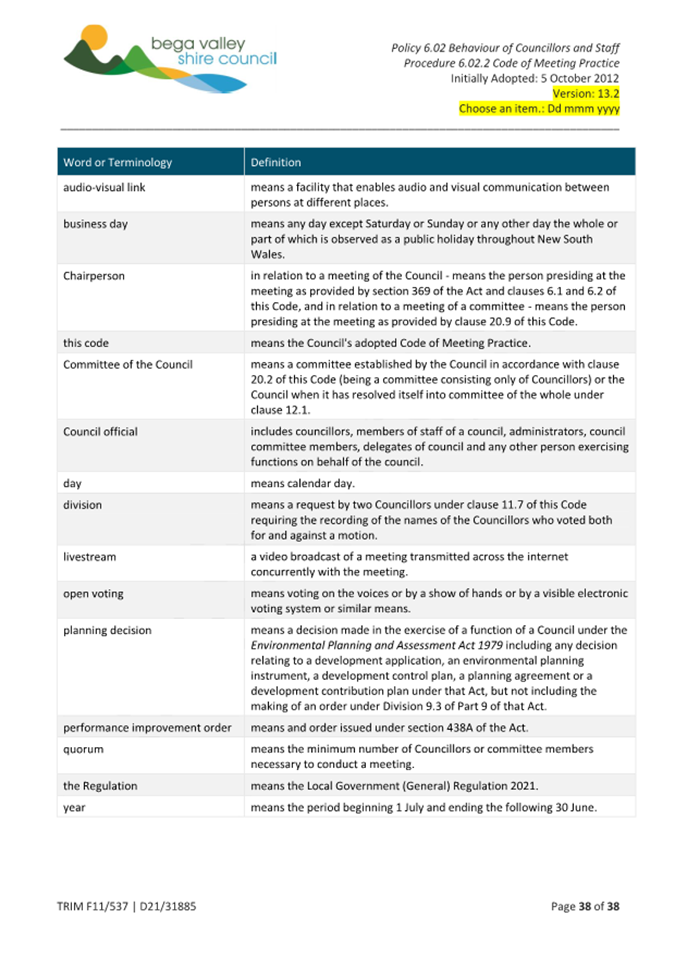
Council 28 January 2026
|
Item
10.5
|
10.5. Quarterly Budget Review Statement (QBRS) December 2025 (Q2
Review)
Quarterly Budget Review Statements
(QBRS) are prepared and presented to Council in accordance with Section 203 of
the Local Government (General) Regulation 2021.
Director Organisational Services
Officer’s
Recommendation
1. That
Council receive and note the December 2025 (Q2) Quarterly Budget Review
Statement (QBRS).
2. That
the budget recommendations detailed in the attachment to this report be
adopted.
Executive
Summary
As part of the Integrated
Planning and Reporting (IPR) framework, a Quarterly Budget Review Statement
(QBRS) must be presented to Council for this financial quarter. This report
provides the FY2026 December (Q2) Quarterly Budget Review Statement.
In summary, the QBRS report for
the quarter ending 31 December 2025 provides the following projected results:
· Total Income decreased by $8.9m. This includes:
- Interest and Investment
revenue increased by $0.5m
- Operational grants
increased by $0.3m
- Capital grants decreased
by $9.6m
· Expenses increased by $1.4m. This includes:
- Employee benefits and
on-costs increased by $0.3m
- Materials and services
increased by $1.1m
· Consolidated
net operating result before grants and contributions provided for capital
purposes has a projected deficit of $11.3m.
· Capital expenditure decreased by $10.9m. This includes:
- Open space/recreational
assets decreased by $9.4m
- Roads, bridges and
footpaths increased $0.7
- Water supply network
decreased by $1.8m
- Sewer
supply network decreased by $0.6m
· The revised projected cash figure at 30 June 2026 is
expected to be $149.2m with external restrictions of $114.0m.
The Responsible Accounting
Officer reports that the December quarterly review presented indicates
Council's projected financial position at 30 June 2026 will be satisfactory.
Background
The QBRS is presented in the statutory format as per the
Quarterly Budget Review Statements guidelines. It supports effective oversight
by including clear, relevant and meaningful information. They provide
councillors and the community with a clear picture of how council is
performing, facilitating good decisions that enable council to operate
efficiently by measuring progress against goals and objectives.
A summary format shows council’s income statement by
fund and type.
The Capital Budget Review Statement (CBRS) prepared provides
variance details. It is the intent of this report to provide information on the
financial performance of Council as a whole and, for each activity of Council.
The budgeting process sees Council commence preparation of
annual budgets in September of each year. As can be expected, many external
factors are unknown at that time and therefore it is important that routine
budget reviews are undertaken and presented to Council for adoption. As
required by the Local Government (General) Regulation 2021, we request
Council to make budget adjustments through the QBRS process.
Council officers retain the ability to enquire, transact,
and report on the detailed general ledger, which includes budgets. If there are
specific questions relating to detailed transactional information, officers can
provide answers to those questions.
Operationally, our teams are continuing to demonstrate
improvement in our financial reporting and systems, focusing on reducing errors
and improving real time information. The Q2 budget review is a process that
informs the development of the budget for the following financial year.
Options
A detailed review by council officers has been undertaken to
prepare this QBRS review.
Option 1: Adopt the QBRS attached to this report
(Recommended option)
It is recommended that this review be adopted to ensure
Council staff are supported in their role to deliver for the community. This
will:
· Ensure
Council’s budget remains responsive to current financial conditions and
operational needs.
· Support staff
in delivering services and projects aligned with community priorities.
· Demonstrates transparency
and good governance in financial management.
If the adjustments are not approved, there may be an impact
on delivery of existing work plans to deliver within the resource allocations.
Option 2: Consider alternative or additional budget
adjustments
Council has the option to consider other budget adjustments.
This may allow the elected body to address emerging priorities or concerns not
captured in the current QBRS or respond to new information or community
feedback. Risks of this option include:
· delay in
implementation of recommended adjustments.
· introducing
financial or operational risks that may not have been considered or carefully
assessed.
· place
unexpected pressures on Council and staff time and resources, potentially
disrupting planned projects and impacting the timely delivery of core services.
Community
and Stakeholder Engagement
Engagement undertaken
Internal engagement with staff has been undertaken to
develop the recommendations for the QBRS adjustments.
Engagement planned
The budget adjustments requested in the QBRS are included as
an attachment to the business paper and published on Council’s website.
Once approved, the adjustments are made in our financial reporting systems.
Future reports will reflect the adopted changes.
Financial
and Resource Considerations
Operating Result
Council’s consolidated budget, net operating result,
has declined by $10.3m since the September review. The revised December budget
is projecting a surplus of $34.2m. The consolidated net operating result before
grants and contributions provided for capital purposes has decreased by $0.7m,
resulting in a projected deficit of $11.3m.
Income streams have seen an increase in investment income of
$0.5m.
Operational Grants have increased by $0.3m.
Capital Grants decreased by $9.6m. Included in the total are new
grants, previously received grants and new grants transferred to contract
liability. The reduction is mainly due to both grant funding and capital
expenses for Merimbula Boardwalk being transferred to the next financial year.
Expenses increased by $1.4m.
Employee costs increased by
$0.3m and materials and services increased by $1.1m.
The recommended changes have the
following impact on the net operating result by fund:
|
|
Revised Budget (incorporating revotes/carryovers)
$000’s
|
Q2 Requested Changes
$000’s
|
Projected Year End Result $000’s
|
|
General Fund
|
39,525
|
(8,121)
|
31,404
|
|
Water Fund
|
(2,156)
|
185
|
(1,970)
|
|
Sewer Fund
|
7,097
|
(2,334)
|
4,763
|
The recommended changes have the
following impact on the net operating result before grants and
contributions provided for capital purposes by fund:
|
|
Revised Budget (incorporating revotes/carryovers)
$000’s
|
Q2 Requested Changes
$000’s
|
Projected Year End Result $000’s
|
|
General Fund
|
(13,098)
|
(476)
|
(13,575)
|
|
Water Fund
|
(2,260)
|
(17)
|
(2,243)
|
|
Sewer Fund
|
4,703
|
(200)
|
4,503
|
Capital
Capital expenditure is estimated to decrease by $10.9m in
the December QBRS to $109.7m. The largest movements were in Open Space/Recreational
of $9.4m. This is mainly due to both grant funding
and capital expenses for Merimbula Boardwalk being transferred to the next
financial year. Other reductions were in the sewer supply network of
$1.8m due to Bermagui Sewer Pump Station being
transferred to next financial year.
Cash and Investments
Council had cash and investments
of $154.0m at 31 December 2025. The revised projected cash figure at 30 June
2026 is expected to be $149.2m of which $114.0m is expected to be externally
restricted.
Legal
/Policy
In accordance with Regulation
203(1) of the Local Government (General) Regulation 2021, the Responsible
Accounting Officer must prepare and submit a Budget Review Statement to Council
after the end of each quarter.
Clause 203 of the Local
Government (General) Regulations 2021 states:
Budget Review Statements and
revision of estimates
1. Not later than two months after the
end of each quarter (except the June quarter), the responsible accounting
officer of a council must prepare and submit to the council a budget review
statement that shows, by reference to the estimate of income and expenditure
set out in the statement of the council’s revenue policy included in the
operational plan for the relevant year, a revised estimate of the income and
expenditure for that year.
2. A budget review statement must
include or be accompanied by:
a. A report as to
whether or not the responsible accounting officer believes that the statement
indicates that the financial position of the council is satisfactory, having
regard to the original estimate of income and expenditure, and
b. If that position
is unsatisfactory, recommendations for remedial action.
c.
A budget review statement must also include any information required by the
Code to be included in such a statement.
Impacts
on Strategic/Operational/Asset Management Plan/Risk
Strategic
Alignment
The QBRS is a key instrument in
Council’s Integrated Planning and Reporting framework. It provides transparent,
quarterly reporting on financial performance and seeks in‑year budget adjustments in accordance with clause 203 of
the Local Government (General) Regulation:
CSP
Strategy E.1
– Lead, govern and regulate in an ethical, equitable, transparent and
accountable way.
E.3
- Council has well-governed financial and strategic management processes to
ensure ongoing viability and value for money.
Operational
Plan E3.1.1
- The Operational Plan’s progress reporting now occurs quarterly,
directly aligned with the QBRS process. This integration ensures that
Council’s financial and operational performance are reviewed together,
supporting informed decision-making and continuous improvement.
Delivery Program
· Councils’
role to provide services, facilities, programs, planning and reporting is
directly supported by the QBRS, which is a core mechanism for corporate
planning, budget control and performance reporting.
· The Delivery
Plan’s priority focus on governance, record‑keeping
and customer experience supports accurate and timely financial reporting and
continuous improvement of budget processes that feed the QBRS.
Environment
and Climate Change
While the QBRS itself does not directly impact environmental
outcomes, it supports Council’s environmental objectives by ensuring that
resources are available for the delivery of environmental programs,
infrastructure, and initiatives. The transparent allocation and monitoring of
funds enables Council to respond to emerging environmental priorities and
maintain its commitment to sustainability and responsible resource management.
Economic
The QBRS provides a transparent and timely assessment of
Council’s financial performance, supporting effective resource allocation
and long-term financial sustainability. By identifying budget variances and
recommending in-year adjustments, the QBRS ensures Council’s financial
decisions are responsive to changing circumstances and aligned with community
priorities. This process builds confidence in Council’s management of
public funds and supports the delivery of services and infrastructure that
underpin local economic resilience and growth.
Financial reporting is an important part of being
transparent and accountable. It enables expectations to be set, monitored and
communicated and acknowledges each councils own unique environment,
circumstances, specific transactions and events.
Risk
QBRS reporting enhances Council’s risk management by
providing regular oversight of financial performance and identifying emerging
risks or opportunities. The QBRS process ensures that potential financial,
operational, and compliance risks are identified early and addressed through
appropriate mitigation strategies.
Transparent reporting and clear documentation of budget
adjustments support informed decision-making and strengthen Council’s
capacity to avoid or manage risks. Regular reporting enables councillors and
the community to assess progress and measure Council’s financial health.
It enables variances to be understood and addressed throughout the year and
facilitates timely corrective actions as required. It also enables spending
commitments to be managed now and into the future.
Accurate, reliable and openly available financial
information builds trust and engagement. It enables Councillors and the
community to regularly and routinely assess council’s progress against
intended goals and objectives.
Social
/ Cultural
The QBRS contributes to social and cultural outcomes by
ensuring Council’s resources are allocated efficiently and equitably to
meet the needs of the community. Transparent financial reporting promotes trust
and accountability, enabling the community to understand how Council is
delivering on its commitments. The QBRS process supports the ongoing provision
of services, programs, and facilities that enhance community wellbeing,
inclusion, and quality of life.
Attachments
1⇩. QBRS
report December 2025
|
Council
|
28 January 2026
|
|
Item
10.5 - Attachment 1
|
QBRS report December 2025
|
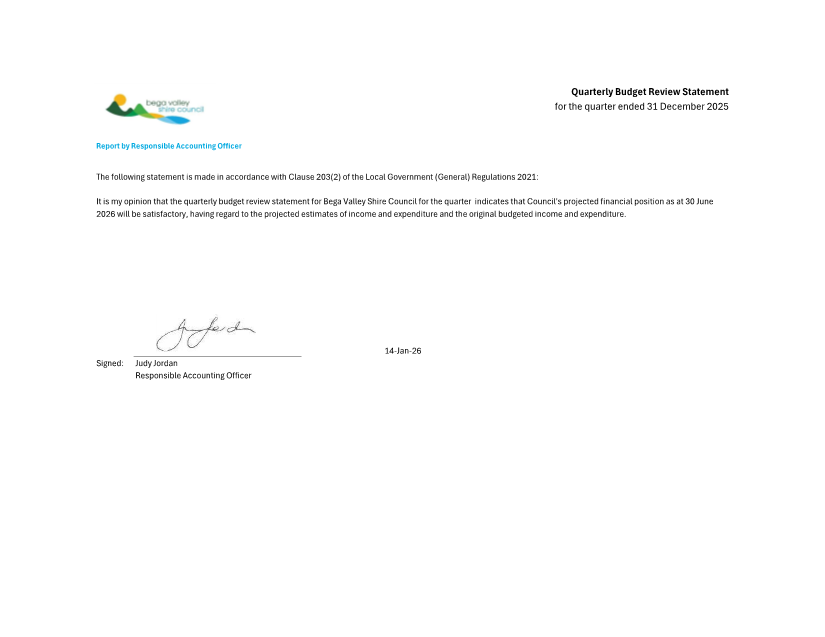
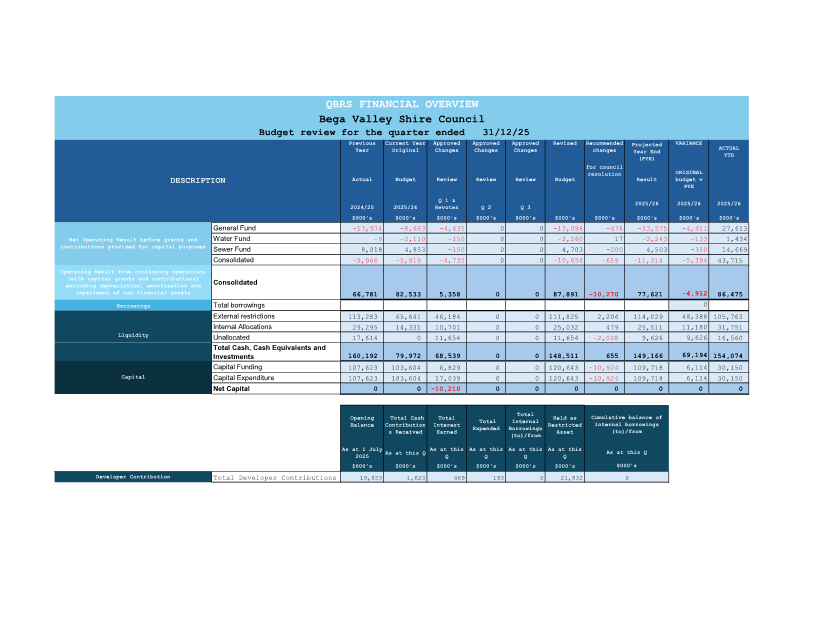
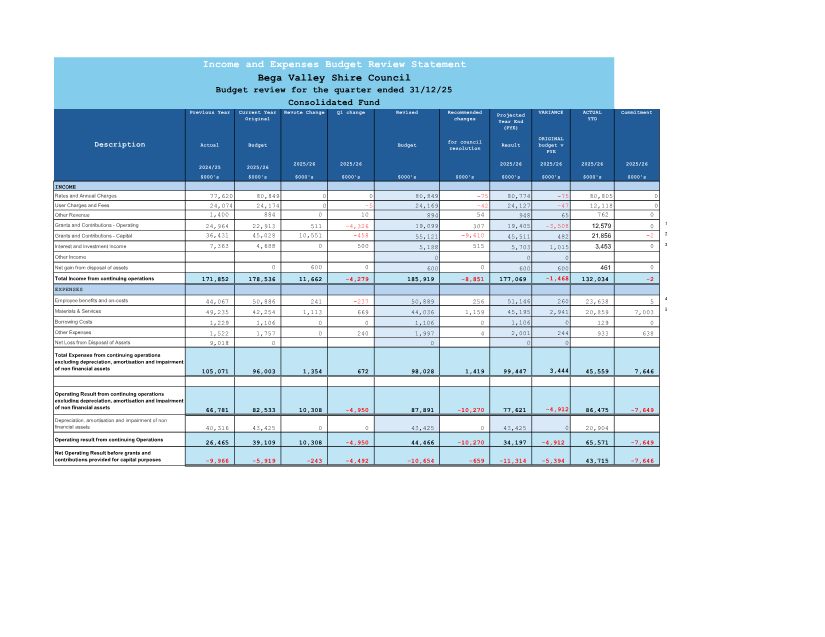
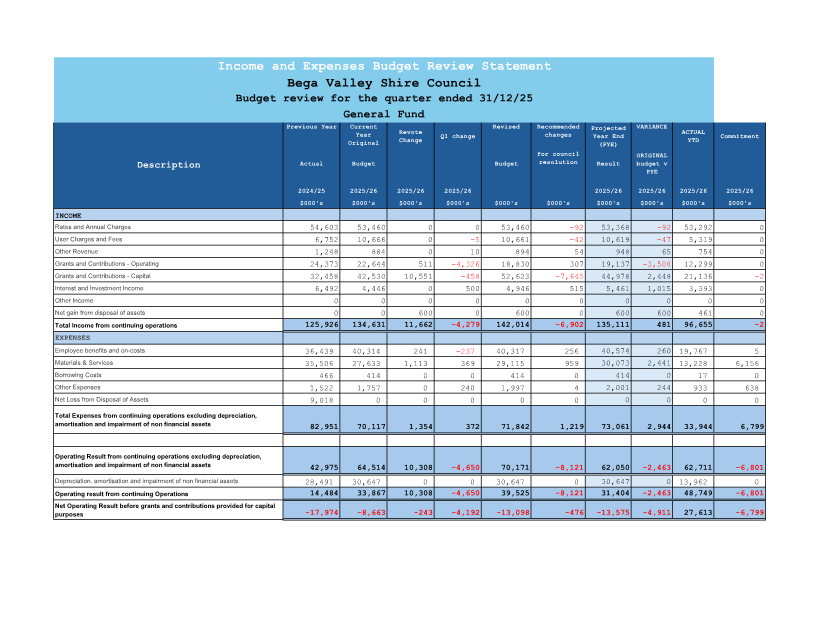
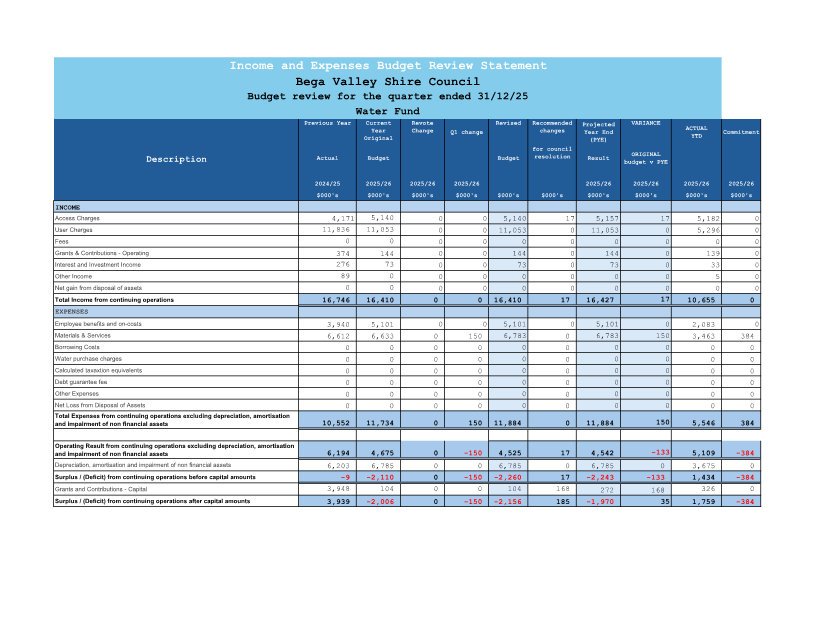
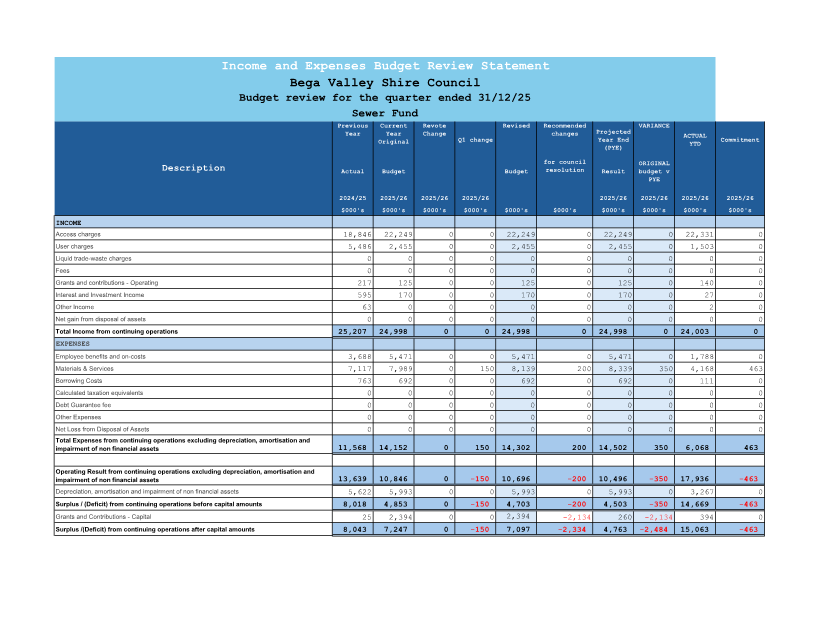
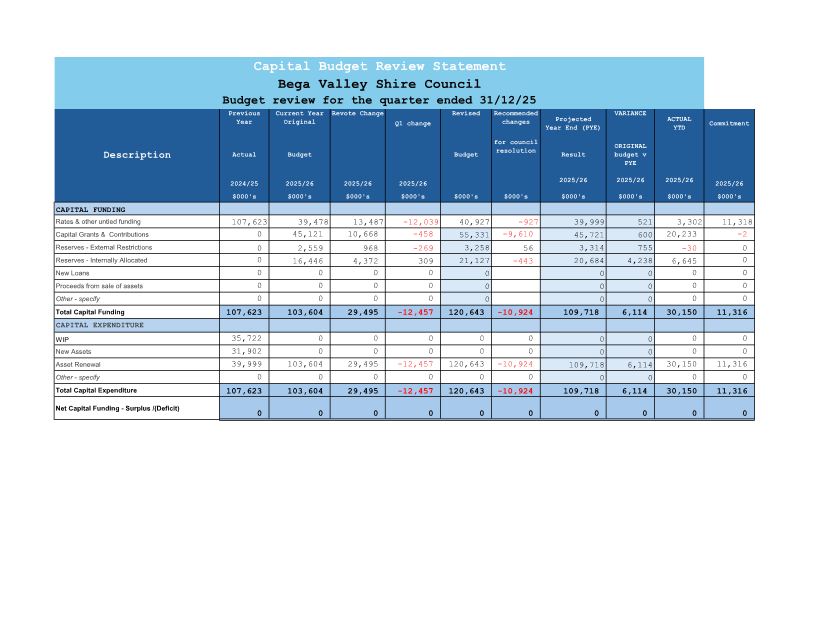
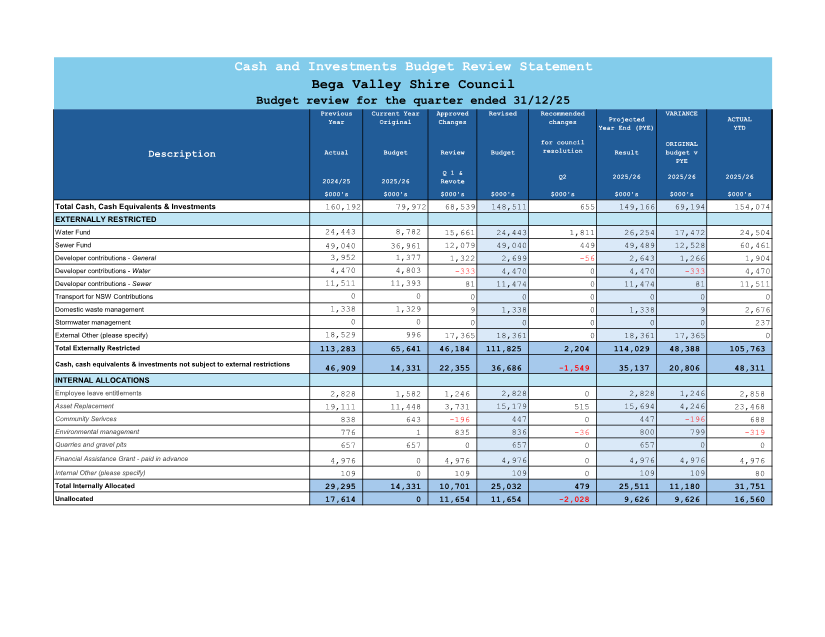
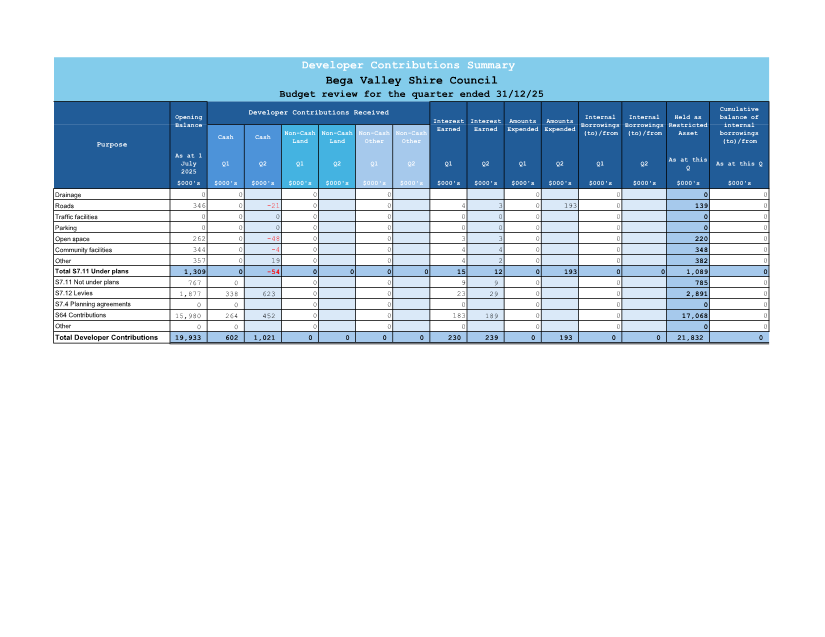
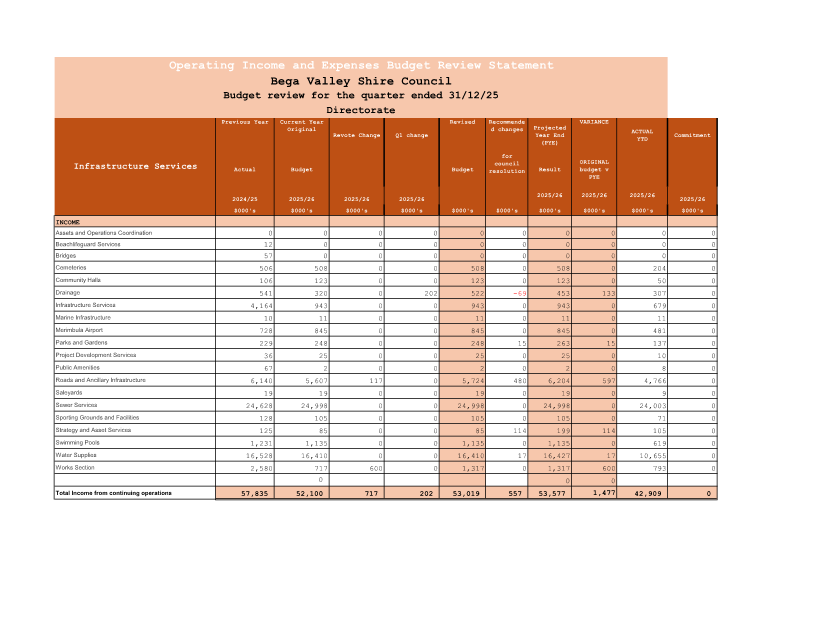
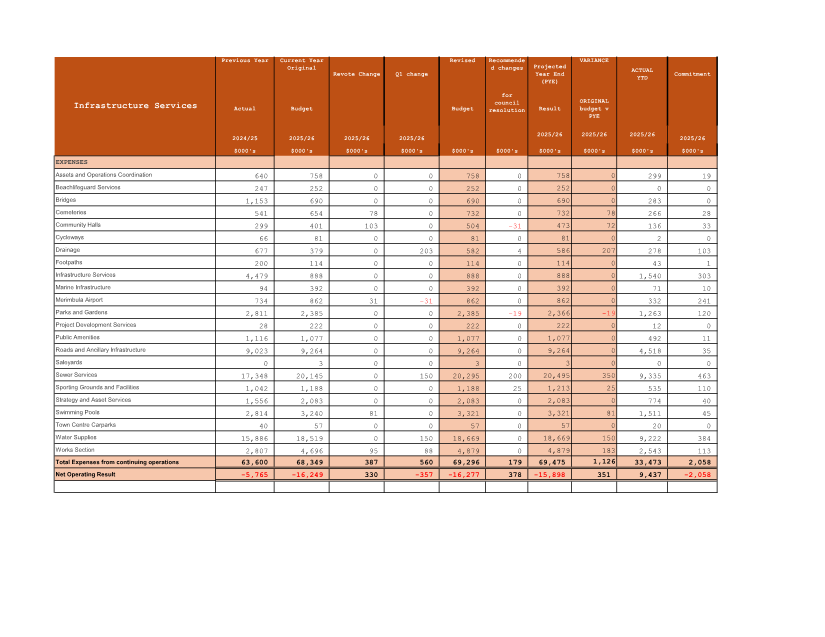
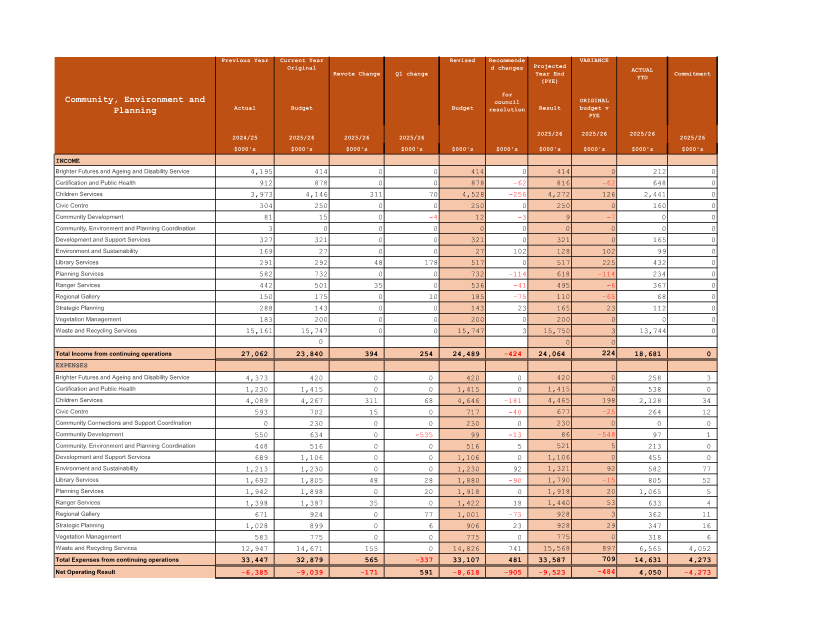
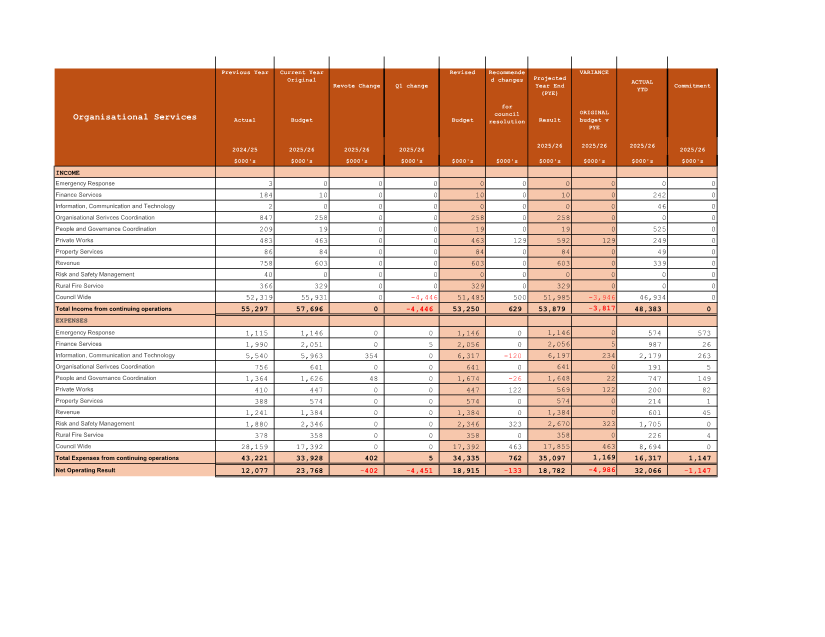
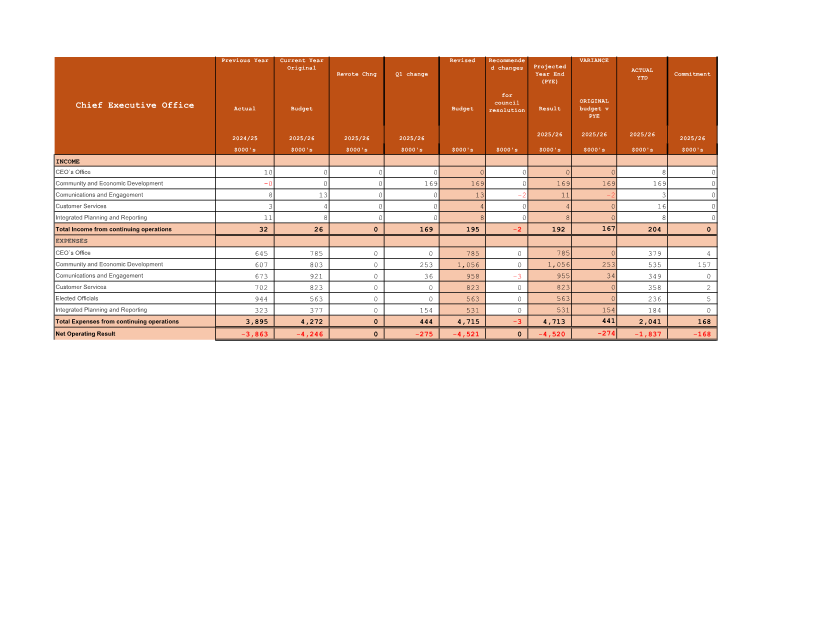
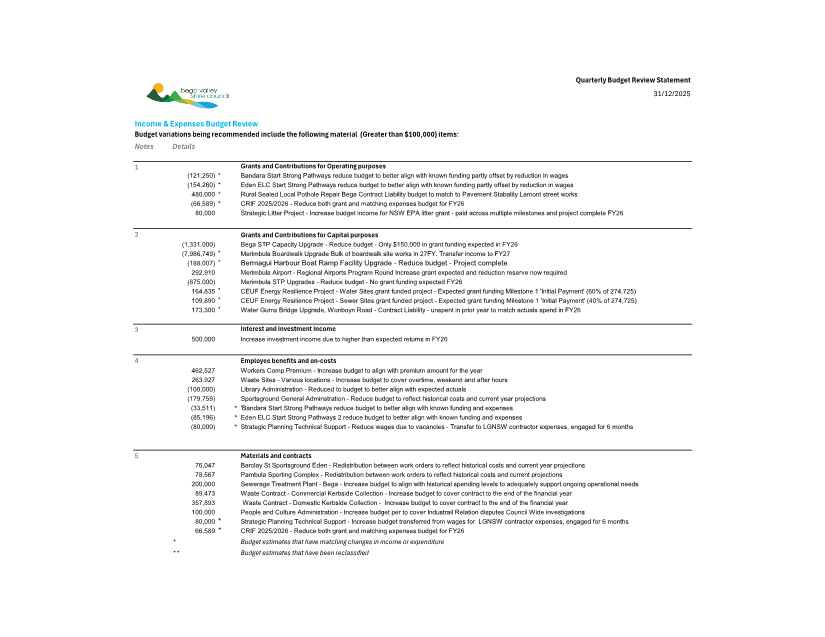
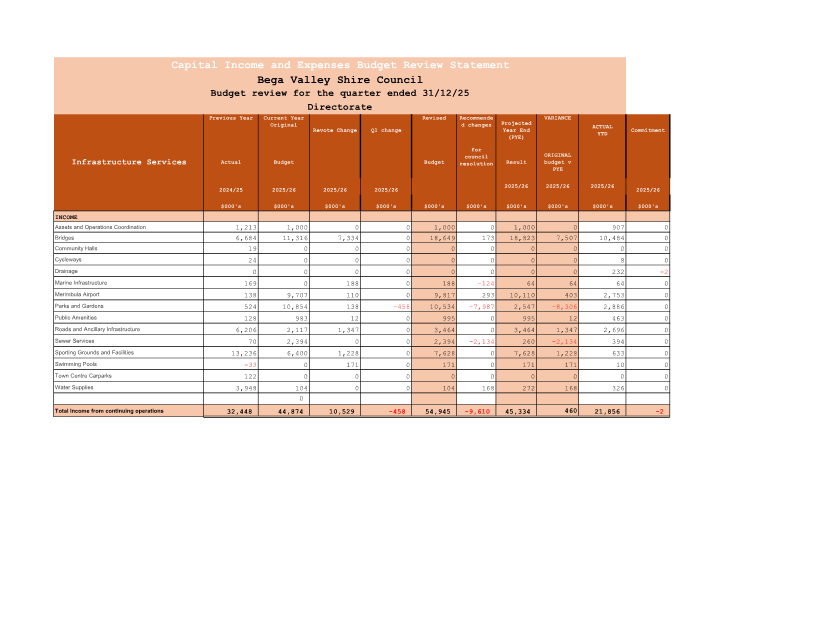
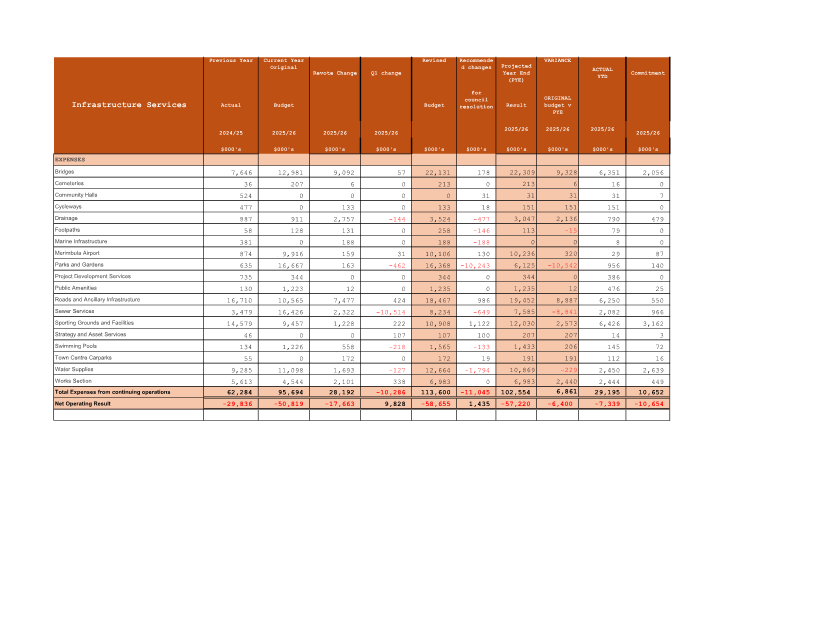
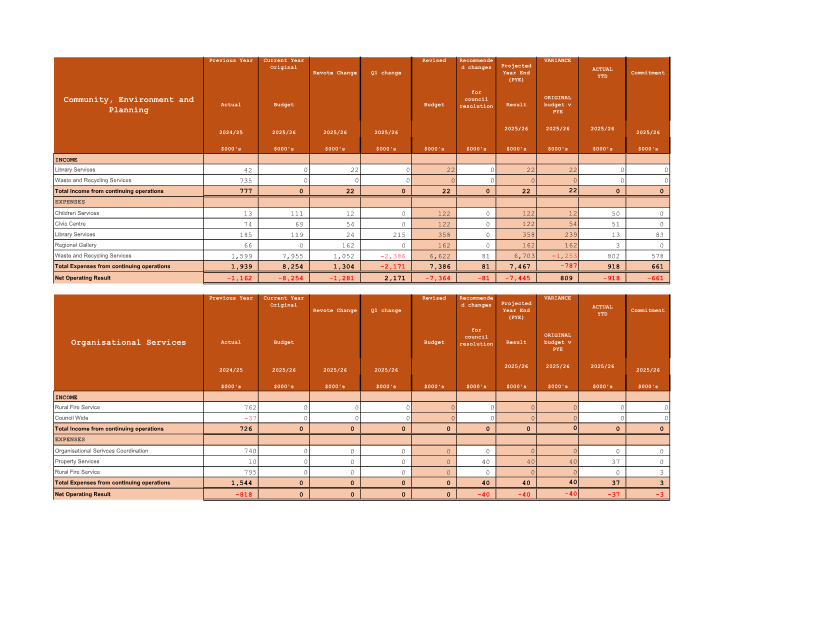
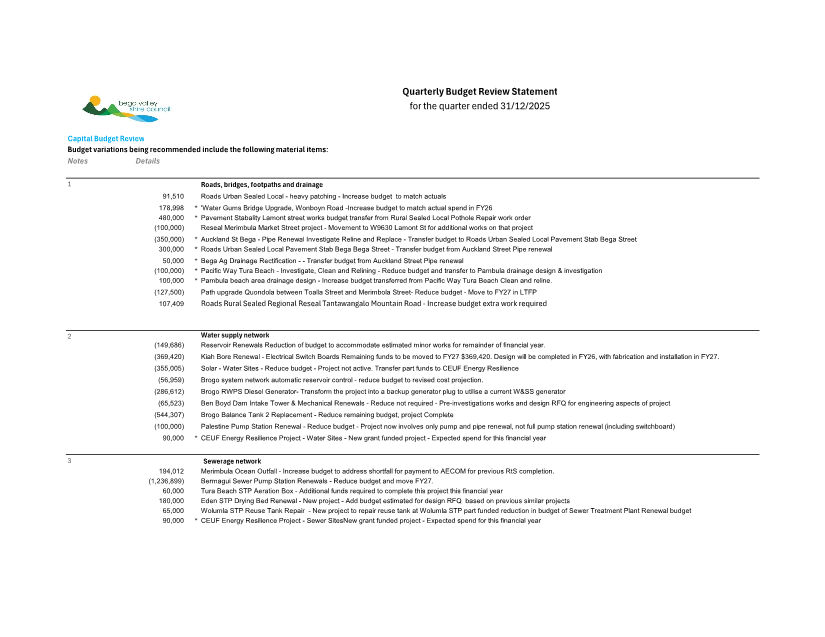
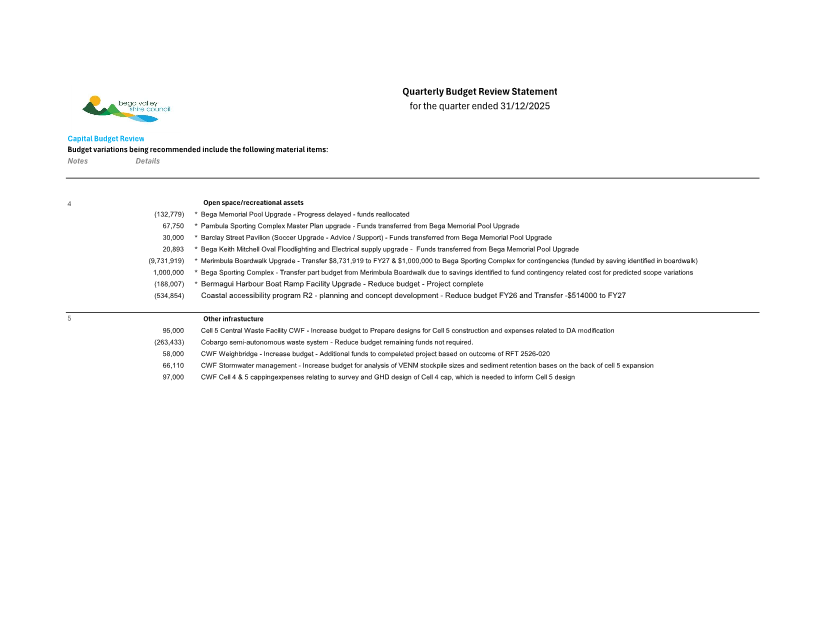
Council 28 January 2026
|
Item
10.6
|
10.6. Certificate of Investment December 2025
This report details Council’s cash and investments at
31 December 2025.
Director Organisational Services
Officer’s
Recommendation
1. That
Council receive and note the report on Council’s investment position at
31 December 2025.
2. That
Council notes the certification of the Responsible Accounting Officer.
Executive Summary
I, Judy Jordan, as the Responsible Accounting Officer of
Bega Valley Shire Council, hereby certify the investments listed in the
attached reports have been made in accordance with Section 625 of the Local
Government Act 1993 (the LG Act) and clause 212 of the Local Government
(General) Regulation 2021.
On 31 December 2025 the total
capital value of cash and investments was $154,074,425 with 88% of
Council’s investment portfolio directed to term deposits and the
remainder held in cash deposit accounts. The following is investment
information by fund:
|
Fund
|
December 2025 ($’000)
|
|
General Fund
|
53,128
|
|
Water Fund
|
28,974
|
|
Sewer Fund
|
71,972
|
|
TOTAL
|
154,074
|
All investments have been appropriately recorded in
Council’s financial records, reconciled monthly.
Background
The Local Government Act 1993 and Local Government
Regulation 2021 require that the Responsible Accounting Officer must
present to Council monthly, the status of the investments held by Council. The
Responsible Accounting Officer must detail the investments held, and their
compliance with both internal policy and external regulation under the
Ministerial Order of Investments.
Options
This is a receive and note report and does not require
consideration of options for decision.
Community
and Stakeholder Engagement
Engagement undertaken
There is no community or stakeholder engagement associated
with the recommendation of this report.
Engagement planned
The investment details of Council are published in Council
business papers and are publicly available at Council offices and on
Council’s website.
Financial
and Resource Considerations
A list of Council’s
cash and investments held at 31 December 2025 is detailed below:
|
Table 1: Cash and
Investments Listing
|
|
Issuer
|
Rating
|
Type
|
Purchase Date
|
Maturity Date
|
Interest Rate (%)
|
Capital Value ($)
|
|
BOQ
|
A-
|
TD
|
11/01/2024
|
12/01/2026
|
4.8500
|
2,000,000.00
|
|
NAB
|
AA-
|
TD
|
18/12/2024
|
14/01/2026
|
4.9700
|
5,000,000.00
|
|
NAB
|
AA-
|
TD
|
28/01/2025
|
28/01/2026
|
4.9000
|
2,500,000.00
|
|
Westpac
|
AA-
|
TD
|
08/02/2024
|
09/02/2026
|
4.8400
|
5,000,000.00
|
|
ING Bank (Australia) Ltd
|
A
|
TD
|
11/03/2024
|
11/03/2026
|
4.8500
|
5,000,000.00
|
|
NAB
|
AA-
|
TD
|
18/12/2024
|
15/04/2026
|
4.8900
|
2,000,000.00
|
|
Westpac
|
AA-
|
TD
|
28/06/2024
|
28/04/2026
|
5.2000
|
2,500,000.00
|
|
NAB
|
AA-
|
TD
|
24/06/2025
|
04/05/2026
|
4.1900
|
5,000,000.00
|
|
ING Bank (Australia) Ltd
|
A
|
TD
|
25/09/2024
|
25/05/2026
|
4.5300
|
5,000,000.00
|
|
BOQ
|
A-
|
TD
|
31/01/2024
|
26/05/2026
|
4.8000
|
2,000,000.00
|
|
Westpac
|
AA-
|
TD
|
25/02/2025
|
15/06/2026
|
4.6200
|
5,000,000.00
|
|
BOQ
|
A-
|
TD
|
28/05/2024
|
28/07/2026
|
5.0000
|
5,000,000.00
|
|
ING Bank (Australia) Ltd
|
A
|
TD
|
26/08/2024
|
18/08/2026
|
4.6200
|
3,000,000.00
|
|
NAB
|
AA-
|
TD
|
30/06/2025
|
20/08/2026
|
4.0500
|
5,000,000.00
|
|
Westpac
|
AA-
|
TD
|
06/09/2023
|
07/09/2026
|
4.8800
|
3,000,000.00
|
|
Westpac
|
AA-
|
TD
|
30/09/2025
|
30/09/2026
|
4.1700
|
5,000,000.00
|
|
NAB
|
AA-
|
TD
|
30/05/2025
|
14/10/2026
|
4.1000
|
4,000,000.00
|
|
NAB
|
AA-
|
TD
|
26/11/2024
|
05/11/2026
|
4.8000
|
3,000,000.00
|
|
BOQ
|
A-
|
TD
|
28/05/2024
|
26/11/2026
|
4.9500
|
5,000,000.00
|
|
Hume Bank
|
BBB+
|
TD
|
26/08/2024
|
08/12/2026
|
4.5500
|
5,000,000.00
|
|
Westpac
|
AA-
|
TD
|
30/09/2025
|
06/01/2027
|
4.1400
|
4,000,000.00
|
|
Suncorp Bank
|
AA-
|
TD
|
11/01/2024
|
11/01/2027
|
4.8800
|
2,000,000.00
|
|
NAB
|
AA-
|
TD
|
25/02/2025
|
25/02/2027
|
4.5500
|
5,000,000.00
|
|
ING Bank (Australia) Ltd
|
A
|
TD
|
25/09/2024
|
25/03/2027
|
4.5000
|
2,000,000.00
|
|
NAB
|
AA-
|
TD
|
26/02/2025
|
05/04/2027
|
4.5000
|
5,000,000.00
|
|
BOQ
|
A-
|
TD
|
20/03/2025
|
11/05/2027
|
4.4900
|
3,000,000.00
|
|
BOQ
|
A-
|
TD
|
06/03/2025
|
11/05/2027
|
4.5500
|
3,000,000.00
|
|
Westpac
|
AA-
|
TD
|
28/02/2025
|
16/06/2027
|
4.5000
|
3,000,000.00
|
|
BOQ
|
A-
|
TD
|
20/03/2025
|
08/07/2027
|
4.4900
|
2,000,000.00
|
|
BOQ
|
A-
|
TD
|
06/03/2025
|
08/07/2027
|
4.5500
|
2,000,000.00
|
|
NAB
|
AA-
|
TD
|
29/08/2025
|
19/08/2027
|
3.9500
|
5,000,000.00
|
|
BOQ
|
A-
|
TD
|
28/02/2025
|
13/10/2027
|
4.5000
|
2,000,000.00
|
|
BankVic
|
BBB+
|
TD
|
15/10/2025
|
15/10/2027
|
4.2000
|
3,000,000.00
|
|
ING Bank (Australia) Ltd
|
A
|
TD
|
16/12/2025
|
16/12/2027
|
4.7000
|
5,000,000.00
|
|
ING Bank (Australia) Ltd
|
A
|
TD
|
24/06/2025
|
30/08/2028
|
4.0100
|
2,000,000.00
|
|
BankVic
|
BBB+
|
TD
|
25/09/2025
|
25/09/2028
|
4.0800
|
2,000,000.00
|
|
ING Bank (Australia) Ltd
|
A
|
TD
|
28/02/2025
|
28/02/2029
|
4.7000
|
2,000,000.00
|
|
ING Bank (Australia) Ltd
|
A
|
TD
|
30/05/2025
|
13/06/2029
|
4.2400
|
5,000,000.00
|
|
Commonwealth Bank
|
AA-
|
CASH
|
31/12/2025
|
31/12/2025
|
3.6500
|
14,926,520
|
|
Commonwealth Bank
|
AA-
|
CASH
|
31/12/2025
|
31/12/2025
|
3.6500
|
3,000,000
|
|
NSWTC IM SCF
|
AA-
|
CASH
|
31/12/2025
|
31/12/2025
|
0.0000
|
147,905
|
|
Totals
|
154,074,425
|
|
Table 2: Interest from
Cash and Investments
|
|
Interest earned
for December 2025
|
$524,987
|
|
Financial year to
date interest earned
|
$3,390,890
|
|
*Revised Budgeted
interest for 2025/2026 financial year
|
$4,620,000
|
|
Percentage of the
2025/2026 budget earned by Council
|
73%
|
Council’s investment portfolio is largely directed
towards term deposits (88%). The remainder of the portfolio is held in cash
deposit accounts with CBA and TCorp (12%).
The investments held by Council remain sufficiently liquid
with 63% of investments maturing within the next 12 months.
Council’s cash and investment portfolio has a weighted
average maturity of 374 days.
For the month of December, the investments held by Council
provided a return of 4.69% p.a. This annualised performance exceeded the
monthly RBA cash rate of 3.60% and the AusBond Bank Bill Index of 3.71%. The
below table represents the annualised performance of council’s investment
portfolio.
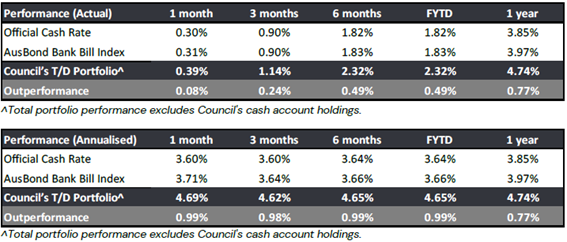
With the potential for interest rate cuts in the future and
the maturing of higher yielding term deposits Council has been attempting to
lock in rates across 1–5-year tenors. This aims to provide some
protection against potential lowering rates.
Council continues to utilise the platform Imperium Markets,
to assist in conducting, managing, and reporting on Council’s
investments. This provides an automated process of sourcing quotes and
investing monies which is allowing Council to better address investment risks.
Additional to the platform, Arlo Advisory provide investment advice on the
surrounding market conditions and how Council can maximise returns within the
Ministerial Order and Council’s investment policy.
|
Table 3: Investments by Fund $’000
|
|
Fund
|
October-2025
|
November-2025
|
December-2025
|
|
General
Fund
|
54,840
|
59,058
|
53,128
|
|
Water Fund
|
28,937
|
26,587
|
28,974
|
|
Sewer Fund
|
70,221
|
69,216
|
71,972
|
|
TOTAL
|
153,998
|
154,861
|
154,074
|
Each Fund’s allocation can only be utilised for its
specific operations. For example, Water Fund cannot use its financial resources
on General Fund projects.
Included in the General Fund investments are amounts that
are externally restricted for specific purposes, i.e. contributions and unspent
grants. In addition, there are amounts that are internally restricted by
Council.
The value of outstanding government
grant debtors on 31 December 2025 is $2,065,085.74 with $19,575 aged 4+ months.
Council continues to work with our funding partners to keep these debts
minimised.
Legal
/Policy
Section 625 of the Local Government Act 1993 (LG Act)
determines money may only be invested in a type of investment authorised by
Order of the Minister for Local Government and published in the Local
Government Gazette. The current Ministerial Order of Investment was published
17 February 2011.
Clause 212 of the Local Government (General) Regulation
2021 (LG Regulations) determines the Responsible Accounting Officer must
provide Council with a written report setting out details of all money Council
has invested under Section 625 of the LG Act.
The report must also include a Certificate as to whether the
investments have been made in accordance with the LG Act, LG Regulations and
Council’s Investment Policy.
Council has an Investment Policy (policy number 6.07)
adopted on 27 November 2024. The policy is reviewed every four years by Council
and annually by Council officers.
Impacts
on Strategic/Operational/Asset Management Plan/Risk
Strategic
Alignment
This report is provided in accordance with Council’s
Community Strategic Plan (CSP), 2025-2029 Delivery Program and operational Plan
activities
CSP Theme: Our
civic leadership – Local leadership is strong, consultative and
responsive to our community’s needs.
CSP Strategy: E.3
Government services have well -governed financial and strategic management
processes to ensure ongoing viability and value for money.
This reporting supports the implementation of
Council’s adopted Delivery Plan 2025-2029 as identified through the
following core business activity undertaken by the finance team to:
· Manage
Council’s borrowings and investments in accordance with Council’s
Financial Strategy
Environment
and Climate Change
Council considers the importance of environmental, social
and governance factors in investment decision making.
As at 31 December 2025, Council’s investment portfolio
included $5 million of green certified investments.
Economic
Council’s investment policy objective is to maximise
returns by investing with the most favourable rate of return. Performance of
investments are reported monthly, quarterly and annually.
Risk
Council policies have strict guidelines to reduce
Council’s risk to capital. The following graphs provide representation of
Council’s compliance to these measures.
Risk management means our investments are made giving regard
to key criteria of counterparty, credit quality and maturity compliance.
At 30 December 2025, all cash and investments held are
within the counterparty, credit quality and maturity policy limits.
Other legal instruments, such as the Ministerial Order
referenced above, are also being used to mitigate financial risk.
Legend:
Compliant Non-compliant
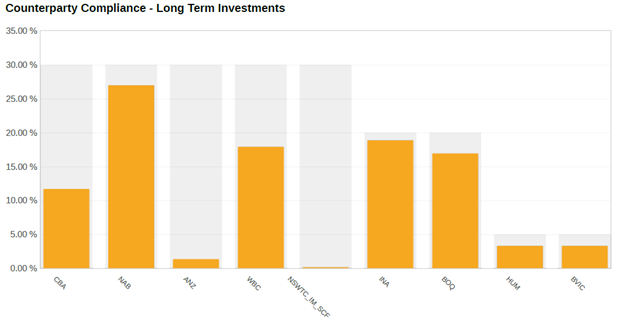
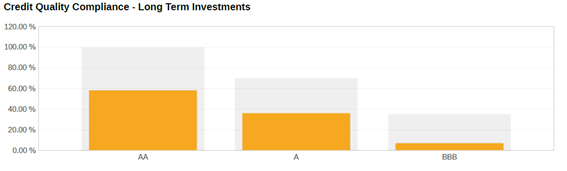
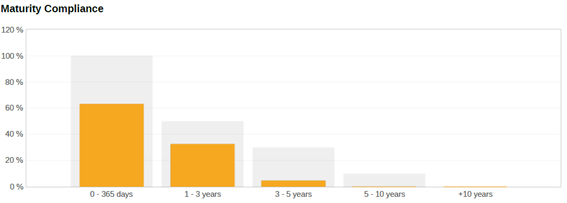
Social
/ Cultural
Maximising performance of returns enables the organisation
to leverage additional funding received as a result of investment performance
and use these towards community projects, programs and services.
Attachments
Nil
Staff Reports -
Executive
28 January 2026
11.1 Snug
Cove Maritime Precinct Memorandum of Understanding...................... 461
11.2 Actions
from resolutions of Council - Progress Report..................................... 469
Council 28
January 2026
|
Item
11.1
|
11.1. Snug Cove Maritime Precinct Memorandum of Understanding
This report seeks authorisation to
execute a memorandum of understanding with land managers in Snug Cove, Eden,
outlining the parties’ commitment to cooperate on future planning and
development in the precinct.
Manager Engagement and Corporate Strategy
Officer’s
Recommendation
That Council delegate to the Chief Executive Officer
authority to enter into a memorandum of understanding with Transport for NSW,
Port Authority of NSW, and the Eden Local Aboriginal Land Council as provided
in Attachment 1.
Executive Summary
Council officers have coordinated with Transport for NSW,
Port Authority of NSW, and the Eden Local Aboriginal Land Council (LALC) to
draft a non-binding Memorandum of Understanding (MOU) to guide collaboration in
the Snug Cove maritime precinct. The MOU establishes objectives, a
working-group governance model, and protocols for communication. Executing the
MOU will formalise multi-agency cooperation that is already occurring and
support ongoing collaboration in precinct planning and development as well as positioning
the parties for future funding opportunities.
Background
The parties to the proposed MOU are the key owners or
managers of various parcels of land in the Snug Cove precinct. Council has
worked closely with Port Authority of NSW and Transport for NSW in supporting
developments in Snug Cove over many years, including the breakwater wharf, wave
attenuator and Eden Welcome Centre.
In October 2023, Council and Transport for NSW executed a
MOU as a demonstration of the parties’ collaboration on Snug Cove
precinct development. At the time, Transport for NSW was applying for Federal
Government funding for infrastructure in Snug Cove, including a marina. The
2023 MOU intended to provide evidence of Council support for and commitment to
the project. The funding application was unsuccessful.
In December 2023 the NSW government announced that a key
parcel of land in Snug Cove would be returned to the Aboriginal community. Eden
LALC has now taken ownership of the site, which previously hosted the Eden
Marine Discovery Centre.
Since August 2025, Council officers,
together with NSW Government Regional Development and Delivery staff, have been
facilitating meetings of the parties to the proposed MOU. The purpose of these meetings is to facilitate
collaboration on the design and development of the precinct, as well as to
secure funding for further development of Snug Cove.
The proposed MOU intends to formalise these relationships,
support ongoing collaboration between the parties and position the parties for
future funding opportunities.
Options
1. Proceed
as recommended: Delegate to the Chief Executive Officer authority to enter into
the MOU provided in Attachment 1. Recommended.
2. Vary
the MOU: Delegate to the Chief Executive Officer authority to enter into a MOU
that varies from that described in Attachment 1. Council would need to provide
proposed alternative wording and further discussions with other parties would
be required.
3. Not
proceed: Not enter into a formal MOU arrangement with the parties.
Community
and Stakeholder Engagement
Engagement undertaken
The proposed MOU has been prepared in close consultation
with Eden LALC, Transport for NSW and Port Authority of NSW.
All parties to the proposed MOU are represented the Port of
Eden Stakeholder Group, co‑convened by Port Authority of NSW and
Transport for NSW and includes community representatives from port businesses,
maritime user groups, and residents. The Stakeholder Group provides a valuable
forum for regular engagement with key stakeholders in the precinct.
Engagement planned
If supported, once Council has signed the MOU the other
parties to the MOU will be notified. Ongoing engagement between the parties
will be undertaken in accordance with the MOU. The parties will continue to
engage with other Snug Cove stakeholders through the Port of Eden Stakeholder
group.
Financial
and Resource Considerations
There are no financial costs associated with the MOU.
Staff do not intend for the MOU to require
any further resource commitments beyond current levels of participation
in the collaboration.
Legal
/Policy
An MOU is generally not a legally binding contract. The
draft MOU expressly states that the parties do not intend any of the provisions
of this MOU to be legally enforceable.
Impacts
on Strategic/Operational/Asset Management Plan/Risk
Strategic
Alignment
Community Strategic Plan
A.2 Respect
and promote our cultural heritage and diversity and partner with and
acknowledge Traditional Owners and First Nations people.
A.3 Ensure
growth and change in our towns and villages enhances character that reflects
local identity, improves liveability, and supports community needs.
B.1. Support
local business and industry to be resilient and successful.
B.2. Promote
and support opportunities to diversify and grow our economy and provide local
jobs.
B.5 Strengthen
infrastructure and connectivity at Port of Eden, Merimbula Airport and through
the East-West freight corridor.
B.7 Encourage
regional collaborations and partnerships.
D.3 Plan
and provide for improved access to community facilities and leisure and
recreation assets that will meet current and future needs
Delivery Plan | Service Summary | Corporate Planning and
Improvement
· Drive
Council’s advocacy priorities and approach to government
· Develop and
maintain collaborative partnerships with key stakeholders to support business
and industry development
· Attract investment
in the shire to further economic development outcomes
Environment
and Climate Change
Future development proposals will remain subject to
statutory approvals and environmental assessment. The MOU framework emphasises
appropriate approvals and responsible operations.
Economic
Precinct activation is expected to increase maritime
visitation and safe mooring capacity; enable hospitality, retail and marine
services; strengthen tourism (including Aboriginal cultural tourism) and
regional connectivity; leverage prior public investment and reduce uncertainty
through multi-party coordination.
Risk
The fragmented tenure in Snug Cove, managed by multiple
agencies and organisations creates a risk of disjointed, incompatible and
delayed development in the precinct. The proposed MOU seeks to mitigate this
risk by formalising cooperation between the parties and establishing a working
group to facilitate ongoing collaboration.
The MOU expressly states that nothing in the MOU will
influence the execution of Council’s statutory functions and processes.
However, there is a risk of perceived conflicts of interest if Council is the
assessing authority for proposed development in the precinct. Council will
manage this risk on a case by case in accordance with the Environmental
Planning and Assessment Act and Council’s Policy 3.12 Council
related Development Application Conflict of Interest.
No other risks have been identified.
Social
/ Cultural
The
collaboration will assist Eden LALC in integrating its plans with the wider
precinct and may assist in attracting investment in the Eden LALC site. The
collaboration aims to support Aboriginal participation, local employment and
cultural tourism opportunities. Multi-partner governance and shared
communications will promote inclusive precinct outcomes and strengthen
relationships across government and community.
Attachments
1⇩. Attachment
1 DRAFT Snug Cove Maritime Precinct Memorandum of Understanding
|
Council
|
28 January 2026
|
|
Item
11.1 - Attachment 1
|
Attachment 1 DRAFT Snug Cove Maritime Precinct Memorandum of
Understanding
|
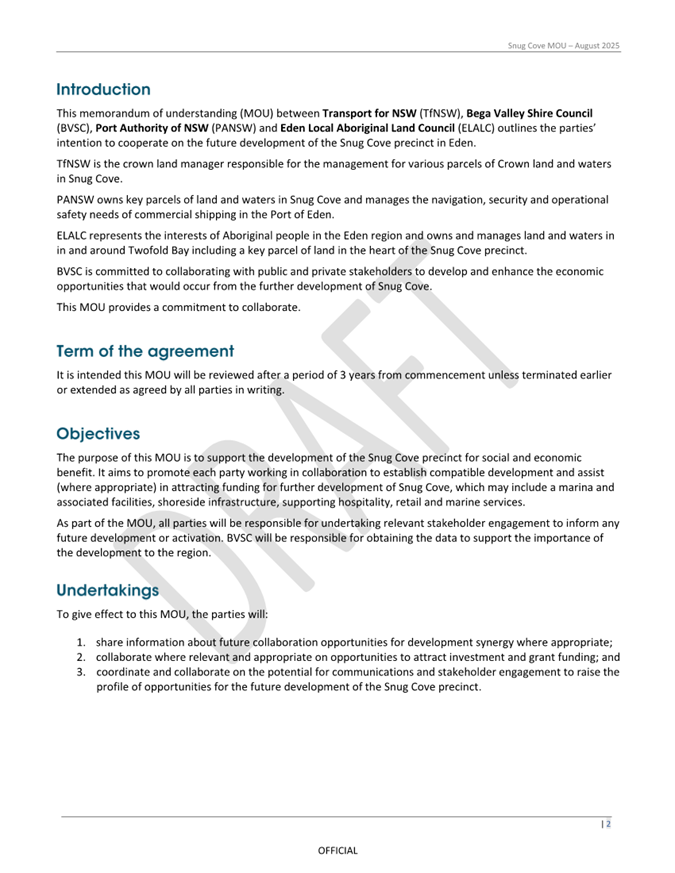
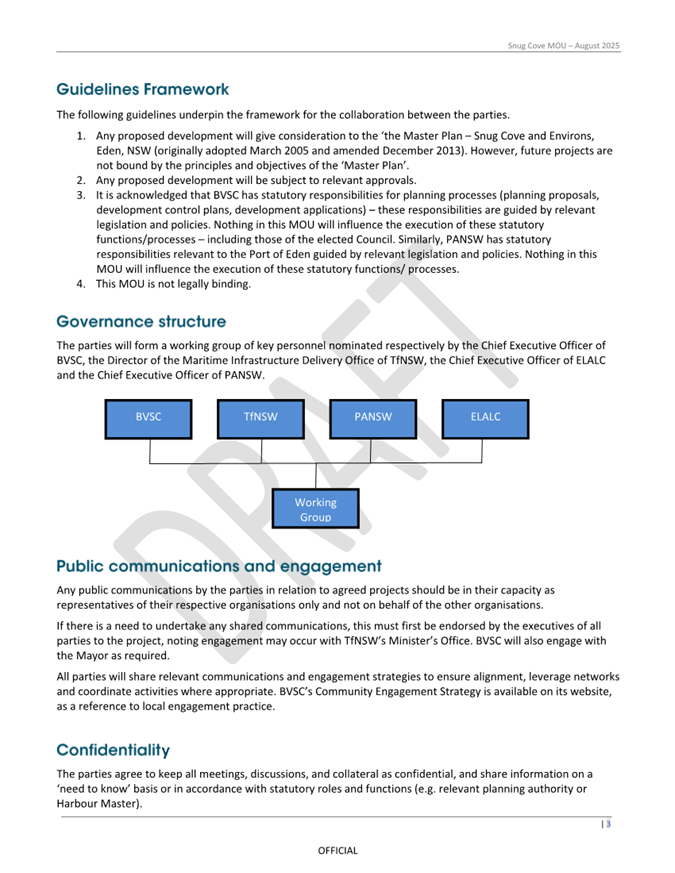
|
Council 28 January 2026
|
Item 11.2
|
11.2. Actions from resolutions of Council - Progress Report
This report provides a progress update on Council officer
actions following previous Council Resolutions.
Chief Executive Officer
Officer’s
Recommendation
That:
1. Council
be provided quarterly update reports to monitor progress on implementation of
Council resolutions
2. Council
notes the progress update on implementation of Council resolutions contained
within this report
3. Council
endorse the completed resolutions contained within this report
Executive Summary
It is important that Council is transparent in its progress
on implementing the resolutions of Council. This report provides a formal
mechanism of accountability back to Council and provides the information openly
to the community via Council’s website.
Background
Following each Council meeting Council Resolutions are
tasked to an officer in Council’s electronic Report System - InfoCouncil.
Progress of actions undertaken in relation to respective resolutions is
monitored internally by senior staff.
At the Council meeting of 18 May 2022, it was resolved:
1. That
Council be provided quarterly update reports to monitor progress on
implementation of Council resolutions
2. Council
notes the progress update on implementation of Council resolutions contained
within this report
At the Council meeting of 22 May 2024, it was resolved
1. That
Council be provided quarterly update reports to monitor progress on
implementation of Council resolutions
2. Council
notes the progress update on implementation of Council resolutions contained
within this report
3. That
future action progress reports include any resolutions that have been actioned
since the prior report to allow Council to endorse closure of those actions
Below is a link to outstanding actions from previous Council
resolutions since 5 September 2025.
Open actions from resolutions of
council for the period 5 September 2025 to 19 January 2026
Below is a link to completed actions since 5 September 2025.
Completed actions from resolutions
of Council as at 19 January 2026
Options
There are no options associated with this report.
Community
and Stakeholder Engagement
There are no community and stakeholder engagement
requirements associated with this report.
Engagement undertaken
There has been no engagement undertaken associated with this
report.
Engagement planned
There is no engagement planned associated with this report.
Financial
and Resource Considerations
There are no direct financial or resource considerations
associated with this report. If Council resolved to do anything other than note
the update there may be financial impacts to be considered.
Legal
/Policy
There are no legal/policy impacts associated with this
report.
Impacts
on Strategic/Operational/Asset Management Plan/Risk
Strategic
Alignment
6.11.5 of Council’s current delivery program states: Support
Councillors and ensure open and effective Local Government in our Shire.
Environment
and Climate Change
There are no environment or climate change impacts
associated with this report.
Economic
There are no economic benefits/impacts associated with this
report.
Risk
There are no risks associated with this report.
Social
/ Cultural
There are no social/cultural
impacts associated with this report.
Attachments
Nil
Notices of
Motion
28 January 2026
14.1 Thank
you to Bega Valley Shire Council staff.................................................... 472
|
Council 28 January 2026
|
Item 14.1
|
14.1. Cr Helen O'Neil - Thank you to Bega Valley Shire Council staff
Notice of
Motion
That Councillors congratulate and publicly thank staff for
their work in the lead up to and during the busy Christmas and new year’s
period that often goes unnoticed.
Background
Walking and driving through our villages in the days before
the main tourism season was to see clean streets, refreshed landscaping and
some clever work in maintaining facilities and seats to make sure visiting busy
areas would be a pleasant experience.
Similarly, we had staff making sure all of our water and
sewer systems were working on Christmas day with some staff sacrificing their
own time to ensure that the rest of our community and visitors could enjoy
theirs.
We had staff on call over new year’s and we’ve
had many people in many roles working quietly behind the scenes to make sure
our busiest time not only runs as smoothly as possible but is also a delightful
experience for those coming to our special part of the world to visit.
Cr Helen O'Neil
Attachments
Nil
Questions with
Notice
28 January 2026
15.1 Cr
O'Neil - Update: Parbery Avenue, Bermagui................................................ 474
15.2 Cr
O'Neil - Cuttagee Bridge design and renewal progress................................ 476
15.3 Cr
O'Neil - Active Transport Strategy and Long Swamp track, Bermagui......... 477
|
Council 28 January 2026
|
Item 15.1
|
15.1. Cr O'Neil - Update: Parbery Avenue, Bermagui
Would the Council provide an update on the staged
development of the site around Parbery Avenue, Bermagui including
the current controls to ensure environmental impact are minimised or
remediated?
Are there continuing actions to ensure the runoff issues
experienced last year which soil erosion of clay soils are not repeated?
Director Community Environment and Planning
Staff
response:
Environmental protection and ensuring suitable safeguards
are in place at the development site is of the utmost priority for Council.
Council officers attended the site immediately after the
intense rainfall event last year and have been attending the site regularly
since. Council officers and the developer’s contractors have been openly
communicating to stabilise the site and to ensure additional suitable controls
are implemented.
In response to this specific incident, the situation was
formally reviewed and additional requirements implemented to ensure future
works are undertaken with strengthened environmental safeguards.
In relation to vegetation clearing on the site, the clearing
to date has been undertaken within the approved development
footprint and in accordance with the approved Biodiversity Management
Plan. The works have been overseen by the onsite ecologist, who has confirmed
that the trees were checked carefully for signs of breeding activity (nests,
hollows, etc) prior to removal. No hollows, nests or signs of breeding were
found in the trees.
A koala corridor, located on the golf course side of the
site connecting the forested area in the south-east with the natural reserve
along the central gully, has been maintained. In addition to the detailed
Biodiversity Management Plan in place for the remaining vegetated areas of the
sites, a range of additional environmental safeguards were put in place as part
of the subdivision approval, and include:
· oversight of all
clearing by an onsite ecologist
· pre-clearance
surveys conducted prior to any clearing
· clearing scheduled
outside of breeding periods to avoid disruption to native species
· ongoing ecological
monitoring during clearing, including spotlight surveys, dawn pre-clearance
walks, and camera trapping
· identification and
protection of key vegetation areas, including retention of selected trees
within the development
· a rehabilitation
plan for the natural reserve to enhance habitat value
· a planting plan
for the koala corridor, incorporating koala feed tree species
· interpretive
signage is required post construction to educate future residents on the
importance of koalas, the purpose of the koala corridor and the value of the
retained natural reserve.
Council officers continue to monitor the site to ensure
compliance with the relevant approvals.
The Sapphire Cove development provides an important supply
of residential allotments of varying sizes, to accommodate a range of
development types. Council’s strategic planning documents encourage
affordable and adaptable housing however there is an element of market demand
to which Council cannot directly influence. Council’s planning
framework permits multi dwelling housing including smaller dwellings, should
landowners seek to develop in this manner.
Attachments
Nil
|
Council 28 January 2026
|
Item 15.2
|
15.2. Cr O'Neil - Cuttagee Bridge design and renewal progress
What is the progress and actions
taken on developing the design and renewal of the Cuttagee Bridge since the
2025 design decision?
What environment assessment,
heritage evaluations, and integration with the precinct around the bridge will
be undertaken and by who?
Director Infrastructure
Staff
response
Following Council’s resolution of 12 November 2025,
formal direction was issued to the appointed design team to progress Option 3
to detailed design, in alignment with the funding deed. Detailed design is now
underway. As part of associated value management actions, a preliminary Value
Management workshop was held on 5 December, involving the design team, GHD,
TfNSW, and Council staff.
Council staff are preparing grant funding documentation to
ensure the project is shovel ready for funding opportunities. The Safer Local
Roads and Infrastructure Program (Tranche 5) is currently open, with a future
funding opportunity identified through the Disaster Ready Fund, anticipated to
open in mid-2026.
NGH were directed to progress the Review of Environmental
Factors (REF) following Council’s resolution. The REF will include the
southern car park within its assessment boundary. As part of this work, NGH
will also prepare the Statement of Heritage Impact (SOHI).
Consideration of the broader precinct is being addressed
through the Cuttagee Bridge Movement and Place Assessment (Precinct Study),
which is currently being finalised by GHD.
Attachments
Nil
|
Council 28 January 2026
|
Item 15.3
|
15.3. Cr O'Neil - Active Transport Strategy and Long Swamp track,
Bermagui
Will the Council update the Active Transport Study to
reflect impact of last year’s storm on the Long Swamp track, reflecting
the value of maintaining cycling connections between Fairhaven and Beauty Point
with the Bermagui town area?
Director Infrastructure
Staff
response:
Council does not propose to update or reprioritise the
adopted Active Transport Strategy at this time. Current efforts remain focused
on progressing the short‑term priority actions identified within the
Strategy.
Given Council’s fiscal constraints and advice from
Crown Lands that reinstatement of the Long Swamp track is unlikely, Council is
not in a position to develop or resource any alternative alignment outside the
Strategy’s existing priorities. If interested community groups wish to
pursue a proposal in response to the closure, Council encourages the
preparation of a Community Project Proposal. Any proposal submitted will be
formally considered by Council, including assessment of required resourcing and
alignment with the Active Transport Strategy.
Attachments
Nil
Questions
without Notice
28 January 2026
16.1 Cr
Daly - Recovery of materials......................................................................... 479
Council 28
January 2026
|
Item
16.1
|
16.1. Cr Daly - Recovery of materials
At the 10 December 2025 ordinary
council meeting Cr Daly asked about the recovery of materials during demolition
or renewal of assets for example the Circularity centre.
What is our approach and how do we
work with developers to retain materials of value?
Chief Executive Officer, Mr Anthony
McMahon clarified that the question is for both council and the private sector
and took the question on notice.
Director Community Environment and Planning
Staff
response
From a development approvals
perspective, developers are required to consider and plan for demolition waste
and resource recovery at the Development Application stage and demolition
phase.
The Bega Valley Development Control
Plan 2013 currently requires a Management Plan to be developed where demolition
is proposed. The Plan is required to outline how waste is handled during
construction and operation of the development. It includes details on waste
generation volumes and materials, how it will be stored, treated, recycled, its
transportation, and disposal destination.
Compliance with the approved
Management Plan then becomes a requirement of any subsequent development consent.
Council’s Waste and Recycling
Services team has seen an increase in developers proactively contacting them to
discuss resource recovery opportunities that are available in the shire
(whether or not via Council facilities), as well as ways they can work with
Council in a more collaborative way with respect to waste and resource
management.
For Council-led infrastructure
projects, the recovery and reuse of materials is considered on a
project-by-project basis.
For bridge replacement and renewal
works, Council staff assess individual elements for potential reuse. Where
suitable, materials are salvaged and stored at the bridge yard for use in other
capital or maintenance projects.
Similarly, for stormwater assets,
when infrastructure is exhumed, individual components such as pipes and
headwalls are assessed for reuse. Suitable materials are retained and stored at
Council depots or stockpile sites for future maintenance or capital works.
Where drainage structures cannot be reused, concrete materials are recycled at
Council’s Waste and Recycling Centre in Eden. This also occurs for other
concrete structures such as kerb and footpath.
Pavement repair or renewal works
may require the removal of the existing pavement gravel or asphalt. Pavement
and asphalt materials are reused at alternative locations as re-sheeting
gravel, sub-base or select fill, as appropriate. General earthworks and
trenching may also include the generation of spoil. Depending on the quality of
the material generated this material
is reused onsite or in adjacent projects.
As part of Disaster Recovery works,
where materials can be salvaged or deemed appropriate for reuse, this is
incorporated into the civil contractor’s scope of works. This includes
dismantling, retaining and transporting materials to Council depots or approved
stockpile sites. These activities are undertaken in accordance with disaster
recovery funding arrangements upon approval from the Reconstruction Authority.
In addition, some construction
contracts include specific salvage and reuse clauses (for example, under the
Fixing Country Bridges program), which formalise the recovery and retention of
materials for future reuse.
Attachments
Nil