|
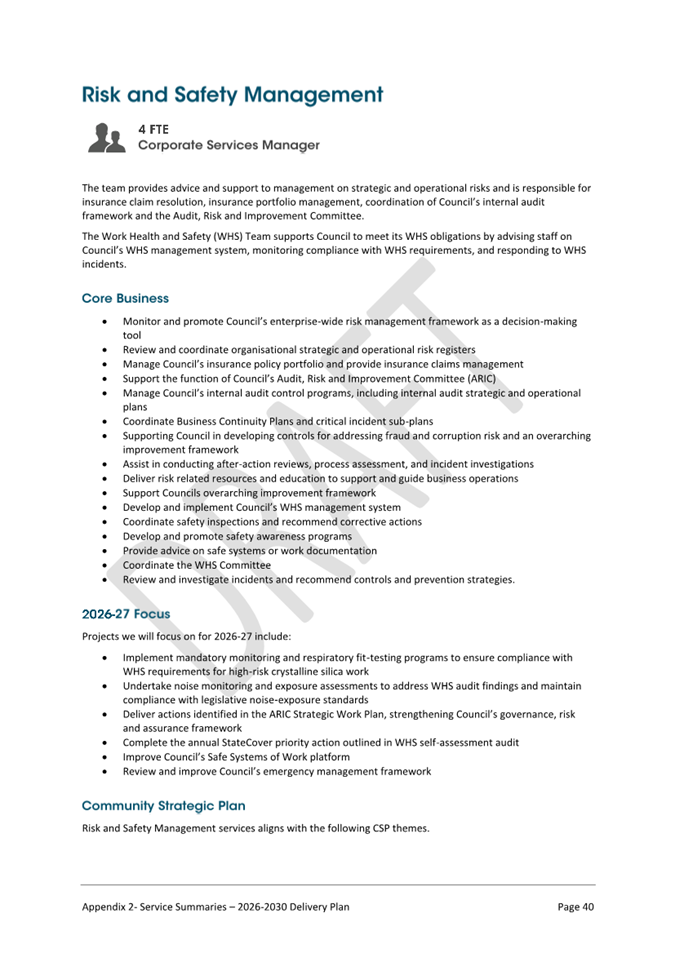
Ordinary
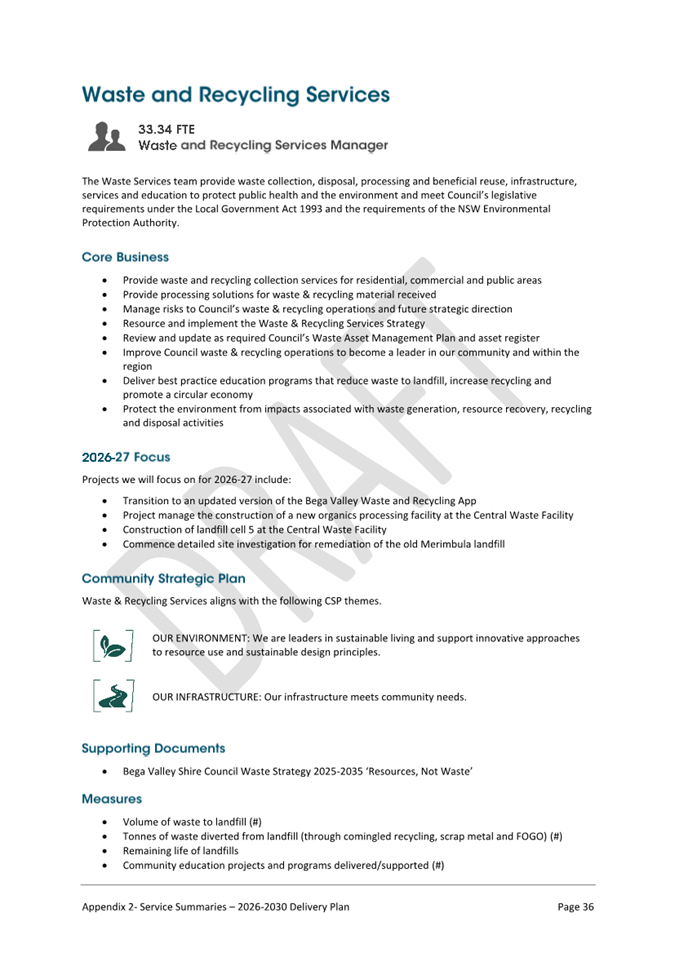
Meeting
Notice and Agenda
An Ordinary Meeting of the Bega Valley Shire Council will be held at Council Chambers, Biamanga Room Bega Valley Commemorative Civic Centre
Bega on Wednesday, 6 May 2026 commencing at 2:00pm to
consider and resolve on the matters set out in the attached Agenda.
To:
Cr Russell Fitzpatrick, Mayor
Cr Mitchell Nadin, Deputy Mayor
Cr Tony Allen
Cr Simon Daly
Cr Peter Haggar
Cr Clair Mudaliar
Cr Peggy Noble
Cr Helen O’Neil
Cr David Porter
|
Copy:
Chief Executive Officer, Mr
Anthony McMahon
Director, Infrastructure, Mr
Andrew Latta
Director, Community,
Environment and Planning, Mrs Emily Harrison
Director, Organisational
Services, Mrs Iliada Bolton
Manager Engagement and
Corporate Strategy, Mrs Kaliegh Smerdon
Executive Officer (Minute
Secretary), Mrs Jackie Grant
|
|
Live Streaming of Council Meetings
Council meetings are recorded and live streamed to the
Internet for public viewing. By entering the Chambers during an open
session of Council, you consent to your attendance and participation being
recorded.
The recording will be archived and made available on
Council’s website www.begavalley.nsw.gov.au. All care is taken to
maintain your privacy; however as a visitor of the public gallery, your
presence may be recorded.
Publishing of Agendas And Minutes
The Agendas for Council Meetings and Council Reports for
each meeting will be available to the public on Council’s website as
close as possible to 5.00 pm on the Thursday prior to each Ordinary
Meeting. A hard copy is also made available at the Bega Administration
Building reception desk and on the day of the meeting, in the Council Chambers.
The Minutes of Council Meetings are available on Council's
Website as close as possible to 5.00 pm on the Monday after the Meeting.
1. Please
be aware that the recommendations in the Council Meeting Agenda are
recommendations to the Council for consideration. They are not the
resolutions (decisions) of Council.
2. Background
for reports is provided by staff to the Chief Executive Officer for
presentation to Council.
3. The
Council may adopt these recommendations, amend the recommendations, determine a
completely different course of action, or it may decline to pursue any course
of action.
4. The
decision of the Council becomes the resolution of the Council, and is recorded
in the Minutes of that meeting.
5. The
Minutes of each Council meeting are published in draft format, and are
confirmed by Councillors, with amendments if necessary, at the next
available Council Meeting.
If you require any further information or clarification
regarding a report to Council, please contact Council’s Executive
Assistant who can provide you with the appropriate contact details
Phone (02 6499
2222) or email execassist@begavalley.nsw.gov.au.
Ethical Decision Making and Conflicts of Interest
A guiding checklist for Councillors, officers and community committees
Ethical decision making
·
Is the decision or conduct legal?
·
Is it consistent with Government policy, Council’s
objectives and Code of Conduct?
·
What will the outcome be for you, your colleagues, the Council,
anyone else?
·
Does it raise a conflict of interest?
·
Do you stand to gain personally at public expense?
·
Can the decision be justified in terms of public interest?
·
Would it withstand public scrutiny?
Conflict of interest
A conflict of interest is a clash
between private interest and public duty. There are two types of conflict:
·
Pecuniary
– regulated by the Local Government Act 1993 and Office of
Local Government
·
Non-pecuniary
– regulated by Codes of Conduct and policy. ICAC,
Ombudsman, Office of Local Government (advice only). If declaring a
Non-Pecuniary Conflict of Interest, Councillors can choose to either disclose
and vote, disclose and not vote or leave the Chamber.
The test for conflict of interest
·
Is it likely I could be influenced by personal interest in
carrying out my public duty?
·
Would a fair and reasonable person believe I could be so
influenced?
·
Conflict of interest is closely tied to the layperson’s
definition of ‘corruption’ – using public office for private
gain.
·
Important to consider public perceptions of whether you have a
conflict of interest.
Identifying problems
1st Do
I have private interests affected by a matter I am officially involved in?
2nd Is
my official role one of influence or perceived influence over the matter?
3rd Do
my private interests conflict with my official role?
Local Government Act 1993 and Model Code of Conduct
For more detailed definitions
refer to Sections 442, 448 and 459 or the Local Government Act 1993 and Bega
Valley Shire Council (and Model) Code of Conduct, Part 4 – conflict of
interest.
Agency advice
Whilst seeking advice is generally useful, the
ultimate decision rests with the person concerned.Officers of the
following agencies are available during office hours to discuss the obligations
placed on Councillors, officers and community committee members by various
pieces of legislation, regulation and codes.
|
Contact
|
Phone
|
Email
|
Website
|
|
Bega
Valley Shire Council
|
(02)
6499 2222
|
council@begavalley.nsw.gov.au
|
www.begavalley.nsw.gov.au
|
|
ICAC
|
8281
5999
Toll
Free 1800 463 909
|
icac@icac.nsw.gov.au
|
www.icac.nsw.gov.au
|
|
Office
of Local Government
|
(02)
4428 4100
|
olg@olg.nsw.gov.au
|
http://www.olg.nsw.gov.au/
|
|
NSW
Ombudsman
|
(02)
8286 1000
Toll
Free 1800 451 524
|
nswombo@ombo.nsw.gov.au
|
www.ombo.nsw.gov.au
|
Disclosure of pecuniary interests / non-pecuniary interests
Under the provisions of
Section 451(1) of the Local Government Act 1993 (pecuniary interests)
and Part 4 of the Model Code of Conduct prescribed by the Local Government
(Discipline) Regulation (conflict of interests) it is necessary for you to
disclose the nature of the interest when making a disclosure of a pecuniary
interest or a non-pecuniary conflict of interest at a meeting.
The following form should
be completed and handed to the Chief Executive Officer as soon as practible
once the interest is identified. Declarations are made at Item 3 of the
Agenda: Declarations - Pecuniary, Non-Pecuniary and Political Donation
Disclosures, and prior to each Item being discussed:
Council
meeting held on __________(day) / ___________(month) /____________(year)
|
Item
no & subject
|
|
|
Pecuniary
Interest
|
In my opinion, my
interest is pecuniary and I am therefore required to take the action
specified in section
451(2) of the Local Government Act
1993 and or any other
action required by the Chief
Executive Officer.
|
|
Significant
Non-pecuniary conflict of interest
|
– In my opinion, my
interest is non-pecuniary but significant. I am unable
to remove the source of conflict. I am therefore required to treat
the interest as if it were pecuniary and take the action specified in section 451(2) of the
Local Government Act 1993.
|
|
Non-pecuniary
conflict of interest
|
In my opinion, my interest is non-pecuniary and less
than significant. I therefore make this declaration as I am required to do pursuant to clause
5.11 of Council’s Code of Conduct. However, I intend to continue to be involved with the matter.
|
|
Nature of interest
|
Be specific and include information
such as :
·
The names of any person or organization with which you have a
relationship
·
The nature of your relationship with the person or organization
·
The reason(s) why you consider the situation may (or may be
perceived to) give rise to a conflict between your personal interests and
your public duty as a Councillor.
|
|
If
Pecuniary
|
Leave
chamber
|
|
If
Non-pecuniary (tick
one)
|
Disclose
& vote Disclose
& not vote Leave
chamber
|
|
Reason
for action proposed
|
Clause 5.11 of Council’s Code of Conduct provides
that if you determine that a non-pecuniary conflict of interest is less than
significant and does not require further action, you must provide an
explanation of why you consider that conflict does not require further
action in the circumstances
|
|
Print
Name
|
I disclose the above
interest and
acknowledge that I will
take appropriate action as I have indicated above.
|
|
Signed
|
|
NB: Please
complete a separate form for each Item on the Council Agenda on which you are
declaring an interest.
Agenda
Statement of Commencement of Live Streaming
Acknowledgement of Traditional Owners of Bega Valley Shire
Statement of Ethical Obligations
1 Apologies and requests for leave of
absence
2 Confirmation Of Minutes
Recommendation
That the Minutes of the Ordinary Meeting held on 22 April
2026 as circulated, be taken as read and confirmed.
3 Declarations
Pecuniary,
Non-Pecuniary and Political Donation Disclosures to be declared and tabled.
Declarations also to be declared prior to discussion on each item.
4 Public Forum – report by Mayor
of deputations heard prior to the meeting
5 Petitions
5.1 Petition
- Reject any DA proposal to reopen a quarry at Bournda.......................................... 8
6 Mayoral Minutes
7 Urgent Business
8 Staff Reports – Community, Environment
and Planning
8.1 Development
Application statistics - January to March 2026............................................... 10
8.2 Planning
Proposal for Deferred Matters.................................................................................... 15
8.3 Central
Waste Facility Power Upgrade Project Delegations.................................................. 83
9 Staff Reports – Infrastructure
9.1 Supply,
delivery and service agreement for pressure sewer pod parts............................... 88
9.2 Request
for Tender (RFT) 2425-052 Supply of chemicals to Water and Sewer Services.. 95
10 Staff Reports – Organisational Services
10.1 Creation
of easement - Cobargo-Bermagui Road, Cobargo................................................. 100
10.2 Eden
Kindergarten Reserve 89653 – Crown Land Manager Arrangements...................... 106
11 Staff Reports - Executive Services
11.1 Exhibition
of Integrated Planning and Reporting documents.............................................. 113
11.2 Cuttagee
Bridge............................................................................................................................ 404
12 Councillor Reports
13 Rescission/Alteration Motions
14 Notices of Motion
14.1 Climate
Impact Prioritisation..................................................................................................... 412
15 Questions with Notice
16 Questions without Notice
17 Confidential Business
Representations by members of the public regarding
closure of part of meeting
Adjournment Into Closed Session, exclusion
of the media and public........................... 415
Statement of Cessation of Live Streaming for the period of the Closed
Session.
Statement of Re-Commencement of Live Streaming
18 Noting of Resolutions from Closed Session
19 Declassification of reports considered previously
in Closed Session
Petitions
06 May 2026
5.1 Petition
- Reject any DA proposal to reopen a quarry at Bournda....................... 8
|
Council 6 May 2026
|
Item 5.1
|
5.1. Petition -
Reject any DA proposal to reopen a quarry at Bournda
Cr Porter tabled a petition he received from Stop Bournda
Quarry Inc asking for BVSC Councillors to reject DA 2021.360 to open a quarry
and a rock processing industry at 1399 Sapphire Coast Drive, Bournda, Bournda
Downs. The petition contains over 800 signatures.
The Acting Chief Executive Officer advised in accordance
with the Code of Meeting Practice staff will provide a further report back to
Council on the petition.
Chief Executive Officer
Staff
Response
The petition from Mr Johan Ras on behalf of Stop Bournda
Quarry Inc tabled at the 22 April 2026 Council meeting meets the requirements
under the Code of Meeting Practice (Procedure 6.02.2), particularly section
4.33, and as such is a valid petition.
The subject of the petition was:
To reject Development
Application 2021.360 to open a quarry and rock processing industry at 1399
Sapphire Coast Drive, Bournda.
The petition was signed by 949 people.
At the 22 April 2026 Council meeting, Council considered a
report from staff recommending approval of this development application with
conditions (Item 8.1). Council subsequently resolved to defer making a decision
to enable staff to prepare a supplementary report addressing those relevant
additional matters raised at the public forum of 22 April 2026.
The supplementary report will be provided to Council
for consideration once completed.
Attachments
Nil
Staff Reports
– Community, Environment and Planning
06 May 2026
8.1 Development
Application statistics - January to March 2026............................ 10
8.2 Planning
Proposal for Deferred Matters............................................................. 15
8.3 Central
Waste Facility Power Upgrade Project Delegations............................... 83
|
Council 6 May 2026
|
Item 8.1
|
8.1. Development
Application statistics - January to March 2026
This report provides an update on
Council’s development application processing timeframes for the period January
to March 2026.
Director Community Environment and Planning
Officer’s
Recommendation
1. That Council note the information
contained in this report.
2. That Council note reporting on
development application lodgement and assessment statistics
will now be provided in the quarterly Delivery Plan updates and not as a
separate report to Council.
3. That Council note future reporting will
focus on the NSW Planning League Table data only to
ensure consistency of reporting and comparison.
Executive Summary
This report provides an update on Council’s
development application processing timeframes and associated commentary for the
period 1 January to 31 March 2026.
During this period, the average net DA processing time (i.e.
minus ‘stop clock’ days) was 133.47 days.
(‘Stop clock’ days is the time taken for the Applicant to provide
additional information when requested.)
The average gross DA processing time for this period was
270.23 days.
This period saw an increase in the net and gross average DA
assessment timeframes due to an increased focus on resolving legacy DAs. Legacy
DAs are DAs that have been in the system for a considerable period of time and
typically have been on hold (‘stop clock’) awaiting additional
information from the applicant. In some cases, DAs may have been abandoned but
not withdrawn.
Importantly, in March 2026, 85% of DAs were meeting the
Minister’s Expectations, with 75% meeting the Minister’s
Expectations for the financial year to date.
DA statistics should be interpreted with caution as
processing time varies based on the number and complexity of DAs, as well as
resourcing levels during the reporting period.
Background
Development Application processing times (Council
data)
|
|
2024
(full
year)
|
2025
(full
Year)
|
Jan-Mar
2026
|
|
DAs
determined+
|
343
|
277!
|
53
|
|
No
of undetermined Applications@
|
168
|
113
|
96
|
|
Average
DA processing time (gross)
|
162.03
days
|
161.12
days
|
270.23
days
|
|
Average
DA processing time (net - ie minus ‘stop clock’ days)*
|
92.69
days
|
87.86
days
|
113.47
days
|
|
Estimated
cost of construction (approved)
|
$170,178,307
|
$282,528,867
|
$51,825,545
|
Notes:
- Note: The statistics provided in the table above are
based on current Council data and reporting mechanisms and may not completely
align with data provided on the NSW Planning Portal and NSW Government’s
Council league table.
- + DAs determined does not include Modification
Applications.
- *Stop Clock days is the time taken for the Applicant to
provide additional information. This time may not be counted as processing time
for the purpose of the deemed refusal period as per the Regulations.
- @Total
number of undetermined applications includes Development Applications and
Modification Applications
- ! information
provided here is valid as at the time of running the information report. Some
minor variances may occur due to routine maintenance of applications between
reporting periods.
Minister’s Statement of Expectations Order
2024
The Environmental Planning and Assessment (Statement of
Expectations) Order 2024 came into effect on 1 July 2024. The Minister for
Planning and Public Spaces, the Honourable Paul Scully MP, made the order to
set the expectation for councils in relation to their performance of a range of
planning and development functions under the Environmental Planning and
Assessment Act 1979.
For the period of 1 July 2025 to 30 June 2026, the Bega
Valley has been set a gross average Lodgement time of 7 days and a gross
average DA processing time of 105 days. Staff are continuing to work towards
meeting these targets.
NSW Planning League Table
The NSW State Government League Table tracks gross DA
assessment timeframes across the state. Information from this data set is
provided below.
It is pleasing to note that in March 2026, 85% of
development applications assessed met the Minister’s expectations, with
75% meeting the Minister’s expectation for the financial year to date.
Extract from Council League Table
|
|
2024/25
(full
year)
|
Oct
2025
|
Nov
2025
|
Dec
2025
|
Jan
2025
|
Feb
2025
|
Mar
2025
|
|
DAs
assessed
|
291
|
27
|
22
|
20
|
8
|
17
|
27
|
|
Lodgement
days
|
15
|
9
|
8
|
7
|
9
|
6
|
7
|
|
Number
applications lodged^
|
266
|
19
|
18
|
22
|
12
|
21
|
19
|
|
Average
assessment days (gross)
|
137
|
148
|
102
|
95
|
290
|
307
|
165
|
^ Number of applications
lodged excludes modification applications and review of determination
applications
It is important to note that assessment timeframes will continue
to fluctuate throughout the year, based on the number and complexity of DAs, as
well as resourcing levels during the reporting period. Adjustments will also be
noted as legacy applications continue to be determined.
Extract from Council League Table for March 2026
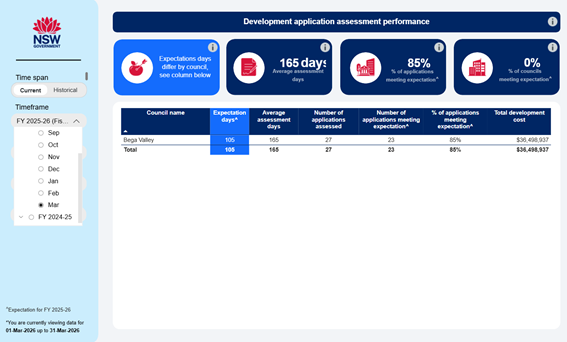
The graph below provides time series data from the League
Table for the 2024/25 financial year and into the third quarter of 2025/26
financial year.
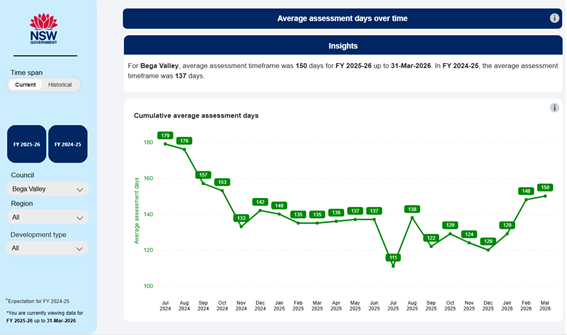
The Council league table is available online at: https://app.powerbi.com/view?r=eyJrIjoiMTlhNjZhZjItMWU1ZS00ZjE1LWI1YWUtMzY5YmIzYjM2ZjE2IiwidCI6Ijk2ZWY4ODIxLTJhMzktNDcxYy1iODlhLTY3YjA4MzNkZDNiOSJ9
Contributing factors
Council’s ability to meet the new targets depends, in
part, on the completeness of the applications received. In order to meet the
Lodgement timeframe, incomplete or low quality development applications are
being returned and applicants asked to resubmit once they have completed or
improved the application. Additionally, a much smaller window of time for
applicants to pay their DA fees is required in order to meet the new target.
The development professionals group has been advised of the changes, however there
may be continued frustration as the impacts are experienced by applicants.
Of note over the last quarter, assessment times have
increased significantly as legacy applications are being finalised.
Legacy applications are those that have been in the system for a considerable
period of time and have been on hold (‘stop clock’) awaiting
additional information or revised plans as Applicants have worked with
Council’s assessing officers to refine proposals and address issues
raised throughout the assessment and/or from feedback during community
consultation. It is anticipated that assessment times will continue to
fluctuate whilst legacy applications move out of the system.
Development Assessment Service Review
The findings of the service review by Morrison Low
consultants was presented to Council at its meeting of 28 January 2026 and the
implementation plan (roadmap) was endorsed by Council at its meeting of 25
March 2026. Addressing determination of legacy applications is consistent
with Recommendation 15 of the review.
Options
There are no options associated with this report.
Community
and Stakeholder Engagement
Engagement undertaken
Council has provided information on its website and through
media enquiries and statements as needed to alert the community to delays in DA
assessment timeframes as well as actions applicants and owners can take to
streamline the process. This includes the development and distribution of the
DA Matrix to guide applicants on what reports and information may be required
for different types of development.
Engagement planned
No further engagement is planned as a result of this report,
however website content will be updated as required to ensure the community is
aware of DA assessment challenges. Further updates to the website will be made
over time to provide additional information to support applicants through the
DA process.
Ongoing communication with the development professionals
group will continue throughout the implementation of the DA Service Review
implementation roadmap.
Financial
and Resource Considerations
Providing a development assessment service is a key part of
Council’s core business and budget. There are no new financial impacts
arising from this report.
Legal
/Policy
Providing a development assessment service is a key part of
Council’s core business. There are no new legal or policy impacts arising
from this report.
Impacts
on Strategic/Operational/Asset Management Plan/Risk
Strategic
Alignment
Development Assessment supports the five key themes in the
Community Strategic Plan 2042 (2025 Revision):
A. Our
community: We are a vibrant, respectful, inclusive and connected community that
enjoys a culturally rich community life. We are a resilient and caring
community that supports the health and wellbeing of our residents. Our
shire is a safe and affordable place to live.
B. Our
economy: Our economy is prosperous, diverse and supported by innovative and
creative businesses. We have meaningful employment and learning opportunities
for people at all stages in life. Our key industries are resilient and strong.
C. Our
environment: Our air and water are clean, and our natural environment and rural
landscapes are protected. We adapt to and mitigate the effects of climate
change. We are leaders in sustainable living and support innovative approaches
to resource use and sustainable design principles.
D. Our
infrastructure: Our infrastructure meets community needs. Our community has
access to quality community assets that support health and wellbeing. Our
transport networks support our community to work, learn and socialise.
E. Our
civic leadership: Government services have strong organisational practices that
deliver services and facilities to meet community needs. We are an informed and
engaged community with transparent, consultative and responsive Government
services.
Development applications are assessed in accordance with the
Bega Valley Local Environmental Plan, Development Control Plan, and state
government legislation.
Environment
and Climate Change
There are no environment or climate change impacts arising
from this report.
Economic
There are no new economic impacts arising from this report.
Development plays a key role in supporting the shire’s
economy, creating short term employment and, with commercial development,
creating longer term employment opportunities.
Risk
There are no new risks arising from this report.
Social
/ Cultural
There are no new social or cultural
impacts arising from this report. Development assessment enables housing growth
and supports a connected and supported community.
Attachments
Nil
|
Council 6 May 2026
|
Item 8.2
|
8.2. Planning
Proposal for Deferred Matters
This report seeks a Council
resolution to submit a planning proposal to the Department of Planning, Housing
and Infrastructure which seeks to rezone the four areas deferred from Bega
Valley Local Environmental Plan 2013.
Director Community Environment and Planning
Officer’s
Recommendation
1. That
Council resolve to support the planning proposal to rezone the four areas
deferred from Bega Valley Local Environmental Plan 2013.
2 That
Council endorse submission of the planning proposal (Attachment 1) and
supporting information to the Department of Planning, Housing and
Infrastructure requesting a Gateway Determination under Section 3.34 of the Environmental
Planning and Assessment Act 1979.
3. That
following Gateway Determination, the planning proposal be placed on public
exhibition.
4. That
Council endorse, subject to the conditions of the Gateway Determination and
providing no substantial changes to the planning proposal are required and no
objections are received during exhibition, to progress the planning proposal to
finalisation and gazettal without a further report to Council.
Executive Summary
This report seeks Council
endorsement to proceed with a planning proposal that applies the Bega Valley
Local Environmental Plan 2013 (BVLEP 2013) to four
remaining deferred areas that are still subject to the outdated Bega
Valley Local Environmental Plan 2002 (BVLEP 2002).
Despite BVLEP 2013 being in place since mid-2013, these
deferred matters continue to present legal, strategic, governance and
environmental risk, as development is assessed under a legacy framework that
predates contemporary planning standards and statutory requirements.
The planning proposal does not increase development
intensity or alter existing development permissibility. Instead, it replaces
BVLEP 2002 controls with equivalent Standard Instrument–based controls
under BVLEP 2013, completing the transition away from BVLEP 2002 and delivering
a contemporary, consistent statutory planning framework across the Bega Valley
Shire.
Background
BVLEP 2013 came into effect in 2013 and since then Council
has been working to apply contemporary zones and planning controls to those
properties that were not zoned under BVLEP 2013 and were still subject to the
controls of BVLEP 2002. Thirteen years later, despite numerous attempts to
rezone the remaining deferred matters (details of which are included in the
Planning Proposal provided as Attachment 1), Bega Valley Shire still contains
four areas that are deferred from BVLEP 2002.
Development applications can still be lodged for these
sites, however, the provisions of BVLEP 2002 apply which presents several risks
to Council, the community and the environment.
The objectives of this planning proposal are to:
· Apply BVLEP 2013
to the four areas (Deferred Matters) that remain zoned under BVLEP 2002 by
matching the existing permissible uses and development standards, and
· Repeal BVLEP 2002.
Rationale for change
The NSW Government has long sought a consistent, simple and
transparent planning system through the Standard Instrument (Local
Environmental Plans) Order 2006. BVLEP 2002 does not support this objective, as
it relies on locally drafted clauses, zone names and definitions that require
interpretation. This increases dispute risk and results in more complex,
inconsistent and inefficient development assessment, creating uncertainty,
delays and increased risk for Council and applicants.
BVLEP 2002 reflects early 2000s planning priorities, with
rigid, low density zoning and limited flexibility to respond to contemporary
housing needs. In contrast, BVLEP 2013 provides a modern framework that
supports housing uplift where strategically justified, using standard
development controls (Clauses 4.1, 4.3 and 4.4) and Clause 4.6 variations to
facilitate additional housing without rezoning. Recent amendments further
support housing diversity outcomes.
BVLEP 2002 also predates the current NSW strategic planning
framework and is poorly aligned with contemporary State Environmental Planning
Policy (SEPPs) regional plans and Council’s Local Strategic Planning
Statement (LSPS). BVLEP 2013 is designed to operate within the Standard
Instrument framework, making it easier to interpret, apply and align strategic
objectives with zoning and development standards.
In addition, BVLEP 2002 contains outdated environmental
zones and provisions that are not suited to managing increasing climate related
risks. BVLEP 2013 includes stronger provisions for climate resilience, coastal,
flood and bushfire hazards, biodiversity protection and environmental
conservation, and aligns with the SEPP (Resilience and Hazards) 2021, the
Biodiversity Offset Scheme and current hazard planning frameworks. Continued
reliance on BVLEP 2002 increases the risk of inappropriate approvals and potential
liability following natural hazard events.
Finally, BVLEP 2002 relied on Development Control Plans
(DCPs) to regulate building heights and minimum lot sizes in some areas. As
these DCPs have since been repealed, some deferred land no longer has
appropriate controls. Applying BVLEP 2013 will introduce clear, mapped and
consistently applied controls for building height, minimum lot size and floor
space ratio.
Benefits for Council and development assessment
Repealing BVLEP 2002 and incorporating the remaining
deferred land into BVLEP 2013 will support Council’s objective of faster,
simpler and lower risk development assessment through:
· Standardised zones
and clauses
· A flexible and
contemporary residential planning framework
· A clear link
between the LSPS and the LEP
· Modern
environmental and conservation zoning
· Well tested
Standard Instrument language
· More efficient
assessments and plan amendments
· Consistent, up to
date development controls
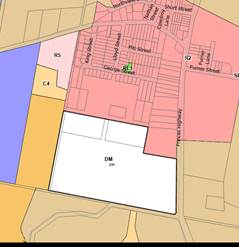
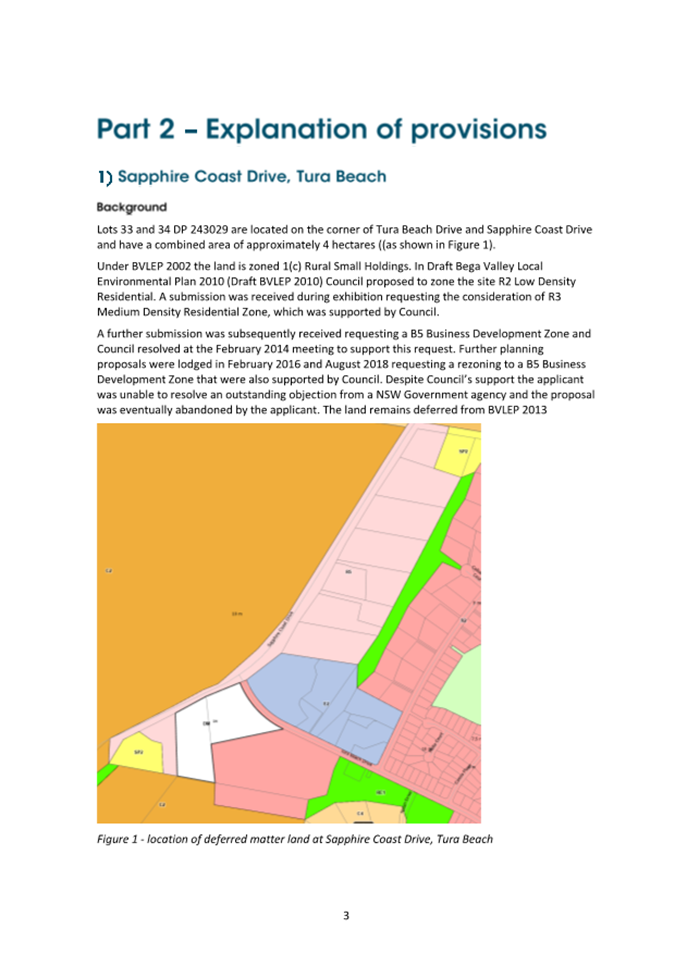
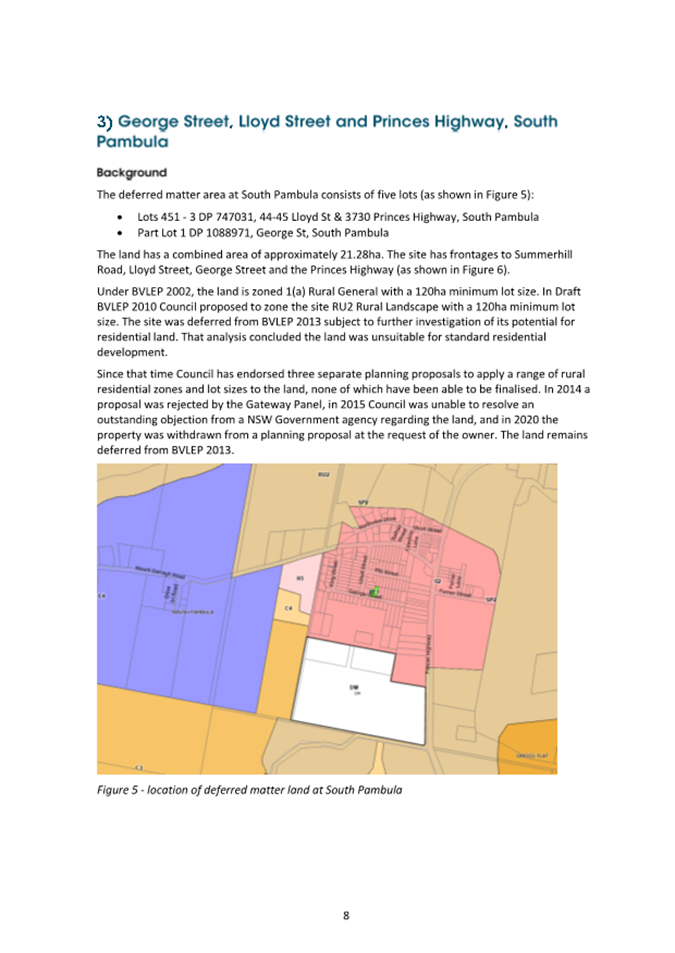
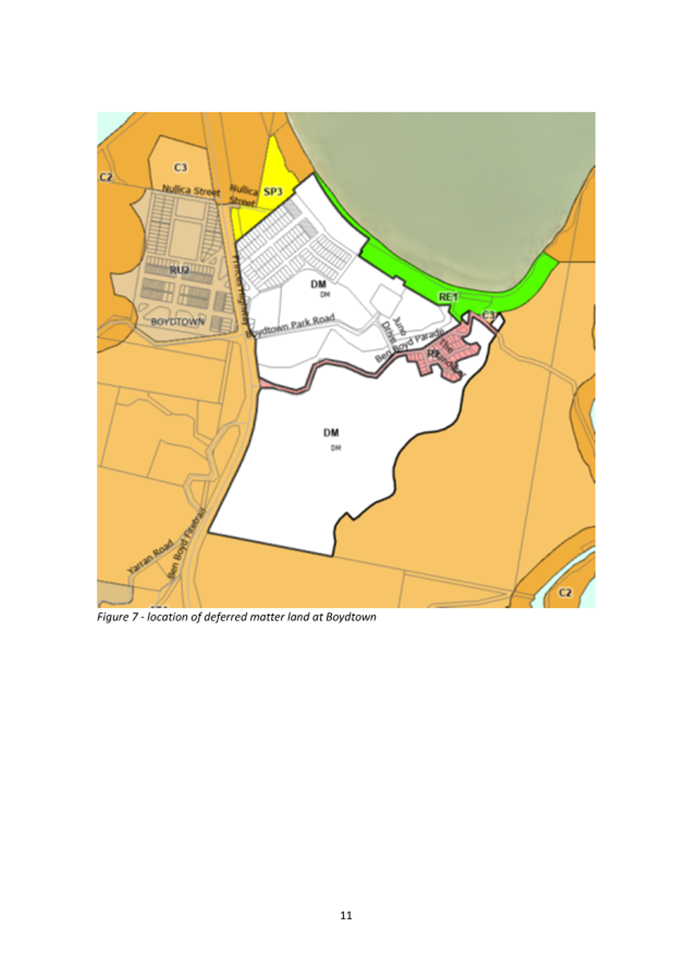
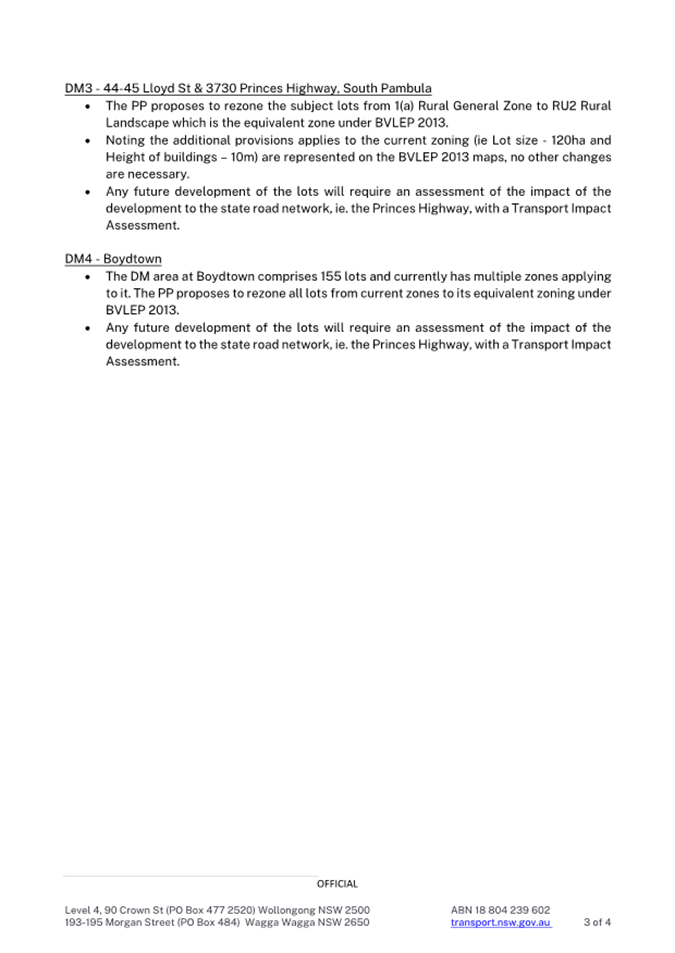
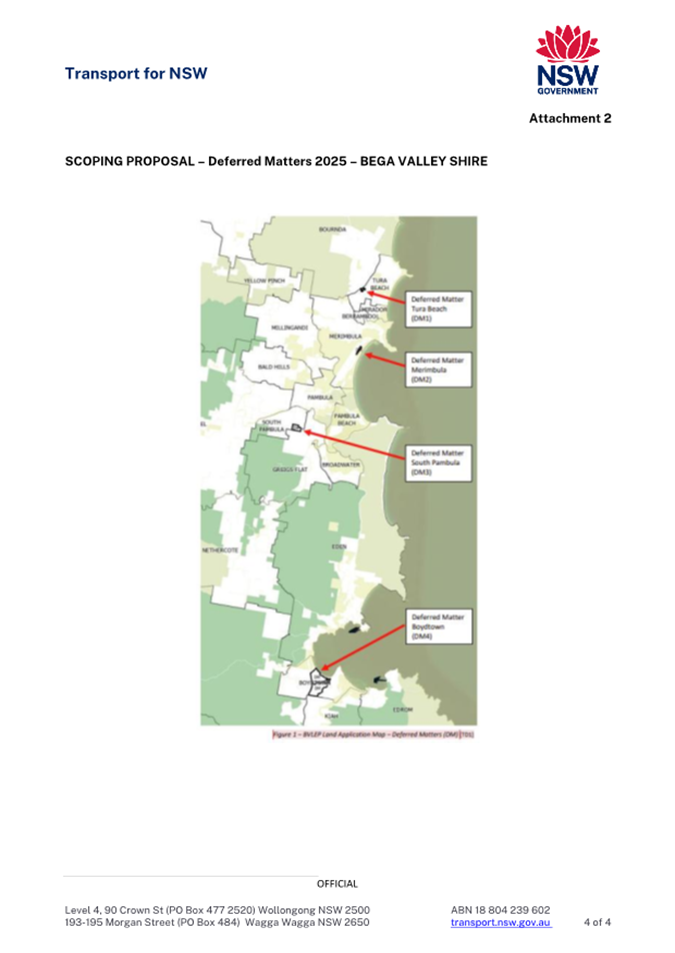
Impacted land (identified
on maps in white with “DM” notation)
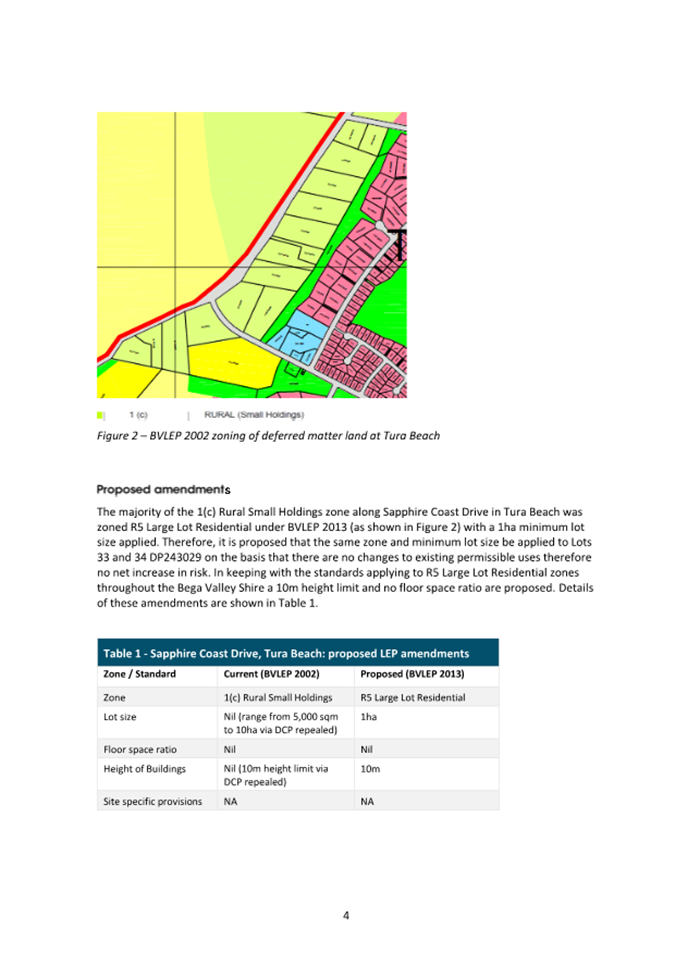
Sapphire Coast Drive, Tura Beach
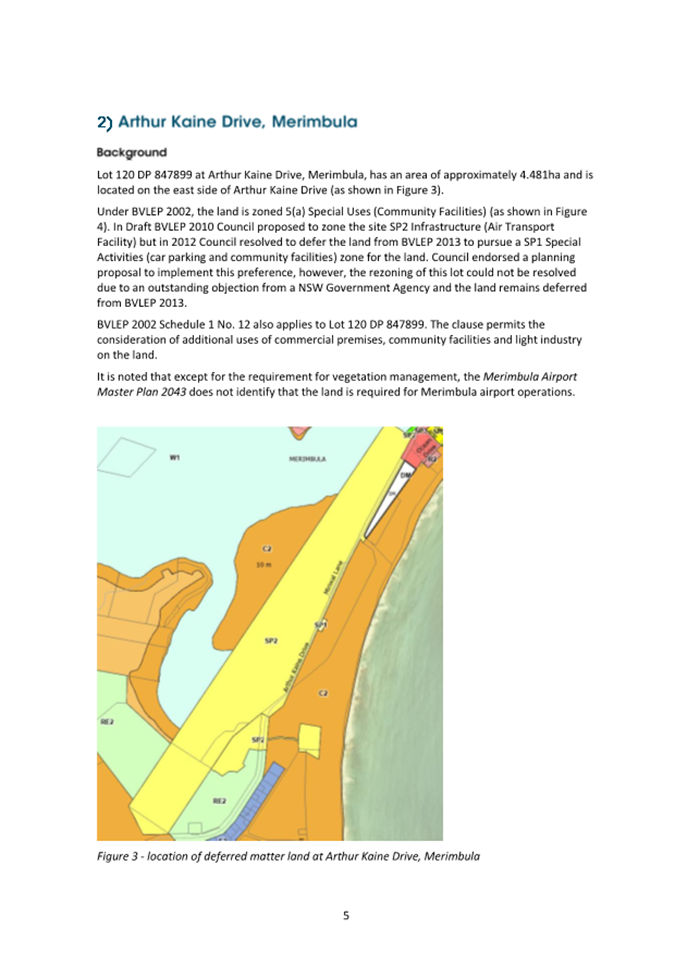
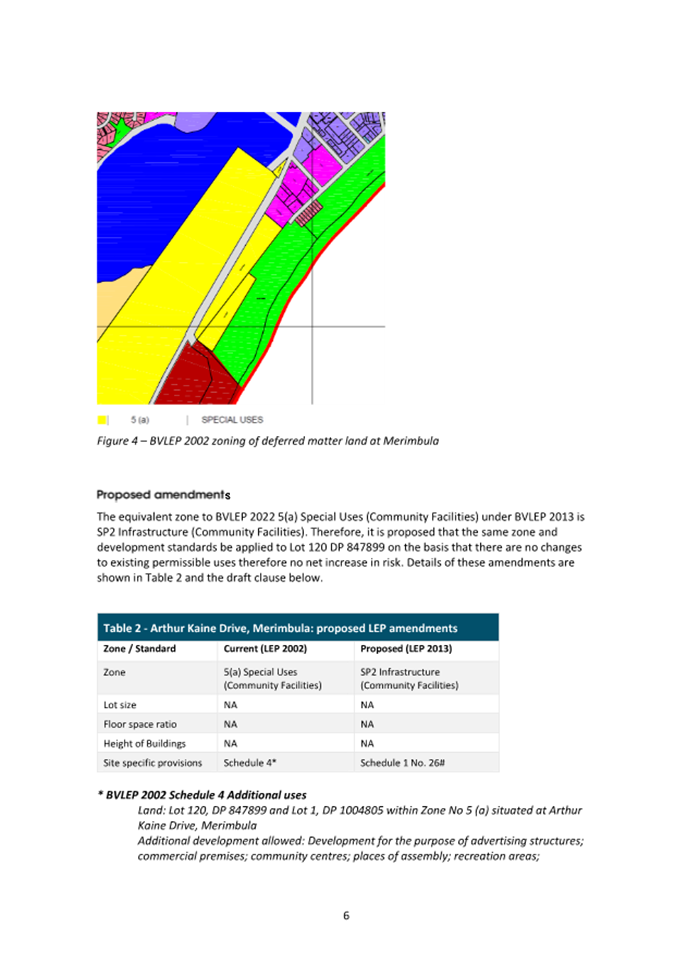
Arthur Kaine Drive, Merimbula
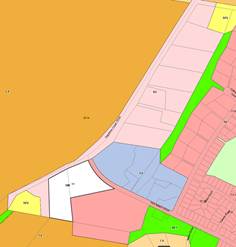
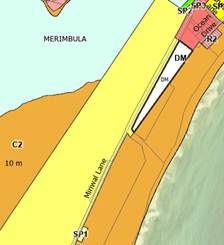
George Street, South Pambula
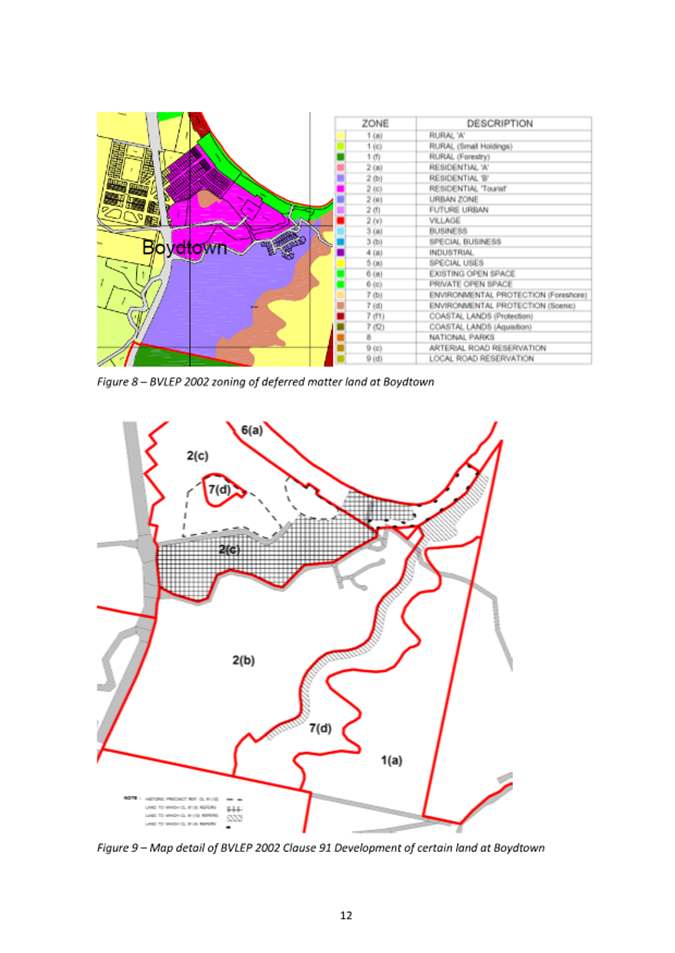
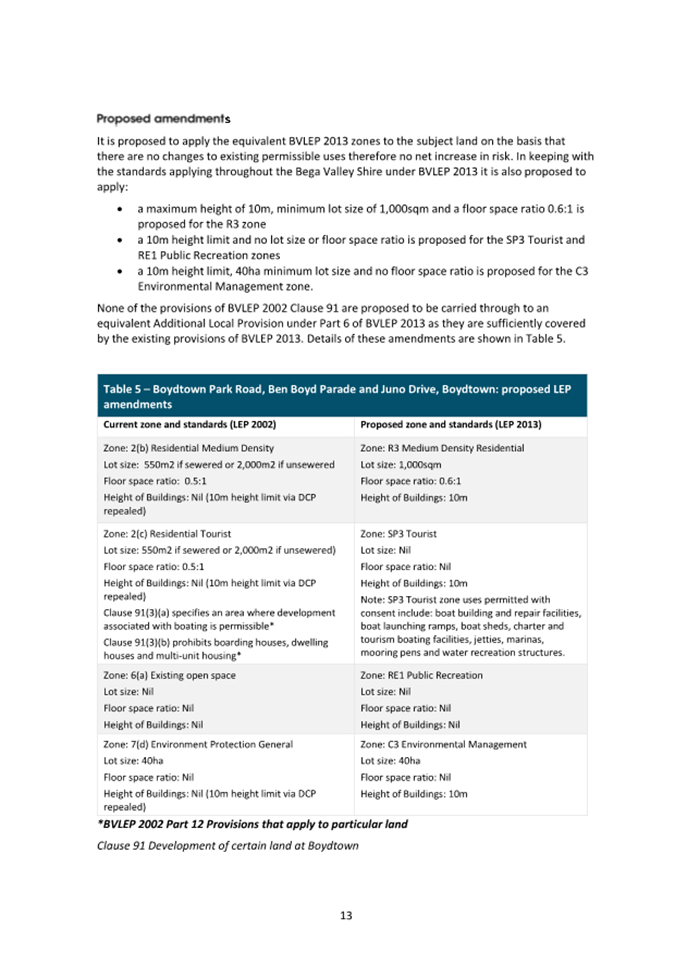
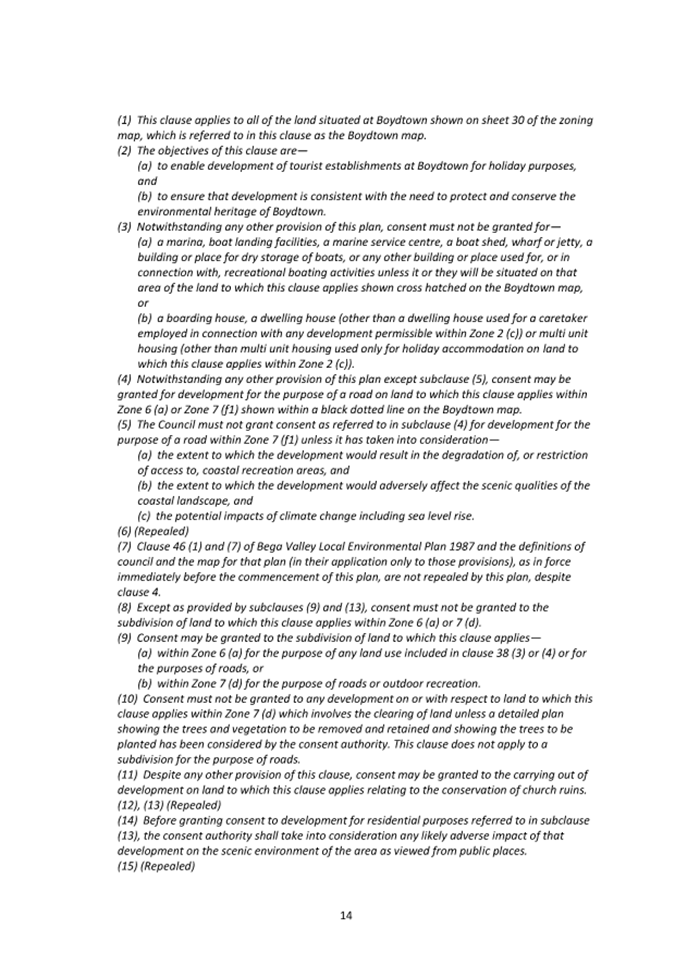
Boydtown
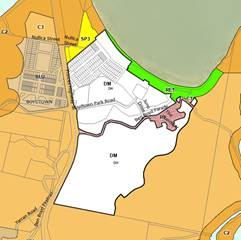
|
Proposed amendments
|
|
Land
|
Current (BVLEP 2002)
|
Proposed (BVLEP 2013)
|
|
Sapphire Coast Drive,
Tura Beach
Lots 33 - 34 DP 243029
|
Zone: 1(c) Rural Small
Holdings
Lot size: Nil (range
from 5,000 sqm to 10ha via DCP repealed)
Height of Buildings: Nil
(10m height limit via DCP repealed)
|
Zone: R5 Large Lot
Residential
Lot size: 1ha
Height of Buildings: 10m
|
|
Arthur Kaine Drive,
Merimbula
Lot 120 DP 847899
|
5(a) Special Uses
(Community Facilities)
Schedule 4
|
SP2 Infrastructure
(Community Facilities)
Schedule 1 No. 26
|
|
George Street, Lloyd
Street and Princes Highway, South Pambula
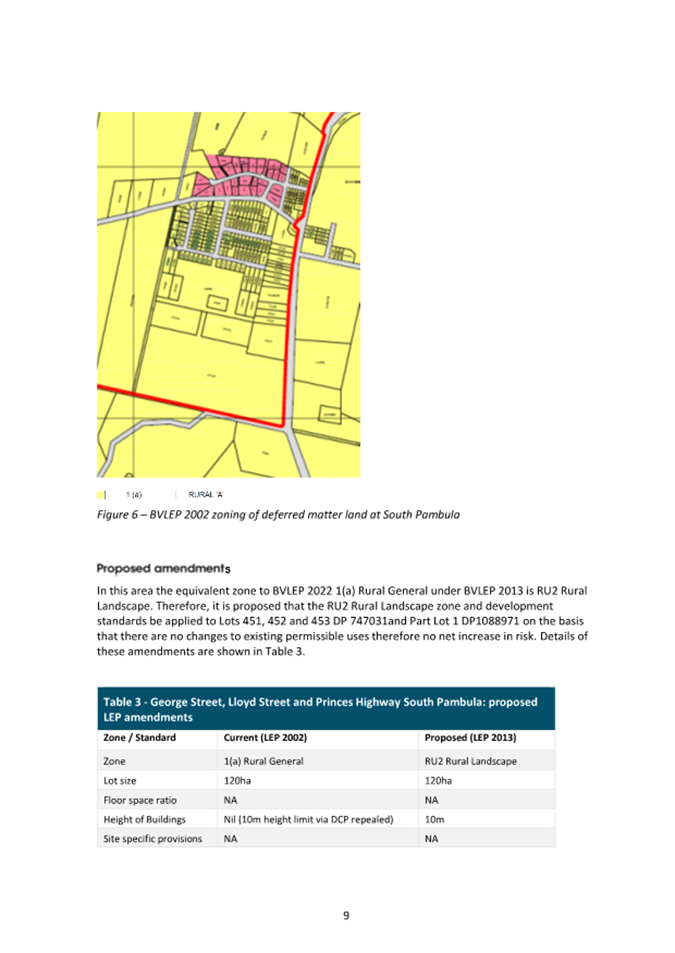
Lots 451-3 DP 747031 / Part
Lot 1 DP 1088971
|
Zone: 1(a) Rural General
Lot size: 120ha
Height of Buildings: Nil
(10m height limit via DCP repealed)
|
Zone: RU2 Rural
Landscape
Lot size: 120ha
Height of Buildings: 10m
|
|
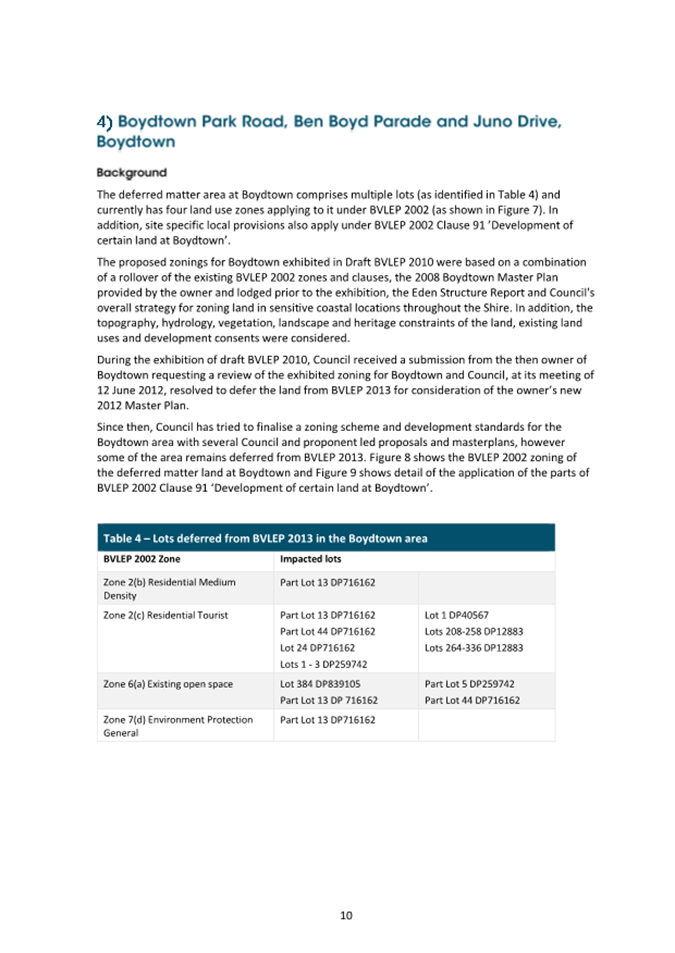
Boydtown Park Road, Ben
Boyd Parade and Juno Drive, Boydtown
Lot 13, 24 & 44 DP 716162
/ Lots 1 - 3 & Part Lot 5 DP 259742 / Lot 1 DP 40567 / Lots 208-258 &
264-336 DP 12883 / Lot 384 DP 839105
|
Zone: 2(b)
Residential Medium Density
Lot size: 550m2 if
sewered or 2,000m2 if unsewered
Floor space ratio:
0.5:1
Height of Buildings: Nil
(10m height limit via DCP repealed)
|
Zone: R3
Medium Density Residential
Lot size: 1,000sqm
Floor space ratio: 0.6:1
Height of Buildings: 10m
|
|
Zone: 2(c) Residential Tourist
Clause 91(3)(b)
prohibits boarding houses, dwelling houses and multi-unit housing
Lot size: 550m2 if
sewered or 2,000m2 if unsewered)
Floor space ratio: 0.5:1
Height of Buildings: Nil
(10m height limit via DCP repealed)
|
Zone: SP3 Tourist
Lot size: Nil
Floor space ratio: Nil
Height of Buildings: 10m
|
|
Zone: 6(a)
Existing open space
|
Zone: RE1
Public Recreation
|
|
Zone: 7(d) Environment Protection General
Lot size: 40ha
Height of Buildings: Nil
(10m height limit via DCP repealed)
|
Zone: C3 Environmental Management
Lot size: 40ha
Height of Buildings: 10m
|
Assessment
of Planning Proposal
STRATEGIC MERIT ASSESSMENT CRITERIA
Does the proposal give effect to the relevant regional plan?
The proposal gives effect to the Draft Southeast and
Tablelands Regional Plan by supporting increased housing supply and
diversity, improving strategic alignment across the NSW planning hierarchy,
strengthening climate change and hazard resilience, protecting environmental
assets while enabling sustainable growth and delivering a more consistent,
efficient and defensible planning system. These outcomes ensure Bega Valley
Shire’s local planning controls effectively implement the Draft Regional
Plan’s vision for resilient, well‑planned
and thriving regional communities.
Does the proposal demonstrate consistency with the relevant
Local Strategic Planning Statement (LSPS)?
The planning proposal will give statutory effect to
Council’s LSPS priorities for sustainable and resilient settlements,
housing choice and affordability, a vibrant and diverse local economy, and
protection of environmental and cultural values.
Does the proposal respond to a change in circumstances that has
not been recognised by the existing planning framework?
The planning proposal does not respond to a change in
circumstances that has not been recognised by the existing planning framework.
SITE-SPECIFIC MERIT ASSESSMENT CRITERIA
Does the proposal give regard and assess impacts to the natural
environment on the site to which the proposal relates and other affected land
(including known significant environmental areas, resources or hazards)?
Overall, it is considered that the proposal will result in a
decrease of risk of inappropriate approvals and potential liability following
natural hazard events. BVLEP 2002 contains outdated environmental zones and
provisions that are not suited to managing increasing climate related risks.
Applying BVLEP 2013 to the land will result in stronger provisions for climate
resilience, coastal, flood and bushfire hazards, biodiversity protection and
environmental conservation, and aligns with the SEPP (Resilience and Hazards)
2021, the Biodiversity Offset Scheme and current hazard planning frameworks.
Does the proposal give regard and assess impacts to services and
infrastructure that are or will be available to meet the demands arising from
the proposal and any proposed financial arrangements for infrastructure
provision?
The planning proposal does not increase development
potential or intensity of the lands to which it applies and therefore does not
increase demand for public infrastructure.
Options
Options available to Council are to:
1. Resolve
to support the planning proposal and forward it to the Department of Planning,
Housing, and Infrastructure for Gateway Determination. This is the recommended
option.
2. Not
support the planning proposal. BVLEP 2002 will stay in effect indefinitely,
potentially resulting in uncertainty and increased risk for landowners and the
community.
Community
and Stakeholder Engagement
Engagement undertaken The
Department of Planning, Housing and Infrastructure arranged pre-lodgement
consultation with the following agencies: NSW Department of Climate Change,
Energy, the Environment and Water Conservation Planning and Assessment, NSW
Department of Climate Change, Energy, the Environment and Water South East,
Coast Estuary and Flood, Department Primary Industries Agriculture, Department
Primary Industries Fisheries, Heritage NSW, NSW Rural Fire Service, State
Emergency Services and Transport for NSW.
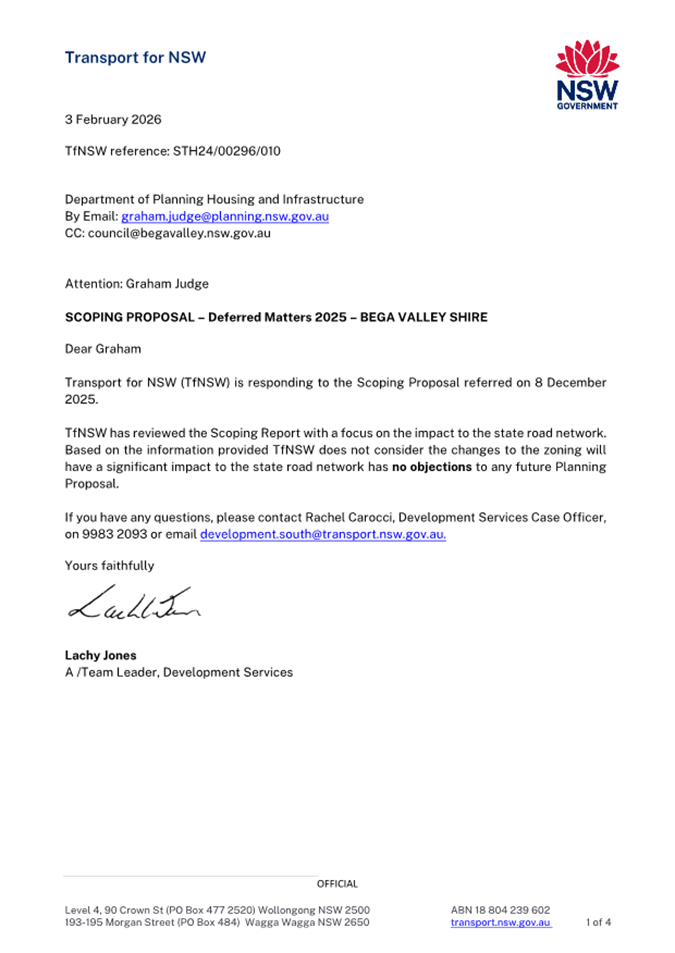
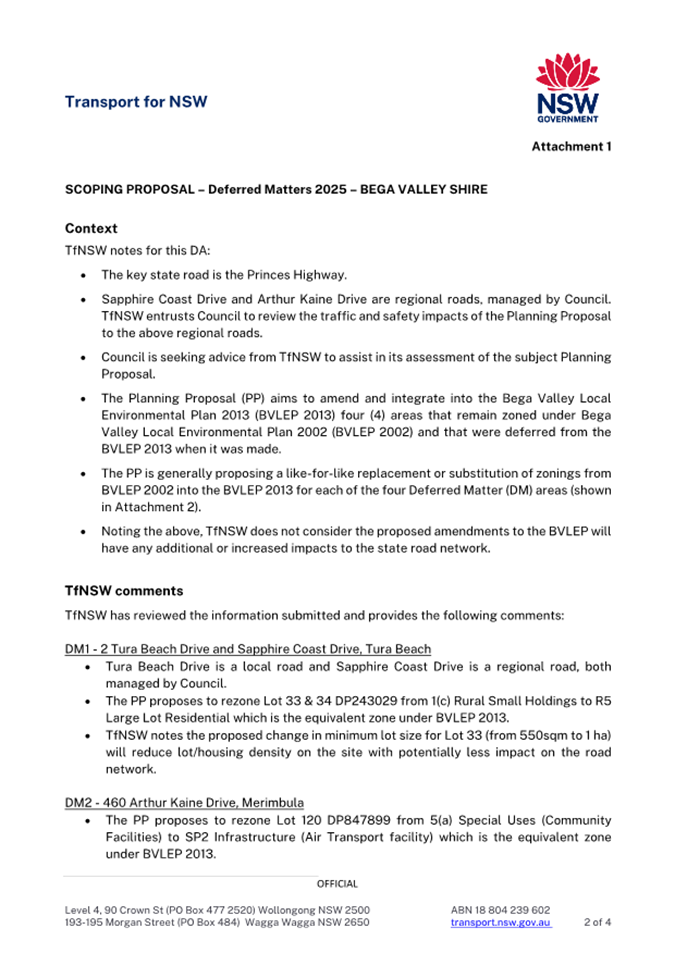
The eight
affected landowners have been advised of the proposed Planning Proposal and
staff will continue to engage with those landowners throughout the process.
Engagement planned
If the
planning proposal receives Gateway approval, community consultation will be
consistent with the requirements of the Bega Valley Shire Community
Engagement Strategy, being a minimum exhibition timeframe of 28 days, or as
specified by the Gateway Determination. Public exhibition of the planning
proposal will include notification on Council’s website and in writing to
impacted landowners.
Should
agency or community feedback to the planning proposal be received that warrant
substantial changes to the planning proposal, a further report will be prepared
for Council outlining the submissions received and the changes to the planning
proposal recommended in response to those submissions prior to resolving
whether to proceed with amending BVLEP 2013.
If no
objections to the planning proposal are received and no substantial changes are
required to the planning proposal, it is recommended that Council resolve to
authorise staff to proceed to finalise the proposed amendment to the BVLEP
2013.
Financial
and Resource Considerations
The processing of the planning proposal and its public
exhibition will be undertaken as part of Council’s regular work program.
Legal
/Policy
The planning proposal has been prepared in accordance with
section 3.33 of the Environmental Planning and Assessment Act 1979
and the Local Environmental Plan Making Guidelines (August 2023).
Impacts
on Strategic/Operational/Asset Management Plan/Risk
Strategic
Alignment
The planning proposal will give statutory effect to
Council’s Local Strategic Planning Statement priorities for
sustainable and resilient settlements, housing choice and affordability, a
vibrant and diverse local economy, and protection of environmental and cultural
values, and to advance the Community Strategic Plan themes of strong
communities, valued environments and prosperity for the Bega Valley.
Environment
and Climate Change
The planning proposal will strengthen environmental and
climate change risk management, improve integration with contemporary coastal,
flood, bushfire and biodiversity planning frameworks, and reduce the ongoing
risk of inappropriate development outcomes arising from outdated zoning and
controls.
Economic
The planning proposal will support a stronger and more
resilient local economy by providing clear, contemporary and consistent
planning controls that reduce investment uncertainty, facilitate employment and
housing delivery, and align land use regulation with current NSW Government
economic and productivity objectives.
Risk
The planning proposal will mitigate legal, strategic and
governance risk arising from reliance on a pre Standard Instrument framework,
improve certainty and defensibility in decision making, and ensure planning
controls align with contemporary NSW Government policy and the statutory
planning hierarchy.
Social
/ Cultural
The planning proposal will provide
clearer, more consistent and contemporary planning controls that improve
transparency and certainty for the community, support appropriate housing
choice and local amenity, and ensure development outcomes better reflect
current community expectations and needs.
Attachments
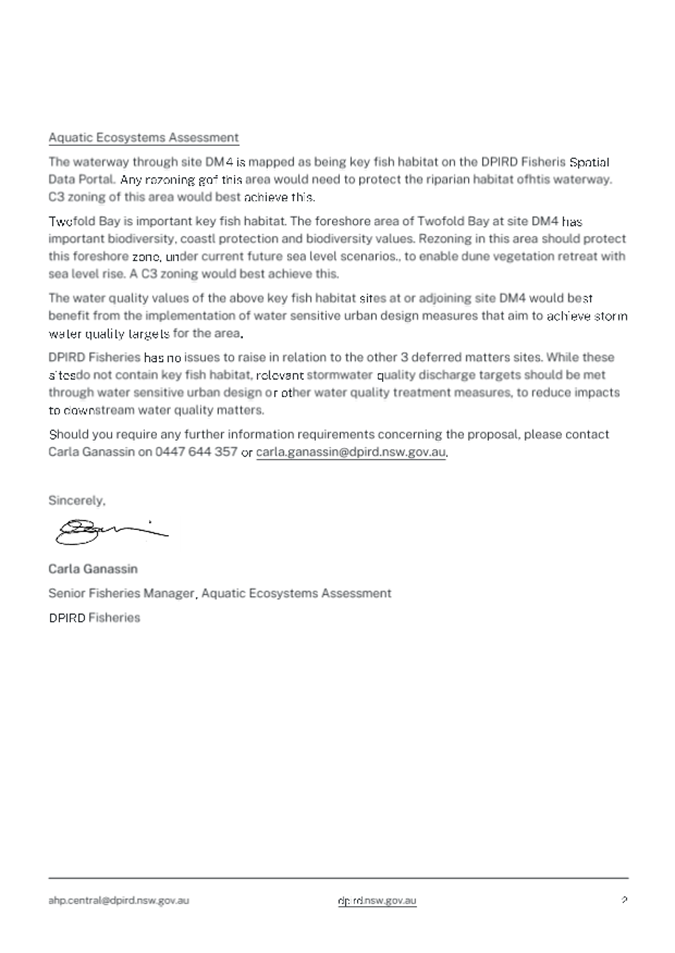
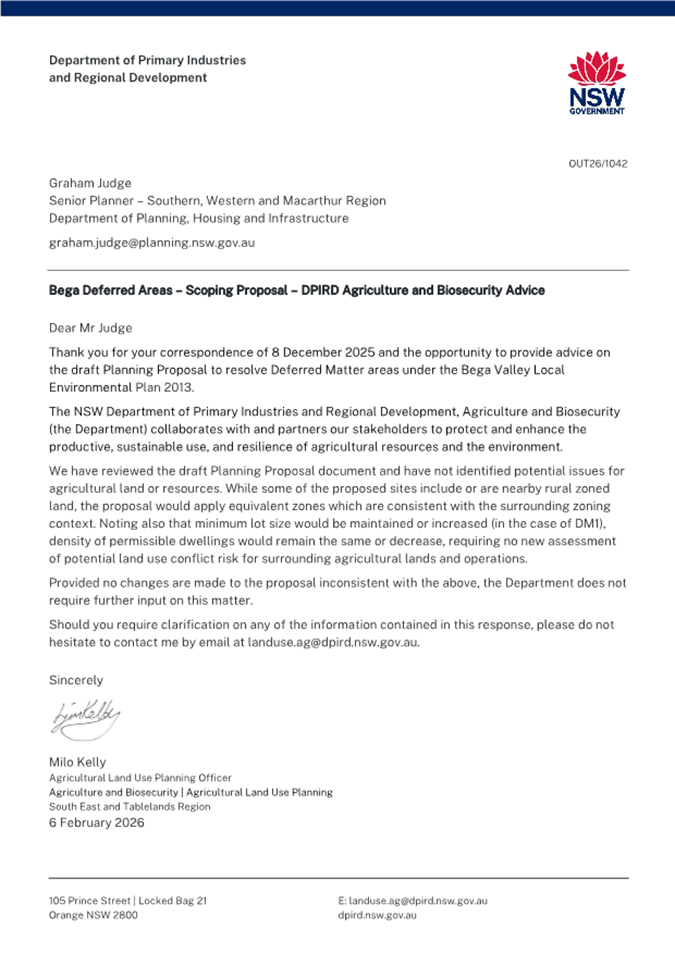
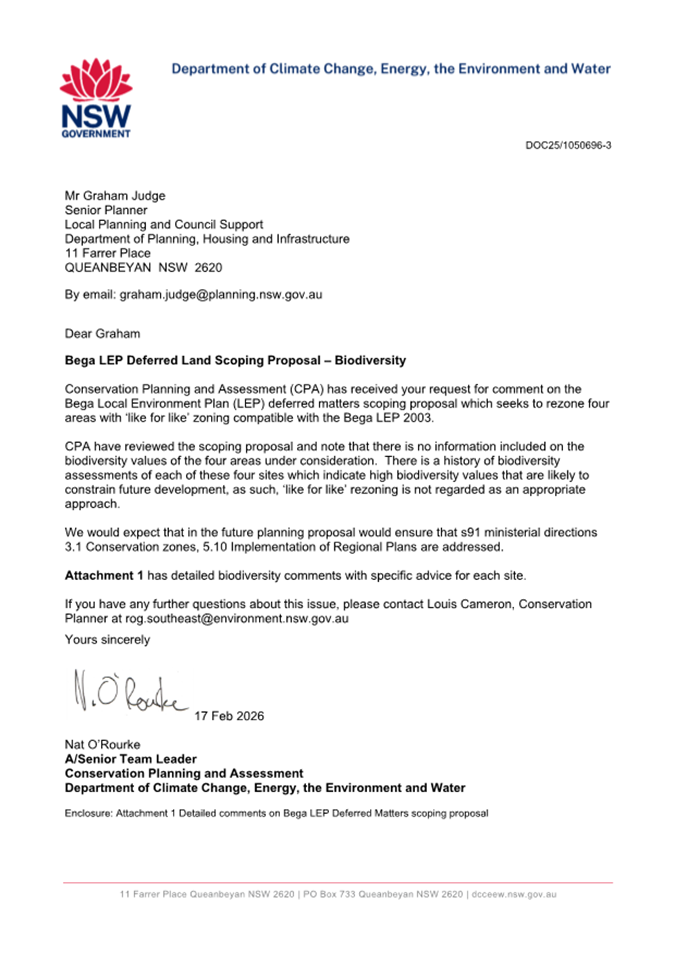
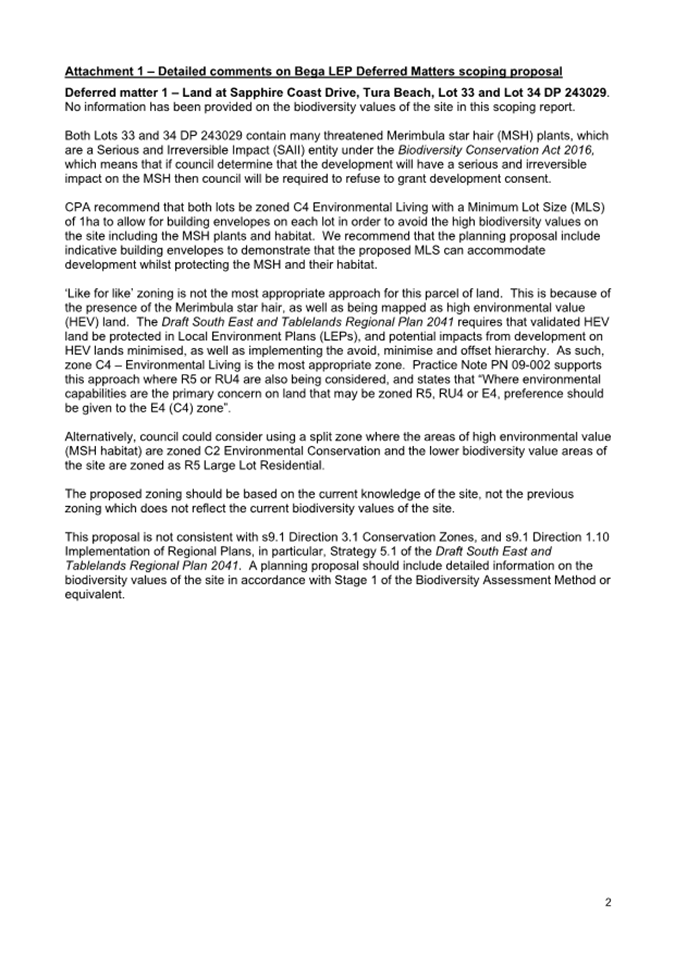
1⇩. Deferred
Matters Planning Proposal May 2026
|
Council
|
6 May 2026
|
|
Item 8.2
- Attachment 1
|
Deferred Matters Planning Proposal May 2026
|

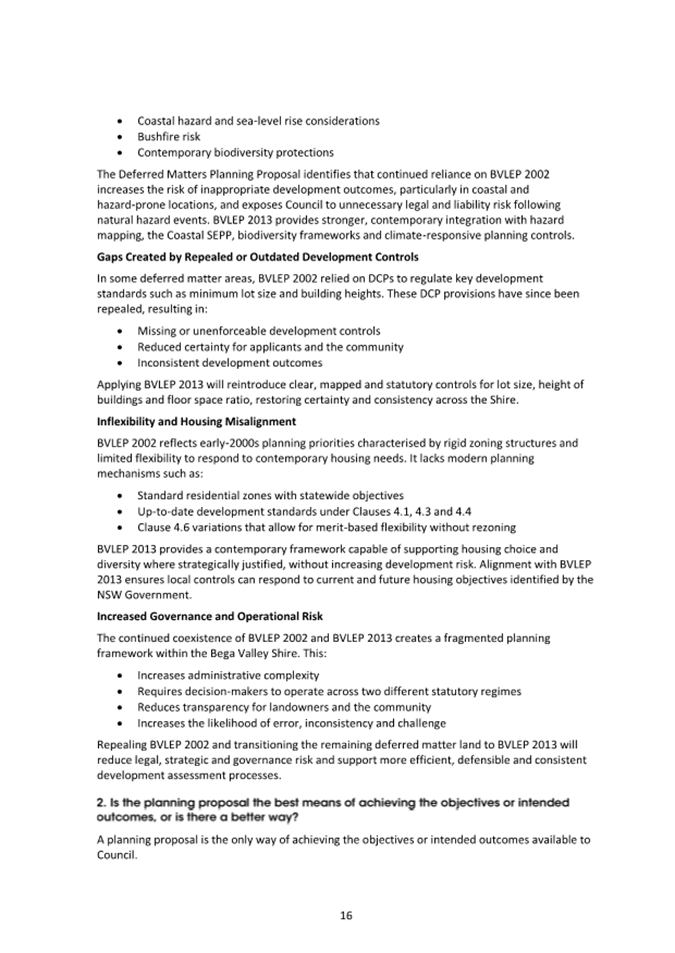
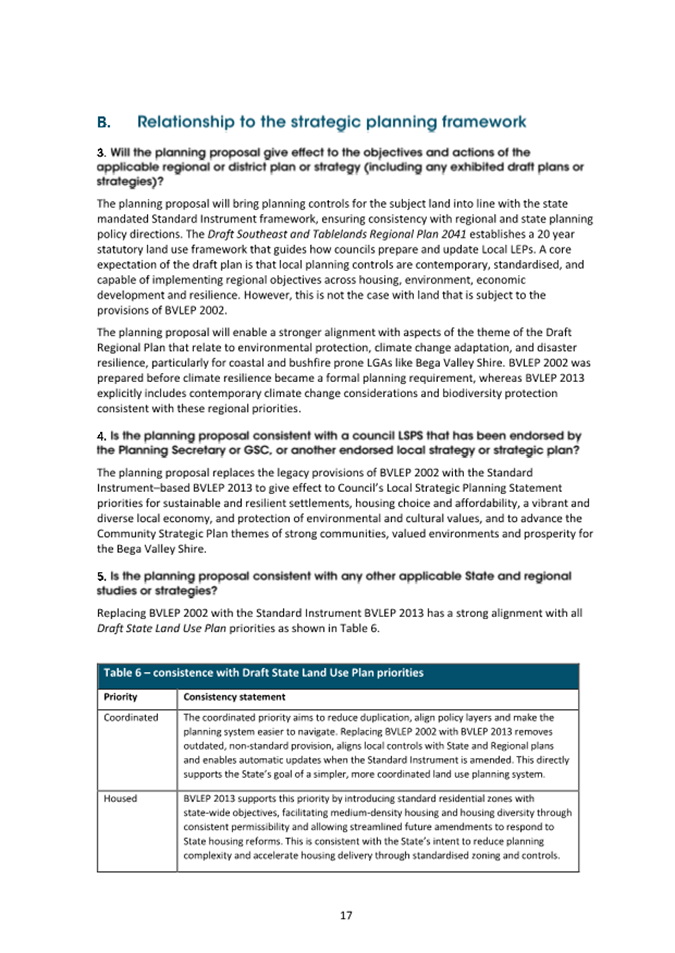
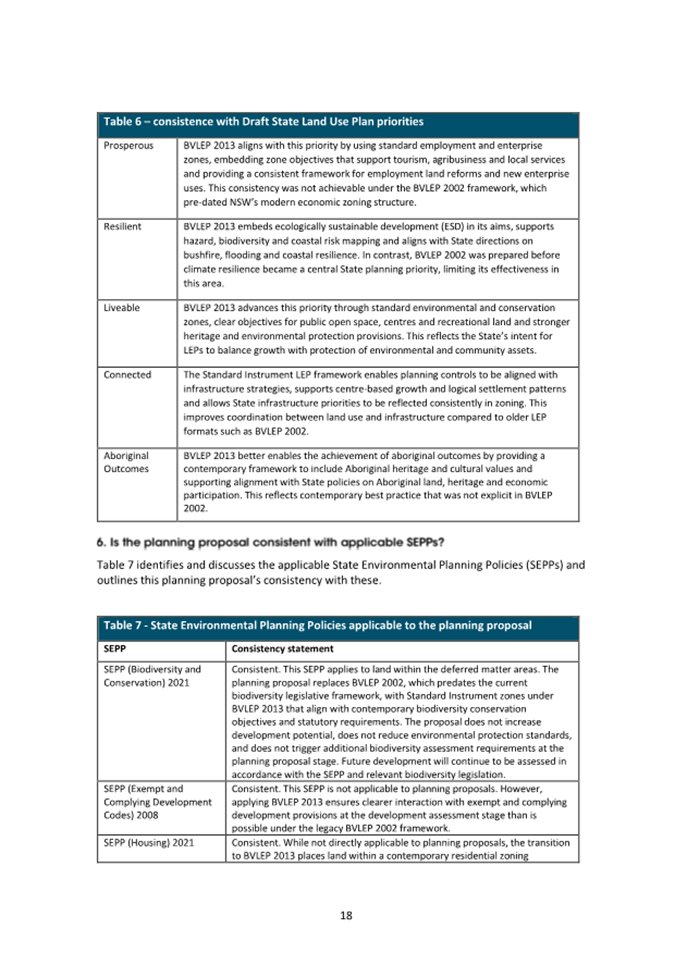
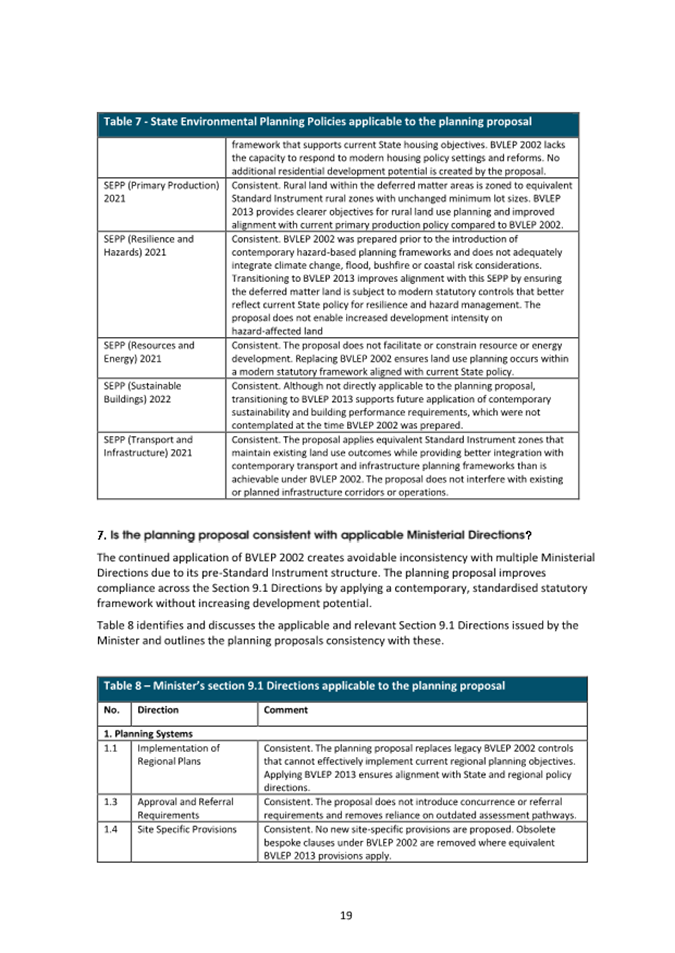
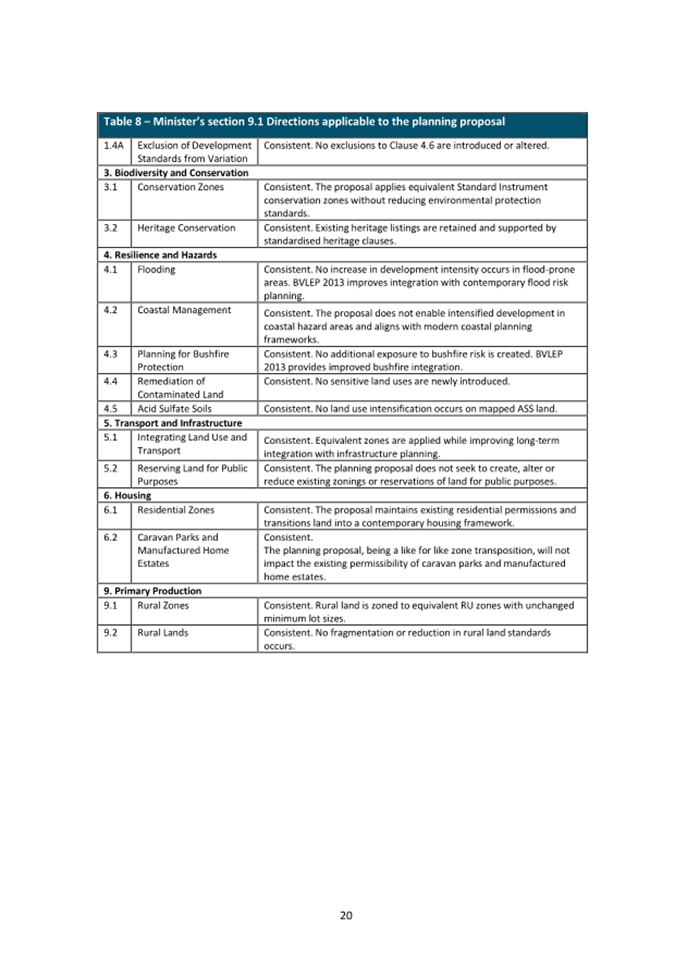
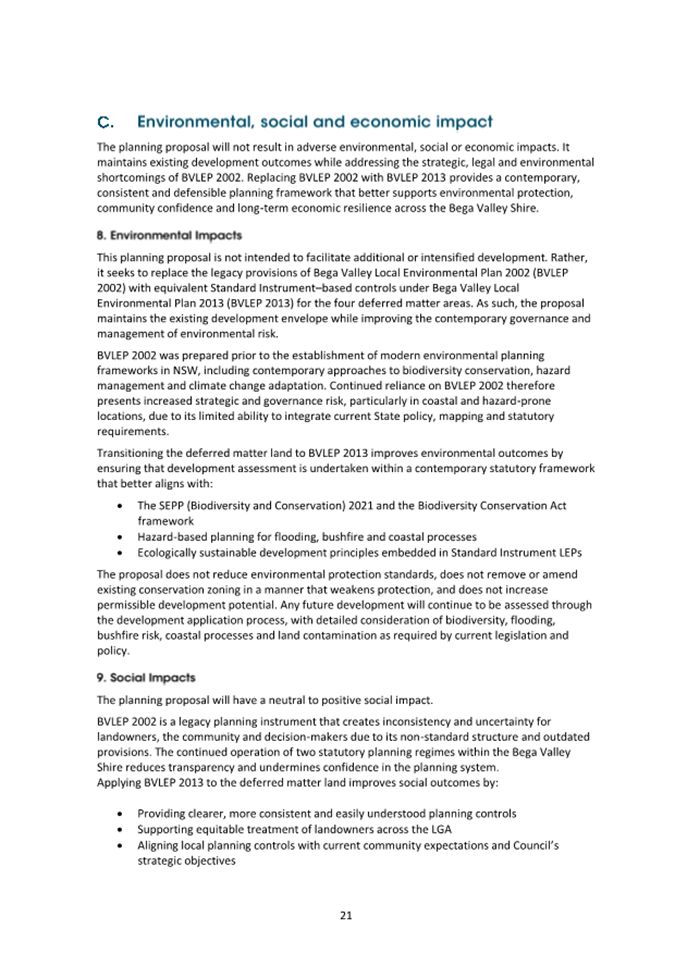
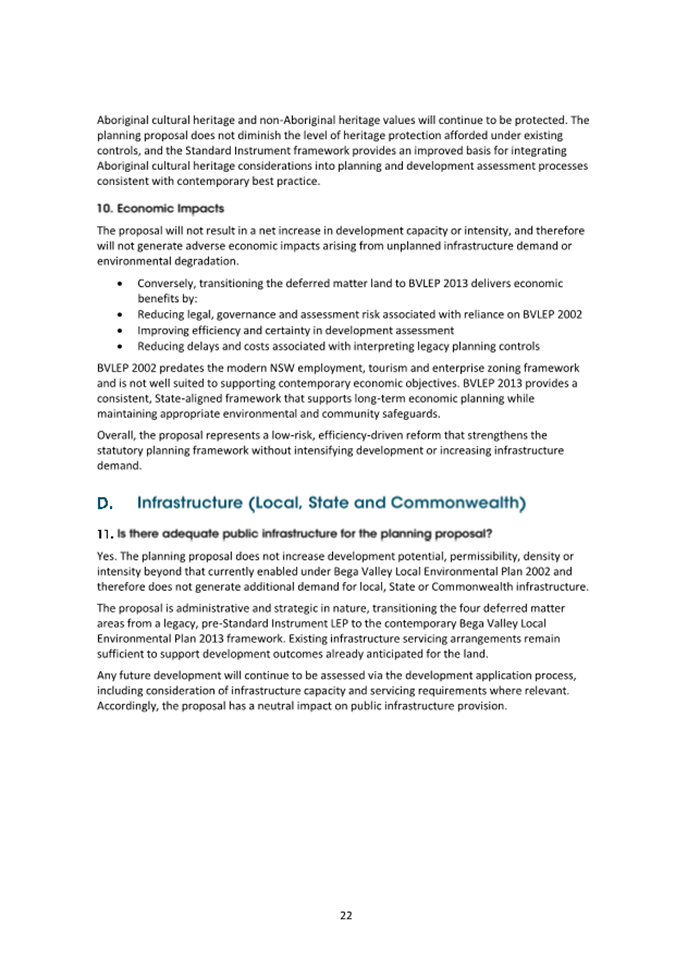
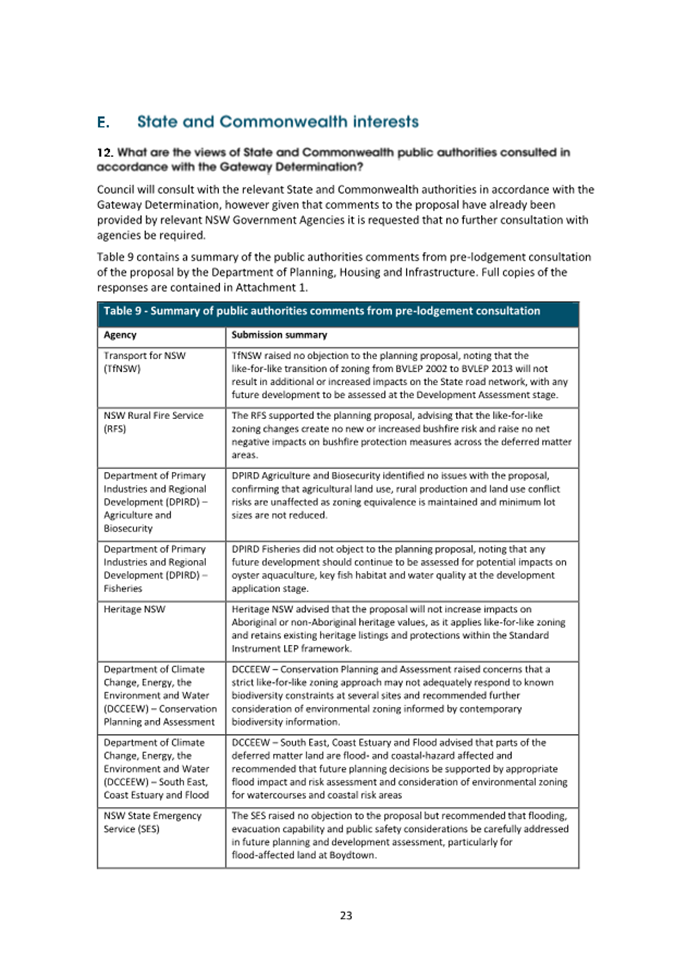
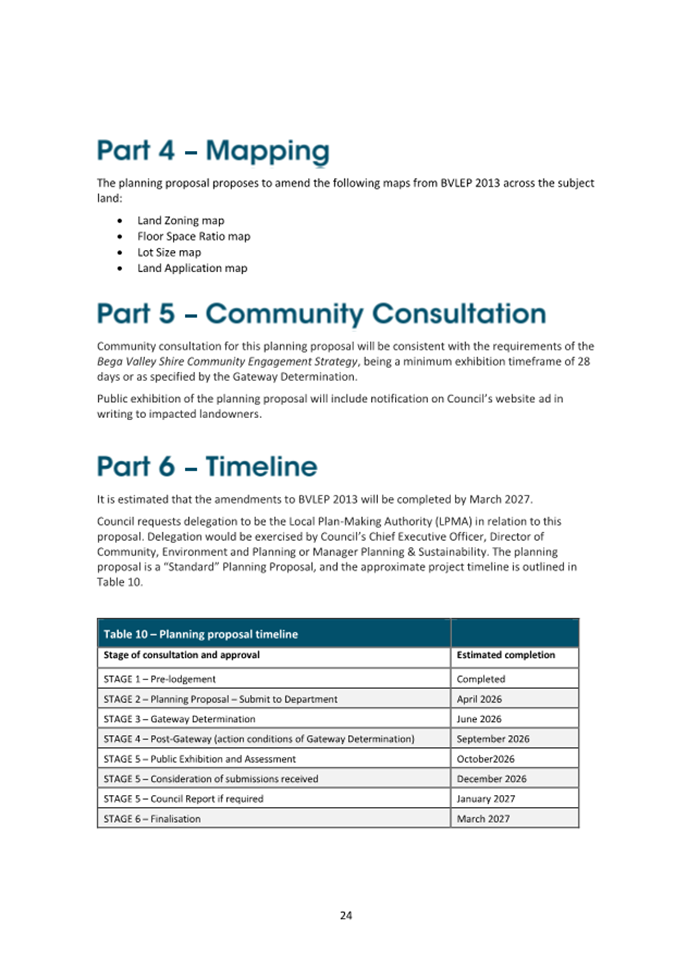
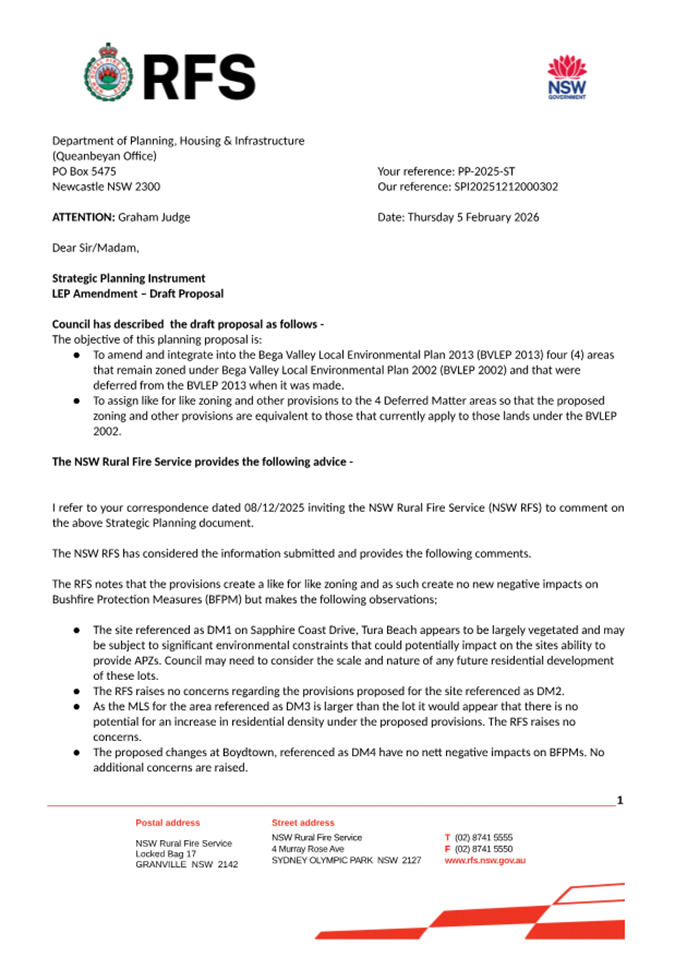

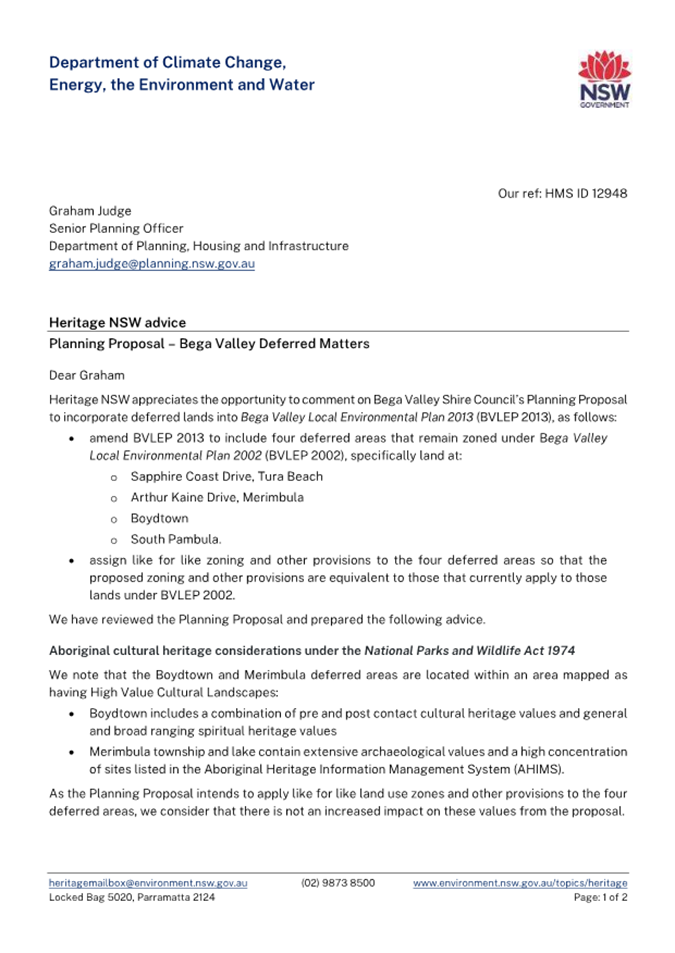
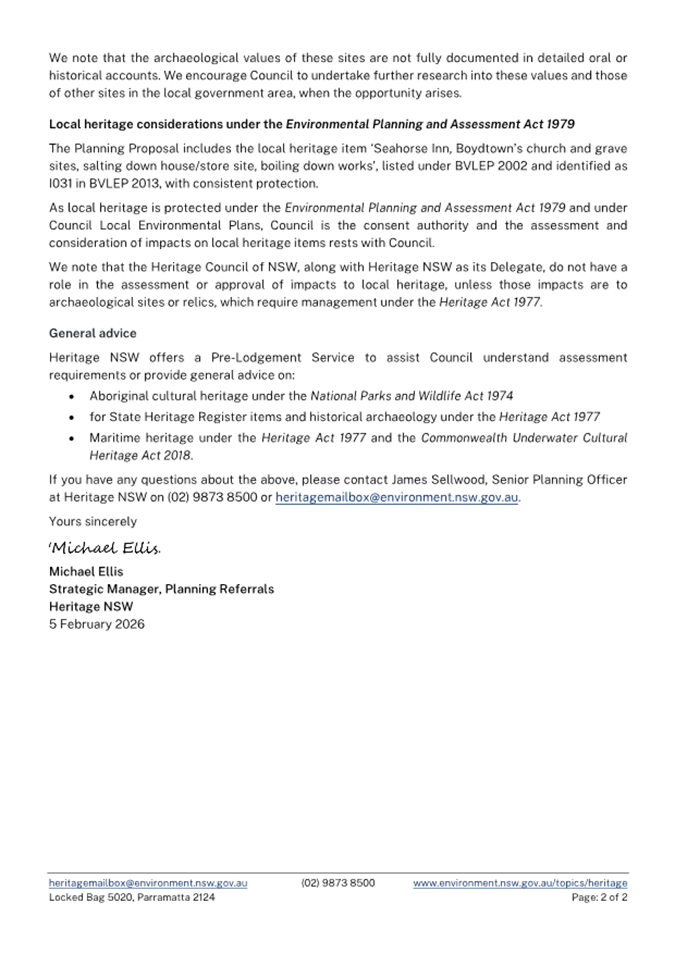
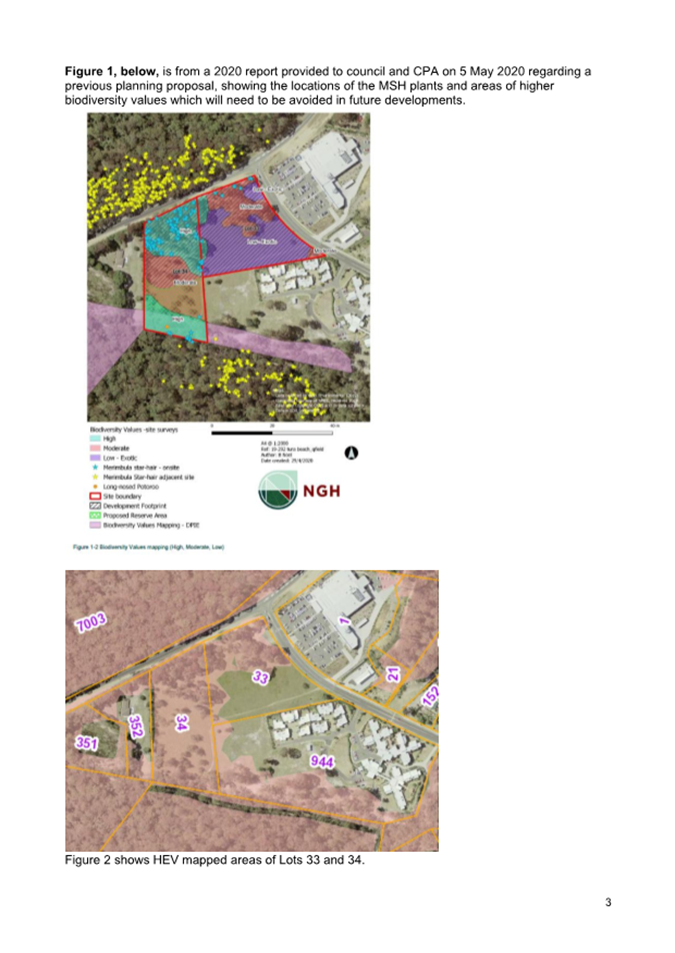
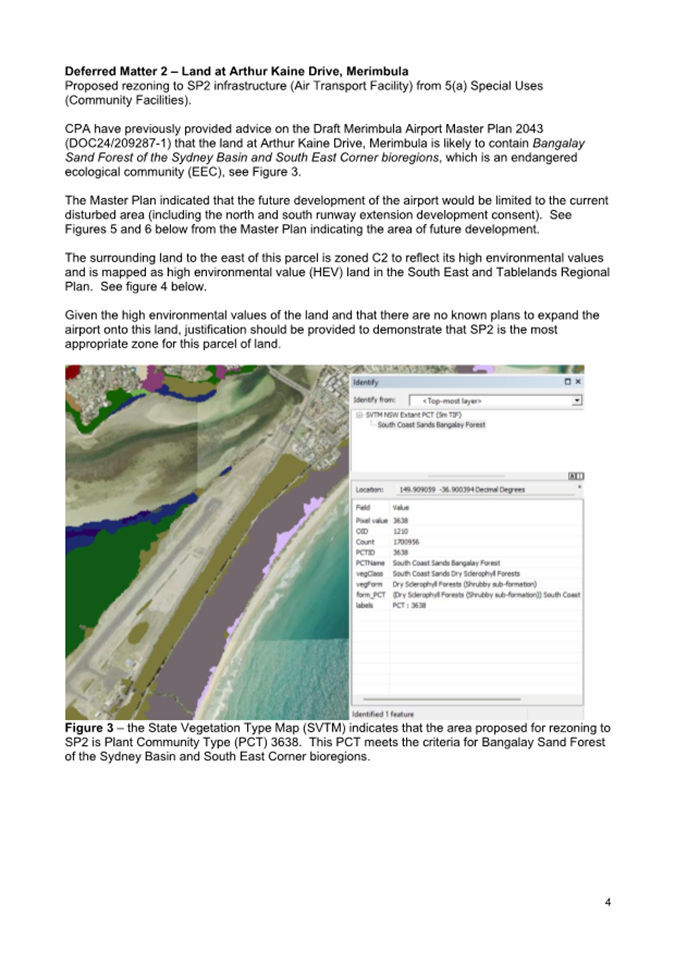
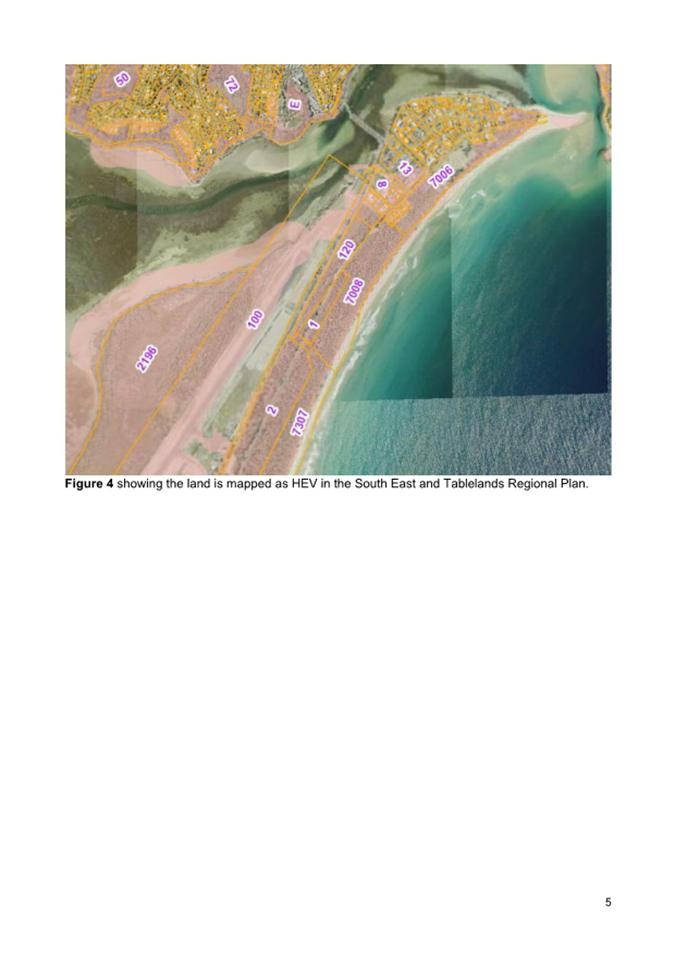
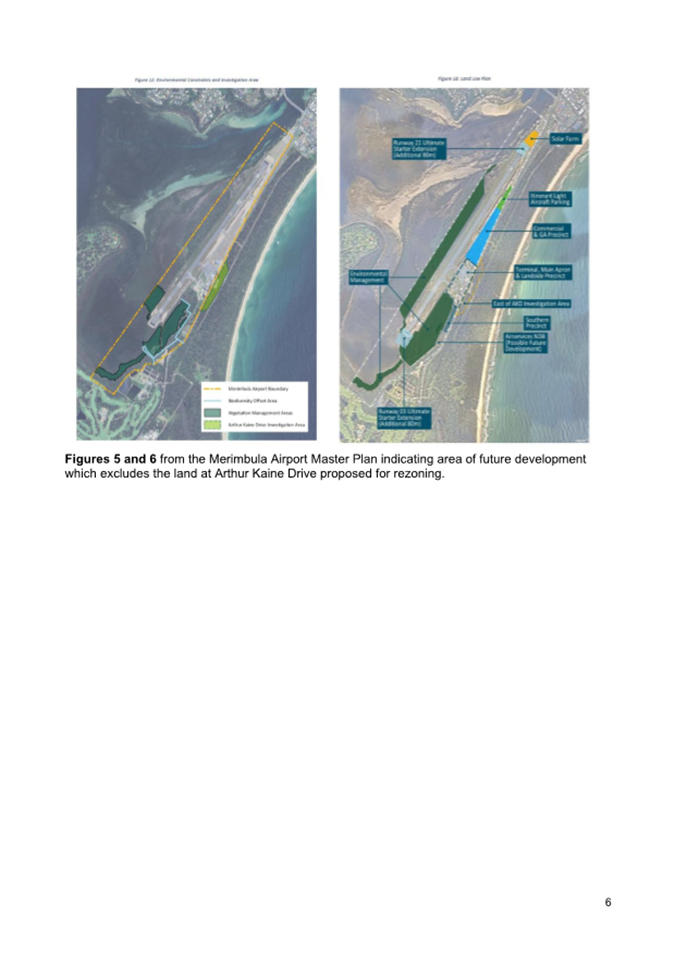
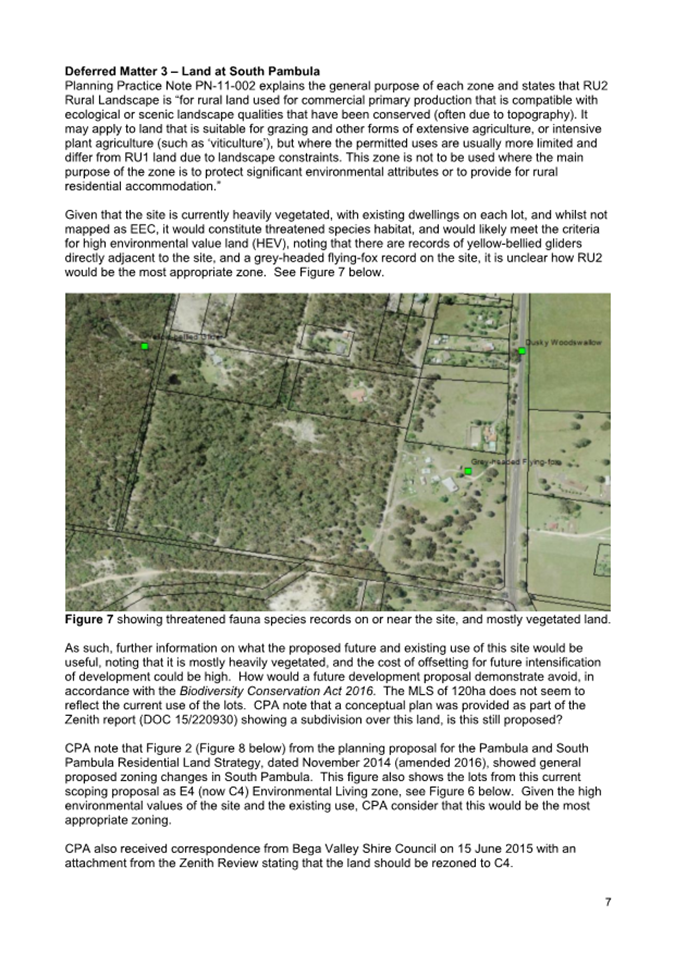
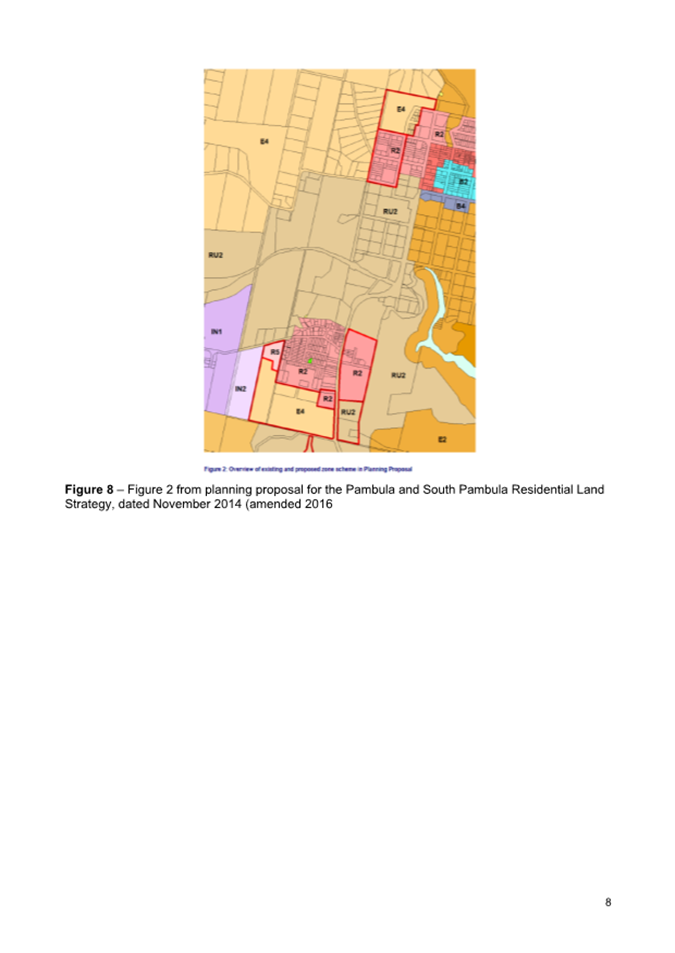
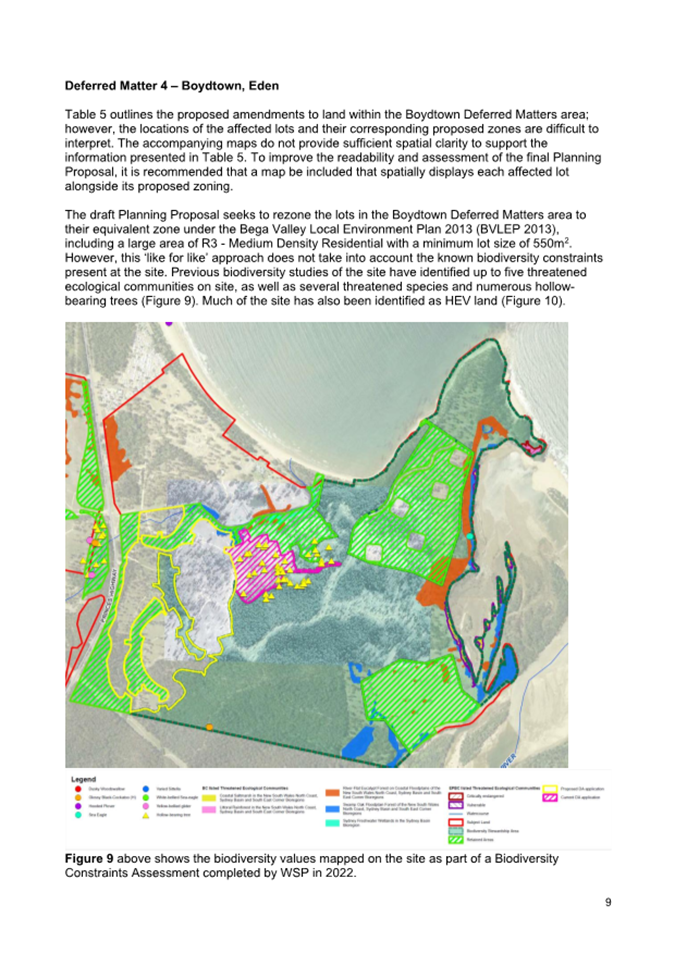
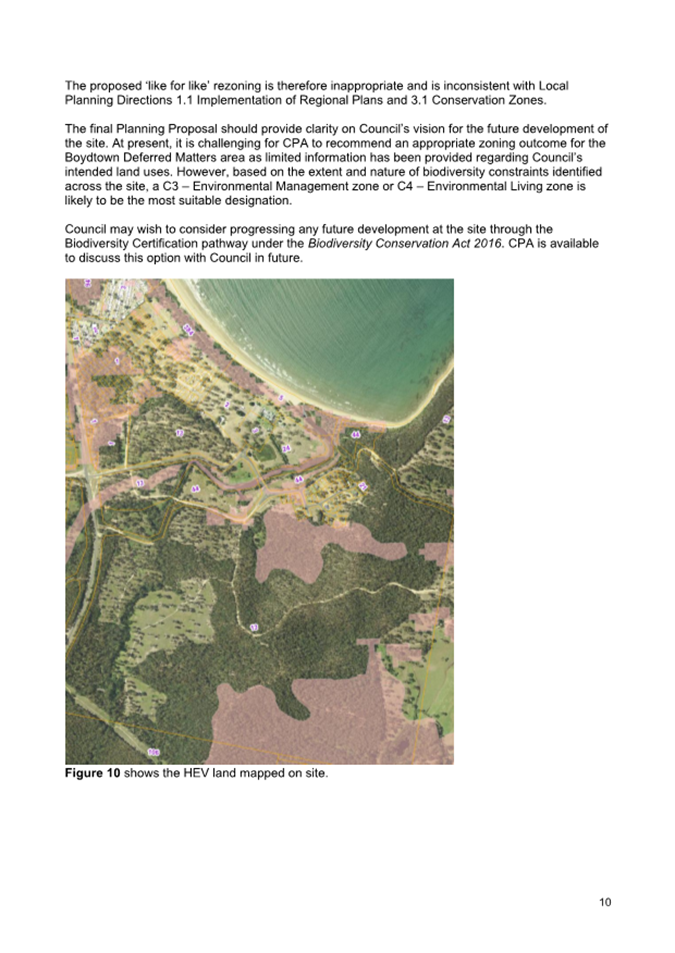

|
Council 6 May 2026
|
Item 8.3
|
8.3. Central Waste
Facility Power Upgrade Project Delegations
To provide an overview of the
Central Waste Facility Power Upgrade Project and delegate authority to the
Chief Executive Officer to proceed.
Director Community Environment and Planning
Officer’s
Recommendation
That Council:
1. Note
the requirement for power upgrade works on private land to support the future
development of the Central Waste Facility.
2. Delegate
authority to negotiate public works on private land to the Chief Executive
Officer in relation to the project and execute any necessary
documentation to formalise negotiations.
Executive Summary
Council is progressing plans to develop the Central Waste
Facility. This includes the construction of a new Organics Processing Facility
in the near term, and preliminary plans for further resource recovery
operations. These projects have identified that the existing electrical power
supply is insufficient to meet future power demand and requires upgrades to
network infrastructure.
Council has engaged Essential Energy approved consultants to
undertake site investigations and preliminary designs for the power upgrade.
This has identified works required on eight privately owned properties where
the Essential Energy network is located under easements. As the work is being
undertaken by Council acting as a developer, access easements benefitting
Essential Energy are not automatically conferred to Council. Additionally, as
the works are upgrades (not asset maintenance or renewal) private landholders
are required to agree to the extent of works to be undertaken on their land.
Council’s existing suite of delegations do not cover
liaison and approvals to conduct Council works on private land. This report
seeks Council’s delegation to the Chief Executive Officer to liaise with
and negotiate any access requirements and works required on private land for
the purpose of the Central Waste Facility power upgrades.
Background
The proposed organics processing facility and future
resource recovery operations at the Central Waste Facility will require power
when it is in testing mode, which is predicted to be around March 2027. The
organics processing facility is designed to operate with some energy 24 hours a
day, 7 days a week. The proposed design incorporates significant solar
renewable energy generation but as a commercial facility a connection to the
power network is necessary in case of generation downtime due to faults or maintenance
as well as overnight.
Council engaged power design consultants who have confirmed
the upgrade requirements include key components including an upgraded 750kVA
substation and 4.5km of upgraded power line. This necessitates the replacement
of several dozen poles and supporting cross-arms to support the upgraded lines.
Several of these components have long lead times for supply. Where the terrain
is impassable due to factors such as gradient or watercourses, temporary or
permanent crossings may be required to be constructed to allow access to the
network infrastructure. If the best access routes are outside of existing
easements new access arrangement may need to be formalised.
To undertake any works on the network all affected property
owners and stakeholders are required to give consent. The majority of the
affected network is in Council road reserves, however there are eight private
properties with network infrastructure where works will be required. To date
Council has informed all affected stakeholders of the project for its
consultants to undertake early investigations, inspections and design work.
Options
Liaising with owners of the eight affected properties and
gaining their agreement for access and works is the only feasible option to
progress the project.
Designing all future facilities at the Central Waste
Facility to be power independent of the network has been considered and is not
economically or operationally feasible.
Community
and Stakeholder Engagement
The power upgrade project has very low community scale,
limited to the owners of the eight affected properties. However, it also has
moderate community impact due to its interdependency with the future
development of the Central Waste Facility. Under the IAP2 framework adopted in
Council’s Community Engagement Strategy, Council has an obligation to
inform and consult with affected community members. This is consistent with the
approach necessary to gain all property owners consent to access and undertake
works on their properties.
Engagement undertaken
In order to conduct preliminary investigations and survey of
the power network affected landholders were informed of the project in 2025.
Several affected landholders have already provided access and works approval
for their properties.
Essential Energy has been engaged throughout the project in
accordance with their processes and procedures.
Engagement planned
Council staff and its contractors will liaise with the
owners of the eight directly affected properties to successfully deliver the
power upgrade project. Council staff will undertake negotiations to agree to
access and works conditions should this become necessary under the proposed
delegation to the Chief Executive Officer. Due to the technical nature of
electrical works, negotiations may be attended and facilitated by
Council’s contractors who can advise on the extent of access and works
needed to upgrade the network.
Essential Energy will be engaged to approve any final
designs and works to be undertaken on their network infrastructure.
Financial
and Resource Considerations
The power upgrade project is approved in Council’s
Long Term Financial Plan and Delivery Plan/Operational Plan. Project estimates
are within approved budget.
|
Item
|
$ Excl GST
|
|
Expenditure
Detail
|
|
|
Preliminary
Investigation and Design
|
$69,773
|
|
Final
Design Delivery
|
$219,750
|
|
Construction
|
$600,000
|
|
Total
Expenditure
|
$889,523
XXXX (sum of all costs)
|
|
|
|
|
Source
of Funds
|
|
|
WO 9308 Electrical Upgrades
at the CWF
|
$1,362,250
|
|
Total
income available
|
$1,362,250
* total income = total project cost
|
|
|
|
|
Total
Project Capital Cost
|
$889,523
|
|
Total
Available Construction Funding
|
$1,362,250
|
|
Project
Funding Shortfall
|
-$472,727
= total expense – total income
|
Financial Option Impacts | Life
Cycle Costing
|
Ongoing
Financial Impacts
|
$ Excl GST
|
|
Capital Investment | Upgrade
|
$889,523
|
|
Annual maintenance and operational costs
|
N/A
|
|
Depreciation costs
|
N/A
|
|
User charges (annual income)
|
N/A
|
Legal
/Policy
As a Local Government Authority Council has extensive rights
over public lands vested in Council. Unfortunately, easements over private
property benefiting Essential Energy do not extend to Council. Equally owners
of private properties have the right to refuse access and works where existing
easements or legislation do not give rights to an authority or developer. This
is the case for this project as it requires upgrades to infrastructure to
facilitate Council development.
It is therefore essential that Council has the proper
delegations in place to liaise and negotiate access and works to progress this
project.
Impacts
on Strategic/Operational/Asset Management Plan/Risk
Strategic
Alignment
The power upgrade at the Central Waste Facility is an
essential project to achieving Council’s commitments outlined in the
Community Strategic Plan, Delivery Plan and Waste Strategy. It underpins all
future development at the Central Waste Facility which is directly linked to
three of the five themes in the CSP, ‘B. Our Economy’, ‘C.
Our Environment’, and ‘D. Our Infrastructure’.
Environment
and Climate Change
The power upgrades are required to support future energy
needs at the Central Waste Facility, in particular a new Organics Processing
Facility and future resource recovery operations. These interdependent projects
are essential to Council meeting its environmental and climate change
obligations including reducing waste to landfill, recovering material for reuse
and recycling, and limiting Council’s carbon emissions.
Economic
Projects at the Central Waste Facility focus on resource
recovery and circular reuse. These principles underpin the Circular Economy.
The projects are also expected to lead to job creation and in the case of the
new Organics Processing Facility, the production of nutrient rich compost for
agricultural, commercial and residential use in the Bega Valley.
Risk
Without the delegation to liaise with and negotiate access
and works, the project cannot lawfully proceed. This would have a catastrophic
impact on the interdependent projects at the Central Waste Facility.
Further, there is a risk that delays to the power upgrade
project will delay the commissioning and operation of a new Organics Processing
Facility, on track for approval and construction in Financial Year 2026/27.
There is a risk that private landholders may seek some
compensation or may restrict access or works. The ability to negotiate a
mutually agreeable outcome with landholders is essential in mitigate this risk.
Social
/ Cultural
The power upgrades are required to
support future energy needs at the Central Waste Facility, in particular a new
Organics Processing Facility and future resource recovery operations. These
inter-dependent projects have significant environmental benefits, which in turn
demonstrate Council and the community’s social commitment to caring for,
and safeguarding the environment now and for future generations.
Attachments
Nil
Staff Reports
– Infrastructure
06 May 2026
9.1 Supply,
delivery and service agreement for pressure sewer pod parts............. 88
9.2 Request
for Tender (RFT) 2425-052 Supply of chemicals to Water and Sewer Services............................................................................................................................. 95
|
Council 6 May 2026
|
Item 9.1
|
9.1. Supply, delivery
and service agreement for pressure sewer pod parts
This report seeks Council approval
to enter a non-exclusive four-year supply, delivery and service agreement with
Enviro One Services Pty Ltd (Enviro One) for the supply of new pressure sewer
pod parts and servicing of existing pumps, to provide pricing certainty,
warranty benefits and continued operational support for critical sewer assets.
Director Infrastructure
Officer’s
Recommendation
1. That Council, by
resolution under section 55(3)(i) of the Local Government Act 1993, determine
that a satisfactory result would not be achieved by inviting tenders for the
supply of specialist parts and servicing for the existing installed Enviro One
pressure sewer assets.
2. That Council
approve the non-exclusive four-year supply and delivery agreement, and
associated warranty and service profile, with Enviro One Services Pty Ltd,
subject to Procurement review, negotiation and execution in accordance with
Council’s delegations.
3. That
authority be delegated to the Chief Executive Officer to:
3.1 execute all
necessary documentation;
3.2 approve
contract variations up to the available allocated budget;
3.3 authorise
the extension of the contract for the further term/s in accordance with the
contract.
Executive Summary
Council has a substantial installed
base of Enviro One pressure sewer assets that require ongoing maintenance,
repair and replacement. Council currently purchases Enviro One parts and
servicing on an ad hoc basis, which creates procurement inefficiency, exposes
Council to price variation and makes it harder to maintain stock levels for
critical parts.
Review of Council’s purchase
history confirms that Enviro One parts and servicing are a recurring and
material area of expenditure. The proposed agreement would provide direct
savings on some high-value recurring items and price certainty across a broader
range of parts and services.
The agreement is non-exclusive and
does not prevent Council from trialling alternative products or seeking
competitive pricing for future renewal programs. Council is currently
undertaking field trials of alternative pressure sewer systems from multiple manufacturers
to inform long-term asset planning. Early results have been mixed, with no
preferred alternative identified at this stage.
This report is not intended to
determine Council’s long-term pressure sewer product strategy. It is
directed to supporting the existing installed Enviro One fleet in a more
efficient and commercially structured manner.
Background
Based on Council’s GIS data, there are approximately
1,306 sewer boundary kits and 984 pump control panels across the Shire, with an
estimated 960 of these being Enviro One pump systems.
Council is responsible for maintaining this installed asset
base, which requires ongoing procurement of replacement parts, servicing of
pumps removed from service and supply of replacement pumps where units are
beyond economical repair. Council currently holds strategic stock of
higher-value critical parts to reduce delays when failures occur. However,
ongoing usage means stock levels can be difficult to maintain through ad hoc
purchasing alone. Orders are also at times staged to match immediate operational
need and procurement approval pathways, which can lead to smaller and more
frequent purchases and reduce overall efficiency, in particularly with freight
costs.
Enviro One has proposed a non-exclusive supply and delivery
agreement, with an accompanying warranty and service profile. The proposed
agreement relates to the ongoing support of the existing Enviro One assets
already installed across the Shire. It does not prevent Council from separately
going to market for broader renewal programs or from trialling alternative
products where appropriate.
Subject to Council approval, the agreement would be reviewed
by Procurement and negotiated before execution. The proposed agreement provides
a four-year term, with prices fixed for the first 12 months and then subject to
CPI or negotiation. The supplier has also provided supporting service
information including service assessment rates, logistics arrangements and a
10-day turnaround commitment.
Council is aware that alternative pressure sewer products
are available in the broader market and is actively assessing these through
field trials. Details of this assessment are included in the confidential
attachment. Initial findings indicate that while alternative systems are
available, each presents design and operational limitations and no preferred
replacement has yet been identified. This work is separate to the current
report and will inform future renewal and replacement decisions.
Options
Option 1: Review, negotiate and enter into the proposed
non-exclusive supply and delivery agreement and associated warranty and service
profile (recommended)
This is the recommended option. This option would secure
pricing and service terms for the existing Enviro One systems, provide direct
savings on some high-value recurring items, improve price certainty across a
broader range of parts and services, and retain flexibility to use alternative
suppliers where appropriate.
Option 2: Continue to purchase parts and services on an
ad hoc basis
This option is not recommended. It would continue
Council’s exposure to price variation, fragmented procurement, repeated
quotation requests, variable service terms and delays associated with
procurement approvals. It would also not provide the same price certainty or
service support arrangements.
Option 3: Invite tenders each time parts or service are
required
This option is not recommended. While alternative suppliers
exist in the broader pressure sewer market, this option would not efficiently
address the immediate need to support the existing Enviro One systems with
compatible parts, consistent servicing and timely support.
Community
and Stakeholder Engagement
As this report relates to the procurement of parts and
servicing arrangements for existing sewer infrastructure, no specific community
engagement has been undertaken. The proposed agreement does not change the
level of service to customers, expand the pressure sewer network or alter the
approved budget program.
Engagement undertaken
Internal consultation has occurred with Water and Sewer
Operations, procurement and relevant staff responsible for asset management and
maintenance of pressure sewer systems.
Engagement planned
Subject to Council
approval, Procurement will complete its review of the proposed agreement and
negotiate final commercial terms, including warranty wording, pricing schedule
inclusions and any agreed additional parts. Council will also continue current
field trials and market awareness activity for alternative pressure sewer
products to inform future renewal and replacement decisions.
Financial
and Resource Considerations
Council has a significant and recurring expenditure on
Enviro One pressure sewer pump parts, repairs, replacements and associated
servicing. Review of Council’s purchase order history confirms that this
is an established operational need rather than occasional purchasing. Review of
detailed quote history indicates that the proposed agreement would provide
direct savings on selected high-value recurring items and price certainty
across a broader range of parts and services. Detailed expenditure and pricing
analysis is provided in the confidential memo.
The proposed supply agreement includes nominated pricing for
finished goods and key spare parts, with prices fixed for twelve months and
then subject to CPI or negotiation. For other listed items, the principal
financial benefit is price certainty rather than a further immediate discount.
While freight remains variable and is not fully fixed under the proposed
pricing schedule, the agreement is expected to improve procurement efficiency
by reducing repeated ad hoc pricing requests and supporting a more consistent
approach to stock and repair planning.
Council is currently undertaking field trials of alternative
pressure sewer systems from multiple manufacturers to inform future asset
planning. The proposed agreement does not restrict Council’s ability to
continue these trials, obtain comparative pricing, or go to market for broader
renewal works. It provides a structured and efficient mechanism to support the
existing Enviro One assets while this assessment process continues.
|
Financial
year
|
Expenditure for purchases from
Enviro One Services Pty Ltd
|
|
FY2023
|
Refer to confidential
memo
|
|
FY2024
|
Refer to confidential
memo
|
|
FY2025
|
Refer to confidential
memo
|
|
FY2026 (year to date)
|
Refer to confidential
memo
|
|
Average
annual expenditure excluding GST
|
Refer to confidential memo
|
|
Source of Funds
There are typically three work
orders used for pressure sewer equipment. Additionally, site specific
operational work orders are occasionally used when appropriate.
|
|
Operational
WO.Varies – Site specific operational work orders used when appropriate
|
Nominal $30,000 /
year based on historic expenditure
|
|
Operational
WO.4082 – Sewer Pressure System Pump Rebuilds
|
$69,293 / year
|
|
Capital
WO.5373 – New Pressure sewer connections
|
$140,243 / year
|
|
Capital
WO.5599 – Pressure Sewer Pod Renewals
|
$116,955 / year
|
|
Total
yearly income available
|
$356,491
|
Financial Option Impacts | Life Cycle Costing
The proposed agreement supports a more consistent and
efficient approach to maintaining the existing Enviro One assets. The principal
financial benefits are direct savings on selected recurring items, improved
price certainty and clearer service arrangements. The supporting service
documents also indicate broader value through service turnaround expectations,
warranty support and a more structured repair versus replacement model.
|
Ongoing
Financial Impacts
|
$ Excl GST
|
|
Capital Investment | New & Renewal
|
Existing budgeted program
|
|
Annual maintenance and operational costs
|
Existing recurrent expenditure. The agreement is
intended to improve cost certainty rather than create a new budget pressure
|
|
Depreciation costs
|
No direct change from entry into the agreement
itself. Depreciation will continue to be determined by the value of
capitalised assets replaced or renewed
|
|
User charges (annual income)
|
No direct impact on annual user charges arising from
execution of the agreement
|
Legal
/Policy
In accordance with the Local Government Act 1993 55(3)(i),
Council is not required to invite tenders before entering a contract in
instances of:
(i) a
contract where, because of extenuating circumstances, remoteness of locality or
the unavailability of competitive or reliable tenderers, a council decides by
resolution (which states the reasons for the decision) that a satisfactory
result would not be achieved by inviting tenders,
The proposed agreement would exceed the relevant procurement
threshold and therefore requires Council approval. The reasons for
Council’s decision for an exemption include:
a. the
existing installed base of Enviro One pressure sewer assets across the Shire
requires ongoing specialist parts supply and servicing;
b. there
are currently no other reliable suppliers for these specific parts and
services;
c. Council
is actively undertaking field trials of alternative pressure sewer systems from
multiple manufacturers to inform future asset planning, however early results
have been mixed and no suitable like-for-like replacement has yet been
identified for the existing installed fleet;
d. a
non-exclusive agreement preserves Council’s ability to trial and use
alternative suppliers where appropriate;
e. the
agreement is expected to provide pricing certainty, warranty benefits and more
efficient procurement outcomes for critical operational assets.
In this case, the proposed agreement relates to specialist
parts supply and servicing for an existing installed fleet of Enviro One
pressure sewer pumps. It is considered that a satisfactory result would not be
achieved through an open tender process due to the need to maintain
compatibility with the existing network, provide service continuity for a
critical asset class, and improve efficiency for a recurring maintenance need.
The agreement remains non-exclusive and preserves Council’s discretion to
use alternative suppliers where appropriate.
While alternative suppliers exist for broader pressure sewer
products and future replacement programs, Council is not readily able to
approach the market for equivalent compatible parts and specialist servicing
for the existing installed Enviro One systems. This limits the prospect of
achieving a satisfactory result through inviting tenders for this specific
requirement. In addition, current trials of alternative systems have not yet
identified a suitable replacement that would provide a like-for-like, operationally
proven alternative for the existing installed fleet.
Impacts
on Strategic/Operational/Asset Management Plan/Risk
Strategic
Alignment
This proposal supports the reliable operation and
maintenance of essential water and sewer infrastructure. It also supports
efficient procurement, responsible asset management and continuity of service
for existing sewer customers.
Environment
and Climate Change
The proposed agreement does not change the approved asset
footprint or create any new environmental impact. It supports the continued
maintenance and reliable operation of existing sewer infrastructure, which
contributes to effective wastewater management.
Economic
The agreement is expected to improve procurement efficiency
and provide greater cost certainty for an ongoing area of operational
expenditure. It may also reduce avoidable administrative effort and freight
inefficiency associated with fragmented purchasing.
Risk
Without an agreement, Council remains exposed to unplanned
price increases, procurement delays and reduced ability to maintain appropriate
stock holdings for critical sewer assets. Delays in obtaining parts or
servicing may affect Council’s ability to respond to pump failures in a
timely manner.
The proposed non-exclusive agreement reduces these risks by improving price
certainty and procurement efficiency, while preserving flexibility to use
alternative suppliers where appropriate.
There is also a risk that alternative products currently
under trial may not prove suitable for widespread deployment, reinforcing the
need to maintain reliable supply and servicing arrangements for the existing
Enviro One fleet.
Social
/ Cultural
The proposed agreement supports the
continued reliable operation of sewer services for affected communities. No
specific adverse social or cultural impacts have been identified.
Attachments
1. Attachment
1 - Agreement for Pressure Sewer Pod Parts - Financial and Market Assessment (Confidential
- As this attachment contains commercial information of a confidential
nature that would, if disclosed (i) prejudice the commercial position of the
person who supplied it; or (ii) confer a commercial advantage on a competitor
of the Council; or (iii) reveal a trade secret as per Section 10A(2)(d) of the
Local Government Act 1993.
Although the above relates more explicitly to the discussion
of closed business, it also forms part of the basis of justification as to why
information relied upon in informing the public decisions made by Council are
kept confidential. To consider this confidential material in open Council would
be, on balance, contrary to the public interest (as defined in Section 14 of
Government Information Public Access (GIPA) Act 2009) as it would
potentially disclose private business information provided by tenderers in a
confidential tender process and would also impact Council’s position in
relation to its consideration, therefore impacting the tender process. This
meets the requirements of Sect 10 D of the Local Government Act 1993
if Council were to close the meeting to discuss the details of individual
tenderers.
2. Attachment
2 - Agreement for Pressure Sewer Pod Parts - Supply Agreement (Confidential -
As this attachment contains commercial information of a confidential nature
that would, if disclosed (i) prejudice the commercial position of the person
who supplied it; or (ii) confer a commercial advantage on a competitor of the
Council; or (iii) reveal a trade secret as per Section 10A(2)(d) of the Local
Government Act 1993.
Although the above relates more explicitly to the discussion
of closed business, it also forms part of the basis of justification as to why
information relied upon in informing the public decisions made by Council are
kept confidential. To consider this confidential material in open Council would
be, on balance, contrary to the public interest (as defined in Section 14 of
Government Information Public Access (GIPA) Act 2009) as it would
potentially disclose private business information provided by tenderers in a
confidential tender process and would also impact Council’s position in
relation to its consideration, therefore impacting the tender process. This
meets the requirements of Sect 10 D of the Local Government Act 1993
if Council were to close the meeting to discuss the details of individual
tenderers.
3. Attachment
3 - Agreement for Pressure Sewer Pod Parts - Service Profile (Confidential -
As this attachment contains commercial information of a confidential nature
that would, if disclosed (i) prejudice the commercial position of the person
who supplied it; or (ii) confer a commercial advantage on a competitor of the
Council; or (iii) reveal a trade secret as per Section 10A(2)(d) of the Local
Government Act 1993.
Although the above relates more explicitly to the discussion
of closed business, it also forms part of the basis of justification as to why
information relied upon in informing the public decisions made by Council are
kept confidential. To consider this confidential material in open Council would
be, on balance, contrary to the public interest (as defined in Section 14 of
Government Information Public Access (GIPA) Act 2009) as it would
potentially disclose private business information provided by tenderers in a
confidential tender process and would also impact Council’s position in
relation to its consideration, therefore impacting the tender process. This
meets the requirements of Sect 10 D of the Local Government Act 1993
if Council were to close the meeting to discuss the details of individual
tenderers.
|
Council 6 May 2026
|
Item 9.2
|
9.2. Request for
Tender (RFT) 2425-052 Supply of chemicals to Water and Sewer Services
This report details the
recommendation to Council in relation to the evaluation of RFT 2425-052, for
the establishment of a Panel of preferred suppliers for the provision of
Chemicals to Water and Sewer Services.
Director Infrastructure
Officer’s
Recommendation
1. That Council accepts the recommendation
outlined in the attached confidential memo.
2. That Council accept all tenders in
relations to contract for the works described in RFT 2425-052
Supply of chemicals to Water and Sewer Services, at the tendered schedule of rates
for an annual ceiling amount of $xxx (including GST), subject to variations,
provisional sums
and prime cost items.
3. That Council delegate the Chief
Executive Officer the authority to execute all necessary documentation.
4. That all tenderers be advised of
Council’s decision.
Executive Summary
This report outlines the recommendation from tender
evaluation RFT 2425-052. The recommendation is to establish a panel from the
tender recipients in the supply of multiple chemicals across the Water and
Sewer section of Bega Valley Shire Council (BVSC). The chemicals are crucial
requirement to provide safe drinking water and meet the Environment Protection
Authority (EPA) licencing conditions. By accepting the recommendation BVSC will
be demonstrating value for money and securing chemical delivery and quality.
Background
BVSC operates 10 sewage treatment plants (STPs) and 3 water
treatment plants (WTPs). To comply with NSW Health guidelines and Environmental
Protection Licence (EPL) requirements, the Council must procure a range of
chemicals.
Historically, chemicals were sourced using exemption forms
supported by three quotes. However, due to the high overall expenditure, BVSC
has elected to undertake a formal market tender process. This approach will
establish a panel of pre-qualified suppliers for ongoing engagement.
All chemicals used across water and sewer operations have
been listed as individual line items. This structure enables BVSC to select the
best value-for-money supplier for each specific chemical.
Options
Option 1: Establishment of a panel of
preferred suppliers for the provision of chemicals water and sewer services.
This is the recommended option. This will provide a
structured and reliable approach to procurement. BVSC will be able to secure
more stable and competitive pricing over the contract period, reducing exposure
to market fluctuations. In addition, it strengthens the reliability and
continuity of chemical supply, ensuring that essential operations across water
and sewer services are not disrupted.
Option 2: Continue to purchase chemicals via
direct engagement getting quotes and potentially following the exemption
pathway.
This is not the preferred option. This reflects the current
procurement approach that is being undertaken. While it has been functional to
date, the process can be time-consuming and administratively intensive,
particularly when sourcing multiple quotes and completing exemption
documentation for each purchase. As a result, these delays can increase the
risk of disruptions to chemical supply, potentially impacting the continuity of
water and sewer operations.
Community
and Stakeholder Engagement
As this report relates to the procurement of chemical supply
arrangements for water and sewer, no specific community engagement has been
undertaken. The proposed agreement does not change the level of service to
customers.
Engagement undertaken
Internal
consultation has occurred with Water and Sewer Operations, Procurement and
relevant staff responsible for chemical requirements.
Engagement planned
Subject to Council approval, Procurement will complete its
review of the proposed agreement and negotiate final commercial terms,
including pricing schedule inclusions and exclusivity on product agreements.
Financial
and Resource Considerations
There is already a water and sewer chemical budget as it is
an ongoing operational cost. No extra resourcing is required.
|
Item
|
$ Excl GST
|
|
Expenditure
Detail
|
|
|
FY23
|
$324,025
|
|
FY24
|
$475,787
|
|
FY25
|
$537,221
|
|
FY26 to date
|
$442,980
|
|
|
|
|
Source of Funds
|
Water and Sewer Operational Budget
|
|
Water and Sewer Operational Budget FY26
|
$564,082
|
|
Total
income available
|
$564,082
|
Financial Option Impacts | Life
Cycle Costing
|
Ongoing
Financial Impacts
|
$ Excl GST
|
|
Annual maintenance and operational costs
|
Existing ongoing expenditure
already captured in the budget. The awarding of a panel is intended to
improve costs opposed to creating new budget pressure
|
|
User charges (annual income)
|
No direct impact on annual user charges
arising from this recommendation
|
Legal
/Policy
This will ensure we comply with all relevant environmental
and regulatory requirements, including the Protection of the Environment
Operations Act 1997. Operations are also to align with the NSW Drinking Water
Guidelines to ensure the safety and quality of water. In addition, all activities
must be conducted in accordance with the conditions of the Environmental
Protection Licences (EPLs) applicable to the sewage treatment plants.
Impacts
on Strategic/Operational/Asset Management Plan/Risk
Strategic
Alignment
Establishing a panel of suppliers for the provision of
chemicals will align with the objectives of the Water and Sewer Strategy,
supporting the delivery of safe, reliable drinking water to the community at a
competitive and cost-effective price.
The creation of a chemical supply panel will also enable a
more efficient procurement process, allowing for faster turnaround times and
greater certainty in the availability of critical treatment chemicals. This
improved reliability will help ensure that all treatment plants can
consistently meet the relevant legislation, regulatory requirements, and
licence conditions imposed on their operations.
Environment
and Climate Change
Chemicals are required to help provide better quality
effluent and drinking water. Chemicals are used in the STPs to remove
phosphorus, correct pH, disinfect and help settle the biomass. Without chemical
injection effluent that does not meet the EPL would be released into the rivers
and ocean causing environmental impacts and potential health impacts. The panel
created via this tender will help create security around chemical supply and
delivery.
Economic
Chemicals are a large cost in Water and Sewer operations. By
running a tender and getting value or money we may see a slight decrease in
cost for the chemical budget.
BVSC pay a load limit exceedance fee to EPA annually. The
fee is generated from parameters such as Phosphorus, Biological Oxygen Demand,
Nitrogen and Total Suspended Solids. By securing the chemical supply BVSC will
be undertaking the due diligence to remove the chemically affected parameters
and keep the annual fee low.
Risk
If the panel does not go ahead BVSC will still have to
procure chemicals via the exemption form process or 3 quote which has time
delays and increases the risk of chemicals not arriving on time.
Social
/ Cultural
By securing chemical delivery BVSC
is securing cleaner waterways and safe drinking water. By undertaking a tender
to develop a panel BVSC are chasing value for money.
Attachments
1. RFT
2425-052 - Confidential Memorandum to Councillors (Confidential - As
this attachment contains commercial information of a confidential nature that
would, if disclosed (i) prejudice the commercial position of the person who
supplied it; or (ii) confer a commercial advantage on a competitor of the
Council; or (iii) reveal a trade secret as per Section 10A(2)(d) of the Local
Government Act 1993.
Although the above relates more explicitly to the discussion
of closed business, it also forms part of the basis of justification as to why
information relied upon in informing the public decisions made by Council are
kept confidential. To consider this confidential material in open Council would
be, on balance, contrary to the public interest (as defined in Section 14 of
Government Information Public Access (GIPA) Act 2009) as it would
potentially disclose private business information provided by tenderers in a
confidential tender process and would also impact Council’s position in
relation to its consideration, therefore impacting the tender process. This
meets the requirements of Sect 10 D of the Local Government Act 1993
if Council were to close the meeting to discuss the details of individual
tenderers.
Staff Reports
– Organisational Services
06 May 2026
10.1 Creation
of easement - Cobargo-Bermagui Road, Cobargo............................. 100
10.2 Eden
Kindergarten Reserve 89653 – Crown Land Manager Arrangements..... 106
|
Council 6 May 2026
|
Item 10.1
|
10.1. Creation of easement - Cobargo-Bermagui Road, Cobargo
The purpose of this report is to
seek Council approval to progress the creation of a drainage easement at
Cobargo Bermagui Road, Cobargo in a manner that mitigates legal, financial and
infrastructure risks.
Director Organisational Services
Officer’s
Recommendation
1. That Council
contribute to the survey costs associated with establishing the drainage
easement over Lot 1 DP 1169111 at 8–10 Cobargo Bermagui Road, Cobargo,
noting that the landowners will remain responsible for all legal costs and NSW
Land Registry Services fees.
2. That the Chief
Executive Officer be delegated authority to negotiate an acquisition of
interest in land within Lot 1 DP 1314367 at 2 Cobargo Bermagui Road, Cobargo,
by agreement with the landowner on terms consistent with the Land
Acquisition (Just Terms Compensation) Act 1991.
3. If the acquisition
of easement cannot be completed by agreement within a reasonable timeframe,
Council acquire the required interest in land within Lot 1 DP 1314367 at 2 Cobargo
Bermagui Road, Cobargo, by compulsory process under the Land Acquisition
(Just Terms Compensation) Act 1991, pursuant to sections 186 and 187 of the
Local Government Act 1993, and do all things supplemental or incidental
to, or consequential for, that purpose.
4. That Council
affixes the Seal of Council to any documents required to be sealed relating to
the acquisition of interest in land within Lot 1 DP 1314367 at 2 Cobargo
Bermagui Road, Cobargo, and that authority be delegated to the Mayor and Chief
Executive Officer to execute those documents
5. That authority be
delegated to the Chief Executive Officer to execute on behalf of Council any
documents associated with the acquisition of interest in land within Lot 1 DP
1169111 at 8–10 Cobargo Bermagui Road, Cobargo and Lot 1 DP 1314367 at 2 Cobargo
Bermagui Road, Cobargo, not requiring the affixing of the Seal of Council.
Executive Summary
This report addresses Condition 39 of Development Consent
DA2023.104 for land at 8–10 Cobargo Bermagui Road, Cobargo, which
requires the creation of a drainage easement in favour of Council prior to the
issue of an Occupation Certificate. The easement is required to protect an
existing overland flow path and support Council’s long‑term stormwater
management responsibilities.
Council officers have confirmed that the drainage corridor
also extends across the adjoining property at 2 Cobargo Bermagui Road, which is
not subject to the development consent. As a result, different statutory
pathways apply, compliance with the development consent and a potential
acquisition process under the Land Acquisition (Just Terms Compensation) Act
1991 (NSW). Engagement has been undertaken with both landowners to clarify
these distinctions.
The report recommends supporting the creation of the
drainage easement required under the development consent, including Council
contributing to survey costs, and authorising further engagement with the
adjoining landowner. This approach secures critical drainage infrastructure,
mitigates legal and asset risks, and supports timely activation of the approved
development.
Background
Council granted development consent DA2023.104 for
development at 8–10 Cobargo–Bermagui Road, Cobargo, which includes
Condition 39 requiring the creation of a drainage easement in favour of
Council. The purpose of the easement is to protect an existing overland flow
path and ensure Council’s long‑term
access to, and management of, stormwater infrastructure servicing the
catchment.
The applicants have completed all other requirements for the
issue of an Occupation Certificate (OC). Their Principal Certifier has advised
that a partial OC cannot be issued while Condition 39 remains outstanding.
The applicants have sought legal advice and indicated they
may have grounds to seek removal of Condition 39 through the Land and
Environment Court. Notwithstanding this, they have expressed a strong
preference to resolve the matter cooperatively to avoid litigation and
associated delay and cost. The applicants have proposed that they would proceed
with creation of the easement, and Council contribute to the surveying costs
associated with establishing the easement, while the applicants would fund
legal costs and NSW Land Registry Services (NSW LRS) fees.
Their stated objective is to enable timely issue of an OC so
they can occupy the dwelling.
As part of progressing the drainage easement required under DA2023.104,
Council officers have reviewed the physical extent of the existing overland
flow path and associated drainage infrastructure. This review has identified
that, in addition to the subject land (Lot 1 DP 1169111), the drainage corridor
also traverses the adjoining property at Lot 1 DP 1314367.
While DA2023.104 includes a condition requiring the creation
of a drainage easement over the subject site, there is no explicit condition of
consent requiring the creation of an easement over the adjoining land. However,
establishment of an easement over the adjoining property is necessary to ensure
the drainage system is appropriately secured, defined and protected in its
entirety, and to support Council’s long‑term
ability to manage the infrastructure and mitigate flood risk.
Accordingly, Council has sought preliminary advice from a
registered surveyor on the preparation of easement plans over both parcels,
recognising that different plan types may be required. This includes the
potential use of a sketch plan to support a Transfer Granting Easement for the
subject land, and a Deposited Plan with Section 88B Instrument for the
adjoining land, should formal registration be required under an compulsory
acquisition process. The appropriate pathway will depend on landowner agreement
and the final acquisition mechanism.
This matter is being considered as part of Council’s
broader assessment of how best to progress the drainage easement arrangements
in a practical, legally robust and cost‑effective
manner.
Options
The options available to Council are:
1. Support
creation of the drainage easement for 8–10 Cobargo Bermagui Road with a
shared‑cost
approach. Under this option, Council would support the creation of the drainage
easement required by Condition 39 of Development Consent DA2023.104 and agree
to contribute to the survey costs associated with establishing the easement, as
proposed by the landowners. The landowners would remain responsible for the
legal costs and all NSW Land Registry Services fees.
This option would enable timely compliance with the
development consent, facilitate the issue of the OC, and avoid the risk, delay
and cost associated with potential litigation. It also enables Council to
properly secure the drainage corridor in a legal manner, protecting long‑term stormwater
management outcomes across the catchment. (Recommended)
2. Require
full compliance with Condition 39 at the landowners’ cost. Under this
option, Council would require the landowners to fully comply with Condition 39
of DA2023.104 at their own cost, including all survey, legal and registration
expenses required to create the drainage easement. While this option is
consistent with a strict interpretation of the development consent, it carries
an increased risk of protracted delay and potential Land and Environment Court
proceedings.
Community
and Stakeholder Engagement
Targeted stakeholder engagement has been undertaken with the
individual landowners affected by the drainage corridor, noting that the
statutory pathways and processes applicable to each property are different.
Engagement has been tailored to each owner’s specific circumstances,
informed by the relevant planning approvals, property interests and legislative
requirements.
Engagement undertaken
Council officers have engaged separately with each affected
landowner to explain how the drainage line interacts with their respective
properties and to outline the different statutory processes that apply.
For the property at 2 Cobargo Bermagui Road, Cobargo,
engagement has focused on the fact that no development consent applies which
would require the creation of a drainage easement. As a result, any easement
over this land would need to be formally acquired by Council. Discussions and
subsequent correspondence have explained Council’s preference to progress
the matter by agreement where possible, the absence of any proposed drainage
works, and the requirement for any acquisition to be undertaken in accordance
with the Land Acquisition (Just Terms Compensation) Act 1991 (NSW).
Engagement with the adjoining landowner at 8–10
Cobargo Bermagui Road has occurred separately and has reflected a different
process, whereby the drainage outcomes arise in the context of development
approvals and associated requirements. Correspondence has clarified roles and
responsibilities, including survey and legal processes subject to Council
approval, and confirmed that Council infrastructure teams do not propose any
civil works within the drainage corridor.
In both cases, engagement to date has been focused on
setting expectations, clarifying the different pathways applicable to each
property, and ensuring landowners are informed in advance of any matter being
reported to Council for decision.
Engagement planned
Subject to Council approval, further engagement will
continue on an individual basis with each affected landowner, recognising the
different statutory and procedural requirements that apply to each property.
For the property at 2 Cobargo Bermagui Road, Cobargo where
an easement would need to be acquired, Council intends to commence formal,
without‑prejudice
negotiations in accordance with the Land Acquisition (Just Terms
Compensation) Act 1991 (NSW), including engagement regarding survey,
valuation, compensation and registration processes. For the property at
8–10 Cobargo Bermagui Road where drainage obligations arise through
development consent, engagement will continue to occur through the planning and
approvals framework.
No broader community consultation is proposed, as the matter
relates to discrete properties and specific drainage infrastructure.
Financial
and Resource Considerations
The creation of a drainage easement to satisfy the
requirements of the development consent will involve survey, legal and
registration costs.
Indicative cost estimates obtained from a registered
surveyor for preparation of easement documentation are as follows:
· Sketch plan
suitable to accompany a Transfer Granting Easement: approximately $3,025 (incl.
GST) per lot.
· Deposited Plan
with Section 88B Instrument (including NSW Land Registry Services lodgement):
approximately $4,840 (incl. GST) per lot, plus applicable NSW LRS assessment
fees.
The total cost to Council will depend on:
· whether a sketch
plan or deposited plan is ultimately required,
· whether easement
creation over the adjoining land (Lot 1 DP 1314367) proceeds by agreement or
requires a more formal acquisition process, and
· the extent of
Council’s agreed contribution toward survey costs.
Any approved expenditure will be accommodated within
existing operational budgets, subject to final cost confirmation. No additional
recurrent financial impacts are anticipated.
Legal
/Policy
Condition 39 of Development Consent DA2023.104 requires the
creation of a drainage easement in favour of Council over the land at
8–10 Cobargo Bermagui Road, Cobargo as a prerequisite to the issue of an
OC. Council has the power under the Environmental Planning and Assessment
Act 1979 (NSW) to impose and enforce conditions of consent that are
reasonable, relevant to the development and directed toward a proper planning
purpose, including stormwater management and flood mitigation.
In relation to the land at 8–10 Cobargo Bermagui Road,
the obligation to create the drainage easement arises directly from the
development consent. Compliance with Condition 39 may be achieved through
agreement between the parties and registration of the required easement
documentation, and Council may adopt a flexible administrative approach to
facilitate compliance, provided the condition itself is not waived or amended.
Council has considered the litigation risk associated with
strict enforcement of Condition 39, including the applicants’ indication
that they may seek relief through the NSW Land and Environment Court.
Supporting a shared‑cost
approach to survey expenses for the land subject to the development consent,
without waiving or varying the condition itself, is considered a lawful and
proportionate response that mitigates risk while preserving Council’s
regulatory position.
By contrast, the adjoining land at 2 Cobargo Bermagui Road,
Cobargo is not subject to a Development Consent condition that would require
the creation of an easement over that land. Any drainage easement required over
the adjoining property would therefore constitute an acquisition of an interest
in land by Council. In those circumstances, Council is required to act in
accordance with the Land Acquisition (Just Terms Compensation) Act 1991
(NSW).
Council’s Procedure 4.10.5 Acquisition, Dedication and
Disposal of Land or Interests in Land provides that, wherever possible,
easements are to be obtained by mutual agreement with landowners, and that
compulsory acquisition powers are to be used only where agreement cannot be
reached and the easement is required for a public purpose. The recommended
approach is consistent with these principles and does not involve compulsory
acquisition at this stage.
Any negotiations with the owner of 2 Cobargo Bermagui Road
will be undertaken on a without‑prejudice
basis and subject to Council approval and will comply with the requirements of
the Land Acquisition (Just Terms Compensation) Act 1991 (NSW) should a
formal acquisition pathway be pursued.
The proposed approach reflects sound governance principles
by recognising the different legal frameworks applying to each property, acting
reasonably and transparently, and protecting Council’s long‑term stormwater
infrastructure and asset interests.
Impacts
on Strategic/Operational/Asset Management Plan/Risk
Strategic
Alignment
The matter aligns with Council’s Delivery Plan
2025–2029 commitment to effective asset stewardship and infrastructure
management, particularly in relation to stormwater, drainage and flood
mitigation infrastructure. Securing drainage easements supports Council’s
role in maintaining and managing public infrastructure that protects property,
reduces flood risk and supports long‑term
service delivery outcomes.
The recommended approach also aligns with Council’s
governance and regulatory service objectives, including the fair, transparent
and proportionate administration of development consents, and the resolution of
compliance matters in a manner that is legally robust while supporting timely
development outcomes. By facilitating compliance with an existing condition of
consent, the proposal supports efficient regulatory processes without
compromising Council’s statutory responsibilities.
Environment
and Climate Change
The proposal supports the protection and ongoing management
of an existing natural overland flow path that forms part of the local
stormwater and drainage network. Formalising drainage easements ensures that
natural flow paths are appropriately defined, protected from obstruction and
able to function as intended during storm events, thereby reducing flood risk
to surrounding properties and infrastructure.
The approach does not involve the construction of new
drainage infrastructure or modification of the existing drainage corridor.
Council’s infrastructure teams have confirmed that there are no current
or planned works to pipe, line or otherwise alter the natural drainage line,
which will continue to function in its existing state. Accordingly, no adverse
environmental impacts are anticipated because of the proposal.
Securing the drainage corridor through appropriate legal
mechanisms supports Council’s broader climate resilience objectives by
maintaining the capacity of natural drainage systems to manage increased
rainfall intensity and stormwater runoff associated with climate variability
and change. The proposal aligns with best‑practice
principles that favour passive, nature‑based
stormwater solutions where feasible, rather than reliance on hard
infrastructure.
Economic
The proposal enables timely compliance with the development
consent, supporting issue of an OC.
By resolving the matter cooperatively, the approach
minimises delay, litigation risk and associated costs, while securing drainage
infrastructure and reducing potential future costs related to flood damage and
reactive works.
Risk
The risks associated with this report align directly with
several Council’s identified Strategic Risks:
Assets and Infrastructure: The drainage corridor is
critical stormwater infrastructure servicing the local catchment. Failure to
secure the required drainage easements increases the risk that Council may be
unable to effectively manage, access or protect the overland flow path, potentially
resulting in increased flooding impacts, reactive maintenance and higher long‑term infrastructure
costs. Progressing formal easement arrangements mitigates this risk by securing
Council’s long‑term
access and management rights over the drainage corridor and supporting
proactive asset management.
Climate Change: Increased rainfall intensity and more
frequent storm events heighten the importance of clearly defined and protected
drainage pathways. Securing the drainage corridor supports Council’s
climate adaptation response by maintaining natural flood conveyance and
reducing exposure to climate‑related
flood impacts.
Disaster or Catastrophic Event: Inadequately
protected drainage infrastructure increases Council’s exposure during
flood events, potentially impacting public safety, service continuity and post‑event recovery.
Formalising drainage easements mitigates this risk by ensuring stormwater
pathways remain functional and legally protected during and following disaster
events.
Regulatory and Statutory Compliance: Failure to
appropriately address Condition 39 of Development Consent DA2023.104 may expose
Council to regulatory non‑compliance
and litigation risk. Delays or inconsistent application of statutory processes
may result in challenge through the NSW Land and Environment Court. The
recommended approach mitigates this risk by facilitating lawful compliance with
the development consent while applying appropriate statutory processes to each
affected landowner.
Effective Civic Leadership: Prolonged delay or
perceived inconsistency in decision‑making
may undermine community trust and confidence in Council’s governance.
Progressing a transparent, proportionate and policy‑aligned approach demonstrates sound civic
leadership, good‑faith
engagement with landowners and responsible management of public infrastructure
in the public interest.
Social
/ Cultural
The proposal supports the timely
occupation and use of an approved development, contributing to community
activation and local amenity in Cobargo. Facilitating a cooperative and
transparent process also supports positive relationships between Council and
landowners by ensuring fairness, clarity and procedural integrity.
Attachments
Nil
|
Council 6 May 2026
|
Item 10.2
|
10.2. Eden Kindergarten Reserve 89653 – Crown Land Manager
Arrangements
This report considers the future
management and statutory options for Eden Kindergarten Reserve 89653, including
potential changes to Crown Land Manager arrangements and reserve purpose, in
response to the site no longer being required for Council operations and a
request from Eden Local Aboriginal Land Council.
Director Organisational Services
Officer’s
Recommendation
1. That Council make
an application to the NSW Department of Planning, Industry and Environment
under section 3.3 of the Crown Land Management Act 2016 (NSW) to revoke
Council’s appointment as Crown Land Manager of Eden Kindergarten Reserve
89653.
2. That Council make
an application to the NSW Department of Planning, Industry and Environment
under section 2.14 of the Crown Land Management Act 2016 (NSW) for an
additional reserve purpose of Community Purposes to be added to Eden
Kindergarten Reserve 89653.
3. That Council
delegate authority to the Chief Executive Officer to execute on behalf of
Council any documents and take any actions necessary to give effect to the
applications to the NSW Department of Planning, Industry and Environment.
Executive Summary
Eden Kindergarten Reserve 89653 is Crown land reserved for
Kindergarten purposes, with Council currently appointed as Crown Land Manager.
Following the consolidation of preschool services into the Eden Early Learning
Centre, the Eden Kindergarten building is surplus to Council’s
operational needs. In September 2024, an Aboriginal Land Claim (ALC 56619) was
lodged over the site, and Eden Local Aboriginal Land Council (Eden LALC)
subsequently requested that Council’s Crown Land Manager role be
transferred to support broader community and health‑related uses.
Council sought advice from Crown Lands, which confirmed that
Crown Land Manager appointments cannot be transferred but may be revoked,
subject to Ministerial approval and due diligence. This report outlines the
legal framework, risks and options for Council, including whether to retain its
appointment or progress revocation and an application for an additional reserve
purpose.
Any change to land management arrangements requires Council
resolution and further statutory approvals before the site can be activated or
developed.
Background
Eden Kindergarten Reserve 89653 is Crown land reserved for
Kindergarten purposes, with Bega Valley Shire Council currently appointed as
Crown Land Manager.
Council’s Children’s Services previously
operated from two sites in Eden, the Preschool building located on Eden
Kindergarten Reserve 89653 and the Eden Early Learning Centre. Preschool
services were subsequently consolidated into the Eden Early Learning Centre,
resulting in the Eden Kindergarten building no longer being required.
Therefore, the Eden Kindergarten building has remained
surplus to Council’s operational needs. This has prompted consideration
of alternative uses for the site and engagement with the Eden Local Aboriginal
Land Council (Eden LALC) regarding potential future management and activation
of the reserve, particularly following the lodgement of a new Aboriginal Land
Claim (ALC 56619) in September 2024.
In October 2024, Eden LALC formally approached Council
requesting that Council’s appointment as Crown Land Manager be
transferred to Eden LALC. In making this request, Eden LALC outlined
aspirations to activate the site for broader community and health‑related uses,
potentially including a medical or health services facility.
Council officers sought advice from NSW Crown Lands
regarding whether Council’s appointment as Crown Land Manager could be
transferred to another entity. Written advice was subsequently obtained
outlining the legislative framework, available management pathways and matters
requiring consideration should Council wish to pursue a change to existing
arrangements. This advice was shared with Eden LALC.
NSW Crown Lands advised that appointments as Crown Land
Manager cannot be transferred between entities. Council may, however, request
revocation of its appointment, in which case all built assets on the reserve
would revert to the Crown and no compensation would be payable to Council. NSW
Crown Lands further advised that Eden LALC may seek appointment as a non‑Council Category 2
corporate Crown Land Manager at the same time, and that, if approved, the
revocation of Council’s appointment and the appointment of Eden LALC
could be gazetted concurrently. To support any request for revocation, NSW
Crown Lands indicated that a current property condition report and a valuation
of Council‑funded
built assets on the reserve would be required.
In this context, a building defects assessment was obtained
in February 2024 from an external consultant in relation to the Eden Preschool building. The assessment
identified a range of defects and maintenance matters, some of which required
priority attention, and this subsequently prompted targeted repair and
maintenance works by Council.
In addition, a building asset valuation was undertaken as
part of Council’s 2024 Buildings Revaluation, carried out by APV Valuers
& Asset Management. The Eden Preschool
building was assigned a current value of $451,771 as at 30 June 2024 and
recorded in the Asset Level Report and associated component and insurance
valuation schedules.
Eden Kindergarten Reserve 89653 is currently dedicated for
the reserve purpose of Kindergarten. This reserve purpose does not permit the
broader community and health‑related
uses proposed by Eden LALC. Under section 2.14 of the Crown Land Management
Act 2016 (NSW) (CLM Act), the Minister may authorise Crown land to be used
for one or more additional purposes by notice published in the Gazette. A
resolution of Council is required to make an application to the Minister
seeking approval for any additional reserve purpose.
Should Council support progressing Eden LALC’s
request, a separate Ministerial application would be required to seek approval
for an additional reserve purpose of “Community Purposes”, to
enable consideration of broader community‑based
uses consistent with Eden LALC’s aspirations.
Any application for an additional reserve purpose would be
subject to assessment by NSW Crown Lands in accordance with the CLM Act,
consideration of undetermined Aboriginal Land Claims and the existing Native
Title claim, and the preparation of a comprehensive Native Title status report.
Crown Lands has advised that such a report would need to be supported by
Council records, including relevant development approvals, works history and
any leasing or licensing arrangements.
Approval of an additional reserve purpose does not authorise
development. Any future development or change of use would remain subject to
separate planning approval processes under the Environmental Planning and
Assessment Act 1979 (NSW).
The application for an additional reserve purpose is
separate from, and may run concurrently with, any request to revoke or vary
Council’s appointment as Crown Land Manager.
Engagement with Eden LALC has continued, with Eden LALC
requesting that Council progress this matter through a formal report to Council
seeking revocation of Council’s appointment as Crown Land Manager and the
addition of a broader reserve purpose to support potential future uses of the
site.
Options
The options available to Council are:
1. Revoke
Council’s appointment as Crown Land Manager. Under this option, Council
would request revocation of its appointment as Crown Land Manager, enabling the
Eden LALC to seek appointment as a non‑Council
Category 2 Crown Land Manager. If Council’s appointment is revoked, all
built assets on the reserve would revert to the Crown and no compensation would
be payable to Council. Council would relinquish ownership, control and ongoing
liability associated with the site. (Recommended)
2. Maintain
the status quo with Council retaining appointment as Crown Land Manager. Under
this option, Council would retain its appointment as Crown Land Manager and no
change to management arrangements would be pursued at this time. Eden
LALC’s proposed uses would be unable to proceed while the Aboriginal Land
Claim process remains unresolved. The site was vacant at the time Aboriginal
Land Claim ALC 56619 was lodged in September 2024 and, as a result, Council is
limited in its ability to grant use or occupation of the land while the claim
remains undetermined. Consequently, the site is not currently available for
activation or community use, limiting Council’s ability to progress
alternative uses during this period.
Community
and Stakeholder Engagement
Engagement undertaken
Council officers have undertaken ongoing engagement with the
Eden LALC in relation to Eden Kindergarten Reserve 89653. This has included
discussions and site engagement coordinated through the Director Community,
Environment and Planning.
On 14 April 2026, Council officers met with representatives
of Eden LALC to discuss the site, its current status, and Eden LALC’s
aspirations for future use. The meeting provided an opportunity to clarify
Crown land processes, outline the constraints associated with the existing
reserve purpose and the undetermined Aboriginal Land Claim, and discuss
potential pathways for progressing management and activation of the site.
Council officers have engaged with NSW Crown Lands to seek
advice on the legislative framework and available options relating to Crown
Land Manager arrangements and potential changes to the reserve purpose. Formal
written advice has been received outlining the statutory pathways, procedural
requirements and matters requiring consideration should Council wish to
progress any change in management or reserve purpose.
Following the meeting with Eden LALC, Council officers have
continued internal liaison and have advised Eden LALC that its request will be
progressed through a formal report to Council for consideration.
Engagement planned
Subject to Council’s resolution, Council officers will
continue to engage with the Eden LALC to communicate Council’s decision
and outline the next steps, including any agreed pathway for progressing Crown
land management arrangements and/or an application for an additional reserve
purpose.
Ongoing liaison will also occur with Crown Lands to confirm
procedural requirements, evidentiary expectations and timeframes associated
with any proposed application to revoke or vary Crown Land Manager arrangements
and to seek Ministerial approval for an additional reserve purpose, should
Council resolve to proceed.
Further engagement with relevant internal stakeholders will
be undertaken to support preparation of any required documentation, including
the compilation of Council records to inform Native Title and Aboriginal Land
Claim considerations.
Should Council endorse progressing applications under the
CLM Act, Eden LALC and Crown Lands will be kept informed throughout the
process, noting that no change to land use or management arrangements can occur
unless and until all statutory approvals are obtained.
Financial
and Resource Considerations
Should Council resolve to progress any change to Crown Land
Manager arrangements and/or seek Ministerial approval for an additional reserve
purpose, costs may be incurred. This may include the need to obtain Native
Title advice, updated building assessment and an updated valuation of the
building may also be required by Crown Lands to progress any request for
revocation of Council’s Crown Land Manager appointment.
While Council remains Crown Land Manager, ongoing
operational costs continue to be incurred. These costs include routine
maintenance, inspections and asset management activities. The site is currently
unable to generate any income and, due to the undetermined Aboriginal Land
Claim and existing reserve purpose, Council’s ability to activate or
lease the site is constrained, resulting in ongoing holding costs without a
corresponding revenue stream.
Officer time will be required to prepare and submit any
necessary applications, compile supporting documentation and liaise with Crown
Lands, Eden LALC and relevant advisers. These activities are expected to be
managed within existing staff resources.
At this stage, Crown Lands has advised that there is no
known application fees associated with requests to revoke or vary a Crown Land
Manager appointment or to seek approval for an additional reserve purpose under
the CLM Act. Any future financial implications arising from changes to land
management arrangements, asset ownership or redevelopment proposals would be
subject to separate Council consideration and budget approval.
Legal
/Policy
Eden Kindergarten Reserve 89653 is Crown land managed under
the CLM Act. Any proposal to revoke or vary Council’s appointment as
Crown Land Manager, or to seek approval for an additional reserve purpose, must
comply with the requirements of that Act and relevant Ministerial processes.
Under section 2.14 of the CLM Act, the Minister may
authorise Crown land to be used for additional purposes by notice published in
the Gazette. Any application for an additional reserve purpose must consider
Native Title and Aboriginal Land Claim matters.
In accordance with section 377(1)(s) of the Local
Government Act 1993 (NSW), the making of an application to the Minister is
a non‑delegable
function of Council and must be authorised by a resolution of Council.
Approval of an additional reserve purpose or a change to
Crown Land Manager arrangements does not authorise development. Any future
development or use of the land would remain subject to the Environmental
Planning and Assessment Act 1979 (NSW).
Impacts
on Strategic/Operational/Asset Management Plan/Risk
Strategic
Alignment
The consideration of Crown land management arrangements for
Eden Kindergarten Reserve 89653 supports Council’s objectives under the
adopted Delivery Program 2025–2029 to responsibly manage land under its
care or control, ensure decisions are made lawfully and transparently, and
address legacy tenure and governance matters where they arise. Progressing this
matter through a formal Council report reflects Council’s commitment to
strong governance, compliance with statutory obligations and sound decision‑making.
The report also aligns with Council’s focus on
effective asset management and stewardship by addressing the ongoing holding
and maintenance costs associated with under‑utilised
assets, and by considering opportunities for land to be managed or activated in
a manner that better aligns with current and future community needs, subject to
legislative constraints.
In addition, the proposed engagement with Eden LALC and
Crown Lands supports Council’s commitment to collaboration with
Aboriginal organisations and State agencies, and to ensuring appropriate
consideration of Aboriginal Land Claims and Native Title matters in accordance
with legislative requirements.
Environment
and Climate Change
There are no direct environmental or climate change impacts
associated with this report. The matters considered relate to governance, land
management arrangements and statutory processes. Any future use or development
of the site would be subject to separate assessment under relevant planning and
environmental legislation, including consideration of environmental and climate
change impacts at that time.
Economic
While Council remains Crown Land Manager, the Eden
Kindergarten site incurs ongoing holding and maintenance costs without
generating income. Consideration of alternative land management arrangements or
a broader reserve purpose may, over time, support more economically productive
use of the site for community or service‑based
activities, subject to legislative approvals.
Any broader economic benefits associated with future
activation or development of the site would be considered as part of separate
Council reports and approval processes.
Risk
Should Council retain its appointment as Crown Land Manager
while the site remains surplus to operational needs, there is an ongoing
financial risk associated with holding and maintaining an under‑utilised asset that is
unable to generate income. These holding costs may continue for an extended
period while the Aboriginal Land Claim remains undetermined.
There is also a regulatory and statutory compliance risk if
any change to land management arrangements or reserve purpose is progressed
without full adherence to the requirements of the CLM Act, the Aboriginal
Land Rights Act 1983 (NSW) and the Native Title Act 1993 (Cth). This
risk is mitigated by seeking formal advice from Crown Lands, progressing
matters through Council resolution, and ensuring appropriate evidentiary
material is obtained to support any applications.
Reputational risk may arise if community expectations
regarding activation or transfer of the site are not managed carefully. This
risk is mitigated through transparent engagement with Eden LALC, clear
communication of Council’s statutory obligations, and resolution of the
matter through a formal Council report.
Social
/ Cultural
The Eden Kindergarten site holds
social and cultural significance within the local community, having
historically accommodated early childhood education services. While the
facility is no longer required for Council’s Children’s Services
operations, it remains an identified community asset within Eden.
The engagement with Eden LALC
reflects Council’s commitment to respectful collaboration with Aboriginal
organisations and recognition of the cultural significance of land to
Aboriginal people. Consideration of Eden LALC’s aspirations for community
and health‑related uses provides an opportunity to support culturally
appropriate outcomes, subject to statutory processes and approvals.
Attachments
Nil
Staff Reports -
Executive
06 May 2026
11.1 Exhibition
of Integrated Planning and Reporting documents........................... 113
11.2 Cuttagee
Bridge................................................................................................. 404
|
Council 6 May 2026
|
Item 11.1
|
11.1. Exhibition of Integrated Planning and Reporting documents
This
report recommends that a suite of Integrated Planning and Reporting documents
including an outline of the services, projects and initiatives to be delivered
over the next four years be considered by Council and placed on exhibition.
Manager Engagement and Corporate Strategy
Officer’s
Recommendation
That:
1. The
draft Delivery Plan 2026-2030, draft Long Term
Financial Plan 2026-2035, draft Strategic Asset Management Plan 2026-2030, draft
Revenue Policy 2026-2027 and draft Fees and Charges 2026-2027 be placed on public exhibition for 28
days from 7 May 2026 to 5 June 2026.
2. Council
hosts a total of four community meetings and one webinar during the exhibition
period to share the plans and receive feedback. A meeting will be held in the
towns of Eden, Merimbula, Bega and Bermagui during May 2026.
3. Following
public exhibition, further reports be provided to Council for consideration of
submissions and adoption of the draft Delivery Program 2026-2030, draft Long Term Financial Plan 2026-2035, draft
Strategic Asset Management Plan 2026-2030, draft Revenue Policy
2026-2027 and, draft Fees and Charges 2026-2027
at the Council meeting on 22 June 2026.
Executive Summary
Under
the NSW Integrated Planning and Reporting (IPR) framework established by the
Local Government Act 1993, councils are required to prepare and review a suite
of strategic and operational planning documents. These documents include a
Community Strategic Plan, a Resourcing Strategy (incorporating the Long Term
Financial Plan, Strategic Asset Management Plan, Workforce Strategy and Digital
Services Strategy), a Delivery Program and an Operational Plan (sections
402–405, Local Government Act 1993). Councils are also required to adopt
an annual Revenue Policy, budget and Schedule of Fees and Charges (section 223
and section 608).
Councillors
and staff have collaborated to prepare an updated suite of Integrated Planning
and Reporting documents to support delivery of the CSP for the 2026–27
financial year and forward planning period. These draft documents are proposed
to be placed on public exhibition for a minimum of 28 days in accordance with
the Local Government Act 1993 and the Office of Local Government’s
Integrated Planning and Reporting Guidelines.
Council is seeking community
feedback on the draft suite of documents and a series of community meetings
will be held in May. Council welcomes submissions on these important planning
documents.
Council
continues to refine and improve its IPR practices. For the 2026–2030
planning period, Council has prepared a single four‑year Delivery Plan that integrates the former Delivery
Program and annual Operational Plan. This approach improves clarity and
transparency, reduces duplication, and provides a consolidated view of
Council’s services, projects and actions across the Council term, while
continuing to meet the requirements of sections 404 and 405 of the Local
Government Act 1993.
Background
The Local Government Act 1993
requires all NSW councils to prepare, review and adopt key integrated planning
documents under the Integrated Planning and Reporting (IPR) framework. These
include a Community Strategic Plan, Delivery Program, Operational Plan,
Resourcing Strategy, Revenue Policy and Schedule of Fees and Charges (sections
402–405, section 223 and section 608).
Council adopted the Community
Strategic Plan (CSP) 2042 in June 2025 following the local government
elections, in accordance with section 402 of the Local Government Act 1993. The
CSP sets the long‑term vision, outcomes
and priorities for the shire and is informed by community engagement.
Delivering the outcomes
articulated in the CSP relies on shared decision‑making
and effective partnerships with government agencies, non‑government organisations, business and the community,
consistent with the principles of the IPR framework and the Office of Local
Government’s Integrated Planning and Reporting Guidelines.
The Resourcing Strategy supports
implementation of the Delivery Plan by identifying the assets, workforce,
financial capacity and systems required to deliver Council’s services.
The Resourcing Strategy comprises the Long Term Financial Plan, Strategic Asset
Management Plan, Workforce Strategy and Digital Services Strategy, as required
under section 403 of the Local Government Act 1993. The Workforce Strategy and
Digital Services Strategy adopted in 2025 remain current and we do not intend
to review them until the next term of Council.
For the 2026–2030 planning
period, Council has integrated the four‑year Delivery Program
and the annual Operational Plan into a single Delivery Plan. This approach
provides a streamlined and consistent planning document that clearly outlines
Council’s planned services, projects and actions over the coming four years,
reduces duplication across planning documents, and continues to meet
Council’s statutory obligations under sections 404 and 405 of the Local
Government Act 1993.
The draft suite of Integrated
Planning and Reporting documents included in this report has been prepared for
public exhibition in accordance with legislative requirements. Submissions
received during the exhibition period will be considered and, where appropriate,
incorporated prior to a further report being presented to Council seeking
adoption of the final documents.
The diagram below illustrates
the relationship between the Community Strategic Plan, Delivery Plan and
Resourcing Strategy within the IPR framework, and highlights the importance of
ongoing community engagement, monitoring and evaluation.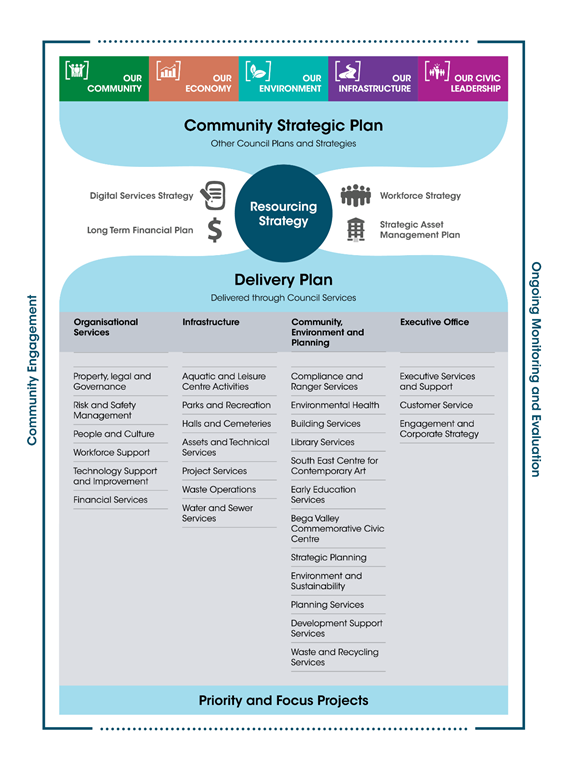
Delivery Plan 2026-2030
The Delivery Plan details the
services and projects Council will deliver over the next four-years. It is the
result of rigorous planning and prioritisation and aims to provide the best
value services to the community. The Delivery Plan details the capital program
over the next 4 years that sees over $339 million invested in our assets. It
also outlines the day-to-day core business %that our 29 service areas deliver,
along with 3 cross-organisational priority projects and 127 focus projects to
improve the services we provide.
The
Delivery Plan 2026-2030 is structured around Council’s three different
roles:
· Provide:
Services, facilities, infrastructure, programs, planning and engagement.
· Collaborate:
Partner with community, business and industry, other councils, and other tiers
of government.
· Advocate:
Amplify the voice of our community to get the best possible outcomes.
The
Draft Delivery Plan 2026-2030 and its two appendices is Attachment 1 in this
report.
Resourcing
Strategy
Long
Term Financial Plan
The Long Term Financial Plan
(LTFP) was last updated in June 2025. The draft 2026-35 LTFP includes
three scenarios for the general fund: scenarios A, B and C. These scenarios
illustrate different levels of service and project delivery, each aligned to
the income required to make them viable. To deliver the projects and services
included in scenarios A and B would require significantly more funding. The
draft Delivery Plan assumes the adoption of scenario C as Council’s
budget. The LTFP also identifies potential funding pathways for scenarios A and
B to illustrate the requirements for a more ambitious delivery program.
The LTFP is compiled using a range of estimates and
assumptions to project the future revenue and expenditure required by Council
to deliver the services and projects we have planned. These estimates and
assumptions are based on what we know now and will change as we understand more
about the external impacts on our plans. Council is monitoring the impacts of
global events, inflated fuel prices and potential supply chain implications.
Further revisions to the LTFP may be required prior to adoption or implemented
through the quarterly budget review process.
The LTFP helps to make informed decisions about what we can
afford and when we need to invest funds to keep services running smoothly,
avoid running out of cash and to ensure future generations are considered.
The
Draft Long Term Financial Plan 2026-2035 is Attachment 2 to this report.
Strategic
Asset Management Plan
Council manages and maintains more than $2 billion worth of
assets, which enable us to provide services to our community. These assets
include roads, drainage, pathways, water and sewer infrastructure, community
facilities, parks and recreational facilities, administration buildings,
cemeteries, works depots, plant and vehicle fleet and the Merimbula Airport.
The level of service delivered by these assets is largely determined by the way
they are maintained and operated within Council’s available resources.
The Strategic Asset Management Plan (SAMP) sets out the
broad framework for undertaking structured and coordinated management of
Council’s assets in accordance with Council’s Asset Management
Policy. It outlines key principles that underpin our approach to providing the
assets that are essential to our community. Supporting the SAMP are detailed
Asset Management Plans (AMPs) for each asset class, which are living documents
that are continually updated and refined. Summaries of the AMPs are included in
the SAMP.
The SAMP must be considered in conjunction with the Long
Term Financial Plan 2026-35, that outlines the available funding under three
different revenue options. Aligned with those three revenue options are three
different capital programs to describe what asset maintenance, renewal and
upgrades can be achieved within each option.
We have a vast number of assets spread across our shire that
depreciate every year, and we have insufficient funds to adequately maintain
and renew them. This reality underscores the importance of planning, continuous
improvement and clearly articulating the resourcing gaps we have in meeting our
asset management responsibilities.
The Draft Strategic Asset
Management Plan 2026-2030 is Attachment 3 to this report.
Revenue Policy
The draft Revenue Policy 2026-27
outlines the proposed rating structure, pensioner rebates, borrowings, debt
recovery, transfer of rates and supply charges for water, sewer and waste
services.
Council general rates are
proposed to increase by the IPART advised rate peg of 3.5%. Water and Sewer
access and usage charges are set to increase by 3.5% in alignment with the rate
peg. Waste charges will be increased by 4.7%. The 4.7% increase is an overall
revenue increase across all waste charges due to increased recycling costs. Our
draft 2026-27 budget (scenario C) has been developed assuming this level of
rate increase will be adopted.
Projected General Rates Income
The rate peg for 2026-27 is set at 3.5%.
|
Category
|
Base Rate $
|
Ad-valorem Amount ¢ in
dollar
|
Base rate %
|
Number of Assessments
|
Rate Yield $
|
Rate Yield %
|
|
Residential
|
878
|
0.00250469
|
46
|
18,862
|
36,358,601
|
84
|
|
Farmland
|
878
|
0.00250469
|
25
|
786
|
2,765,705
|
6
|
|
Business
|
878
|
0.00671913
|
18
|
891
|
4,402,389
|
10
|
|
Mining
|
0
|
0
|
0
|
0
|
0
|
0
|
|
|
TOTAL
|
20,539
|
$43,526,595
|
100
|
Council will conduct a review of
the rating structure during the 2027 financial year. This review will focus on
ensuring our rating structure is fair and equitable for all ratepayers.
The
Draft Revenue Policy 2026-27 is Attachment 4 to this report.
Fees and Charges
In accordance with Section 608
of the Local Government Act 1993 and other relevant
legislation, Council is authorised to charge and recover approved fees and
charges for any service it provides. All Council’s fees and charges are
reviewed on an annual basis prior to finalisation of Council’s budget and
several Council facility management committees have provided their input into
the draft fees and charges.
Fees and charges in general (not
including statutory fees, fees set by management committees or those aligned
with CPI) have been increased by 3.5%, aligned with rate peg. There are several
proposed changes to the draft fees and charges for this year as outlined below.
· A new tiered approach to community halls and
sportsgrounds fees is proposed. Council plans to implementing a new halls and
sportsground booking platform in July 2026 to streamline facility booking. The
platform will support the proposed revised approach.
· Developer fees for car parking are proposed to increase
in accordance with Council’s revised Voluntary Planning Agreements Policy
which was adopted on 14 August 2024. These changes were accidently omitted from
the 2025-2026 fees and charges.
The Draft Fees and
Charges 2026-27 are Attachment 5 to this report.
Options
Council has a range of options
when considering the recommendations included in this report. Delaying the
exhibition of the IPR documents will have future impacts.
The Officer’s
recommendations in this report will ensure Council meets its legislative
responsibilities to have the suite of IPR documents adopted by 30 June 2026.
Community
and Stakeholder Engagement
Engagement undertaken
Extensive internal engagement
has been undertaken in the development of these IPR documents. Councillors have
been engaged in the development of these documents, and the Audit Risk and Improvement
Committee will review them at its next meeting.
Engagement planned
Council will engage with the
community from 7 May 2026 to close of business on 5 June 2026 by:
· Making
the IPR suite of documents available for the community to read on
Council’s website, in our public libraries and at the customer service
counter in Zingel Place, Bega
· Informing the community about the public exhibition
through the media, social media and Council’s newsletters; inviting the
community to provide feedback through a Have Your Say page on Council’s
website.
· Notifying and inviting community associations, groups and
business chambers to have their say.
· Undertaking a series of community events and a webinar
where Councillors and senior Council staff will be in attendance to discuss the
draft IPR documents as per the schedule below.
|
LOCATION
|
DATE
|
TIME
|
|
Bega
|
13 May 2026
|
5pm-6pm
|
|
Merimbula
|
14 May 2026
|
4pm-5pm
|
|
Eden
|
18 May 2026
|
5pm-6pm
|
|
Webinar
(online)
|
19 May 2026
|
5pm-6pm
|
|
Bermagui
|
25 May 2026
|
5pm-6pm
|
Submissions will be acknowledged
and considered by Council officers and included in the 22 June 2026 report to
Council prior adoption of the suite of IPR documents.
Financial
and Resource Considerations
The Delivery Plan and Resourcing
Strategy documents summarise how Council will allocate the revenue it receives
from rates, charges, fees, developer contributions, loans and grants.
Council manages assets valued
over $2 billion and delivers a vast range of services that our community relies
upon. Almost 80% of the shire local government area (LGA) is National Parks,
State Forest or public reserve that provides no rateable income. Council has
been crippled by rising costs to maintain assets, well above rate peg. If
Council doesn’t spend the adequate amount on assets now, we risk further
deterioration, costing us all much more in the long run, particularly on our
road and bridge networks. This has significant financial implications for
Council and the community, both now and for future generations.
Council employs close to 450
staff and the continued financial pressures we face impacts our service
delivery and organisational culture. Our staff live and work here and are
driven to deliver for the community and doing so in a financially constrained environment
is difficult. Council struggles to compete with the private sector to obtain
and retain the skills and talent we need to deliver our services with salary
structures tied to the Local Government Award.
The focus in developing the
ten-year Long Term Financial Plan, four-year Delivery Plan and annual budgets
is to ensure long term financial sustainability while ensuring the continued
delivery of a broad range of services and capital works informed by Council’s
underlying strategies.
Legal
/Policy
Section
404 of the Local Government Act 1993 requires Council to have
a Delivery Program to implement the strategies established in its Community
Strategic Plan, within the resources available as identified under the
Resourcing Strategy. The Delivery Program draws on and implements actions contained
in adopted Council policy documents.
Section
405 of the Local Government Act 1993 requires Council to adopt
an Operational Plan before the beginning of each financial year which details
the activities to be engaged in by the Council during the year as part of the
Delivery Program. The Delivery Plan 2026-2030 will fulfill the Act requirements
by providing a detailed 4 year plan, commensurate with a typical Operational
Plan, for activities the Council will undertake within each year.
The
Office of Local Government’s Integrated Planning and Reporting Guidelines
and Handbook are comprehensive tools which have been used in the revision of
this suite of IPR documents.
Under
the Local Government Act 1993, Council is required to develop and
publicly exhibit documents in the Integrated Planning and Reporting Framework
for a period of 28 days and consider submissions made prior to adoption.
Section
223 of the Local Government Act 1993 requires Council to develop a
rating and revenue policy. The revenue policy must include the statements and
particulars required by legislation.
Impacts
on Strategic/Operational/Asset Management Plan/Risk
Strategic
Alignment
Council
has a responsibility to ensure that adequate services are provided to the
community, and that financial planning is transparent to provide confidence in
Council’s ability to deliver on the community’s priorities.
The IPR documents once exhibited
and adopted, will guide the Council’s operations. The suite of documents
is integral to Council delivering on its numerous plans and strategies. In
particular, the documents support the following adopted strategies.
CSP 2042 Theme: Our civic
leadership – Local leadership is strong, consultative and responsive to
our community’s needs
CSP 2042 Strategy: E.1 Lead,
govern and regulate in an ethical, equitable, transparent and accountable way
Delivery Program 2025-2029
Corporate Planning and Improvement – Core Business – Implement and
monitor the Integrated Planning and Reporting (IPR) Framework
Environment
and Climate Change
Council’s LTFP models the
ongoing financial need to maintain our current levels of service.
Council’s financial sustainability is impacted by numerous factors
including the increasing frequency and severity of weather events on
Council’s infrastructure. Our assets team continue to consider the
implications of maintaining and renewing our existing assets within a changing
climate.
Several of the Delivery Plan
2026-2030 focus projects listed support the implementation of Council’s
adopted Climate Resilience Strategy, amongst other environmental focussed work.
Economic
As one of the Bega Valley
Shire’s largest employers and consumers of a range of services, Council
has a significant role to play in the local economy. It is acknowledged that
adjustments in Council’s annual operating budgets and long-term financial
planning have flow on effects to the local economy and this is considered as
part of the LTFP and annual budget development process.
The budget for next financial
year continues to see investment in resources that support our local economy as
an employer and service provider and as a procurer of local works and services.
Risk
The forward focussed IPR and
annual budget development process helps to provide transparency and
accountability into the financial management and forward planning of Council.
This aims to reduce financial, reputational and organisational risks. IPR aligns
strategic goals, financial planning, and operational activities to help reduce
risk in the services we provide.
Improves decision-making with better information
IPR requires councils to take a
holistic view of their operations—linking long-term goals (like the
Community Strategic Plans) with shorter term plans including the four year
Delivery Plan and Resourcing Strategy documents. This alignment helps identify
potential risks early, such as:
· Financial sustainability risks
· Asset management issues
· Community dissatisfaction
By having clearer visibility of
long-term goals and current capabilities, Council can make informed decisions
that mitigate future problems.
Reduces financial risk
Through financial planning
components like the Long Term Financial Pans and the Strategic Asset Management
Plan council can:
· Forecast funding shortfalls
· Prepare for economic and population shifts
· Avoid overcommitting resources
This forward planning minimises
surprises and ensures Council can be financially resilient.
Supports proactive asset management
Many of Councils risks are tied to physical
assets—roads, buildings, parks, etc. Integrated planning approaches
includes consideration of key asset data and the need we have to maintain or
renew assets. We can better understand:
· Asset condition
assessments
· Maintenance
schedules
· Renewal and
upgrade plans
This reduces the risk of asset failure, unexpected repair
costs, or public safety issues.
Engages the community and key stakeholders
IPR includes community engagement, which:
· Surfaces hidden or
emerging risks early (e.g. social, environmental)
· Builds trust and
transparency
· Helps manage
reputational risk
Engaged communities are more likely to support decisions and
understand trade-offs.
Promotes accountability and continuous improvement
Integrated planning and reporting means risks are regularly
reviewed through:
· Quarterly progress
and financial reports
· Annual reports
· Audits, service
reviews and performance monitoring
This ensures plans stay relevant and risks are reassessed as
circumstances change.
Social
/ Cultural
Council has insight into what
the community wants through our IPR and community engagement initiatives; and
knows that our community places a high priority on maintaining our current
levels of service. Council manages over $2 billion worth of assets. We are a
large shire (by area) and maintaining and renewing these assets is expensive.
We also have a relatively small number of ratepayers compared to the size of
our shire and vast areas of state and national parks and forests from which we
are unable to generate income.
The documents being placed on
public exhibition will have future social and cultural implications. The
challenge Council faces is balancing affordability with the community’s
desire to maintain our current levels of service. Impacts of the proposed
budget once adopted will be monitored throughout the year and any adjustments
needed is done through the quarterly budget review process.
Regional Circularity Cooperative membership
The draft budget includes a vast number of expenditure
items. One item that is unique and recommended for inclusion in the budget is
an annual $2,000 membership for the Regional Circularity Cooperative. Council
was a founding member of the Cooperative in 2022 but withdrew from membership
in 2023 following the Cooperative’s success in securing funding for the
National Circularity Centre. With the Centre now having obtained development
consent, the risk of conflicts of interest has reduced. Staff recommend renewing
Council’s membership to support its role as a key participant in the Bega
Circular Valley program.
Attachments
1⇩. Draft
Delivery Plan 2026-2030
2⇩. Draft
Long Term Financial Plan 2026-2036
3⇩. Draft
Strategic Asset Management Plan incl AMP summaries 2025-2030
4⇩. Draft
Revenue Policy 2026-27
5⇩. Draft
Fees and Charges 2026-2027
|
Council
|
6 May 2026
|
|
Item
11.1 - Attachment 1
|
Draft Delivery Plan 2026-2030
|
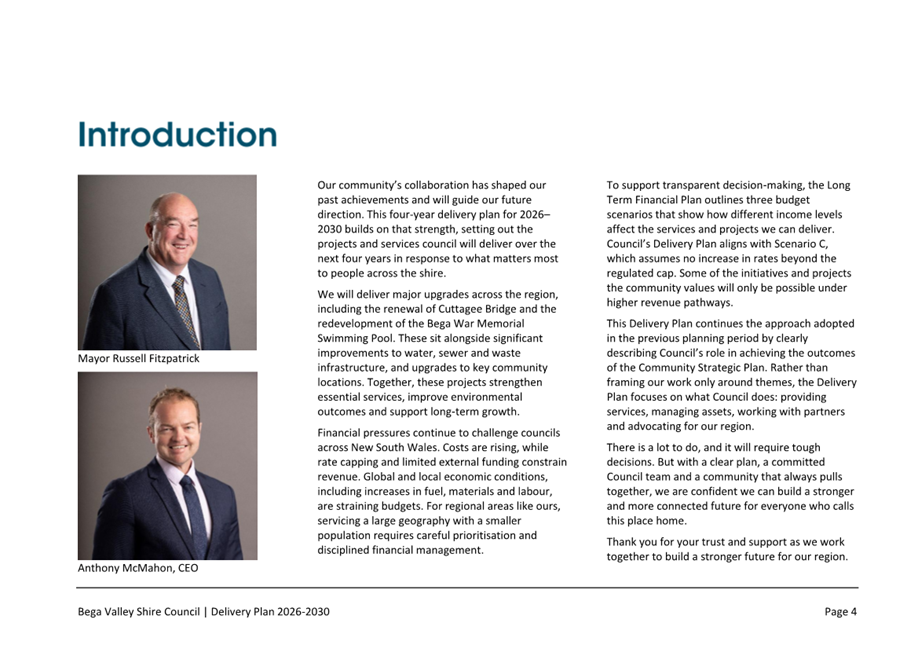
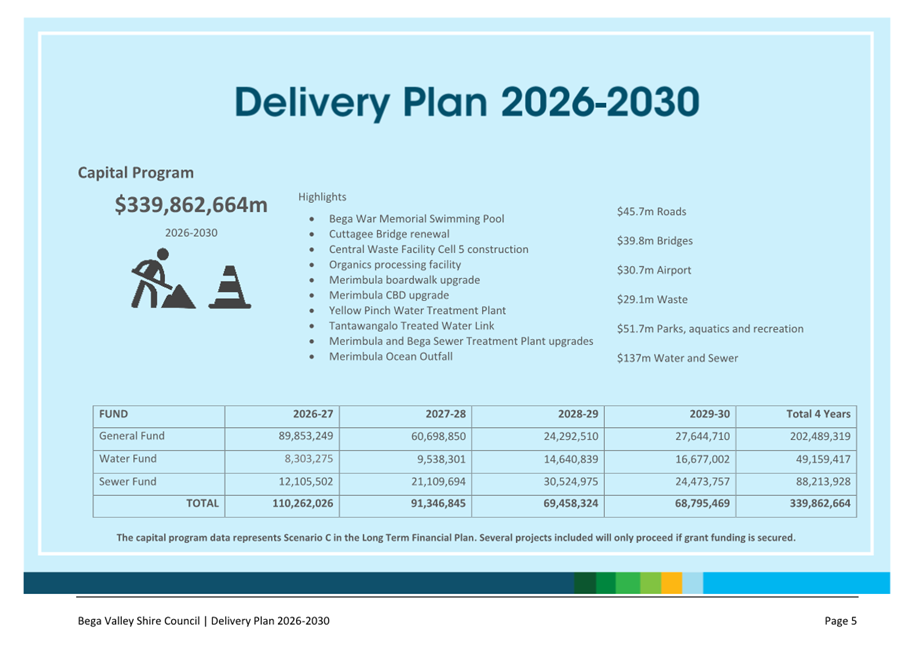
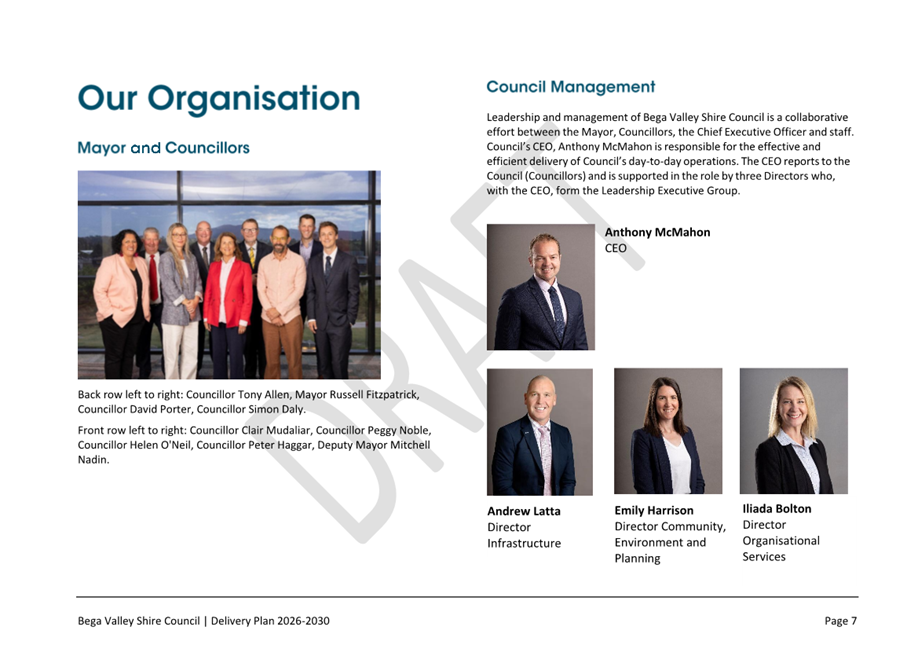
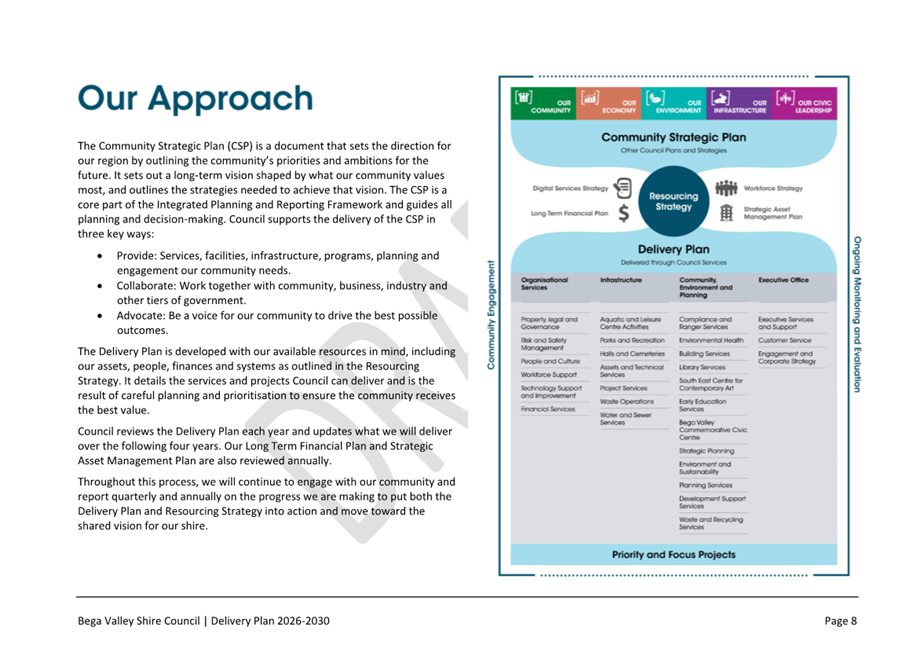
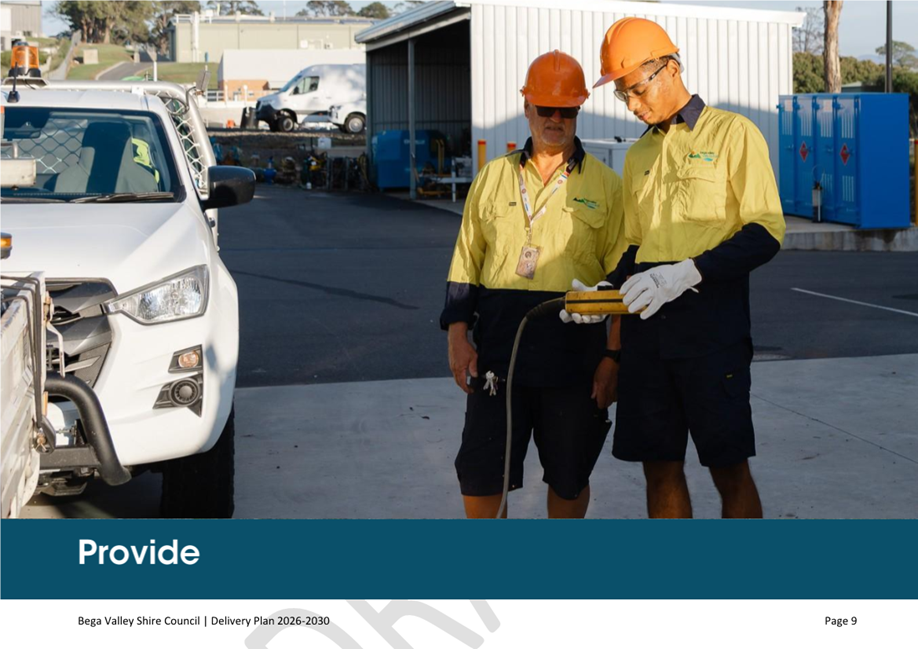
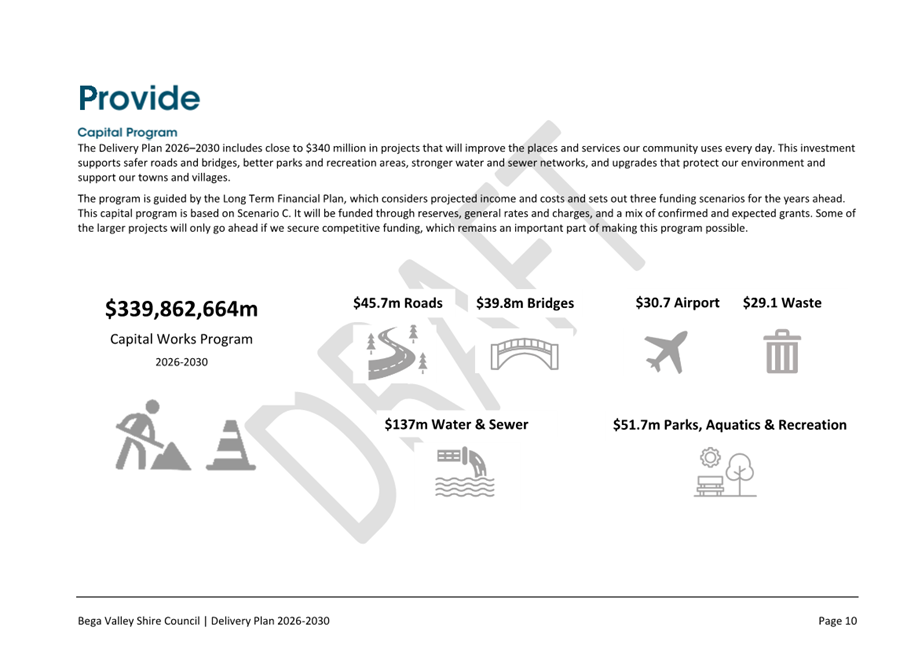
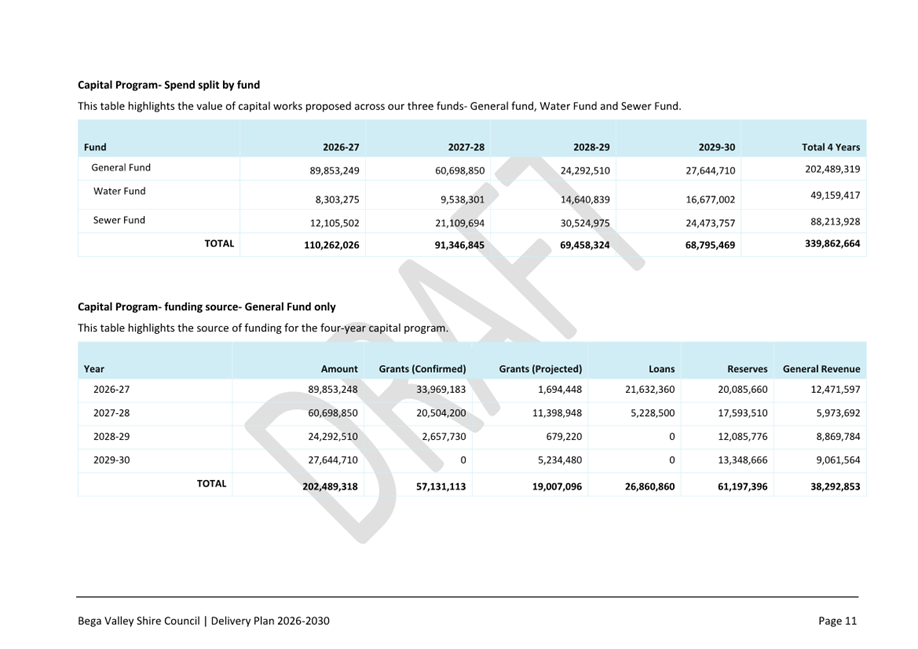
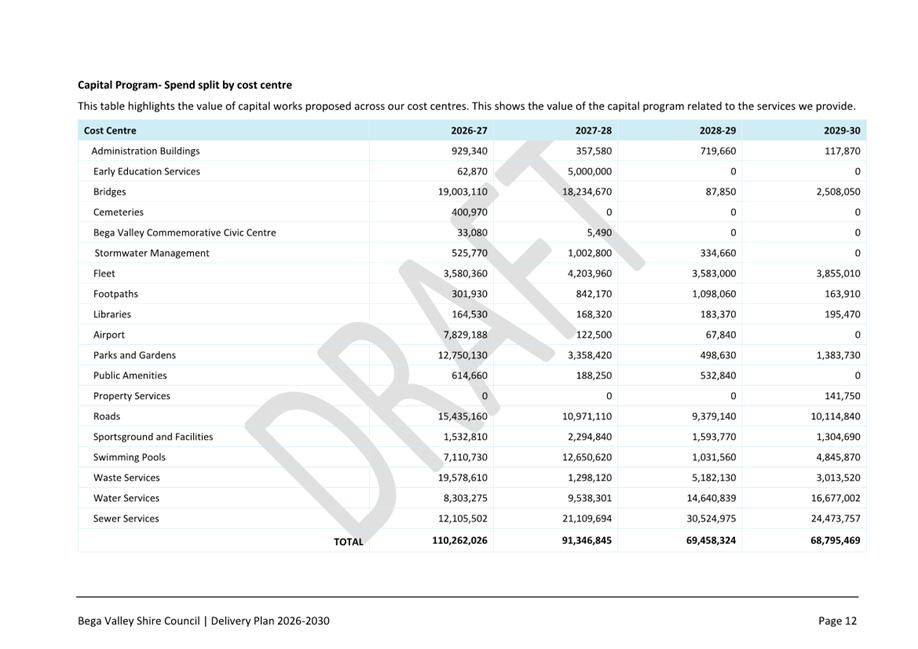
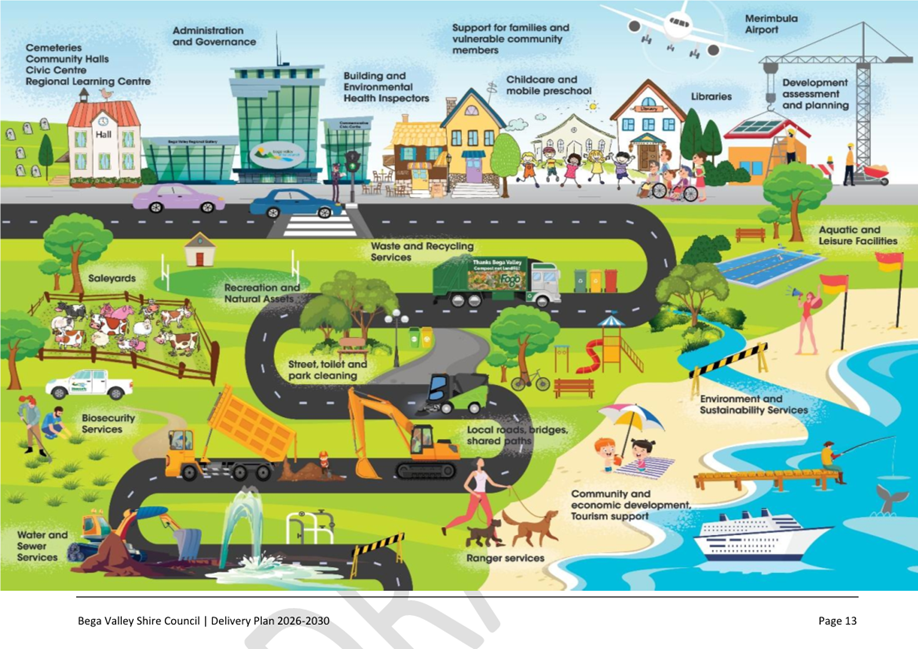
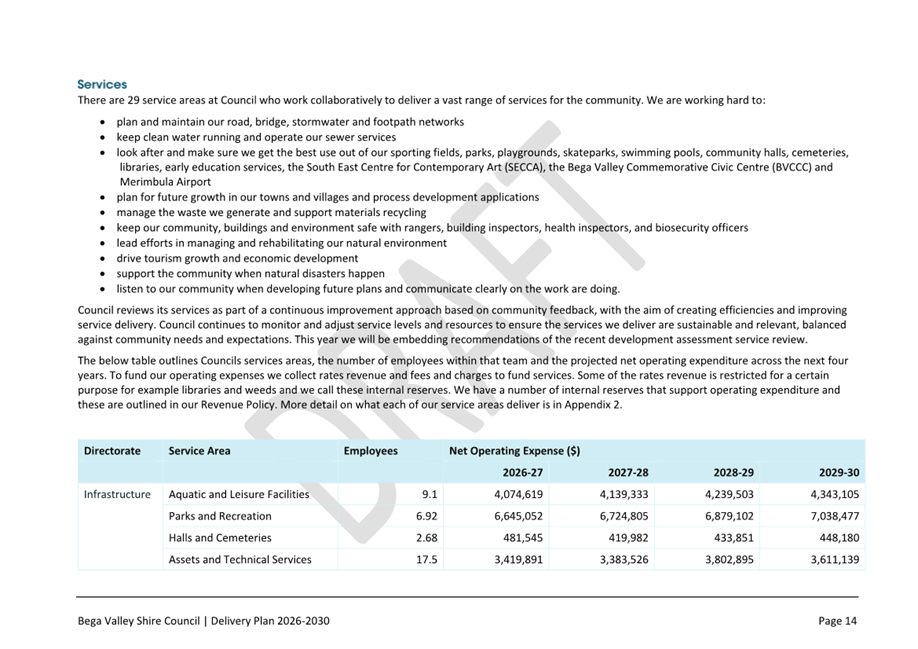
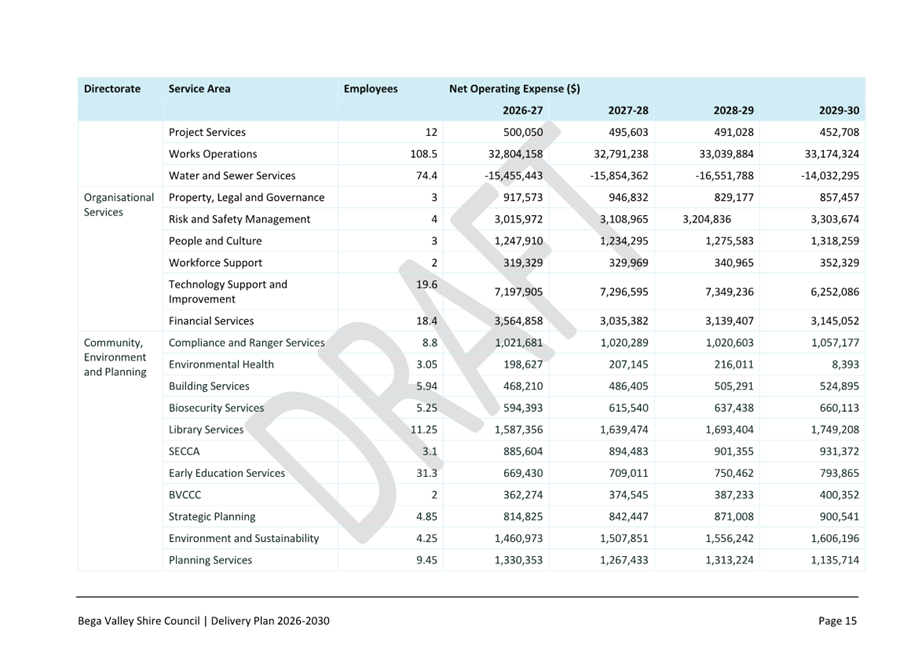
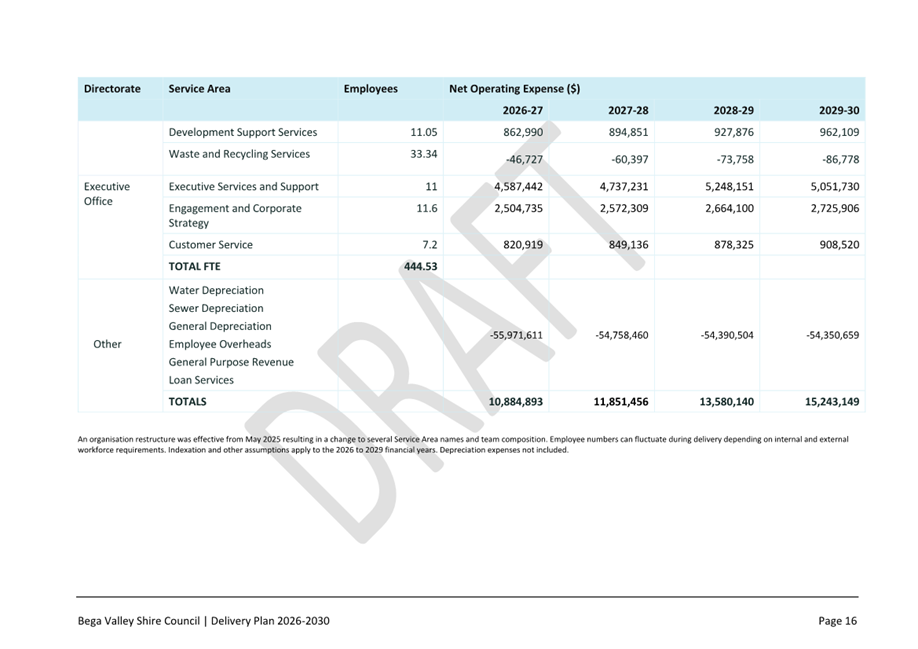
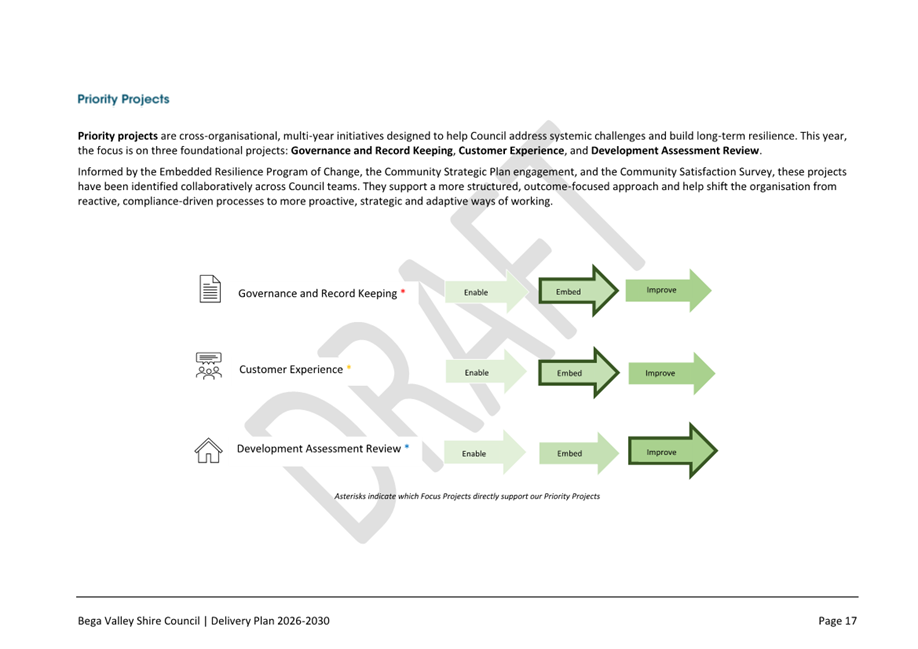
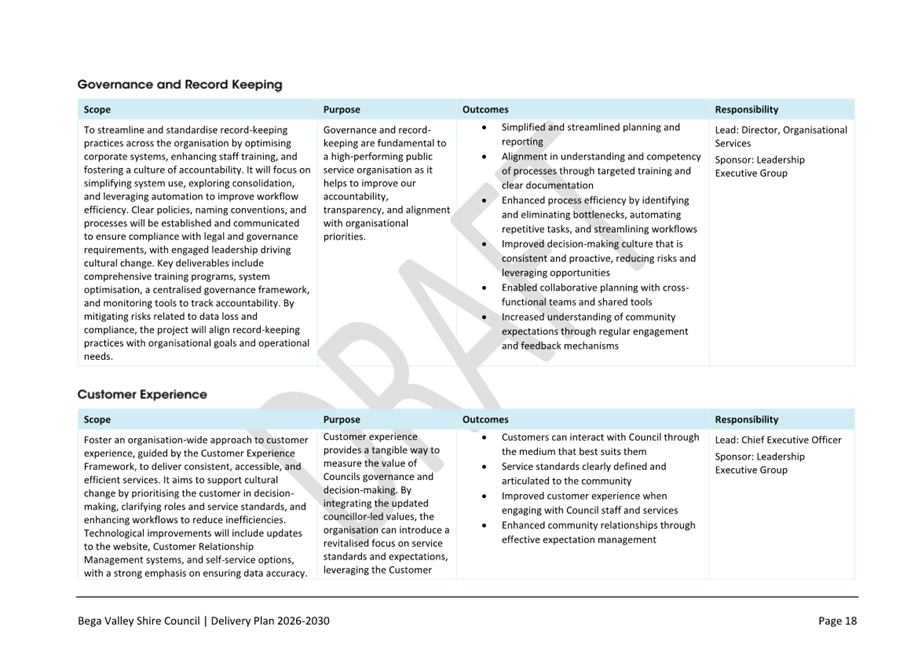
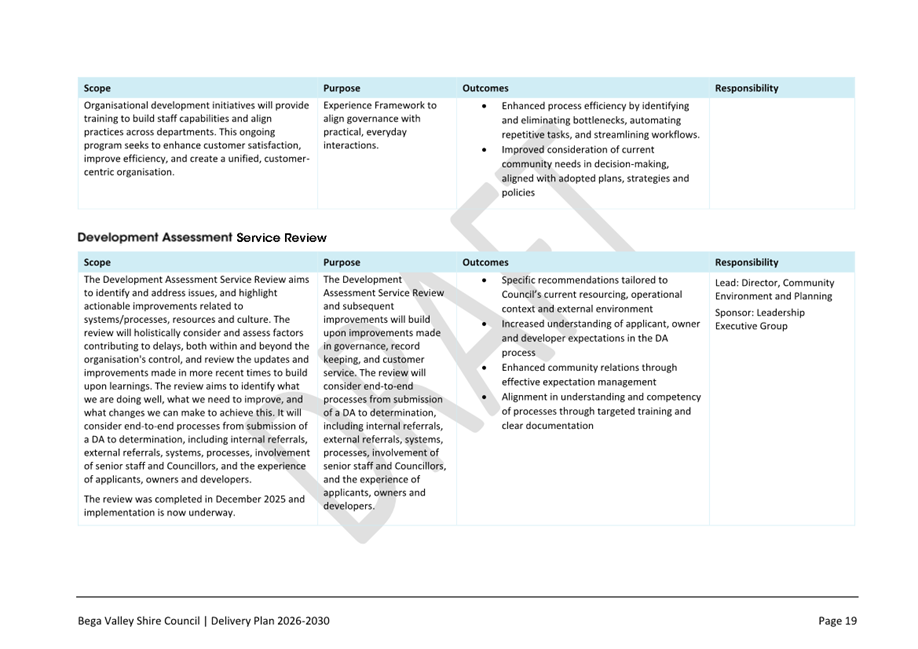
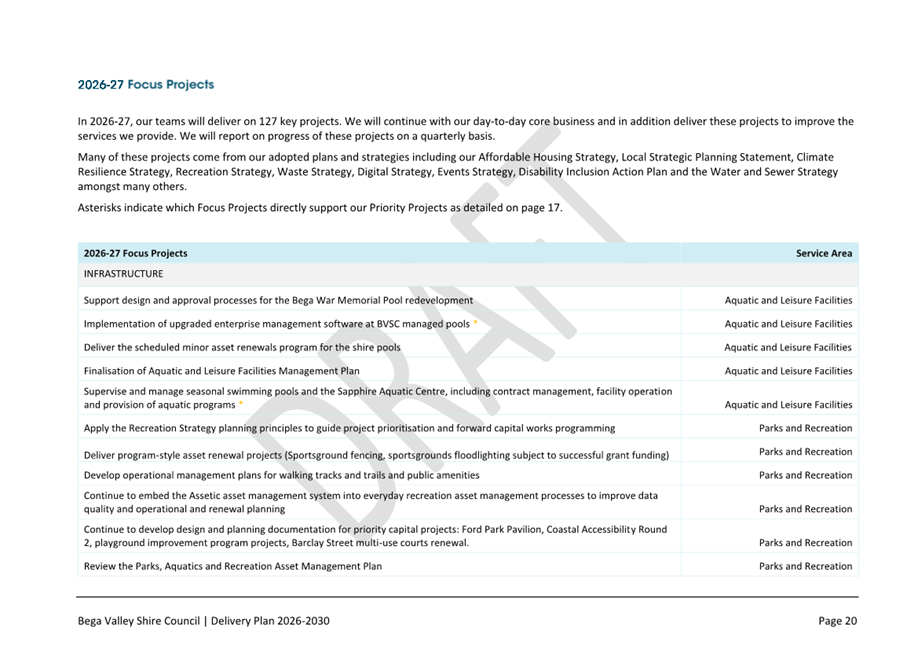
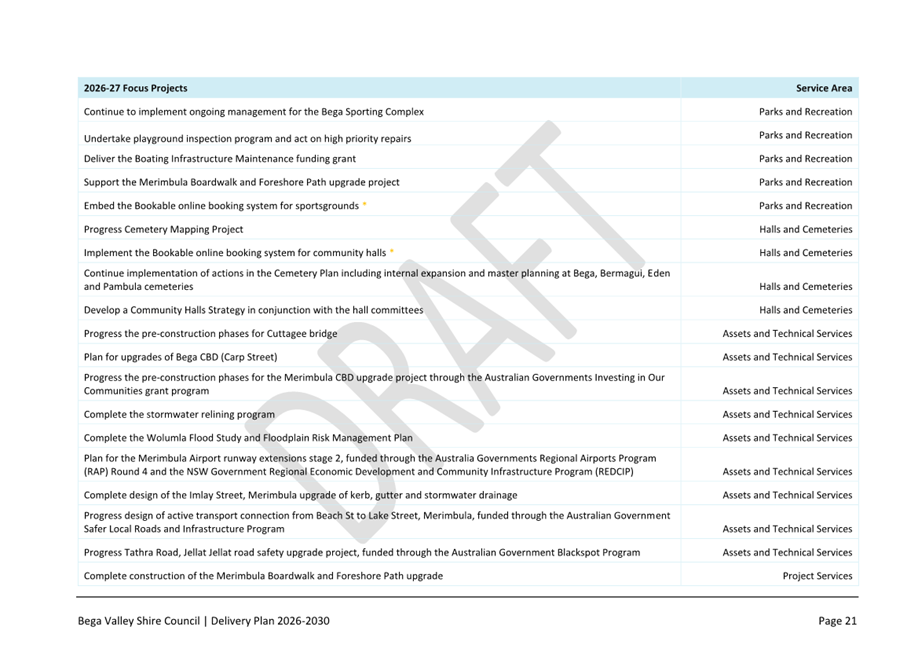
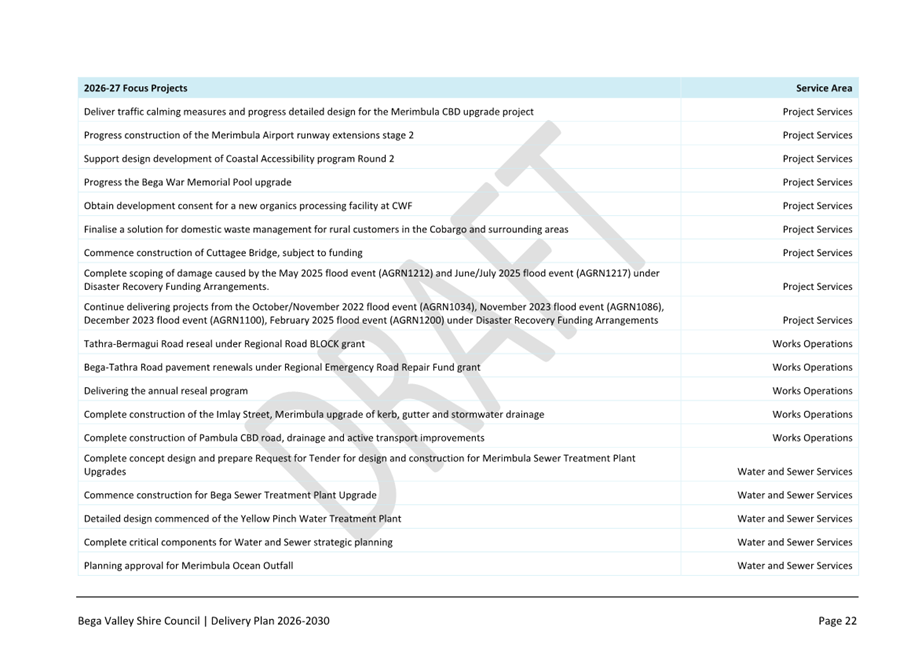
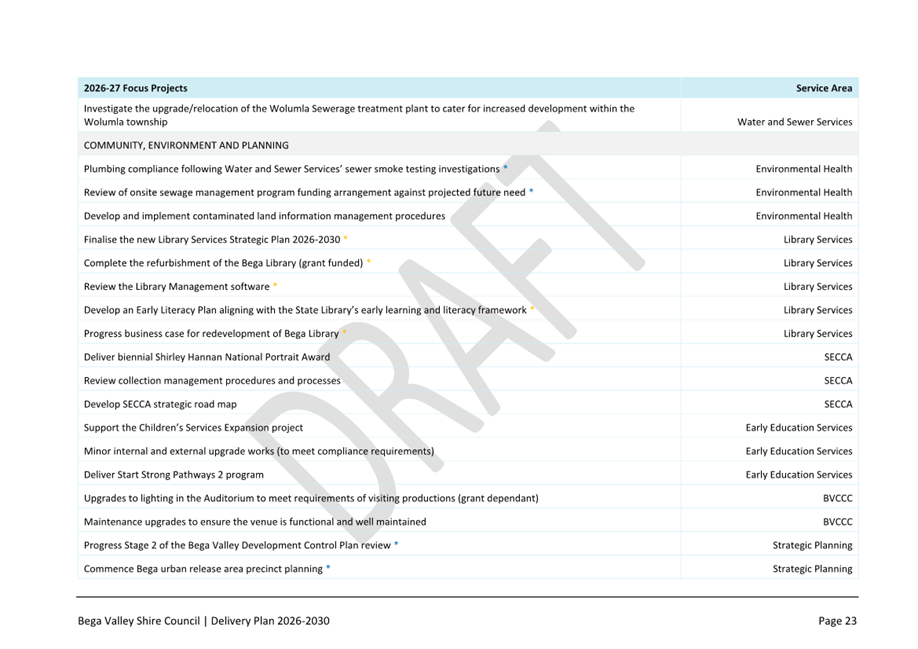
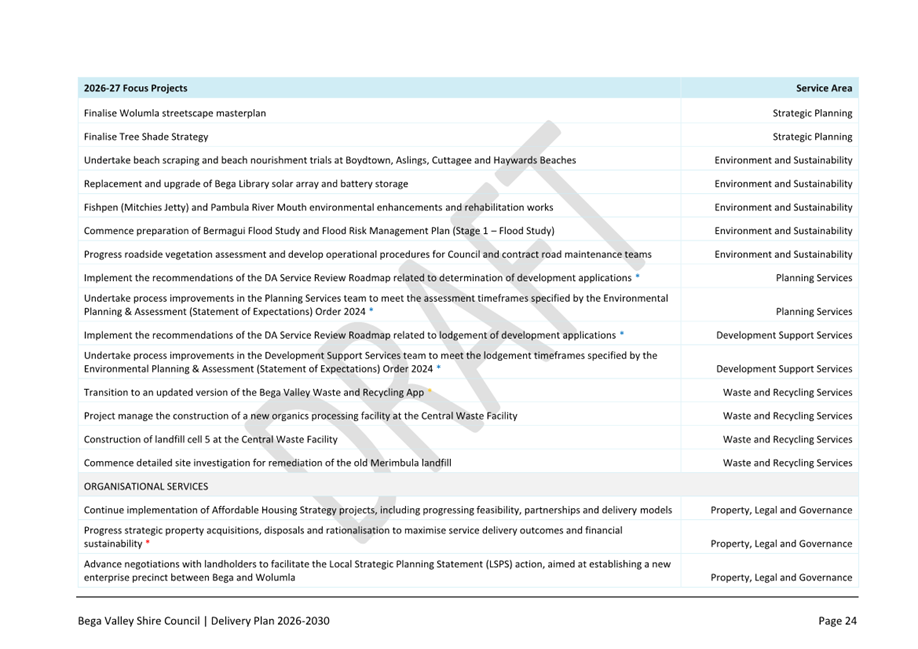
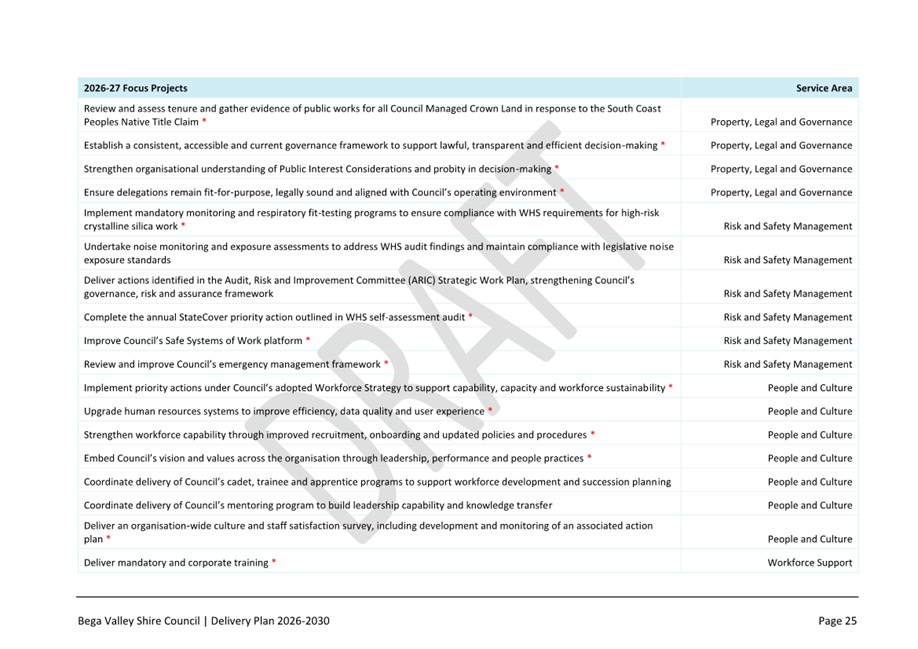
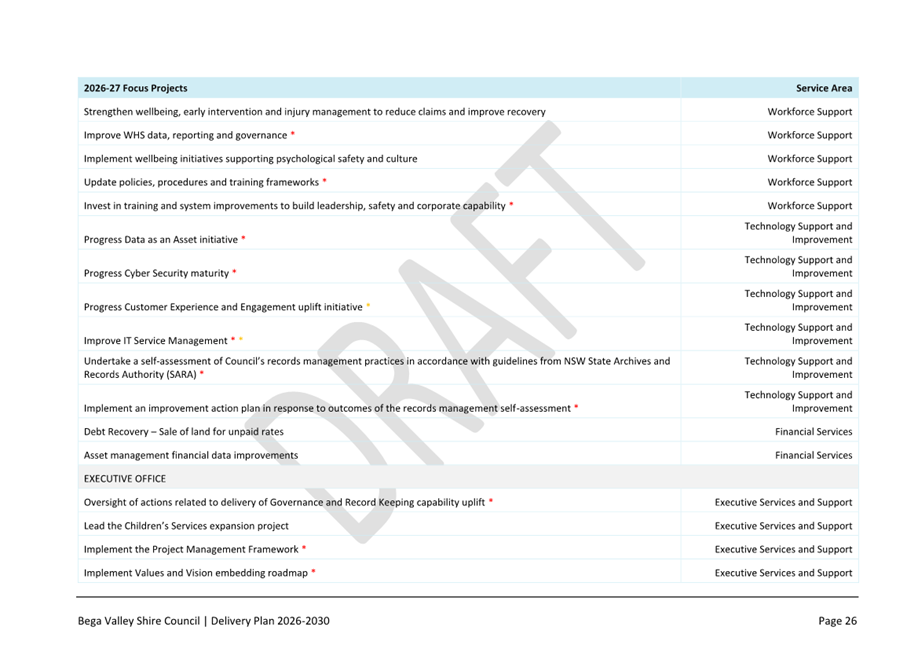
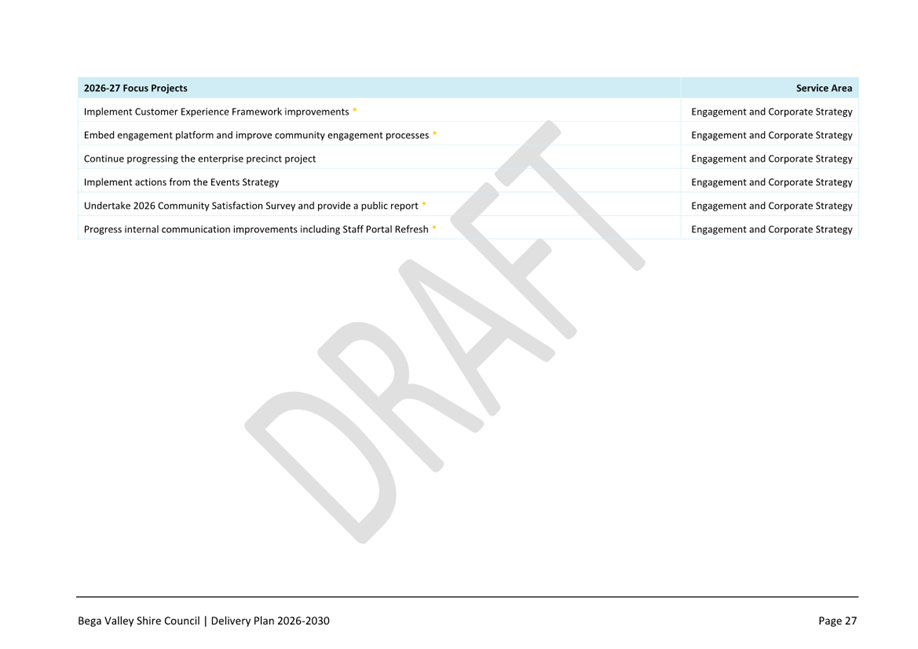
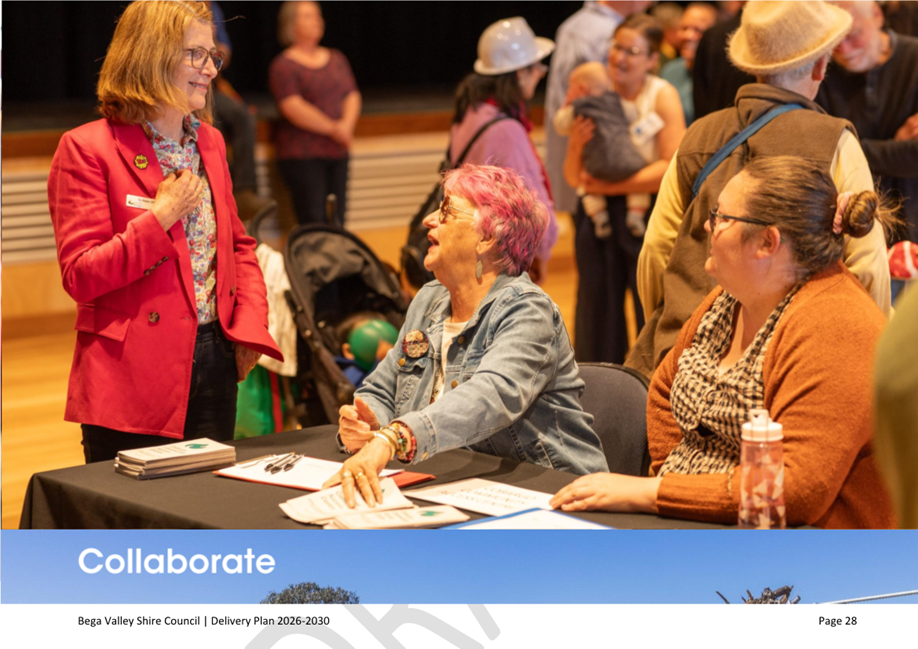
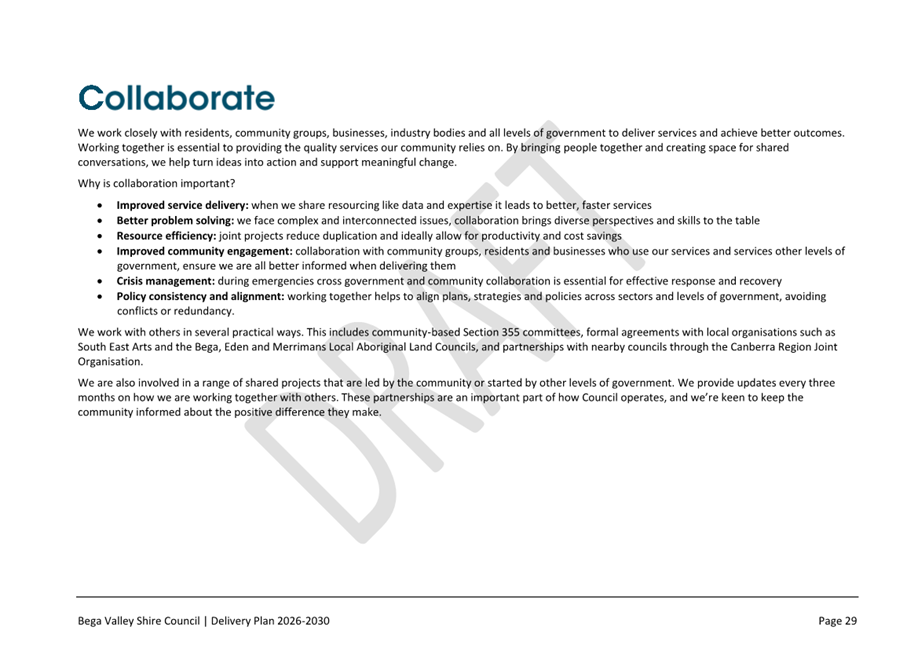
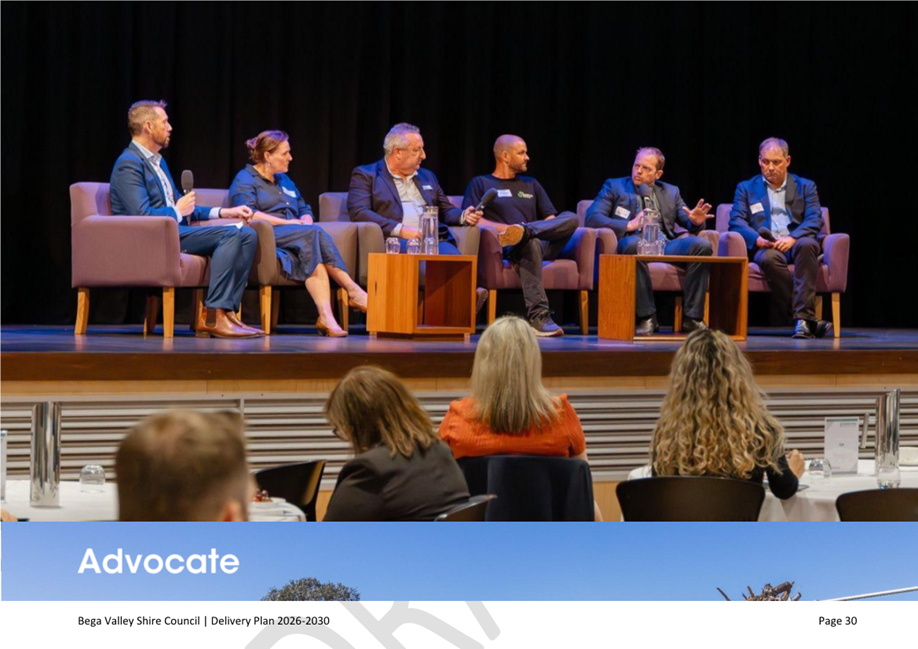
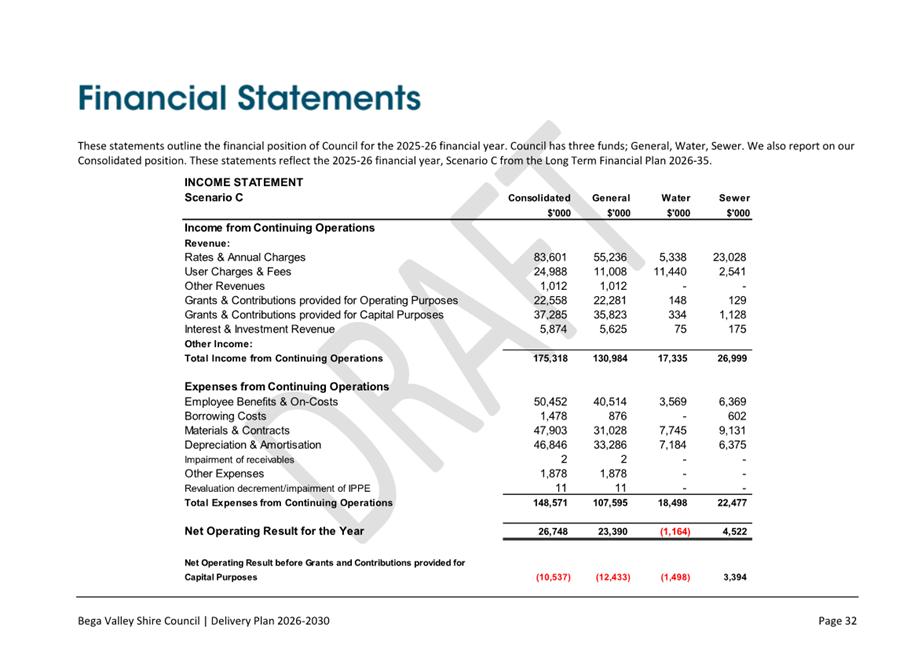
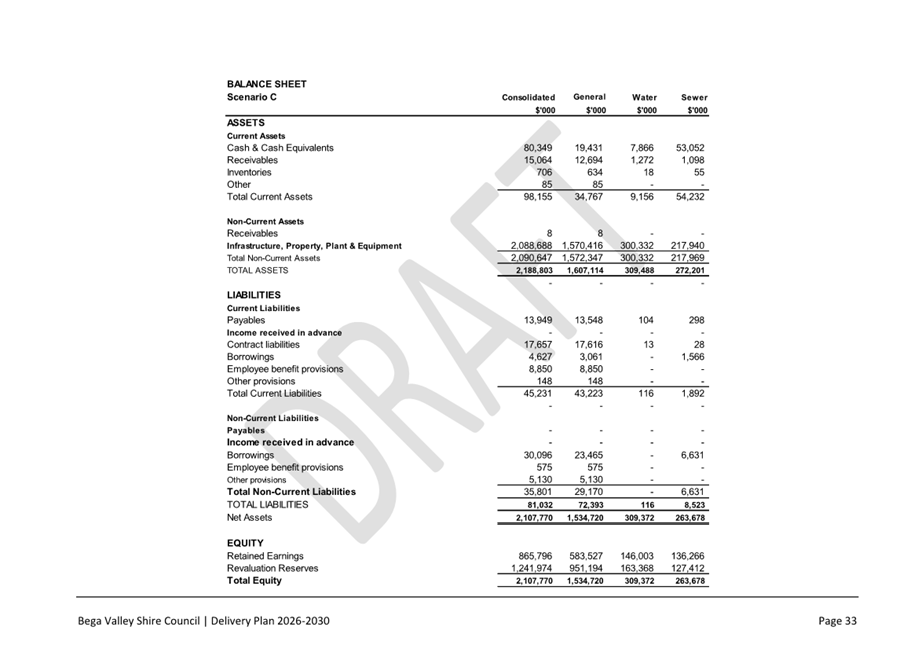
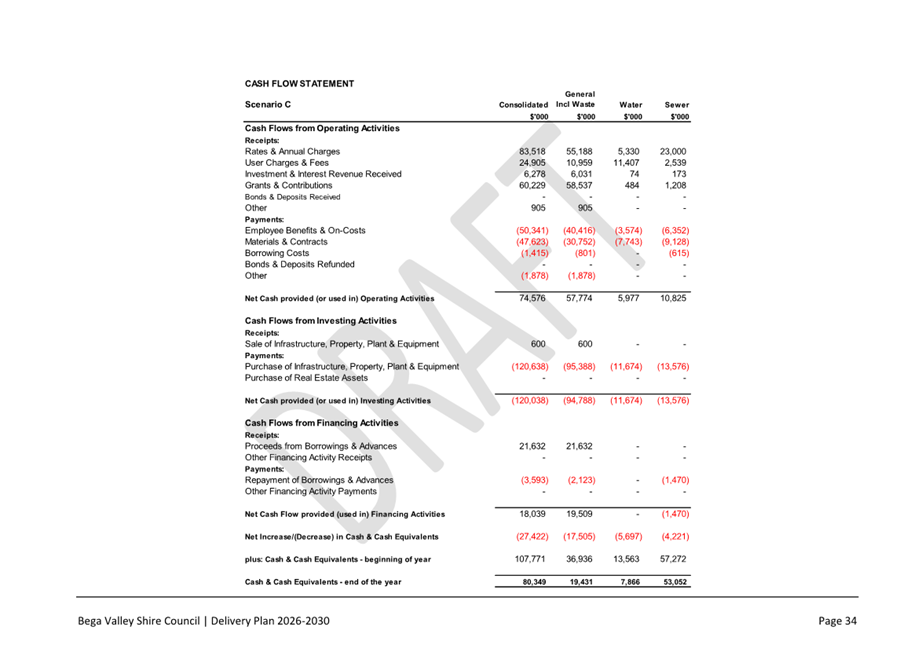
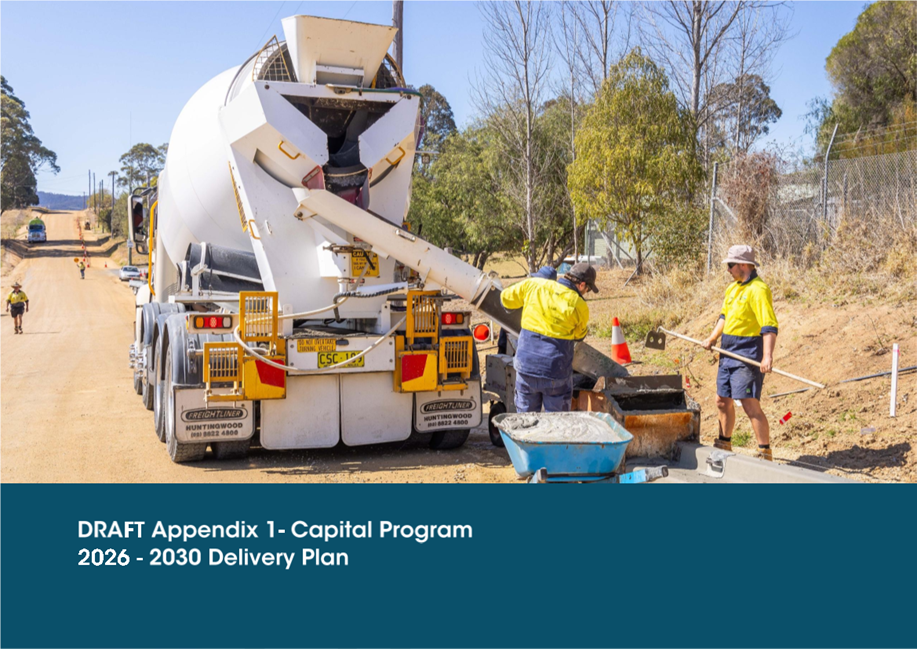
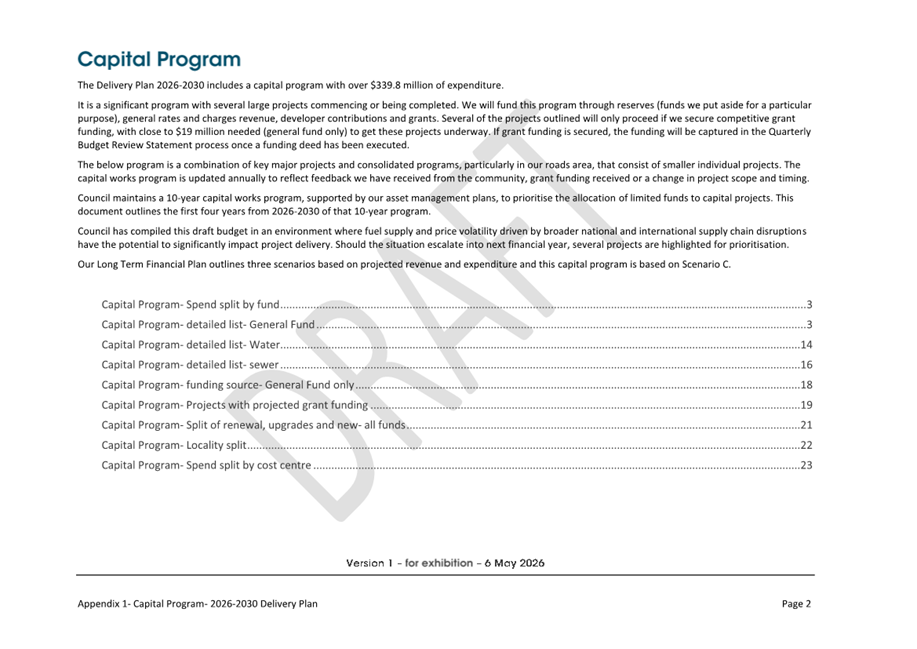
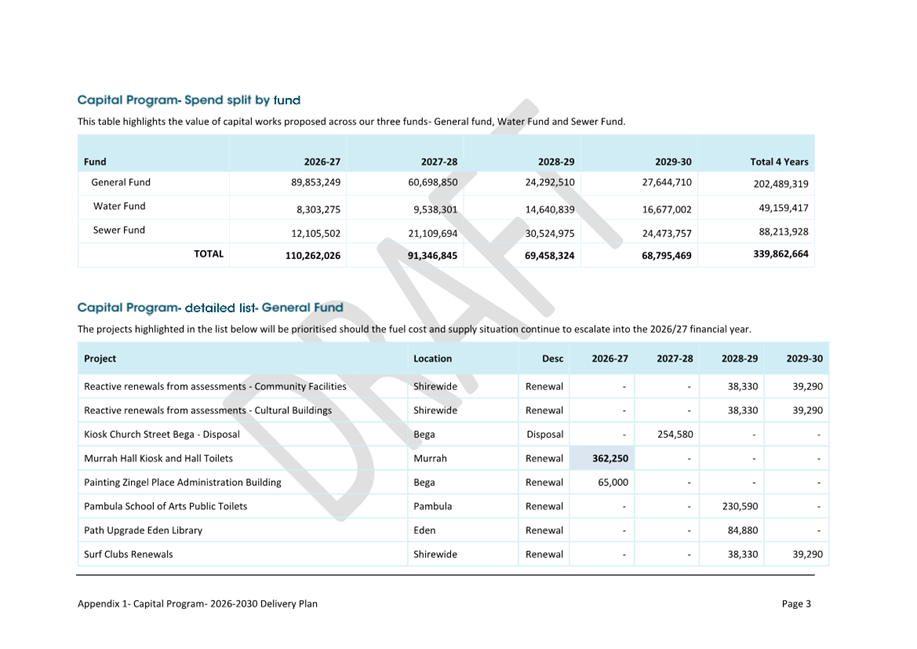
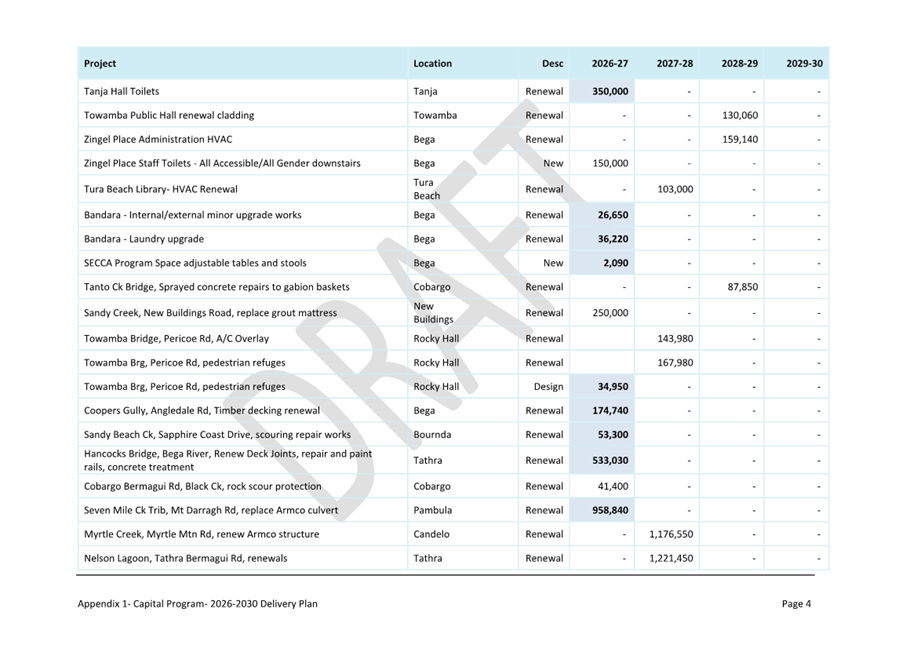
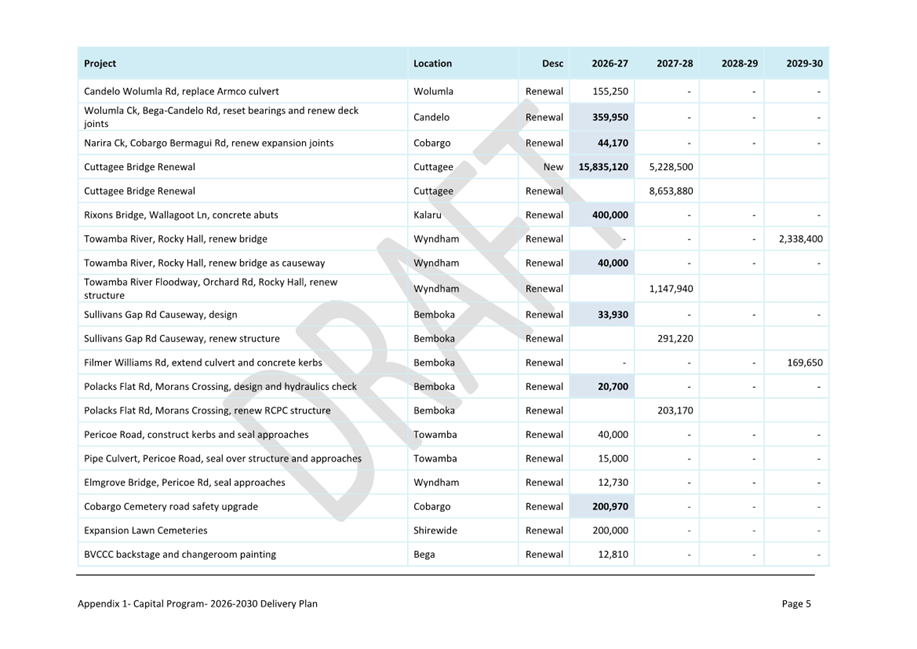
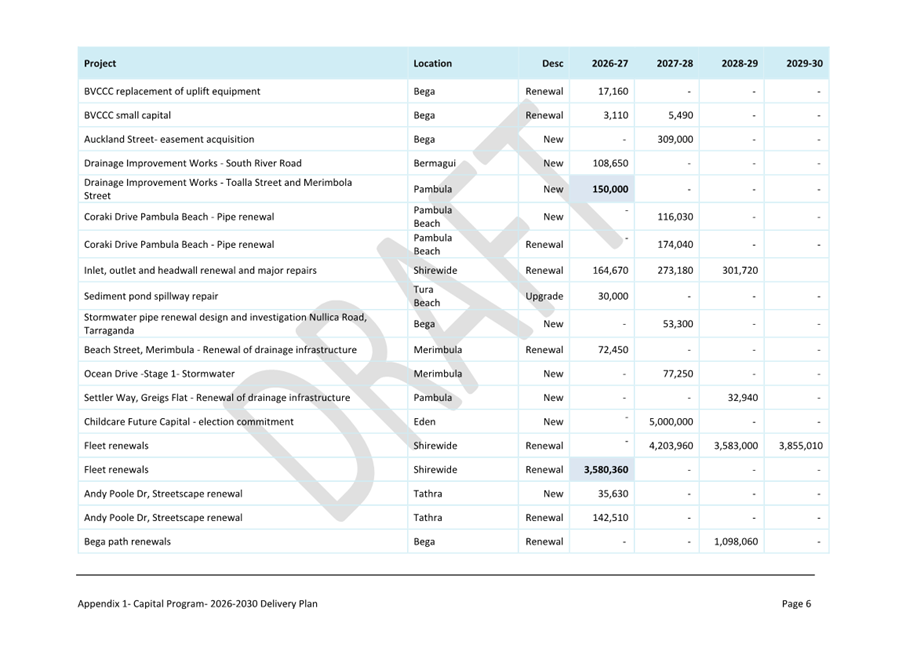
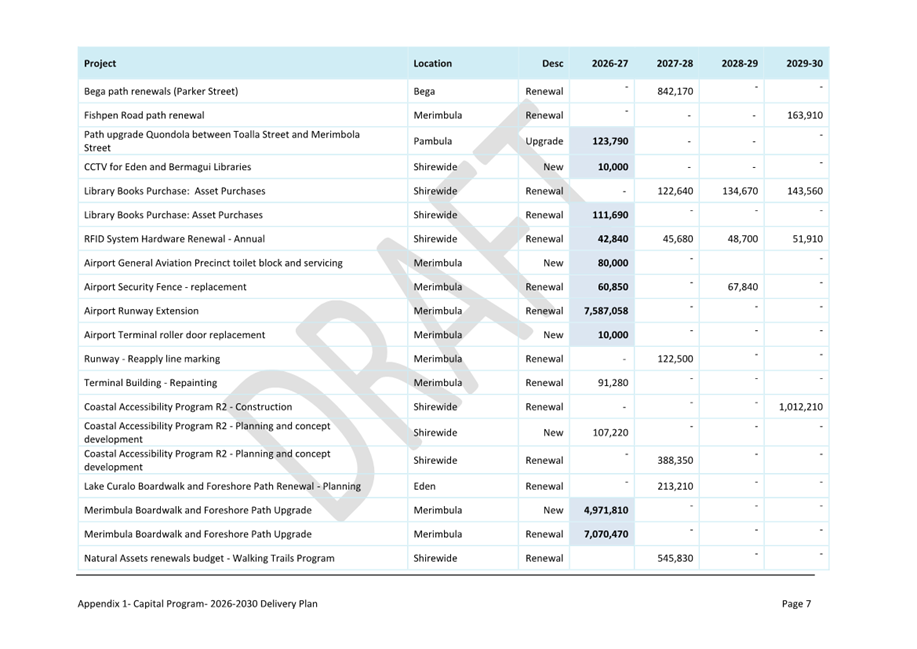
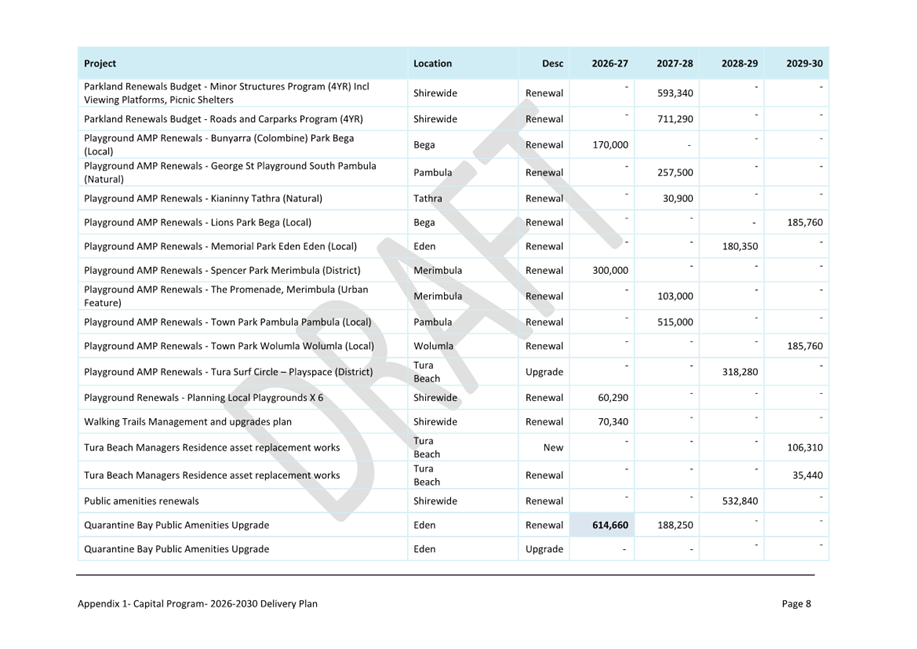
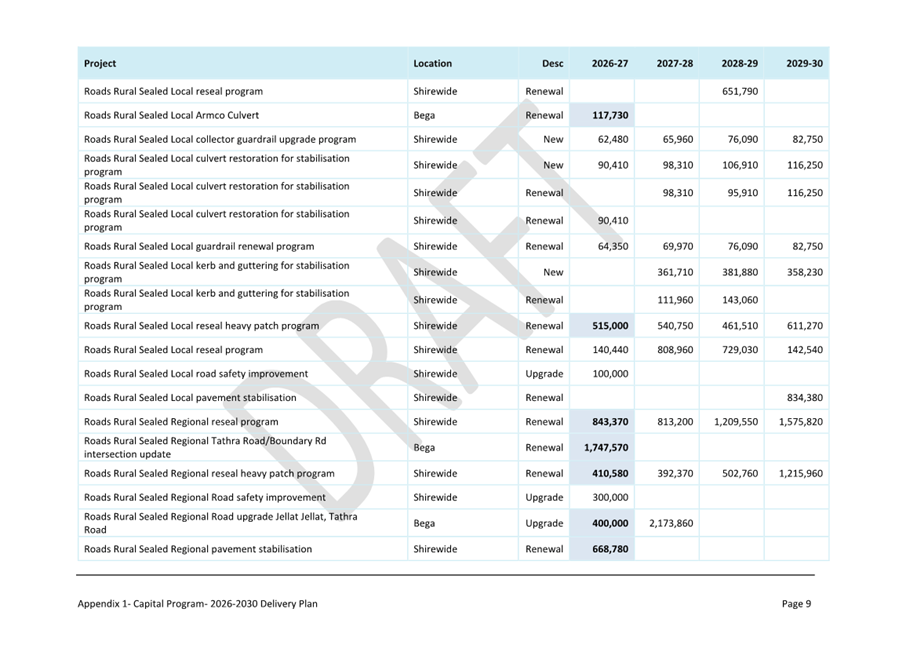
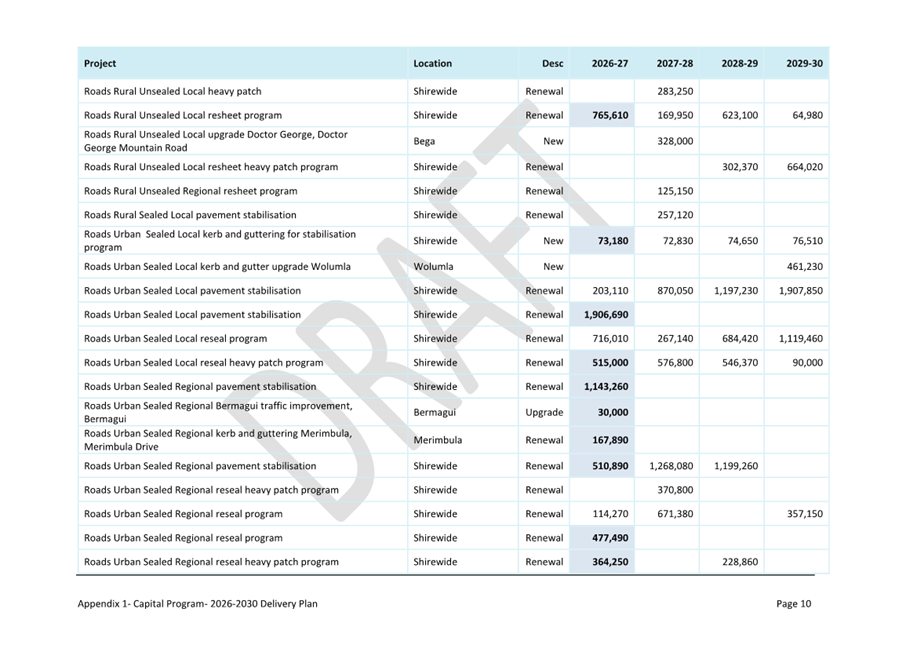
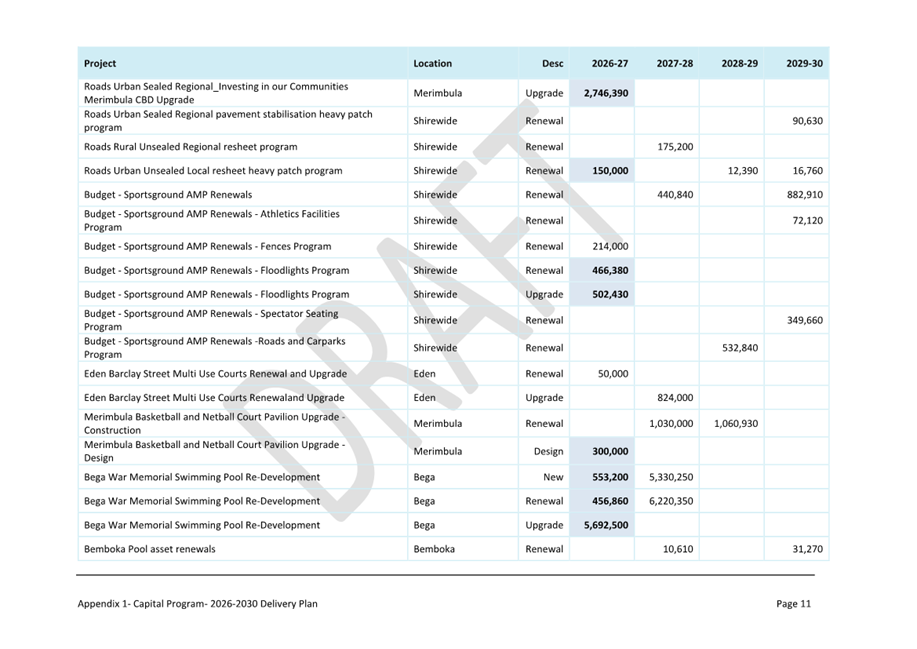
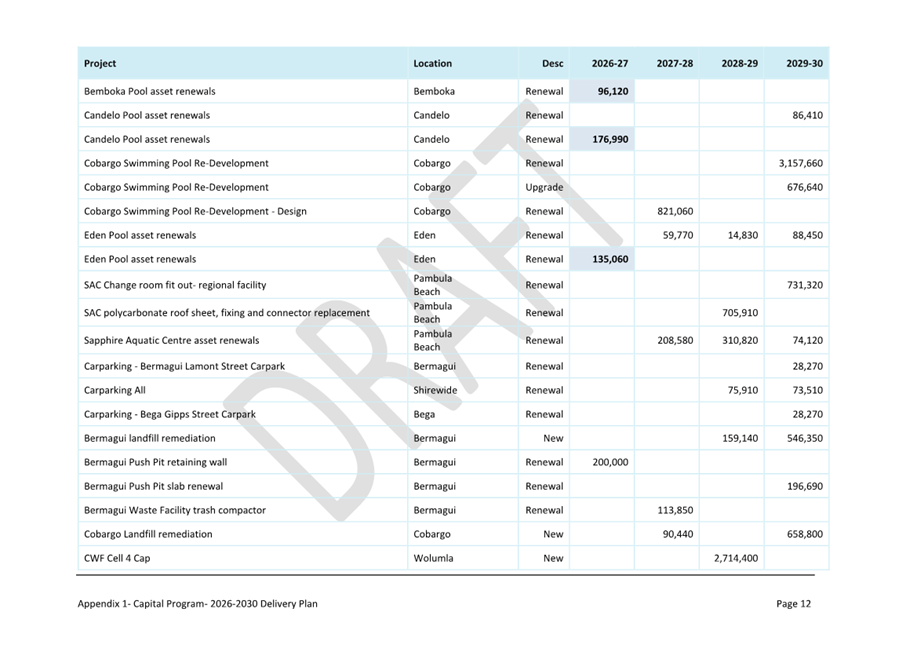
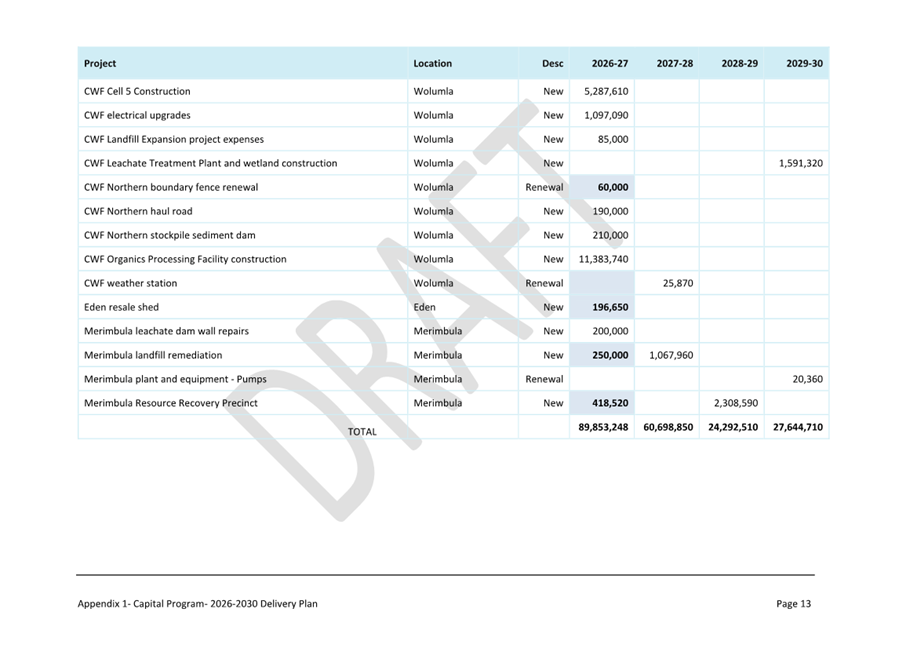
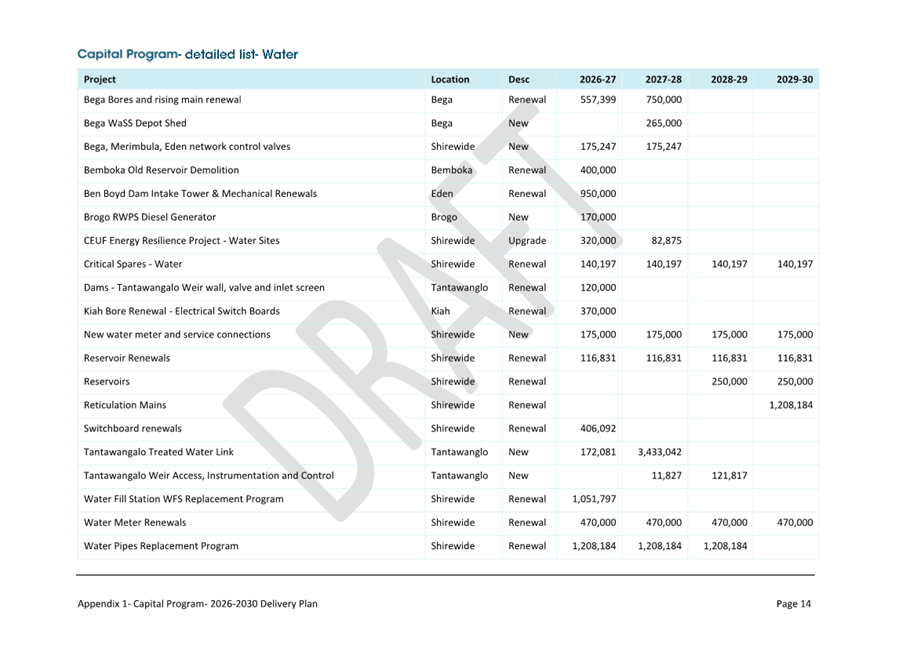
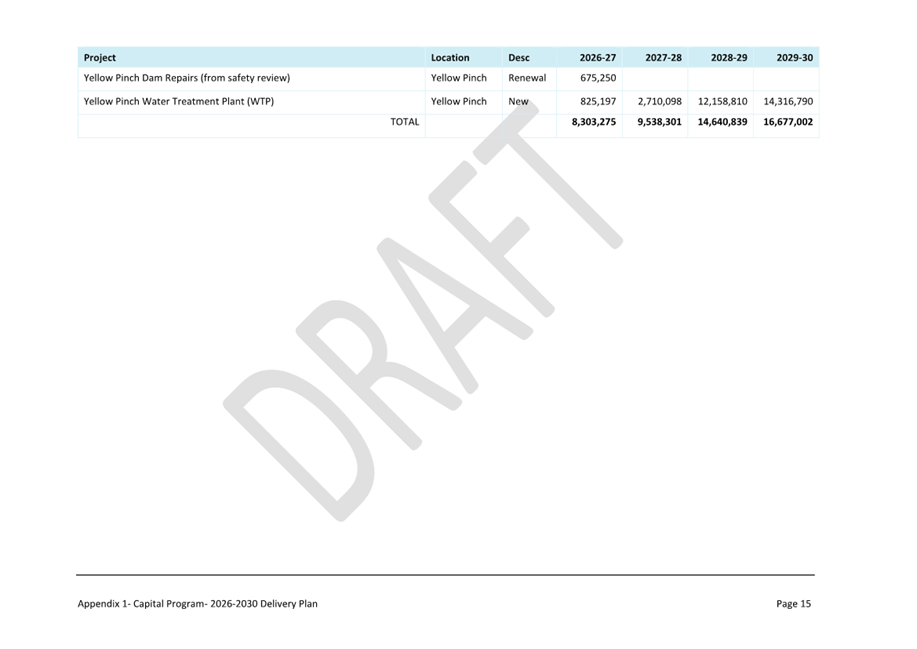
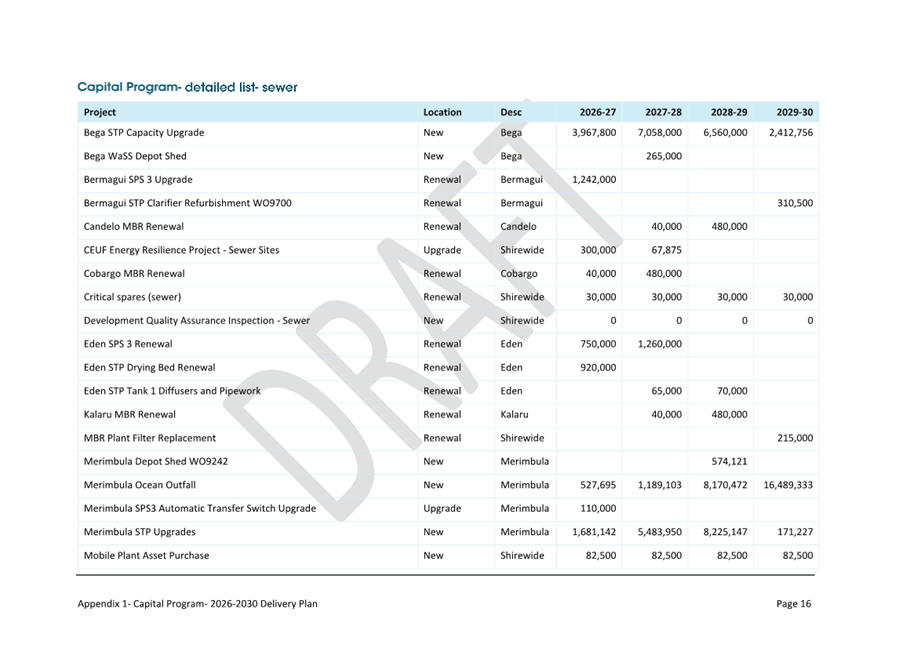
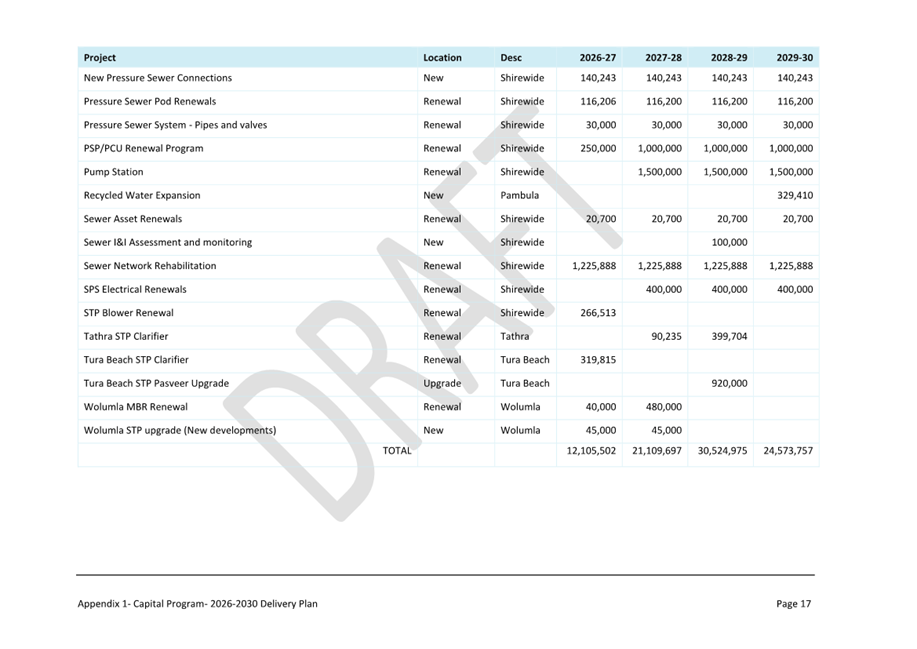
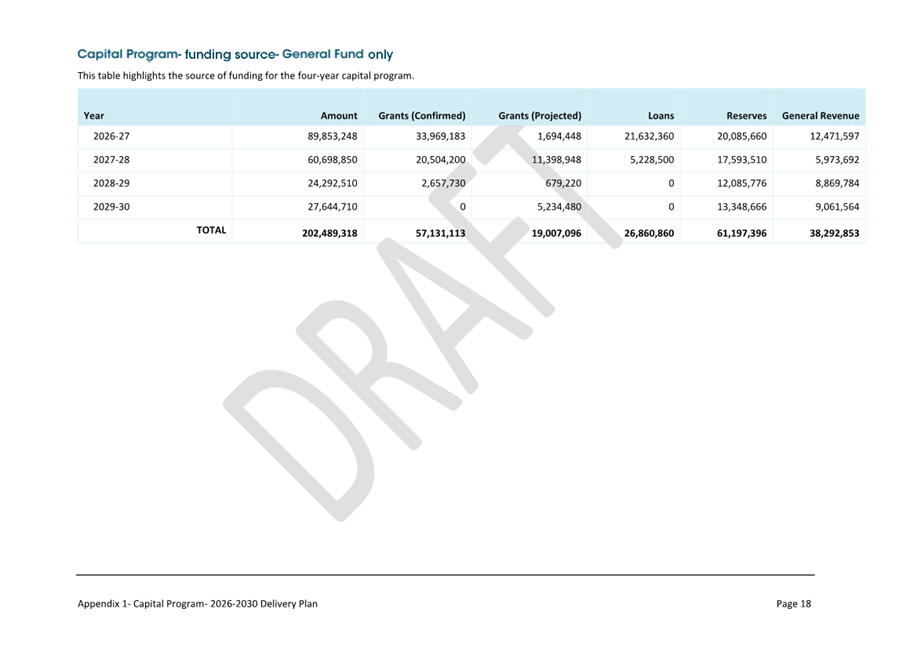
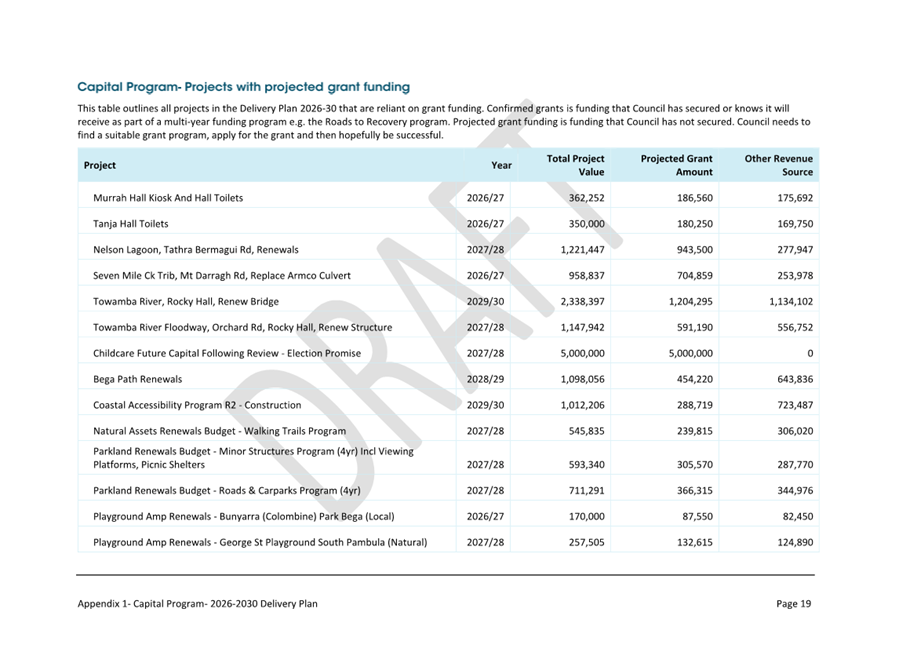
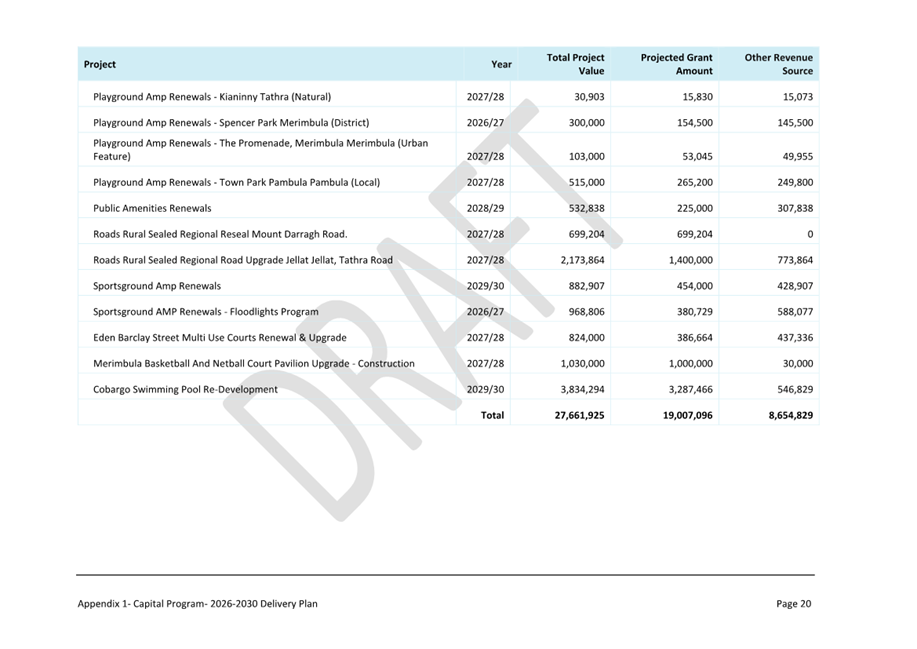
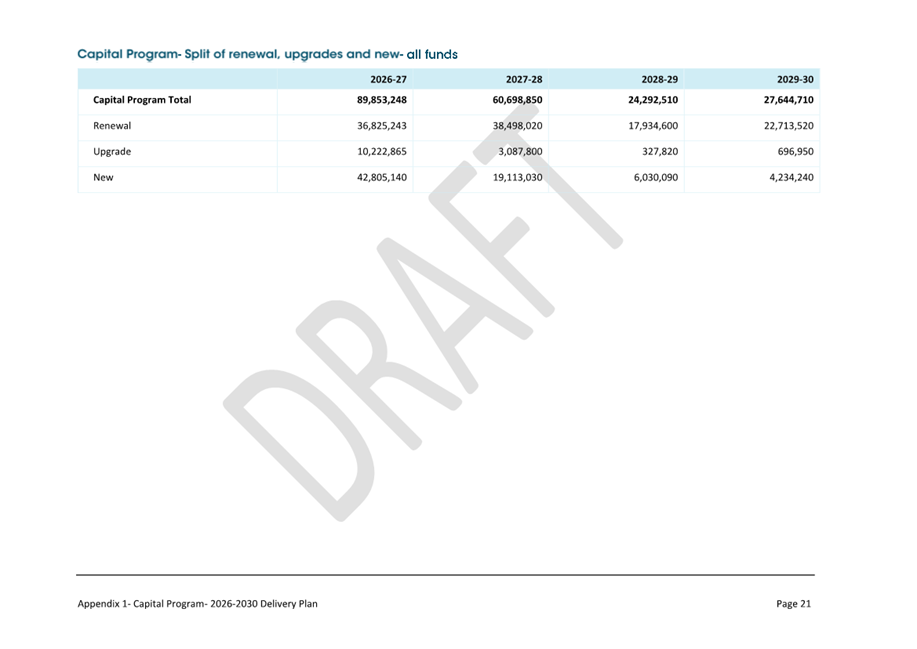
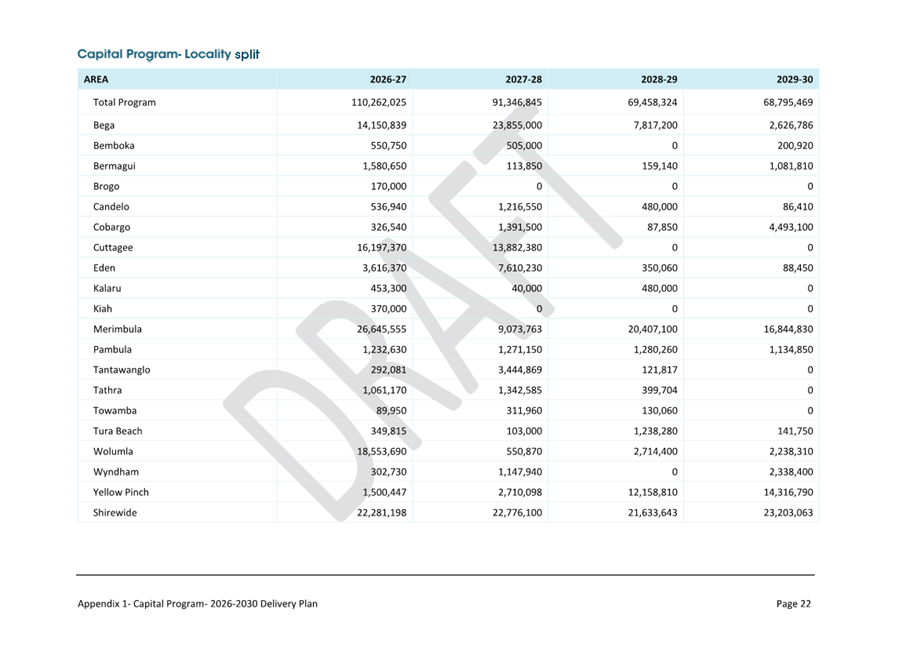
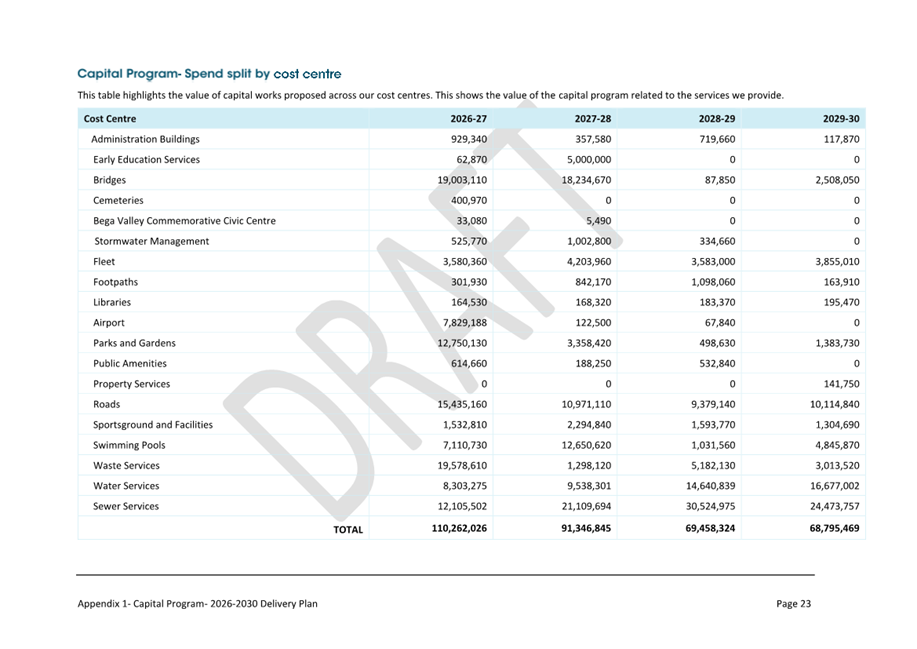
|
Council
|
6 May 2026
|
|
Item
11.1 - Attachment 2
|
Draft Long Term Financial Plan 2026-2036
|
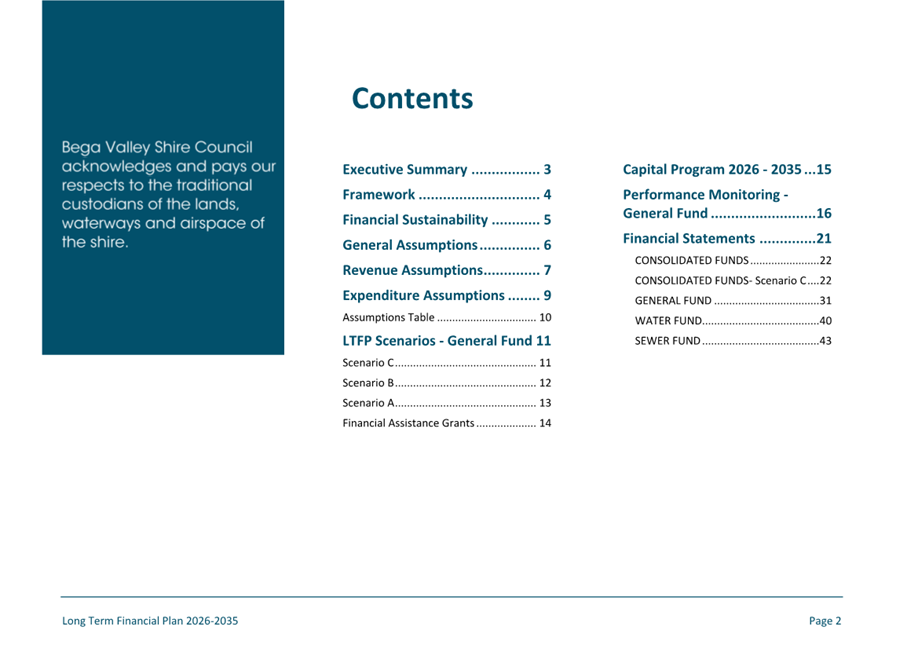
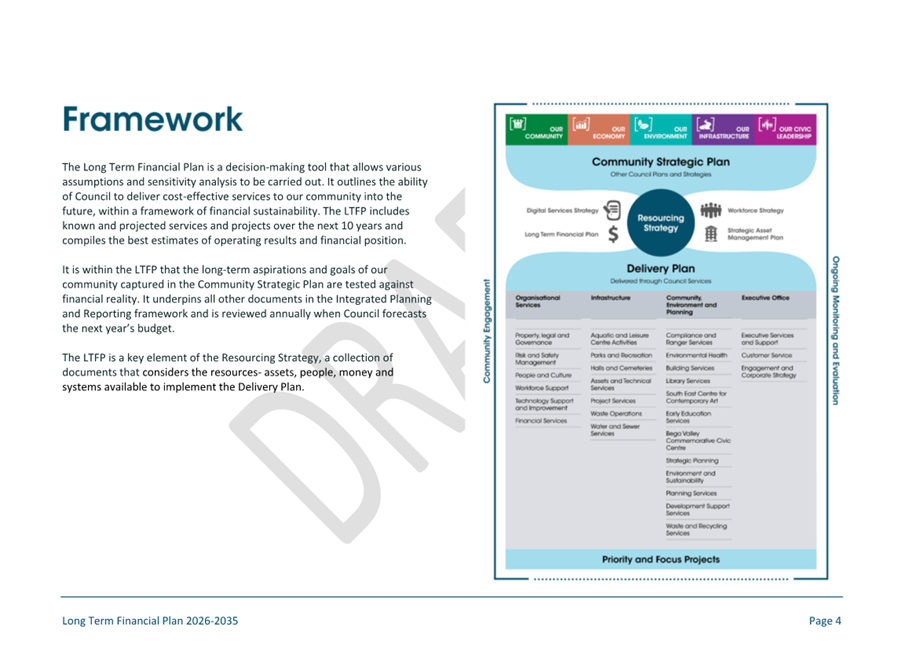
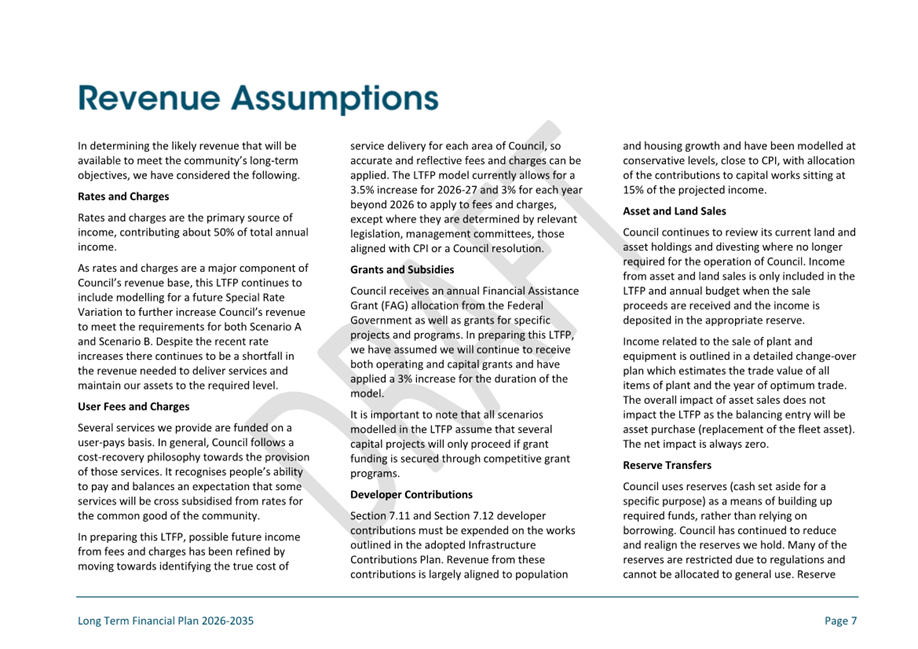
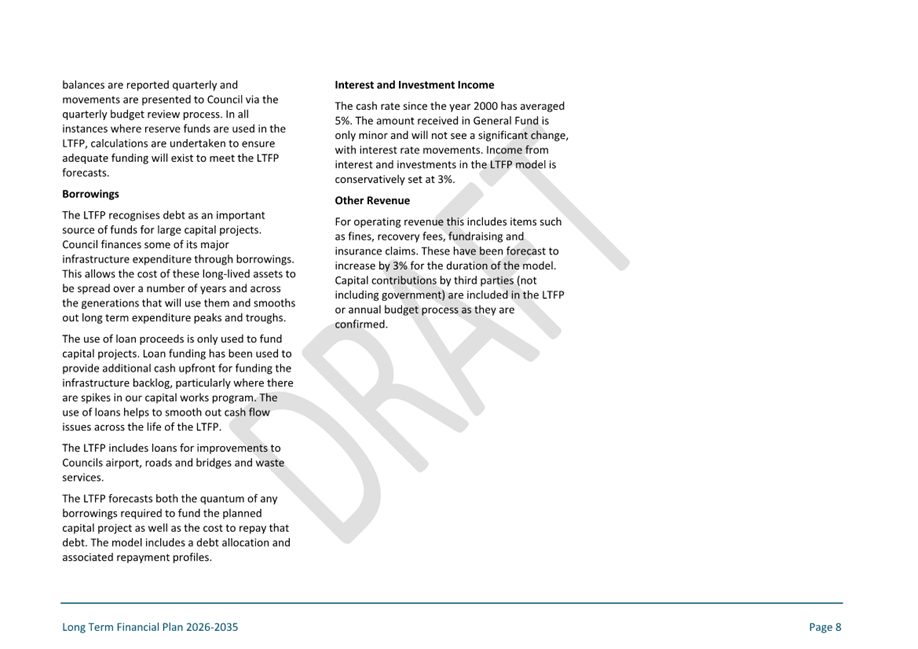
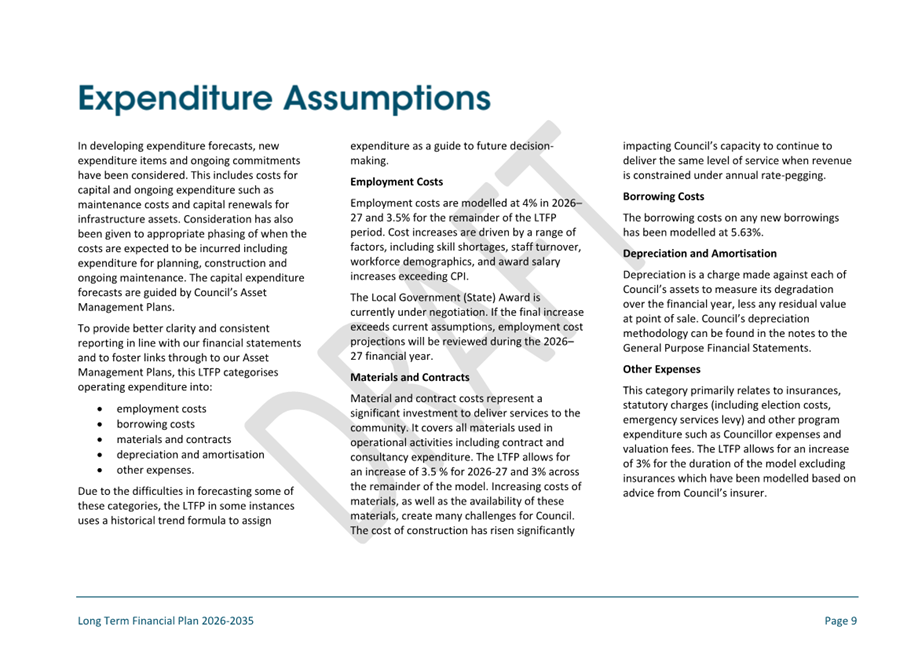
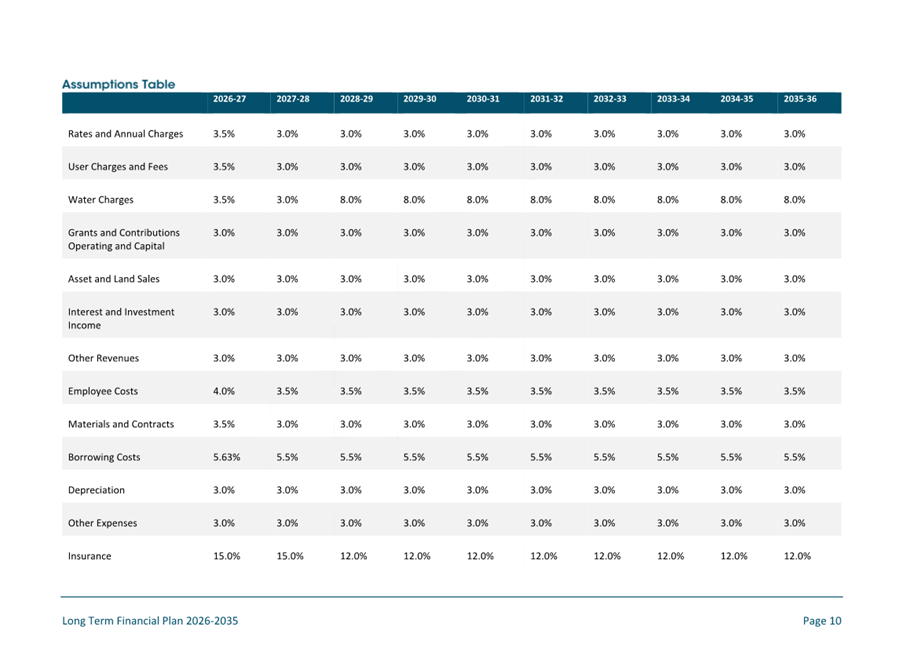
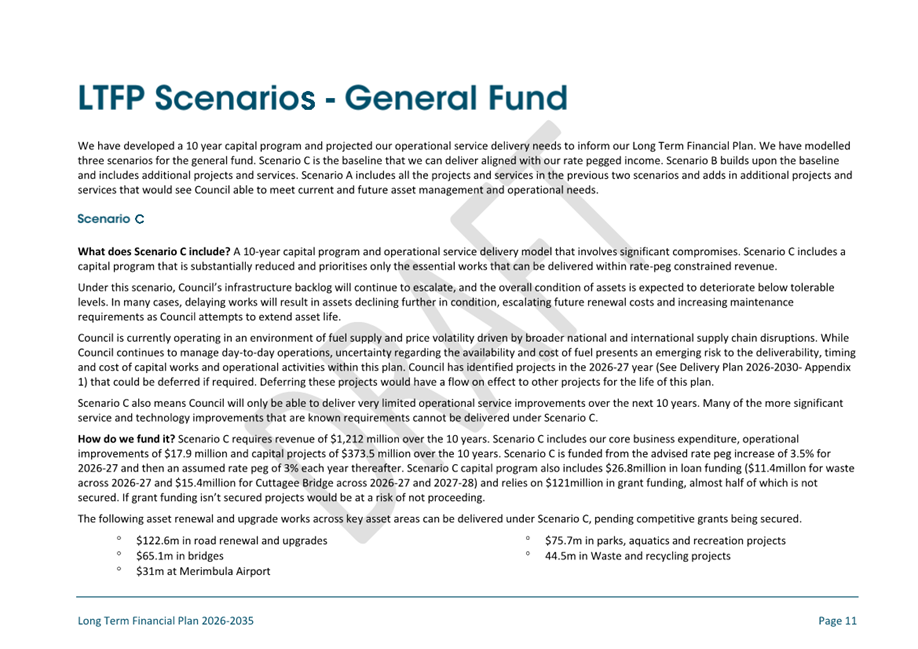
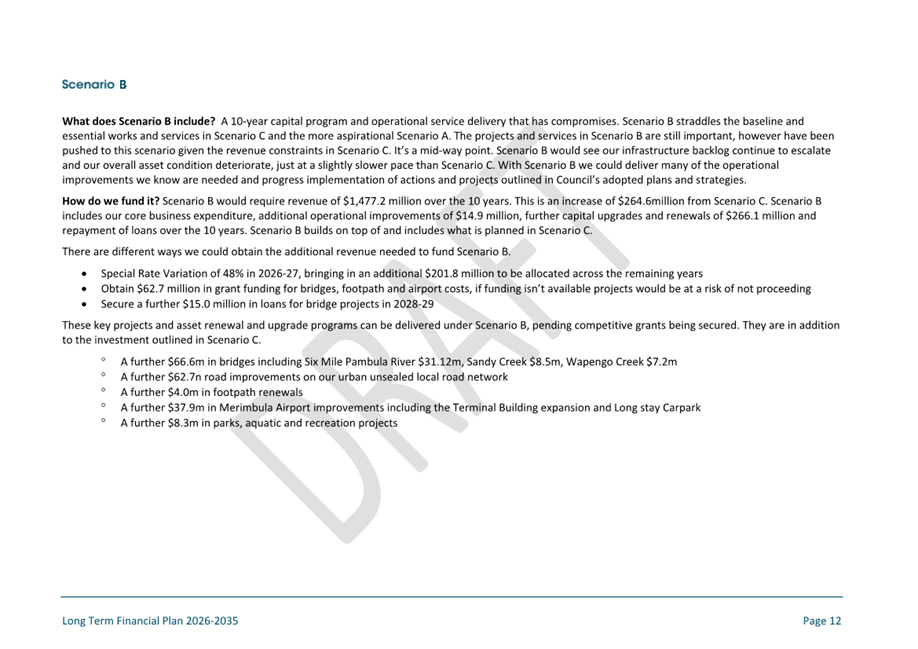
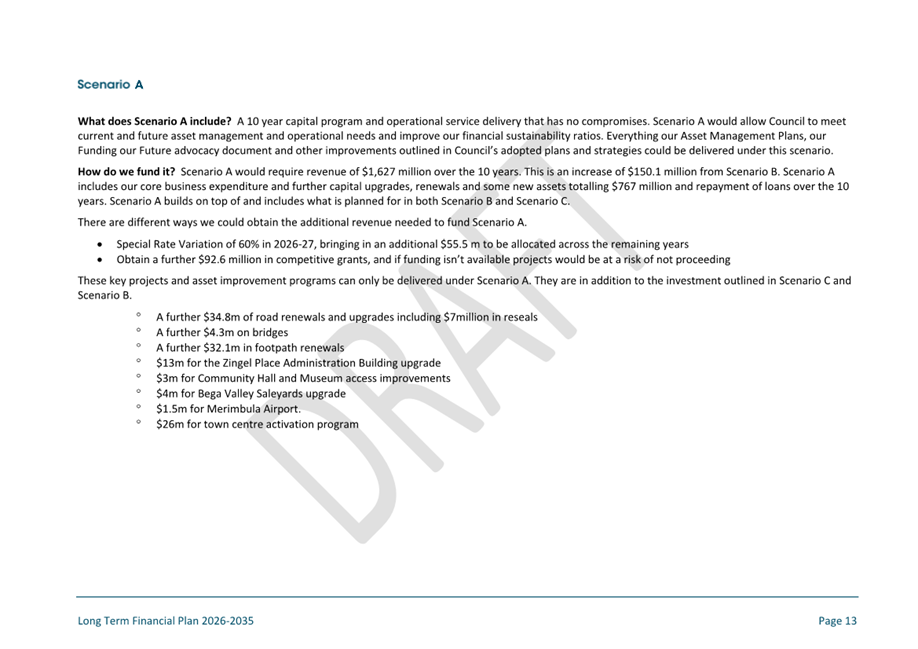
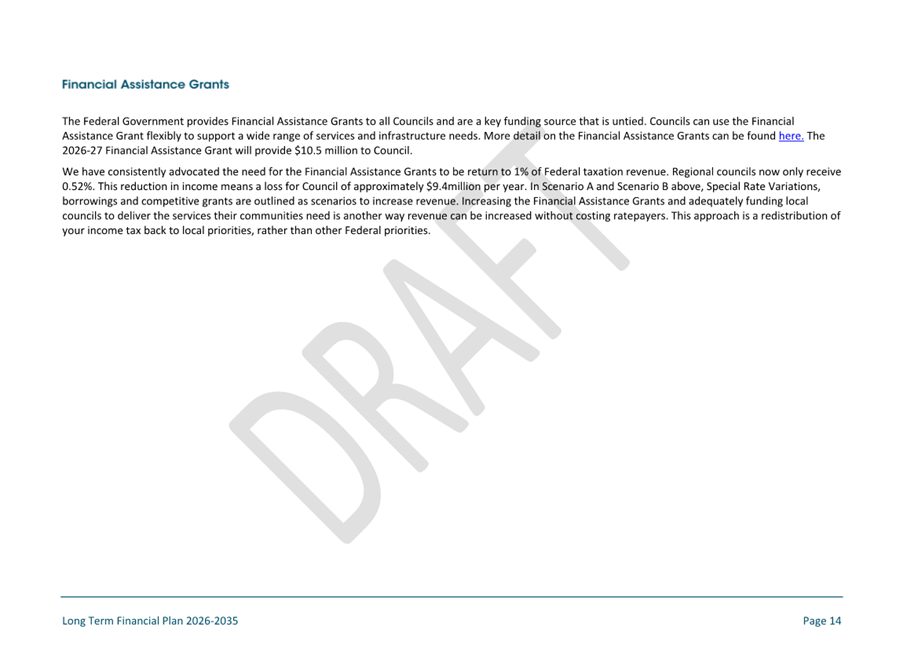
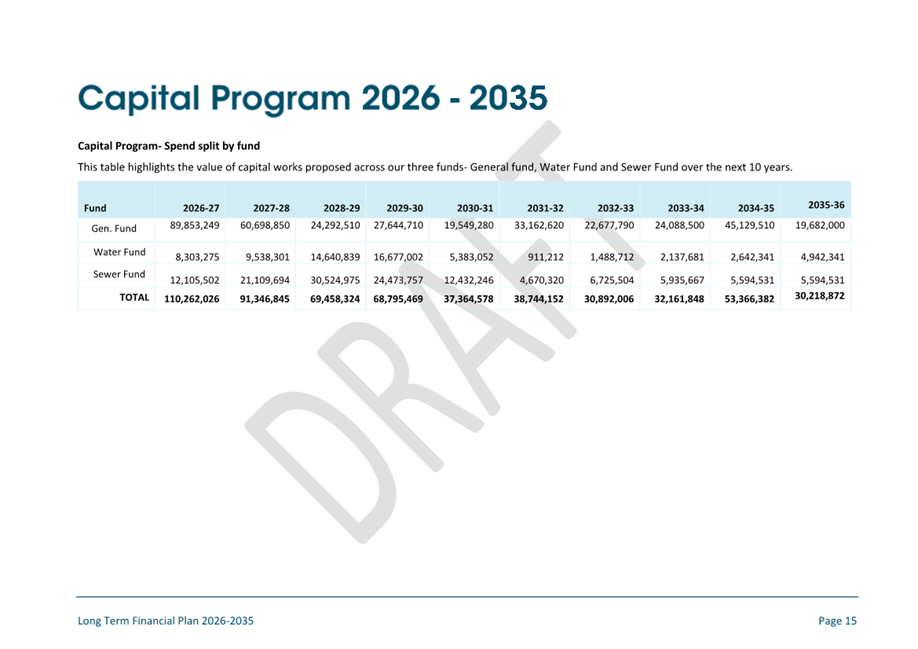
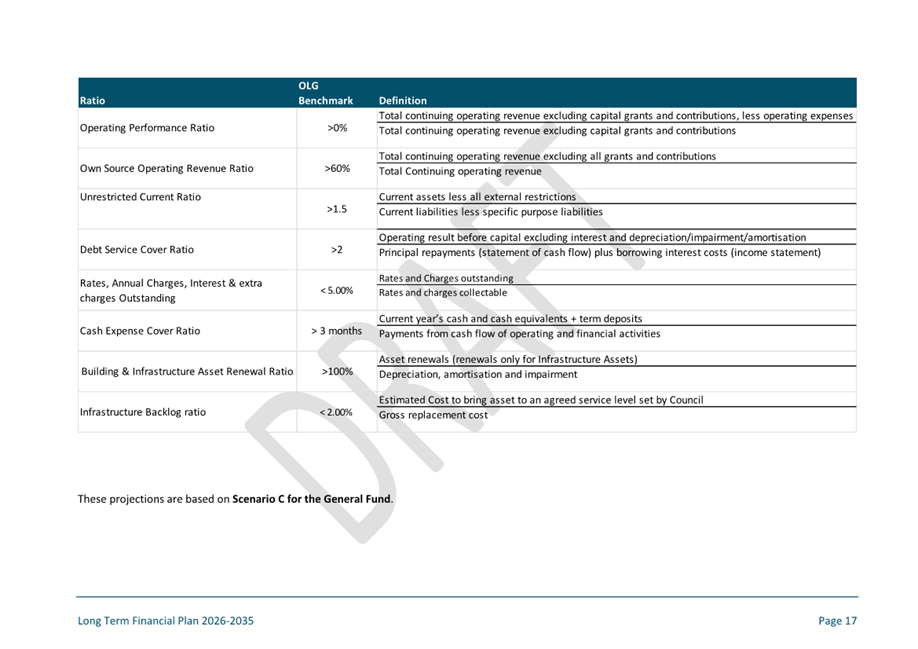
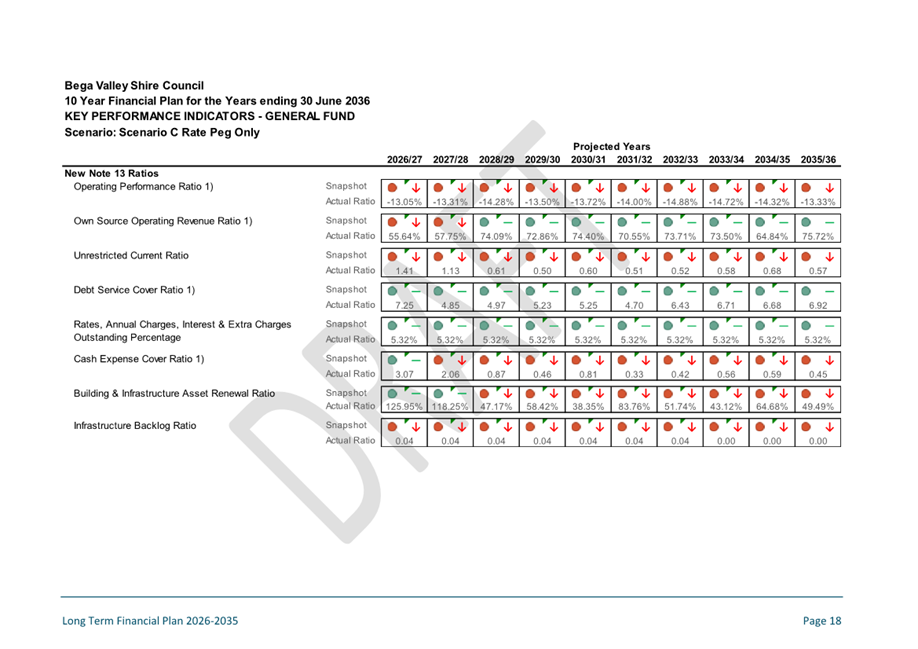
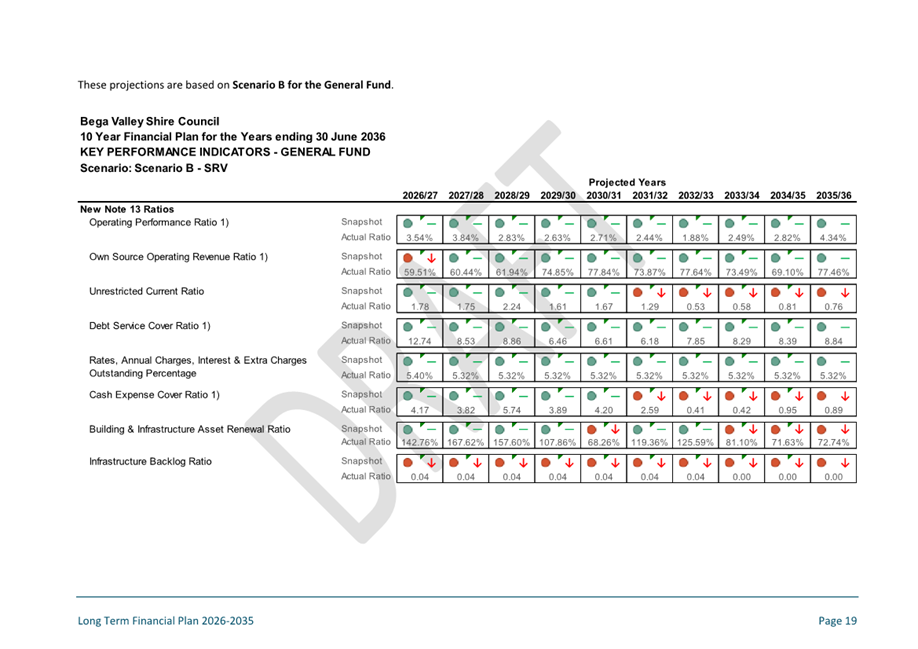
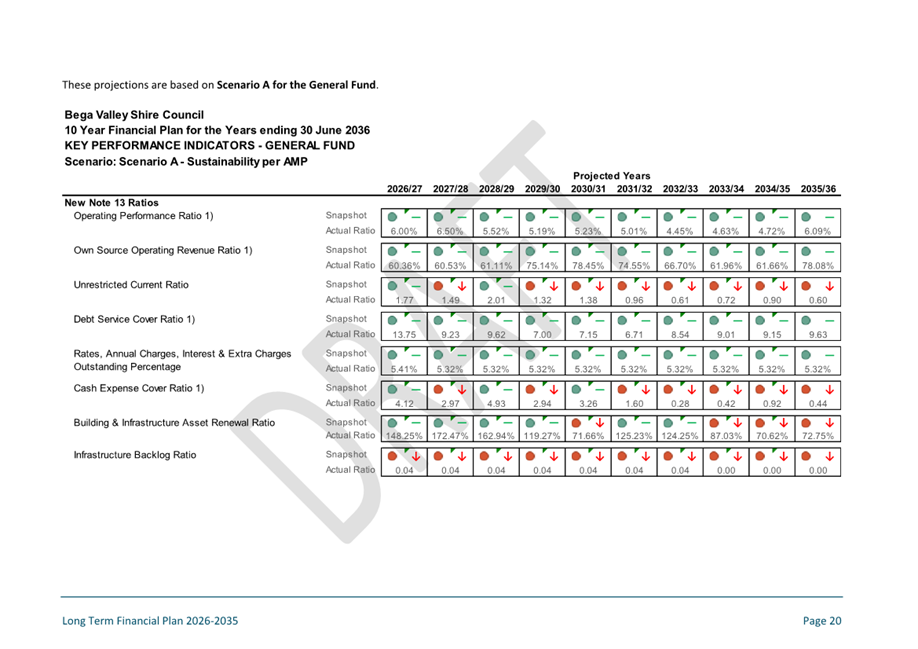
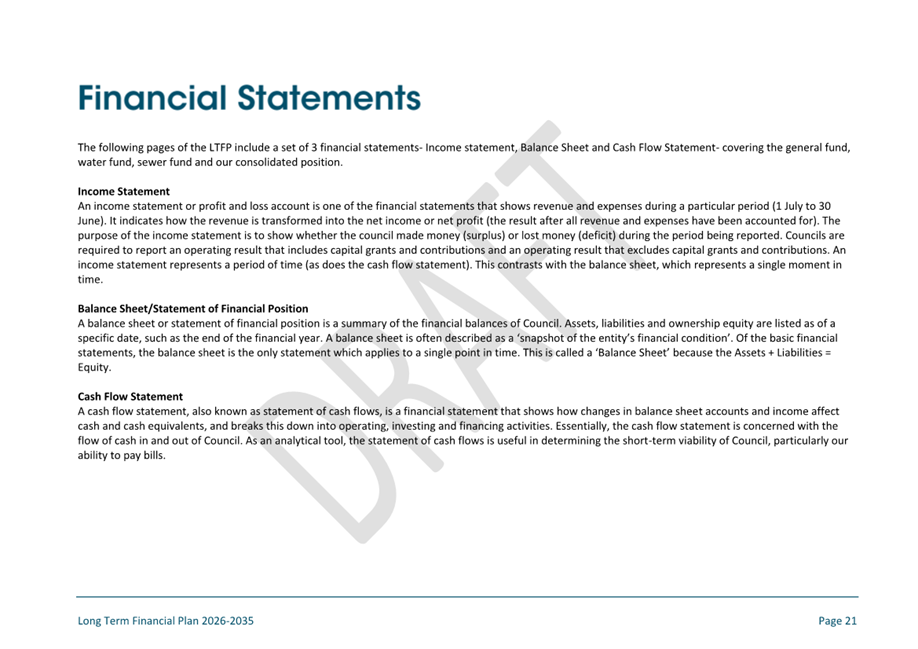
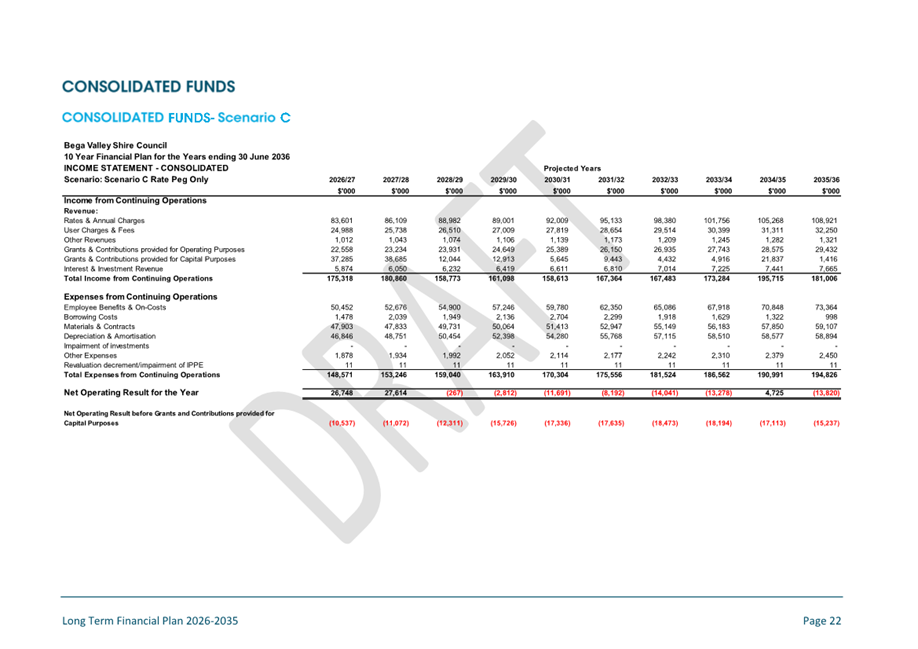
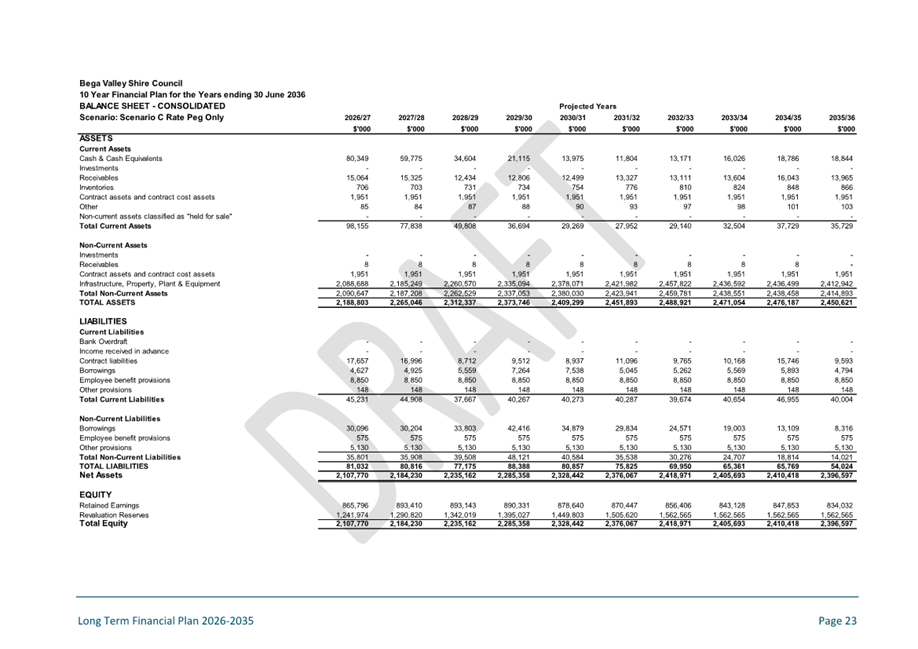
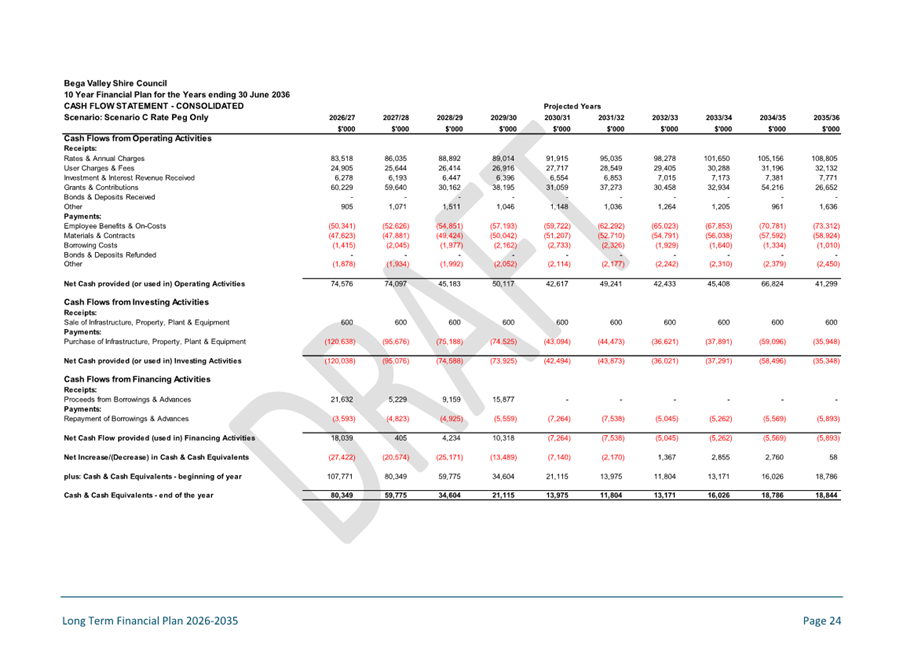
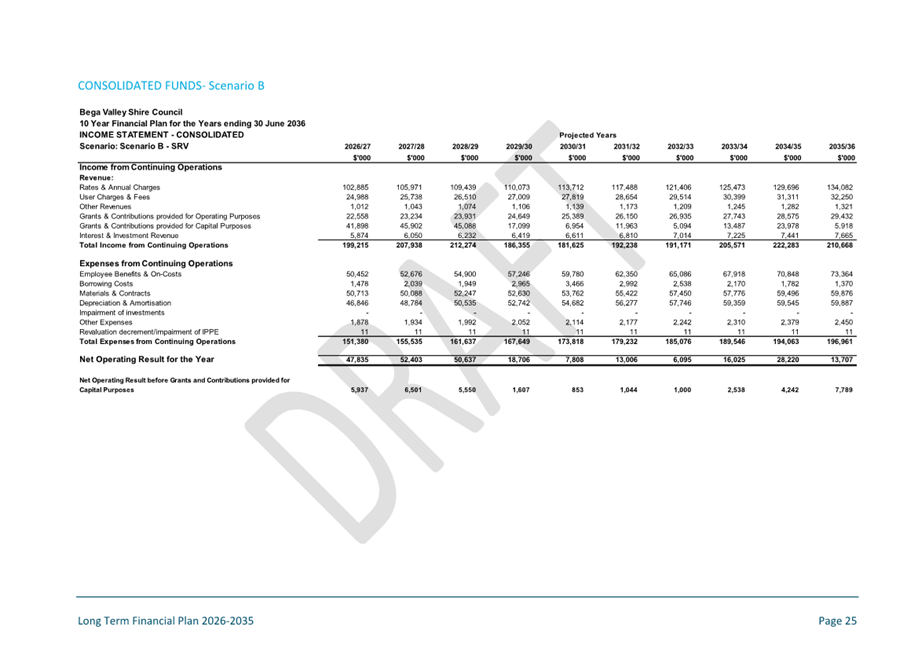
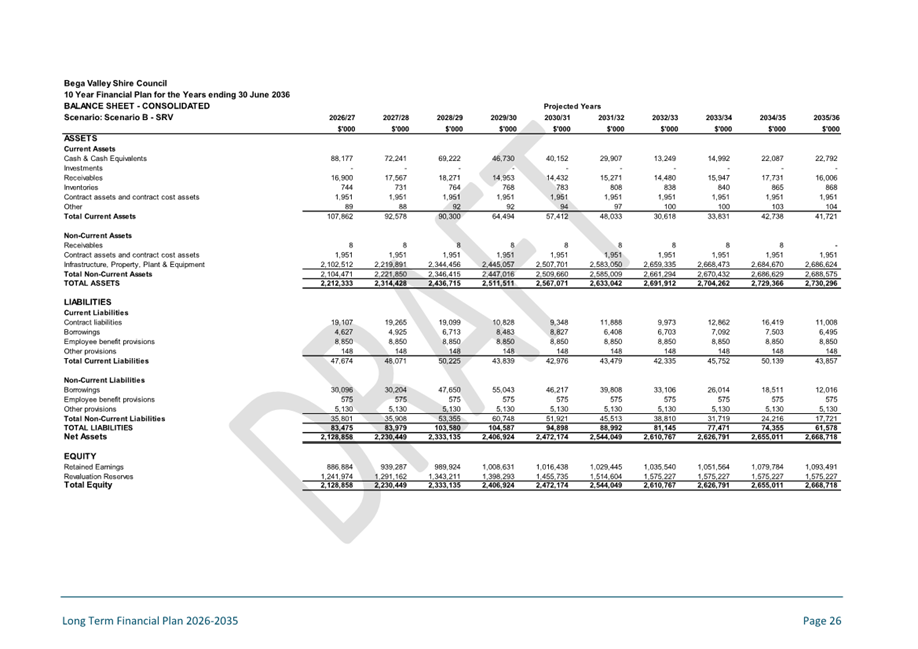
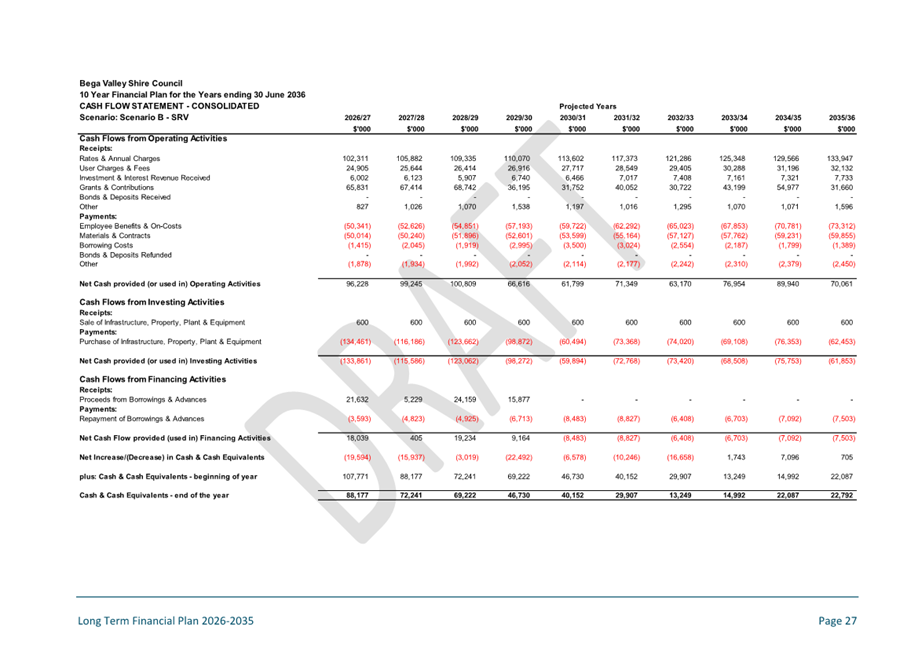
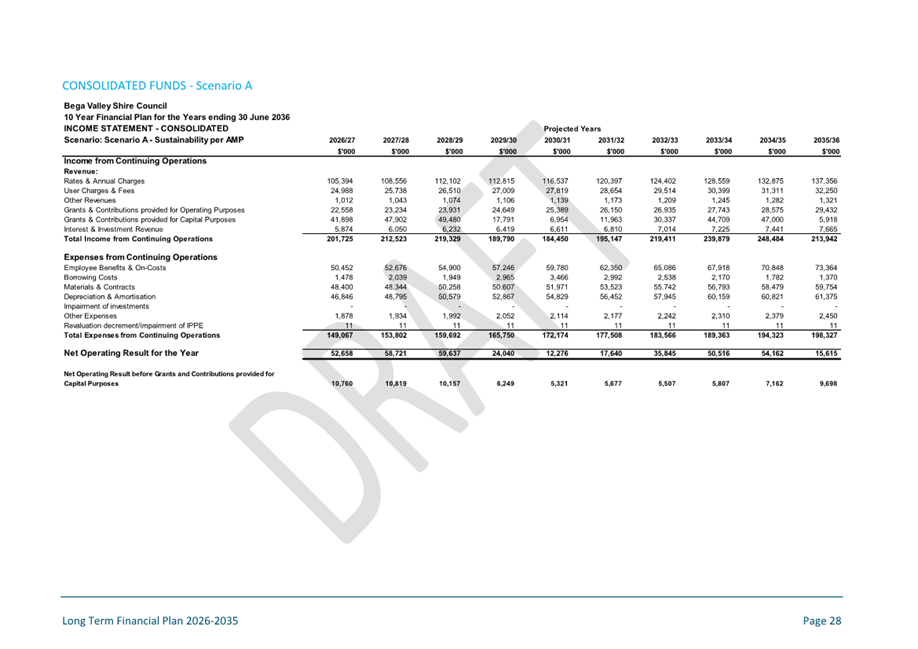
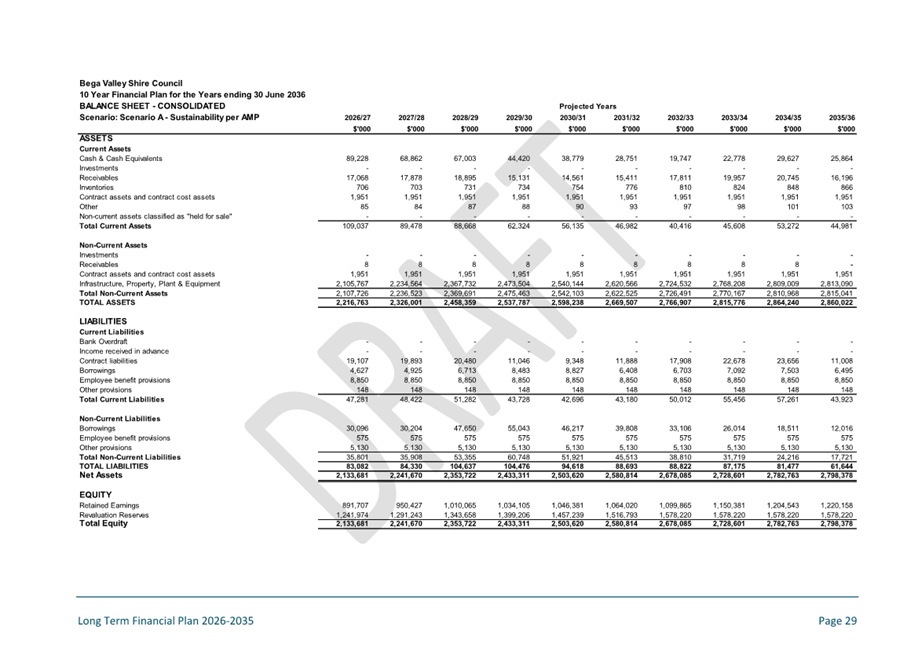
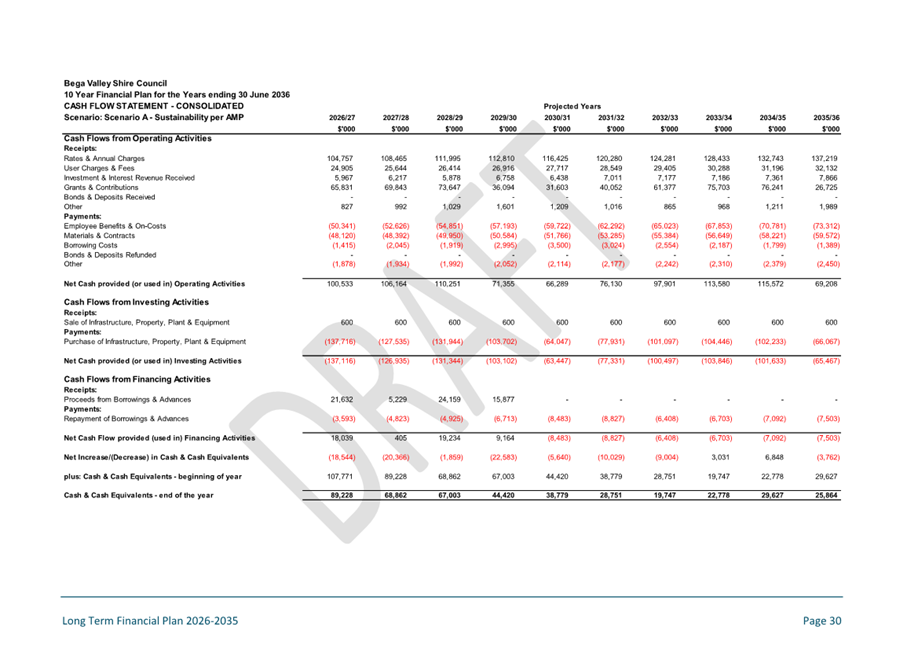
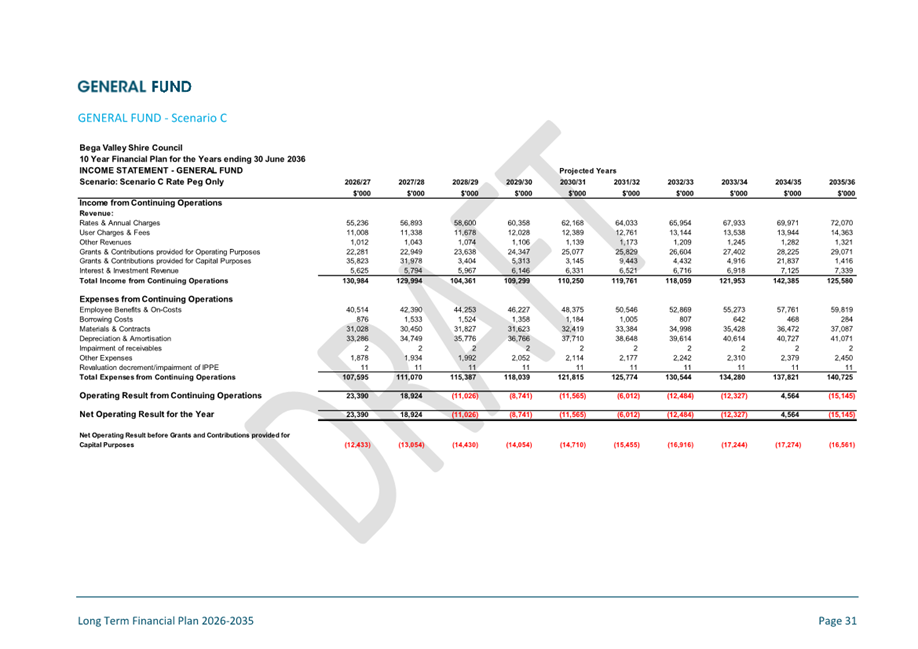
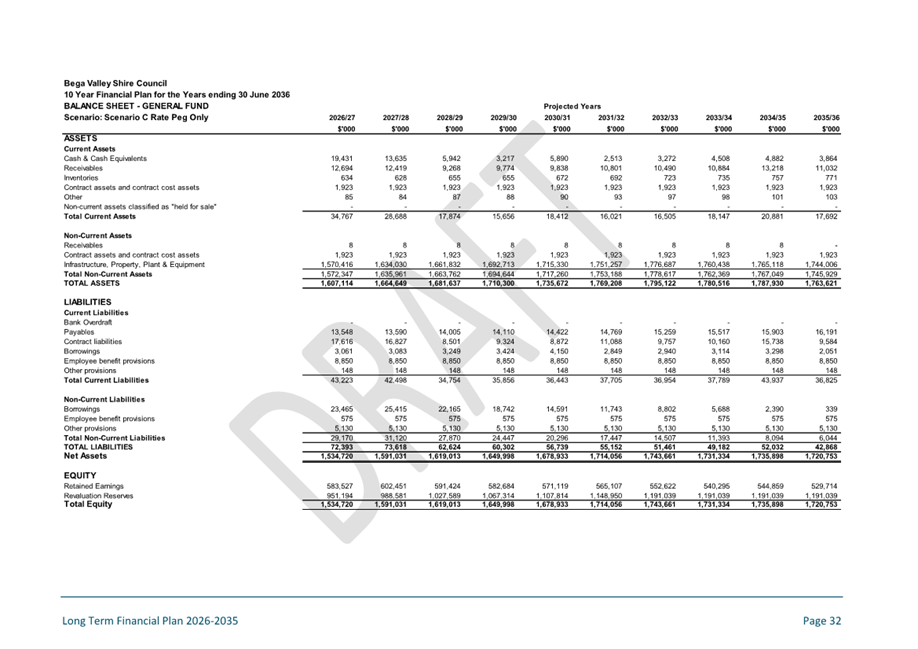
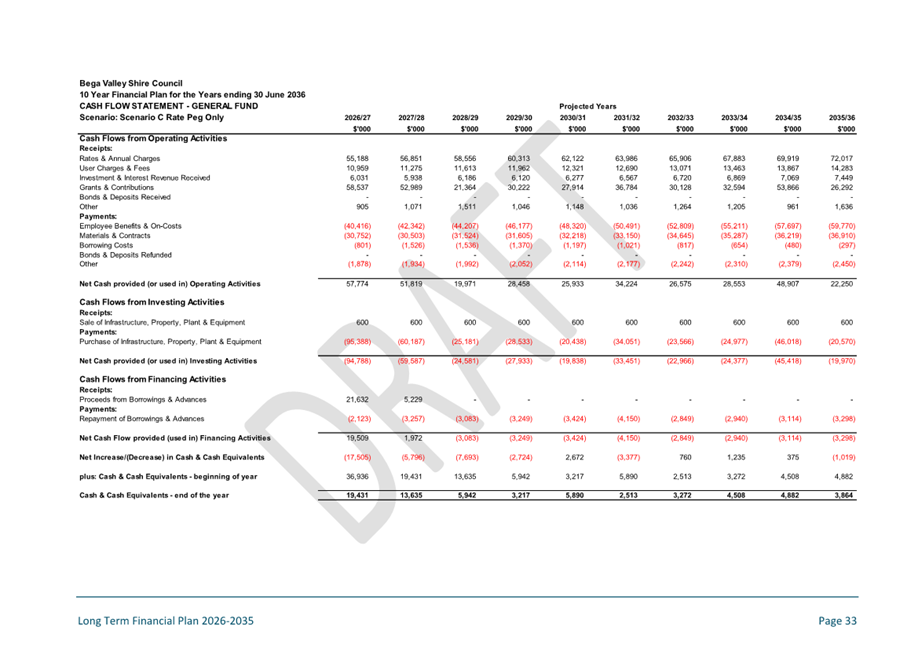
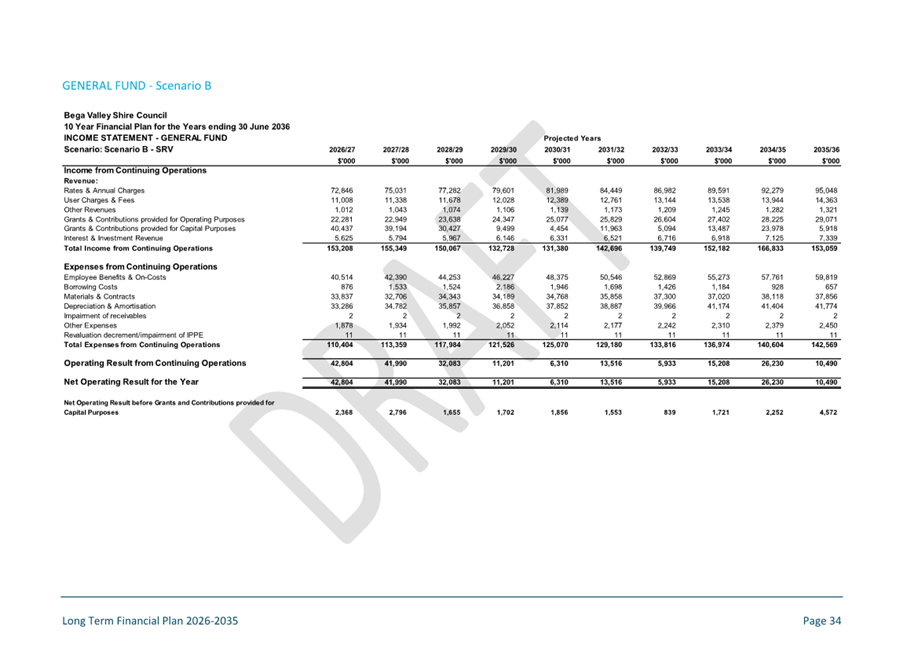
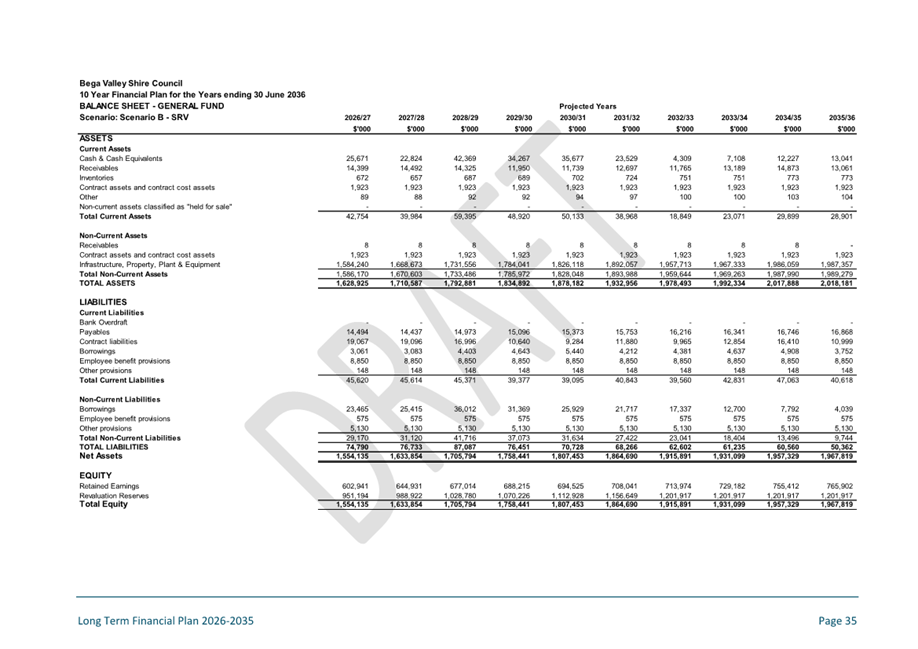
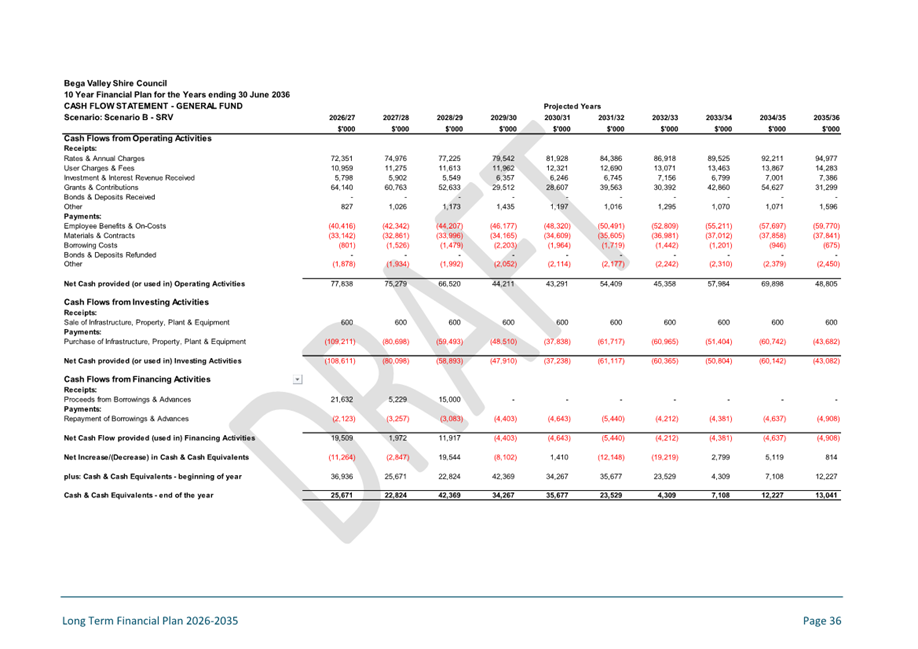
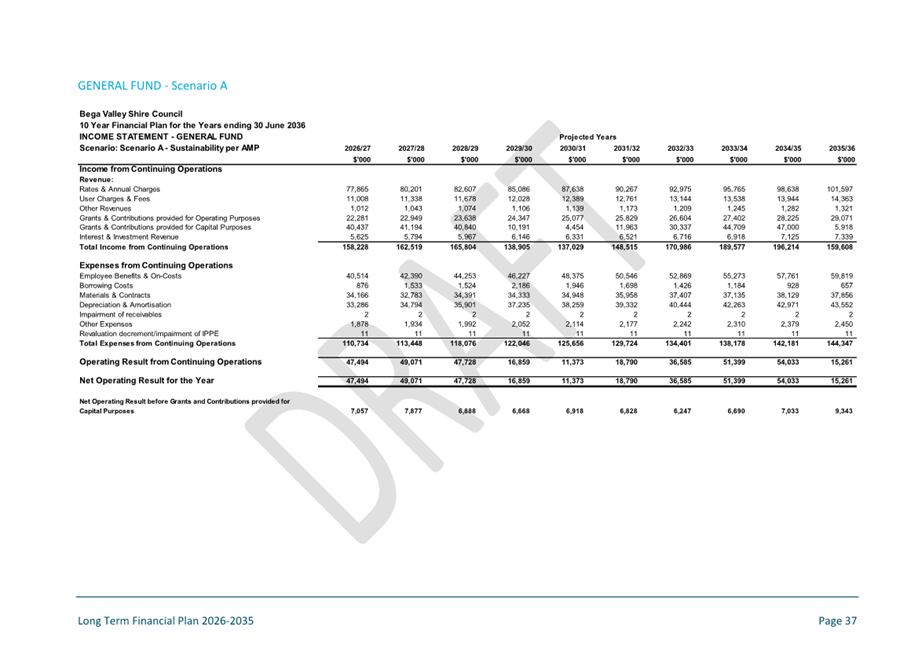
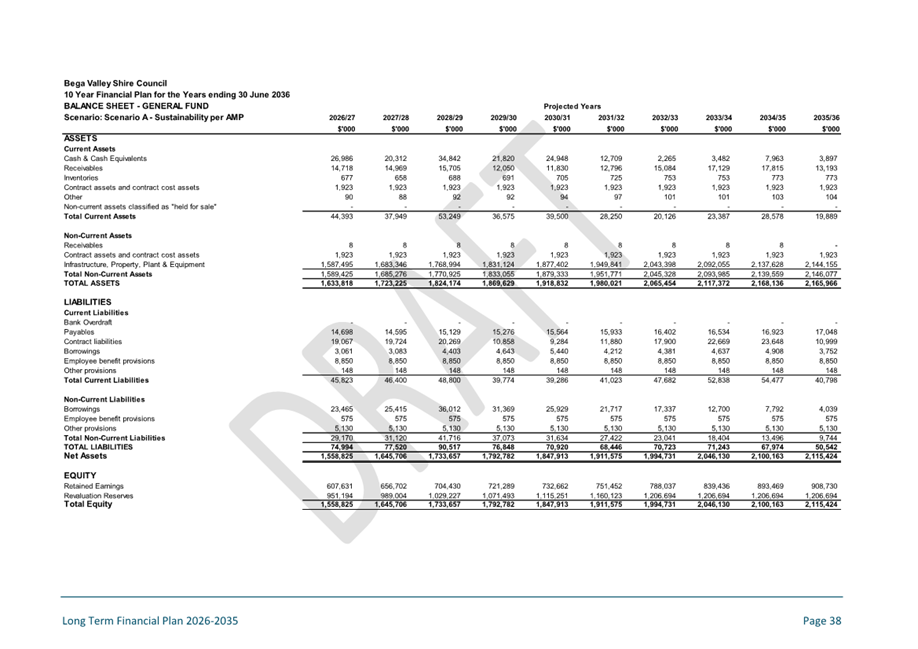
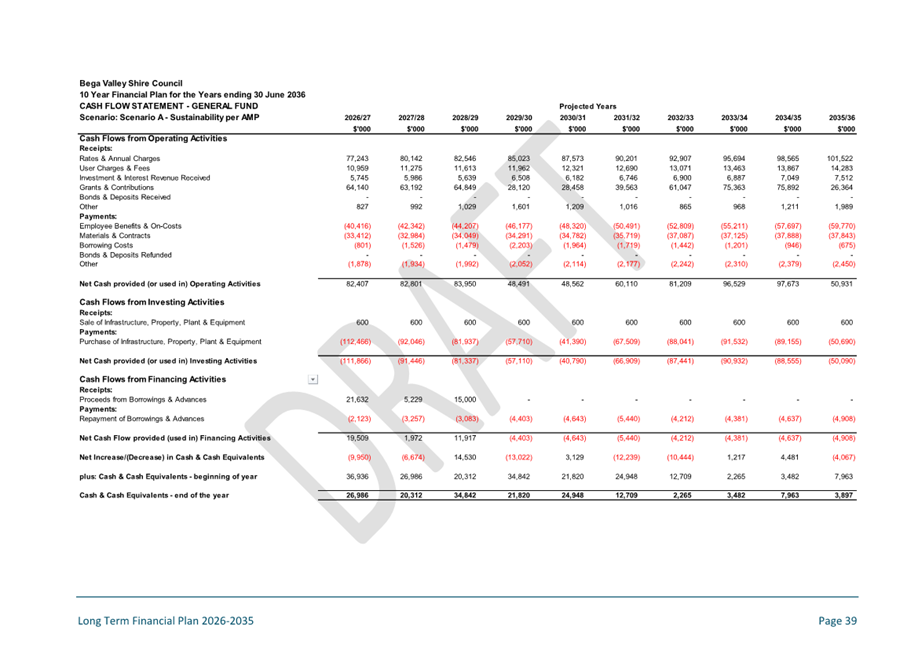
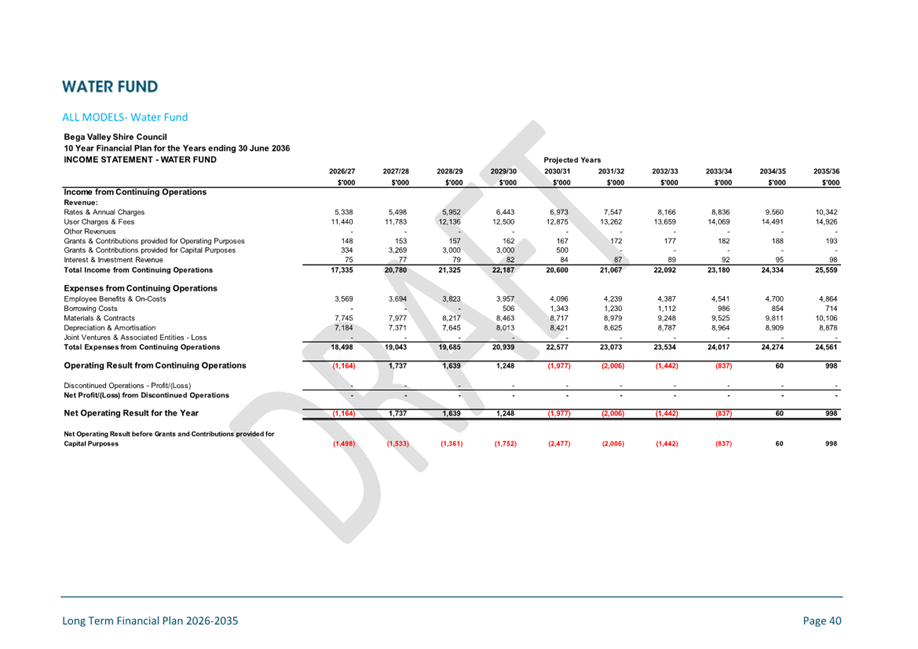
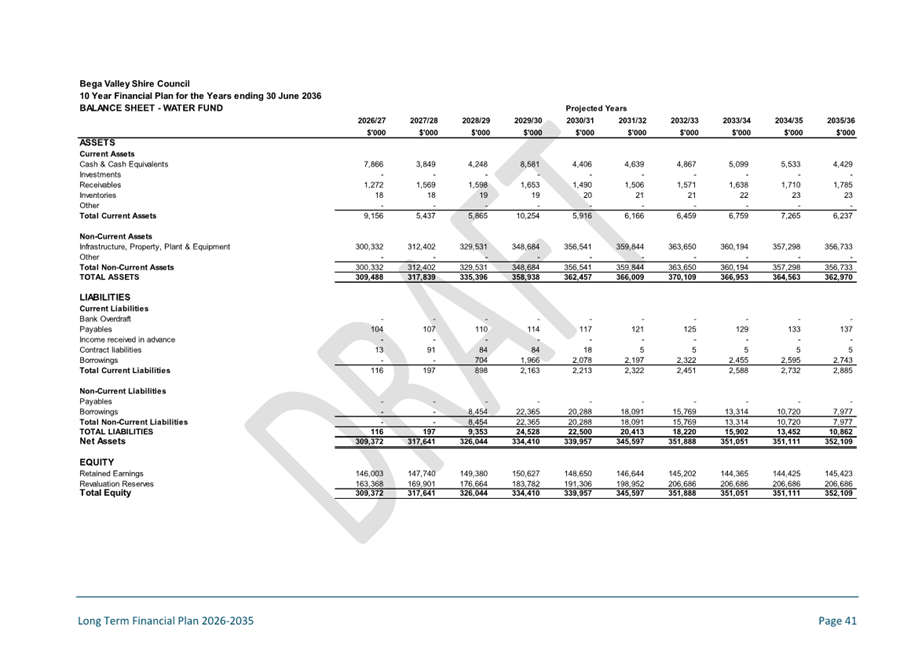
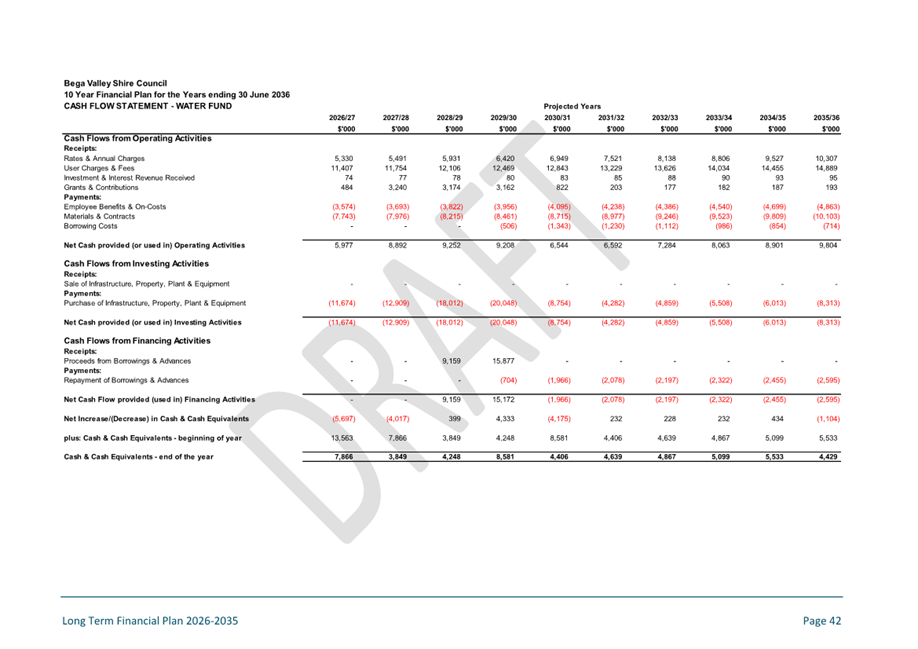
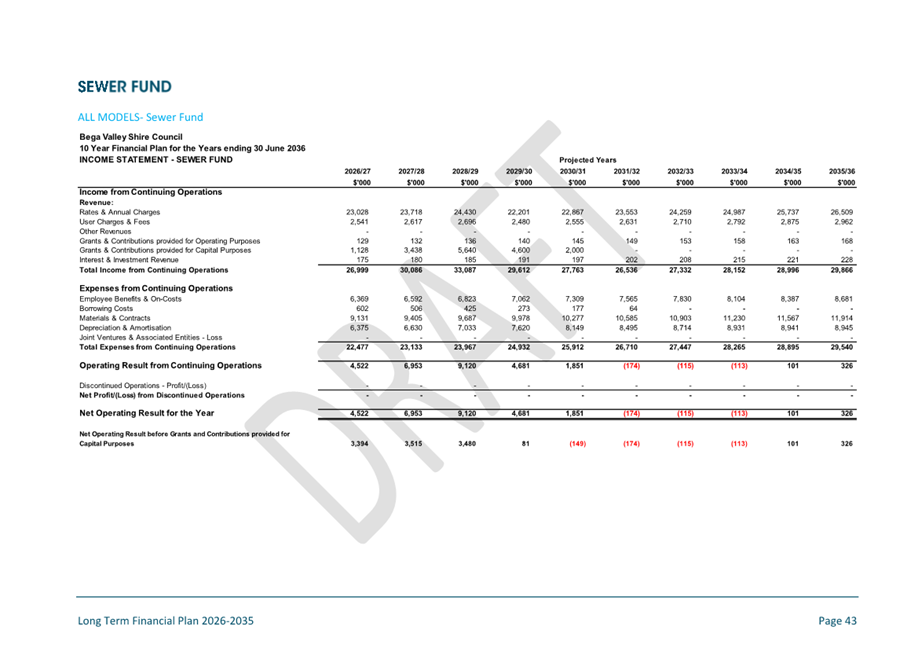
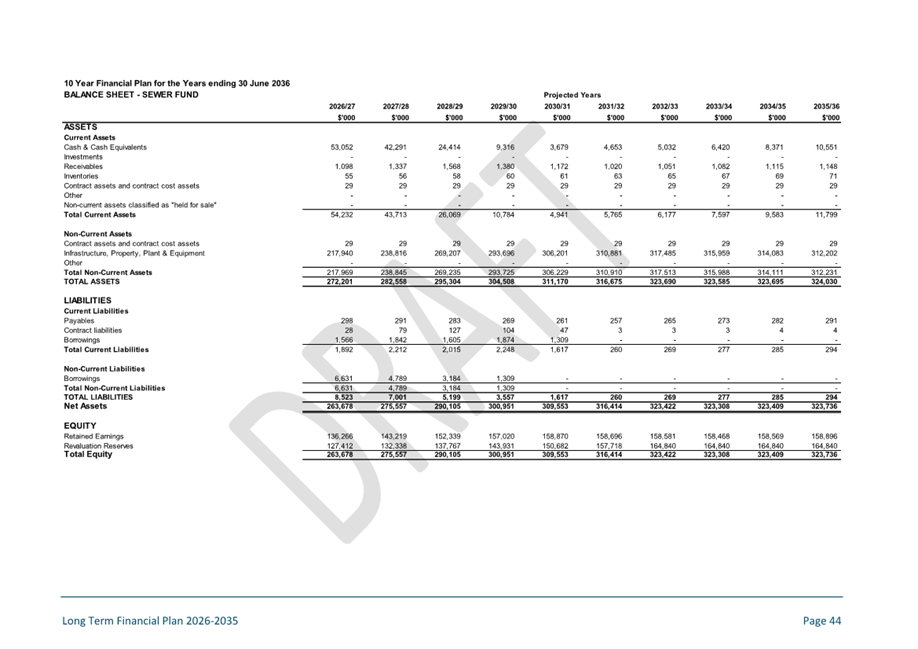
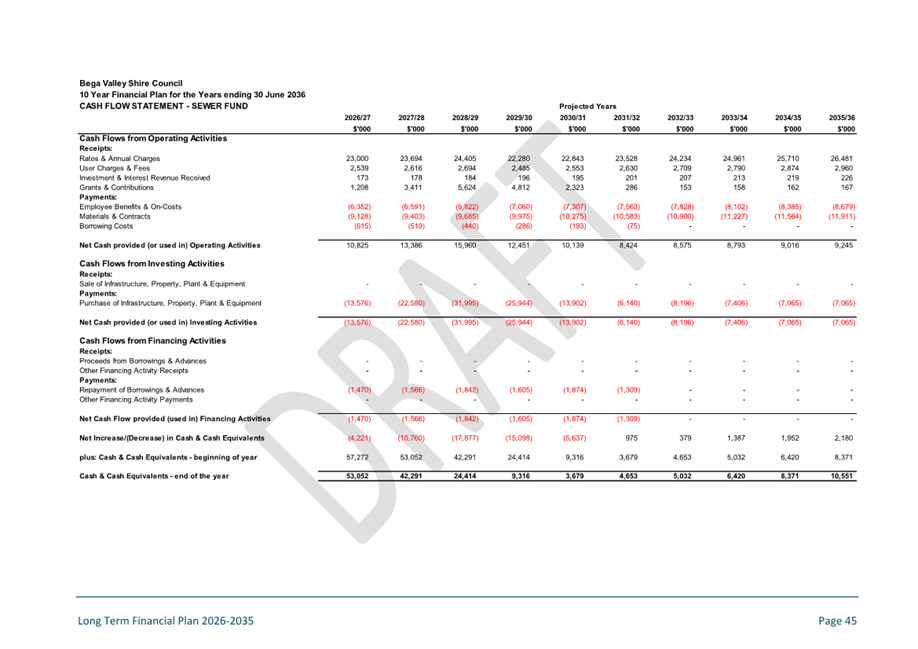

|
Council
|
6 May 2026
|
|
Item 11.1
- Attachment 3
|
Draft Strategic Asset Management Plan incl AMP summaries
2025-2030
|
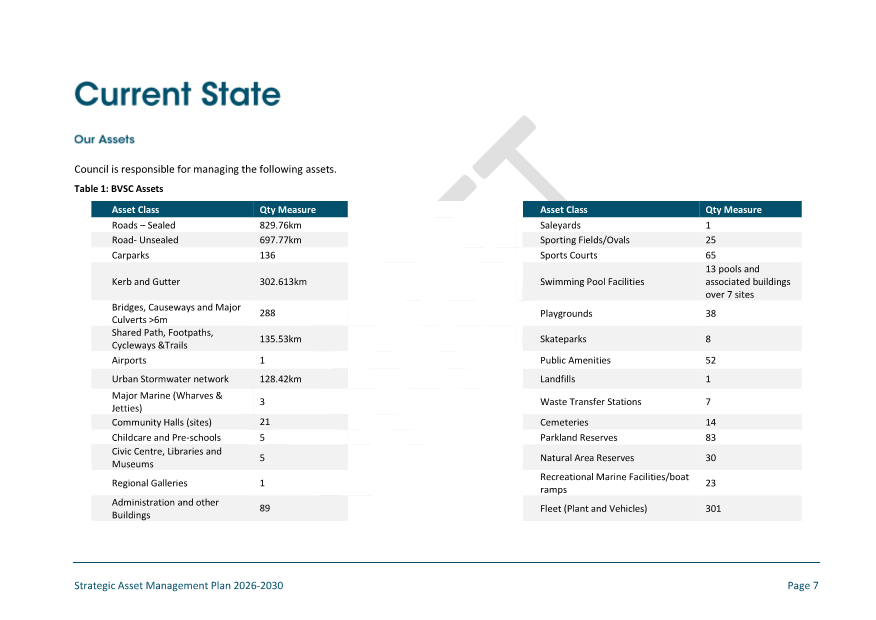
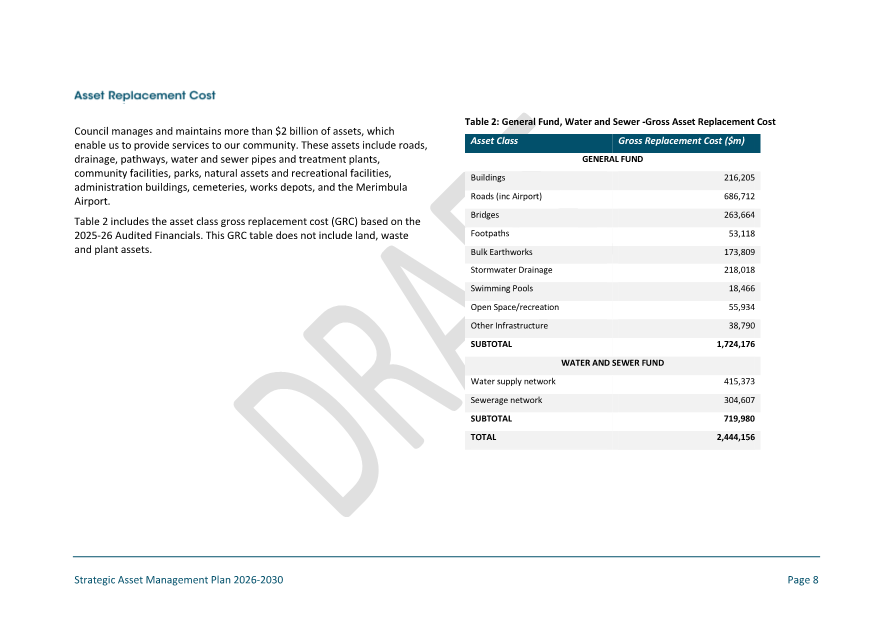
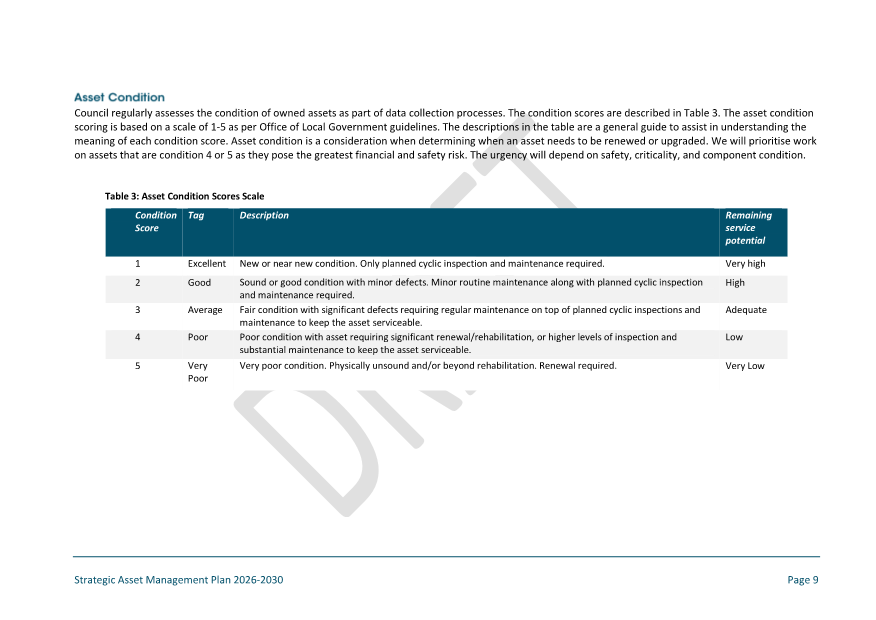
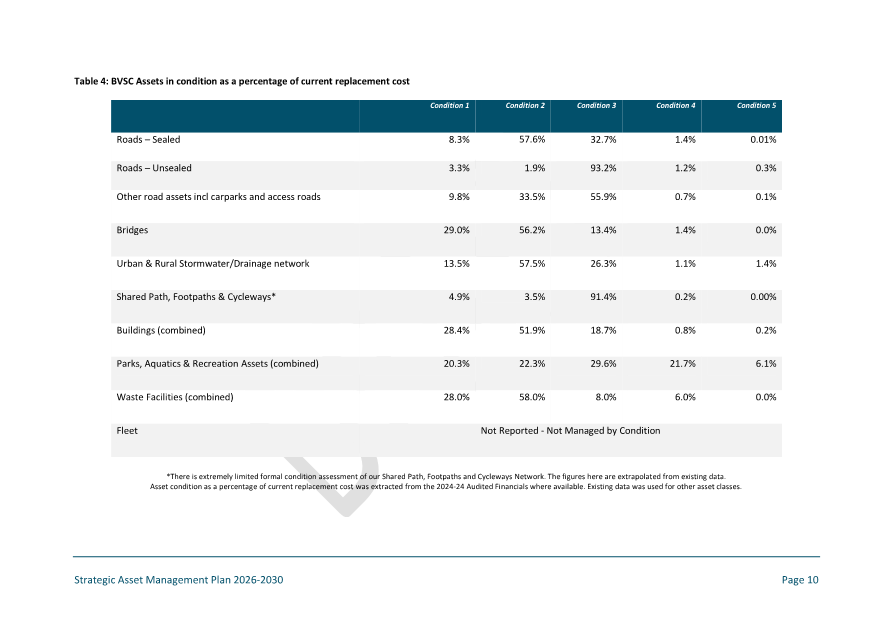
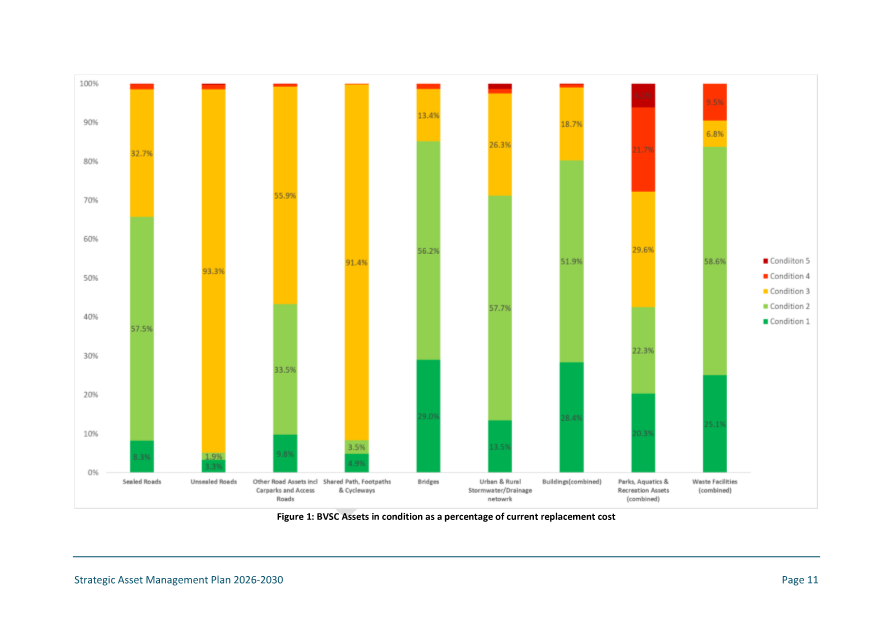
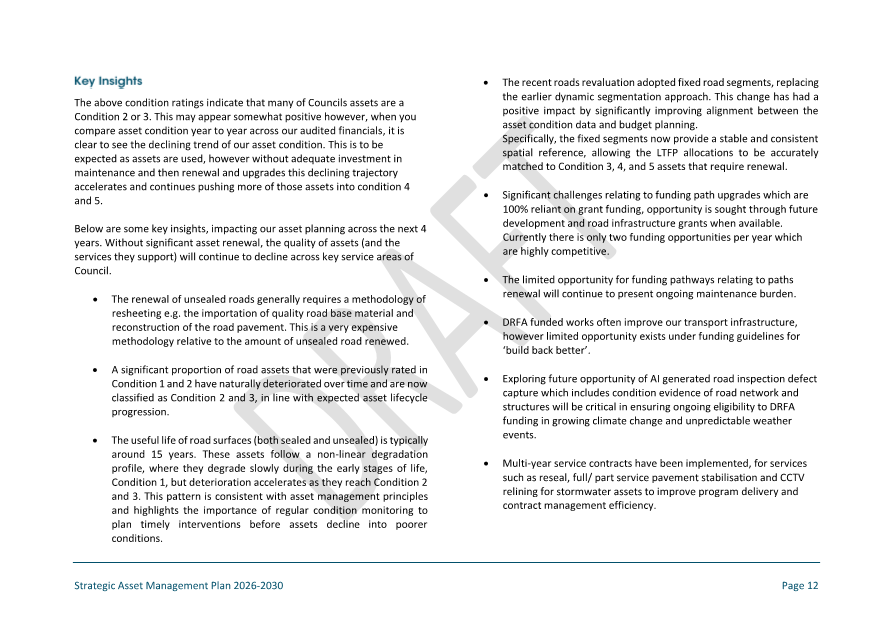
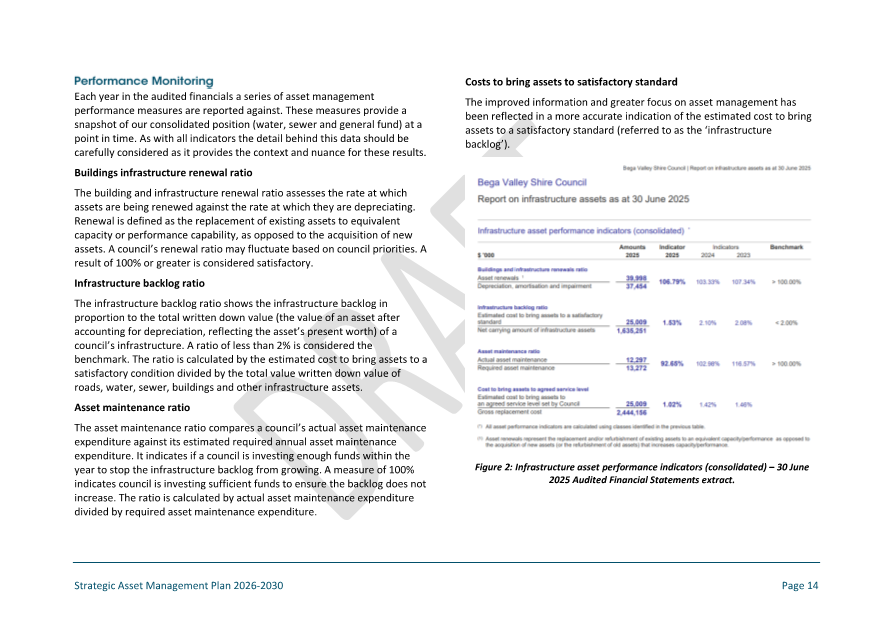
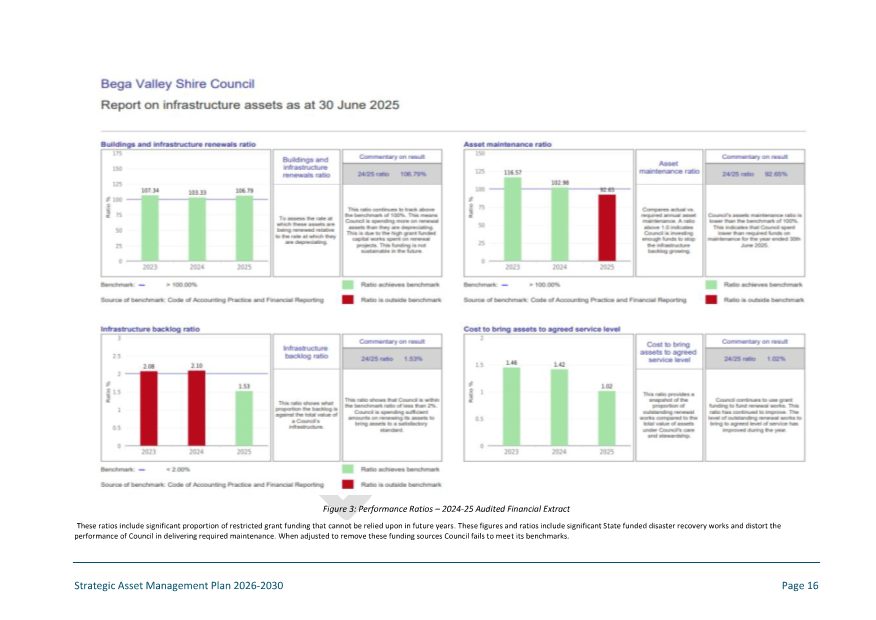
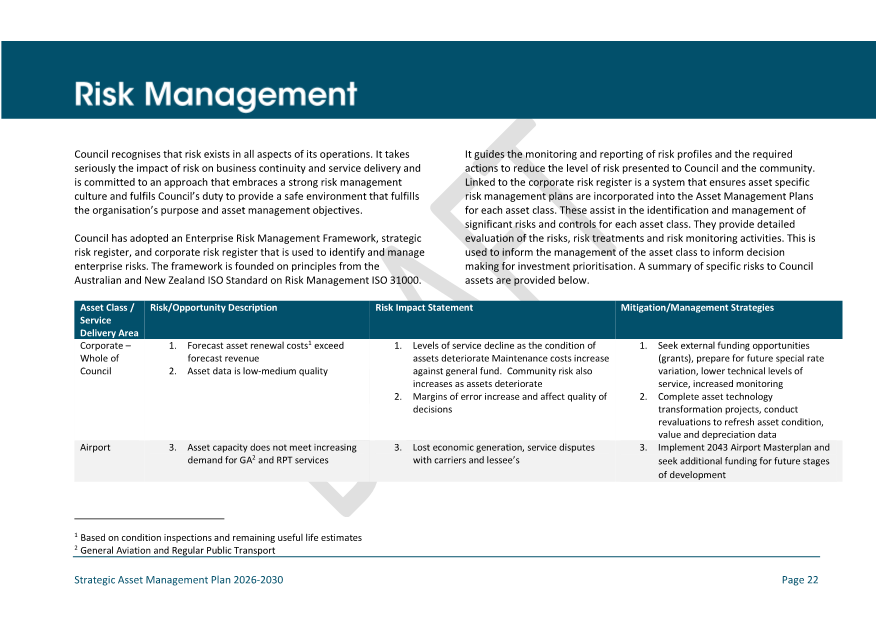
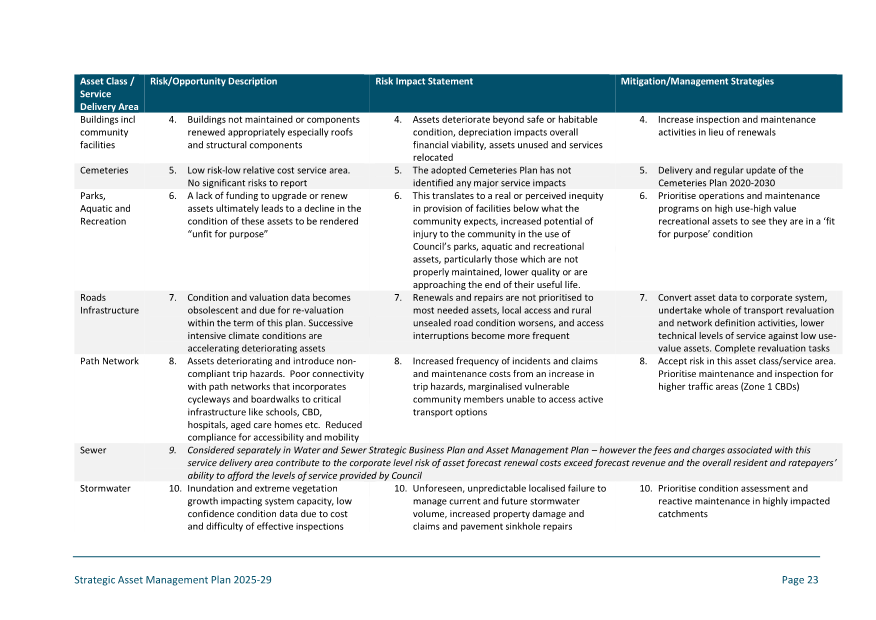
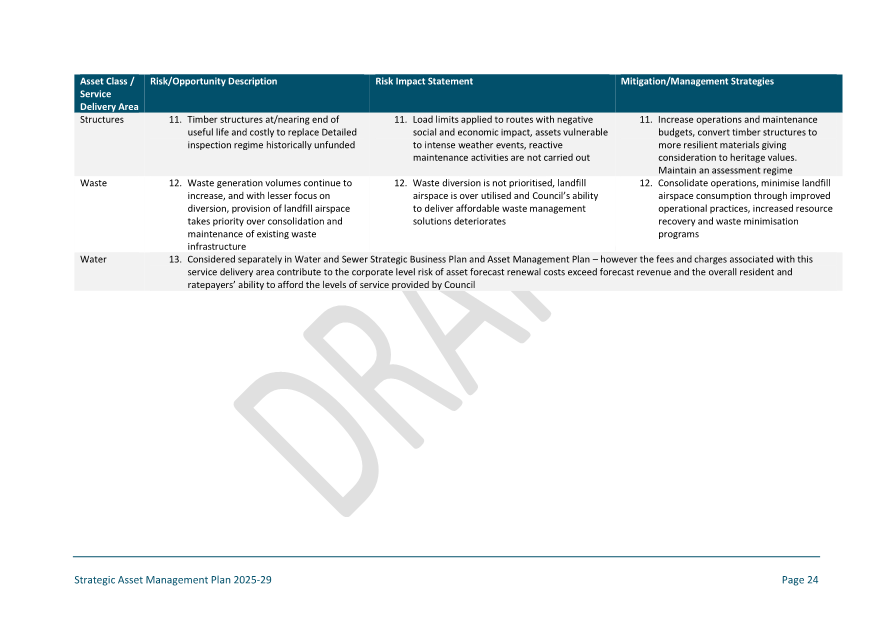
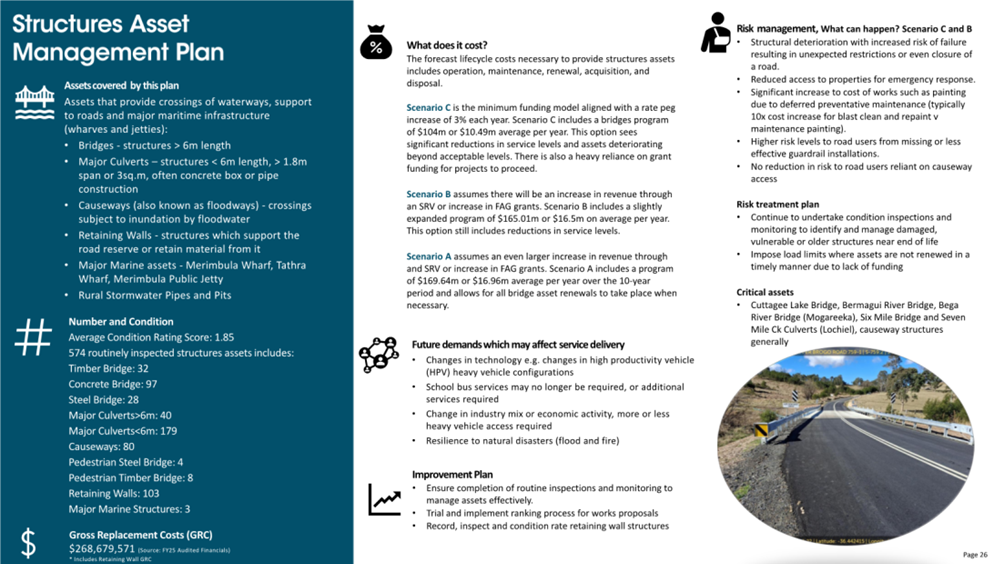
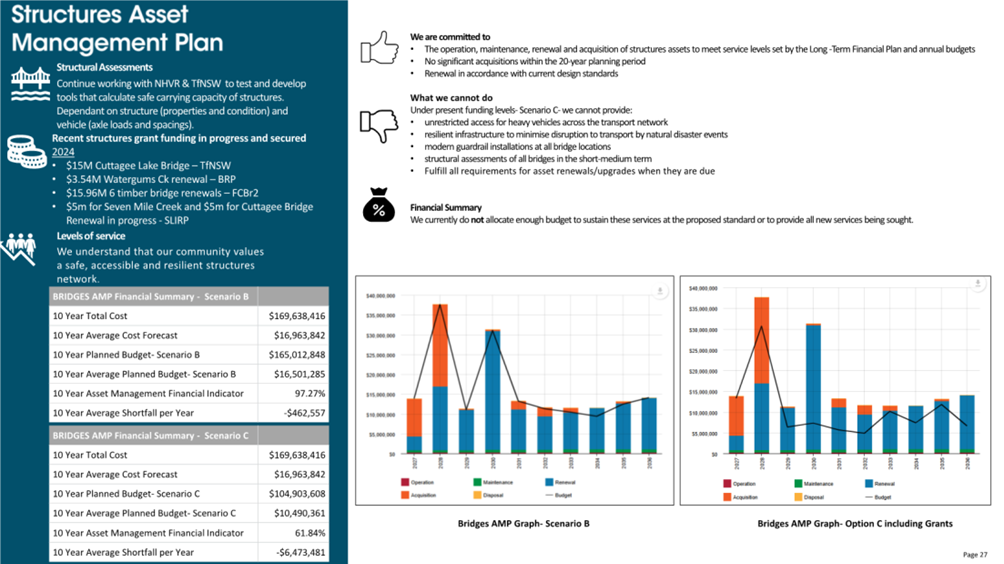
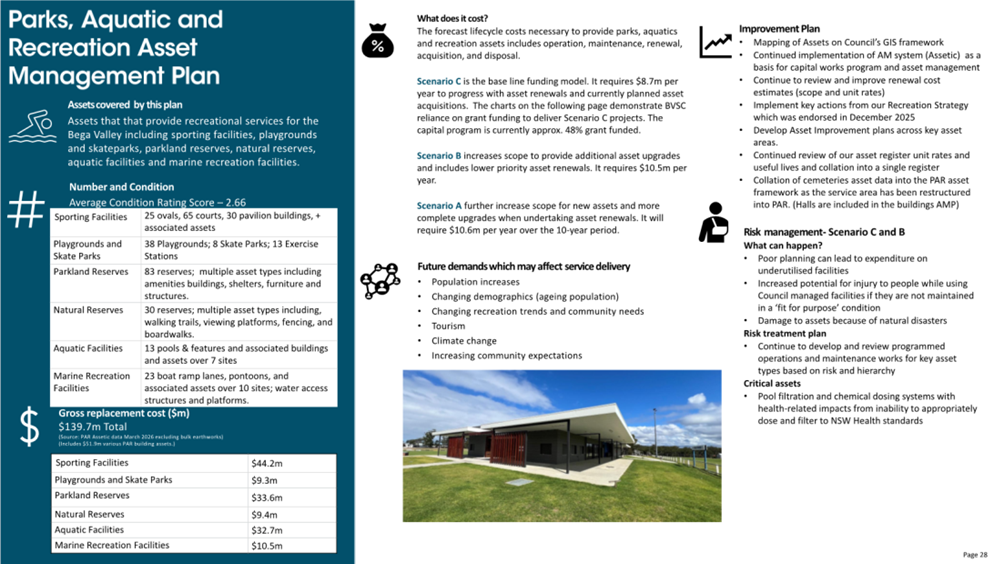
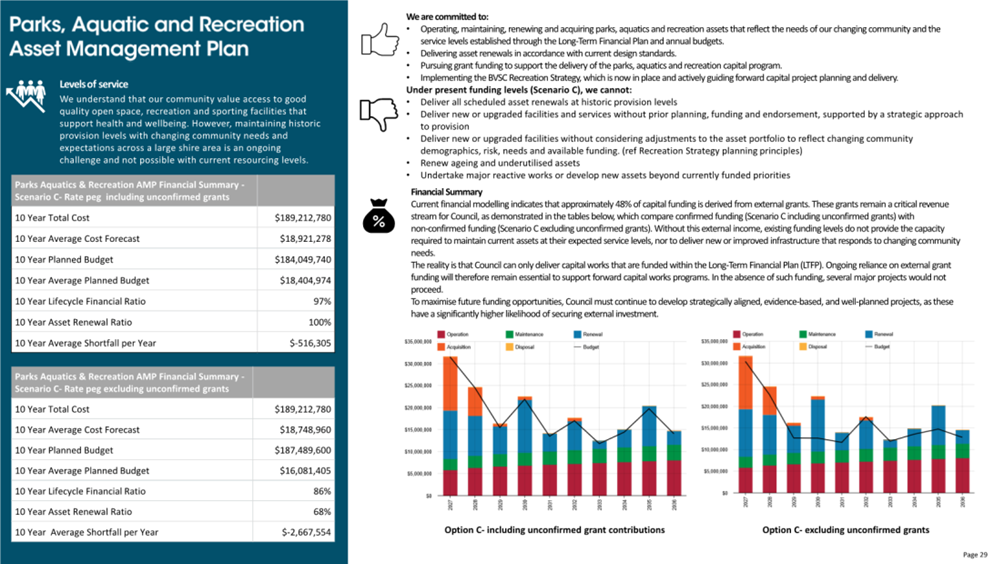
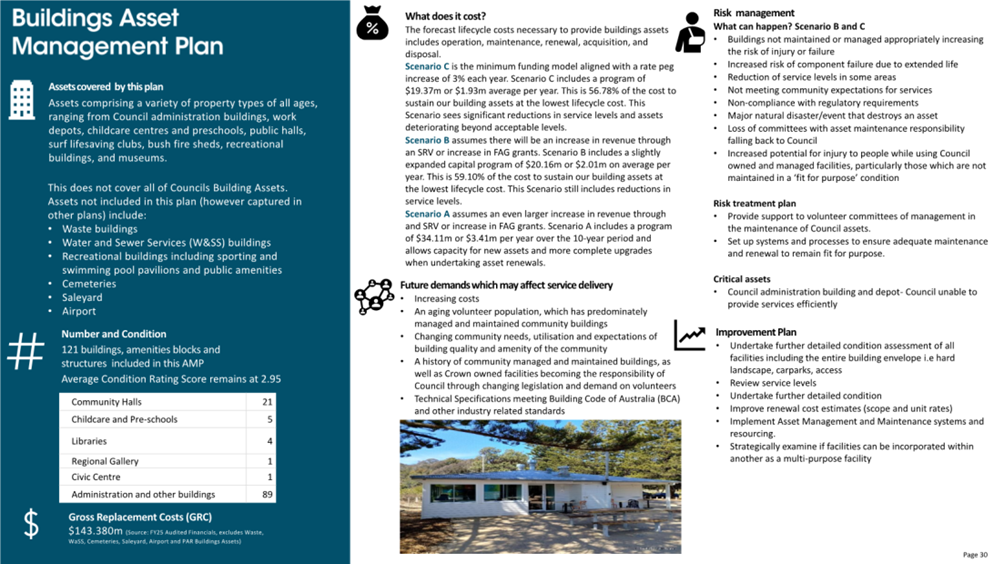
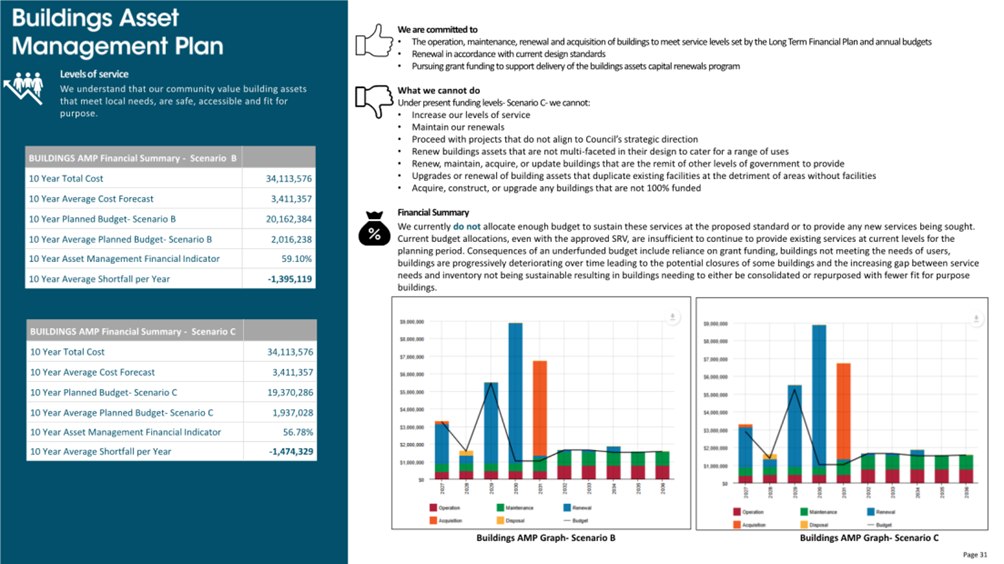
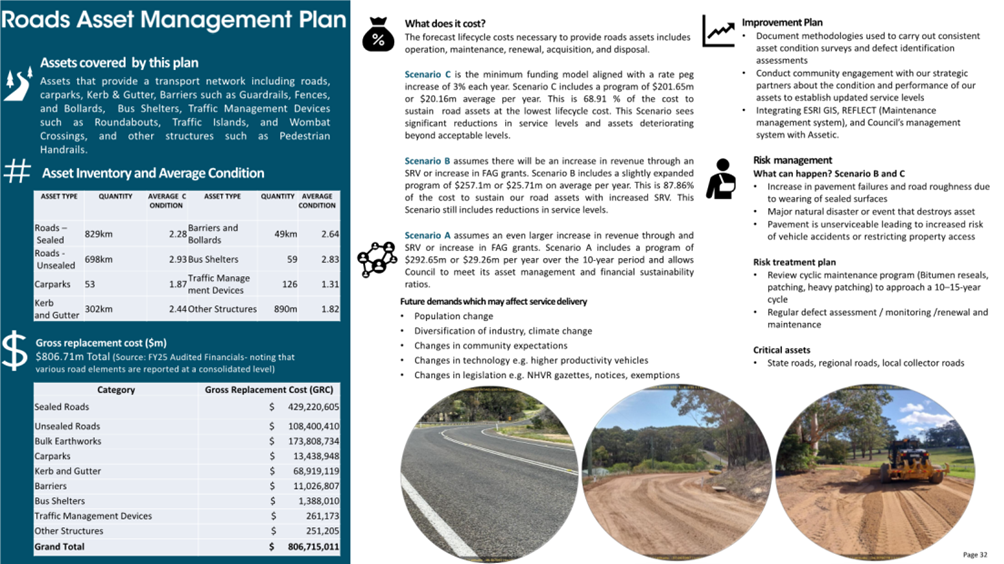
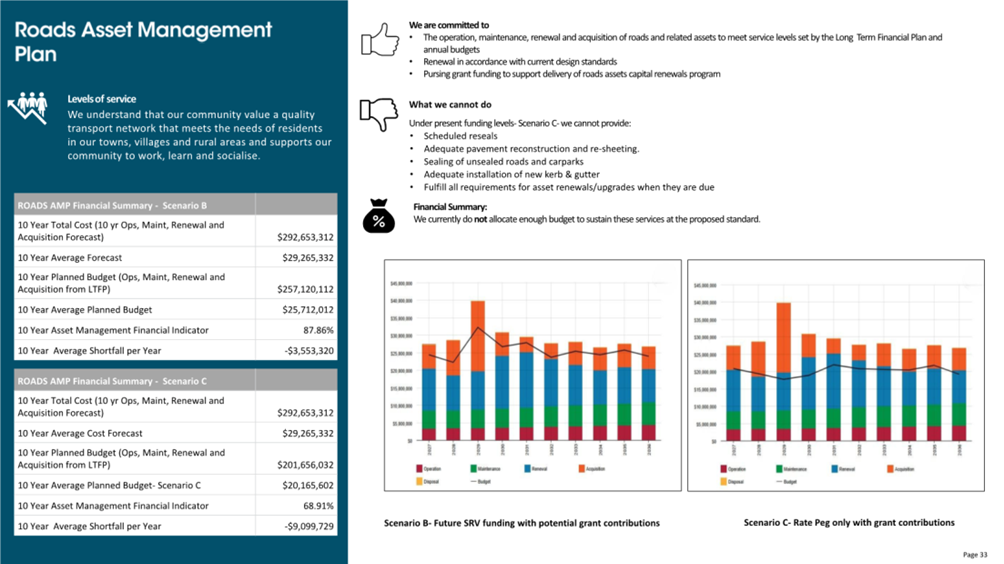
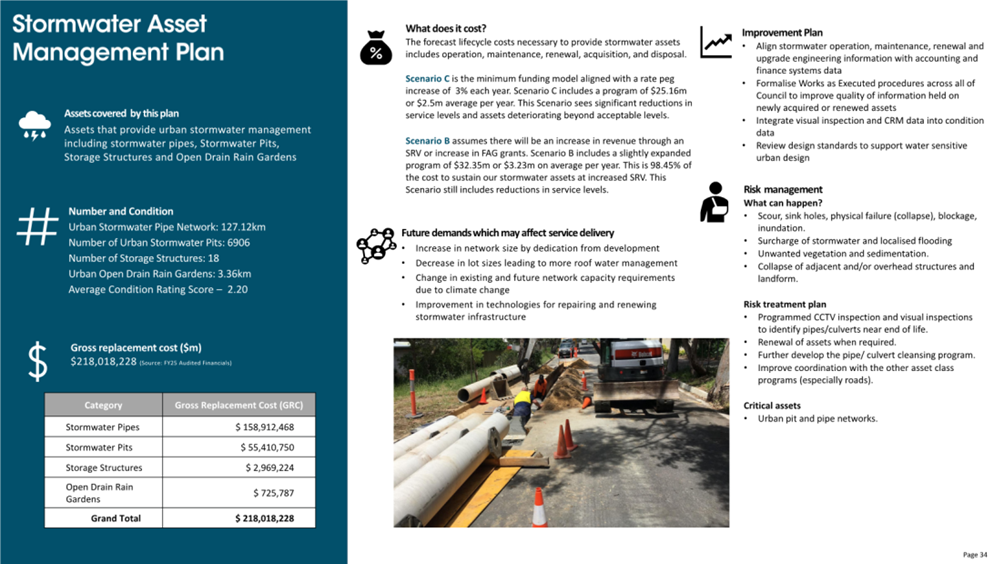
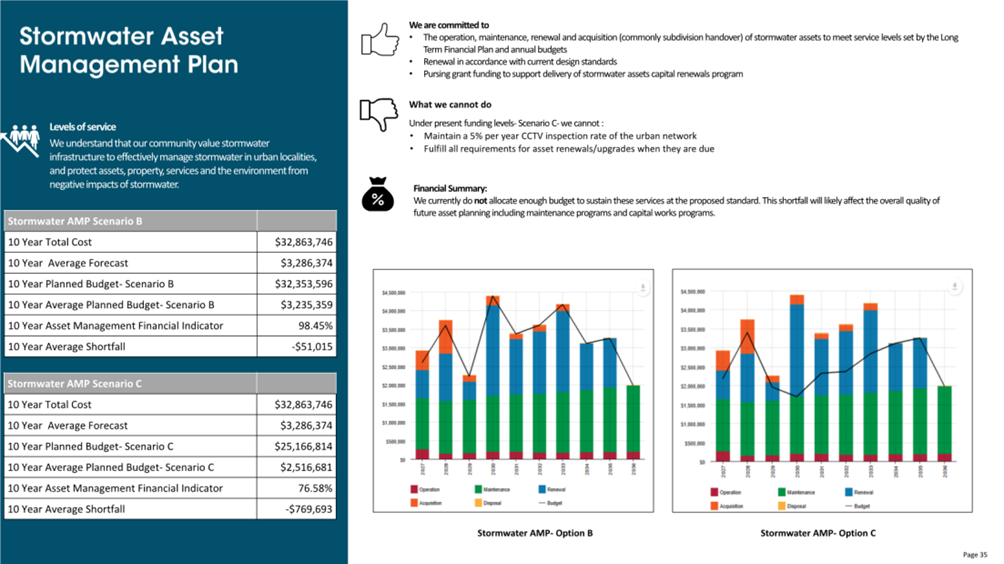
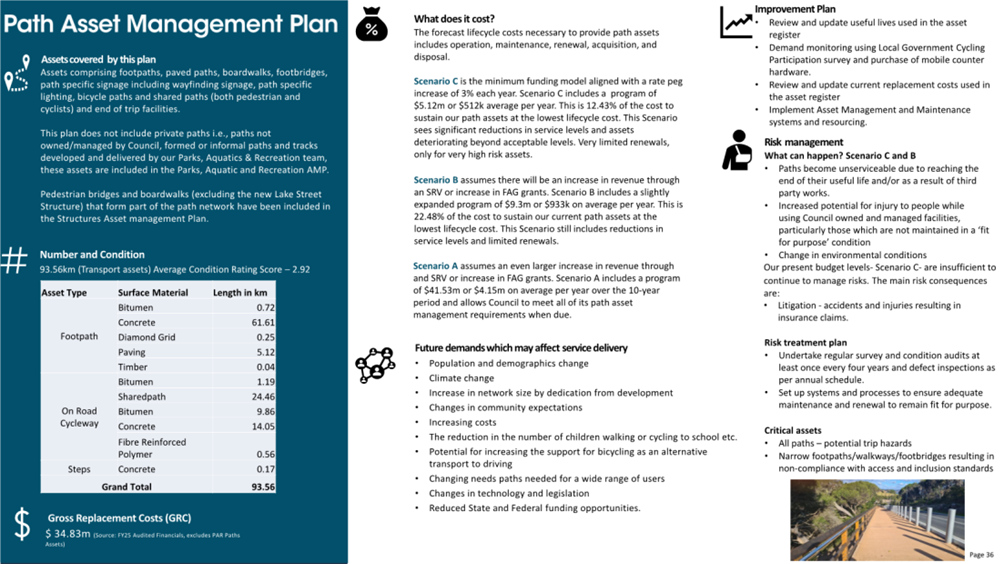
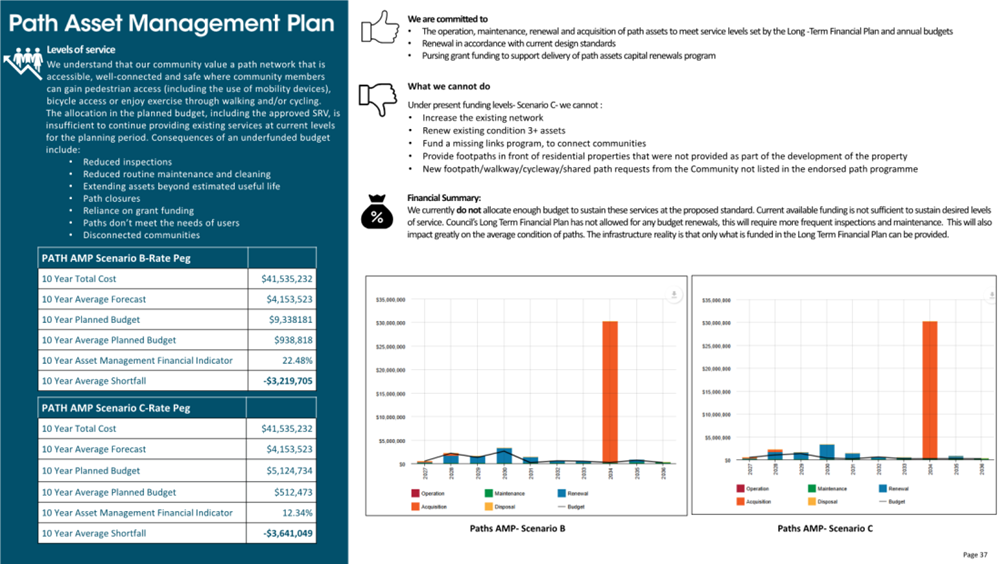
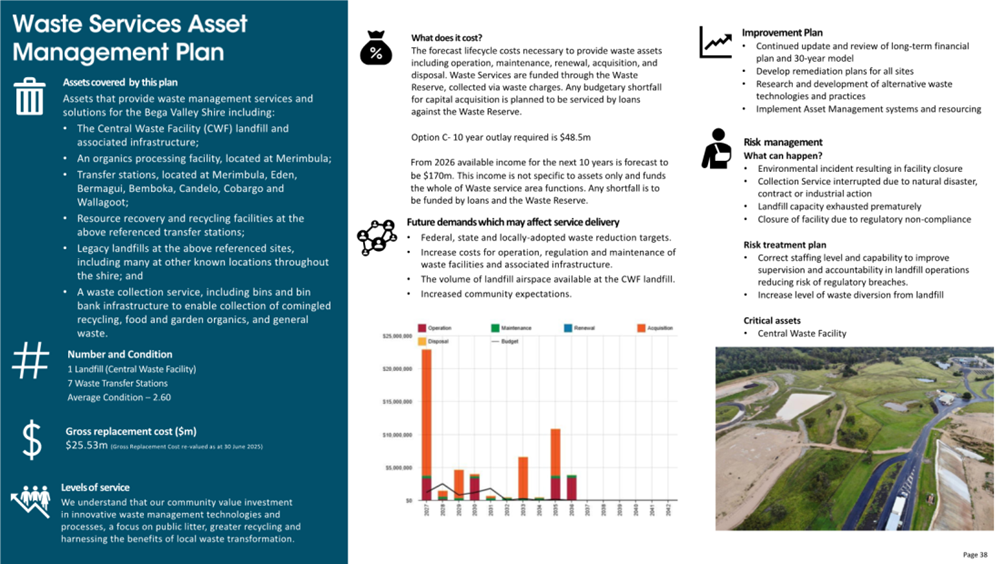
|
Council
|
6 May 2026
|
|
Item
11.1 - Attachment 4
|
Draft Revenue Policy 2026-27
|

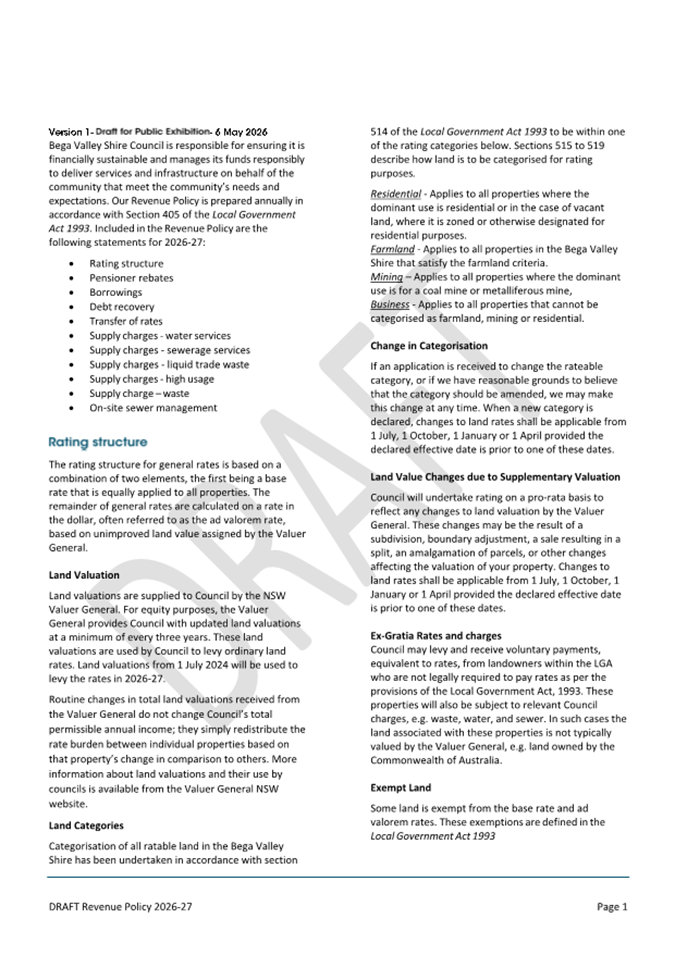
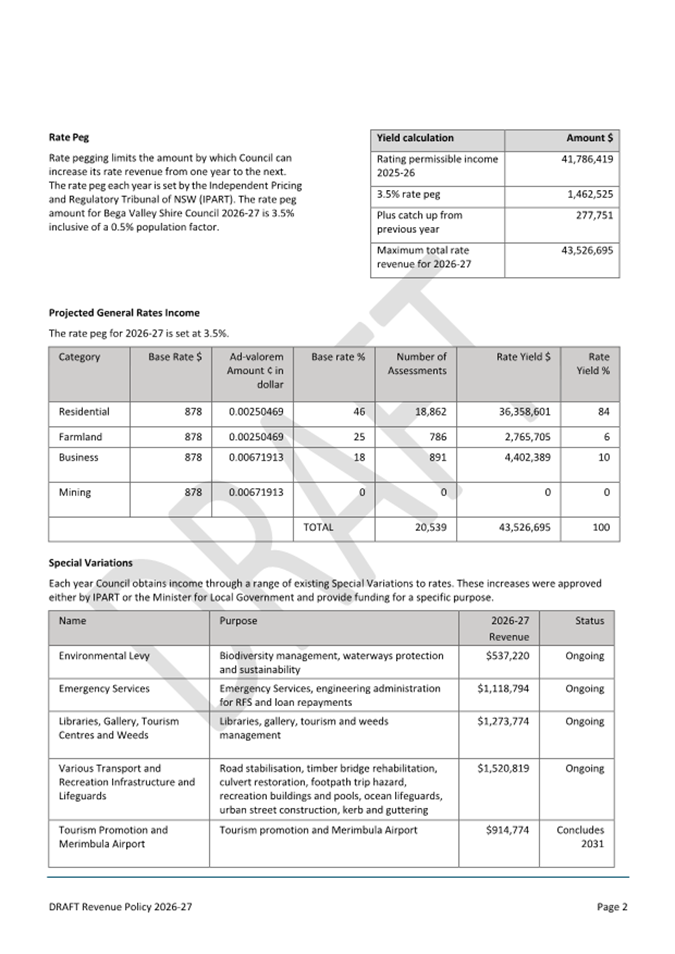
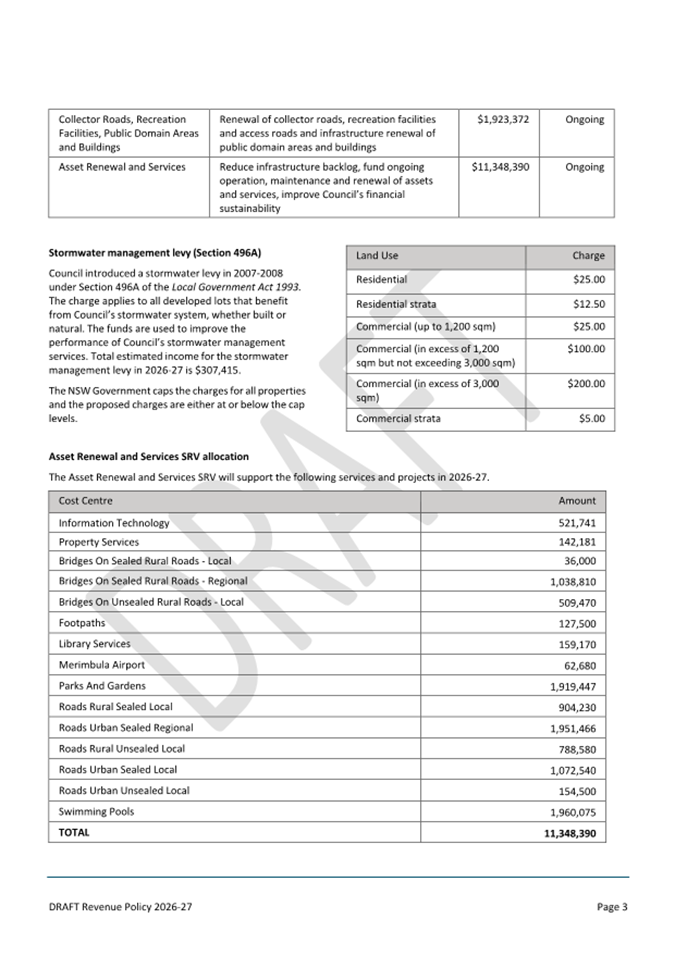
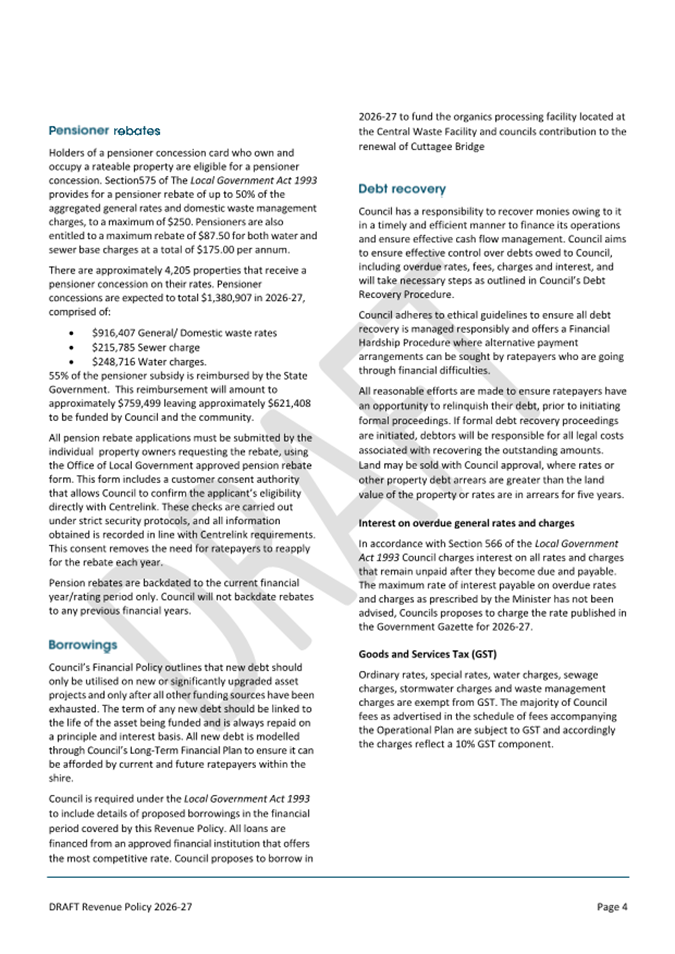
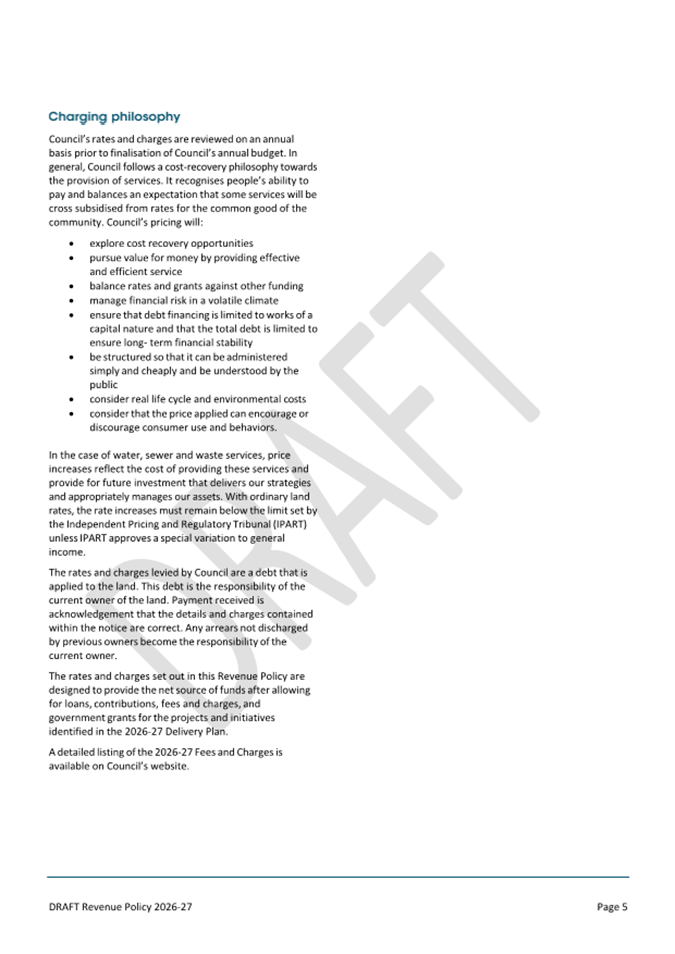
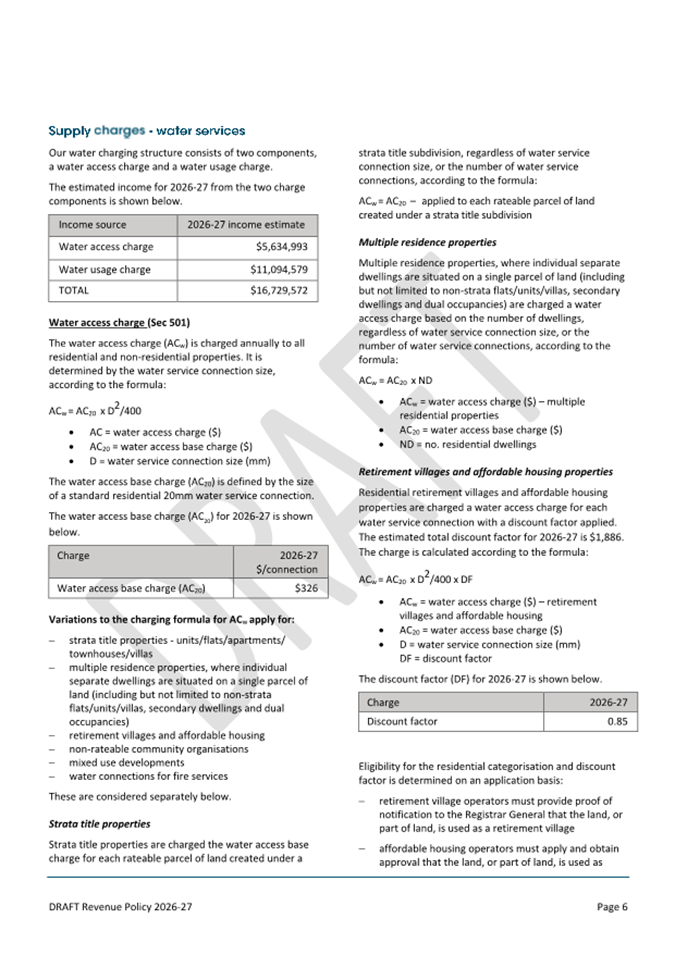
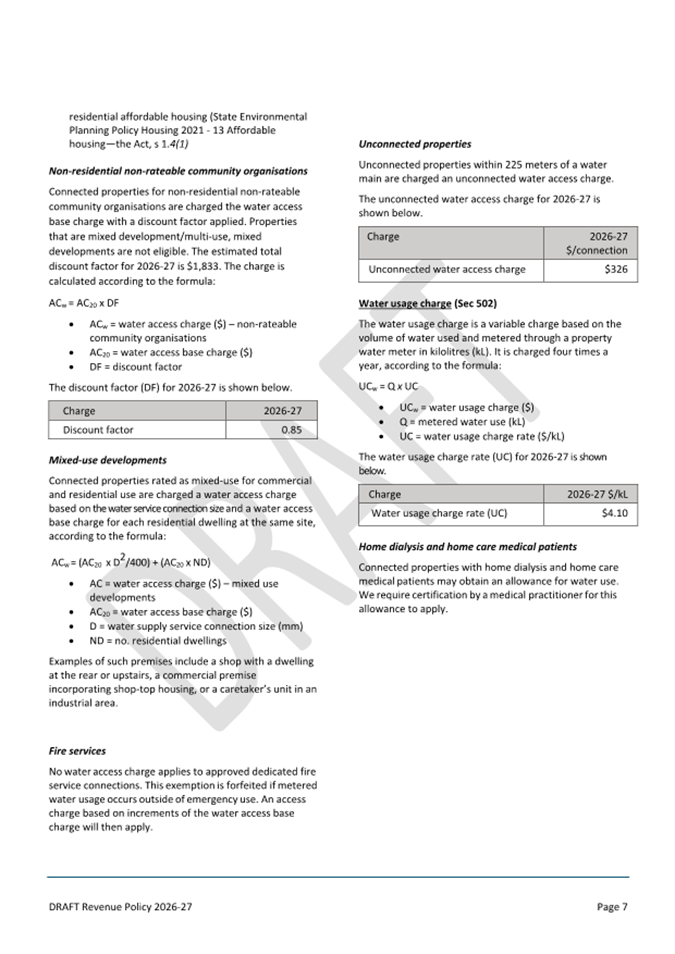
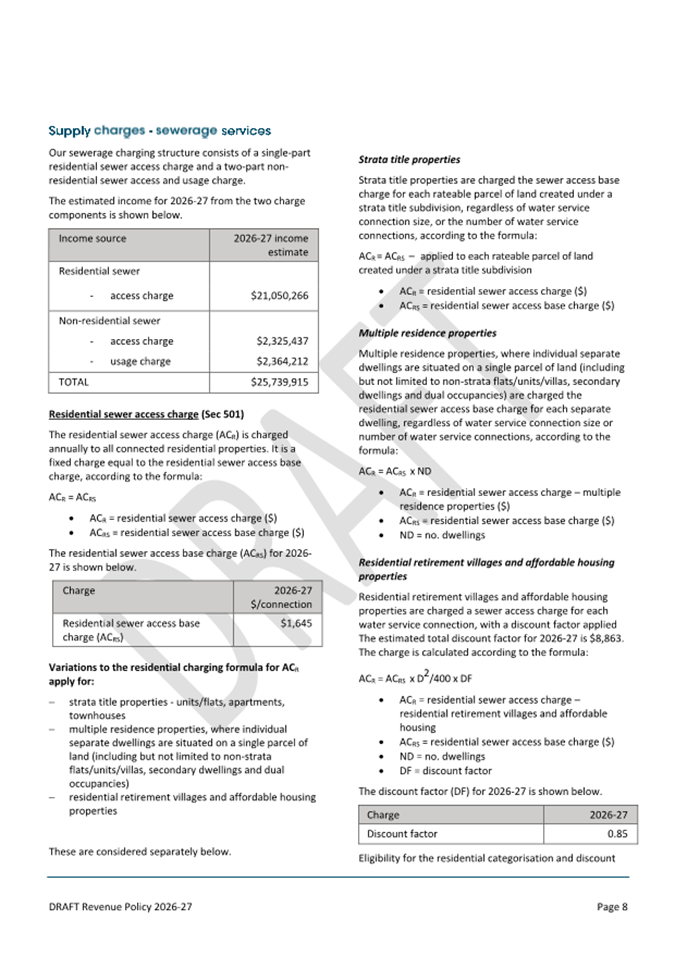
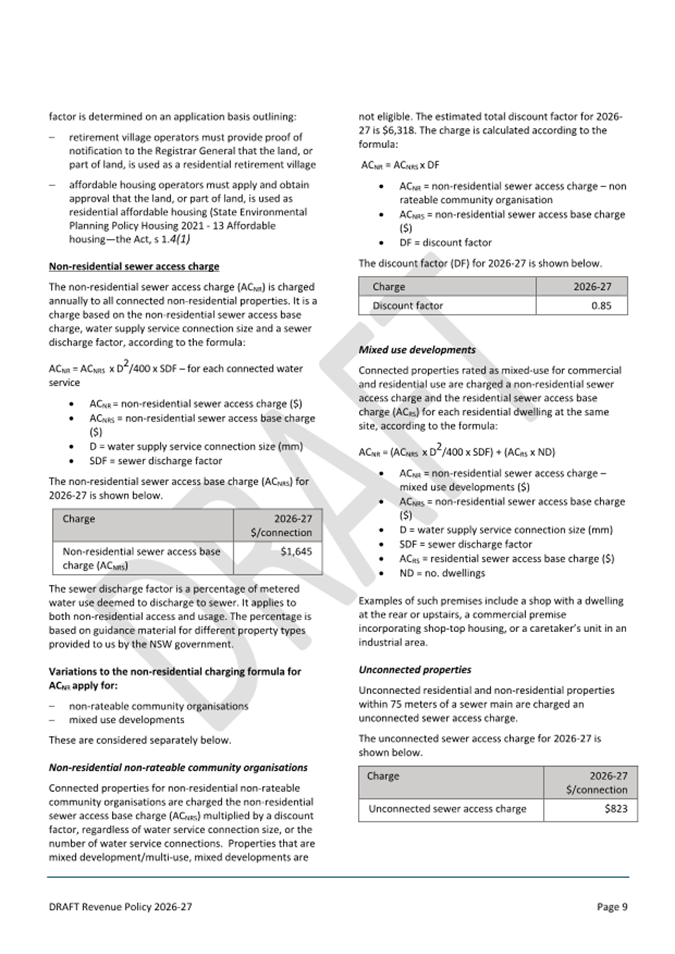
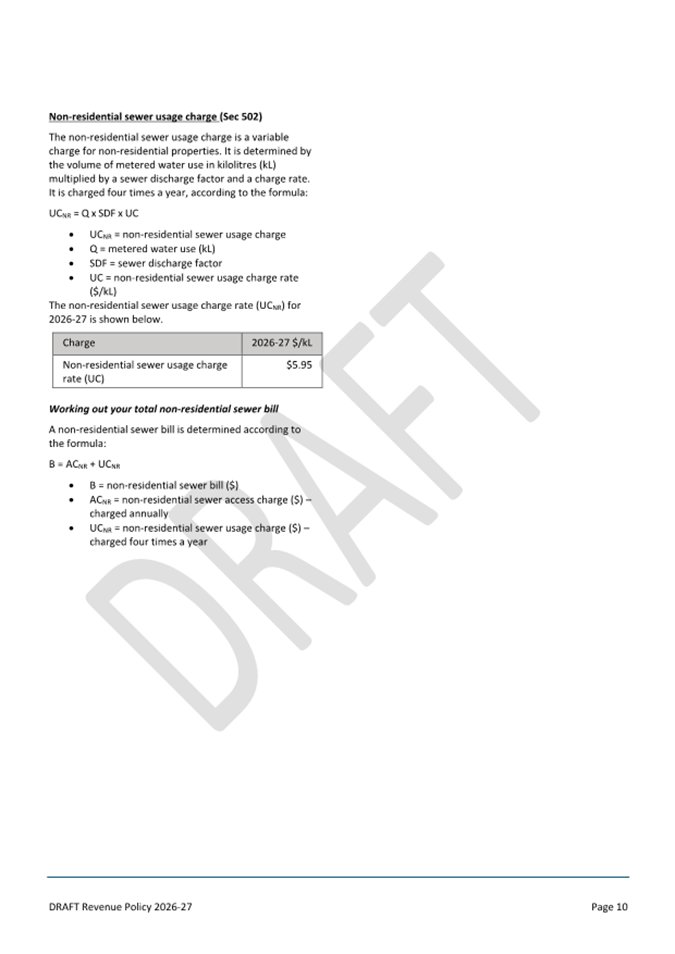
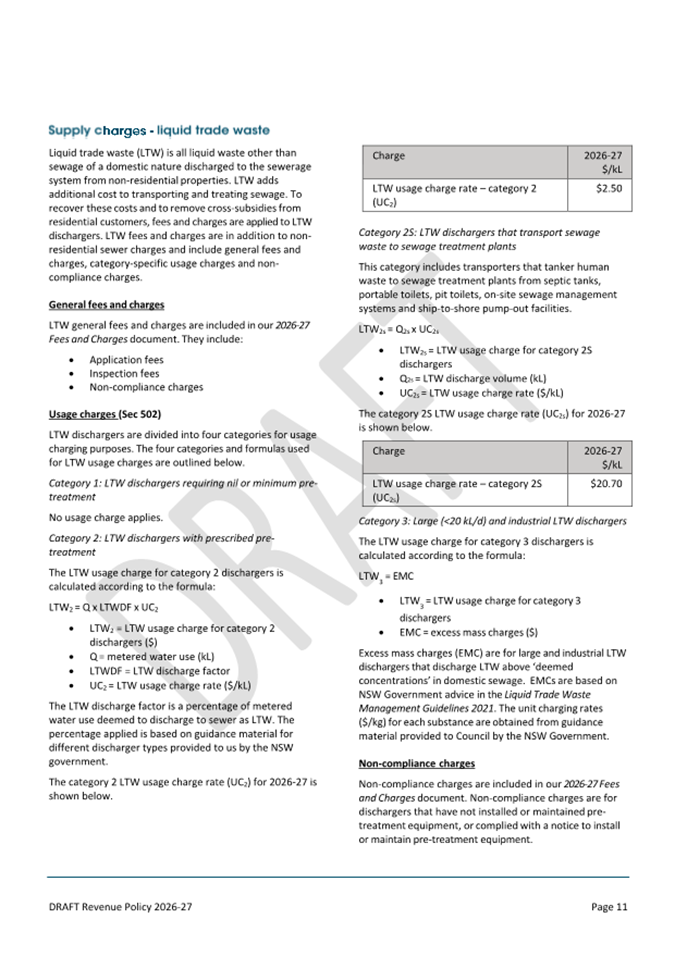
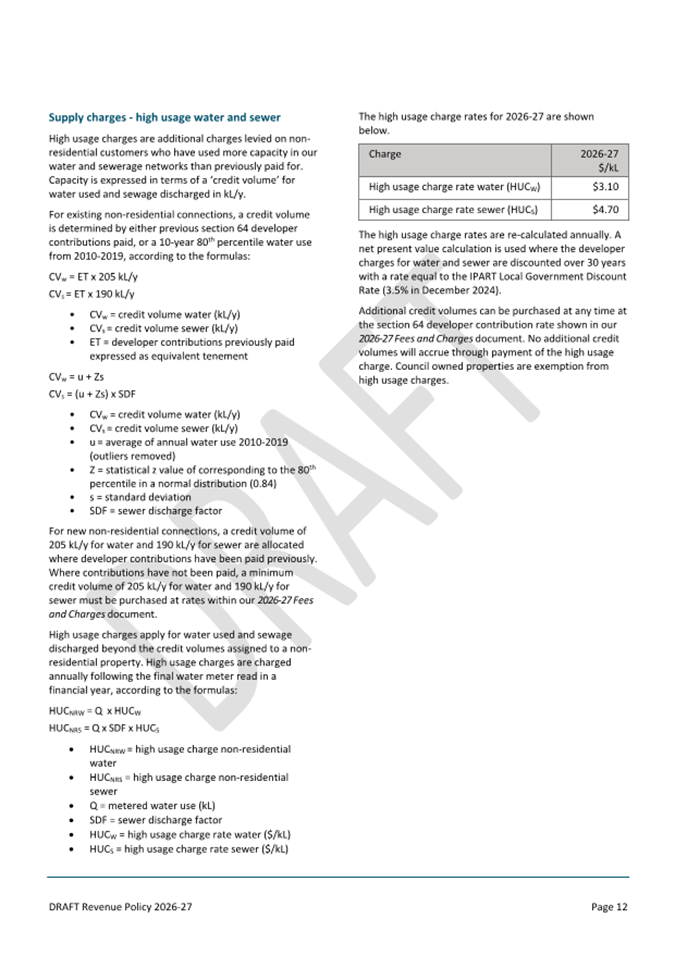
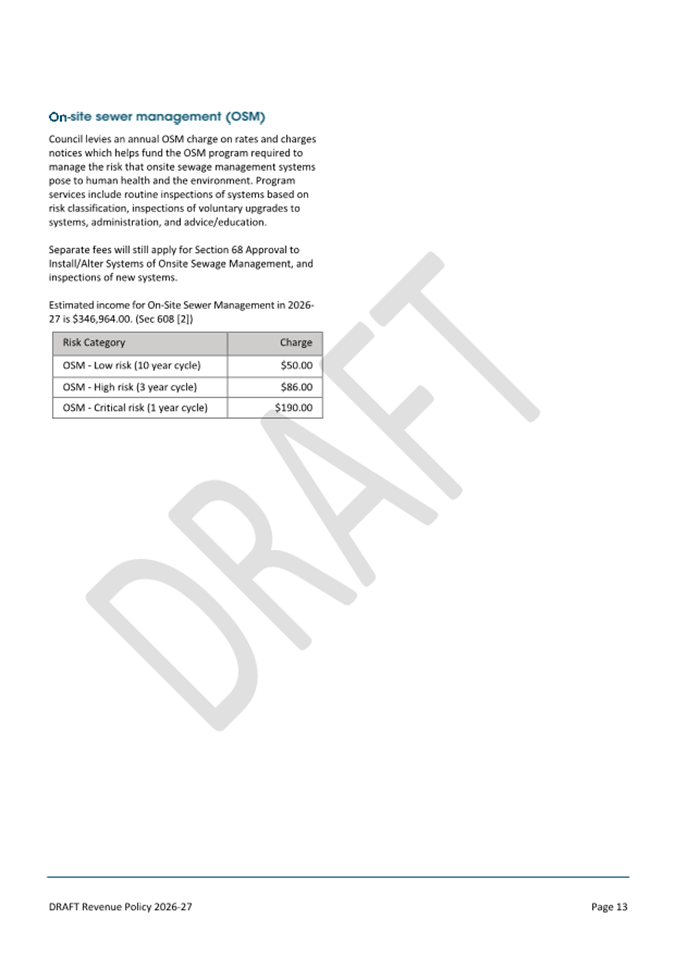
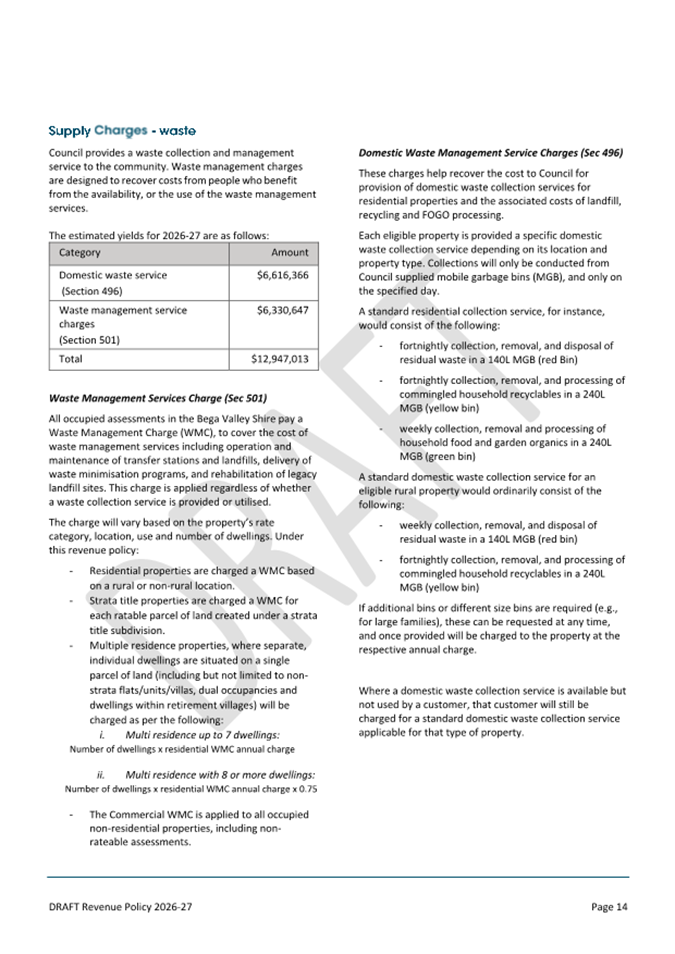
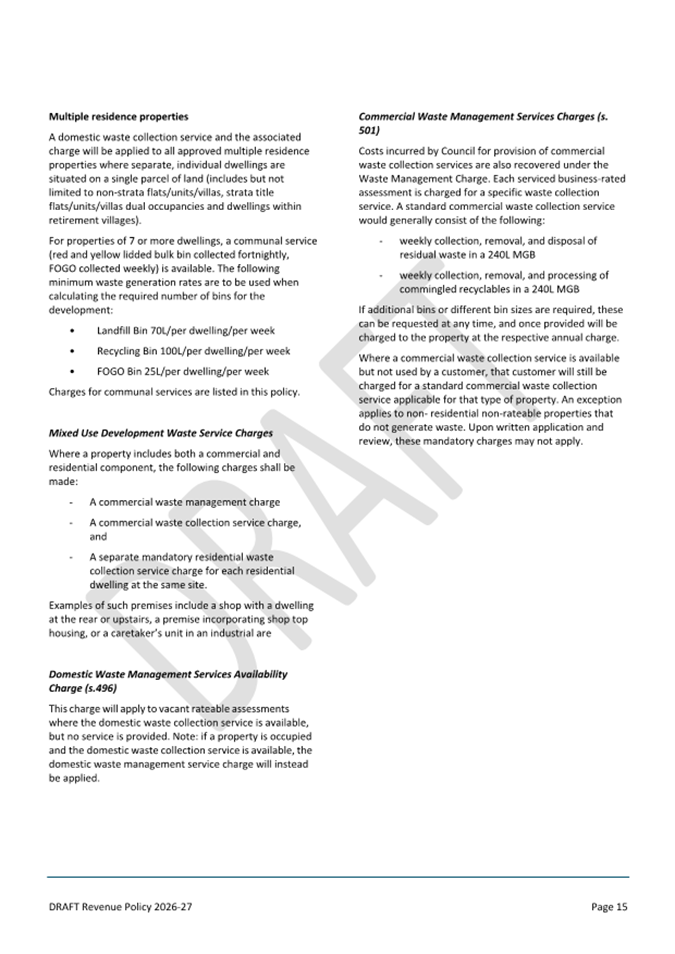
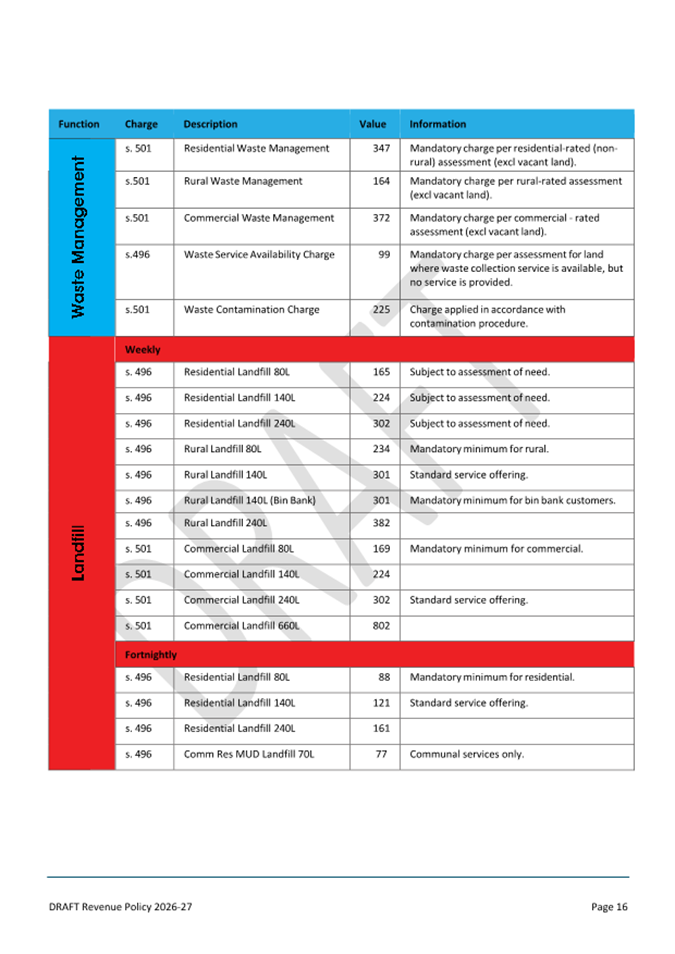
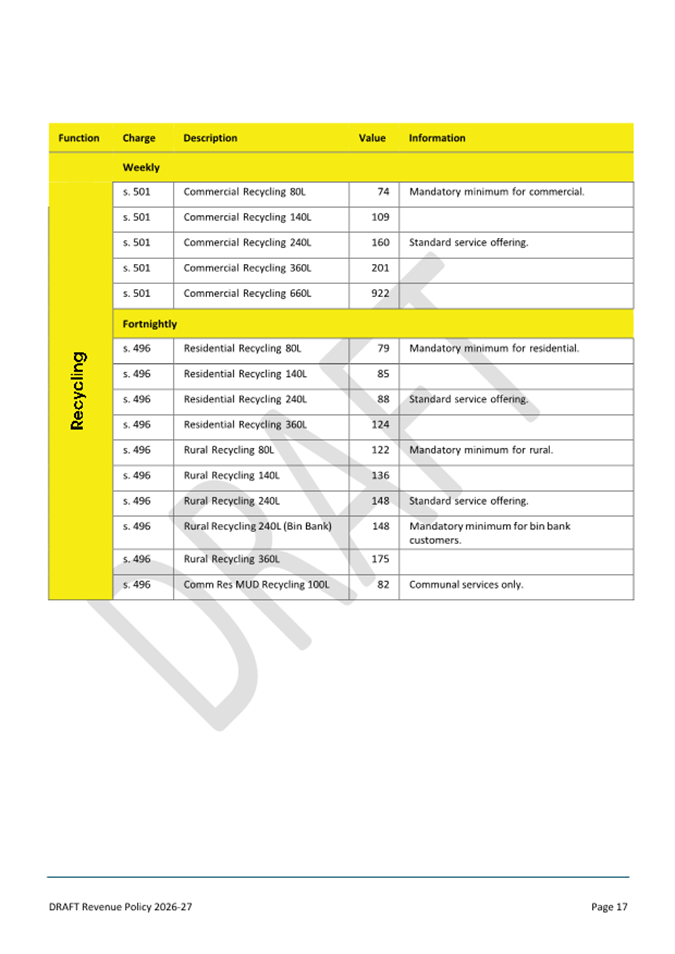
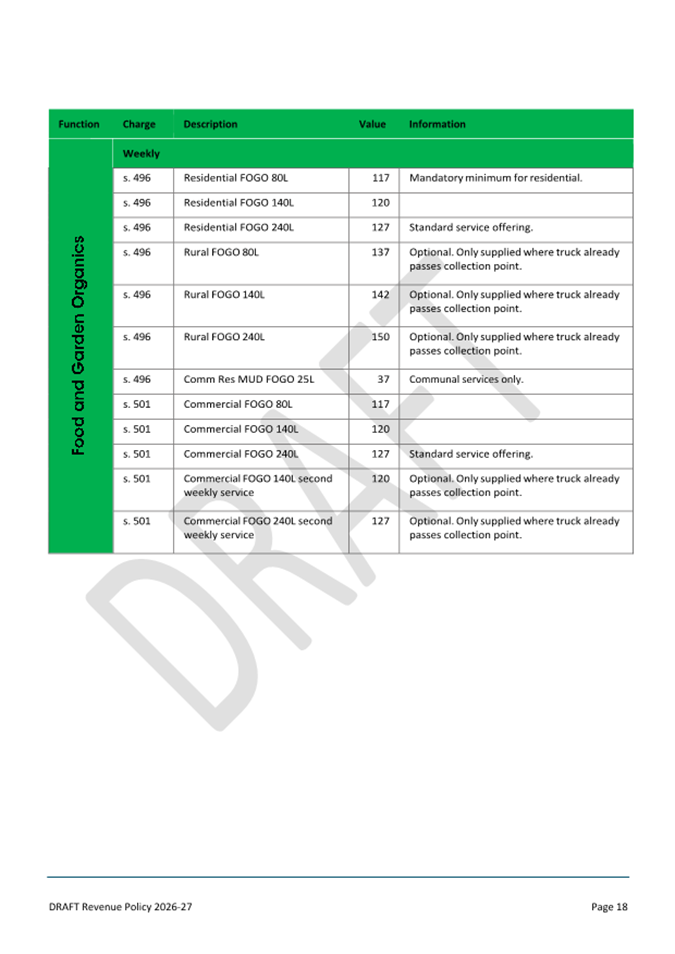
|
Council
|
6 May 2026
|
|
Item
11.1 - Attachment 5
|
Draft Fees and Charges 2026-2027
|

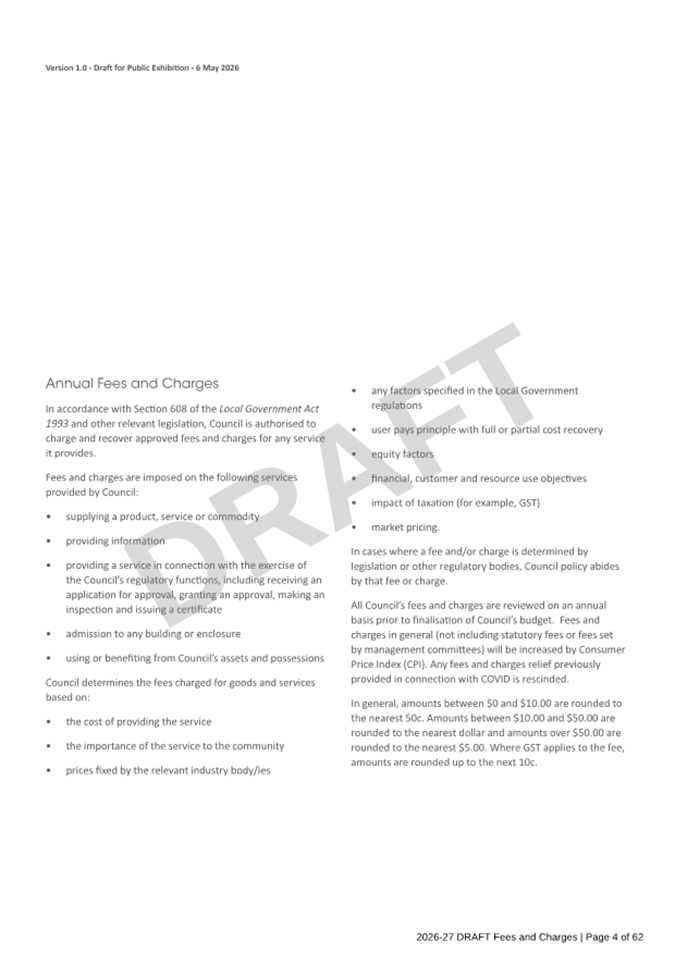
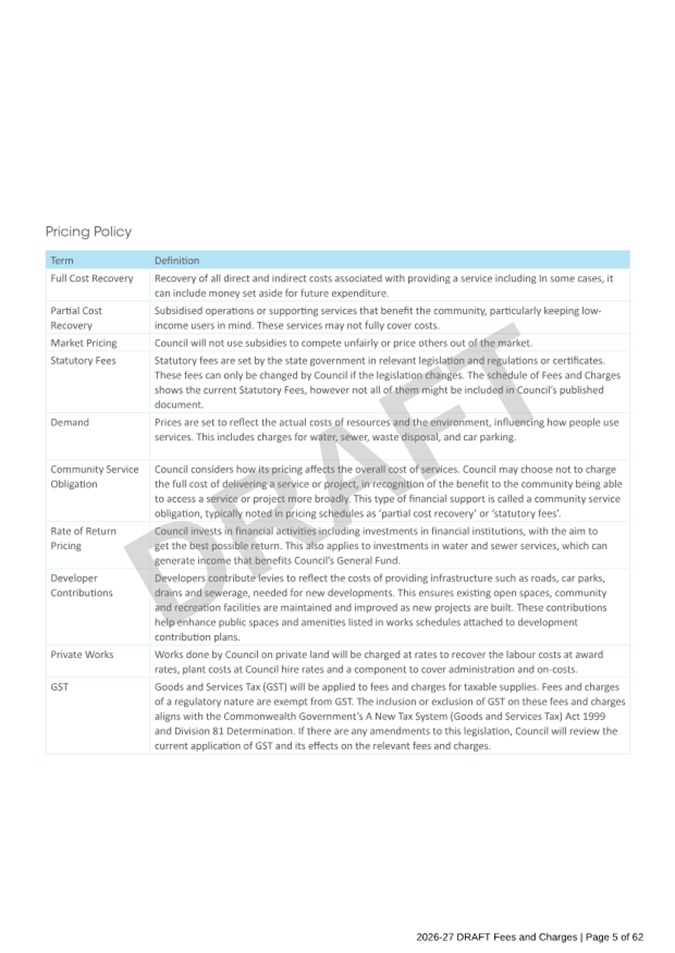
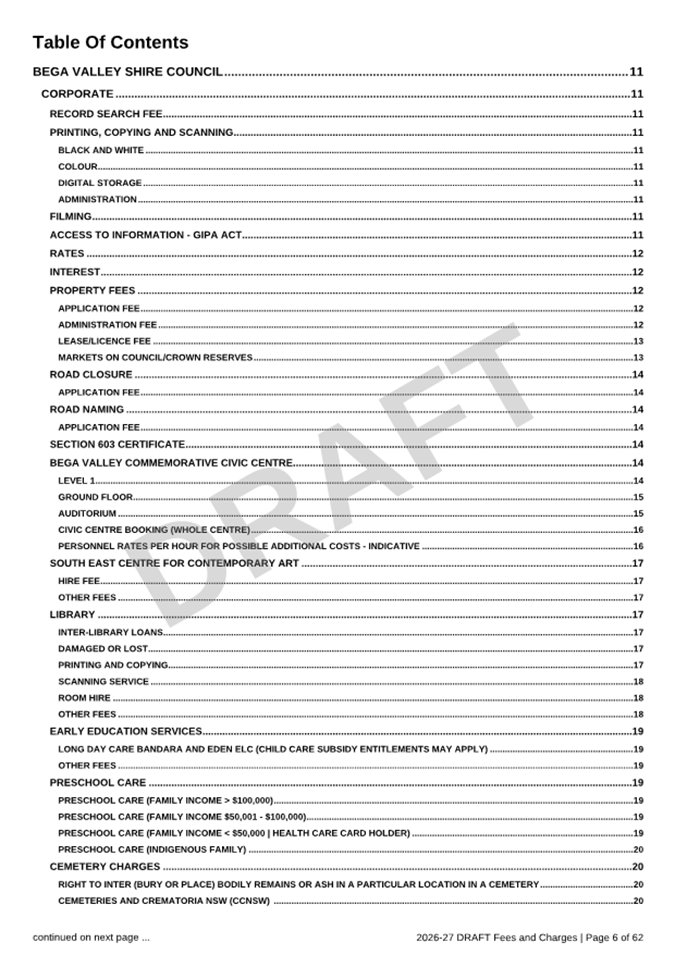
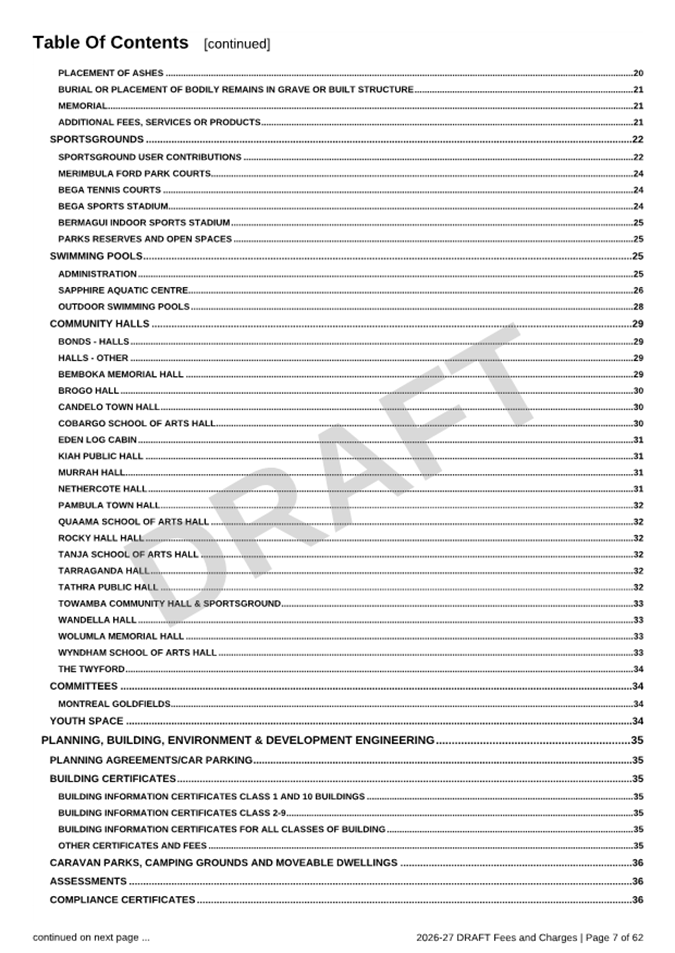
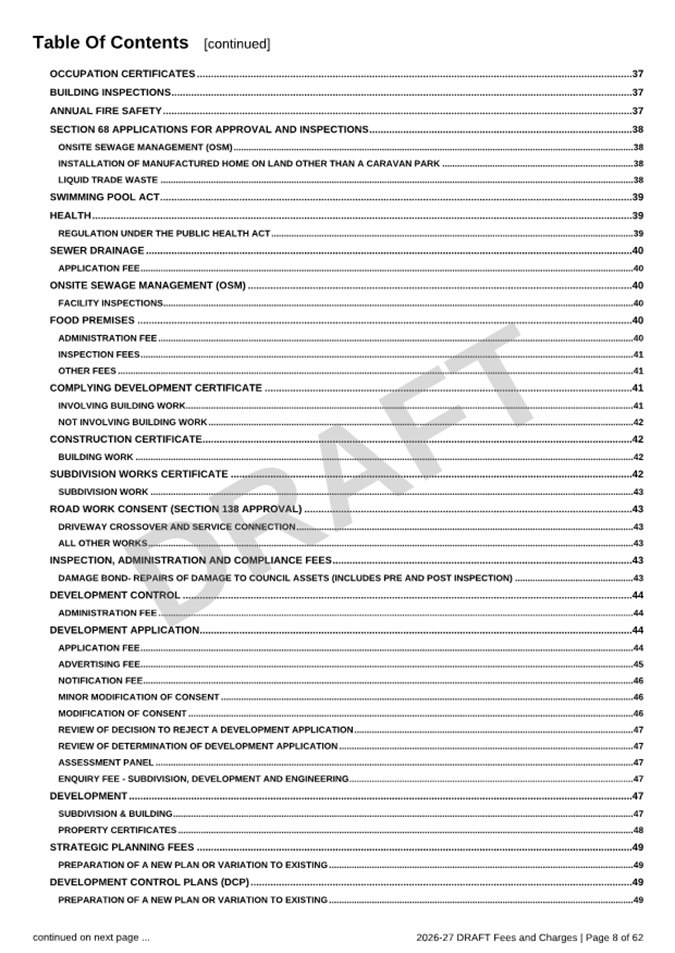
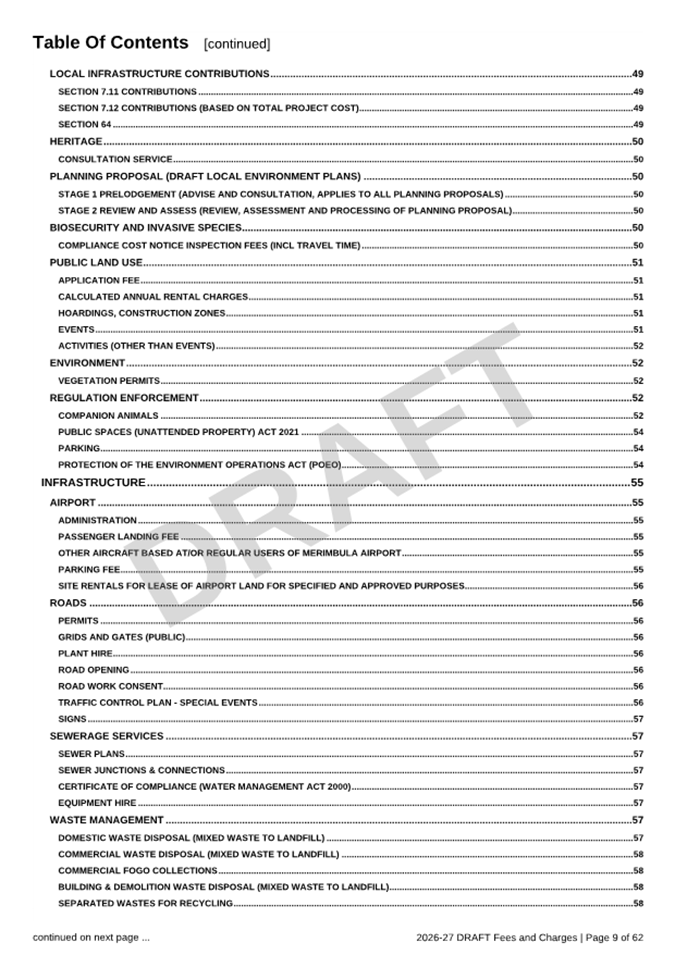

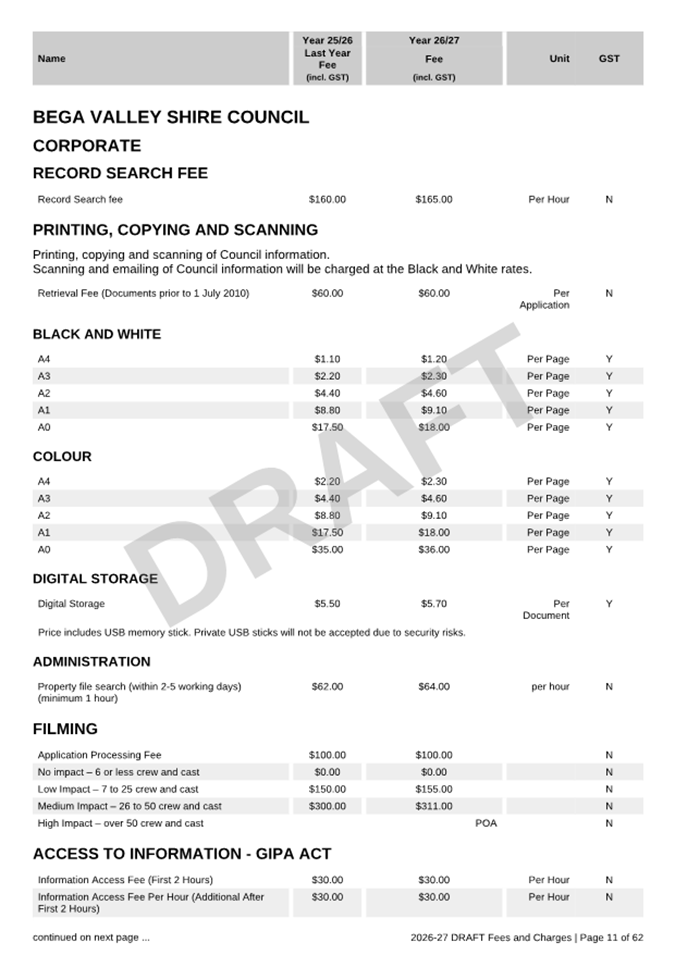
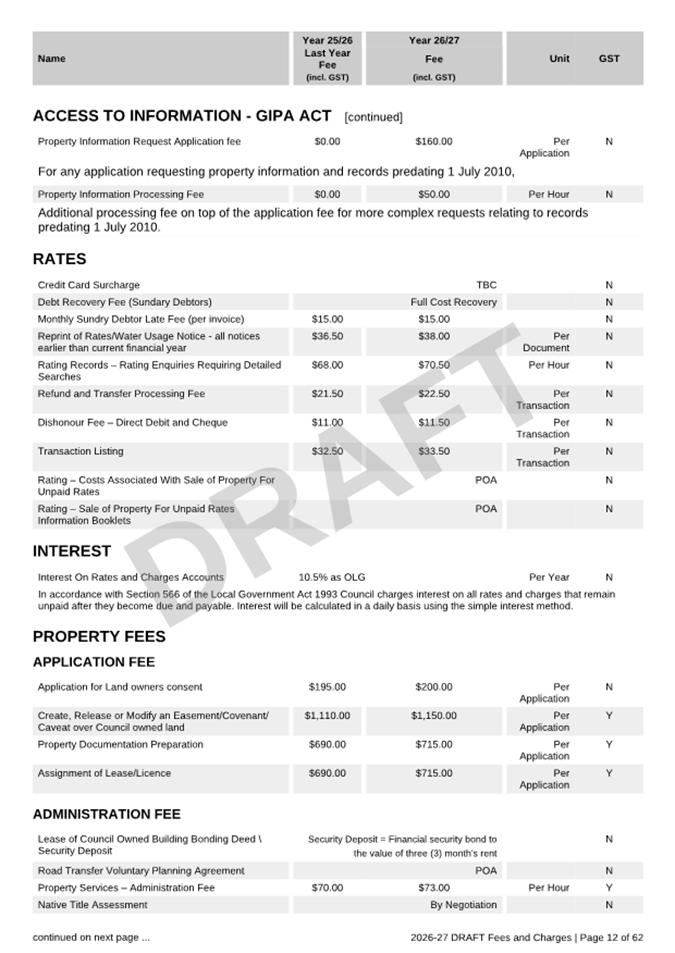
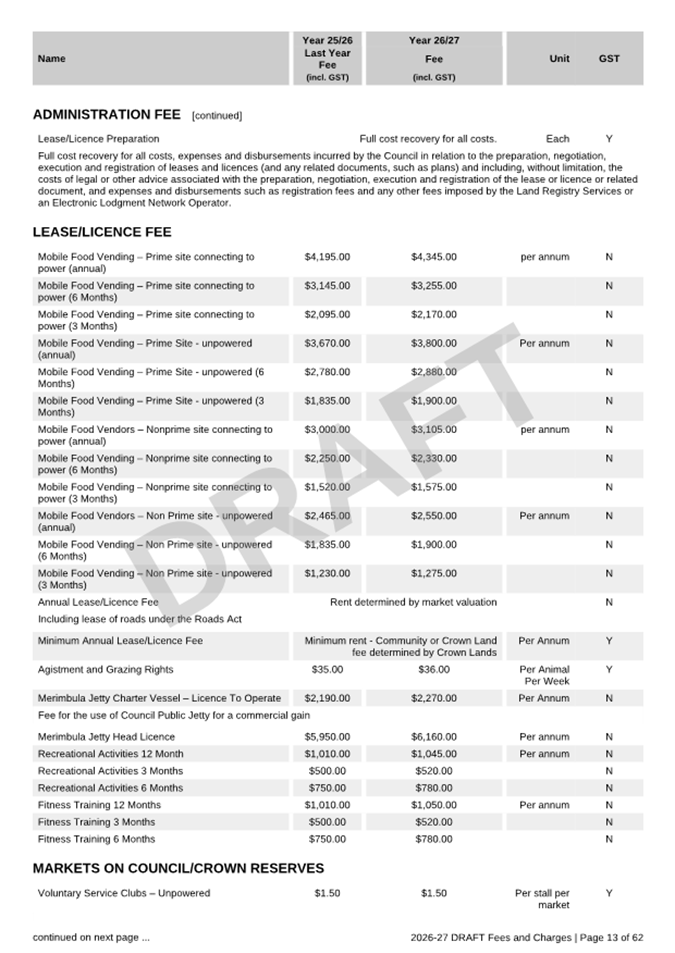
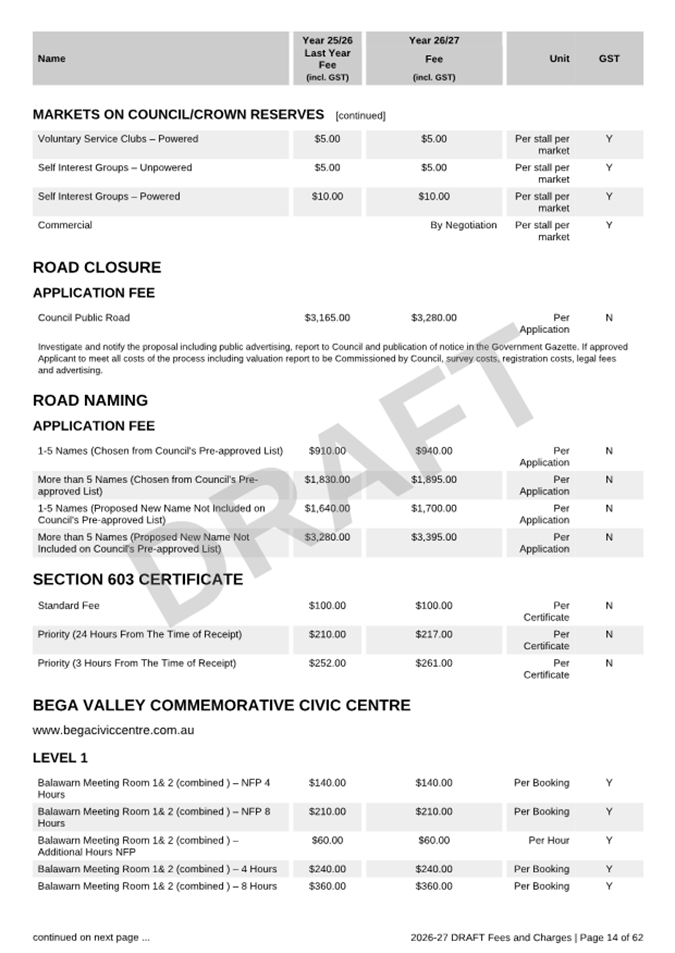
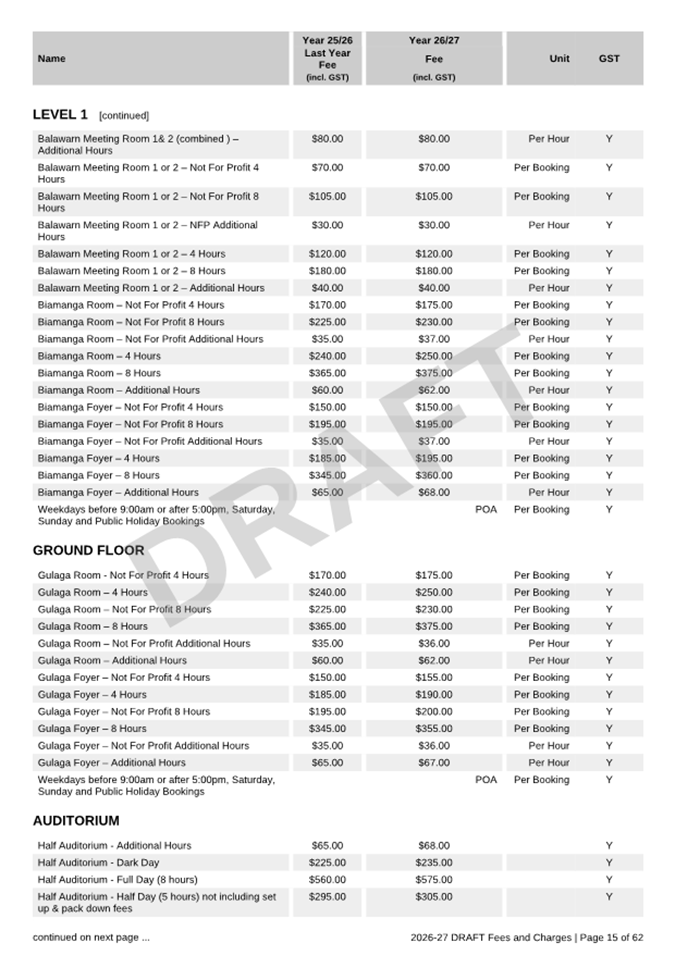
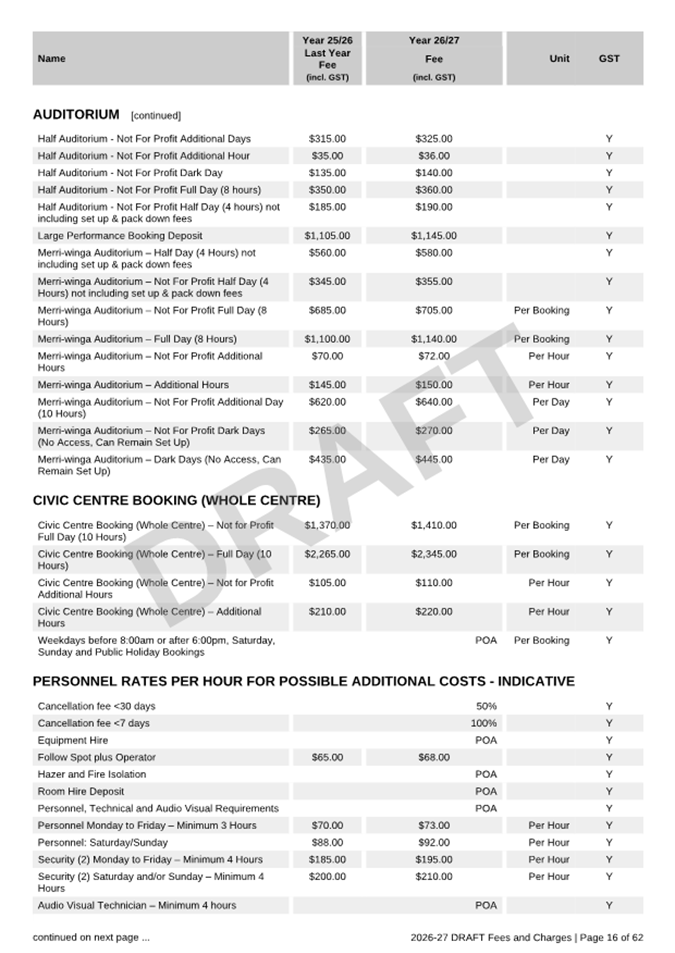
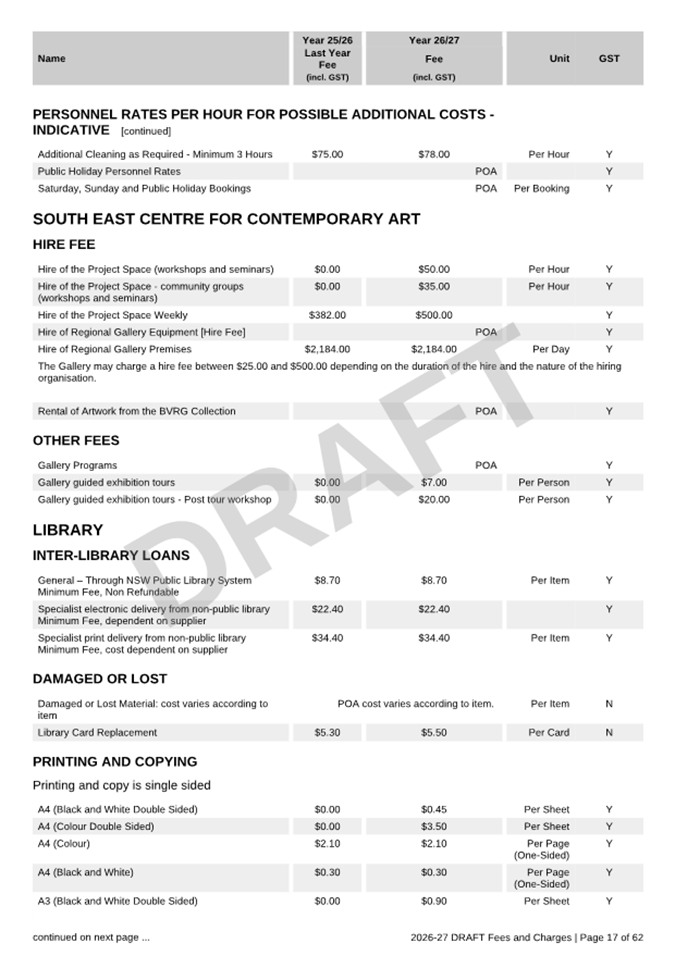
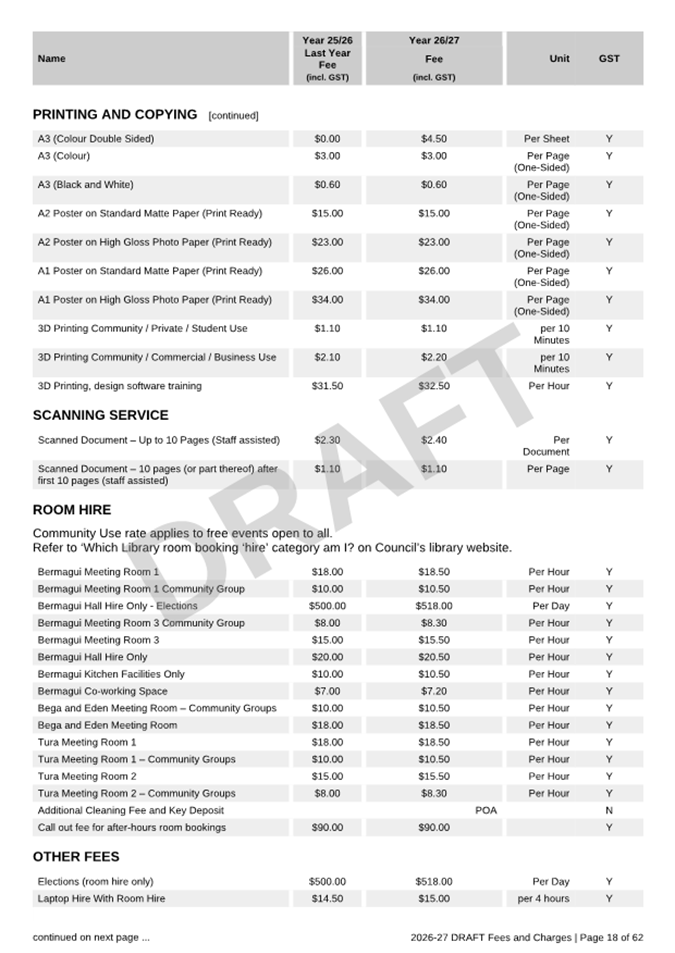

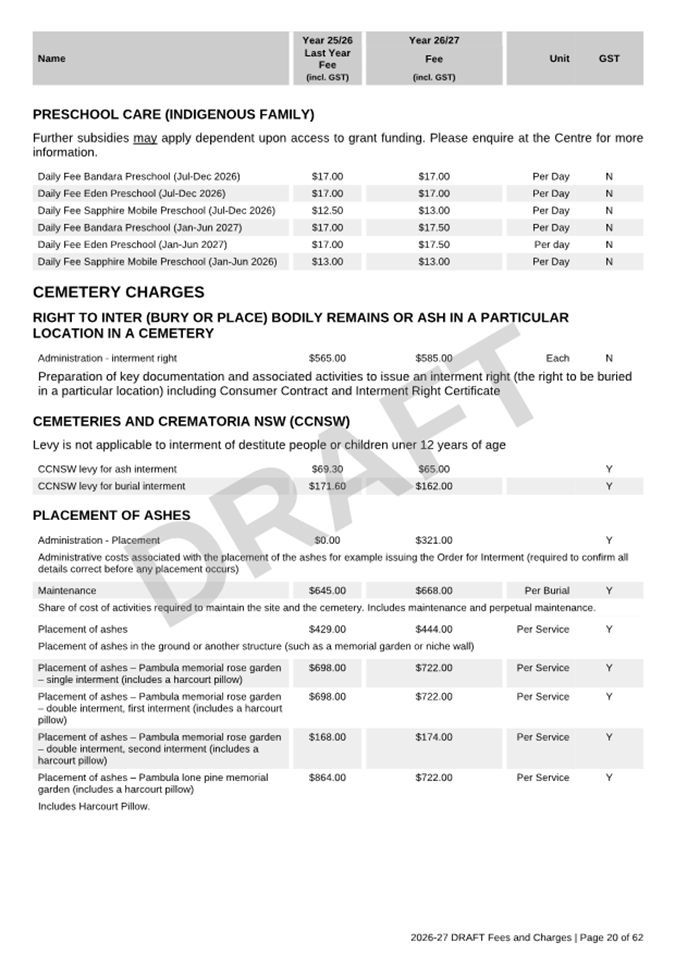
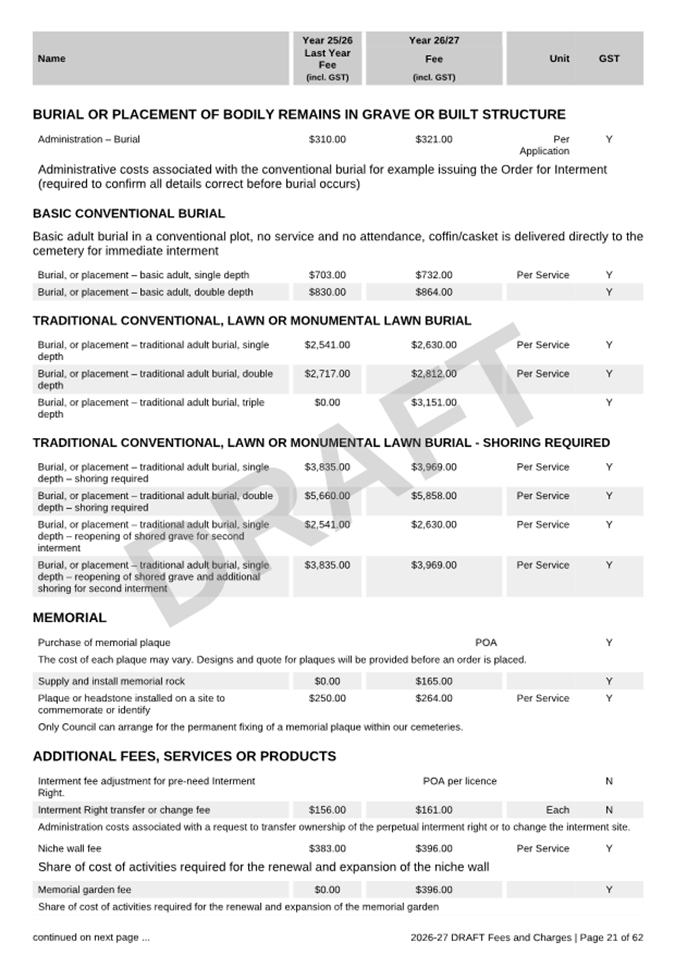
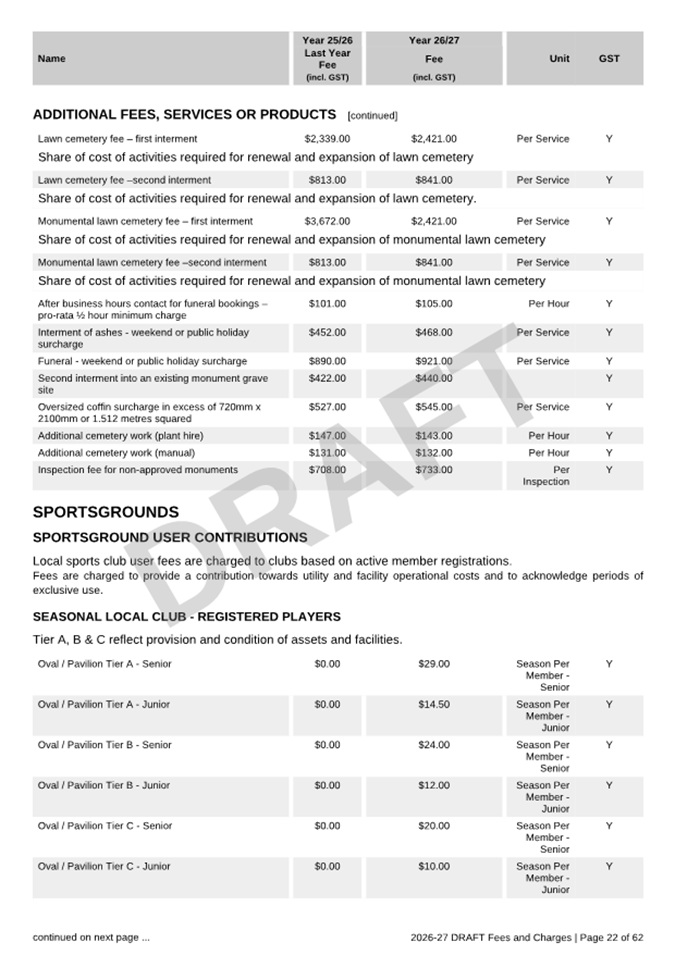
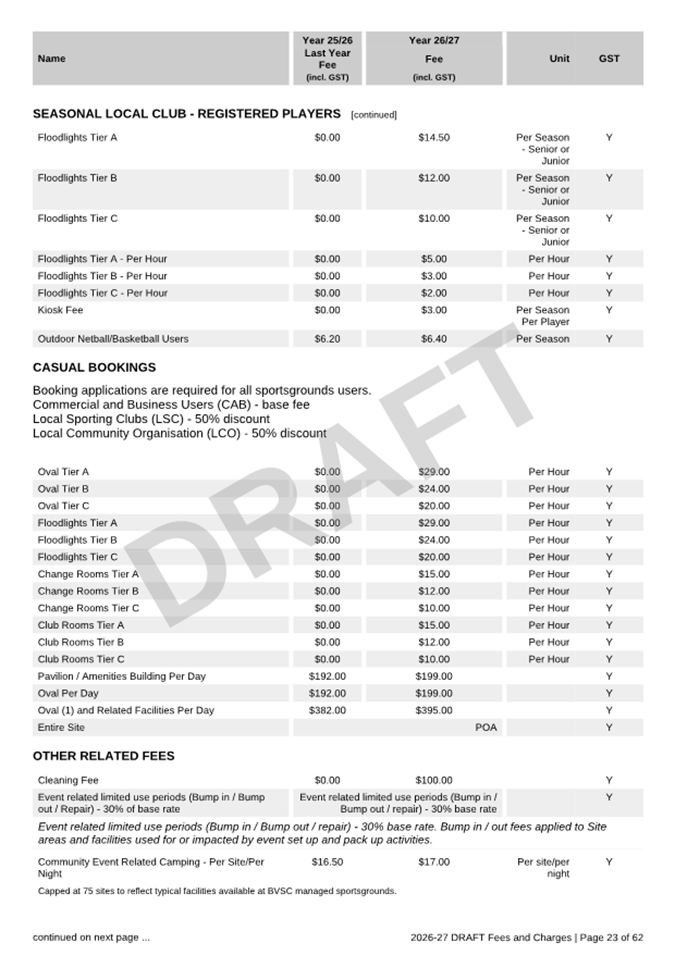
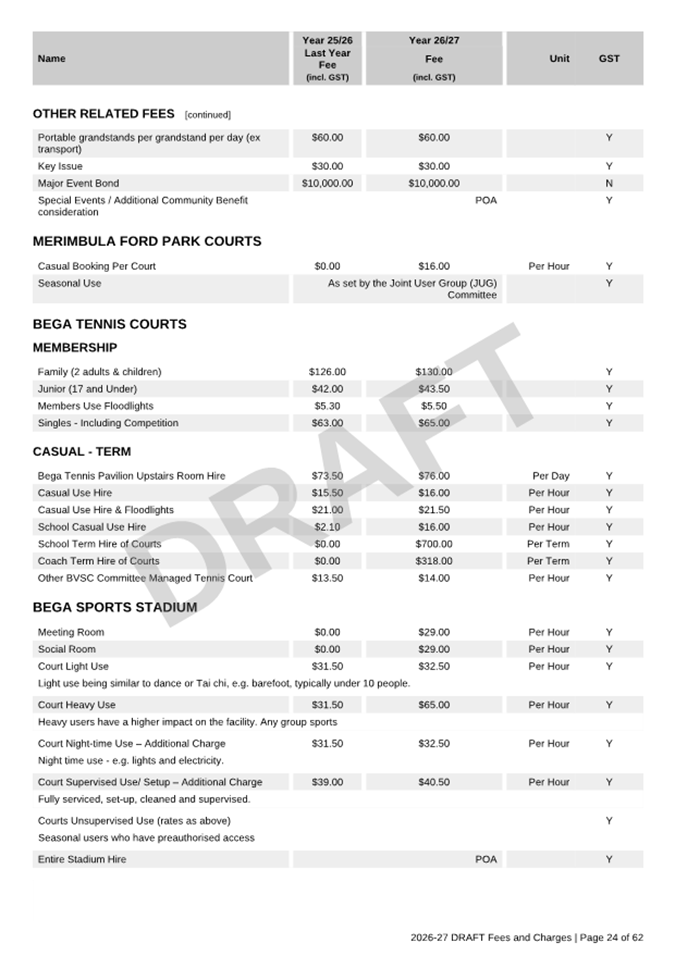
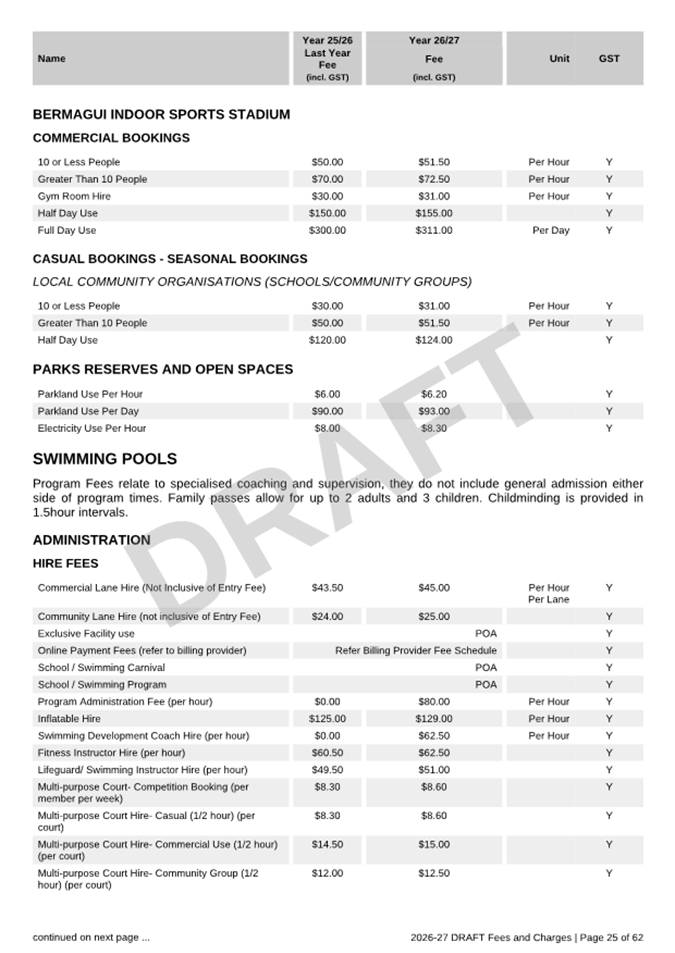
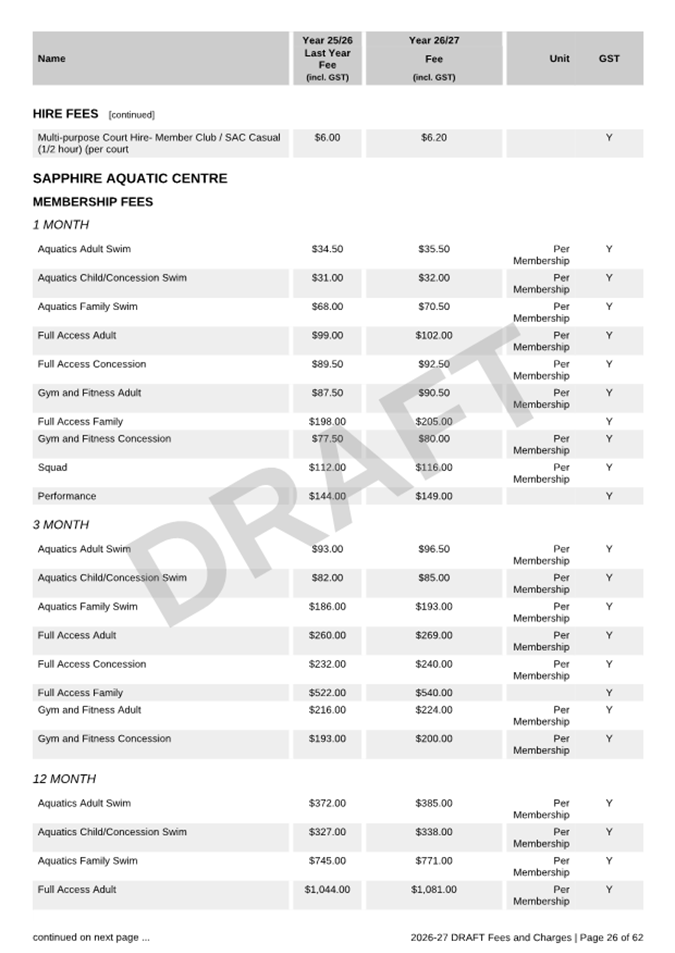
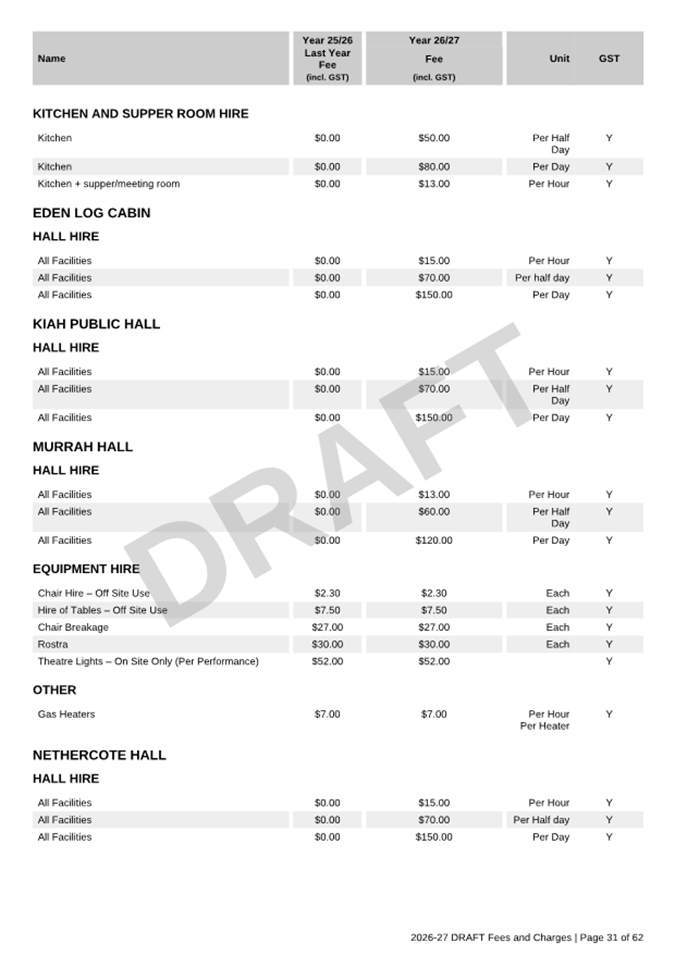
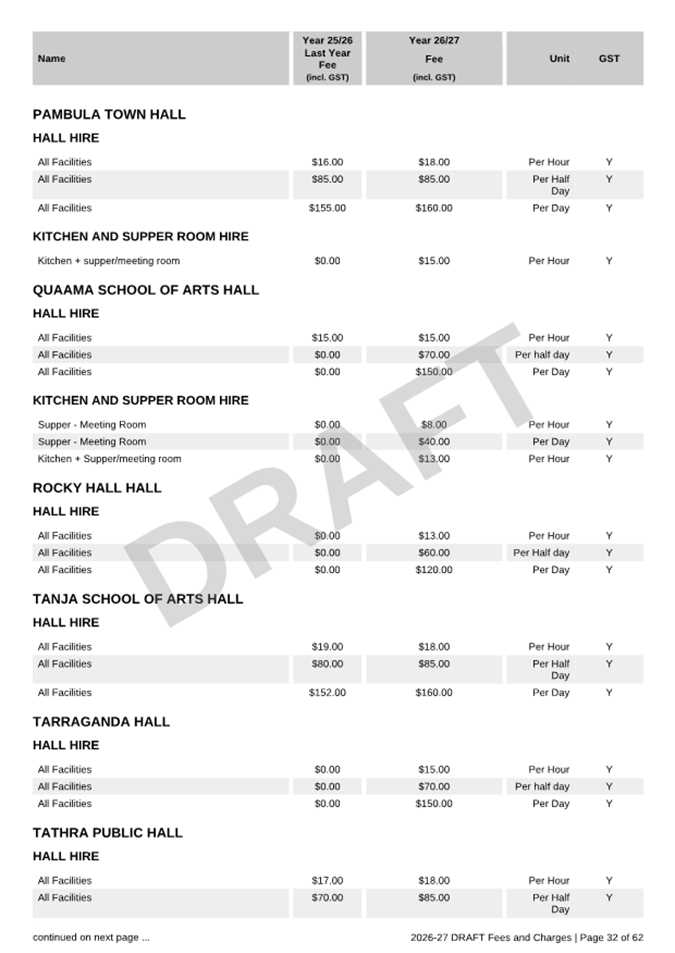
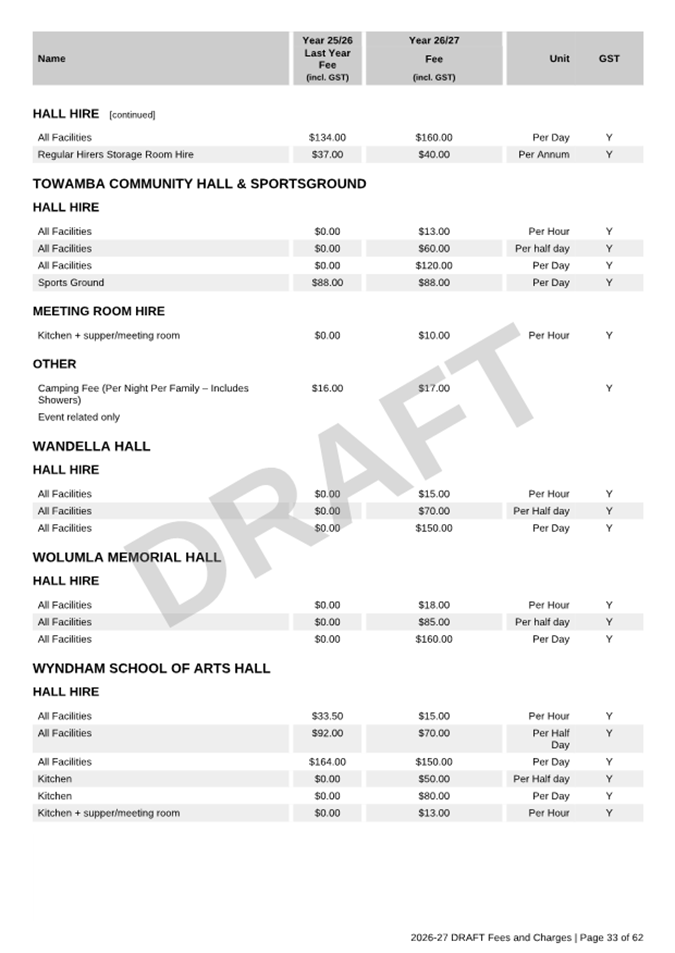
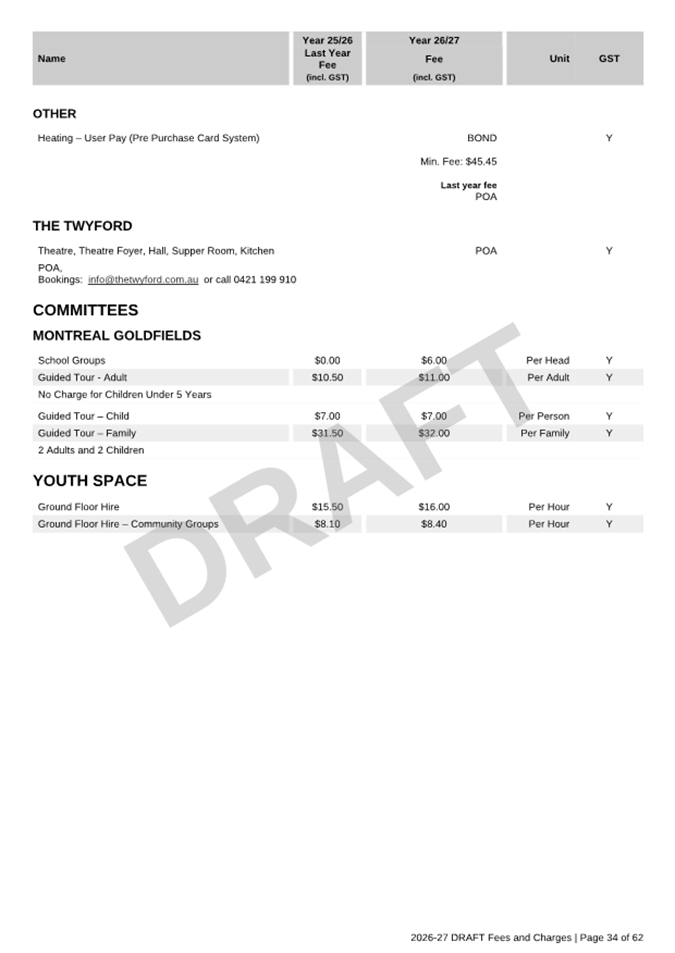
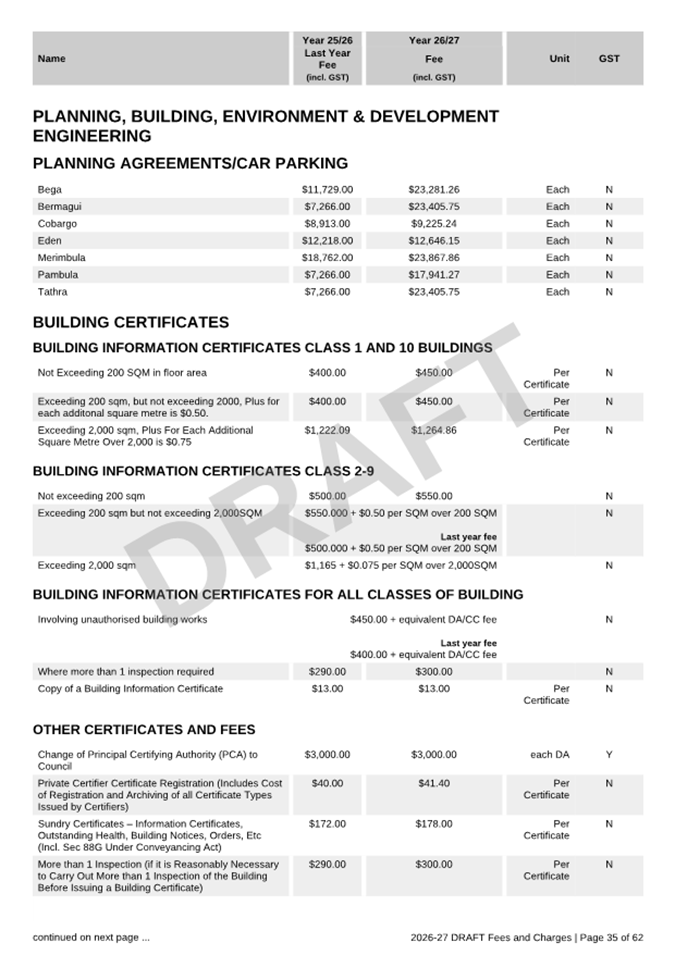
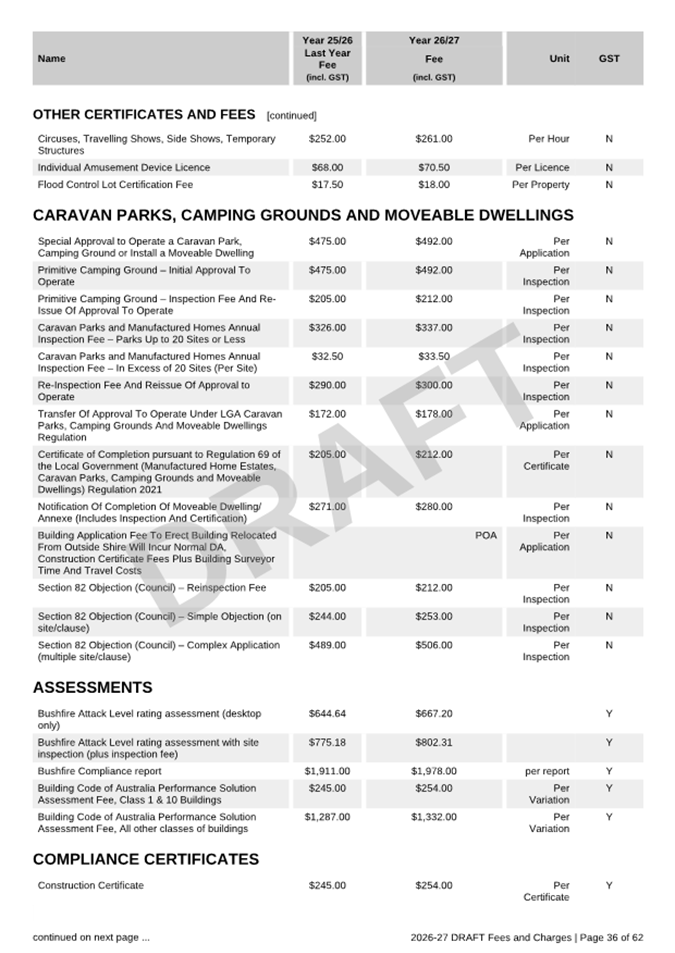
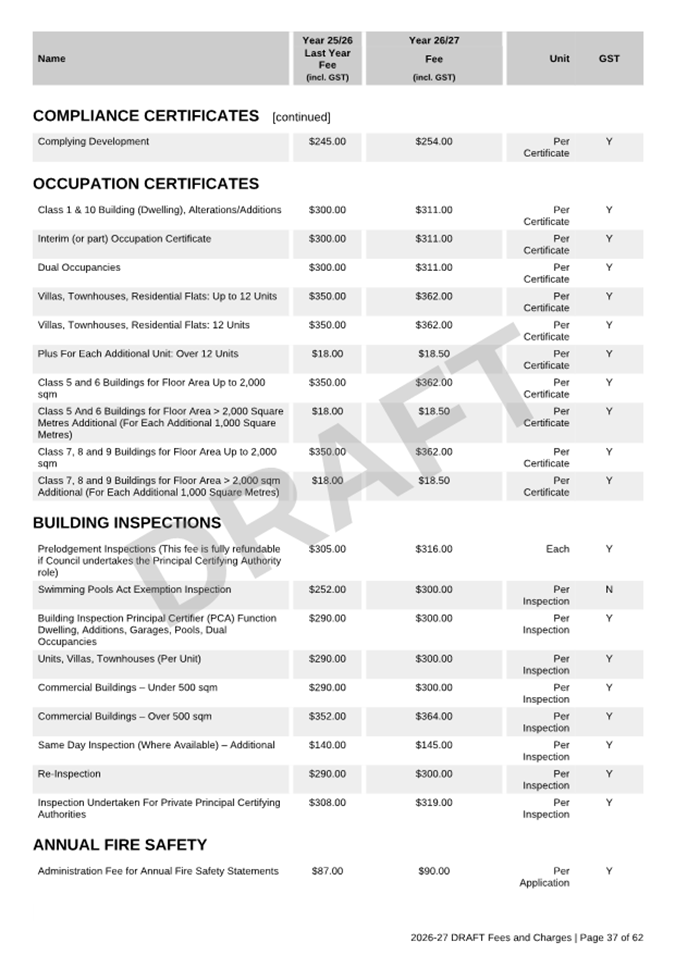
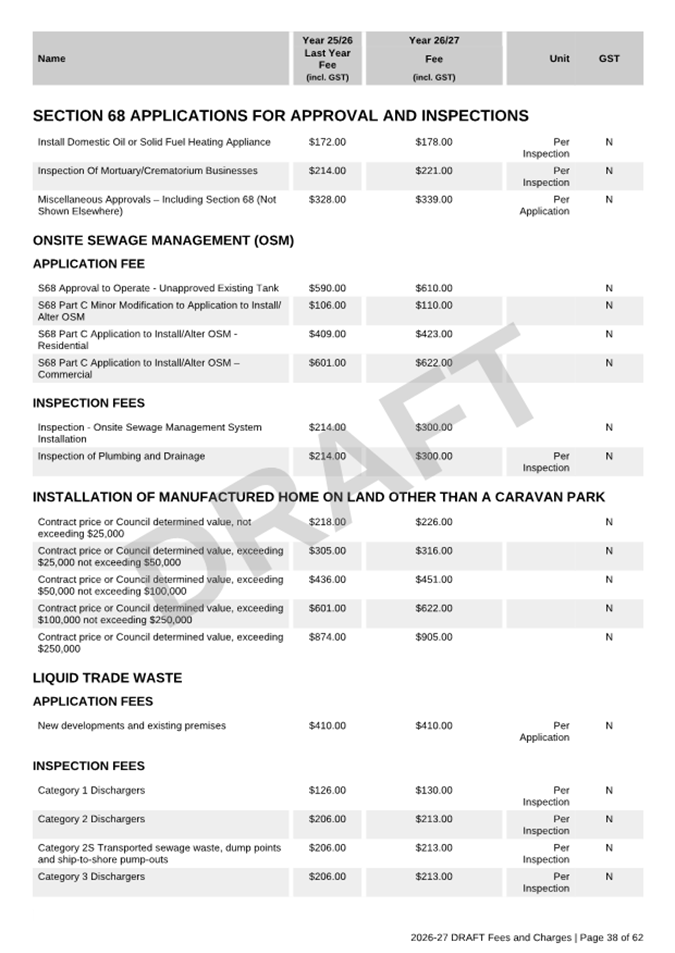
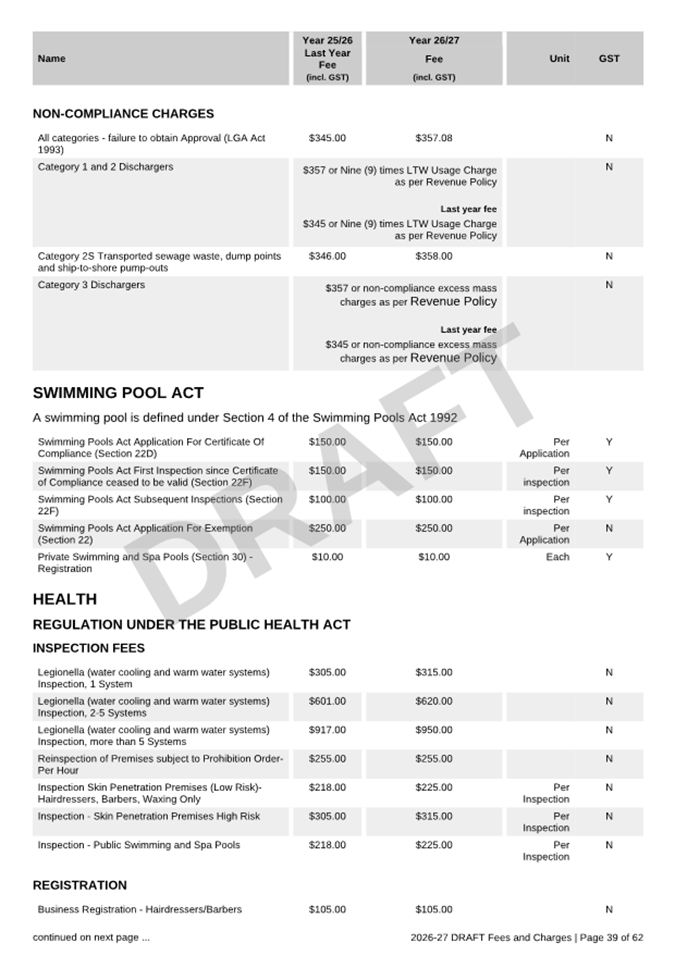
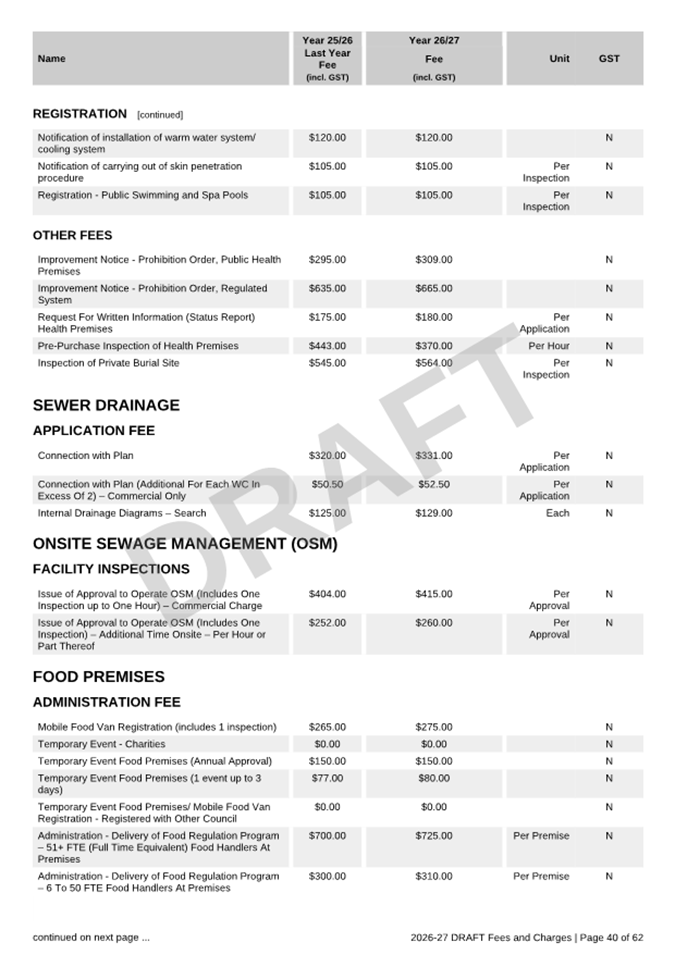
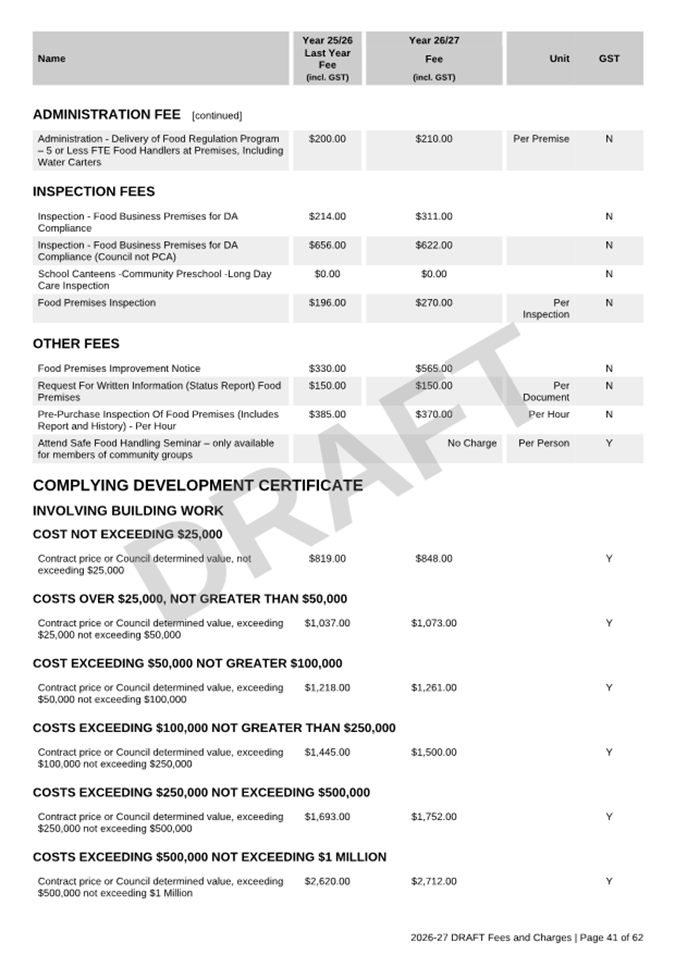
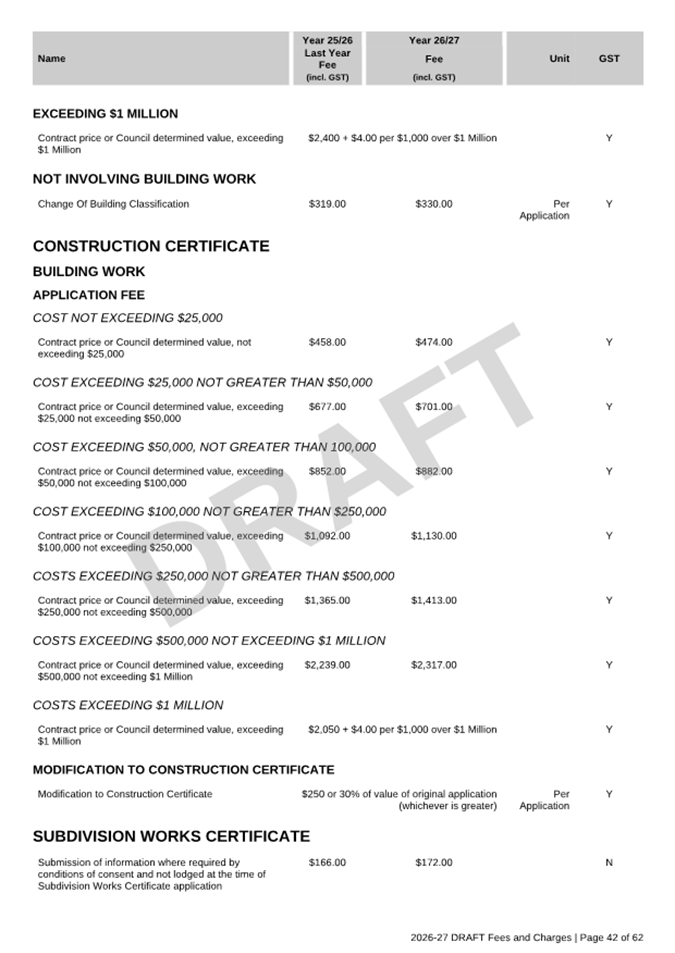
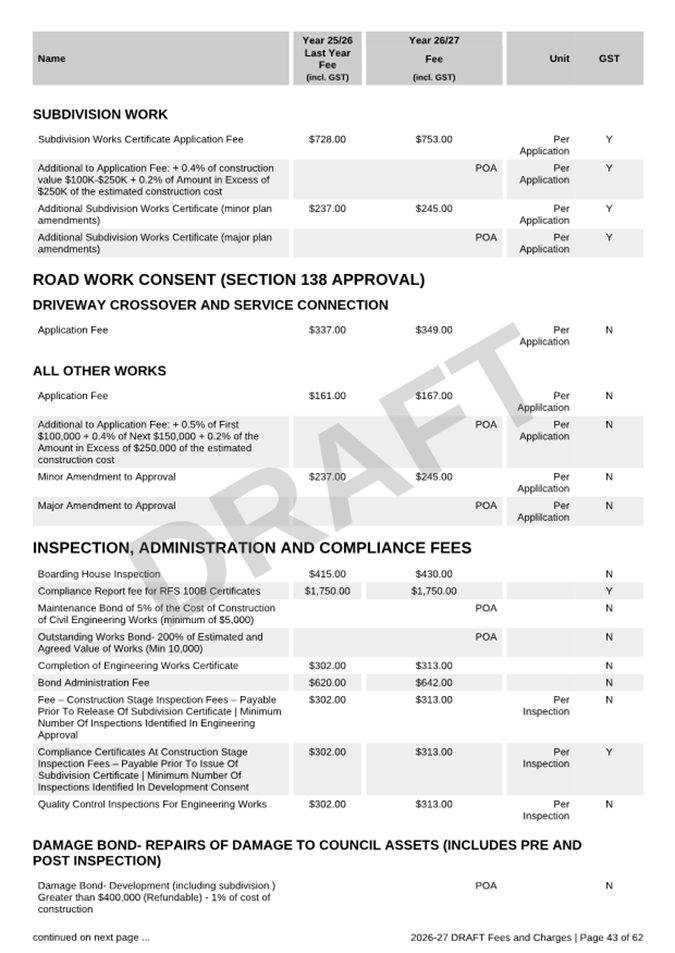
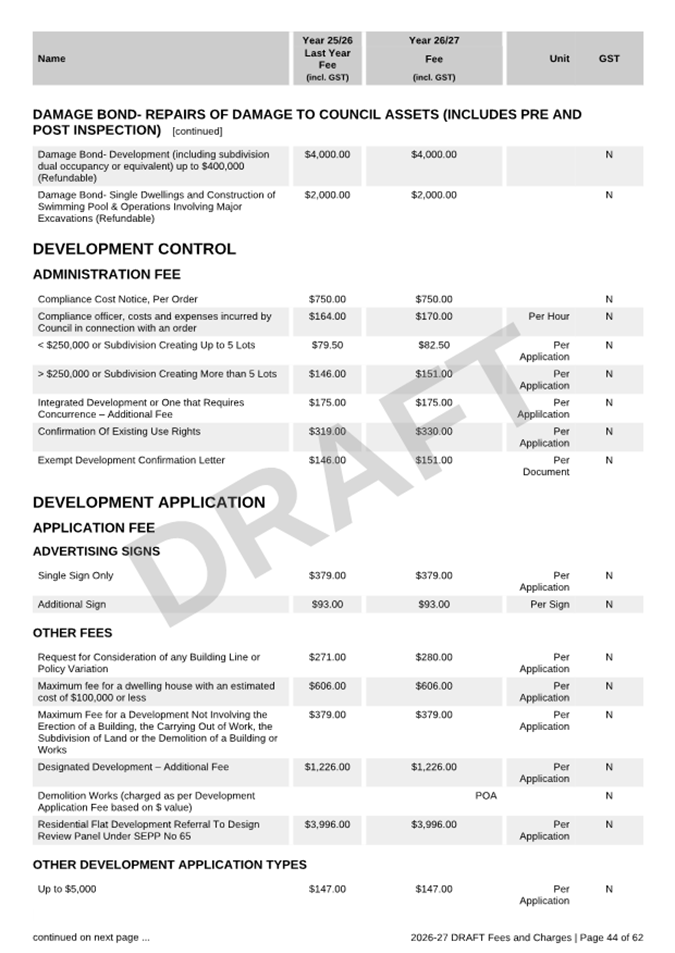
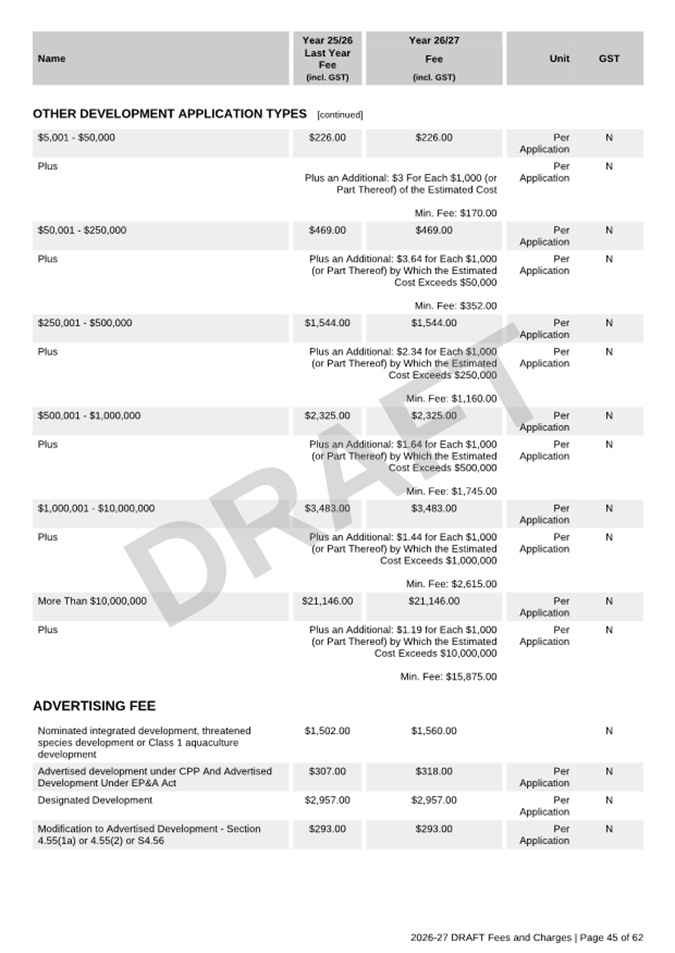
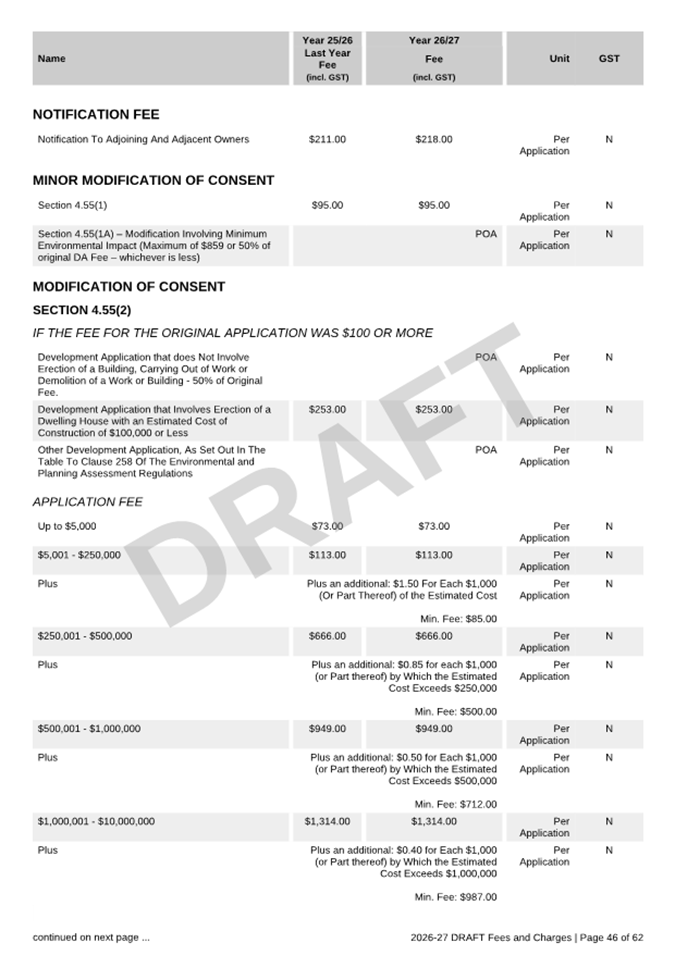
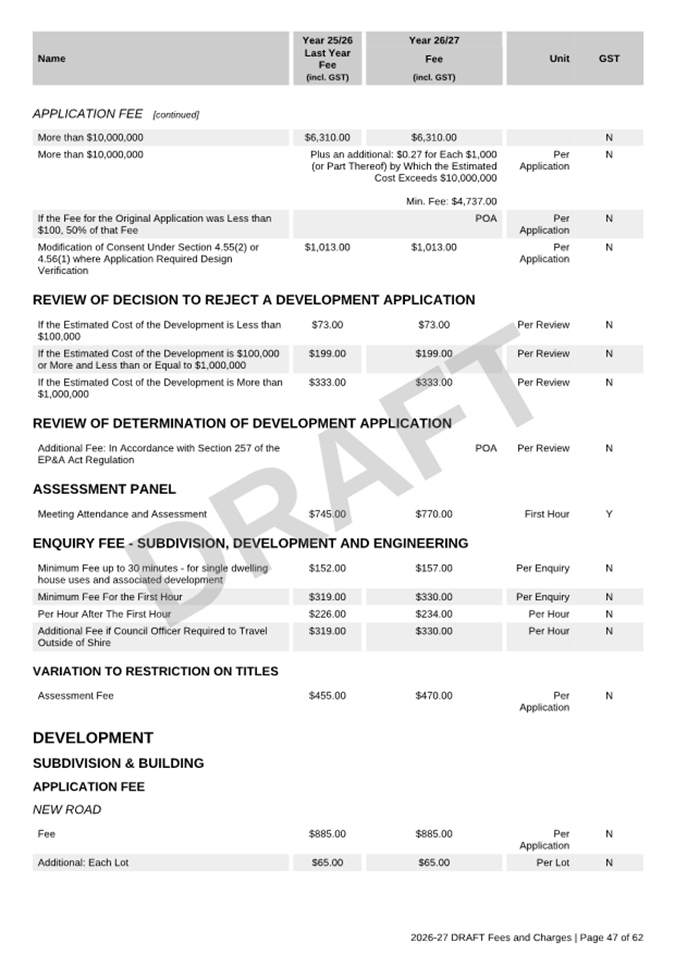
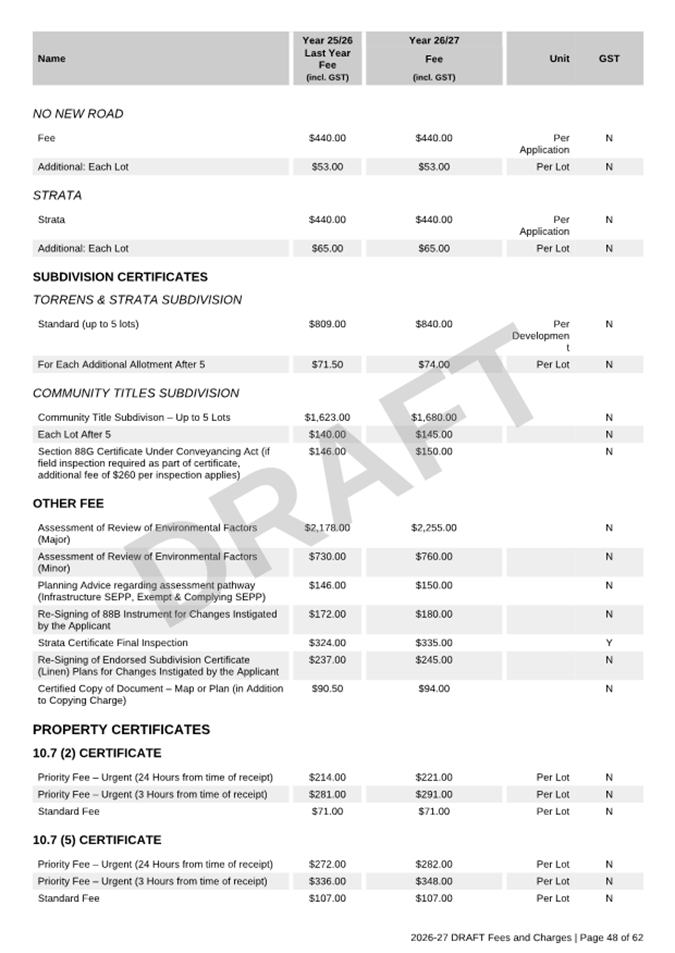
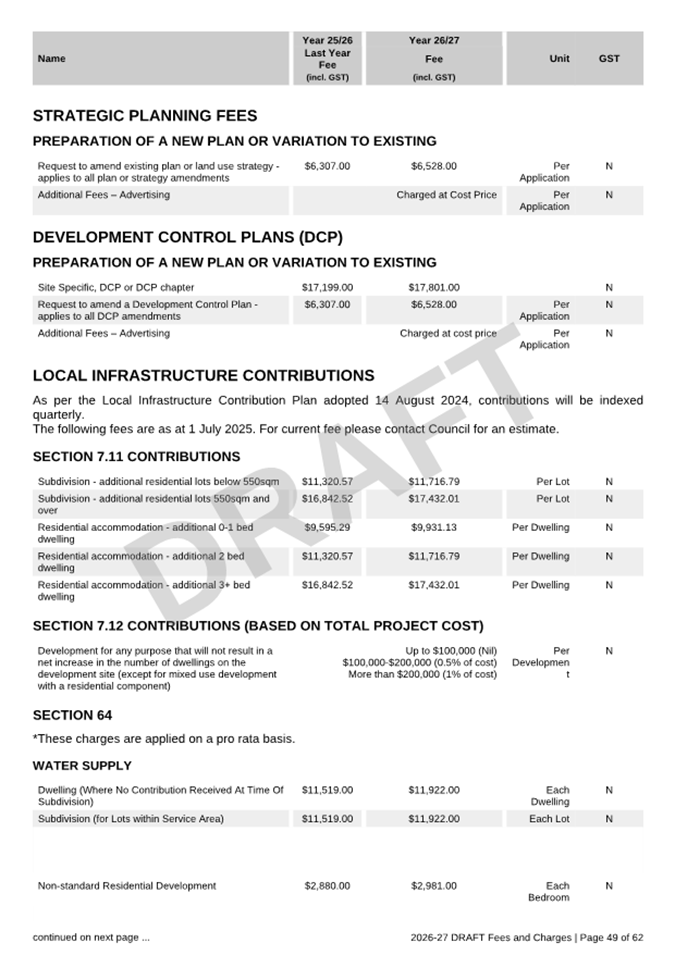
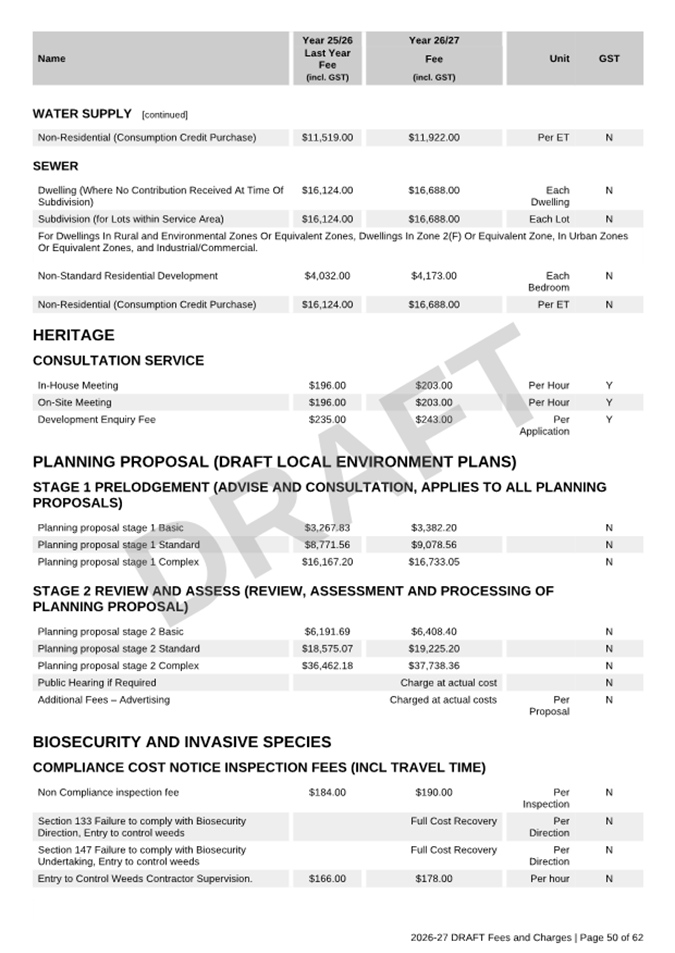
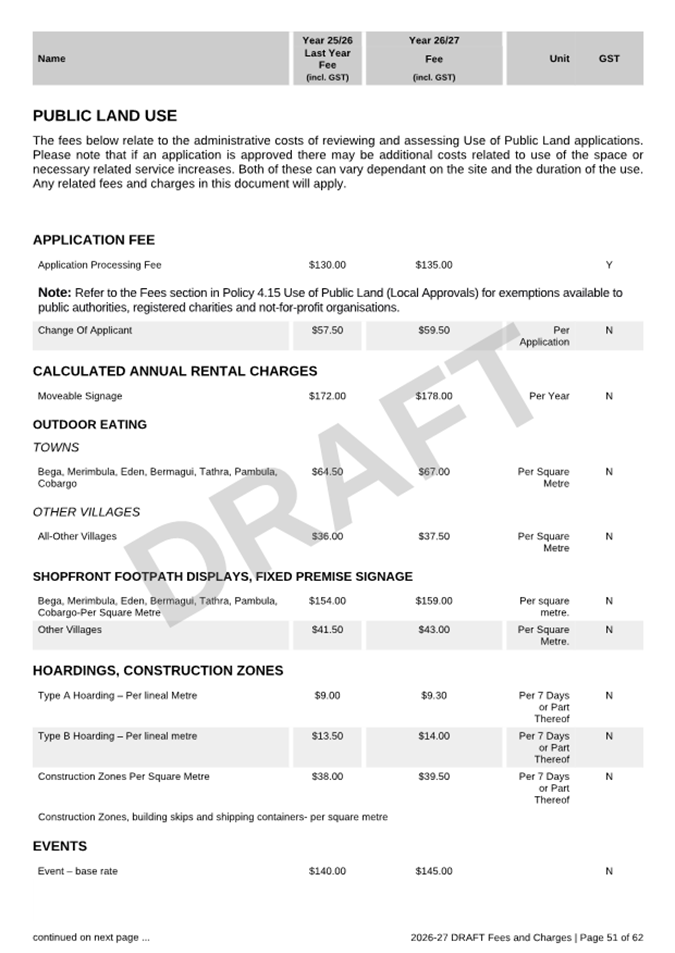
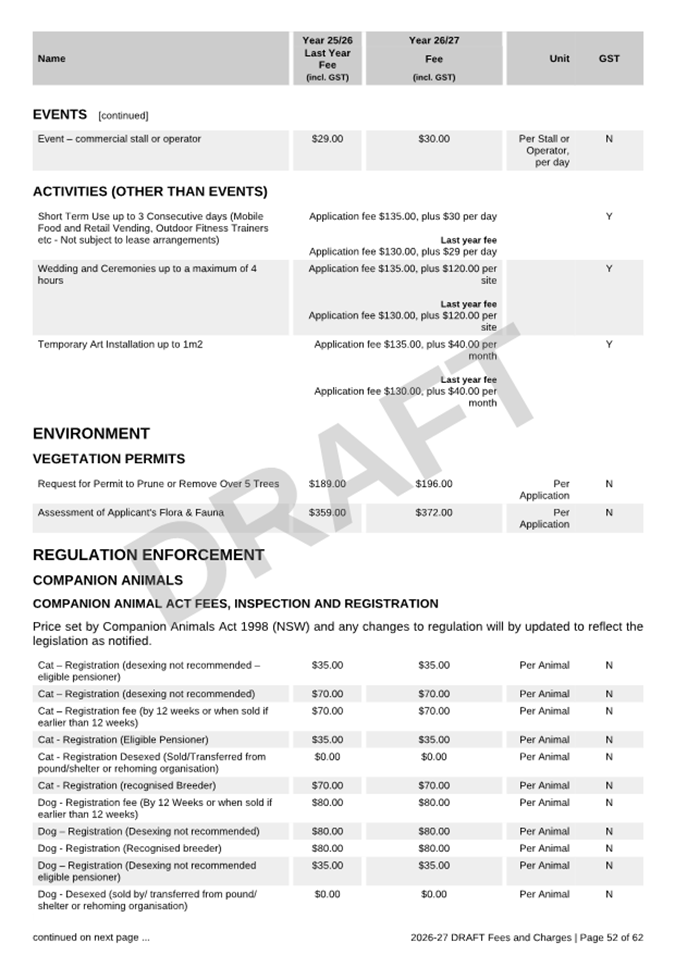
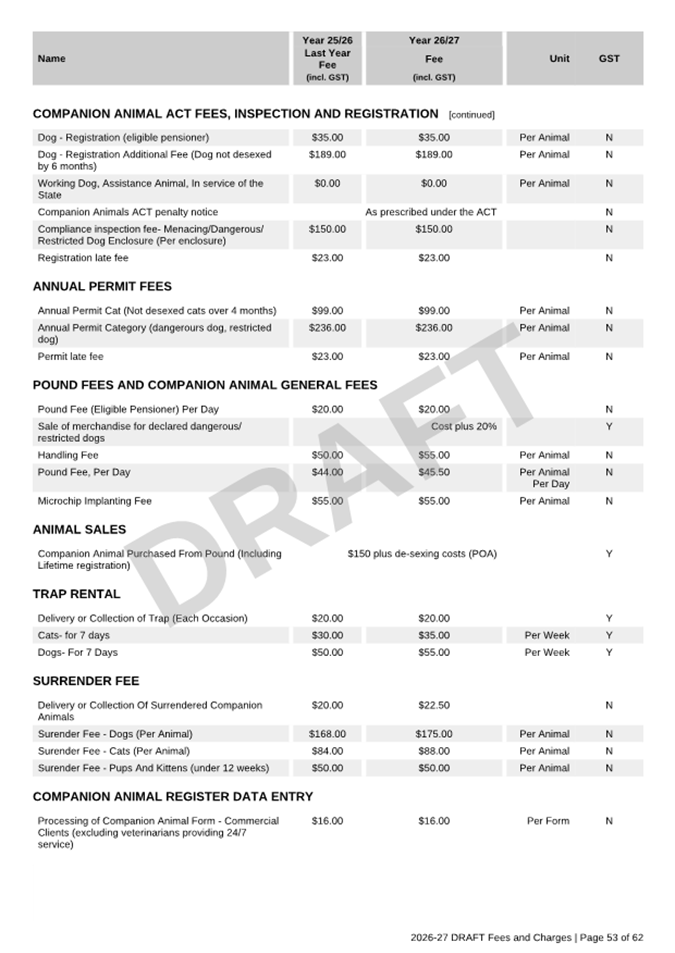
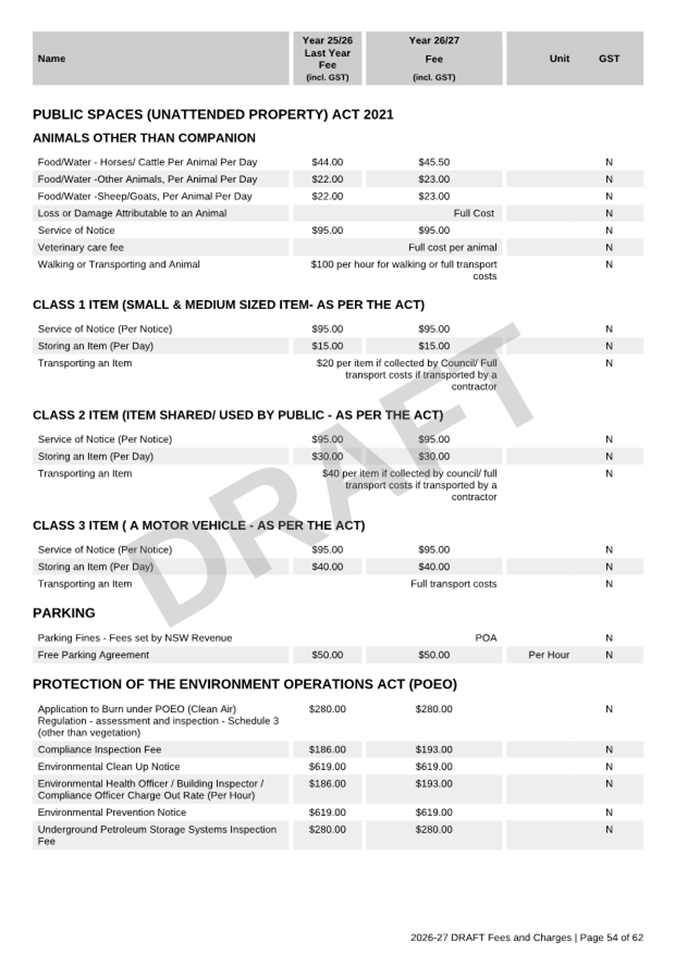
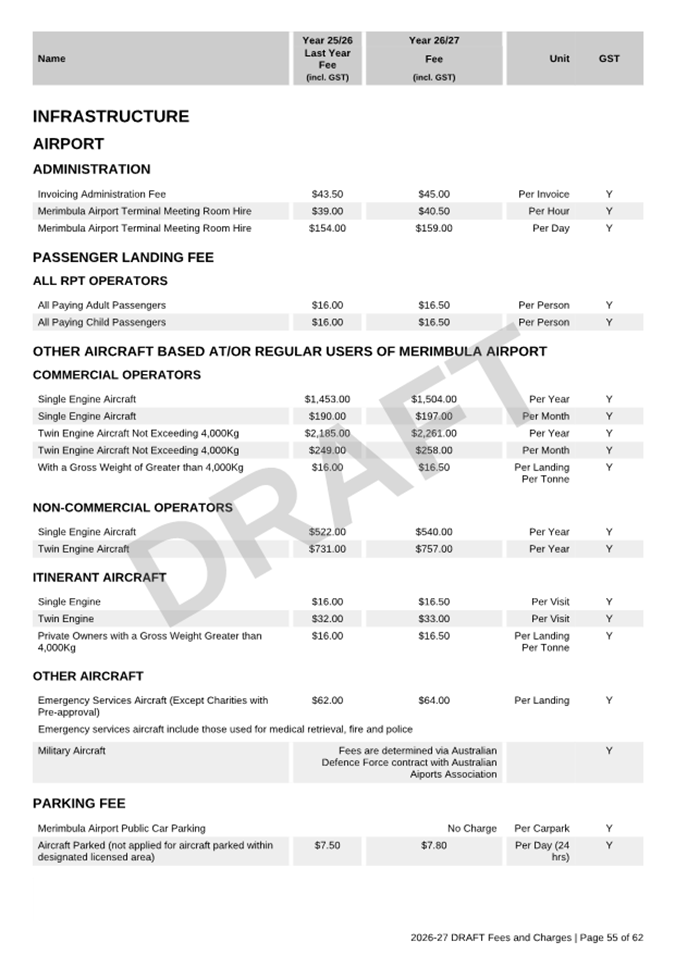
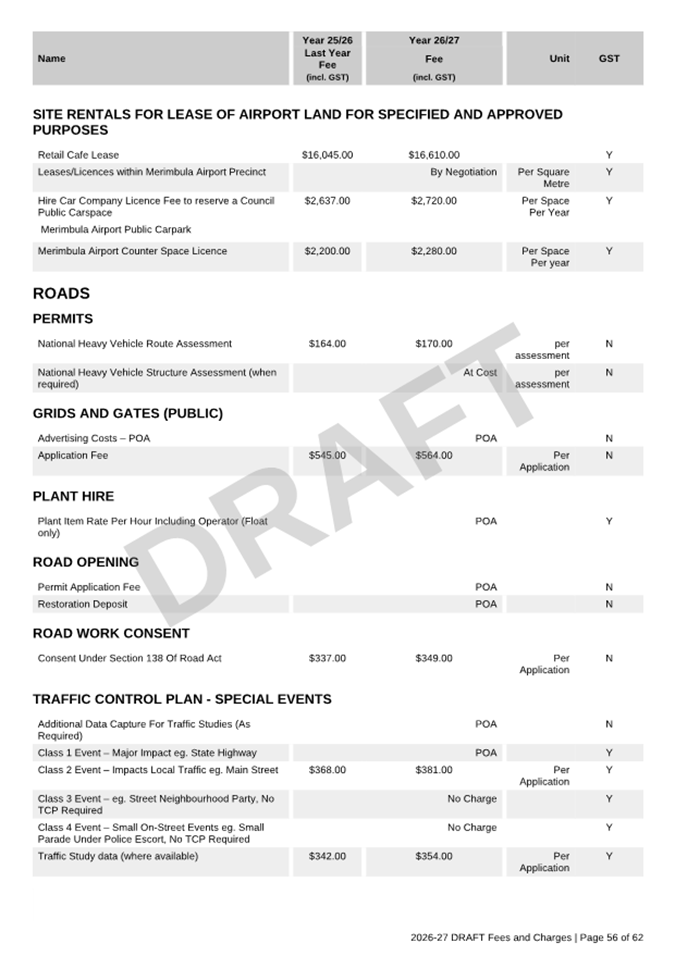
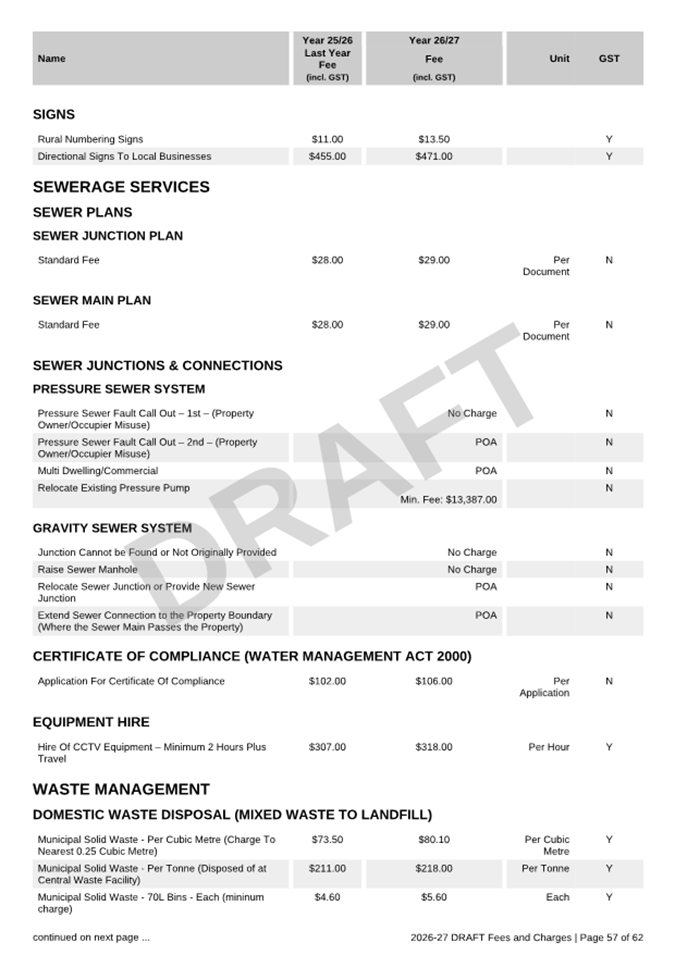
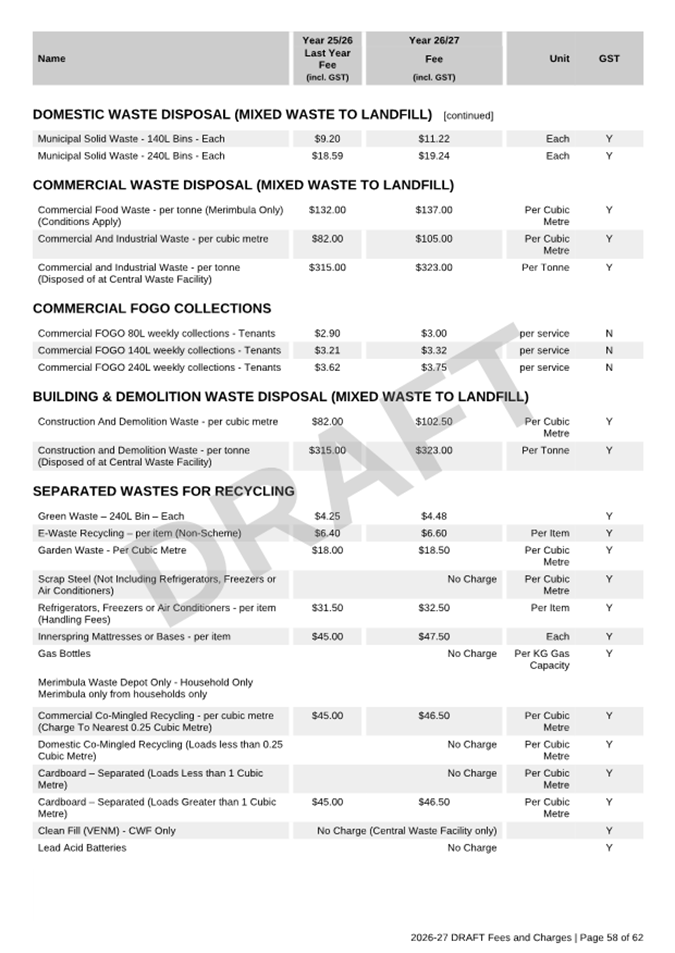
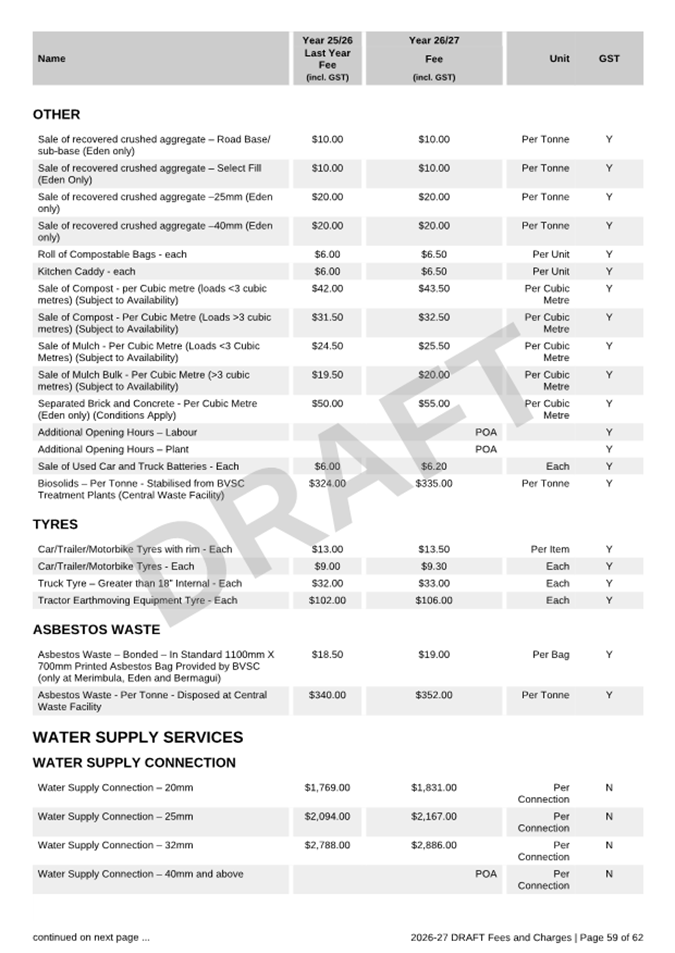
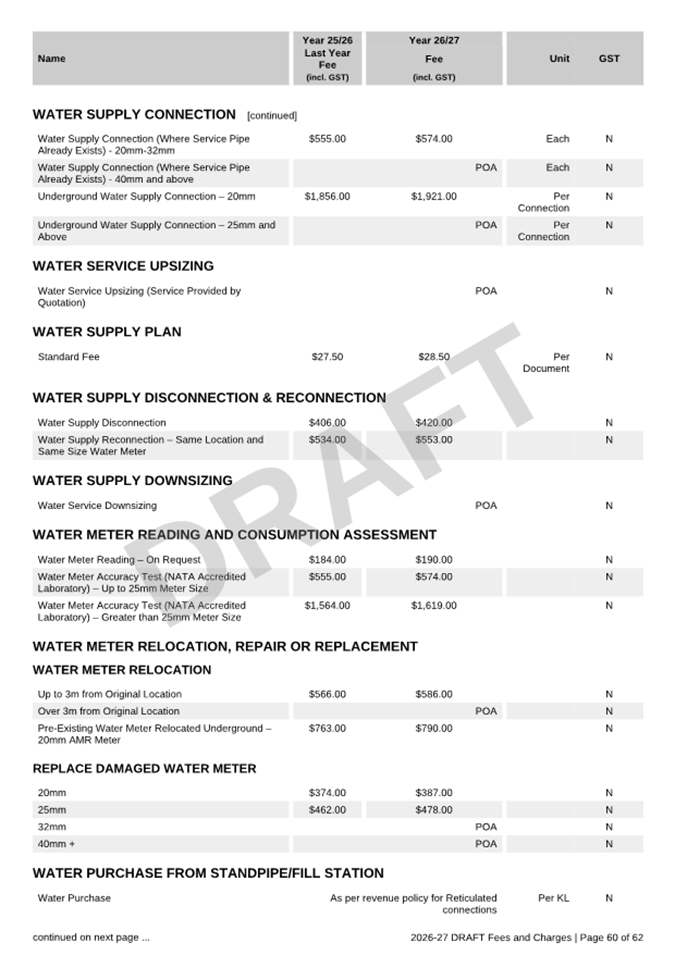
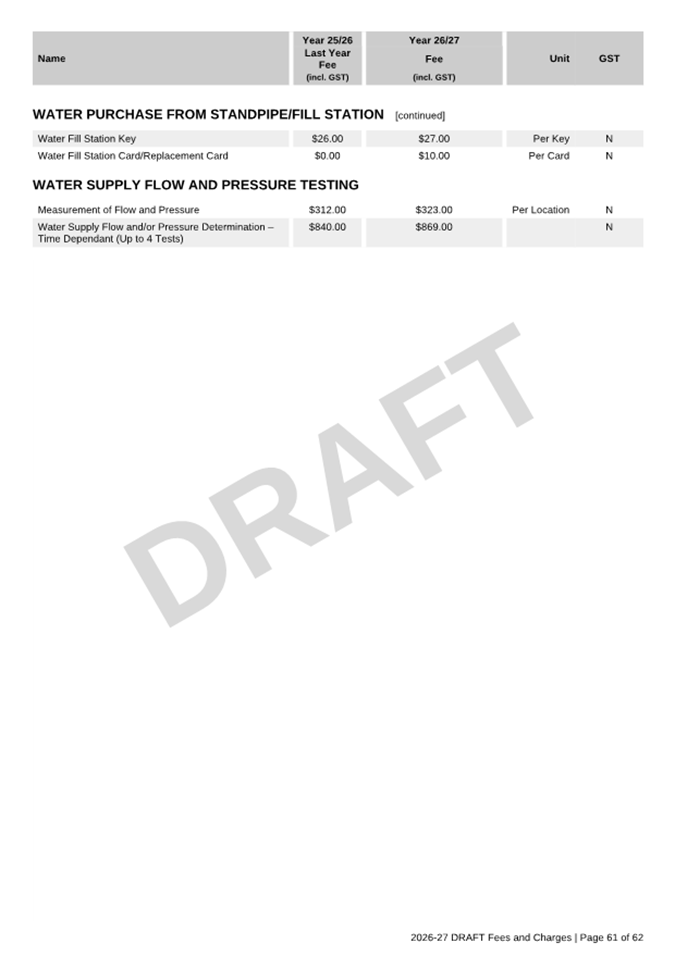

|
Council 6 May 2026
|
Item 11.2
|
11.2. Cuttagee Bridge
This report provides a
recommendation on seeking additional funding for Cuttagee Bridge.
Chief Executive Officer
Officer’s
Recommendation
It is recommended that:
1. Council
write to the NSW Government requesting that the State fully fund the project
noting it would be on the condition that it becomes a bridge in line with the
two lane hybrid structure with decorative timber, attached shared pathway and
handrails concept, as presented to the 12 November 2025 Council meeting and
that staff work with TfNSW to fast track the project as much as reasonably
practicable.
2. Delegate
the CEO to negotiate and implement a revised funding deed
Executive Summary
Council has received correspondence from Transport for NSW
that offers unspecified additional financial support to enable the completion
of the Cuttagee Bridge project with several associated caveats. This report
provides a recommended response to the offer and discusses benefits and risks
of different options.
Background
The Cuttagee bridge
replacement project has a well-documented history, with the most recent Council
report on the project presented to the 12 November 2025 Council meeting. The
report can be viewed on council’s website here:
https://begavalley.infocouncil.biz/Open/2025/11/OC_12112025_AGN_1081_AT_WEB.htm
At the 12 November
2025 Council meeting, Council resolved as follows:
1. Progress option 3 as
outlined in the report and in alignment with the funding deed to detailed
design and planning for the replacement of Cuttagee Bridge.
2. Commences advocating for
and seeking additional funding sources to ensure the bridge construction
can be delivered.
Since
that meeting staff have been working with GHD as the appointed project
management and contract administration consultants to progress detailed design
and environmental assessments in line with the requirements and milestones of
the funding deed between Council and TfNSW. Council staff and TfNSW have
continued to work constructively and collaboratively on delivering the project
in accordance with the deed and the resolutions of council.
On 21
April 2026 Council executives promptly met with senior TfNSW officials at the
request of TfNSW to discuss the project. During the meeting TfNSW indicated
that there may be an opportunity for council to seek a funding variation to the
project however it was likely any additional funding would come with some
caveats. Out of the meeting it was agreed that council would be very willing to
explore the opportunity for additional funding and would consider any
associated requirements.
Despite
media reports, Council received official correspondence from TfNSW on 23 April
2026 as attached to this report. Subsequent to the letter received, Councils
CEO sought clarification, particularly relating to the anticipated expectations
associated with the funding to ensure that the consequences of any additional
funding were clearly understood by all parties. Additionally,
clarification was sought as to the accuracy of media reports that TfNSW was
offering to embed an experienced Engineer within Council to further support
delivery of the project. At the time of publish this report a response had
not been received.
Since
receiving the correspondence from TfNSW, Council staff have consulted the
appointed bridge designers to determine any time and cost associated impacts as
a result of changing the design of the bridge that has recently been finalised.
Their advice has been that should the design to be moved through to
construction be the two lane hybrid as presented at concept design level to the
November 2025 Council meeting, the design cost impacts will be approximately
$200,000 and the time impacts could be up to 3 months.
In addition to the above, the TfNSW engineering assessment report for Cuttagee Bridge was recently
released which reiterated the criticality of replacing the bridge as a priority
and that it is not suitable for restoration. The report is available at:
https://www.transport.nsw.gov.au/news-and-events/reports-and-publications/bridge-over-cuttage-lake-condition-assessment-paper
Options
Council has
several options available with some of the key (realistic) options outlined in
broad terms below:
· request that the
state fully fund the project on the condition that it becomes a bridge in line
with the two lane hybrid concept presented to the 12 November 2025 Council
meeting and that staff work with TfNSW to fast track the project as much as
reasonably practicable
· Stick with the
resolved position to construct a two-lane concrete bridge noting this likely
comes with significant additional financial risk
· Variations in
between each of the above options
The first option
is the recommended option as it reduces the risk to council in terms of
deliverability of the project as well as potential broader financial/service
impacts on the community.
Community
and Stakeholder Engagement
There has not been any specific community engagement
associated with this report. There has been extensive community on the Cuttagee
Bridge project over recent years.
Engagement undertaken
The report to the November 2025 Council meeting provides
detailed information on the community engagement undertaken on the project up
to this point.
Engagement planned
There is no further engagement planned or recommended as a
result of this report other than to inform the community that Council will be
seeking additional funding and that this will involve a change of design if it
occurs. Should further engagement and consultation be required this may slow
down further progress of the project.
Financial
and Resource Considerations
The
current available budget for the project is $15m in line with the current
funding deed with TfNSW. It has been well documented throughout the project
that this budget is not adequate to replace the bridge. Council has just
recently received the detailed design for a two lane concrete bridge and the
associated cost estimates.
The
financial information now available is presented table below.
Council
staff have been working on a grant application to the Federal Safer Local Roads
and Infrastructure program to contribute towards the project. This program is
capped at $5m per project and is highly competitive. Furthermore, based on
historical rounds of the program it is not expected that decisions and
subsequent funding deeds would be provided should Council be successful within
the timeframes expected by TfNSW, Council or the community based on the stage
this project is at.
Should
council not be able to secure additional external funding then realistically
the only options are:
1. that the project doesn’t proceed and the bridge would likely
ultimately need to be closed
2. Council funds the gap which would mean not doing significant works
across other parts of the transport network and/or and potentially other
service areas across the shire
|
Item
|
$ Excl GST
|
|
Expenditure
Detail
|
|
|
Detailed Design
|
$1,600,000
|
|
Site
Establishment and Demolition
|
$1,500,000
|
|
Main
Bridge and Road Construction
|
$17,000,000
|
|
Decorative
Timber Elements
|
$550,000
|
|
Temporary
Bridge and Access
|
$7,100,000
|
|
Total
Expenditure
|
$27,750,000
|
|
|
|
|
Source
of Funds
|
|
|
TfNSW Regional Roads Program
|
$15,000,000
|
|
Additional TfNSW Funding
Required
|
$12,750,000
|
|
Total
income available
|
$27,750,000
|
|
|
|
|
Total
Project Capital Cost
|
$27,750,000
|
|
Total
Available Construction Funding
|
$27,750,000
|
|
Project
Funding Shortfall
|
$0
|
Financial Option Impacts | Life
Cycle Costing
|
Ongoing
Financial Impacts
|
$ Excl GST
|
|
Capital Investment | Renewal, Upgrade, New
|
$27,750,000
|
|
Depreciation costs
|
$277,500
|
Legal /Policy
There are no specific legal or policy implications
associated with this report. It is likely that a new funding deed with TfNSW
will need to be implemented as a result of this report.
Impacts
on Strategic/Operational/Asset Management Plan/Risk
Strategic
Alignment
Completion of the project will achieve alignment with
Council’s following strategic objectives:
Community Strategic Plan: D. - Our infrastructure
complements our natural surroundings and character while enhancing the lives of
our community.
Strategic Objectives are - Our public and private
infrastructure and community services meet community needs.
D.2. Provide infrastructure and services to meet the needs
of residents in our towns, villages and rural areas.
Delivery Program:
Delivery Program: D2.4 – Construct (upgrade or
renewal) civil assets/ infrastructure.
Environment
and Climate Change
The environment and climate changes aspects of this project
are as has previously been reported. It is noted that the Environment and
Climate change related impacts associated with the bridge design option now
associated with the recommendation in this report further addresses heritage
considerations.
Economic
The Tathra-Bermagui Road
(MR272) is a Regional Road, which runs through the North-East coastal area of
Bega Valley Shire Local Government Area (LGA), an important agricultural region
that generated around $37 million, or 31.5% of the total Shire agricultural
value in 2020. The road provides an important transport and freight link
between Bermagui, localities and towns further south to Tathra.
Furthermore, the road
provides the region with important supply chain links to the freight and
logistics sector and agricultural processing areas in the LGA. It also forms an
important alternative secondary link to the Princes Highway should incidents occur
between Cobargo and Bega.
The route is also highly
popular with tourists connecting Bermagui to Tahra and the various beaches and
National Parks in between.
Seeing this project through
to completion is important form an economic perspective and should the bridge
ultimately fail due to not being replaced there is likely significant economic
impacts
Risk
There is a risk that if a new funding deed sets unrealistic
milestone completion dates for a project of this complexity there may either be
cost impacts through contractors pricing in risks, there may be contractual
risks with contractors unable to deliver or a combination of both. There is
also a risk that if construction is pushed to commence prior to all design and
tender documentation being finalised and all relevant environmental assessments
and relevant permits being in place that legislation may be breached. This risk
should be able to mitigated via agreement with TfNSW on a realistic yet
streamlined funding deed.
There is also a risk of further financial escalation
relative to the cost estimates when the project goes to construction tender.
This risk has been mitigated to the greatest extent possible at this stage
though the cost estimation process followed and ensuring appropriate
contingencies are in place.
Social
/ Cultural
Cuttagee Bridge is located on
the Tathra Bermagui Road (MR272), crossing the Cuttagee Lake entrance at the
northern end of Cuttagee Beach. It is a scenic and sheltered location that is
popular for visitors and residents alike.
Tathra Bermagui Road is a
popular tourist road (Route 9), providing access to the coastal tourism assets
of the Sapphire Coast, while the Cuttagee section links Barragga Bay and
Bermagui locally.
The bridge provides an important link during natural
disasters such as bushfires with limited viable alternate routes.
Attachments
1⇩. 2026.04.23
Letter to BVSC Cuttagee Bridge
|
Council
|
6 May 2026
|
|
Item
11.2 - Attachment 1
|
2026.04.23 Letter to BVSC Cuttagee Bridge
|
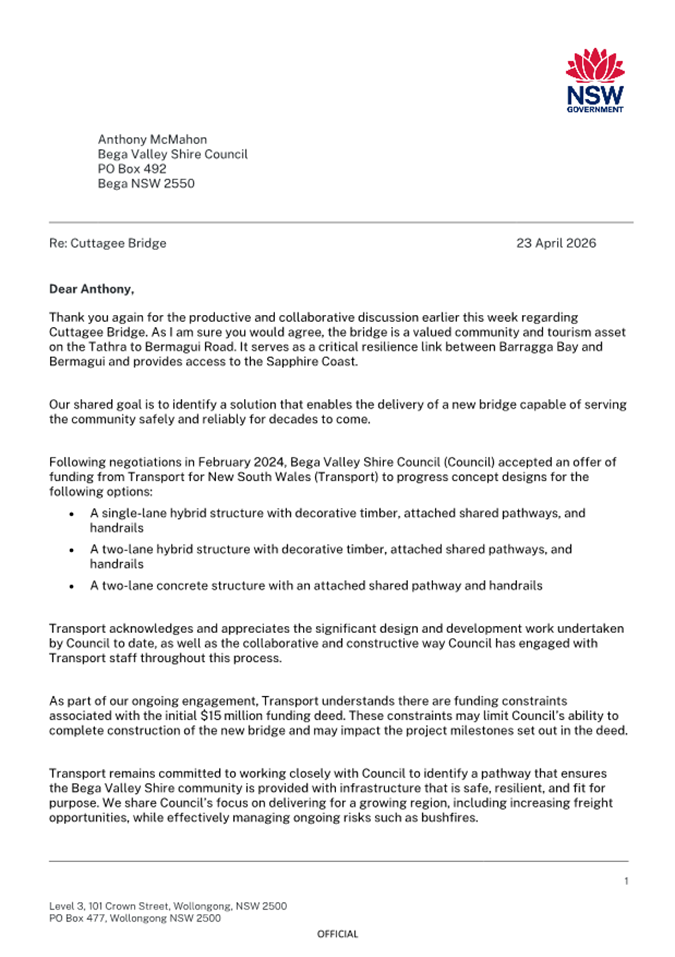
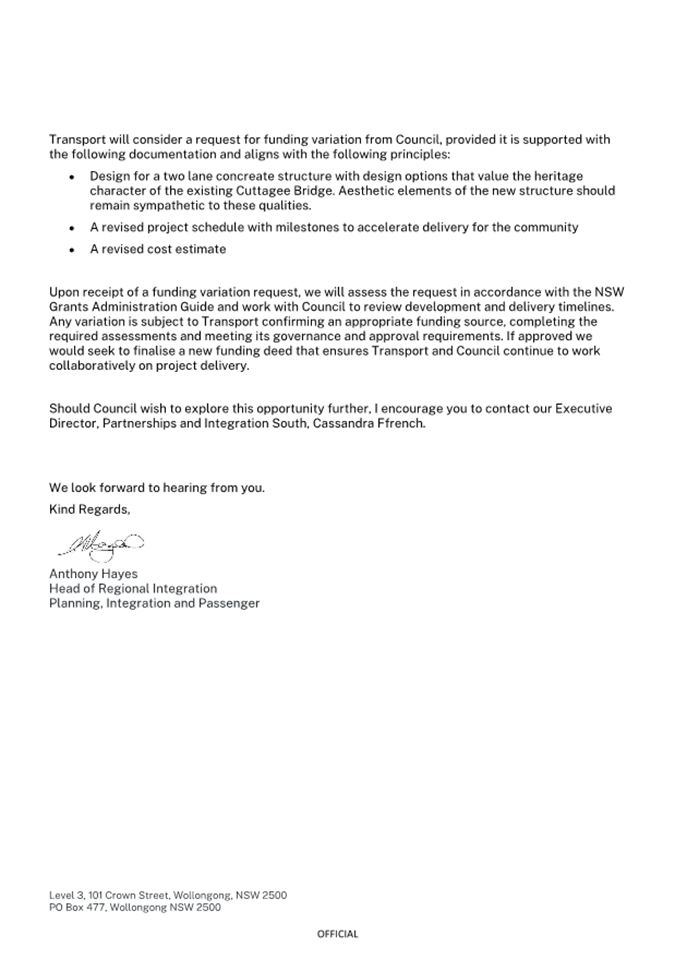
Notices of
Motion
06 May 2026
14.1 Climate
Impact Prioritisation............................................................................ 412
|
Council 6 May 2026
|
Item 14.1
|
14.1. Cr Peter Haggar - Climate Impact Prioritisation
Notice of
Motion
1. That Council acknowledges:
a) the
Climate Emergency Declaration from 2019
b) the
growing urgency of climate resilience policies as reflected in the Australian
heatwave records of last summer and the forecast El Nino for 2026
2. That Council calls on staff to ensure
that Council’s Climate Resilience response across our operational,
strategic planning and policy platforms, continues to reflect the best
available science as new evidence becomes
available.
3. That Council receive a briefing from
the CSIRO Climate Division on current medium and long-range
climate projections and the implications for South East Australia
Background
Since this Council declared a climate emergency in 2019 the
evidence supporting that emergency has grown. Across the globe different
regions have experienced years that have surpassed the 1.5 degrees average
annual temperature increase that was set in Paris in 2015. “The
average annual temperature of Australia in 2019 and 2024 was at or around the
temperature expected to be the new long-term average (the 'new normal') when
the world is at +1.5 °C since pre-industrial” (CSIRO).
Since the declaration a greater understanding of increases
in local Sea Surface Temperatures has resulted in greater expectation of East
Coast Lows and resulting storm damage as reflected in the Australian Climate
Service data.
The intention of this motion is not to tell staff or
councillors what to believe but rather to ensure that Bega Valley Shire Council
commits to ensuring that the best and most up to date evidence is available and
considered.
The Australian Actuaries Climate Index (AACI) recorded its
42nd consecutive positive value in the summer of 2025/26, indicating that the
frequency of extreme weather across Australia continued to remain above the
1981–2010 reference period average.
The composite index, which combines high temperature,
rainfall, wind and sea level, showed positive values across all regions,
reflecting a mix of regional extremes. Contrary to the spring of
2025, the southern parts of the country experienced unusually high
temperatures, while the north remained wetter than average. “
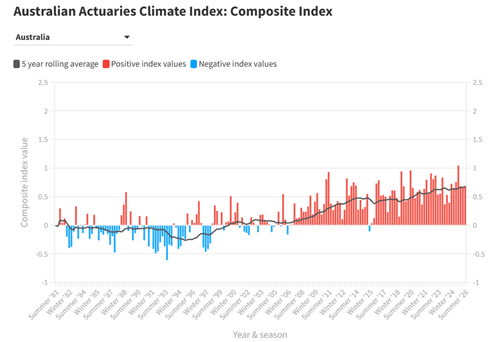
The summer of 2025/26 brings warm
temperatures and wild weather - Actuaries Digital - Actuaries Institute
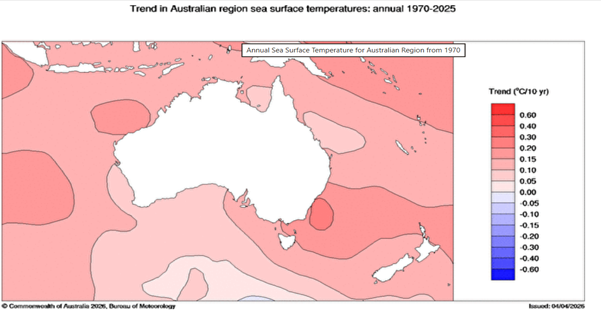
Australian climate variability &
change - Trend maps
Accelerating global warming
Full article: Global Warming Has
Accelerated: Are the United Nations and the Public Well-Informed?
El Nino 26/27? Super El Nino ??
“An El Niño in 2026 would extend the run of
active Pacific years (either La Niña or El Niño) to seven in a
row, equalling the current record of seven from 1969 to 1975.”
Possible El Niño within
months raising potential for hot, dry year across Australia - ABC News
“Abstract. El Ninos have always been important.
However, in the context of a warming planet – likely accelerated warming
– El Ninos have even greater impact. Moreover, the frequency and nature
of El Ninos themselves may be affected by the warming. Media attention to the
possibility of an upcoming “Super El Nino” irritates some
scientists, given inherent uncertainty in forecasts. We push back gently
against that irritation. Predictions in the face of uncertainty are a valuable
approach, with the potential to increase our understanding. We take our hats
off to ECMWF for their bold prediction. We also suggest an El Nino diagnostic,
alternative to the usual diagnostic, that provides an earlier, more meaningful
assessment. It is already clear that we will have an El Nino in 2026-27. A
little more time is needed to be certain that it will be a Super El Nino, but
it looks like it will be a strong one. Let us see what we can learn from
it.”
Super-Duper El Nino.2026.04.15.pdf
AMOC
Critical Atlantic current
significantly more likely to collapse than thought | Oceans | The Guardian
Staff
response:
Since Council’s initial climate response actions in
2007, our operational, strategic and policy positions have been based on the
best available climate data and have considered the policy settings of the
Australian and NSW Governments. The various iterations of our Climate Change
Strategy, now Climate Resilience Strategy, Clean Energy Policy, various Flood
and Coastal Hazard Studies and the recently adopted Flood and Sea Level Rise
Policy are all based on the latest available climate data and modelling approaches.
The incorporation of the latest and most credible climate
and scientific data into Council’s decision-making approach, the
modelling used in flood, coastal and bushfire studies and our general policy
settings, is essential in Council meeting the legal standard set under Section
733 of the Local Government Act. Section 733 exempts NSW councils from
liability regarding advice or actions taken in good faith concerning
flood-liable land, bush fire risks and coastal protection, providing councils
are following the latest available science or are in compliance with relevant
manuals to prove good faith decision making.
Staff have had a strong focus on both climate adaptation and
mitigation as part of our ongoing climate response. Examples of our climate
adaptation program include the land use zoning approach to high risk areas in
BVLEP 2013, the siting and design of major infrastructure, our interconnected
water reticulation and supply network, and coastal management and dune
protection programs. Our mitigation efforts have focused on Council’s own
operations and have seen significant investments in renewable energy and energy
efficiency upgrades across our building assets, recreational facilities and
water and sewer infrastructure in particular. Ongoing emission monitoring is
occurring to identify opportunities for further improvements that will likely
focus on our waste management, sewage disposal and fleet composition.
The review and updating of Council’s Climate
Resilience Strategy will be one of a number of priorities for Council’s
Environment and Sustainability team over the next 12 to 24 months. This review
will provide Councillors and the community the opportunity to have input into
the prioritisation of remaining management actions and the incorporation of new
priorities that are reflective of the best available climate projections and
scenarios
Cr Peter Haggar
Attachments
Nil